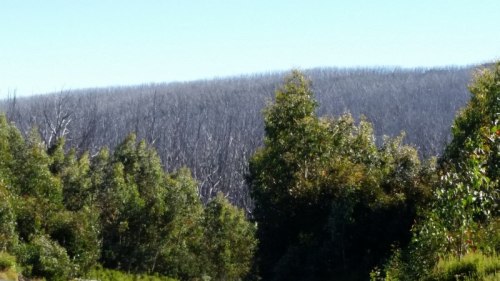
Tom Griffiths is one of my favourite Australian historians. He is the Director of the Centre of Environmental History ANU, and a fiercely intelligent and very human man. He’s a beautiful writer, who captures images so well in words, and he provides sharp insights and the telling anecdote. While listening to this program, we were driving through the bush around Marysville that had been ravaged by the 2009 bushfires, and it seemed particularly apposite to consider the anthropocene and the recuperative power of the earth that is so under threat through climate change. His lecture at the Australian Museum is a clarion call for the humanities in a wide-ranging, erudite and thought-provoking podcast- well worth a listen.
Griffiths was also featured briefly on Geraldine Doogue’s Saturday Extra (an excellent program!). He picked up on one of the points he made during the Australian Museum address: that of the emergence of new regional histories that combine the environment and emotion, history and literature. He was followed by Tony Hughes-d’Aeth, speaking about his new book Like Nothing on this Earth, which Griffiths praised highly, and which looks at the Western Australian wheatbelt through the eyes of regional writers like Dorothy Hewett, Tom Flood, Albert Facey and Jack Davis.
Saturday Extra is going to feature a historian writing one of these new regional/environmental histories each week during March.
I don’t particularly remember Frank Hardy. If asked off the top of my head, I would have said that he died in the 1970s. I’m like the former premier of New South Wales Barry Unsworth who said in 1986, “I thought Frank Hardy was dead. I really did.” In fact, Frank Hardy didn’t die until 1994, but for me he somehow seems always to be of the black-and-white TV decades, always associated with the races and cigarette smoke. I don’t remember the television program “Would You Believe?” (1970 -1974) which seems to have been a forerunner to “Would I Lie To You?”, on which he appeared as a regular panelist. But I do remember the Channel 2 miniseries ‘Power Without Glory’, for which Frank Hardy was notorious when it was published in 1950 and feted when it was televised in 1976. It tells the story of John Wren of Collingwood, fictionalized as John West of Carringbush, and the corruption of the local ALP.
Melburnites of a certain age (and older) will be familiar with the underworld figure John Wren and it seems that many Melbourne families have their own John Wren stories. For myself, my first husband’s family’s foundry was in Johnston St Collingwood, just up the road from John Wren’s tote. On my side of the family, my own great-grandfather joined in the Sunday morning horse races along Sydney Rd to the Sarah Sands Hotel ( a turn of the century version of drag racing maybe?) where he ended up beating a horse owned by John Wren, who was keen to purchase the victorious horse. My great-grandfather was not keen to sell. Wren came up to my great-grandfather, assured him that every man had his price, and left his card with him. I don’t know how the story ended.
The first word in the subtitle of Hocking’s book is ‘politics’, and it was politics that drove Frank Hardy’s life. Hardy, as a member of the Communist Party, was financially supported by the Party for four years to write Power Without Glory. I had naively forgotten that the Communist Party hated the Labor Party as much – if not more- than the Nationalists/Liberals. The book was a way of smearing the Labor party by publicizing links between Labor politicians and the underworld ‘entrepreneur’ John Wren.
In her biography of Frank Hardy Frank Hardy: Politics Literature Life, Jenny Hocking describes the writing of Power Without Glory and its effect on the rest of Frank Hardy’s literary work. It was a big book that Hardy mapped out carefully, researching real-life figures and very loosely fictionalizing them by giving them pseudonyms with the same initials. The book’s Wikipedia entry has a long list of the real-life and fictional characters, and the renaming is all rather obvious. It was an unwieldy book, and it was to solve a narrative problem that Hardy took up a rumour that he’d heard about an extramarital affair and a resulting illegitimate daughter. As Hocking tells it, Hardy agonized over the inclusion of this illegitimate daughter and so he changed her identity into a son. He was to continue to agonize over this decision in his own reflections on the writing process for the rest of his career.
Power Without Glory was published in 1950 within the context of the Menzies government’s Communist Party Dissolution Act. It was printed surreptitiously, as seen in a fascinating article by Des Crowley about the State Library of Victoria’s four-volume copy of the book ‘Proof Copy or Clandestine Version‘. Almost immediately Hardy was brought before the court by the Wren children for criminal libel of their mother Ellen Wren (Nellie West). Hardy was found not guilty, on the basis that John West was a synthesized fictional character, not a real person. He had escaped the clutches of the law through the decision that Power Without Glory was fiction but he and his readers knew that, at its core, it was not. The questions of fact, fiction, truth, reality and memory lay at the heart of many of his later works, most particularly The Hard Way and Who Killed George Kirkland? It was like a weeping sore.
But as Hocking shows, there was more to Hardy’s career than Power Without Glory. Hardy was a member of the Communist Party from youth. Hocking describes the Australian literary scene at the time, when ASIO agents eyed literary figures and organizations with suspicion, and when the Party itself fractured after Kruschev’s revelations about Stalin, and the rise of Communist China. Hardy was an outsider to academia, he was very much a contemporary of the other realist writers at the time: Jean Devanny, Dorothy Hewett, Katherine Susannah Pritchard. Hocking captures well the jealousies and enmities within the various branches of the Society of Realist Writers, and the politics behind the editorship of the Melbourne Realist Writers’ Group’s publication Realist Writer as it metamorphized into Overland. Hardy railed against the “Patrick White Australia Policy” which lionized White but starved Hardy of Commonwealth grants because of his politics. In many ways, he received more recognition overseas that he did in Australia, even though he affected a quintessentially ‘Australian’ identity and stage presence.
Hardy was often impecunious, often because of his gambling, in which he followed his father. He was a difficult husband, conducting multiple affairs, leaving his wife Ross [sic] to cover the family expenses, and in effect doing exactly what he wanted to with little thought of his obligations or responsibilities. He was a loving brother to his sister Mary, who compered that weird Channel 7 trotting show Penthouse Club, which I loathed.
[As an aside, Marieke Hardy who appeared on the late, lamented First Tuesday Book Club, followed her grand-father and great-aunt into screen-writing and television]
He was also heavily involved with the Wave Hill Walk Off, acting as scribe and reporter for Vincent Lingiari and the Gurindji land rights struggle. It was an involvement that drew the enmity of business, the Liberal government and the Communist Party, which dominated the indifferent North Australian Workers’ Union. It was through this involvement that he became a close friend of Fred Hollows.
I really enjoyed this book, which took me to many events and places that I didn’t anticipate. Hocking draws heavily on Frank Hardy’s own papers, but also Hardy’s autobiographical writing, newspapers spanning some 40 years, correspondence and papers of a slew of contacts and interviews. You don’t need to have read Hardy’s works (I’ve only read Power without Glory) because Hocking gives a good taste of their flavour, and her list of Hardy’s works at the end of the book highlights how prolific he was as a playwright, journalist and writer of both short stories and full length novels. The book is painstakingly researched but easy to read.
But -oh- he was a slippery character. He was a great ‘yarner’ and gave the appearance of being open, while boiling inside with secrets. His carefreeness barely cloaked carelessness and irresponsibility.
Near the end of the book, Hocking sums up his life:
In Hardy’s fragmented character, the committed political activist, tireless Party worker and determined writer coalesced with the man who shamelessly abandoned himself to the lure of racing, gambling and debt. It was this divided character, with its alternating obsessions that had enabled Hardy to withstand decades of official disinterest, denial and derision, sustained by a political cultural milieu that he had himself helped create. But the uneasy juxtaposition of literary revelation, political action and personal secrecy within him always threatened to fracture, held together through continuing self-examination and by the unmet promise of eventual disclosure. Although he wrote extensively about himself, presenting each new work as the opportunity for self-reflection and revelation previously denied him, in each retelling Hardy revealed little that was new. (p 256)
Source: La Trobe University Library
Read because: My interest was piqued after reading Paul Strangio’s book about the Victorian Labor Party Neither Power nor Glory
It’s been a rough month or so, and we decided to head away for a couple of days. I’m keen to head back to Tasmania this year but Steve’s U3A commitments preclude going away for more than a week. So instead we decided to head up to one of my favourite places, Marysville. When I was a child, we used to stay there for a week each September at Marylands Guest House. We went up there again in about 2005, by which time Marylands was somewhat out of our price league, having been rebadged as Marylands Country House.
Marysville was almost obliterated during the Black Saturday bushfires of 2009, along with all its guesthouses. Although there has been a lot of rebuilding, there is now only one Guest House as such, complete with tennis court, billiard table, table tennis table, lounge, library etc. That’s what I wanted: not a B&B, not a motel room, but a proper guest house.
El Kanah was originally one of the ‘Mary’ chain of fake-Tudor guesthouses, called Mary Meadows. There’s a picture of it in its Mary Meadows form here. During the 1970s it was taken over as a Christian enterprise and renamed El Kanah. In fact, my best friend Micheline and I stayed there after end-of-year exams one year. You can see the pre-fire El Kanah here and some interior shots of the guesthouse here. You can see photos of El Kanah in the aftermath of the fires here.
The present-day El Kanah is still a Christian undertaking, but no questions are asked about your religious affiliations when you book in. I don’t know how they would have reacted if we declared our Unitarian and an agnostic leanings, but they were very pleasant and friendly people. The Billy Graham video, the wafting sound of hymns and ‘blessings’ didn’t bother us. It’s certainly a large undertaking, and I wonder quite frankly how they can afford to run the place. It’s not cutting-edge in its architecture, but it’s very comfortable, and I’m glad they kept the curved windows at the front to reference the old El Kanah (Mary Mount). It’s a patchwork bed cover sort of place and it only has instant coffee. If it’s real coffee and modern decor you want, go down to the Vibe instead.
From the front
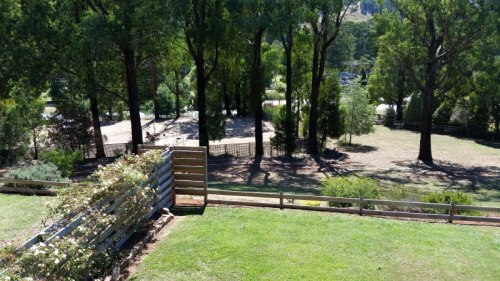
View from our balcony
Our room
Anyway we had a lovely few days, ambling down to the town for our real coffee and a read of the newspapers, kicking back and reading a whole book in one day in either their very comfortable library or out in the garden, and driving around to the various forest walks.
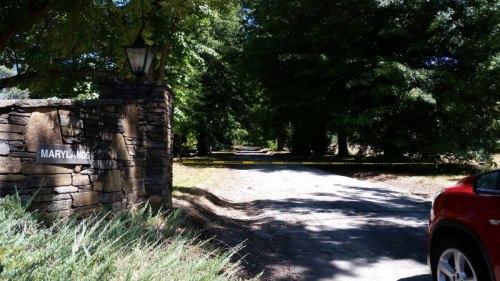
We drove past where Marylands used to be. When we visited on Cup Day a few years back, there were plans to subdivide the site. I’m rather pleased that the driveway lined with oak trees is still the same as it used to be, with no sign of building yet.
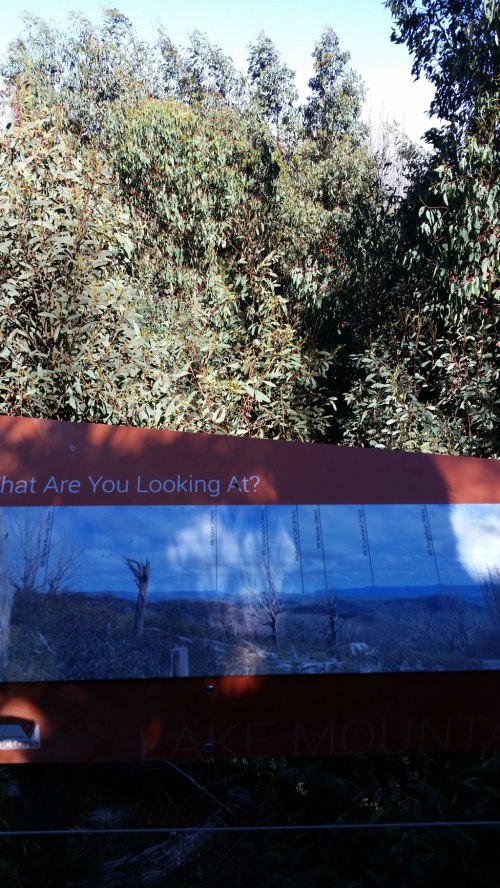
We drove up to Lake Mountain, a popular cross-country ski-ing location. Of course, there was no sign of snow at all on a 25 degree day. We were interested by the Bjarne K Dahl memorial boardwalk which was constructed before the trees all began growing back. This image on the information board from October 2013 shows the outlook at that time, with the surrounding mountains clearly visible. There’s been so much growth in the intervening five years that it is unrecognizable.
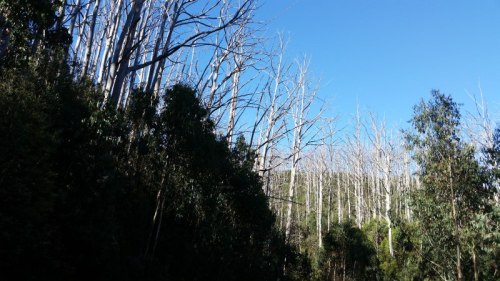
That’s not to say that there’s no evidence of the bushfire. Particularly on the tops of the mountains, there is little regrowth yet.
I was interested to learn that the reason that Lake Mountain has large grassed expanses is because the mountain ash trees did not have a chance to regenerate after the 1926 fires before they were burned again in 1939. The rapid succession of bushfires disrupted the usual seed-dropping cycle that allows mountain ash forests to recover from fire.
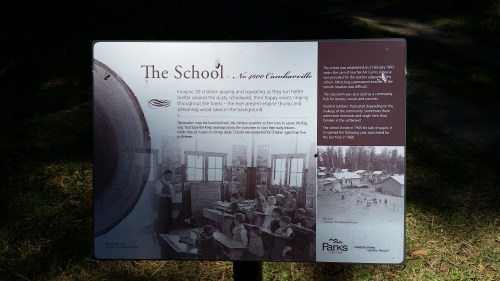
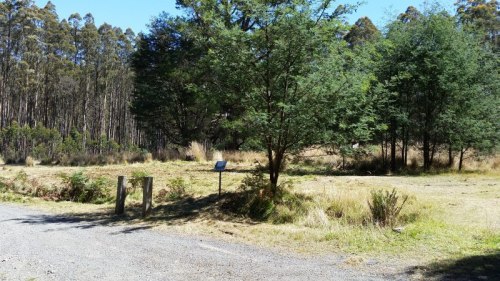
We visited Cambarville, which had been a timber town during the 1940s, following the 1939 bushfires. It is now an empty site, with a few interpretative signs laying out the school, mill and ‘main’ street.
It, too, was burnt out during the Black Saturday fires, although it was long gone by then. It must have been a pretty bleak place to live, with no electricity, mud and inhospitable terrain.
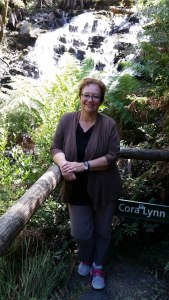
The waterfall walks were beautiful.
Even though there has been lots of money poured into Marysville to ‘save’ it, there’s still something ghostly about it. I know that we went up mid-week during summer, but it feels as if the rebuilt town is too big for itself. The Vibe hotel and convention centre dominates the main street, and the rebuilt bowling greens do not have a bowling club to use them. There are very few ruins any more, but many footpath crossings lead only to empty blocks.
The autumn leaves will turn soon. All of the oak trees in Murchison Street are flourishing, and Marysville will be just as beautiful in autumn as it was before the fires. And it does have a real guest house.
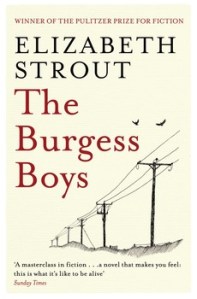
The ‘Burgess Boys’ are both lawyers: Jim a hot-shot defence lawyer and Bob, an easy-going, rather aimless legal-aid lawyer, both living in New York. They are called home by their sister Susan, who needs their legal help after her rather gormless son Zach throws a pigs-head into a mosque, triggering outrage over the hate crime. The family had grown up in the small town of Shirley Falls, Maine but the Burgess Boys had both escaped as soon as they could, leaving Susan a rather embittered, passive single mother after her marriage had broken up. As the title suggests, the family was about The Boys, not her. Shirley Falls had received a large number of Somali immigrants, which had caused tension in the town, which was whipped up further by Zach’s action.
Beside the pig’s head, this is a story of adult siblings who have drifted apart after their parents died. Their father had died while they were young, as a result of a car accident for which Bob felt responsible, and there is a lot of unspoken business between them.
I’ve read quite a bit of Elizabeth Strout in recent years, and I’m starting to wonder if I’ve read too much, because my satisfaction seems to decrease with every book after the brilliant Olive Kitteridge, which I loved. There was too much time spent inside the heads of these rather unattractive people, and the Unitarian minister was so saccharine that I felt ill (AND I’m a Unitarian myself!) The significance of the disparity between New York and Maine tended to pass me by, and it felt as if there were just too many issues bubbling away in the pot here.
So, along with writers like Ann Tyler and Sue Miller, whom I’ve enjoyed a great deal in their early books but then felt jaded towards, I think I need a bit of a rest from Elizabeth Strout. I’ll come back to her later.
Sourced from: CAE Book Groups
Read because: CAE book group selection (although I missed the meeting unfortunately)
Set in the Northern Territory in 1929 and based on actual events, this is a beautiful filmed story of menace and injustice. When an aboriginal stockman kills a crazed white station owner in self-defence, he and his wife escape into the outback, where they are hunted by a posse of self-appointed avengers, assisted by other stockmen as trackers. It has Bryan Brown and Sam Neill, both of whom have appeared in too many films like this. There are no romantic frontier myths here: it’s brutal and harsh and unforgiving. Hard to watch, but necessary to watch, too.
This is certainly no action movie, and it’s more an exploration of a situation than a plot. Menashe is a widower, and as a result his son is taken from his custody and raised in his brother-in-law’s house in a ‘proper’ family. He works as a poorly paid grocery clerk, and is looked down upon by the other men of the community. The best way to think of the film is more as a documentary than narrative, and it certainly gives a fascinating look into a Hasidic community within a modern city. The main character is actually acted by the real-life man on whose story the film is based, and it’s a bit like watching a reality program as it does not feel acted at all. It’s completely in Yiddish with subtitles.
I’ve taken to trying to walk a bit more for fitness, and so I kit myself up with my smartphone and wireless headphones, turn on a podcast and off I go. For the past 23 hours I’ve been listening to Dan Carlin’s Hardcore History opus, ‘Blueprint for Armageddon’, which runs for six episodes ranging in length from 3 hours and 7 minutes to a massive 4 hours and 29 minutes. It’s about World War I, told chronologically and based largely on primary sources and a survey of secondary sources.
Dan Carlin is not a historian, but a broadcaster who loves history. He spends too much comparing people and events for my liking, and at times I felt as if the series was descending into trench-porn as he tried to capture the experience of fighting on the western front. He cited frequently from primary sources from soldiers fighting on different sides, read in a harsh tone to distinguish it from his commentary.
So why did I persist for 23 hours? Well, he did a really good job particularly in the first episode on laying out the groundwork for the war that was to follow, drawing heavily on Barbara Tuchman’s The Guns of August. Even though he confessed his frustration at what he left out (even at 23 hours!), I thought that he did a good job of ranging across the different theatres of war, even picking up on the Australians and New Zealanders although his main focus is the western front. He does go on and on about things, but I didn’t mind that as my mind could go off on a little wander of its own, then I could refocus and catch up with what he was saying (indeed, by the time I tuned in again, he was often still making the same point!) And although he does labour some ideas, at heart they’re often insightful, original and interesting points that he’s making.
Still, that’s enough military history for me for now.
Last year I did an online course about Macondo, the setting for many of Gabriel Garcia Marquez’s stories and novels (see course details here). Of course, I read all the stories in English, but I found the videos and transcripts in Spanish challenging and rewarding, and could revert to the English translations when it all became too hard. So, when I saw that Coursera were running a second course, I signed up. It’s called Gabriel Garcia Marquez: Between Power, History and Love, and it looks at his work after the publication of One Hundred Years of Solitude. Once again, I’m reading the books in English but here’s an added degree of difficulty: there are no English subtitles or translation of the transcript. I’m on my own!
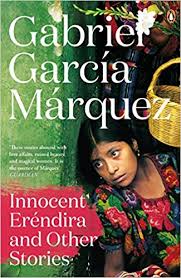
The first week looks at the short story collection Innocent Erendira and other stories. As the lecturers explain, these short stories were written after the critical acclaim of Hundred Years and before the publication of The Autumn of the Patriarch, which marked a departure from his earlier work. The stories therefore have wisps of his earlier work, but apparently prefigure the books that he was to go on to write.
The volume starts with ‘A Very Old Man with Enormous Wings’ about an angel arriving in a small village, where he is locked in the chicken-coop and becomes a sensation among the villagers. It reminded me a little of Elizabeth Knox’s The Vintner’s Luck, where the angel Xas bursts into a real-life setting. ‘The Sea of Lost Time’ is also set in a village, where the smell of roses permeates a village which is indebted to an unscrupulous gringo. The smell of roses reminded me of the butterflies in One Hundred Years of Solitude. In ‘The Handsomest Drowned Man in the World’ a body washes ashore and the women of the village fall in love with it. ‘Death Constant Beyond Love’ is about a dying senator who comes to a poverty-striken village and falls in love with a 19 year old. in ‘The Last Voyage of the Ghost Ship’ a ghostly ship, seen only in glimpses, sails into a village. Again, I was reminded of One Hundred Years, although it was a train that arrived in a village there. ‘Blacaman the Good, Vendor of Miracles’ is a gruesome story about torture, where a trickster takes on a young boy as his sidekick.
The final story, which gives the collection its name, is ‘The Incredible and Sad Tale of Innocent Erendira and Her Heartless Grandmother’. Heartless indeed, this obese, manipulative grandmother prostitutes her granddaughter, chaining her to the bed to service lines of men. It’s the longest story in the collection – more novella than short story, but it was too violent and distressing for me, I’m afraid.
Prostitution of children by parents arises in other stories here too, as in ‘Death Constant Before Love’ where a father gets his daughter to seduce the senator in order to gain a favor from him. There are other themes that run across the stories too. Many of them make reference to the sea (‘The Handsomest Drowned Man’, ‘The Last Voyage of the Ghostly Ship’ and ‘The Sea of Lost Time’) and tricksters and shysters abound. It’s a violent world. There’s plenty of power being exercised here, by people who should be showing love.
Stylistically, the most striking story is ‘The Last Voyage of the Ghost Ship’ which has only one full stop: the one that finishes the story. Marquez manages to progress the story well, using only commas.
So, all in all, a good collection of short stories, and the Coursera lectures are worth listening/watching too. Just don’t ask me to translate them!
The sun was shining and we had no commitments. So we hopped into the Big Red Car and drove up to Kyneton, about ninety kilometres from Melbourne. A former gold rush town, it still has many original buildings and the wide streets and verandahs of an Australian country town. For many years it has been a favourite ‘Sunday drive’ destination with antique stores and restaurants.
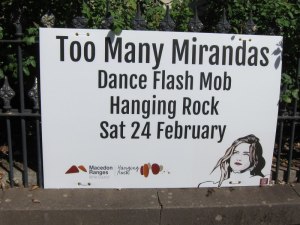
Kyneton isn’t far from Hanging Rock, which is going to be the setting for a ‘Too Many Mirandas’ flashmob later in February.
Feel like joining them? Here’s the video so that you can learn the dance. It looks like fun. But I think I’m more Miss Appleyard than Miranda or even Ethel.
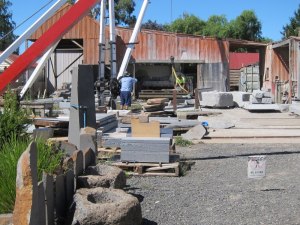
There was a stonemason’s yard where they were operating a hand-operated crane to move some marble blocks.
One guy to turn the wheel, the other to position the stone
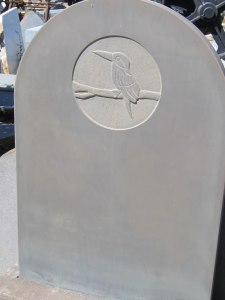
Fancy a headstone with a bit of Os-tray-iana on it?
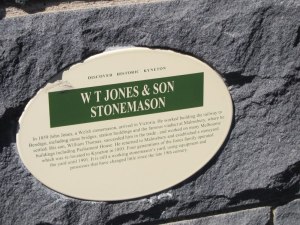
It’s a very long standing business (a very little pun)
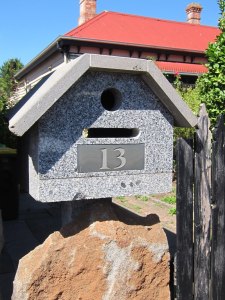
Putting one’s stonemasonry skills to work on the letterbox
The museum was open so of course we went in. They’ve obviously had lots of financial support for the museum, which was housed in a former bank building with lots of land attached. Their main exhibition in the front rooms in on loan from Tennis Australia, and features lawn tennis objects, including a Teddy Tingling tennis dress.
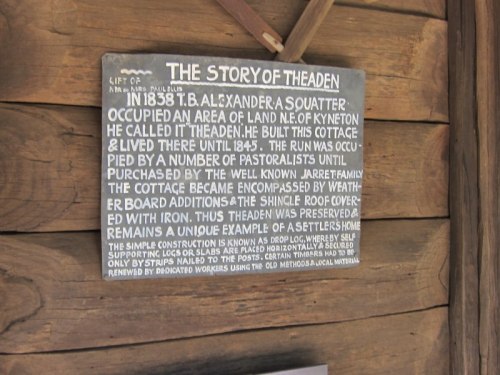
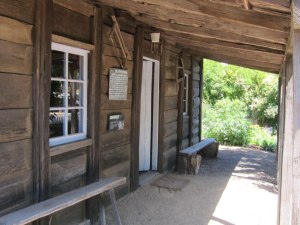
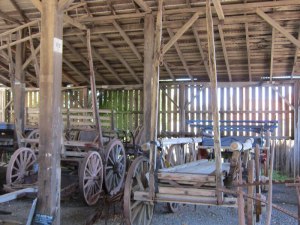
In the grounds outside they had a very well-preserved timber slab hut. The original hut had been built around and encased in weatherboards, leaving the original hut in very good condition. It was originally located on a local farm property but has since been shifted to the museum. The pig shed from the local market was shifted to the museum site too, and is now used to display agricultural equipment.
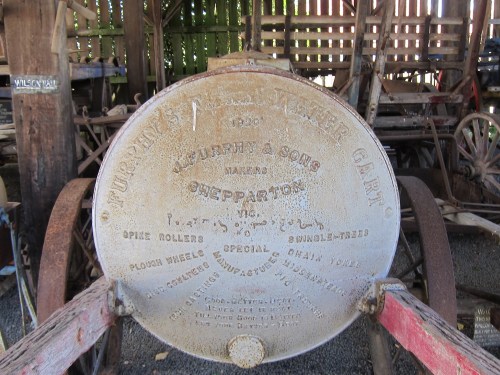
There was a Furphy water cart there, dating from 1920. I’d never noticed what looked like hieroglyphics on the tank end. Steve thought it looked like shorthand, and according to the ADB, that’s exactly what it is, apparently exhorting the reader to stay away from strong drink and stick to water instead.
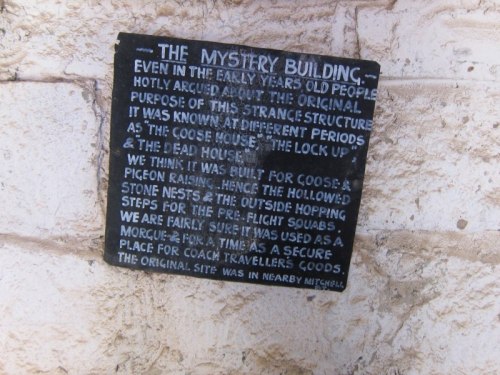
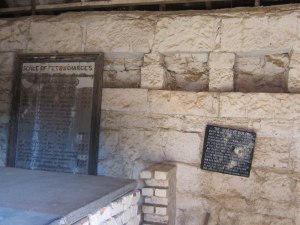
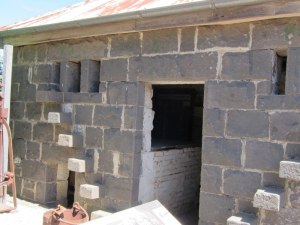
They even have a bluestone structure that no-one really knows why it was built. They think it might be a pigeon loft because there are alcoves built into the walls which might be used for nesting, and steps leading down from the windows for young birds just learning to fly. It had at various times been used as a morgue too, but no-one really knows.
Upstairs in the old bank building the rooms are still laid out as they would have been when it was used as the bank manager’s residence. All in all, well worth a visit although I wish that someone from the local historical society had been in attendance because the woman working there, while very welcoming and helpful, did not come from the area and her knowledge of Kyneton as a broader area was limited.
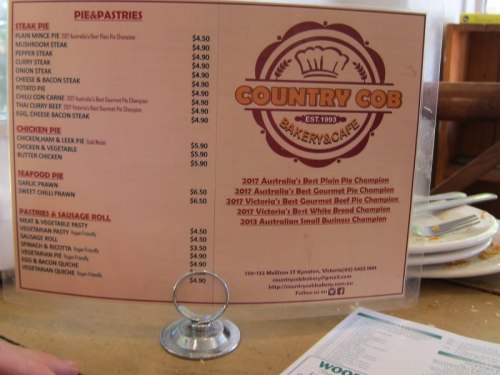
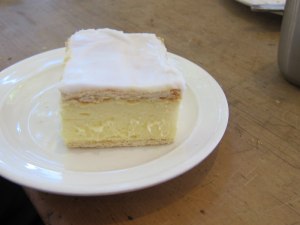
After museum-ing, it was time for lunch. How could we pass a bakery that had won so many prizes? Pies, vanilla slices- it just cleaned up the competition! I’m obviously not good at this taking-pictures-of-your-food thing because I’m sure the pie looked better before I started eating it. At least I took a photo of the very good vanilla slice before I hoed into it.
A final drive to the Botanic Gardens, where the National Trust heritage-listed trees were carefully listed in a useful pamphlet available as you go in the gate. Then we headed for home, going past the school. In the local community newsletter it appears that the school site is about to be closed because a new school is opening up and there’s a movement afoot for the old school to be used for community purposes. It’s a beautiful bluestone school, with a WWI memorial to fallen former scholars right in the playground where the kiddies play. But Kyneton has just so many historic buildings for community purposes and a limited, albeit active, population to use them. Wait and see, I guess.
It must be all those Dickens and Trolloppe BBC miniseries. When you’re reading 19th century colonial letters and newspapers, you’re often engulfed with a sense of deja vu. You’ve seen these dilemmas before; the characters feel familiar- you can even picture the the actor who’s going to depict them when it comes to television…
Except that this feeling of deja vu is an illusion. The past is not just “us in funny clothes” as Greg Dening once said. (Readings/Writings p. 209) If we’re trying to make sense of people’s actions in the past, there is a whole web of constraints and sensibilities that are largely invisible to us if we’re just relying on imagination and common-feeling. Especially when we’re writing as historians, rather than novelists.
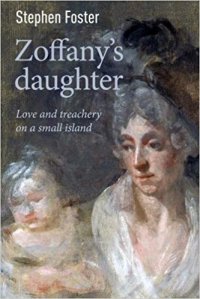
The historian’s methodological self-discipline is exemplified by Stephen Foster’s book Zoffany’s Daughter. As a historian, he encountered a newspaper article from 1825 about the Horne custody case on the Isle of Guernsey. As he tells it:
The report seemed irrelevant to the research I was then pursuing – yet I paused, intrigued by a narrative that appeared at once remote and familiar. …Indeed, stories about child custody disputes today seem all too familiar(p.2)
And it is an arresting little story. After their marriage breakdown, the Rev. Thomas Horne agreed to his wife taking custody of two of his daughters, and paid their maintenance. However, he later changed his mind and demanded the return of his daughters. Cecilia Horne (nee Zoffany – hence the title) hid her youngest daughter Laura and refused to reveal her whereabouts. This is the story of the case.
As Foster suggests in an epigraph “Most of this story is true. So far as I know, none of it is false. Much of it is fiction”. He’s right- if you counted up the pages, much of the book is turned over to the invented journal of Cecilia’s older daughter, Clementina, who was not part of the court case because her father, after some consideration, allowed her to stay with her mother. There was a Clementina Horne, but there was no journal. These pages are pure Foster, but as a historian, he operates within the constraints of those invisible sensibilities and the factual parameters of the time.
“Remote and familiar” is how the story appeared to him, and “remote and familiar” is the balance that a historian needs to keep. It’s a balance that Foster explores in reflective chapters that are interspersed throughout this book. In this regard, Foster is very much a present narrator. He strolls onto the stage in these reflective chapters in the first person to discuss various elements of the historiographical challenge. These are discussed more as discursive, personal, writerly challenges, rather than academic ones. The nature of gossip and its influence on the written record, for example, makes no mention of Kirsten McKenzies’ Scandal in the Colonies, a highly pertinent resource. In his chapter ‘On history and pictures’ he discusses the attempts to find a likeness of Cecilia Zoffany within his self-portraits and portraits of his family. His chapters ‘On the history of child custody’ and ‘On the rule of law’ explain the colonial law about divorce and custody in operation at the time, and the distinctiveness of Guernsey law. Methodologically, the most important chapter is ‘On small history’ where he defends the use of microhistory to illuminate a broader picture, pointing to the well-known examples of Ginsburg’s The Cheese and the Worms, Natalie Zemon Davis’s The Return of Martin Guerre (neither of which I have read, I must confess) and Emmanuel Le Roy Ladurie’s excellent Montaillou (which I have read).
One of the things that Foster does very well was to capture the differences between Guernsey law and society, and the English context which we think we know through Trollope and Dickens. The French influence was deep-seated, and anti-Catholicism was more nuanced. On the other hand, I don’t know whether Foster gave enough emphasis on the rarity of a situation where a father would grant not only custody but maintenance as well to his estranged wife. Fathers – or their extended family – kept the children if they wanted them, full stop. Foster acknowledges that the court case split the small Guernsey community, but I think that his sympathies are rather too strongly with the mother, Cecilia. However, he has the humility to leave judgments about the significance of the case, its lessons (if any) for modern custody cases and the effect on the child to the reader. Perhaps this is the 21st writer speaking, rather than the historian.
This is a self-published volume, which is an interesting choice by an academic historian, although Foster has also published with Pier9 (a Murdoch company). Certainly his thanks extend to other well-known historians (Michael McKernan, Alan Atkinson) and the blurb from Ann Curthoys, the author of Is History Fiction? is well-chosen. I was delighted to find full colour plates interspersed throughout the text, capturing well the Guernsey location at the time, and emphasizing Mrs Cecilia Horne’s connection with her painter father Johan Zoffany.
I was also really pleased to find that the notes at the back made clear the sources and documentary basis of his work as a historian in the book. I’m sometimes uneasy, I must admit, with ‘creative non-fiction’ and the blurring of lines between history and fiction. I appreciated Foster’s straightforwardness about what was invented, and what was not. For me, it’s only when the author has signalled their awareness of the distinction, that I can really relax. And relax I did, with this book, and I was genuinely interested to find out what happened in the end, and satisfied with the fidelity of the ending.

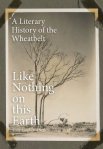 Griffiths was also featured briefly on Geraldine Doogue’s Saturday Extra (an excellent program!). He picked up on one of the points he made during the Australian Museum address: that of the emergence of new regional histories that combine the environment and emotion, history and literature. He was followed by Tony Hughes-d’Aeth, speaking about his new book Like Nothing on this Earth, which Griffiths praised highly, and which looks at the Western Australian wheatbelt through the eyes of regional writers like Dorothy Hewett, Tom Flood, Albert Facey and Jack Davis.