Category Archives: Uncategorized

Judge Willis’ Sydney

Most of my attention has been directed toward Judge Willis’ time in Melbourne, where he was appointed as the first resident judge of the Supreme Court of New South Wales for the Port Phillip district.  But he was in Sydney for much longer than he was in Melbourne- from November 1837 to March 1841- compared with his stay of two years and three months in Melbourne.

In Sydney, he was one of three judges who formed the Supreme Court bench, and so he was not as prominent as he was in Melbourne, where he was the only Supreme Court judge.  In fact, I’ve found it hard to form a clear view of him in Sydney: he doesn’t seem to have socialized much with any of the people whose writings I’ve been able to access from Sydney at the time.  From my point of view, he seems to become much more defined once he was given virtually free rein (and reign!) in Melbourne.

But he WAS there in Sydney and so, tramping the streets of Sydney this last week, I tried to see it through Willis’ eyes.

His Court
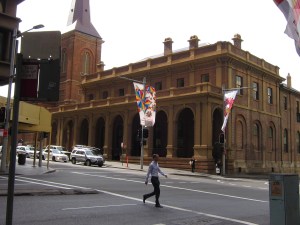
Supreme Court Sydney

Stairwell in the rotunda, Supreme Court Sydney

Stairwell in the rotunda, Supreme Court Sydney

By the time Willis arrived in Sydney in 1837, the court had abandoned its temporary premises and moved permanently into the Supreme Court buildings in King Street.  Although the appearance of the courts has been altered by later additions, inside under the rotunda it is largely unchanged.  The courts were designed by Francis Greenway, the “convict architect” who was responsible for the design of several buildings during Macquarie’s time.

His Church – maybe.
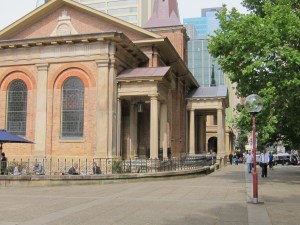
St James' Church, Sydney

St James’ Church, Sydney

Next to the court house is St James’ Church.  Actually, the building that houses the church today was originally intended to be the law courts with a larger cathedral built elsewhere, but after Commissioner Bigge criticized Macquarie’s extravagant expenditure, the planned law courts were turned into St James’ instead, and the law courts were built next door in what had been a schoolhouse (and they are still there- as you saw, further up the page!)

I don’t actually know that Willis attended this church- he may have attended St Philips instead- but I strongly suspect that he did as he aligned himself publicly with Bishop William Broughton who frequently officiated at St James.  (By the way, feeling rather downcast at some recent sad news, I attended the choral evensong there on Wednesday evening.  The choir was absolutely beautiful.) I know from his time in Upper Canada and Melbourne, and back home in England that Willis attended Anglican Churches regularly, often morning and evening on Sundays.

His library

Then there’s the Australian Subscription Library. Unfortunately it survives as only a plaque in the footpath.
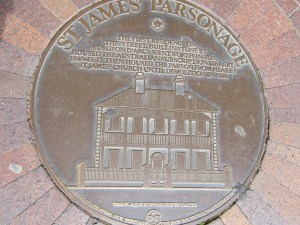
IMG_0126

ST JAMES’ PARSONAGE. The first residence on this street, built in stone by Surgeon D’Arcy Wentworth in 1820, housed the Australian Subscription Library 1840-3.  It then housed the parson from nearby St James’ Church until demolition in 1888.

I know that Willis belonged to this library because in early 1841 there was a brouhaha concerning a confidential cabinet document that had somehow found its way into the collection.  Heads needed to roll (figuratively) and they did: the Assistant Colonial Secretary Harrington lost his job over it.

The Parliament- maybe???
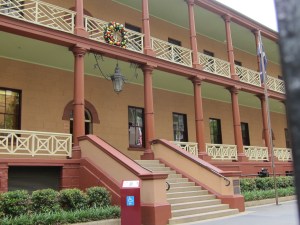
State Parliament, Sydney

State Parliament, Sydney

While Willis was in Sydney, there was only one body that gave advice to the Governor, the Legislative Council.  It was appointed by the governor, and by 1829 had been enlarged to between ten and fifteen members.  It met in the ground floor rooms of what were at that time the Chief Surgeon’s rooms in the Sydney hospital.  Like the church and the court buildings, the hospital was also designed by Francis Greenway, and funded by an early form of public/private partnership, based on the monopoly of spirits imports- hence the name ‘Rum Hospital’ that has been attached to the building ever since.  I have no evidence that he ever attended Parliament,  but it was open to the public from 1838 onwards.

Government House- certainly

Model of the original Government House, Museum of Sydney

Model of the original Government House, Museum of Sydney

As puisne Judge, Willis most certainly did attend levees and functions at Government House.  The building that is now Government House was commenced but not completed during his time in Sydney, so he would have attended  the old Government House. In 1809 it looked like this:
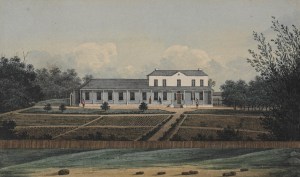
Government House Sydney 1809

Government House Sydney 1809

It fell into disrepair- in fact, it sounds a rather shoddy building from the outset, and was demolished in 1846.  There is a ghost of the original house in the stencilled outline in  the forecourt of the Museum of Sydney, where it originally stood.  If you go up to the corner, you can catch a glimpse of Circular Quay down below, and imagine the early Port Jackson shoreline.

So….

Actually, despite the heavy building activity in Sydney over recent decades, and a cavalier attitude towards heritage buildings during the 1960s (thank you Jack Mundey!) there’s more to find of Willis in Sydney than there is in Melbourne.

The ANZLHS conference at Sydney

I’ve been up in Sydney for the last couple of days for the Australian and New Zealand Law and History Society conference.  You’ll note that the name of the organization  is ‘Law and History Society’ and not ‘Legal History Society’.  It’s an important distinction: it’s not just lawyers exploring historical cases but historians wading into legal waters as well. The conference reflects this dual focus, as I now realize even more clearly after attending the British Legal History conference last year which is far more lawyer-oriented.

IMG_0105

It probably reflects my membership within the historian camp, but the presentations that have remained most clearly with me are those involving people rather than principles.  So, just off the top of my head: terrific papers on the wardens watching Jimmy Governor before his execution; taking Nat Turner’s profession of faith seriously, a South Sea Islander petitioning for a lease on an island in the middle of a river in Northern Queensland,  and the fascinating case of Eugenia Falleni (the topic of a recent book).

But good papers on historical legal issues as well: vagrancy legislation in NZ and Australia during the 19th century; 18th trials of slave traders in Sierra Leone, and 19th century factory legislation that dared not speak its name in limiting the employment of women and children.

Some sessions I attended just for fun, like the “Literary Traces” panel, which ranged across Rousseau, Dickens, and the concept of “the reasonable man”.  Then there were the issues which spilled out of historical straitjackets into current issues: the historical trajectory of international human rights, the concept of marital rape immunity, and immigration law.

Did I give a paper? Yes I did, based on a case that arose out of the abolition of slavery in 1834 in British Guiana featuring Judge Willis (of course).  I’m not quite sure what I’ll do with it yet.

Lots to think about and I learned much.  Well worth going.

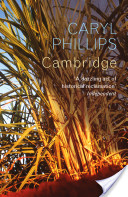
‘Cambridge’ by Caryl Phillips

cambridge

1991, 184 p.

A funny thing happened while I was reading this book.  I’m in the habit of reading in bed before I go to sleep, but I never read ‘work’ (i.e. thesis) books that I think I might need to really concentrate on.  Novels, yes; diaries, yes; arcane books from Google books yes.  Occasionally I find something in these books that I might jot down, but it’s all pretty low key.

So here I was, reading Cambridge by Caryl Phillips.  I’d heard about it on one of the lists that I subscribe to,  in response to a question regarding novels set on Caribbean sugar plantations. It is, indeed, set in the West Indies.  Now, I’ve read quite a few books about the West Indies by now for my thesis,  including travel books to the West Indies as in Mrs Carmichael’s jolly tracts review here and here, and diaries.  The first section of Cambridge is told from the perspective  of a young Englishwoman sent out to check on her father’s plantation before returning home to marry an older man her father had chosen for her.  So utterly convinced was I by the narrative voice  that I picked up a pen ready to make a note until I thought- hold on: it’s fiction.

The first section, told in the first person by Emily Cartwright is written as a journal-type narrative (although not divided by dates or other chronological markers) and in the immediate past tense.  When Emily arrives at an unnamed West Indian island, at an unspecified time (somewhere between 1807 and 1834) she finds that the manager, Mr Wilson, has disappeared and been replaced by Mr Brown.   Mr Brown is a surly, uncouth man but Emily falls in love with him gradually, and all of a sudden he is no longer ‘Mr Brown’ but Arnold.  Emily is troubled by Mr Brown’s black mistress, a woman called Christiane, whom all the other slaves fear to be an obeah (witch) woman.  Cambridge, a large well-built negro worker, is set to keep watch over her at night.  The first part of the book is by far the longest – 122 of the book’s 184 p.  It is told at a leisurely pace- hence, I think, my being lulled into thinking of it as an authentic diary, and it shares the one-dimension perspective of the diary genre.

The second section is told by Cambridge- a slave whose travels have taken him on his own Atlantic triangle- Africa, England, West Indies.  He is a man of many identities and many names- Cambridge,  David Henderson, Olumide. His voice is the formal, stilted witness of the evangelical convert, and he retells many of the same events as Emily does, but brings another truth to them.

In an interview with the New York Times, Caryl Phillips said:

To begin a book I must first find characters who allow me access to their lives and who trust me to tell their stories….I began by reading period novels. That wasn’t enough, so I turned to diaries and collections of letters. I found that a considerable number of personal narratives existed, written by English travelers to the Caribbean. All of that helped me to understand the language of the period, the attitudes that it shaped and reflected and the subtlety of statement common to the period.

I think that it was this capturing of nuance so authentically  that I responded to: so much so that I was disappointed by a third short narrative, in the form of a newspaper story, that somehow missed the mark.  It starts as a report such as you might find in the ‘criminal’ section of a colonial newspaper, but it then segues into the florid prose of a story-telling also common to the colonial press of the time,  complete with improving verses and sunrises and sunsets.  But in reality, you’d find these two separate sorts of writing in different parts of the newspaper as two completely different articles.   For something that had felt so authentic up to this point, this was disappointing.

This is the third  Caryl Phillips book I have read: I reviewed his Crossing the River  and Dancing in the Dark some time back.  Both Crossing the River  and Cambridge are similar with their multiple narrators, but I think that this book has a much better unity.  It is a pastiche, of course, but a very well researched one (and I know this because I’ve read the same primary sources!) that wears the research lightly.

I suspect from the rather dismissive reviews on Google that it has been assigned as school reading.  I acknowledge that the first part is very slow, and events unfurl as they do in life.  It’s a much more complex book than these disgruntled young readers realize. It also supports an academic response as well, all steeped in postcolonial theory (see here and here and here as well) .

My rating: 9/10

Read because: It was suggested on a list of fiction works addressing plantation life

Sourced from: The Annexe at La Trobe University.  Obviously not enough people borrowed it.  They should.

Nurse??!!

Ever since the Black Saturday fires some years back, 774ABC radio is the designated emergency ratio station for Melbourne.  As a result, if there’s fire, flood, funny smells- then 774ABC goes onto ’emergency’ footing with frequent warnings and advice interspersed with its normal programs (unless of course it’s a REAL emergency, at which time usual programming is suspended).

There was a fire at a recycling centre in suburban Melbourne this morning, and this triggered  774ABC emergency warnings right in the midst of “Making Christmas Gifts with Craft”- quite a surreal juxtaposition!  I was interested that at the end of the warning about toxic smoke, keeping your windows shut, turning off the airconditioner and staying inside etc, there was advice to call Nurse- On-Call if you had any concerns.

Nurse-on-Call is a telephone service that provides 24 hour a day advice from a registered nurse. I’ve never used it.  From what I have heard from people who have used it, they’re normally told to go to hospital.  This may reflect the demographic of my sample- i.e. old codgers primed for heart attacks, and perhaps it’s different when people ring with a baby or young child.  But I can’t help thinking that in these litigious times, it would be unwise to advise to “just wait and see”.

Perhaps in a situation like this though, when people are wanting reassurance as much as anything else, there might be a role for nurse-on-call as a way of deflecting unnecessary panic.  But it did make me wonder about the statistics on Nurse-on-Call: is my perception that they always advise ‘go to hospital’ valid? Has it saved hospital visits or increased them?  I did actually go to the Dept. of Health webpage where they had their annual report, but it would have taken 8 minutes to download and I thought…..nah.

On to The Conversation website and blow me down….there’s a report on telephone medical advice lines. In a Medical Journal of Australia article, researchers looked at the difference in  ‘appropriate referrals’ from GPs, a telephone medical advice line, and self-referral.  I’m a bit disconcerted by their definition of ‘appropriate referral’ which ranged from  admission to hospital, referral in an inpatient or outpatient clinic, transfer to another hospital, performance of radiological or laboratory investigations- or death in the Emergency Department. (I’m hearing echoes of Monty Python’s ‘I told you I was sick!”)  As might be expected, GPs scored the highest in ‘appropriate referrals’ but interestingly telephone-line and self-referrals were ranked much the same- in fact, the self-referrals scored slightly higher.

Moreover, the study found that people when do receive advice to seek medical advice in a non-Emergency Department (so there goes my theory),  50% of people ignored the advice and turned up anyway. The conclusion of the study? The MJA editorialized:

It is not clear that, if offered an informed choice, the community would choose to pay for telephone advice that makes little difference to their behaviour over other health service priorities. In relation to whether an ED visit is required, it appears that a phone call will not answer the question.

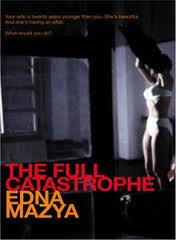
‘The Full Catastrophe’ by Edna Mazya

2005, 334 p.

It’s a commonplace but true that one of the best things about being in a bookgroup- apart from the friendships you make with fellow readers- is that you read books that you wouldn’t normally read.  Come to think of it, one of the worst things about being in a bookgroup is, too, that you read books you wouldn’t normally read-  and often for very good reason.

But in this case, I simply hadn’t heard of this book or the writer. Edna Mayza, apparently, is a well-known Israeli playwright. The narrator of the story is Ilan Ben Nathan, a 48-year-old astrophysicist who works at the Technion (university)  in Haifa.  His wife, Naomi is twenty years younger  and he is besotted, possessive and obsessive about this wife that he can scarcely believe he has landed.  So insecure is he that he becomes (quite rightly) convinced that she is having an affair and it dominates his every word and action with her.  You know that it’s not going to end well when he tracks down her lover, who is, perversely, an older man like he is, and he confronts him.  I shall say no more.  Think Woody Allen, think of suffocation and close-up, minute scrutiny and that’s Ilan: nerd on the outside, screaming heap of obsessions and fears on the inside.

It is striking that this book written by a playwright has such a distinctive, breathless present-tense narrative style where the dialogue is reported as part of very long, run-on sentences that extend sometimes even over pages.  It’s just as anxiety-provoking and suffocating as Ilan is, and it works brilliantly once you get used to it.  Here’s an example:

When I get home in the evening I find Naomi sitting at her desk…Her movements seem jumpy, I can’t get her to meet my eyes, she immediately offers to make me supper and I say that I’ve already eaten at the Technion.  She asks with a glassy look, what do you want to eat, I say again, more slowly, I’ve already eaten Naomi, and she asks, should I defrost a steak for you?  I stand there and wait for her to come back to me, and after moving restlessly to and fro she pulls herself together, faces me without looking at me, and asks, is anything wrong, and I repeat in the same tone, is anything wrong, and now she almost looks at me and asks in a different tone, is anything wrong, and I saw, nothing’s wrong, why should anything be wrong, I’m simply trying to explain to you that I’ve already eaten, and now that I’ve finally caught her attention she understands, and she kisses me lightly and says that in that case she’ll carry on working…

As I said, the writing does take a bit of getting used to, but it also draws you completely into Ilan’s world view.   I was interested to see that the book has been made recently into an Israeli film called Naomi . At first I wondered how such an interior form of narrative would translate onto the screen, but when I think about it, for the reader, Ilan’s narrative makes you an observer only- his consciousness does all the work for you. Often watching a film is a receptive act too, because you are not participating in the conversation yourself, but watching and listening to it from the outside.  So perhaps it’s not so strange that a playwright would create such a text after all.

I can’t remember having read any books set in present-day Israel.  There’s no writing for an international audience here at all: it is as local as a Helen Garner book is for Melburnians. I found myself curious about the position of Arabic people in Israel (are they the same as Palestinians?) and was rather surprised to find that Galilee was a desert spot with weekend rentals (wasn’t there a Sea of Galilee?)  There were lots of restaurants and apartments, and I never did quite make a mental picture of where Naomi’s lover lived- there is mention of a red plastic curtain and I summoned up a picture of a red curtain covering a makeshift shack in a slum against a cliff face, whereas my fellow-bookgroupers saw abandoned tenement buildings.  I guess I’ll just have to wait for the movie.

And I’ll make a point of hunting it down  too, because this is a terrific book: suffocatingly, insistently compelling and shot through with black humour.

My rating: 8.5/10  (maybe even a 9!)

Sourced from: Council of Adult Education

Read because: it was the November book for my bookgroup.

And as an aside, it’s called Love Burns in America. Can’t really see why the name change, I must admit.


Judge Willis and Mabo

Australia is celebrating this week the twentieth anniversary of the Mabo decision that rejected the doctrine of terra nullius and recognized native title. The ‘Mabo Case’ findings did not mention Judge Willis by name, but it would have been entirely appropriate to have done so because in many ways, he anticipated Mabo by 151 years in a case called R. v Bonjon.  However, for a number of different reasons, the Bonjon case remains a mere footnote in history.

In 2010 I gave a paper at the Australian and New Zealand Law and History Conference about the Bonjon case, and you can read it here.

‘The Longing’ by Candice Bruce

2012, 354 p.

In her acknowledgments at the back of this book, Candice Bruce names Jan Critchett’s book A Distant Field of Murder (see my review here) as one of the sources that deeply influenced the writing of this book.  I suspect that I know exactly the paragraph in Critchett’s book that encapsulates what Bruce is trying to do in her book:

The frontier was in fact a very local phenomenon, the disputed area being the very land each settler lived upon.  The enemy was not on the other side of neutral ground.  The frontier was represented by the woman who lived near by and was shared by her Aboriginal partner with a European or Europeans.  It was the group living down beside the creek or river, it was the ‘boy’ used as guide for exploring parties or for doing jobs now and then.  The ‘other side of the frontier’ was just down the yard or as close as the bed shared with an Aboriginal woman.

Jan Critchett, Distant Field of Murder (p. 23)

It is this shared domestic frontier that Bruce examines in The Longing: a paradoxical space that was intimate in terms of physical proximity and yet at the same time also a yawning gulf.  Ellis MacRorie is a young Scotswoman, who had been shipped off to marry the older, dour Alexander MacRorie, a pastoralist in the Western District of Victoria.  The homestead is one of the grand mansions described by Margaret Kiddle in her wonderful (if flawed) Men of Yesterday, where shearers and workers mingled with the aboriginal servants and farm labourers.  Leerpeen Weelan, known as Louisa, is one of these domestic servants, and in her loneliness and unhappiness, Ellis believes that Louisa is a confidante and friend.  Leerpeen keeps her distance, impassive and silently mourning the loss of her daughter, her tribe, and her country, and rather derisively judging the infatuation that develops between Mrs MacRorie and the American artist Sanford P. Hart who comes to stay at Strathcarron homestead.

And here we run headlong into one of the narrative dilemmas of twenty-first century narrative writing: presenting the aboriginal voice.  Kate Grenville felt that it would be inappropriate to “step into the heads” of her Aboriginal characters in The Secret River; Tom Keneally has said he wished that he had had a greater sensitivity to the ownership of words and worldviews when he wrote The Chant of Jimmy Blacksmith and that he would be more “diffident”  about writing from the Aboriginal perspective today. But the author of this book, Candice Bruce, in an interview with the SMH does not seem to share their qualms:

Surely we have all moved on from then and can see the value in having multiple voices?…We have a shared history, which is not the preserve of only one group, and so to go back to a time where political correctness decrees who is allowed to write from particular points of view is anathema.

I’m not sure that it’s the preserve of one group alone to make this decision.  I personally am not comfortable with the glib ‘move on’ attitude that this quotation (which may well be out of context) suggests. Perhaps, as Kate Grenville found with The Secret River, Candice Bruce may find the commentary that a writer generates as part of the publicity round can overtake the work itself.  But does it matter what an author says about how they approach their work? After all, works of art existed before and long outlive all this publicity flummery that is frothed up by modern marketing.  In the final analysis, a book should stand or fall in its own right, (shouldn’t it?)  irrespective of the author’s intentions or personality- although I’m not sure that the two can always be disentangled.

I am, however, aware that trepidation over the presentation of Aboriginal characters in some ways maintains “otherness” and that fear of causing offence causes the Aboriginal presence in Australian historical fiction to be sidestepped altogether. I don’t know how you get over that- or indeed whether it is possible or presumptuous to attempt to do so.  I’m mindful of Paul Keating’s exhortation in the Redfern speech about “our failure to imagine” the murder, child theft, discrimination and exclusion faced by Aboriginal people if it happened to us. Perhaps this book is what this “imagination” looks like.  The author says that she was encouraged to write this book by Vicky Couzens, a well-known Gunditjimara author from the Western District in which this book is set, who assured her that any controversy would be short-lived if she wrote with accuracy and respect.  I think that Bruce does both these things, but the wariness that she dismisses as “political correctness” exists on both sides, and for good reason.

Leaving aside the question of the wisdom of adopting an aboriginal narrative perspective, how well does she do it?  As well as giving her encouragement, Vicky Couzens also gave Bruce a copy of the Dictionary of Keerray Woorong and Related Dialects, and perhaps this exemplifies the approach that she takes in presenting Leerpeen’s voice.  There are words, naming and labelling, but there’s none of the rise and fall and flow of Kim Scott’s language in That Deadman Dance, or Alexis Wright in Carpentaria.  Words, but not language.

The second narrative arc of this story involves the young art curator Cornelia Bremer who, 150 years later, is researching an exhibition on S. P. Hart for the National Gallery of Victoria.  When the lead researcher is involved in a car accident, she is dispatched to Strathcarron to evaluate the suitability of an S.P. Hart painting in the possession of the MacRorie  family who still live in the family homestead, which is falling into disrepair.  She stays with the family for a couple of days,  learning of the jealousies and rivalries among the remaining family members, and uncovering art work and provenances that are completely unknown to the art world at large.

Here Bruce is on surer ground, because she is herself an art historian who curated the Eugene von Guerard exhibition at the National Gallery of Australia in 1979-80 and contributed to the catalogue of the more recent ‘Nature Revealed’ touring exhibition at the National Gallery of Victoria in 2011 (currently on show at the National Gallery in Canberra until July 2012).  On Candice Bruce’s own website, she shows the images in particular that inspired her, most especially the paintings of Lake Purrumbete and the homestead.  In this regard, I was reminded of Robert Dowling, who also worked as a travelling artist, moving from property to property painting homesteads and livestock as a way for settlers to celebrate their good fortune. When Bruce writes about the excitement of hunting down and reading handwritten correspondence and diaries, and uncovering artwork unknown to the academy, you know that she is writing from first hand experience.   I recognize the wealth of research that underpins this book, because I’ve read much of it myself, but it weighs the book down.  There is a slightly didactic tone to the present-day section, especially in relation to issues over aboriginal artwork and heritage. The  addition of a thwarted extramarital affair added a discordant, even somewhat chick-litty note that made me squirm a bit.

The juxtaposition of these three stories- Leerpeen and her stolen daughter and lost country, Ellis MacRorie and the painter, and Cornelia the art investigator – traverses 150 years.  Bruce emphasizes common humanity and the universality of love and loss, but in so doing hits a few false notes. I found myself becoming tired of the frequent flashbacks, and some of the dialogue, particularly in the present-day section was weak. I enjoyed the section written as Ellis’ diary, and overall enjoyed the historical 1855 thread more than the present-day one.  As a piece of historical fiction, it works well.  It fleshes out those images of the past that are so often formed by film and television, and in this case it draws our attention to colonial domestic relationships that are often overlooked completely. There was, after all, a market for those mission-trained Aboriginal girls (for example, the Cootamundra Domestic Training Home for Aboriginal Girls), yet there is little acknowledgement of their presence.  The imaginative space that historical fiction provides can be one where the imagination that Keating called for can work on us.  In this regard, the book succeeds admirably.

What Bruce does really, really well is landscape, and here her art historian strengths come to the fore.  Her descriptions of landscape are so evocative that you can see it as a painting in your mind’s eye. It’s as if she helps you to ‘frame’ the country yourself, while at the same time reminding us of the aboriginal sense of country, exemplified by the Deborah Bird Rose quote at the start of the book.

Vicky Couzens told her to be accurate and respectful. Candice Bruce gives us accuracy in spades: the depth of research in this book is prodigious, and she brings a wealth of professional experience to the present-day component of the book.  Respectful- yes, I think that she is, but I don’t know that I’m the person who can make that judgment.

My rating: 7.5 -8/10

Sourced from: Yarra Plenty Regional Library

Read because: Lisa at ANZLit Lovers reviewed  it, and I like books set in Colonial Victoria.

‘Otherland’ by Maria Tumarkin

2010, 301 p & notes

“What IS this book?” I wondered half-way through. Travelogue; a reflection on literature and historical methodology;  a history of nations and a history of family; a reflection on the mother/daughter relationship- how would all that be summed up in the one-word descriptor that you often find on the back cover of a book?

“Memoir” .  It seems a little incongruous to me that anyone born in 1974 could write a memoir yet, but if a memoir is a literary construct through which the writer represents a lived experience, then yes, this is a memoir- but I’d qualify it by adding “and much more”.

The author is a Melbourne-based historian, who emigrated from the Ukraine with her parents and sister in 1989, a month after the fall of the Berlin Wall,  at the age of fifteen.  She had returned to Russia  previously, but had not made it to the Ukraine.  On this trip she takes her twelve- year old daughter, Billie, largely because she feels that it is the last chance she will have to do so:

Right now is my last chance to go back with her and still be the centrifugal force of our journey, exercising the course-setting and veto powers.  It is, in other words, my last chance to have Billie follow me around, however begrudgingly, as her mother’s tail.  In a year, maybe a few months, the tail will drop off, or the tail will be wagging the dog, and such a trip, if even possible, will be a different proposition altogether. (p. 28)

It is the journey that ties this memoir together, but it is a layered journey. Mother and daughter are travelling, but Tumarkin is making her own journey back to the relationships that were ruptured when she and her family left so abruptly, and she is making a journey into her own parents’ and grandparents’ experiences as well.  But it is not her story alone: she interweaves the journey with the stories and observations of writers, historians, poets and political dissidents.  In this way, it is an intellectualized endeavour- indeed, I had not heard of many of the writers she cited- but it is also highly personalized.

It is much more than the story of a mother and daughter, and yet this is important too. We read excerpts from Billie’s diary- am I the only one who felt slightly grubbied and complicit in this?  The mother/daughter relationship generally is often fraught, and here I found myself judging the author rather harshly for her own intrusion into her daughter’s perceptions of her experience, where she so much wanted her daughter to see and feel certain things. Ah, but in terms of judgement and criticism Tumarkin was often there before me, aware of her own shortcomings.  There is a stringent honesty in her writing, as when she describes her daughter opening up the piano to play in the apartment of an elderly woman herself the cultured, brilliant daughter of a revered dissident:

In this apartment at the very heart of Moscow, metres away from the Mossovet and Statira Theatres and the Tchaikovsky Concert Hall,  Billie sits down at the old piano.  She plays what she usually plays- Tori Amos and Coldplay.  How alien they sound inside these walls.  Not in Adorno’s ‘no poetry after Auschwitz’ kind of way, no.  And not in a vulgar popular-culture way.  It is just that here these songs, which evoke places and times that make no sense in the world of this apartment, sound thin, flat and inconsequential in the extreme, like a mobile ringtone underneath a cathedral dome. Momentarily I feel ashamed. Ashamed for both of us. (p. 76)

There are several mothers and daughters here.  It is also a history of a Jewish family, who were part of a much bigger history, and here I found myself hampered by my lack of late twentieth-century history: who came first again? Gorbachev? Yeltsin?  I craved a factual chronology, to juxtapose against this very personalized history.

This is a very carefully constructed memoir.  It opens with a cliff-hanger that is not resolved until after half-way through the book.  The writing is reflective and scholarly in places, and confessional and all too human in other places.  Like all journey narratives, it moves forward and there is a homecoming, in more than one sense.  It is quite a journey.

My rating: 9/10

Sourced from: Yarra Plenty Regional Library

Read because: I read it as my third book in the Australian Women Writers Challenge

Moving Here- 200 years of Migration in England

www.movinghere.org.uk

Another good way to while away an hour or two or three- I found a fascinating website about migration to Britain.  Being on the receiving end of wave after wave of British migration, we tend to forget that Britain itself was- and still is- a migration destination.  The National Archives are the lead partner in a consortium of other British heritage organisations and museums, and the site contains photographs, stories and timelines of Caribbean, Irish, Jewish and South East Asian migration to Britain.

www.movinghere.org.uk

Albert Nobbs

We went to see Albert Nobbs. I know that it’s receiving only lukewarm reviews, but I really enjoyed it.  Glenn Close plays a repressed, reclusive little wisp of a man who is, in fact a woman.  He works as a waiter in an Irish  hotel in the late 19th century, painstakingly saving enough to realize his dream of one day owning a tobacconist shop, and terrified of exposure.

It’s a sad little story, and for much of the film, I feared for Albert.  There have been criticisms that Glenn Close is wooden, but I don’t agree.  It’s a very tense, coiled performance and the character of Albert is so repressed and taut that his emotions can only be portrayed as minute gradations, tightly controlled.

Apparently Glenn Close first played the role off-Broadway in 1982, and she and John Banville wrote the film adaptation.  It doesn’t surprise me that John Banville was involved: the film is bleak and sharp, as much of his writing is.

Critics be damned! I liked it.