Category Archives: Uncategorized

I’m b-a-a-c-k (Australian Women Writers Challenge 2014)

A new year, and time to sign up to the Australian Women Writers Challenge for 2014.  It’s the third year that I’ve been involved in this, and its website is turning into a handy little resource for reviews on Australian women’s writing.

The challenge was provoked by the Miles Franklin shortlist of a few years ago that was comprised solely of male writers.  I strongly suspect that a similar situation may arise again this year with the Holy Trinity of Franklin, Winton and Tsiolkas all releasing books during 2013.  We shall see.

Anyway, I’m in again.

The ‘fairytale’ is over

Well, who would have thunk it? Geoffrey and Brynne Edelsten’s marriage is over.

geoffrey-edelsten-brynne-gordon

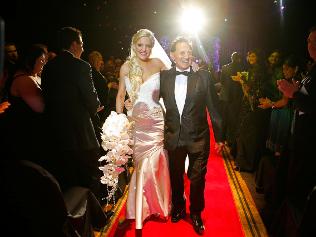
Here are the wedding celebrations described with breathless enthusiasm in 2009, and here’s a rather sad analysis of the same celebration written by a guest some four years later now that it’s over.

Celebrity gossip is my rather grubby secret vice- indulged mainly at the check-out, the hairdressers and doctors with the odd furtive glance at internet links on The Age website-  and I don’t normally write about it here.  But bad hair transplant, curious suntan and Brynne notwithstanding, I do have rather a soft spot for Geoffrey Edelsten.

It was a couple of days before Christmas in 1988 (I think- might have been 1989) and I developed the mother of all sore throats.  Ye Gods- each swallow felt like a knife and I felt absolutely terrible.  I could barely open my mouth; the taste was terrible; as soon as I lay down I felt as if I was going to suffocate…. oh, it was dreadful.   In desperation I went to the walk-up 24 hour clinic in Kingsbury that was owned by none other than the famous Dr Edelsten.  I think that it must have been at the nadir of his fortunes: it was a very humble grey brick surgery in two old houses on a busy corner.  It had the chandelier, but that was about all, with threadbare carpet, hard chairs and the ubiquitous doctor’s-surgery magazines. There were no other patients, and the whole place looked rather tired and crumpled- as did the doctor himself.

It was quinsy, which sounds all very Victorian and old-fashioned.  People used to die of it- in fact, I read a description of Queen Elizabeth I’s death and even though I know that she was supposed to have died of poisoning (perhaps from her face powder), I reckon it was quinsy.  Alison Weir (Elizabeth the Queen, 1998 p.481-4) says that her final illness began with “slight swellings- probably ulcers- in the throat” and she complained to Nottingham “My Lord, I am tied with a chain of iron around my neck. I am tied, and the case is altered with me”. Apparently she just lay on cushions on the floor, “holding her finger continually in her mouth, with her eyes open and fixed to the ground”.  Well, that sounds like me Christmas 1988. Eventually Queen Elizabeth’s ulcer burst and she felt much better (although went on to die a few days later), just as mine burst on Boxing Day (and I lived to tell the tale, obviously).  Instant relief.

The good doctor made his diagnosis and gave me a hefty injection of antibiotics (there was no way that I could swallow a tablet).  And another the next morning and evening, and the morning and evening after that.  By now it was Christmas Day and there he was, alone in that surgery at 8.00 in the morning and there he was still alone in that surgery at 7.00 p.m. that night.  Not once did I see another patient there.

I’ve had quinsy a couple of times since, although never as bad as that first time- touch wood I haven’t had it for the last ten years or so.  I still get nervous at the sign of a sore throat.  I haven’t forgotten that kind doctor in his empty surgery and in spite of all that has happened to him, I feel rather sad for him.

Uplifting Quotes for the Uninspired Historian #18

June Philipp was a historian at La Trobe University during the 1980s.  I’ve heard her spoken of on several occasions, linked with Greg Dening, Rhys Isaac and Inga Clendinnen of the ‘Melbourne School’ of ethnographic history that appeals to me so much.   I was interested in a methodological paper that she wrote in Historical Studies in 1983.

Human action is generated within a social and cultural context whose forms- relations, roles, rules, values, rituals, symbols- shape its logic and project its meanings… Social actions from the past have been preserved in a piecemeal way by having been written down in the form of action descriptions- glimpses of people in the past doing things…. Action has an external dimension, and past action may be observed (though indirectly) as behaviour, as a sequence of physical movements, but its import is not immediately accessible to observers in the present who happen to look back.  It is the ‘inside’ of action that matters most and which the historian must seek to discover…  (p. 350)

Action-oriented history is an empirical study and, in one of its aspects, it is descriptive.  The first aim of the historian is to divest the account of what happened, as much as possible, of interpretation: of the interpretative overtones in which it is clothed by its past recital and by the historian in its re-telling.  The intent is to rehearse and display the actions.  The facts are then construed: actions are scrutinised and analysed patiently in search of clusters or patterns which signify institutionalised forms.  The historian then tries to grasp the meaning being expressed through those forms by the historical actors…  (p.351)

Getting inside actions or episodes in a means of reconstructing the experience and the meanings expressed by people in the past who were conversing in public, amongst themselves.  Getting inside episodes assumes that the primary aim of historical analysis is the recovery, partial although it must be, of the lived reality of people in their past.  To discount that reality is, in all likelihood, to fabricate a history which will try to breathe life into our concepts, models and categories so that they may pass for actuality… (p.352)

June Philipp ‘Traditional historical narrative and action-oriented (or ethnographic) history.’ Historical Studies, 1983, Vol 20, No. 80 pp.339-352

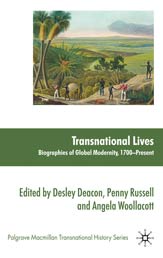
‘Transnational Lives: Biographies of Global Modernity 1700-Present’

‘Transnational Lives: Biographies of Global Modernity 1700-Present’ edited by Desley Deacon, Penny Russell and Angela Woollacott

transnational

2010, 285 p.

It’s when you’re reading through a Dictionary of National Biography ( and there’s many online: Australian, Canadian, New Zealand etc) that you often realize that even though one dictionary might ‘claim’  a particular individual as theirs,  other dictionaries of other nations could write their own account of the subject’s life as well because whole decades of the subjects’ lives  are sometimes spent in another country.  We’re well aware of the technological advances in transport and communications that contribute to the mobility of people and ideas beyond national borders today, but such forces were in play in centuries past too.  It is in this spirit that Transnational Lives presents twenty-one essays on diverse lives that cross national, racial and cartographic boundaries. (Click link for Chapter Listing) Continue reading

‘Eugenia: A Man’ by Suzanne Falkiner

I recently read Mark Tedeschi’s book Eugenia.  It raised quite a few methodological and narrative questions for me, and so I was interested to see how other writers dealt with the same material.  You might  want to read my review of Tedeschi’s book too, because my response to this book was formed after reading it.

eugenia_falkiner

1988, 243 p.

The blurb on the back of this book reads:

In the spring of 1917 an apprentice from the Cumberland Paper Mills, just outside Sydney, was walking along a bush track beside the Lane Cover River when he discovered the partially burnt body of an unidentified woman.  The arrest three years later of a 45 year old Italian woman, Eugenia Falleni, for murder, led to an investigation that fascinated the people of Australia.

Known in the newspapers as the ‘Man-Woman Case’, the trial revealed that from the time she had left New Zealand and gone to sea as a cabin boy, Eugenia had lived at least 20 years of her life in the guise of a man.

There is a entry on Eugenia Falleni in the Australian Dictionary of Biography if you’re not already familiar with her story.

The title of the book is quite definitive- “Eugenia- a Man.”  The image Falkiner has used for the front cover shows Harry Crawford as a young man and is taken from a photographic postcard created between 1900 and 1917 in Sydney.  On the back of the postcard are the words “I am sending you my photo for (a) keepsake, with love from H. Crawford”.  We do not know who wrote these words, as Harry Crawford himself was illiterate; nor do we know to whom they were written.

This book is written is two parts.  Part I, comprising twenty one chapters,traverses Eugenia’s life: her early life, his marriage, the crime and the trials.  It doesn’t take long to get to the death: just 25 pages. Unlike the Tedeschi book, Falkiner is careful to note the source of her information in the text itself (without footnotes), and I must admit that I felt more comfortable with such an approach.  I knew who said what, and when.  Also, this book differs from the Tedeschi book in that it is absolutely silent about what happened on Eight Hours Day when the death of Annie Birkett occurred.

Much of Part I is taken from the trial transcripts, especially those printed in the newspapers.  The press took a close and rather prurient interest in the trial: you only need do a Trove search to find the many print columns devoted to the trial. Falkiner goes through each of the witnesses in turn, and spends almost as much time on the magistrate’s court hearing as the Supreme Court trial.  Like Tedeschi, she is critical of Eugenia’s defence lawyer McDonnell, but it is the appraisal of an onlooker rather than the critique of an insider, as Tedeschi Q. C.  is.

There are occasional chapters during Part I where the author herself comes onto centre stage.  She explains at the outset how she came to be interested in Eugenia; she visits the locations where the death occurred; she traces the houses where various characters lived.  The ‘quest’ narrative is quite a common framing narrative for us now, both in fiction and through shows like ‘Who Do You Think You Are?’ and I must admit that it’s becoming a little hackneyed- but perhaps less so in 1988 when this book was written.

In Part II, the author shares the limelight with Falleni as she tries to get behind the trial to find some sense of Falleni as a person.  She tracks down relatives,  visits them in New Zealand, she even visits Eugenia’s birthplace in Italy.

Histories always exist within an historiographical context, and this is true of Falkiner’s book as well.  You can sense the presence of the 1980s in her interest in the migrant experience and the gender roles of  men and women in the early twentieth century.  She does address the issue of trans-sexuality, but in nowhere near the depth that it might be explored today (and in Tedeschi’s book)  and not at all from the perspective of lesbian history or queer theory.  A recent review written as background material for the play ‘Passing’  tackled the author for her sentimentalized view of Eugenia:

Falkiner’s book is perhaps the most detailed study of Eugenia Falleni’s life but its insight value is diluted by Falkiner’s sentimentality and subjectivity. Falkiner projects unabashed sympathy and no small amount of pop-psychology about gender and sexuality towards her subject – she frames Eugenia as a misunderstood gentle soul suffering from a vague kind of gender identity crisis to such a point that Annie Birkett’s murder, which Eugenia was tried and convicted for and later admitted guilt to, is relegated as a footnote.  (From Passing Research Notes: ‘Trans theory- a brief guide)

I’m not sure that in 1988 there was the  interest or theoretical frameworks at the popular level for queer theory analysis.  If there is sentimentality, I think that it springs from the emotional investment that any biographer makes in her subject, especially where the research springs bottom-up from interest in the individual and their story rather than from a top-down interest in a theoretical phenomenon.  I’ve been aware recently of research into European migrants to Australia at the turn of the century from the perspective of whiteness studies, which is a 21st century twist on the 1980s’-era multiculturalism that Falkiner explores in her book.  One thing that came through very clearly was the marginality and fluidity of a working class existence where housing, jobs and, in Eugenia’s case, identities were temporary and rootless.  I was surprised, in both this book and in Tedeschi’s, about the silence about World War I and its effect on working-class communities and men.  Perhaps the silence is in the documents, but it did strike me as strange.

The book itself is a very easy read, not dissimilar in tone and approach to a Good Weekend article in the weekend’s newspaper.  Perhaps it doesn’t have the little stabs of insight of a Helen Garner (e.g. Joe Cinque’s Consolation) or Chloe Hooper’s The Tall Man, but it is similar to both of them in that the book deals with a crime and the consequences in court and afterward, and the observer’s response.

Should you read this book, or Tedeschi’s?  I’d say “read them both”- perhaps reading this one first.

awwbadge_2013

Sydney Review of Books

As a rule, it takes me until Sunday night to finish reading The Age that arrives on Saturday. My favourite section is ‘Life and Style'( which used to be A2) but it seems that the life and style- the restaurants, the interviews, the film tie-ins etc-  are nudging the book reviews into a smaller and smaller space. It will barely worth the anticipation soon.

I used to look forward to the Australian Literary Review that came out at the start of each month with The Australian but it seemed that the reviews increasingly became just a platform for the right-wing stance of the The Australian generally.  So, when it no longer appeared, it was no great loss either.

I subscribe the the Australian Review of Books but to my shame, I often don’t get round to reading them until months later.  My son would eye the unopened magazine covetously (along with the similarly unopened-yet The Monthly, Griffith Review and Quarterly Review) saying “Oh, come on, I just want to read….” but no, I paid for it, so I’m going to open it in my own good time thank you very much.  I subscribed to the London Review of Books, lured by a very tempting  no-obligation introductory subscription price.  But- oh dear- such long articles; so much reading- each one took almost a week! And six month’s worth of London Review of Books have been added, unopened, to the ‘one day’ pile and the subscription has been allowed to lapse.

And now here’s another one- the Sydney Review of Books.  It is edited by James Ley, and here’s what it has to say about itself:

The Sydney Review of Books is an online journal devoted to long-form literary criticism. It is motivated by the belief that in-depth analysis and robust critical discussion are crucial to the development of Australia’s literary culture. We decided to embark on this project because of our concerns about the reduced space for serious literary criticism in the mainstream media, and the newspapers in particular, given their uncertain future. We intend the Sydney Review of Books to be a venue in which Australian writers and critics can engage with books at length, a venue in which to rediscover the intimate connection between the art of criticism and the art of the essay. The Review’s focus is Australian writing, but it also considers the work of significant overseas authors.

Sydney Review of Books has been developed with the support of the Writing and Society Research Centre at the University of Western Sydney. It is also supported by grants from the Australia Council and Copyright Agency Limited. It has been conceived as a free online publication, in order to maximise its reach. We publish new essays and reviews on a weekly basis and, in offering a selection of high quality criticism by some of the best critics and writers in the country, we hope to enlist your support as readers to ensure that the Review can continue as a dynamic contributor to our literary culture.


It looks good.  And it doesn’t have to sit on a pile, wrapped in a cover, shaming me.

Soft and fuzzies at the MCG.

Two years ago, I posted about the negative nagging admonitions that you are bombarded with at the MCG.  Last Friday I went off to the MCG again with the same son to see the same game (St Kilda v. Richmond) – although unfortunately with a less desirable outcome this time.   It’s a sad, sad thing when you crave a draw.

My chagrin was soothed somewhat by noting that the killjoys and straiteners responsible for the announcements on the score board have gone all soft and fuzzy on us.  Now instead of being harangued with the fines imposed for drinking outside the ground, we’re exhorted to enjoy a drink at the MCG, but just don’t take it outside. Instead of being drawn and quartered for running on the ground, we’re encouraged to be a part of the game, but just not on the turf.    It didn’t change the score, but it did make me feel as if I didn’t have to cringe from yet another telling-off.

‘Gone Girl’ by Gillian Flynn

gonegirl

2012, 395 p.

I always keep a bit of an eye on the Book Scan results of bookshop sales that appears in the Saturday paper.  I’ve noticed Gone Girl bobbing around on the Independent list and –lo and behold!- last week it made it to No.1   However, I haven’t seen anyone reading it, or heard of anyone else who’s read it.  But obviously lots of people have read it, because after reading a glowing review of it in August last year, I put a hold on it at my local library.  Number 63 I was, on ten copies.  Finally, it was my turn.

And I can tell you nothing about it.  Except, perhaps, that it involves a disappearance, and that it is written in alternating chapters, all tethered chronologically back to the day of the disappearance.  Beyond that, I’ll give too much away and I don’t want to do that.  The book just teetered on the edge of implausibility, but didn’t fall over, and each time I started “Hey, but what about….” the author had anticipated my objections.  While not high literature, and probably 1/3 too long, I found it a real page-turner- and hey, we can all enjoy one of those every now and then.

If you can’t stand waiting as No 63 in line, don’t worry- apparently it’s already been optioned as a movie with Reese Witherspoon as one of the lead actors, and it’s absolutely tailor-made for Hollywood.  I’m not quite sure how they’re going to do it- lots of voiceovers, perhaps and  done well, it should be a winner.

My rating: a rather guilty 9/10. Dammit, I could barely put the thing down.

Sourced from: The long waiting list at Yarra Plenty Regional Library

Read because: It has been on the best seller list for ages.

My best reads for 2012

The end of year is the time for lists, no?  Well, here’s my list of my best  10 reads for 2012.  I only give a rating for fiction books generally, although one or two non-fictions crept in here because they were read as an escape from the thesis.

There was only one book to which I awarded a ’10’

1. ‘Good Evening Mrs Craven’ by Mollie Panter-Downes

The other nine received a score of ‘9’.  Three of these were from my CAE bookgroup- none chosen by me- which is a good reason for continuing to participate, quite apart from the friendships there.

2. ‘Drinking Coffee Elsewhere’ by Z. Z. Packer (Yes- a collection of short stories made it onto the ‘best’ list! CAE)

3. ‘Otherland’ by Maria Tumarkin

4. ‘Mateship with Birds’ by Carrie Tiffany

5. ‘Bright and Distant Shores’ by Dominic Smith

6. ‘London War Notes 1939-1945’ by Mollie Panter-Downes  (non-fiction)

7. ‘How To Live’ (A life of Montaigne)’ by Sarah Bakewell  (non-fiction)

8. ‘All That I Am’ by Anna Funder

9. ‘When Will There Be Good News’ by Kate Atkinson (CAE)

10. ‘Water Under the Bridge’ by Sumner Locke Eliot. (CAE)

Happy Christmas Resident Judge

And how did John Walpole Willis spend Christmas in Georgetown, Demerara in 1833?

Xmas Day. JWW (John Walpole Willis) and JW (Jane Willis) at Church in ye Morn’g very fine day.  Mr and Mrs Price, Messrs Harvey & Cowan called.  JWW and JW rode in ye even’g called at Mr Albany’s gave the servants their dinner Roast Beef & Plum pudding.

Happy Christmas all.