Category Archives: Uncategorized

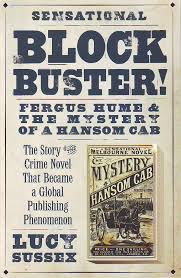
‘Blockbuster: Fergus Hume and the Mystery of a Hansom Cab’ by Lucy Sussex

sussex

2015, 257 p. & notes,

Fergus Hume’s book The Mystery of a Hansom Cab (my earlier review here) has the dual ‘honour’ of being both the best selling detective novel of the nineteenth century and the ultimate one-hit-wonder in a career that generated over 130 novels and numerous stories and articles. Self-published in 1886, it became an instant best-seller both locally – and more importantly for an Australian book at the time- internationally.  Lucy Sussex’s book Blockbuster is a book about the book.  You don’t even have to have read The Mystery of a Hansom Cab because Sussex’s work is far more focussed on the author and his milieu, the commercial trajectory of the book and the provenance of the remaining copies, rather than the book itself.

As she points out in the introduction, Hansom Cab is a thoroughly Melbourne book, starting as it does at the thoroughly respectable corner of Russell and Collins Street outside Scots Church,  passing the thoroughly respectable streets of East Melbourne and meandering its way through the slums of Little Lonsdale Streets and shabby-genteel St Kilda.  Its author, however, was not Melbourne-born but was originally from Scotland, having emigrated to New Zealand as a child when his father took up a position as a master of a lunatic asylum, a job he had also undertaken in Scotland.  Despite a yearning for the stage – a yen that both his sisters were allowed to fulfil-  Fergus was channeled into the law by his father, until he ‘escaped’ with his sisters ‘across the ditch’ so that they could further their stage careers. Once in Melbourne and freed from paternal oversight, he tried to get his scripts accepted for theatrical performance but to no avail.  He wrote The Mystery of a Hansom Cab as a novelistic attempt to get noticed in order to further his theatrical career.  It was an unintentional best-seller that somehow failed to make him a rich man, or substantially boost his theatrical profile.

I was surprised to learn that The Mystery of a Hansom Cab is one of a trilogy of Melbourne novels (the others being Madam Midas, a Realistic and Sensational Story of Melbourne Mining Life [1888] and Miss Mephistopheles [1890]).  The retailing and licensing of the book is a tawdry tale, with Hume selling  the international copyright for only 50 pounds to promoters who certainly promoted it well and made their fortune from it.  In trying to work out the numbers of volumes actually sold, it is hard to tell what is puffery and what is fact. I found the information about the provenance of the remaining collection of editions held here in Australia fascinating.

Although Hume’s books reflect the milieu in which he circulated, there is not a large archive of personal correspondence or autobiographical writing for Sussex to draw on beyond his book When I Lived in Bohemia. She looks, therefore, for resonances of his personal life in his writing and speculates about his homosexuality from the lives of men around him.

Even though I read a lot, I am a stranger to the world of Literary Studies (with capital letters) and I found myself nonplussed at times at the wide-ranging and digressive nature of Sussex’s writing.  Sussex has written on the previously-undiscovered Australian writer Mary Fortune, and at times I found myself lost as she turned her attention to other writers and theatrical figures of the time before returning her focus to Hume.  The historical parts of the book follow the usual historical conventions of footnoting and referencing but when she interviews present-day writers, their commentary is woven into the narrative as a source that she assumes you’re familiar with. It’s almost as if the reader is overhearing a conversation among a group of people who all know what they’re talking about together, but from which the listener is rather excluded.  Certainly one can enjoy the book without having read Hansom Cab but I felt rather short-changed in the frequent references to the other two Melbourne books which I (among many many others I should imagine) have not read.

The book has a large number of short chapters, which usually I would find annoying, but in this case the short chapters maintained the forward chronological thrust of the narrative. However,  I did find the ending of the book untidy, with a postscript, followed by epitaphs of the minor characters and reviews and opinions of Hansom Cab over time. I wasn’t quite sure where the book ended.

That said, though, I did enjoy the book- a lot.  I suspect that my reservations are grounded in my unfamiliarity with Literary Studies, rather than the book itself.  It was awarded the History Publication Award in the 2015 Victorian Community History Awards.and as a historian, I very much enjoyed the way she captured the theatrical and intellectual climate of boomtime 1880s Melbourne and the economics of literary publication within the colonial book-trade.

aww2016 This review has been posted in the Australian Women Writers Challenge 2016
A beautiful autumn day

I love summer. Once the weather turns, I grab hold of every warm autumnal day and try to make the most of it, fearing that it might be the last warm day we have  (although with our unusual weather at the moment, who knows what the weather will be like next week). Today had a forecast top of 27 degrees and looked beautiful, so off to the beach we go!

Over the last few years there’s been a new bus service that runs the semi-circle around Melbourne from Altona in the west to Mordialloc in the east.  Heidelberg Station is in the middle, so that’s where we started the journey.

IMG_2255a

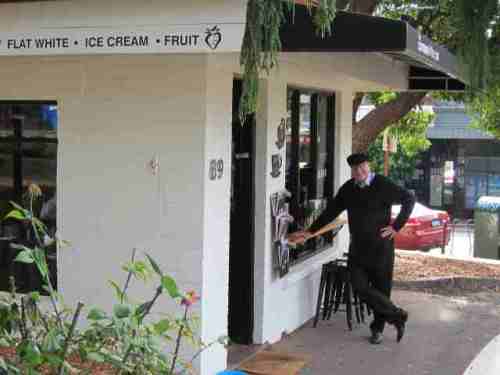
We needed coffee before we started of course, so we stopped at a new little coffee shop in the Fred Laslett Reserve near the station. And very nice coffee it was too!

IMG_2257a

And within ten minutes, the bus arrived.

I’ve been curious about this bus line for a while.  When you see the buses at Heidelberg they never seem to have many people on them, but it certainly filled up and emptied several times on the two hour and ten minute ride to Mordialloc. Shopping centres and railway stations are the main drawcards, and the bus made many stops to pick up people from rather closely distributed bus stops.  Still, when the bus runs as often as this one does (approximately 15 minute frequency), the whole purpose is not so much to get to Mordialloc as a destination bang on time, as to act as a service that passes the major shopping centres along the way.  The bus driver was very good, watching carefully to make sure that the many elderly people using the bus (us excepted of course) were seated before the bus took off.

Finally we arrived- and isn’t it beautiful. If I’d had my bathers, I would have been tempted (although I note that not many other people were indulging).

IMG_2258a

The water was pearlescent and completely still.

IMG_2260a

“The sea wall and boulevard was erected from funds raised by Mordialloc Carnival Committee 1925-6” There were sea baths from 1886, but they were demolished in 1934.

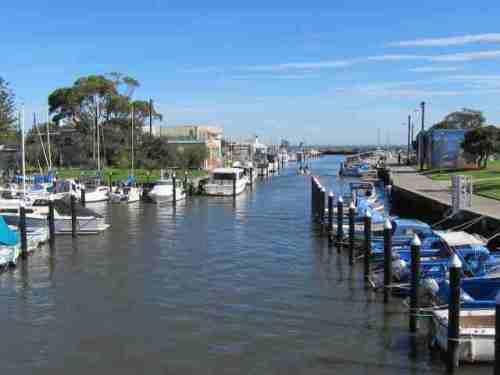
We walked along the pier and marvelled at a huge stingray which looked to be about one metre across.  The creek is lined with small boats. The carnival that yielded the funds for the sea wall was held on the land beside the creek for many years.

IMG_2265a

Small boats moored along the creek

IMG_2261a

Mordialloc Creek

IMG_2263a

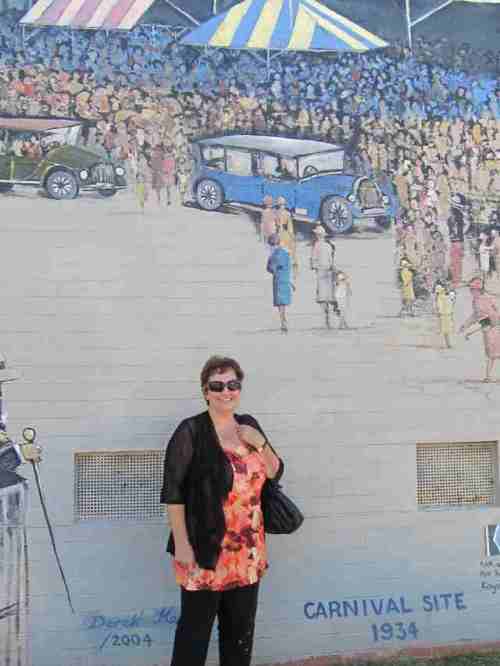
An interesting mural in the park where the carnival used to be held

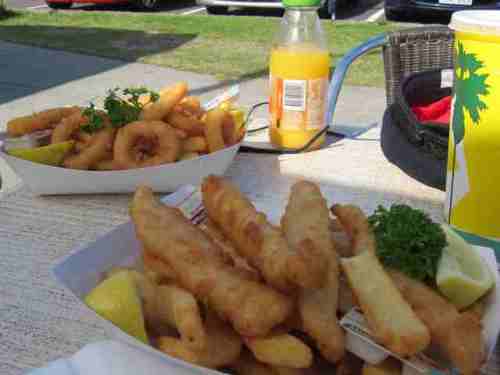
Time for lunch out in the open, overlooking the creek. Flathead tails, calamari and chips- and very good they were too.

IMG_2262a

Now for some serious historic walking. Indigenous people from the Boon Wurrung (Bunurong) people often camped alongside the creek in what is now Attenborough Park, on the edges of the Carrum Swamp.  Their territory lined Port Phillip Bay, the Mornington Peninsula, Western Port Bay and Wilson’s Promontory. In 1852 they were allocated 340 hectares along the creek as a distribution depot, but it was revoked ten years later because it was now considered too close to Melbourne.  The Boon Wurrung people were sent to Coranderrk near Healesville instead- how different it must have been to their coastal territory.

IMG_2268a

These rather hacked conifers are on the Signficant Tree register. I’m pleased that they’ve planted new replacement trees nearby because I suspect that these are on their last legs.

IMG_2266a

A WWI memorial. Interesting that it only commemorated WWI and not later wars

IMG_2267a

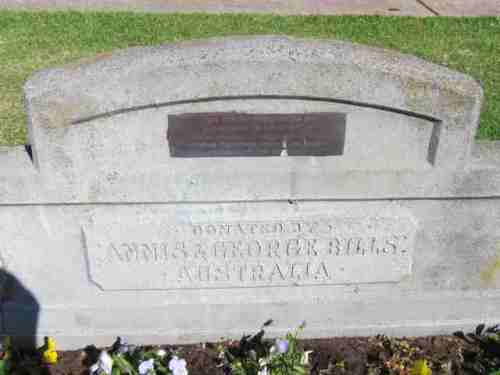
A Bills Water Trough. Over 700 Bills Troughs were constructed for working horses throughout Australia, funded through a trust established by Annis and George Bills who made their fortune through mattress manufacturing. You can find out more at https://billswatertroughs.wordpress.com/

IMG_2271a

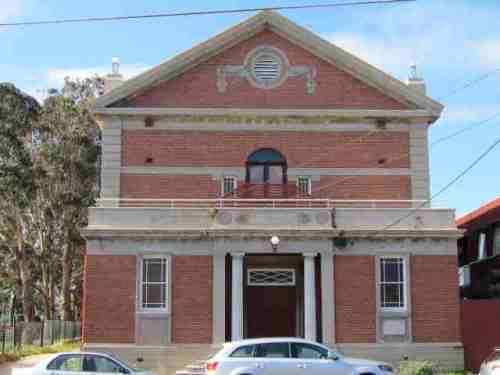
The Masonic Hall, built 1926 and used in 1926 as a courthouse. It was sold in 2008 with the buyer intending to use it as a family home, but was sold to the Council in late 2011

IMG_2272a

I peeped through the letterslot, where you could see the hall, probably much as it was left

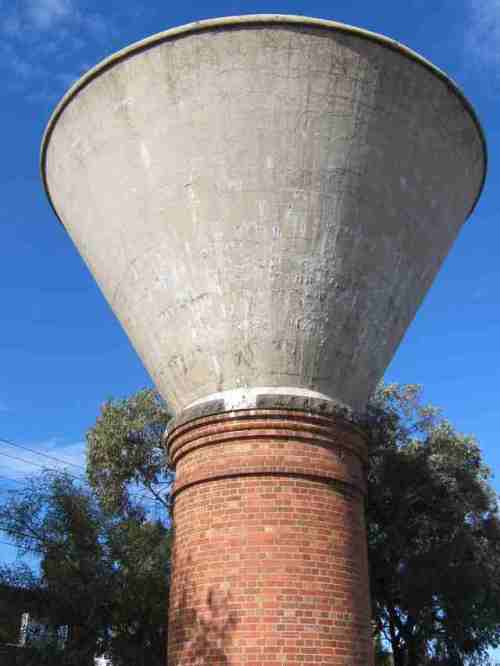
And what is THIS?  It’s the Mordialloc Railway Water Tower, built in 1910 with a capacity of  20,000 gallons.  It has a National Trust rating but we couldn’t read the plaque because it was surrounded by scaffolding.

IMG_2270a

We could hear a train approaching and even though we enjoyed the bus trip, the train seemed much more appealing.  So we bid farewell to the water and headed back to Macleod, hoping that it’s not the last warm day we have this autumn.

It’s been a big week…

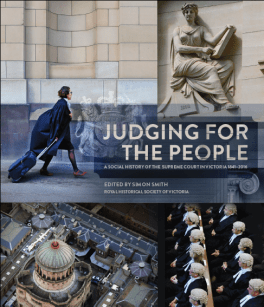
Well, the 175th anniversary of the opening of the Supreme Court has been and gone. There’s an exhibition at the RHSV until 7 June; there was an excellent one-day conference at VU in the city; and then last night was the official launch of the book Judging for the People at the Supreme Court library.  Given that ‘my’ judge, as the first Supreme Court Judge for the district, had a foundational role,  I feel a little bit like I did as a child on Christmas night, realizing that everything’s over.

Judging-for-the-People-264x307

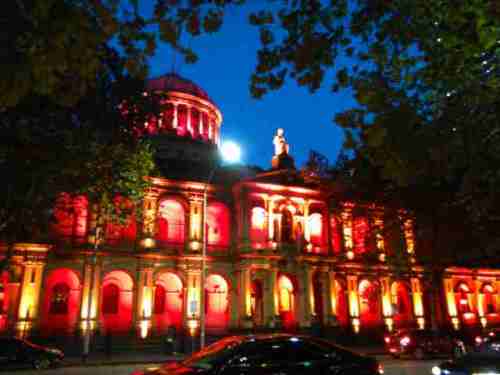
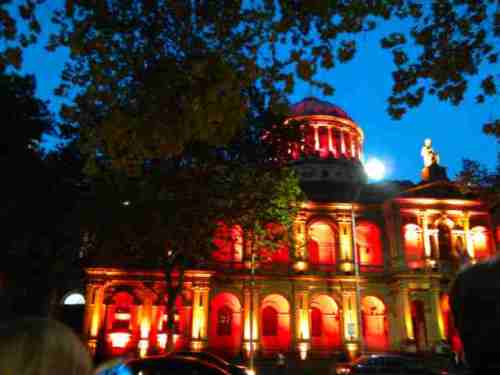
But just like Christmas time, there’s a present for the good people of Melbourne in the form of illuminations of the Supreme Court until 22 May 2016.


IMG_20160412_181952a

IMG_20160412_181740a

John Walpole Willis’ exciting week ahead

Justice John Walpole Willis and his biographer-of-sorts (i.e. me!) are about to have an exciting few days.  Tonight (Friday 8th April) is the opening of the new exhibition at the Royal Historical Society of Victoria 175 Years of Judging for the People, which is on show between 11 April and 7 June 2016 (details here) .

Then tomorrow, Saturday 9th April is the RHSV Conference marking the publication of a new book Judging for the People: A Social History of the Supreme Court in Victoria 1841- 2016 at Victoria University in the city.  I’m giving a short paper on the Bonjon case and its relationship to the Mabo judgment 151 years later.

Finally, on Tuesday 12th April, the book Judging for the People is being officially launched by the Chief Justice of Victoria on the very day of 175 Anniversary of the opening of the Supreme Court of New South Wales in the district of Port Phillip.  I wrote the first chapter of the book which starts off with the Resident Judges, who were the forerunners of the Supreme Court here in Victoria.

So, JWW and I had better both frock up for a few days of commemorative excitement!

VPRS 19 online!

What a wonderful world we live in!  The Public Records Office of Victoria (PROV) has now digitized and made available VPRS 19, the inward correspondence to Charles La Trobe, the Superintendent and later Lieutenant-Governor of Port Phillip.

To see an interactive introduction to the letters, see PROV’s site here.

“What would I want with La Trobe’s  Inward Correspondence?” you may ask. Well- there’s just so much here.  There’s reports from civil servants, letters of complaint, petitions, queries- in effect, anything formal that the people of Port Phillip wanted to convey to Governor Gipps in Sydney had to go through La Trobe here in Melbourne.  Although La Trobe had very little scope and authority to act independently, all requests had to go through him.  Family historians might find letters by or about their forebears; the plans for the newly-established organizations and buildings for the new Melbourne settlement are all here; the debates and controversies in the public sphere are funnelled through here as well. It’s an incredibly rich resource.

I really can’t start to describe how excited I am that these letters have been digitized and made available in this way.  Oh that they had been available five years ago when I was spending hours at PROV, although I think back on that stage as my favourite time in writing my thesis. You still have to dig around to find what you want (and I must confess that it’s taken some fiddling for me to find the transcripts) but oh! this is fantastic! Fantastic, fantastic, fantastic!  [You probably gather that I’m rather excited….]

Postscript

Thanks to Lenore Frost who has alerted me to an index to VPRS 19 which can be found on the Royal Historical Society of Victoria website under its ‘Collections‘ link.  You can get directly to the index  here.

Movie: The Big Short

Some of the reviews that I’d read of The Big Short criticized it for being overly-didactic. “Didac away!” I say, because I found the details of the Global Financial Crisis rather mind-numbing and- as any of you who have met me will testify- I’m really no good with numbers.  And so, this film is a bit “GFC for Dummies” but hey- that’s me.  It’s told in a furiously fast, deliberately self-mocking fashion with lots of thrash metal music and swooping camera shots, but it was a very accessible way to approach something that could be as dry as dust.  My repugnance for the moral hazard that these men (and it is overwhelmingly men) exposed themselves to in betting that the whole financial system would crash was soon sidelined by my repugnance for the power structures that allowed the bankers to get away with it.

This Guardian review discusses the historical accuracy of the film, and gives it a thumbs-up. Combined with the film 99 Homes (which I reviewed here), you’d get a pretty rounded history of recent events.


This Week in Port Phillip 1841: 16-23 March 1841

HAPPY ST PATRICK’S DAY!

March 17, of course, was St Patrick’s Day. As Ken Inglis points out in Australian Colonists, recognition of the day in Sydney dated from 1810 when Governor Macquarie provided entertainment for convicts employed by the government, and the annual St Patrick’s Day dinner at a Sydney hotel was a fixture on the social calendar attended by the most respectable Irishmen- both Catholic and Protestant (p.103). Melbourne in 1841 was not yet so organized, and the occasion passed quietly.

We are glad to be enabled to state that Patrick’s Day passed over without the least infringement upon the public peace. We are almost sorry to have to record the fact that scarcely an additional glass was drained or shillelagh flourished in commemoration of the anniversary of Ireland’s general jubilee, as such might have been done without offence to the Powers that be, a little licence being always conceded on such occasions and a miniature representation of Donnybrook fair would have minded many of what they seem here to forget, that they are Irishmen. Perhaps, however, it is better that the dull monotony of money gathering should have remained uninterrupted than that occasion should have been given Ireland’s enemies to say that her sons in every quarter of the globe are fond of a “row”. Patrick’s Day has now passed over in peace and unmarked by any national display and so much the greater shame for Irishmen say we.  (PPH 19/3/41 p.3)

The day did not go completely unrecognized, though, as twenty to thirty of the men of the Port Phillip Club sat down that night to “a most sumptuous collation”. (PPH 19/3/41 p.3)

SHIPPING NEWS

Perhaps it’s because I’ve only recently finished reading Roslyn Russell’s High Teas and High Seas (review here) but I find myself reading the Shipping News on page 2 of the Port Phillip papers with a little more interest than previously.  Not only does the Shipping News detail the ships that have arrived and departed from Port Phillip and Sydney, but it conveys the communications that were conveyed between ships as they passed each other.  For example, the Port Phillip Herald of March 20 reported the arrival of the Christina  from Sydney. The Christina “spoke” the ship Victoria from Salem (USA) which it encountered off Bateman’s Bay, describing her as “deeply laden” (possibly with its whale catch?). The next day she “spoke” the barque Susan, sailed by Captain Neatby , off Ram Head (which I assume is Rame Head near Croajingalong National Park). The Susan was 92 days out from Plymouth, taking emigrants to Sydney. (PPH 20/3/41 p.2)

Recent emigrants, with their own voyage still vivid in their memories, might have taken a “there but for the grace of God” interest in hearing of other ships following in their wakes. The Port Phillip Herald  of 19 March carried a report from  Lisbon dated October 15 (i.e. nearly six months earlier) that the English ship John Cooper, bound from Greenock to NSW with a general cargo of 98 emigrant passengers, had arrived at Lisbon after being struck by lightning. A passing merchant vessel reported that he had seen her trying to reach Lisbon but, “owing to her crippled state, she appeared to make very little way”. On hearing this, Her Majestys ship Trimlemo was dispatched to go to her assistance, but returned the same day to report that although the John Cooper was close to the bar, she was in such a poor condition that a steamer should tow her into port. Even then, her troubles were not over, as when towed into port at the cost of £350 sterling, it was “found unprovided with a bill of health” and put under four days quarantine. [The John Cooper finally arrived in Port Phillip on 4th April via Adelaide. She left again for Sydney on 3rd May with a passenger list that included 1 corporal, 3 privates, 28th Regiment, 1 constable, 17 male and 2 female convicts. http://www.oocities.org/vic1840/41/jc41.html]

Melbourne itself was still in a state of excitement about the arrival of the Argyle in early March with its load of bounty emigrants, ready for the picking as employees.  The enterprising auctioneer and commission agent  Mr J. C.King established an agency office for Servants at his premises in Elizabeth Street, offering – for a trifling remuneration- to board the emigrant ships immediately after the official inspection of the emigrants and to engage servants for settlers who were unable to get to the ships to do so personally. (PPH 12/3/41).

By 16 March Mr King was able to issue a weekly list of unemployed servants:

WEEKLY LIST OF UNEMPLOYED SERVANTS AT MR KING’S AGENCY OFFICE: Overseers of sheep stations 3; shophands 3; woolsorters 1; hutkeepers 1; watchman 2; overseers of cattle stations 3; stockkeepers 2; bullock drivers 1; overseers of forming establishments 2; ploughmen 2; farm servants 4; Groom and inside servants 1; Gardeners 1; Bricklayers 1; House carpenters 2; Hut builders and fencers 4; female servants 3; Wet nurse 1 (PPH 16/3/41 p.3)

However, a small article in the Port Phillip Herald of 19 March headed ‘DROWNING’ reminds us that the journey to Port Phillip was not necessarily the bright new start that emigrants may have anticipated.  A body was observed floating on the water by the watermen of Williams Town. The body was salvaged. He was very young, dressed in a blue coat and striped cloth trousers and found to have needles and pins in parts of his dress, a few papers and a smelling bottle. He was later identified as a Mr. Macfarlane, who had arrived in the Argyle just a few weeks earlier.

He had been employed by Mr Rucker as a farm servant, and resided on his estate, about two miles from town, but since his arrival he appeared greatly depressed in spirits, and it is supposed that in a fit of temporary insanity the wretched man put a period to his existence. The deceased was a native of the county Tyrone, Ireland, and was respectably connected.

VERY EXCITING NEWS!

The Christina came bearing the London newspapers which carried detailed reports of the birth of Queen Victoria’s first child, Victoria Adelaid Mary, the Princess Royal on November 21 1840.  It was such momentous news that the Port Phillip Herald published a special edition on 20th March, to follow the issue that had appeared on 19th.  Even though this is, strictly speaking, not Port Phillip news, it strikes me as strange that Her Majesty’s subjects, so far away on the other side of the globe, would be reading a report of a birth that seems so intrusive to modern eyes.

On Friday her Majesty and Prince Albert walked in the garden of the Palace and again did her Majesty take her seat at the dinner table, and continued apparently in her usual health till eleven o’clock, when she retired to rest, no suspicion being then entertained of the near approach of those sufferings, which providentially have terminated in a manner so satisfactory to every branch of her august family as well as to the delight of her loyal and devoted servants. At two o’clock yesterday morning the first symptoms of uneasiness were indicated, and at four her Majesty with great firmness directed that her attendants should be summoned; among these was Mrs Lilly, who, we have heard, was formerly nurse to the Duchess of Sutherland, and whose experience at once forewarned her of the propriety of immediately summoning her Majesty’s professional advisers. Sir James Clarke, Dr Locock, Mr R Ferguson and Mr R Blagden were instantly sent for and were quickly on the spot. No doubt now existed that Her Majesty was in labour, although certainly some days sooner than had been anticipated, as the impression was that she would have remained convalescent till early in December.

Once labour had been established, all the protocol of a royal birth swung into place. Good grief- ding!dong! the gang’s all here!!

Such preparations as the suddenness of the emergency would permit were made without delay; and by command of Prince Albert, whose conduct was distinguished by the most affectionate solicitude, combined with firmness, the Hon. W. Murray, the comptroller of the household, roused the inmates of the Palace and special messengers were dispatched to her Royal Highness the Duchess of Kent, the Archbishop of Canterbury, the Bishop of London, the Lord Chancellor, Lord Melbourne, Lord Palmerston, Lord Errol, Lord Albemarle, Lord John Russell and other Privy Councillors, whose constitutional duty it was to be present at the birth of an heir to the throne…. In her Majesty’s chamber were the Duchess of Kent, Prince Albert and the medical men with Mrs Lilly and some of the ladies of the bedchamber; while in an adjoining apartment, the door of which was open, were the other distinguished individuals mentioned. As the day advanced the Palace was kept in perfect quietness, while all noise from without from the passing of bands or otherwise was interdicted. From those who had the best means of information, we learn that her Majesty evinced a firmness and composure almost incredible- at intervals exhibiting a cheerfulness and patient submission to her sufferings, in all respects consistent with the well-known attributes of her character. The near approach of that interesting moment which was to give to these realms an heir to the throne at last arrived and precisely at ten minutes before two o’clock Mrs Lilly entered the room where the Privy Councillors were assembled, with the “Young Stranger”, a beautiful, plump and healthful Princess, wrapped in flannel in her arms. She was attended by Sir James Clarke, who announced the fact of its being a female. Her Royal Highness was for a moment laid upon the table for the observation of the assembled authorities; but the loud tones in which she indicated her displeasure at such an exposure, while they proved the soundness of her lungs and the maturity of her frame, rendered it advisable that she should be returned to her chamber to receive her first attire. PPH 20/3/41

Apparently, ministers and privy councillors and ladies-in-waiting continued to attend royal births until 1894 when Queen Victoria decided that for the birth of her great- grandson, the future Edward VIII, the home secretary would be enough. Home Secretaries attended until the birth of Prince Charles in 1948, when it was announced that the practice would be discontinued.  Jolly good thing too.


1916 Irish Rising: Australian Impact

EasterRising

On this Easter Sunday, I’m going to be at the Melbourne Unitarian Peace Memorial Church to hear Dr. Val Noone speak on ‘1916 Irish Rising: Australian Impact’. It starts at 11.00 am. on Sunday 27th March, 2016.

This year is the centenary of the Rising, and the University of Melbourne is conducting a two-day international conference on 7th and 8th April to commemorate and interrogate the event. There’s details about the conference here– it looks excellent.

A Capital Idea Day 1

Many people I know have had good things to say about the Tom Roberts Exhibition currently on at the National Gallery of Australia, and after finding that it is only on until 28 March, we made the snap  (– well, snap for us-) decision to come up to Canberra for a couple of days.

Tom Roberts was well worth seeing. There’s the iconic pictures of course- Shearing the Rams; The Breakaway; the big Federation picture- but I hadn’t really appreciated Roberts’ versatility until I saw the portraits, narrative pictures, Impressionist pictures all together in one exhibition. 

IMG_2222a

I was surprised by this portrait, executed in 1900, which had quite a Bill-Hensonesque feel about it.

The exhibition was at pains, I thought, to distance itself from any mention of ‘Heidelberg School’, making only slight reference to ‘Eaglemont’ where it had to, and highlighting that Roberts, Streeton, Conder et al painted at ‘camps’ in various locations in Victoria and New South Wales.  But, as a Heidelberg girl, I instantly recognized the Darebin Creek in this small painting which featured in the exhibition and also appeared as a prop on an artist’s easel outside the entrance to the exhibition.

IMG_2223a

The Australian art section has been relocated in the gallery and now is prominently displayed as soon as you come up the escalator.  On the ground floor there is a sobering display of 200 painted traditional burial poles to mark the bicentenary and there are several rooms of indigenous artwork.

 IMG_2225

Remember Erik von Daniken’s Chariots of the Gods and how he tried to convince us that indigenous artists were really painting astronauts?  Haven’t heard much of that hypothesis since….

The Australian art exhibition is beautifully done, with interesting themes and a really broad exhibition of major Australian artists.  It did, however, reinforce my awareness of how rich the National Gallery of Victoria’s collection is, too.

In the gardens outside was a striking sculpture Skyspace Within without. Externally it was a grass covered dome, but inside was a stone stupa  suspended on a sheet of water, open to the sky. It reminded us of the Kaaba in Saudi Arabia, but instead of a swirling, chaotic mass of people surrounding the monolith, it stood silently with the water falling over the edges of an infinity pool.  You could then enter the stupa itself, a cool, round, resonant room with a hole in the ceiling through which you could see the sky.  I wish my pictures did it justice, but they don’t. You’ll just have to come see it for yourself.

IMG_2220a IMG_2221a


Here’s a video walk-through

https://www.youtube.com/watch?v=icTo8j02rx0

Then off to the War Memorial.  As you might have gathered from other blog posts, I am rather ambivalent about the commemoration of war and its tendency to tip into celebration.  The War Memorial is absolutely brimming with expensively mounted displays- it must be the best funded museum in the country, I think- but almost to the point of overwhelming you.   The memorial is divided into  First and Second World War wings, and the World War I section is excellent, as you might expect in these centenary years.

Our main reason for going was to find the works done by Steve’s grandfather, Charles Web Gilbert, who worked as a War Artist immediately after WWI.   He created some of the dioramas that are displayed to such good effect, now supplemented by sound effects and multimedia photographs and film clips.  The names of the war artists are not displayed on the dioramas, but we did find a small named sculpture of stretcher-bearers.

IMG_2233a IMG_2234a

We were surprised to find that the large sculpture, previously called ‘The Memorial to the Light Horse’ had been shifted from its position close to the War Memorial to further down ANZAC avenue.  This is not its only shift: the original was erected in Port Said in 1932 (several years after C.Web Gilbert died) and was severely damaged during World War II. The remnants were brought back to Australia and reconstituted in the statue that now stands along ANZAC avenue.  Not a whisper of the artist for this one, either.

IMG_2238a IMG_2239a

I very much liked the Hall of Memory, with its beautiful Waller stained glass windows.  Looking out across the commemorative flame, I noticed that all of the tablets naming the wars that Australia has been involved in have now been filled on every surface of the rectangular space at the heart of the Memorial.

IMG_2237a

Oh that it could stop now.

‘Nice Work’ by David Lodge

lodge

1988, 277 p.

I often find that my response to a book is largely influenced by the book that I read immediately before.  For example, I found myself quite unable to pick up another fiction book for some time after reading War and Peace, and sometimes I want to get my teeth into something really meaty after reading some self-indulgent fluff.  In this case, I came to David Lodge’s Nice Work as a face-to-face bookgroup read after just finishing the challenging (on all levels) A Girl is a Half-Formed Thing.  I must confess that much of the joy in reading this book was Lodge’s masterful, urbane and instantly comprehensible prose.  In comparison with the book that I read immediately preceding it, this one just flew off the page.

David Lodge, as a former Professor of English Literature at the University of Birmingham, is well placed to turn his wry, satirical eye to red-brick university life in his ‘Campus Trilogy’ comprising Changing Places: A Tale of Two Campuses (1975), Small World: An Academic Romance (1984), and this book  Nice Work (1988).  In this book, flame-haired feminist academic Robyn Penrose, trying hard to get a tenured position at the University of Rummidge (a thinly disguised Birmingham), agrees to be involved in a job-shadowing scheme as part of improving links between the university and the workplace.  She is allocated to Vic Wilcox, the manager of an engineering firm. I think that you can guess what happens….

And it does, and to a certain extent there’s a reassuring predictability about the plot. What I really enjoyed about this book, though, is Lodge’s satirical but penetrating analysis of his characters.  He’s not kind about either of them, but he does not lack affection for them either.  Robyn is immured in the postmodernist sludge served up by Derrida and Kristeva that makes me shrivel up inside, while Vic Wilcox is one of those buttoned-up, slightly pathetic middle-aged men who might be driving his small company car next to you at the traffic lights at 8.00 a.m.

Not content with mere waspishness, Lodge has literary fun in the book as well. The epigraphs that separate the multiple parts of this book are sprinkled with quotes from 19th English novels, most particularly Elizabeth Gaskell’s North and South, and there’s quite a bit of North and South in this book as well.  It’s enjoyable without knowing any of this, but for those in on the joke, it adds another layer as well.