Category Archives: Book reviews

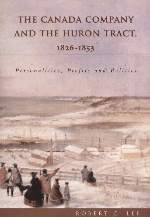
‘The Canada Company and the Huron Tract 1826-1853’ by Robert C. Lee

Robert C. Lee The Canada Company and the Huron Tract 1826-1853: Personalities, Profits and Politics, Toronto, Dundurn, 2004, 304 p.

Thomas Carlyle is supposed to have said “Show me the man you honour, and I will know what kind of  man you are.” In this spirit, I read this book not out of any over-riding interest in the Canada Company per se, but because its first director, John Galt, was a close friend of Judge Willis’ in Canada.  It would seem that both men considered the other an honorable man.  They socialized in York together and they supported each other, so I was interested to see what sort of man John Galt was.

Lee’s description of John Galt is as follows:

A man of many talents, he was a well-travelled, big-picture visionary who was at once restless, energetic, scholarly, absent-minded, combative, disorganized, opiniated and well-connected in high places… (p.45)

John Galt  was born in Scotland in 1779, the son of a ship’s captain and an eccentric mother.  Even though he was extremely tall, he suffered from ill-health throughout his life and was educated at home.  His literary bent was established in childhood, and he become well known for his book A Statistical Account of Upper Canada (1807) which he cobbled together without setting foot in the place, largely from the observations of his cousin who worked as a captain on the Great Lakes.  He commenced studying law, but after a breakdown in his health, he travelled to Greece and Malta,  hung out with Byron, and organized the shipping of the Elgin Marbles.
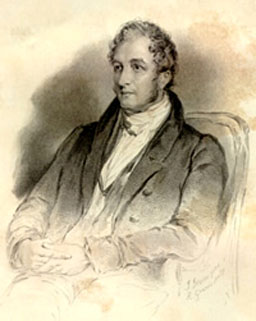
He  published a number of literary works including novels, plays and fictionalized autobiographies.  He supplemented his literary career with work as a parliamentary lobbyist, first for the backers of canal building in Scotland, then for Loyalists along the Niagara frontier seeking redress for their losses in the 1812 War .  He became lobbyist and later operations manager for the Canada Company, which had a plan to purchase lands in Upper Canada that had been set aside for government and church purposes,  survey and package them up for sale to British emigrants.  When the Anglican Church in Upper Canada resisted losing their land, the Canada Company was offered instead a huge, unsurveyed expanse of First Nation land called the Huron Tract. In the final settlement in 1826, the company purchased 1.3 million acres of crown reserves throughout Upper Canada, the Huron Tract, and a million other scattered acres for the uniform price of 3s.6d per acre.

It is sobering to remember that, despite its blustering proclamations of policy, the Colonial Office was often making things up as it went along, especially in the early 19th century.  In the early 1820s the empire stretched across the globe and was still growing, but Britain itself was squeezed by the post-Napoleonic  War slump.  There simply wasn’t the money to pour into infrastructure for the immigration that Britain was encouraging as a solution to domestic unemployment.  There were demands for compensation and rewards for soldiers who had fought in the Napoleonic Wars, loyalist settlers who had fought in the War of 1812 in America, or schemes for resource development and convict labour in New South Wales and Van Diemens Land.  And that’s where private enterprise came in.

In what seemed like a win-win situation, charters were given to private companies of London-based stockholders to purchase huge tracts of land at a fixed price, with the expectation that the company would take over responsibility for infrastructure and settlement schemes.  There may well be others, but I’m aware of the Canada Company, the Australian Agricultural Company formed in 1824 and the Van Diemens Land Company in May the same year.  The two Australian companies were formed with a view to establishing a pastoral industry to provide wool for Britain’s industrial sector  using convict labour, while the Canada Company was established to encourage agricultural settlement by British settlers to counter the American influence from the south.

It was a huge outsourcing of colonialism, and within twenty years the Colonial Office was backtracking, realizing that perhaps they could have asked more for the land given so liberally.  My only real awareness of these companies was that there was a sense of disquiet over the sheer size of the holdings appropriated and privatized in this way, and the linking of the Van Diemen’s Land company with the Cape Grim massacre.   I  was surprised to learn that these three companies were so long-lived.  The Canada Company was dissolved in 1954 with its final licence cancelled in 1961; the  Australian Agricultural Company (now known as AACo  )is  the largest cattle producer  in Australia holding 7 million hectares of land across Queensland and the Northern Territory, and the Van Diemen’s Land Company still exists.

And as for John Galt and John Walpole Willis?  Well, they were kindred spirits in personality, and their fortunes rose and fluctuated in Upper Canada along a similar trajectory.  They both clashed with members of the elite in York, and fell out with the Governor.  When Willis was removed, he put his family affairs into Galt’s hands, but Galt was removed by the board of the company back in London some six months later.

The emphasis in this book was on the Canada Company, and Galt played a role only in the opening chapters.  If I want to find out more about him, I’m going to have to look elsewhere, and I’m tempted to dip into some of his writing instead (especially his autobiography).  But quite apart from John Galt himself, the book provided an insight into the tension between a board of directors back in London, and “localitis” -i.e. the tendency of their operations managers sent out to Canada to become too embroiled in local politics, too generous in public works, and too squeamish to enforce the company’s interests at all costs.  It’s a sobering thought in these days of multinationals and state-based foreign enterprises.
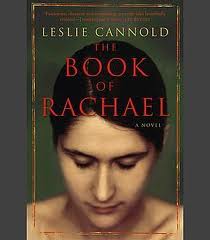
‘The Book of Rachael’ by Leslie Cannold

2011,  324 p.

Leslie Cannold is an esteemed  Australian public intellectual best known for her contribution to debates over feminism and reproductive technology.  I haven’t read her previous non-fiction publications What, No Baby? and The Abortion Myth but I generally read her newspaper columns and articles.  This is her first fictional work.

The impetus for this book, the author tells us, sprang from watching the BBC documentary Son of God.  This documentary examined Jesus the man (as distinct from Jesus the religious figure) and mentioned that he had four brothers who were named.  His sisters- if indeed he even had any- were un-named and not part of the historical record at all.  When Cannold went to research the existence of these possible sisters,  she found that there was nothing – not even enough for an article.  “That’s OK” she thought “I’ll just write a novel instead.”  And here it is: dedicated to the women of her family and to “every woman still struggling for a place in history.”

This  goes some way to explain my response to the book.  Cannold wanted, from the start, to mount an argument about women’s visibility in history, and the injustice of their life experience in 1st century Galilee.  It is a conscious, political statement that places women back into the biblical story.   The eponymous Rachael is the intelligent, headstrong younger daughter of Yosef the carpenter and his wife Miriame, and the sister of the charismatic preacher, Joshua.  This slight shifting in the names unsettles our easy identification with the gospel story, and there is certainly no supernatural or religious element here at all.  Her father Yosef is a good, loving man; Miriame is a carping, bitter woman and certainly no saintly figure;  her brother Joshua changes from a quietly empathetic ally into a somewhat fey, distant figure, driven by his own obsessions and agendas.   Rachael, conscious from the start of her difference and chafing against the many restrictions placed on women, becomes an acolyte of ‘the crone’ Bindy, who initiates her into the women’s arts of healing.  She falls in love and marries Judah of Iscariot, rebel leader of a guerilla band that is resisting the Roman authorities. She struggles with the pressures to have a baby and yet continue her work as a healer.

The anachronisms started early- on the second page in fact, with the ‘Galilean resistance fighters’ (shades of Monty Python’s Judean People’s Front??) and Rachael’s mindset is a thoroughly twenty-first century one.  The book is obviously well  researched, especially the details of women’s medicine and herbalism, but the research is conveyed with a heavy hand.

The book reminded me of Anita Diamant’s The Red Tent, but it has none of the rich female intimacy that marked that book.  The Book of Rachael  is a book of the head that mounts an aetheistic alternative narrative to the gospel.  Perhaps it could be described as an extended, fictionalized ‘what-if’ argument. As  a reader I found myself watching how the argument was constructed, weighing it and judging how well it countered the gospel account.

I  switched to intellectualizing the book because it was the only way that I could break through the writing, that veers between chicklit and stilted, pompous prose.  At times there are hints of a biblical cadence- think Song of Solomon perhaps- but they are fleeting and not sustained throughout the book.  Is it just me, perhaps?  Very few of the reviews I have read address the issue of the narrative voice at all.  I’ll leave it to you- here’s an example. Here is our first century, Jewish narrator.  A deeply troubled Judah has gone off by himself, just prior to Passover,  ostensibly to buy a sacrificial lamb for the feast that night, but we sense (and know) for another purpose:

By late afternoon I was close to gnawing off my own arm from idleness when Judah burst through the door, whistling through his teeth.  I ran to his side, desperate for company and news. ‘Where were you?’

He removed his scarf and pegged it on the hook before turning to me. His brow was smooth and eyes clear.  He was Judah again: vigorous, confident, in charge. ‘Nowhere,’ he boomed cheerfully, then changed his mind: ‘Buying a lamb for sacrifice. I have tied it in the lane.’ He looked around then gathered me for a passionate kiss, one hand gripping a breast.  When we separated he gazed in the direction of the hearth. ‘Is there anything to eat?’  (p. 272,3)

The reviews I have read of this book are generally glowing.  Lisa at ANZLit Lovers wrote one of the most enthusiastic reviews I’ve ever seen her give;  Kylie Ladd on Mamamia liked it too, as did Theo Chapman in the SMH and Patricia Maundel on Radio National’s Bookshow.

I’m afraid that I have to disagree.

My rating: 5/10

Reason read: Australian literature bookgroup

Book obtained from: Eltham Bookshop (purchased)

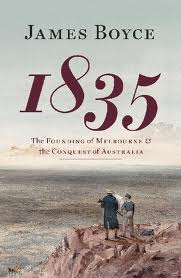
‘1835’ by James Boyce

James Boyce, 1835: The Founding of Melbourne and the Conquest of Australia, Black Inc, Melbourne, 2011.  212 p & notes

At last! I thought when I finally got my hands on this book.  In fact, three ‘at lasts!’  I’m almost sure (nothing is really sure these middle-aged days!) that I read about this book at the beginning of 2010 when publishers were spruiking the books that were about to appear during the year.  I waited throughout 2010 but no sign of it.  And now- here it is.  And ‘at last!’ I thought because in the closing chapters of excellent previous book, Van Diemen’s Land, James Boyce clearly signalled that, just like Tasmanian settlers themselves, his own  thoughts about Van Diemen’s Land crossed the strait as well.  And ‘at last!’ again  I thought because in reading about the early history of the Port Phillip District – for example in A.G.L. Shaw’s A History of the Port Phillip District – you find yourself wondering if Port Phillip will ever get itself off the ground.  Navigators just kept sailing past it, missing the bay completely; Collins picked up sticks and decamped for Hobart after a short time, and the aborted and rather half-hearted  attempts to establish a settlement on Westernport Bay sputtered away fitfully.  Like a car with a flat battery, the Port Phillip settlement just didn’t seem to be able to turn over and take off for decades.

Boyce describes the arrival of squatters coming across from Launceston in 1835 as “a brazen act” that “would shape the history of Australia as much as would the arrival of the First Fleet in 1788” (p xi). It’s a big claim:

…the policy turmoil which followed the establishment of a squatters’ camp in 1835 had an significance far beyond the baptism of a great city.  In this place, at this time, ‘Australia’ was born. (p. xiii)

As might be expected from the title, Boyce starts his book in the year 1835, which he approaches from a range of perspectives: by locating us in the deep time of the Yarra River, and then  amongst the smaller black/white encounters along Bass Strait in the decades prior to 1835 through the unregulated and largely undocumented whaling, sealing and wattle-bark industries.  After this largely geographical perspective he then moves on to explore the political mindset of the three groups of players during 1835: – the financiers, pastoralists and adventurers in nearby Van Diemen’s Land who formed themselves into the Port Phillip Association ; the governors in Sydney under official British instructions to limit settlement to the area adjacent to Sydney ; and the Colonial Office and lobbyists representing opposing evangelical and pastoral interests in London.

It’s important to remember that there was no inevitability about the Port Phillip district being considered as part of New South Wales.  In terms of distance, it was far closer to Van Diemen’s Land than it was to Sydney- it still surprises me when driving down near Lakes Entrance that you’re just as likely to find local Tasmanian stations as Victorian ones on the car radio.  Governor Arthur, whom Boyce suggests was influential in the whole Port Phillip Association endeavour, certainly was in no hurry to let Sydney know what was going on across the strait.

Indeed, as Boyce suggests,  this policy double-speak pervaded the whole endeavour.  Batman’s so-called ‘treaty’, was as Bain Attwood also suggests in his recent book Possession, a legal fiction, but Boyce claims that it was not meaningless, either to the Port Phillip Association, or to the Kulin leaders who putatively ‘signed’ it. Adopting the slow-motion, close reading that Inga Clendinnen used to such good effect in Dancing with Strangers,  Boyce traces the pedigree of the treaty in colonial thinking generally and in the actions of both black and white protagonists in that first year.  There was an intricate dance of go-slow and evasion between all the political actors involved, in Port Phillip, Hobart, Sydney and London, that exploited all the silences and ambiguities of correspondence at a distance.   Had the Colonial Office, or its representatives in Sydney really wanted to suppress the Port Phillip settlement in line with the espoused policy of closer settlement,  they could have used policy to do so. It could have punished squatters for illegal possession by banning them from future land purchases; it could have with-held convict labour from them and it could have equipped Aboriginal Protectors with the authority to award or strip leases depending on the treatment of the Aboriginal tribes already there.  There was, he claims, a choice involved, and the governments here in NSW and the British Govt through the Colonial Office,  chose to do none of these things.

Boyce takes up a second theme that he foreshadowed in his chapter in Van Diemen’s Land entitled ‘Victoria’s Van Diemonian Foundation’.   There was, he claims, a deliberate policy both in the Colonial Office and in Sydney to dilute the influence of the small, bush-savvy Tasmanian ex-convicts who flooded across the strait as shepherds and labourers.  By blaming ex-convict shepherds  as the main threat to Aboriginal tribes, Sydney and the Colonial Office and the behind-the-scene evangelists, championed the more ‘respectable’ large, NSW-based pastoralists as the means of civilizing and incorporating Aboriginal people into the settlement endeavour.  The pastoralists, already a powerful lobby group, were only too pleased to reap the benefits of this portrayal.    Boyce’s argument is not couched in the Marxist terms and language of Martin Sullivan’s earlier Men and Women of Port Phillip, but there is a strong class dynamic at play nonetheless.  In this regard, Boyce’s argument needs to spill out of the 1835 chronological straitjacket he has confined himself within.  For example, although Boyce does not mention it, in succeeding years the decision to hold the first land auctions in Sydney rather than in Melbourne itself played to the interests of Sydney pastoralists and speculators, and the early constitutional arrangements for elections to the Legislative Assembly favoured Sydney-based candidates for Port Phillip seats.  This process of expunging the VDL-based nature of Port Phillip society was set in play in 1835 and intensified in the years following.  But because his book focuses on the first year of settlement in Melbourne,  his account gives more prominence to VDL than the longer-term perspective suggests.

Boyce closes his book by asserting that the land rush and dispossession that so quickly followed the settlement of Port Phillip was not inevitable, even though it was portrayed that way by Governors and the Colonial Office at the time and is still portrayed that waytoday.  His final chapter engages in an exploration of ‘what-if’.  I’m always wary of ‘what-if’ (even though I enjoy it!)- I see it as a guilty pleasure but ultimately a sterile pursuit because the reality is that it didn’t happen.

I’m likewise  a bit uncomfortable about his closing observations that extend his observations about government decision-making, or the lack thereof, during the settlement of Port Phillip  into a discussion of climate change policy today.  His argument has been strong and  persuasive throughout the rest of the book but I don’t know if it can stretch this far into the realm of present-day politics.  Although ‘doing nothing’ or failure to act (are they the same thing?) might be the end result, I’m not sure that it always springs from the same impetus. It might be a deliberate delaying tactic; it may be quite self-conscious; it may be because some actions are literally unthinkable and certainly unvoiceable because other imperatives are more important, or it may reflect a failure of imagination.  I’m not convinced that failure to act on climate change and failure to act to suppress illegal possession are the same thing.  It’s a debate worth having, I suppose, and perhaps that was his purpose in introducing the question at all.

This book is well-written, clear, engaging and forceful in its claims and well worth reading.   As a Melburnian, it nudges you into a different place to look at your city’s history, and that’s a bracing and exciting thing to do.

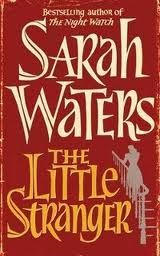
‘The Little Stranger’ by Sarah Waters

2009, 499 p.

I was about to say that it’s a long time since I’ve read a ghost story.  Then I realized that I don’t think I ever have read a ghost story- not even Edgar Allan Poe.  (No- I lie.  I have read A Christmas Carol).  Nor, for that matter, could I think of a ghost movie that I’d seen other than spoofs.   Of course, it’s possible that I have both read and seen ghost stories but they were so utterly unmemorable that I’ve forgotten them completely, or perhaps I just absorbed the ghost story genre by osmosis.

[Errata: I just remembered that I’ve spent Saturday nights for the last few weeks watching ‘Marchlands’.  I don’t know quite how that slipped my mind]

But I have read gothic stories with a hint of the supernatural- think Jane Eyre, Rebecca, Wilkie Collins- great fat books with the big house, the confused first-person narrator, and things that go bump in the night.    The Little Stranger fits right into this genre.  It is a gentle, slow tale told by the local doctor, Dr Faraday, who becomes enmeshed in the distress of the local gentry Ayres family, whose house harbours a ghost. Their home,  Hundreds Hall is falling into disrepair with tangled gardens, vermin, leaking roofs and windows and the family- the vague, aristocratic Mrs Ayres, her son Roderick who has returned from the war with a leg injury and ‘nerves’, and the practical, plain daughter Caroline- cling futilely to a vanishing world of servants, farm labourers and estates.

I was perhaps a little disappointed by the plot, which promised much and kept me anticipating more.  Sarah Waters is a master at emulating but subtly subverting a literary genre, with her lesbian-themed Victorian pastiches in Fingersmith and Tipping the Velvet and the brilliant Blitz-era The Night Watch which I very much enjoyed reading  earlier this year.  There’s no lesbianism in this book,  but as in all her other works she complicates what would otherwise be stock characters.   We don’t actually see much of the ghost in this story, but there are other ghosts as well: the ghosts of men who went to WWII and came back hollow; the ghosts of the British aristocracy in Labour-governed post war England; the ghosts of slowly decaying Georgian mansions and the ghosts of the marriage hopes of a diffident, insecure country doctor and the bluff, angular spinster daughter of the big house.

This is a long book and the tension mounts very slowly.  I found myself anticipating snuggling up in bed to read it and glad that I wasn’t reading it on my own.   I did feel a bit let down by the ending,  and yet I don’t know what ending would have satisfied me. I would have resented having everything tied up neatly, and was wary that the book not step over the line into melodrama on the one hand or gratuitous  terror on the other.

Waters’ balancing act in writing this story was mirrored in my own contradictory response to reading it.   I had that same feeling of wanting to read on but wanting to stop as well, when it seemed that it was becoming a bit too  spooky.  It was the sort of book that you wanted to gallop through, regretting at the same time that you were getting closer to the end.  It brought out the adolescent book-worm in me, wanting to read late into the night, knowing that you’ll regret it the next morning. It was rather nice to be taken back to that type of book, and that type of reading again.

Some reviews? Hilary Mantel liked it in the Guardian;   Dove Grey Reader was slowly won over by it, and Abigail Nussbaum was lukewarm.  If you’ve read it, you’ll enjoy John Crace’s Digested Read of it.

Read because: Sarah Waters is one of my favourite authors.

My rating: 9/10

Obtained from: La Trobe University Library

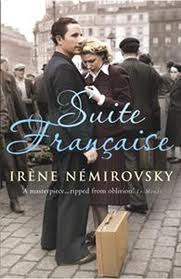
‘Suite Francaise’ by Irene Nemirovsky

2006 (English translation), 344 p & appendices

I purchased this book in the flurry of publicity that greeted its arrival in English translation.  It came with such a wonderful back-story: the 60 year old manuscript lugged around in a suitcase by her orphaned children after their parents were murdered in the Nazi extermination camps finally becomes a world-wide bestsellerBut, as often happens when I simply have to have a particular book, once purchased it sat in its paper bag beside the bed for a few months until it shed its packaging, was put on a bookshelf and joined the long line of books that “I really must read  one day”. By the time I did read it, five years later, I had forgotten the back-story and I’m glad that I did, actually.  It meant that I approached the book just on its own merits without the publicity hype.

The volume contains two separate books in effect, conceived as part of a larger work.  The two books are only tangentially related, quite close to the end.  The first, “Storm in June” focusses on the panic of Parisians just before the German army took over Paris.  In a way, it reminded me of A Woman in Berlin in its depiction of  the physical fear of the oncoming victors and the awareness of being on the wrong, losing side.  There is haste and panic, but there’s also that slow-motion inevitability that life is about to change for the worse.  Nemirovsky draws together a number of smaller stories: a husband and wife who work for a bank whose son is missing at the front; an art connoisseur; a wealthy family with their old, ill father-in-law- there’s several stories running in parallel here.  I must admit that it took me until about p. 150 before I was able to distinguish one from the other and pick up their story without flipping back to remind myself who they were.  No-one comes out of this scenario covered in glory:  the rich are self-centred, hypocritical and selfish, and the poor and teeming masses are desperate as well.

The second book “Dolce” picks up on a small rural community once the Nazi occupation is underway.  A new cast of characters is introduced, but the narrative focuses particularly on Lucile, whose older husband has been captured as a prisoner-of-war, and who lives uneasily with her hypercritical mother-in-law.  German soldiers billet in the villagers’ homes, where they are treated with varying degrees of sullen resentment, hostility, resignation and even curiosity and attraction.  It is only at the very end of the second book that tenuous links are drawn to the characters in Book 1, and you catch a glimpse of the wider vision that Nemirovsky had for her work.

The appendices flesh this vision out for us.  She kept a notebook while writing where she mapped out the wider arcs of the plot and her ideas for the work as a type of symphony with different acts.  She refers several times to Tolstoy’s War and Peace, and even before reading these notebooks I had detected the parallels.  Like Tolstoy, she paints  a broad historical canvas by depicting small, intimate, domestic relationships that intertwine and contrast with each other.

The final appendix is a series of letters written by and to Nemirovsky as the Nazi threat becomes clearer.  We see her husband and friends anxiously combing through her earlier published works, looking for evidence that they can use to argue for her release from arrest, little realizing that she is already dead.  The book closes with the biographical preface that appeared in the French edition when it was first published in 2004.  In this we learn that Nemirovsky was from a Russian Jewish family that had emigrated to France early in the 20th century, and converted to Catholicism- but none of these things were enough to save her from Auschwitz.

I’m glad that I read this book in the order and at the time that I did.  Had I read it earlier, I think I would have been tempted to read the appendices first and this would have shaped my response to the book itself  As it was,  I encountered the book first, incomplete and perhaps undeveloped though it might be in the whole scheme of the larger opus, and it stands up well.  It makes her ending even more tragic, if that’s possible.

‘Tales of Old Toronto’ by Suzanne Marnie

This is a collection of short stories set in or around Ontario, Canada.  It’s available in many places on the internet as it is no longer in copyright.

They are rather odd, nostalgic, sad little stories.  Most, but not all, of them are written from a woman’s perspective and are domestic in scope.  A couple of them start out in the same way, with a long survey of the room in which they are ostensibly written, and they seem to trail off rather inconclusively at the end.  I mostly was left with a sense of lonely, unfulfilled lives- a bit like Eleanor Rigby set in the backblocks of Upper Canada. They’re not particularly sharp-eyed or insightful.

I can find nothing about Suzanne Marnie on the ‘net, and these strange little tales seem to just dangle in amongst antiquarian works on Upper Canada.  They’re queer, defeated little things.

Reason read: Getting myself in the mood for “Old Toronto” while I was there.

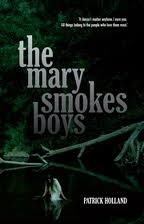
‘The Mary Smokes Boys’ by Patrick Holland

2010, 239 p.

Rather odd name- The Mary Smokes Boys– until I realized that ‘Mary Smokes’ is the name of a country town in Queensland in which the book is set.  The author of this book, Patrick Holland, hails from Roma, inland of Brisbane in Queensland, and in writing this book, he combines his childhood hometown with that of Esk,  the fictional home of the comediennes The Kransky Sisters. In my head when reading this book, I thought of the cold nights of  Toowoomba and those small country towns with their single main street, dogleg railway line and strung-out fibro cottages that you pass on the Melbourne-Queensland run, where you think “But what on earth do people DO here?”

This book falls well within the Australian rural gothic genre- think Chris Womersley’s Bereft, Sonya Hartnett’s Surrender, Gregory Day’s The Patron Saint of Eels, Elizabeth Jolley’s The Well, Craig Silvey’s Jasper Jones  and Rosalie Ham’s The Dressmaker.  It has often been pointed out that the late 19th century literature that so much fed into our image of ourselves as Australians – the Henry Lawsons and Banjo Patersons- was often grounded in a rural setting, despite the fact that Australians then were heavily urbanized.  It’s still true- overwhelmingly Australians live in urban areas, and yet much of our literature is based on small-town life that somehow we feel as if we know, even if it’s just from the window of a car, driving through.

The sense of place and the slow, almost aimless pace of life in a small country town are captured well in this book.  It is in three parts, and it tells the story of Grey and his sister Irene who grow up in Mary Smokes with a shiftless and pathetic father after their mother dies in childbirth.  They are poor, limited, and largely defeated right from the start.  Their mother is a gaping absence in all their lives, and Grey and Irene’s brother/sister relationship develops over time from resentment, solicitude, dependence to eventually something that verges on the edge of  an unhealthy physicality.  The Mary Smokes Boys are the group of marginal, bored, similarly unmotivated boys who grow up in Mary Smokes, who drink too much and dabble in dodgy petty crime and work in dead-end and casual agricultural labouring jobs.  As might be expected in a Queensland town, there’s an aboriginal presence  with wary and unarticulate relationships between white and ‘half-caste’ boys who are connected by the intimacy of time and shared childhood experience.

The tone of the book is laconic- so much so that when big plot shifts occur, they are told in that same, slow, understated narrative voice.  Although events were foreshadowed for some time, as a reader I found myself having to re-read to make sure that something so big had actually happened. It was a pity, too, that big events were often marred by rather clichéd writing, right at the climax, with tears ‘burst[ing] from his eyes’, knives being driven into hearts, and clunky dialogue.

The real strength of the writing comes in the descriptions of landscape, weather and the slow pace of country life. For instance, there’s a description of an all-night shift in a country petrol station that unspools slowly, dreamlike, as travelers emerge out of the darkness of the highway and are swallowed up by it again.  As you read it, you know that at times you’ve been one of the customers passing through the fibro petrol station with its dried-out food and dog-eared magazines that Holland has described so well.

I read this book on my e-reader. It was reasonably priced for an e-book ($9.95), which is about the price that I think an ebook should be, instead of $20.00 which is the price they are asking for some other e-books.  However, I’m still not sure that I don’t read differently, and with less satisfaction, on the e-reader.  I wonder if somehow my sense of the pacing of a book is influenced by one page looking very much like the one that preceded it. I sense a lack of progress through the book, and I think that it’s because you can’t see the pages that you’ve read becoming thicker on the left hand side as you progress through the book.  It’s possible that my judgments about books read in this mode are negatively skewed as a result.

My rating: 7.5/10

Reason read: Australian Literature online bookgroup (even though I finished it long after everyone else)

‘The Bostonians’ by Henry James

504 p.  1886

When in Boston, read The Bostonians, I thought- especially as I already had it on my e-reader and didn’t want to buy paper-based books while I was away. As it happened, it was much longer than I anticipated, and I was still going on it in New York (and even London!) but that suited me fine as it had quite a long section on New York as well.  His descriptions of Boston, Harvard University and New York were evocative, and enhanced my enjoyment of my sightseeing.

So as location-literature, it worked quite well but I’m not so sure that it worked so well as a novel for me.  The plotline revolves around Basil Ransom, a young Southern gentleman, who falls in love with a young feminist orator Verena Tarrant who becomes increasingly under the influence of his cousin, an older, more ardent feminist, Olive Chancellor.  Who and what is the beautiful Verena going to choose: the high moral fervour of the feminist cause, or the romance of the attractive, masculine Basil?  The final third or so of the book teeters on this decision, and a long drawn-out decision it is too.

There is a snideness to James’ approach to Olive Chancellor, who is, it must be admitted a rather unattractive character, and to feminism in general.  I didn’t ever get a particularly good grasp on the politics that Verena espoused, or Verena herself for that matter, beyond an image of her as a golden creature who somehow mesmerized audiences with her oratory.  The relationship between Verena and the older Olive hints at lesbianism, although this probably could not have been explicated further at the time.  The shadowy feminism that bound the women together is presented as little better than charlatanism or some kind of semi-religious mass delusion.

It is a long book, and it felt even longer when I was reading it on in snatches, and on an e-reader with only a vague sense of how much further there was to go: an aspect of e-reading that I don’t particularly enjoy.  I found myself just wishing she’d make up her mind already, and then felt rather annoyed with her final decision anyway.

My rating: 7/10

Reason read: Because I was there!

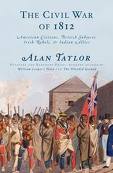
‘The Civil War of 1812’ by Alan Taylor

640 p. 2010

It’s taken me a while to post this review.  I’d borrowed the book while in Melbourne, hoping to finish it before heading over to Canada, where I would hear the author speaking at the Canadian Historical Association conference.  I wasn’t able to finish it in time and, lured by the cheapness of books overseas,   ended up buying my own copy.  It was too heavy to cart around, so after completing it, I sent it home surface mail.  It hasn’t ‘surfaced’ so far, though.

Living on the other side of the globe, I hadn’t realized the challenge to both Canadian and American histories in the title.  But I had taken this book with me into our communal kitchen, where two American fellow-travellers were making breakfast.  “The Civil War of 1812?” he read from the spine of the book, “But the Civil War was in the 1860s”.  Americans tend to ignore the War of 1812 completely (even though they commemorate it every time they sing the Star Spangled Banner), while Canadians tend to see it in terms of a British/American conflict rather than a civil war amongst erstwhile compatriots.

But I think that Alan Taylor , an American historian, has chosen the title of this book very deliberately.  The full title  is “The Civil War of 1812: American Citizens, British Subjects, Irish Rebels and Indian Allies” , a title so long that it almost obviates the necessity of reading the book.  It is a title that sums up his argument very neatly: that the War of 1812 arose from fundamental disagreements about the world view of kindred people- beween Federalists and Republicans in America; between different definitions of “loyalty” in the states that were to become Canada; amongst Irish immigrants, and between the Aboriginal tribes who aligned themselves on either the Republican or British sides.  It was just as much a civil war as the conflagration some 50 years later.

In many ways, this book is a sequel to his earlier book The Divided Ground, and it shares many of the features of that book.  Chapters are headed with single words e.g. ‘Blood’, ‘Crossings’, ‘Scalps’.  As with his earlier book, his focus is on people, flawed as we all are by incomplete and uncertain views of the future, and acting for the best as they saw it, on the  knowledge they had at the time.  There are more players in this drama than in his earlier book, however, and when I heard him speak at the conference, he mentioned his fear that there were perhaps rather too many.  He was right to be concerned: he skates that thin line  but manages not to cross it.  He is helped in this, as he was in his earlier book, by a well-constructed index.

The book is constructed chronologically, but it is not at all a string of battles, written in that laudatory and sychophantic style that many military histories adopt.  Like John Keegan before him, he focusses on the felt physical experience of battle, embodied in pain, blood, smells and fear.  He also highlights the contingency and uncertainty of a civil war, in particular, where ‘loyalty’ can be so easily framed as ‘partisan’ activity with such brutal vindictiveness afterwards.

His focus in almost entirely on the war on the northern border, with only fleeting attention given to the battle of New Orleans and the burning of the White House- the aspects of the 1812 war that, to the extent that Americans remember it at all, are central to the American narrative.  He points out that the American victory at New Orleans was not a turning point at all, but that the the negotiations for ending the war had been set in train prior to this.

Next year will be the bicentenary of the war, and I’m sure that this book has been published with an eye to this market.  It should do well, especially with the paperback version due out later in the year.  It is immensely readable, even for a southern-hemisphere reader with limited knowledge. It mounts a challenge to the American hubris that discounts the war of 1812 as just a skirmish and the accompanying narrative that presents the Revolution as an all-powerful and irresistible phenomenon from the start.  In Taylor’s hands, the contingency and unpredictability is returned to the past- something that we do well to recognize.

You can hear a podcast interview between the author and Lewis Lapham here.

Rating: 9/10

Reason read: Because there was a roundtable with the author at the Canadian Historical Association conference, and because it predates my work on Upper Canada in the 1820s.

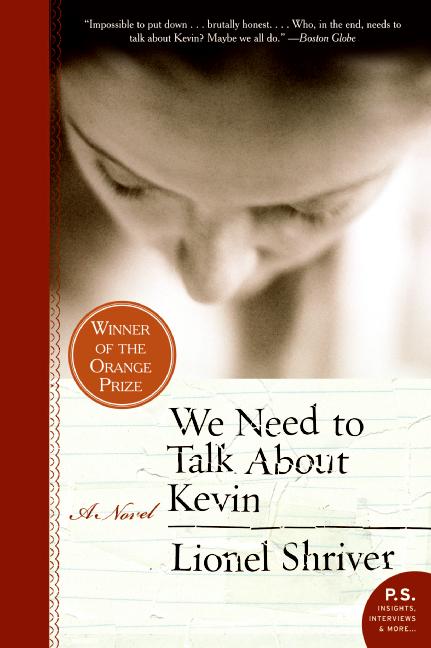
‘We Need to Talk about Kevin’ by Lionel Shriver

2003, 400 p.

I was surprised to note that this book was written in 2003. I felt that it was much more recent than that, and I see that it is about to be released as a movie later this year.  It was my selection for my face-to-face bookgroup, and I was rather dismayed that we did it while I was overseas, thus missing our meeting.  It was the first book that I have purchased for my e-reader, as distinct from the freebies that either came with the reader or that I have downloaded from Internet Archive.  It was rather distressing then, to find that it disappeared from my reader when I had to recharge its batteries through the computer.  I’m not really sure how to get it back: I had downloaded the original on my computer at home, and there was a message about not being able to download it in Canada- obviously ‘they’ had detected that I was in Canada now.  Most curious.  I was about 300 pages, and really wanted to finish it, so I ended up buying a hard copy as well.  So I guess that you could say that this first foray into purchasing an e-book was not an unqualified success.

The fact that I wanted so much to finish it says much about the book.  For about the first 100 pages I was really annoyed by the volubility of this narrator- did she have to go on and on about everything?  Surely Franklin, her estranged husband, would never read these lengthy, detailed letters!

The letters are arranged chronologically, and speak to Franklin as “you”.  They are a form of confession and catharsis as she re-lives her relationship with her son Kevin.  From the outset, she was ambivalent about Kevin: she was undecided about a pregnancy because of her success with her travel-guide company ‘On a Wing and a Prayer’, and she resented her husband Franklin’s overwheleming solicitude for the baby.  Both these tendencies intensified as Kevin grew from baby, to boy, to adolescent: Franklin could see only good in his son, Eva could see only manipulation and malevolence.

I’m not sure at what point my frustration at Eva the narrator dissipated.  It was probably as Kevin became more and more chillingly evil. The small details of his malevolence  were, in many ways, the most disturbing.  We are told in the first pages that Kevin will end up perpetrating an atrocity at his school, and the book slowly, but inexorably, moves towards that point.

I’m sure that the ladies-who-say-ooh in my bookgroup would have discussed motherhood and our ambivalences about our children, and the contribution (if any) of the family’s dynamics to Kevin’s personality.  I’m sure they would have discussed the nature of evil, and whether it is ever inherent, and how the trajectory of Kevin’s crime unfolded.  I wish I’d been there for the discussion.

My rating: 9/10

Reason read: My face to face bookgroup.