Author Archives: residentjudge

‘American Journeys’ by Don Watson

images

2008,  326 p.

I haven’t been to America.  And I don’t normally read travel books.

That said, Don Watson’s American Journeys strikes me as a rather unusual specimen of the genre.  It starts off conventionally enough, with a map of America with snail trails all over it, zigzagging right across the country.  It’s only when you embark on the book that you realise that these are indeed, journeyS plural, undertaken just for the pleasure of seeing what’s there, and that the experience of travel- i.e. moving from point A to point B- is just as important as the final destination.

This feeling of disembodiment- moving across- the continent is reinforced further by the blandness of the table of contents- just Chapter 1, Chapter 2 etc.  It’s really quite hard to locate favourite sections again in this book- it all just flows past.

Nonetheless, there are some truly memorable chapters- the New Orleans chapter in particular is damned good reportage- and indeed, as I flip through the book, I find good segments throughout that I had enjoyed but passed on over without them really making a strong impression on me. Is this shallowness intentional?

But there’s also a repetition about the book.  Again, I can’t work out if this is a weakness, or whether it’s a commentary on the nature of America itself.  Fast food strips, the shambolic nature of privatized public transport with Amtrak, the narrow fundamentalism, the puffed-up boasting, the distance…all these themes crop up again and again, right across his journey.  But then I think about how few concepts one really takes from a book when the last page is turned, (maybe four at best??) and if leaving with a multi-stranded memory of a book is a sign of success, then this book succeeds admirably.

Most of all, this book gave me a more nuanced understanding of American freedom, although I probably still don’t ‘get’ it.  In the past, I have bristled at the smugness and selfishness of George W. Bush’s ‘fridom’ that was so disrespectful of that of other nations.   Don Watson explains it much better than I could paraphrase, so I’ll let him do it:

Freedom is such an old chestnut of American rhetoric that it does not impress outsiders as perhaps it should.  The more the president speaks of it, the less meaning it registers.  When he says ‘Our enemies hate us for our freedoms’ we cringe, even though we know that, down the years, Americans have died in tens of thousands for the cause. In any case, we think, it’s less for the freedoms that they hate you, and more for the influence you exercise. ‘Our enemies hate us for our power, our hegemony’ would be a truer statement, and little would be lost by stating it in these terms.

And yet, when one travels in America, the chestnut sheds at least some of its shell. You come to see that, to Americans, freedom means something that we incurable collectivists do not quite understand; and that they know freedom in ways that we do not.  Freedom is the country’s sacred state.  Freedom is what must be protected.  All over, they will tell you what is wrong with America, but freedom is the one thing they think right.  And whatever the insults to my social democratic senses,  that is what I find irresistable about the place- the almost guilty, adolescent feeling that in this place a person can do what he wants…

If I am American, I am as free as a person can be.  If I am free, I can do- or dream of doing- all the things that it is in my nature to do or to dream; no other place on earth need interest me.  So long as I am guaranteed this freedom, I will forgive the things my country does that are not in my nature or my dreams.  I will be ‘spared the care of thinking about them’.  That is, of course, unless my country or some other place threatens freedom.  (. 325)

The blurb on the back of my book quotes Watson saying “Love and loathing come and go in about the same proportion”, and he conveys this ambivalence so well.

It’s Council Election time

Ah democracy!  This weekend has been local election time in Victoria and my enthusiasm for compulsory voting EVEN extends to council elections, shabby and petty little events though they are.  Many councils opted for postal-vote only, but my council had ‘proper’ elections, complete with flyers, Victorian Electoral Commission staff, the little cardboard booths and the stubby pencils.  Although I could have probably survived without this exercise in local democracy, in general I’m very pleased that we have government-funded, compulsory elections.  I look at the queues of people at American elections, and the skewing of issues on all sides to “get out the vote” and I’m glad that there’s no question about it here: you just have to vote.  It only takes ten minutes out of your life because it’s funded on the knowledge that everybody will attend.

condell

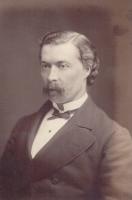
Henry Condell, first mayor of Melbourne

The first council elections in the Port Phillip district were held in Melbourne on 1st December 1842. This was a time when the “anxiety” about Judge Willis was reaching a peak, before subsiding briefly to re-emerge the following year.  They were not the very first elections held in the district: there had been elections for the Market Commission in 1841, but few voted for it.

In Britain, the Municipal Reform Act of 1835 provided the first English municipal elections, and the Colonial Office was keen to extend this rudimentary form of ‘representative democracy’ to the colonies as well.  Given the influx of migration into Port Phillip after 1839, many people would have experienced  this new phenomenon of municipal elections ‘at home’, and certainly the English influence on the election process is very noticeable.

Even before the Government announced the final arrangements for the Melbourne Town Corporation election, there was jockeying between factions about how it would be managed.  There was one private meeting that sought to ensure that the ‘right’ sort of people were elected, drawing I suspect, on the British tradition of sorting it all out between gentlemen and avoiding an unseemly election at all costs.  In defiance of this concept of ‘hole and corner meetings’, a public meeting was held in opposition to proclaim the openness of the election to all qualified comers.

The bill for the Melbourne elections was passed in August 1842, providing for four wards.  Candidates had to possess real estate worth 1000 pounds or live in a residence with an annual rental value of 50 pounds. In order to vote, electors had to occupy property with an annual rental of at least 25 pounds.

On 12 September ‘collectors’ were dispatched to inspect properties to see if the rental value was worth 25 pounds.  As rental properties worth less than 25 pounds were exempt from taxation, the occupants were not qualified to vote.  Such a regulation also ensured that tenants had an incentive for downplaying their rental to avoid taxation.   After the Burgess List had been published, its valuations were challenged by a Committee, which heard appeals.

Prior to the election, all candidates were furnished with ‘queries’ – not unlike the questions posed today in more recent times by lobby groups today before an election.  However, these queries were not so much about policies, but more about establishing the integrity of the candidate.  The questions also reflect an intention, at least, to avoid the secrecy, patronage and jobbery of Old Corruption back in England.  Not all candidates answered the questions.  The questions were (roughly paraphrased)

1. Do you have the time and energy to devote to the position?

2. Will you vacate your position if requisitioned by 2/3 of the burgesses?

3. Will you vote for open-door proceedings? (one of the first actions of the newly elected council)

4. Will you select the mayor and aldermen from among the elected council? (because under the Act, outsiders could be appointed )

5. Will you stay in your seat unless faced with uncontrollable circumstances or requisitioned by 2/3 of the burgesses?

6. Will you oppose the election of any candidate to an office in the gift of countil unless their moral character will bear strict scrutiny ?

7. Have you pledged yourself or put yoursdelf under any obligation?

The election itself was treated as a ‘festival’, but not a public holiday as such.  A hotel in each ward was designated as an ‘alderman court’, and it opened at 9.00 a.m. Electors would take their ballot paper to the polling room in the hotel, check their name against the Burgess list, then their registered vote was read aloud to the gathered throng- thus reinforcing the ‘pledge’ that would often be given before the election to vote for a particular candidate.  Electors had more than one vote to bestow- for example, in the Lonsdale Ward each elector had three choices and could, if desired, spread the vote among three individual candidates, or ‘plump’ all three votes for the one candidate of their choice.  The tally was announced hourly and ‘treats’ were laid on.  At 4.00 p.m. the final total was declared, speeches delivered, bands playing and celebrations and commiserations all round.

And where does our Judge Willis fit into all this?  The newly elected town council trooped before him for a public reception followed by cold corned-beef sandwiches where he was noted for wearing a hat of remarkable construction (the mind boggles).  Garryowen has a good description:

“Judge Willis was fidgetting impatiently on the Bench, commanding the crier to keep order; and the Court, now thronged, to be cleared, commands impossible to be enforced, for the crier was irrepressible with excitement, the spectators were in no humour to be trifled with, and this was one of those occasions on which Willis condescendingly left his bouncing unnoticed.  The Judge as he appeared robed on the Judgement-seat cut a rather grotesque figure.  His coiffure was constructed upon an admixture of two or three orders of hat-architecture, a tripartition of the billy-cock, the shovel, and cocked-hat.  It was not unlike the “black cap” in which Judges pass capital sentences, but it was winged, padded, enlarged and ornamented in such a manner as to be unrecognisable. “

Judge Willis’ own contribution to this newly-minted representative democracy was rather equivocal. He declared that the elections were constitutionally invalid because they had not received the Royal assent, even though he was sure that it would be received in due course and even though the Colonial Office had strongly encouraged the holding of municipal elections.  As a result, the new Town Corporation was unable to levy rates for some time.  Furthermore, the candidates split quickly along class, sectarian and ‘party’ lines to the extent that cases were launched in Judge Willis’ court when disagreements amongst councillors reached such a pitch that they refused to sit together in the same room!

doyle

All in all, happy times.  Welcome to the Lord Mayorship, Robert Doyle (but don’t even THINK about reintroducing cars to Swanston Street!)

References:

David Scoullar’s uncompleted Ph D thesis in SLV

Bernard Barrett The Civic Frontier: the origin of local communities and local Government in Victoria

M. M. H. Thompson The Seeds of Democracy

Garryowen

Port Phillip Apostle No 6 James Purves, landowner

[Check in the comments below for more information about James Purves. As you will see by the end of my entry, I’m quite perplexed about all these Purveses]

James Purves was born at Berwick-on-Tweed on 25 May 1813 and arrived in Van Diemens Land in 1837, moving across to Phillip in 1839.   He commenced practising as an architect and building surveyor that year with an office in Bourke Street opposite Mr Allan’s (whoever he was).  He obtained an auctioneers license in the same year- possibly that’s where he met Welsh?  A different address is given for his office- Little Collins Street, next to McLeans store; then another notice that he moved into McLeans store itself.  Either way, he is located in the commercial centre of town.  He sold the auctioneers business to H. H. Atkinson in 1841, and maintained another architect office in Collins Street from 1840.  His private residence was in Newtown (now Fitzroy) in 1840, then Richmond in 1844 and 1845.  He married Caroline, the daughter of Thomas Guillod of London in October 1842.  His son, James Liddell Purves, who was a barrister, columnist, free trade parliamentarian and member of the Australian Natives Association, was born in Swanston Street in 1843.

purvesjames

There’s his son.  A fine upstanding man he is too.

James Purves Snr. is listed as holding land with Chirnside at the Loddon River and Geelong in 1840, then took a license to run stock in the  Portland Bay district with Chisholm in 1842-3 (but I doubt if it is John Moffat Chisholm, who seems to have always used all three names; there are other Chisholms in Port Phillip) . He also held land in Western Port with Dixon 1842-3; and with E. W. Hobson.  He won a prize for a horse at the first show, held on 3 March 1842 at the cattlemarket on the corner of Elizabeth and Victoria streets- a “failure” of a show, according to Garryowen, where “the exhibits were a vast disappointment”.

There is no evidence of much connection with the other Twelve Apostles.  He seems to be quite active in leasing or purchasing properties in the early 1840s, especially during 1842 when the depression was kicking in, but there does not seem to be any further action after cutting his partnerships in 1843. Unlike the other Twelve Apostles, he had a profession to fall back on- perhaps this saved him from the insolvency that engulfed the others.  He joined with Fawkner and Chisholm in fighting the arrangements made to cover Rucker’s debt once it all went pear-shaped.  In September 1846 he helped fight a fire in a coach factory. By 1850 he was purchasing land again.  He had a licence at Tootgarook- or is it Toolgaroop?-  between 1850-69 where he became an importer and racehorse breeder and also at Traralgon between June 1853 and 1855.

He obviously had the money to send his son ‘home’ to England for his education, his law degree and his Grand Tour.  His son published the diary he wrote on the way home – A Young Australian’s Log. I wonder if that gives any more information?

This is all so disjointed.  There’s a Thomas and Henry Purves in Port Phillip at the time, who DO come out very strongly in Judge Willis’ favour, but I don’t know if they’re connected to James Purves at all.  There’s several mentions of Mr Purves in the newspaper, but I’m not sure which one it is.  And how and why did James Purves get involved in the Rucker scheme?  Search me.

References

Garryowen (again)

Billis and Kenyon Pastoral Pioneers of Port Phillip

Kenyon Index.

Port Phillip Apostle No. 5 John Moffat Chisholm

chisholm

Ah, now THIS Port Phillip Apostle seems well connected with some of the other ones.  As you’ll remember, I’m trying to work out the connections between this group of 12 men who agreed to become liable “jointly and severally” for the debts of one of their number, W. F. A. Rucker.  I’ve been surprised so far by how most  of them had traceable connections with  only one or two of the other men, which seemed strange given that they were throwing their lot altogether.  But, unlike the others, our John Moffat Chisholm seems to have links with several of them.

He was born in Edinburgh, Scotland (no date) and arrived in Melbourne in 1838 and set up business quickly as a merchant.  He married a Miss Osbourne in 1838, and purchased ‘Maryvale’ at Moonee Ponds in 1841.

His business was located in Collins Street, but in 1839 was burnt down. Garryowen hints at ‘mysterious gossip’ over the origin of the fire.   He was well insured, and rebuilt on the same frontage.  He joined with the other drapers in February 1841 to announce their agreement to their shop-assistants’ demands to close by 8.00p.m. except on Saturday nights.  He also made an appearance as employer when he took his servant to the Police Court, presided over by the police magistrate St John, over forfeited wages, and as was common at the time he handed the proceeds over to the hospital building fund.  The Master and Servants legislation of the time, which initially was used mainly against employees when times were good, worked more to the advantage of employees once the depression started to bite.   In April 1841 he sold his business to C. Williamson, then moved his office a month later to Hind and Co.  In January 1842 he bought land at a forced sale in Bourke Street at the very cheap price of 4 guineas per foot.   He fell victim to the “swindler” Barrett   who was execrated by many for skipping off to New Zealand rather than face his creditors.

He also had a property somewhere along the Plenty River where the Plenty Valley bushrangers moved freely, terrorizing the settlers in April 1842, but the exact location has not been determined.

He attended Debating Society meetings, where he signed a letter of support for George Arden when he was facing Judge Willis over libel charges.

He posted bail for H.N. Carrington when he, too,was confined to ‘the rules’ on Willis’ orders but when he found that Carrington was intending to break bail to travel to Sydney, he and his fellow guarantor Peers surrendered their bail, no doubt anxious that they were going to have to pay the penalty.  So here’s a connection with one of the Twelve Apostles- Carrington.

He was on the Committee of Management of the Mechanics Institute, and here we see a further strand of connections with other Twelve Apostles.  William Highett, who was fundamental to Rucker’s arrangement with the bank, was the Treasurer of this organisation, and Alexander McKillop and P.W. Welsh were fellow committee men and, more significantly, fellow Twelve Apostles.

He appeared in court, along with Fawkner and Purves as part of the court cases that fell out of the arrangement with Rucker in February 1843.  The other Apostles seem to have submitted quietly to their fates.

The Kenyon Index has entries showing that there were reports in the Port Phillip Gazette of his insolvency in May 1843, November 1844 and July 1845.  I have another date of 14 March 1843 for his insolvency- so who knows.  He was no stranger to the court- he’d appeared as defendant in six cases between 1841 and 1843 (i.e. in Judge Willis’ time).  He wasn’t alone in that though- when you read through the court lists, nearly every public person appeared in court one way or another.  Quite apart from the financial turmoil of these years, there was also the aspect of the court being the protector of reputation, as Kirsten McKenzie points out:

If personal status was protected and attacked in diverse ways, the law carried the most weight as a weapon against scandal.  For those who could afford it- and were undeterred by the publicity it inevitably involved- it was the final line of defence…  Kirsten McKenzie ‘Scandal in the Colonies’ p. 70

(Actually, I find myself wondering whether EVERYBODY, even today, has a court appearance of one sort of another in their life?  I haven’t yet….  Perhaps the establishment of bureaucracies to do the tasks of fining and penalizing as mere administrative acts have reduced the need to appear in court?)

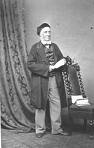
So what happened to John Moffat Chisholm for the rest of his life, I wonder?  He was obviously in Melbourne in 1872 to have his photograph taken by T. F. Chuck, and he died in Melbourne in 1874.

So, I’m really none the wiser.  He seemed to have social connections with Carrington, McKillop and Welsh.  He resisted the fallout from the Rucker arrangement, but had to declare himself insolvent in any event.  He must have recovered financially enough by 1845 to recommence business, and he breathed his last in Melbourne.

References

  • Kirsten McKenzie Scandal in the Colonies
  • Edmund Finn The Chronicles of Early Melbourne  1835-52:  historical, anecdotal and personal by ‘Garryowen’

‘Grotesque’ by Natsuo Kirino

grotesque

2008, 467 p.

The blurbs on the back of this book led me to think that I would be reading a crime novel,or a thriller but I don’t really think that it was either of these things.

The book is strung together by an unnamed narrator, who nurses a long-held hatred of her sister, Yuriko who was acclaimed for her beauty.  After a separation during adolescence, the younger sister returned to Japan and attended the same exclusive high-achieving high school as the narrator.  The story is then taken up by the sister, Yuriko who instead tells us that the narrator is a needy, manipulative woman, undercutting the authority of the narrator’s telling completely.  The two sisters’ stories are interspersed with the ‘journals’ of  school friend Kazue, and the male Chinese refugee accused of murdering both Yuriko and Kazue. They are only loosely termed ‘journals’ as they include direct speech and act mostly as  a vehicle for the author to present yet other perspectives.

So who done it? Stuffed if I know.  All these voices are deceptive and manipulative.

The book is rather sordid- both Yuriko and Kazue work as prostitutes and the lives of all these people are grubby and joyless.  There is much talk of beauty- Yuriko’s purported beauty; the beauty of bonsai; the beauty of intelligent youth that the school prides itself on nurturing- but it’s a putrid, cloying, trashy beauty.

Perhaps I’m too old, or too Western for this book.

Port Phillip Apostle No 3: John Pascoe Fawkner

fawkner

Now what on earth is John Pascoe Fawkner doing here?  He was probably Judge Willis’ most vocal supporter and yet here he is embroiled with some of  Judge Willis’ most vocal opponents in the guise of H. N. Carrington and J. B. Were.   The most plausible explanation that I can think of is that, given his propensity to be right in the thick of all things Melbourne, he became involved because other people were.  Perhaps there’s a proprietorial  element of protecting the civic reputation of  “his” Port Phillip?  Who knows??- but then again, there are many things that puzzle me about John Pascoe Fawkner- most of all,  the nature of the connection between Judge Willis and John Pascoe Fawkner,  a man who seemed to exemplify the things that Willis most strenuously derided.

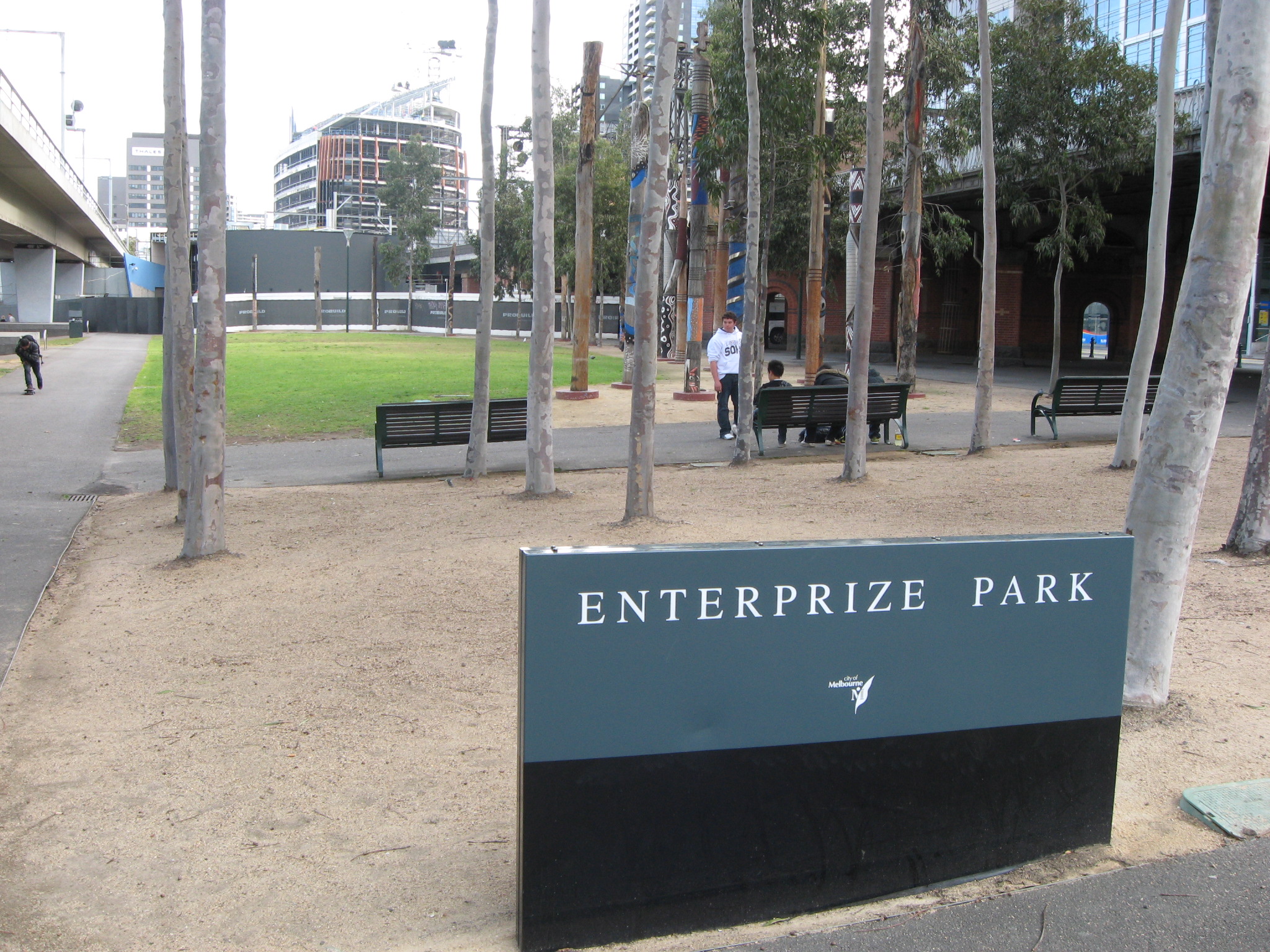
The two Johnnies- John Fawkner and John Batman have contested the title of “Founder of Melbourne” for about the past 100 years, and I notice that this year Capt Lancey nudged his way into contention as well.  Bain Attwood has written a fantastic paper describing the creation of the “founding of Melbourne” narrative that saw Batman championed as the founding father by James Bonwick, only to have this status questioned in recent years and more prominence given to Fawkner instead.  Attwood points particularly to the gradual disappearance of statues and commemorations to Batman and the increased visibility of Fawkner in the narrative, exemplified the recent creation of Enterprize Park (named for Fawkner’s ship The Enterprize)  opposite the Immigration Museum beside the river.

joe-william-street-012

Fawkner fits well into Ville’s “ex-convict and emanicipist” category of entrepreneurs, with their attendant desire for legitimacy, esteem and recognition.  He was the child of a convict and along with his free mother and sister, accompanied his father when he was transported for receiving stolen goods.   They were among the group of convicts and free settlers sent with Lieutenant Collins to establish a settlement at Sorrento until the struggling community was abandoned for Hobart Town instead.   John Pascoe Fawkner had his own brush with the law in 1814 when he was sentenced to 500 lashes and three years government labour for aiding and abetting the escape of seven convicts.  He returned to Hobart in 1816 where he opened a bakery, but shifted to Launceston a few years later after further problems over selling shortweight loaves and using illegal weights.  In Launceston he began anew as a builder and sawyer, then after some problems on character grounds in gaining a licence, opened a hotel and started the Launceston Advertiser newspaper.

Hearing positive reports of the coastal areas of Port Phillip, just across Bass Strait, he engaged a boat and launched an expedition of the area.  Well, that was the intention at least.  When the captain, John Lancey learned that he had violated a restraining order imposed on him because of debt, the ship turned back and deposited John Pascoe Fawkner back onto Van Diemen’s Land territory and sailed off without him.

Fawkner finally set foot on Port Phillip some two months later in October 1835, where he established a hotel, newspaper and bookselling and stationery shop.

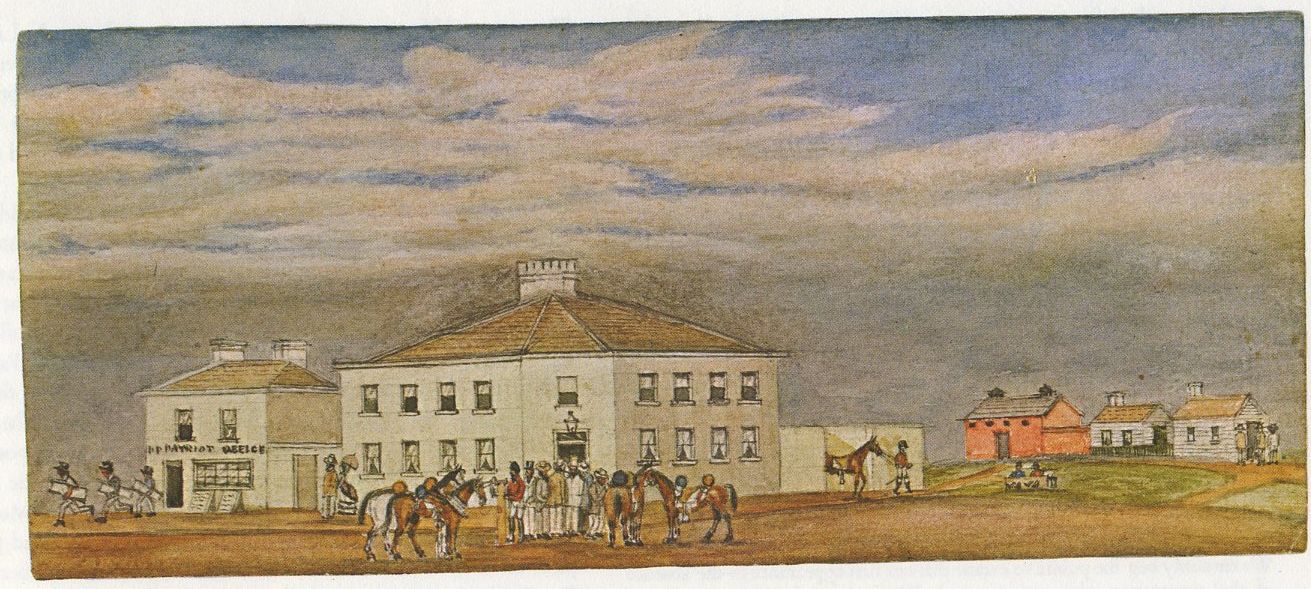
patriotoffice_melbclub2

Patriot office and Fawkner’s hotel  in Collins Street, later leased to the Melbourne Club

At the first government land auctions he purchased 92 pounds worth of land.  At the 1839 land sale he purchased 780 acres along the Sydney Road for 1950 pounds.  Within a fortnight he advertised that the land was available for tenant farms with seed provided, or a total of 85 acres for sale at 10 pounds an acre.  He confided to the Reverend Waterfield that he had gathered 20,000 pounds in four years.  He became a squatter in 1844, taking up a licence for 12,800 acres near Mt Macedon.

He obviously wasn’t always flush with cash, because in 1841 he approached Montgomery, the Crown Solicitor,  as guarantor for a loan to assist his friends Kerr and Holmes to purchase the newspaper and stationery businesses from him.  The money made available to him came from the funds of Judge Willis himself, who had placed his money in Montgomery’s hands for investment.  While this investment was, indeed, through a third party, and although Fawkner no longer owned (but did continue to contribute to) The Port Phillip Patriot, the paper’s unfailing and strident support for Judge Willis is notable.

His financial success came undone in the financial depression of the 1840s,  largely through acting as guarantor for so many bad loans.  He was particularly damaged by his involvement in Rucker’s scheme as one of the Twelve Apostles.   He fought the action strenuously in the courts, but finally declared insolvency in March 1845 listing liabilities of 8,898 pounds and assets of 3184 pounds and claiming to have been stripped of 12,000 pounds and ten houses. He vented his hostility to Rucker and Highett the bank manager through his letters to the Port Phillip Patriot.  Mr Rucker, he wrote,

although he has placed several gentlemen in most perilous circumstances, can yet ride into town and sport his figure as of the first water…

Mr Highett, the ex-manager of the bank

had helped to melt many a piece of worthless paper under the sunny side of the bank screw, so upon a crusade he goes, and by dint of cajoling he did succeed in effecting an arrangement whereby ten or eleven persons bound themselves to pay Mr F. A. Rucker’s debts.

But John Pascoe Fawkner was not to be kept down for long.  He retained his Pascoe Vale properties through a settlement on his wife, and his interest in the Patriot was signed over to his father.  He discharged his insolvency quickly and used his wife’s property settlement as a qualification to stand for a vacancy on the Town Council in 1845, a position he had had to relinquish when declared bankrupt.  He went on to serve for many years on the Legislative Council and died “the grand old man of contemporary Victoria” in 1869.

There were many reasons why Judge Willis might despise him: the ex-convict origins of his fatherand his wife and his own crime in facilitating the escape of convicts; his “fortuitous” financial arrangements during his insolvency which exemplifed the sort of trickery Judge Willis was determined to strike down; his involvement in the hotel trade,  and the rabid nature of his rhetoric in the Patriot.  He was viewed as a radical for many of his ideas:  his plans for a Tradesman’s bank and  schemes for a co-operative land society.  But yet, even though Judge Willis would protest it vigorously,  the two men have qualities in common.  They were both ambitious men.  Willis might have applauded Fawkner’s aspirations to improve himself:

One comfort I have which the falsely proud can never achieve, viz, I have not sunk below, but on the contrary, have raised myself above the rank in which at finding myself of years of discretion I was placed in, and I glory that I have thus passed them.

Both Willis and Fawkner took pleasure in “hunting high game”.  And both Fawkner and Willis seemed to exhibit a similar hot temper and vindictiveness that, at a stretch, might explain why such an otherwise mis-matched couple of men often acted as each other’s supporter.

References:

Bain Attwood ‘Treating the Past: narratives of possession and dispossession in a settler country’  http://law.uvic.ca/demcon/documents/Attwood.pdf

Hugh Anderson Out of the Shadow: the Career of John Pascoe Fawkner

C.P. Billot  The Life and Times of John Pascoe Fawkner.

Simon Ville ‘Business development in colonial Australia’ Australian Economic History Review, vol 38, no 1 March 1998

Departed historians and their historical tales

As you know, I’ve recently been considering the 1840s depression in Port Phillip.  So, off to the library shelves I go. The title certainly looked promising- Forming a Colonial Economy: Australia 1810-1850 by N. G. Butlin.  It even had a chapter ‘Instability and Economic Fluctuations with Special Reference to the Depression of the 1840s and Recovery’.  But how strange- the name of the chapter is almost longer than the chapter itself, which starts on p. 223 and finishes on p.224 with a Postscript.  And there it is:

“Noel Butlin died before he could complete this chapter, and I have not sought to go beyond the material he actually wrote.  His intention in this chapter- based on conversations shortly before his death- was to…. Unfortunately, Noel Butlin could not complete the task.  Having stated the intention of this remaining chapter, it now remains a matter for other scholars of Australian economic history.  M.W. Butlin” p. 226

Thwarted again by the curse of the historian- dying on the job, so to speak.  I seem to have run into a bit of this lately.

[But permit me to digress.  I hadn’t thought of economic history as a dynastic profession, but it seems that it is.  The remainder of Noel Butlin‘s missing chapter was sketched out by M. W. Butlin, who has a string of publications in economic history to his own credit.  And Noel Butlin was the brother of Sydney James Butlin who wrote Foundations of the Australian Monetary System 1788-1851 which I’ve just finished reading.  And S.J. Butlin himself had a book posthumously edited and published by his daughter Judith. ]

But back to the departed historians and their tales.  I’ve also picked up Alex C. Castles’ Lawless Harvests or God Save the Judges: Van Diemen’s Land 1803-55, a legal history (2007) as Tasmania provides a different but parallel legal environment to that of New South Wales.  I opened the preface to read:

“This wonderful book might never have been published had it not been for a chance comment by the Law Society of Tasmania’s former librarian, Mrs Kate Ramsay.  The death of Professor Alex Castles in 2003 prompted her expression of regret that we had never published his work.  That remark sent me rummaging through the Society’s basement archives, where the part-completed manuscript was eventually discovered.

Kate then took on the daunting task of re-keying the manuscript into electronic form and enlisted the assistance of Dr Stefan Petrow to edit the work, write an introduction and complete the bibliography.  The Society owes a debt of gratitude to Kate and Stefan for their outstanding contribution to the resurrection of this book. (p.vi)

And not long ago, I read Donald Horne’s memoir Dying.  The book was in three sections. In the first, he described from his side of the oxygen mask, the experience of dying from lung disease.  His narrative falls silent, and is taken up in the second section by his wife Myfanwy. The final section of the book consists of a collection of incomplete essays that he had not finished writing when he became too ill to continue.  On one level they  are complete, self-contained works, but there is a fuzziness and hesitation about their conclusions that I think he would have tightened had he worked them up to publication standard.  It seems that the act of publication in itself acts as a fixative and stiffener to one’s ideas- that you only really know what you think once you’ve taken another reader or listener through your argument and have enough confidence in what you have written to endorse it under your name.

Another exposure I’ve had to a posthumous work is one step further back than this.  The State Library of Victoria holds the research notes for David Scoullar’s Ph D on public performance in Melbourne 1839-1851.  The catalogue record shows that “Mr Scoullar died before he could complete this doctoral thesis” in 1995.   It’s a strange thing to look through someone else’s incomplete thesis. It’s arranged by chapter into coloured manilla envelopes.  The chapters are in draft form, and you can see him pruning here, adding there but, as with Donald Horne’s work, there is a tentativeness about it as he’s working towards his larger themes.  I know nothing else about him other than this work, but feel grateful that someone recognized its importance to him enough to make it available to other researchers.  It will live on, incomplete though it is and despite the difficulties of citation,  in footnotes and bibliographies of other people’s work.

And, sobered by this reminder of mortality, I shall read on…..

Book catalogues

The postman brought me today one newsletter from Amnesty International, a bill for my subscription for the Age and the Summer Book Guide from Reader’s Feast

spring08final-cover_small

This is an old one from Spring 2008, but you know what I mean- those glossy little publications from your favourite bookstore with all the latest products, short blurbs and some breathlessly enthusiastic recommendations from staff with names like “James” and “Rosie”.   What suckers are we: actually SIGNING UP to receive advertising!  How much does one have to pay, I wonder, to have one’s book featured in this little freebie that keen readers actually ASK to receive?  Still, I do like to see what’s around and tuck it away in the I’d-like-to-read-that-someday part of my brain.

Just occasionally I marvel at the fact that “James” and “Rosie” manage to read such current books that- well, look at that!- just happen to be advertised in the same little publication, but hey- they work in a bookshop.  But I was impressed that “Nigel” in this recent brochure nominated Geraldine Brooks’ “Foreign Correspondence” as his favourite book of the year- a book that was published in 1998  and much enjoyed by the ladies-at-bookgroup. Or, I wonder suspiciously, has it been re-released?

Port Phillip Apostle No. 9 Abraham Abrahams

Now, here’s a  name that distinguishes itself from the other Twelve Apostles’ names by virtue of his strong Jewish associations.  Abraham Abrahams was a merchant, along with Rucker, Were and Welsh, so it is perhaps to be expected that he might have been caught up in the financial syndicate that Rucker formed to rescue himself from insolvency and disgrace.  But given that there were several Jewish merchants in Melbourne at the time (Michael Cashmore, and the Hart brothers spring to mind), it is strange that Abrahams is acting alone here.

So what do I know of Abraham Abrahams?  He was born at Sheerness, Kent in 1813. [update: maybe not- see comments below!]  He arrived in Sydney with his wife and seven children in 1839 at the age of 26 (fast work there!) and was in Melbourne by 1841.  He was described as a “merchant” of Lonsdale Street in 1841 when he donated the land for the first Jewish cemetery on what Garryowen described in 1888 as “a stony rise at the Merri Creek between the now Northcote and Merri Creek bridges”.  The land was found to be unsuitable for burial- the poor sexton dispatched to dig the first grave “found himself working on what nature designed for a quarry and made little or no progress downward” (Finn p. 695).   The grave was only half-dug when the burial party arrived to bury 19 year old Miss Davis, the young daughter of a Melbourne innkeeper, and in any event it was not her final resting place, as the body was exhumed and sent to Hobart.   Realizing that all subsequent funerals would face the same problem, the  Jewish community applied for land adjoining the general cemetery, and after a delay, their application was granted.

In September of 1841, Abraham Abrahams was admitted to the Chamber of Commerce.  Paul de Serville mentions that a “Mr Abraham” served as one of the stewards of the alternative public ball set up in opposition to the more exclusive private Turf Day ball in May 1841.  The battle of the balls exemplified the attempt of “good society” to define its boundaries by limiting attendance to the ball to those deemed suitable.   In defiance, a public ball was championed by the Gazette and Patriot newspapers who jeered the pretensions of the Turf Club stewards.  The “public” ball was held at the end of May 1841, but was apparently not a success.  The more “respectable” stewards eschewed any involvement with it, and on the night, rain kept many guests away (including perhaps those who were looking for an excuse to extricate themselves). Mr Abraham, however, remained as a steward but I am not absolutely sure that this is Abraham Abrahams.

On 7 March 1842 he was appointed Trustee to the estate of the Langhorne Bros, even though at the time his debts amounted to 3792 pounds while his assets were 3655 pounds.  By January 1843 he was listed as insolvent and shifted to Sydney.

Abraham Abrahams served on both general and special juries, alongside other Twelve Apostles. He publicly supported Judge Willis in March 1842, but did not sign the petition circulated in November 1842, and was resident in Sydney by the time that Judge Willis was dismissed in 1843.  Generally, Jewish citizens in Port Phillip publicly supported Judge Willis throughout.

So why and how did he get involved in the Twelve Apostles arrangement?  Hard to say.  As a merchant and through his involvement with the Chamber of Commerce, he would have come into contact with several of them socially.   If he was the Mr Abraham who served as a steward at the Public Ball, then this suggests some element of social visibility, and his jury duty and philanthropic gesture with the land donation indicates a level of civic involvement.  Ah, but who can tell.

Update: see the comments below

[This information below is not correct- see comments. It’s a different Abraham Abrahams!]

Anyway, all ended well. At some stage he moved to Adelaide where he founded the Executor, Trustee and Agency Co. of South Australia which he managed until 1891.  He was one of the original members of the Society of Arts in South Australia, a Governor of the Public Library, the Art Gallery and the Museum there.  He was described as “One of the most distinctive figures in Adelaide, a man most courteous in speech and courteous in manner”.

References:

  • Paul de Serville Port Phillip Gentlemen and Good Society
  • Edmund Finn, The Chronicles of Early Melbourne 1835-51: historical, anecdotal and personal by ‘Garryowen”
  • John S. Levi  These are the Names: Jewish Lives in Australia 1788-1850

From the newspaper November 12 1841

From the Port Phillip Herald November 12 1841:

On Saturday week last Mr Mitton was travelling along the Sydney Road about 25 miles out of town; at about half past seven or eight o’clock in the evening, on approaching a tree, a man sprung from behind it aiming a blow at Mr Mitton: the horse started leaving Mr Mitton on the ground, where he was immediately seized by two men, one of whom knelt on his back keeping him down, while the other kicked him severely, so much so, that he became insensible;  as soon as he recovered he found his saddle close at hand with its girths cut and his horse at some short distance; he immediately rode to Beveridge’s, and heard that two men had been there before him; after remaining a short time, the two men entered the room he was in, but he could not identify them as he had not seen them distinctly, it being dark at the time of the robbery.  On arriving at Beveridge’s, Mr Mitton discovered that he had lost 30 pound in cash,  a watch, and a bottle of castor oil, all of which must have been taken from him when held down or  senseless.  From information received, Neil the district constable, tracked the two men to the Ovens River, where they were arrested on Mr Wallace’s station, with a watch and a considerable sum of money in their possession.  Two men whose names are Joseph Day and Robert Bruce, one of them a native, standing upwards of seven feet high, have been brought into town and were arraigned before the Police Bench yesterday, when the watch found on the prisoners was identified as being the property of Mr Mitton.  They have been remanded for further evidence.

So what happened next?  Unfortunately the Port Phillip Herald didn’t report on the case because the other papers would have reported on it first ( the three newspapers of the day were published each day in turn, and the Port Phillip Gazette reported it).   The case came up for trial on 30th November before Judge Willis.  The victim was called “Mutton”, not Mitton but the location is correctly identified- Beveridge- the later birthplace of Ned Kelly.  You go past it on the way to Sydney, but it’s very small.

beveridge

The Ned Kelly house is still there too, apparently; although I’ve never seen it up close- I think it’s in private hands and surrounded by a wire fence.  I’m surprised that it hasn’t been turned into a tourist attraction.

kellyhouse

What the newspaper report doesn’t tell us is that Mutton had been in Melbourne to apply for a liquor licence at Kilmore, but was beaten to it by another applicant.  He had a drink in Melbourne to drown his sorrows, rode on for about three hours, then refreshed himself with a brandy and water and dinner at Kilmore.  He fell into conversation with Bruce and Day at that inn.  People at the inn noticed that Day was carrying his bundle on an unusual stick.  Mutton resumed his travel at about 5.00 and was heading towards Beveridge when he was sprung from behind.  After recovering consciousness he went on to Beveridge, saw Day and Bruce and had them arrested.  The stolen goods were found on them.  The day after, Mutton returned to the scene of the crime and found the ‘stick’ marked with cutting features.

The defence lawyer tried to argue that Mutton was drunk, and that there were no trees in the location where he claimed to have been attacked.  But to no avail- the prisoners were convicted, and both sentenced to be transported for life.

Gee, you’d be filthy, wouldn’t you- stealing a bottle from a man and finding that it was CASTOR OIL!!!   Neither of the accused was a ‘native’- both were free settlers- and certainly no more was said about one of them being seven foot tall.

References:

  • Port Phillip Herald Nov 12 1841
  • Paul R. Mullaly Crime in the Port Phillip District 1835-51 p.489