Author Archives: residentjudge

Quote? Unquote?

I’m reading and very much enjoying a book by Jane Errington called The Lion, The Eagle and Upper Canada: a developing colonial ideology.  The book was awarded the Corey Prize in 1988, a prize for the best book on Canadian-US relations, jointly sponsored by the American Historical Association and the Canadian Historical Association.  Reviews that I have read about the book at time of publication have not been universally glowing, but I’m enjoying it nonetheless, oblivious as I am at this stage of the nuances of US-Canadian historiography and politics.

One thing I have noticed, though, is that she does not use block quotes but instead snips them up and integrates them into a paragraph. For example:

On 3 June 1814 Rev John Strachan preached a Thanksgiving Service to his congregation in York celebrating the deliverance of Great Britain from the devastating conflict in Europe. “Thankfully and devoutly” he declared, we “acknowledge the mercy and goodness of Almighty God; for protecting His Majesty and His dominions during the whole of this arduous contest; and for the signal and glorious victories obtained by its armies.” “Our joy is full,” he continued, “when we reflect that … Great Britain has been chiefly instrumental, through the blessings of God, in bringing about the happy changes which we now contemplate.” “Truly” she was “the preserver of the independence of Europe” and “the proclamation of peace,” he declared, would triumphantly bring her to “a new era of glory.” And though peace had yet to be won in North America, Strachan called upon Upper Canadians to “rejoice”. We have earned “the happiest time…now rising upon us,” he maintained. (p.97)

This quote is duly footnoted as “Strachan, A Sermon Preached at York on the third day of June, Being the Day Appointed for General Thanksgiving, 1814, 22-3, 38, 34.  It reads smoothly, and it’s only when you look closely that you notice the rather clunky double inverted commas.

Still, I find myself a little uneasy about it.  It reminds me of the technique of “The Week” magazine, to which I subscribe largely because of the generous discount for subscriptions.  As a way of distilling the essence of commentary (and perhaps to avoid copyright issues), the magazine likewise uses snippets of sentences in inverted commas, although sometimes I wonder why they choose such banal words to highlight in this way. For example, it summarizes Rex Jory’s column from “The Advertiser” in this way:

The perfect monopoly has struck again, says Rex Jory. The price of postage stamps “crept up” 5c to 60c last week, and what could we do about it? Nothing.  This is preposterous and outrageous. It’s bad enough that Australia Post can charge “pretty much what it likes” but it also “contemptuously” refuses to provide a weekend service.   etc etc.

Errington’s integration of snippets into a prose summary probably does justice to the sentiments expressed- possibly better than verbatim slabs would have done, but I feel wary- what if she’s misrepresenting what is said?  Although, short of slavishly writing out the whole document, how is any reader to know that paragraphs are not chosen selectively and skewed by ellipses and omissions?

I think, too, of the advice given in Ann McGrath and Ann Curthoy’s recent book How to Write History that People Want to Read that examiners and readers always skip over slab quotes anyway.  Do they? Do I?  I must admit that I think I do sometimes.  I think I’m looking for the analysis rather than the evidence.  Yet the fear of plagiarism or sloppiness prods me into backing myself up when I am writing, even though I don’t always read the evidence when somebody else backs themselves up the same way.  Errington’s technique weaves the analysis and evidence together in a way where it is less easy to skip.  I think I like it, but I’m still not sure.  A little writing challenge to meet, I’m sure.
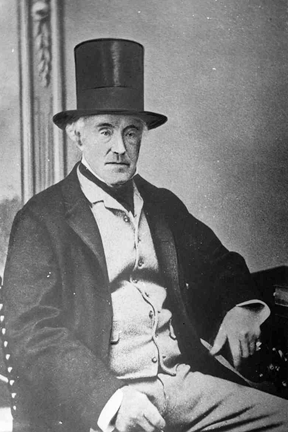
‘Memoirs recorded at Geelong by Foster Fyans’ ed. Phillip L Brown

“What is the use of a book, ” thought Alice “without pictures and conversations?”  I’m with you, Alice.  I  certainly wasn’t expecting conversations in Foster Fyan’s memoirs, and I very much appreciated the maps and illustrations.

Foster Fyans is well known in Geelong as the first police magistrate there (1837-40), then he became Crown Land Commissioner in the district.  The area just out of Geelong known as Fyansford is named after him, and there’s a Fyans Street in Geelong itself.  After visiting Geelong a fortnight ago for the Robert Dowling exhibition I seem to be rather Geelong-conscious at the moment, and I’ve been reading Fyans’ memoirs for a paper that I’ll be giving much later in the year.

As his entry in the Australian Dictionary of Biography suggests, there is not much known about his early life beyond that he was Irish and brought up by an uncle.  In these memoirs he springs from the page as a fully-formed army man, in charge of taking bringing a band of recruits to Portsmouth.  From the start he portrays army life full of masculine humour, eating and drinking, marching and high-jinks- almost a dead ringer for Lydia Bennett’s Mr Wickham and his mates.   His description of the Peninsular War likewise emphasizes life amongst his fellow soldiers, with more distress ascribed to the illness that swept through the camps rather than actual combat.  Then off to India for several years where again, life revolved around hunting and carousing and little mention of actual soldiering.  After a short time in Cape Colony (more parties and shooting), he arrived in Sydney where he spent a short, restless, lonely time before reporting to his regiment and joining his fellow soldiers at Parramatta.  Although he attended Government House, the jocular hail-fellow tone falters here, as the realities of convict settlement and official responsibilities become more apparent to him.  He is sent to the high-security  Norfolk Island where he eventually becomes Acting Commandant, and from there as commandant to Moreton Bay (now Brisbane) which was also a penal settlement at the time.  While  in Moreton Bay he oversaw the rescue of  Eliza Fraser.   His response to the convicts probably reflects the contradictions thrown up by the system- an uneasy wariness of violence that runs just below the surface co-existing with close day-to-day proximity with men not so different from oneself.

From there he was sent as Police Magistrate to Geelong, which is about fifty miles from Melbourne and rich pastoral land.  His memoirs become even quieter at this stage.  He spends quite a bit of time describing an expedition to the port settlement of  Portland, the first recognized land journey between the two settlements.  With only two mounted police and the surveyor Mr Smythe and no maps, they set off in what seemed to be atrocious weather, greeted each morning by the “flying jackass” (kookaburra), the “chanticleer of Australia”.   By 1840 he had been appointed Commissioner of Crown Lands, responsible for maintaining order among the squatters and investigating clashes between the settlers and the displaced aboriginal groups.  Here is a sad litany of violence,  where he mainly sides with the settlers in sympathy for what they perceive as needless stock loss. Like the settlers he is critical of the Aboriginal Protectors and the nearby mission station that he feels only attracts more aborigines to the area and imbues them with a misplaced sense of inviolability.

What started out as a military romp has become a nomadic police-like existence, accompanied mainly by his aboriginal “boy” Bon Jon (the purpose for my reading these memoirs).  It has become much quieter and more isolated.  Perhaps it’s the memoirist running out of puff too, because the memoirs stop abruptly in the bush in 1842.

The editor has written an introduction, where he describes the provenance of the manuscript and the various branches of the Fyans family tree, then gives a brief summary of the content of the memoirs.  I always enjoy hearing about how a manuscript comes to be published. The original, scrawled across five hundred foolscap pages had been typed up by Fyans’ great grand-son and it was donated by his descendants to the State Library of Victoria in 1962.   Although Fyans himself did not divide it into chapters, he did create sections by inserting a page with rough headings for the pages that follow. The  editor has created chapter headings and provided notes  at the end of each chapter.  These rather dour and punctilious annotations to the entries, which are painstaking in their detail, remind the reader of the fallibilities of memory and chronology, and the infelicities that arise when a raconteur is  telling a good story.

I think that it’s almost certain that anyone working exhaustively on an archive of memoirs, diaries or letters comes to build some sort of a relationship (albeit completely one-sided) with the author.  The editor, P. L. Brown (who also wrote the ADB entry) seems rather disenchanted by the many inconsistencies and errors he found

Fyan’s reminiscences had to be checked in order to assess their worth as historical material. This checking disclosed considerable and frequent divergence between actual and remembered events, and made it clear that the text, unless fully annotated, must be more entertaining than instructive. Hence the presentation of archives, both British and Australian, from the latter of which Fyans emerges as an energetic, conscientious public servant, rather let down by his rambling old self, who nevertheless conveys the authentic atmosphere of his historical period, and told few stories which lacked a germ of truth (p. xv)

The memoirs themselves ended abruptly, and the notes themselves end with the transcription of assorted letters and returns, and further details about wills and inheritances.  I found myself wishing that P.L. Brown had returned at this point to round out the picture somewhat and to help me, as reader, to bid farewell to Fyans.  After all, he’d been a rollicking companion for the first 100 pages or so, and despite infelicities and distortions in his retelling, he sure had a story to tell- Spain, India, Cape Colony and Australia- as did many of those peripatetic colonial civil servants.

‘Upper Canada: The Formative Years’ by Gerald M Craig

My research has moved onto another stage: Judge Willis’ Adventures in Upper Canada.  My Australian readers will no doubt agree with me that Canadian history does not figure highly in the Australian history curriculum and that I probably shouldn’t feel as embarrassed as I do by my ignorance about all things Canadian.

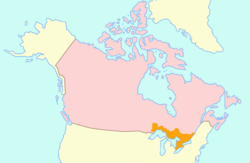
This book was suggested to me on a Canadian history blog as a good, if somewhat dated, starting point in researching Upper Canada.  Where’s Upper Canada? you may ask.  (I certainly did).  As one of my first surprises, it’s not particularly “Upper” at all- it’s the area of Southern Ontario, north of Lake Erie and Lake Ontario. To my antipodean eye “Lower Canada” was actually closer to the north pole (and hence, upper)  than “Upper Canada” was.   It only officially existed until 1841, when Upper and Lower Canada were merged.

This, for me, was Revelation No 1- the river/lake eye view.  In his book, The Tyranny of Distance, Geoffrey Blainey emphasizes the importance of the lack of long inland waterways in Australia.  When you look at a map of Australia, there are none of those meandering rivers that weave , branching and converging across a continent.  Instead, apart from the Murray-Darling system,  there are stubby little twigs that start and break off, seemingly without reason.  No wonder explorers dragged their canoes with them into the Australian desert: their experience in other continents would have reassured them that there would be a river system somewhere, waiting to be discovered.  It also explains why early British settlement in Australia hugged the coast so tightly, and why they were keen to annex strategic harbours rather than the continent as a whole. (p. 122-3).  With a Canadian river-eye view, “Upper” refers to the reaches of the river, not the lines on a map, and “development” involves canals and river engineering works.

Revelation No 2 was the importance of borders, and here I remembered echoes of John Hirst’s first year Australian History subject where he emphasized the importance of Australia not having to share a border with any other colonial power.  I hadn’t considered before the significance in the time of the Napoleonic Wars of having French-Canadian neighbours, or the implications of “loyalists” coming across the border after the War of Independence, and the uneasiness that would evoke.  The book was a salutary reminder.

Revelation No 3 was the familiarity of policies across the empire. I was prepared for this, but it was still an “aha!” moment for me to see migration, land and church policies that I had thought of as “Australian” being applied in another context.  Our “national” history is not as unique as we might want to think it is- much of  it was part of what we would now deride as “one size fits all” empire-wide approach.  Policies that seem puzzling, like the insistence on restricting settlement around the Sydney area, make more sense in the face of Upper Canada’s experience when settlement was allowed to become too dispersed, a phenomenon exacerbated by the policy of reserving large tracts of land for clergy and Crown needs at a later date.  Of course “one size” didn’t fit all, and policies were subverted and ignored, but it’s interesting to observe the empire’s “corporate learning”, even if it only existed on paper.

Revelation No 4 was not strictly a revelation either: more a confirmation of the mobility of colonial careers.  For here we see George Arthur popping up as Lieutenant Governor of Upper Canada, having completed an earlier stint in Van Diemen’s Land- and there’s Charles Buller– I thought he was supposed to be “our” man in Whitehall!

The book was clearly written, with a strong chronological structure.  I found myself raising a sceptical eyebrow at the comment that unlike the United States, Upper Canada was never an “angry” Indian frontier- is that true?  The emphasis on the book was on politics and economics rather than social history, and I don’t think that there was a single woman in the whole book.  That’s fine: I’ve just started reading and plenty of time to rectify that.  There’s an almost laconic view of causality running through the narrative of this book: rebellions and ructions, when they occurred,  are portrayed as almost unnecessary, as structures would have collapsed under their own weight and events would have unspooled anyway.

The book, published in 1963,  was the first cab off the rank in the Canadian Centenary Series.  It concentrates on a defined geographical area within a clearly designated timespan.   The book ends optimistically, looking to the future and further progress.  The concept and premise of “Upper Canada” seems to be a phase in Canada’s history, and I sense that it has been left behind without regret or nostalgia in the march towards other things.

Uplifting Quotes for the Uninspired Historian #4

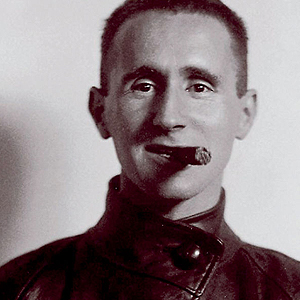
Not from an historian this time, but from Bertolt Brecht in Brecht on Theatre: The Development of an Aesthetic. I’m still thinking about this one.

Historicization (p. 140)

Historical incidents are unique, transitory incidents associated with particular periods.  The conduct of the persons involved in them is not fixed or ‘universally human’; it includes elements that have been or may be overtaken by the course of history, and is subject to criticism from the immediately following period’s point of view.  The conduct of those born before us is alienated from us by an incessant evolution.

and then on p. 90

In other words we must drop our habit of taking the different social structures of past periods, then stripping them of everything that makes them different; so that they all look more or less like our own, which then acquires from this process a certain air of having been there all along, in other words of permanence pure and simple.  Instead we must leave them their distinguishing marks and keep their impermanence always before our eyes, so that our own period can be seen to be impermanent too.

Robert Dowling, Tasmanian Son of Empire.

If you put your skates on, you’ll catch the Robert Dowling, Tasmanian Son of Empire exhibition at the Geelong Art Gallery. But be quick- it finishes on 11 July.  There’s a beautiful NGA site about the exhibition here–  go have a look, it’s a stunning site and almost as good as being there.

Robert Dowling was born in 1827 in Colchester in England, the son of a Baptist preacher.  In 1834 he arrived in Tasmania with his parents, who followed their older sons who had emigrated to the colonies some time earlier.  This Evangelical background is important because it influenced the subjects he painted  for the rest of his life.  He was apprenticed as a saddle-maker but did not follow his trade. Instead he set himself up as a painter of commissioned portraits.  He travelled between Hobart and Launceston painting portraits of many prominent figures and personal friends, including John West the Congregationalist minister and other leading Evangelicals.  In 1854 he shifted across to Port Phillip in the hope of capitalizing on the post-Gold Rush prosperity.  However he found it difficult to gain patronage in Melbourne, so he shifted down to Geelong closer to his extended family, and where he was commissioned to paint portraits by the wealthy Western District pastoralists.

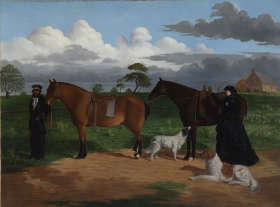
In every exhibition, there’s usually one painting that you linger in front of, and often return to in order to scrutinize it more closely.  For me, it was this painting: Mrs Adolphus Sceales with Black Jimmie on Merrang Station

The catalogue described this as a ‘mourning painting’.  The exhibition catalogue (a beautifully presented book by John Jones) tells me that  Adlophus Sceales died in 1855, leaving a young widow Jane and two young daughters.  Mrs Sceales commissioned the work, and how I wish that I could eavesdrop on the conversation between subject and artist when the painting was being planned!  The riderless horses remind me of the military funeral tradition, but I assume that they were portrayed because he must have loved riding, perhaps with the two dogs shown.  I wonder whose decision it was to include Jimmie, and what his clothes and stance indicate about his role on the station- it looks very formal attire, befitting a manservant for an Englishman.  The emptiness of the picture is striking: the house is not shown, only the stables and it looks rather bleak, empty and cold. The daughters are completely absent.

This was one of several paintings that show Aboriginal people in the Western Districts, sometimes in family groupings, and at other times in close proximity to the settler families with whom they lived.

These are the children of his brother-in-law’s family and I’m struck by the easy pose of the little girl draped innocently ( but not entirely appropriately to our eyes today) over the young  aboriginal man.  What does it say about his role in the family? He’s obviously much older than the children- does he have a carer role?

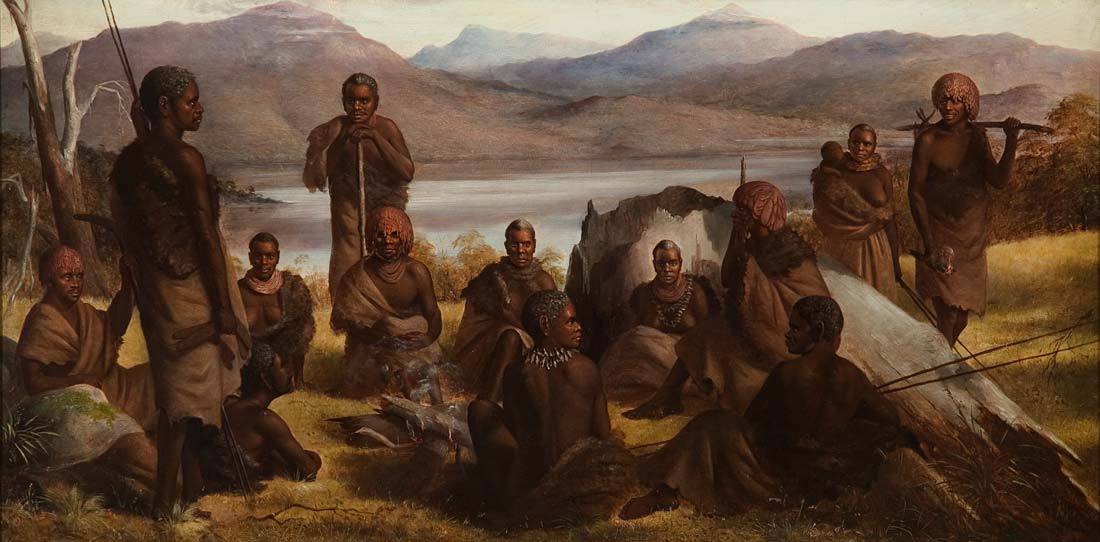
In 1857 Dowling travelled to London to study art, sponsored by the good citizens of Tasmania. He stayed there for nearly thirty years, improving his technique to be sure, and acting almost as a conduit of empire.   He made copies of British paintings for an antipodean audience- a portrait of Queen Victoria, for example was sent back to the colonies as an  important official painting. He sent images of empire home, and he brought images of the colony to the metropole. On the other side of the world, he worked up the paintings of Van Diemen’s Land aborigines painted by the ex-convict artist Thomas Bock, who had possibly instructed Dowling in painting many years earlier.  Bock had died by this time, and Dowling copied Bock’s paintings and inserted them into a range of landscape settings in grand History Paintings.  He made multiple copies, with the same central figures in different groupings and with different backgrounds.

Click on the NGV website about the Dowling exhibition for a zoomable close-up and explanation of the painting.

And, true to form, I can find six degrees of separation (even fewer!) from Judge Willis and this painting.  The smiling figure on the right hand side is Tunnerminnerwait, also known as Cape Grim Jack, who was one of the Van Diemen’s Land blacks who accompanied Protector Robinson across Bass  Strait. He was sentenced to death by Judge Willis and executed in January 1842.  If you have access to academic journals at all, there’s an excellent essay by Leonie Stevens in the June 2010 Victorian Historical Journal called “The Phenomenal Coolness of Tunnerminnerwait” ( a rather phenomenally cool title for the article, too!)

In a world where a few snatched bars of “Kookaburra Sits on the Old Gum Tree” can lead to a lawsuit, we might raise our eyebrows at Dowling’s appropriation of Bock’s images in this way. Here’s Bock’s version of Tunnerminnerwait on the left, and Woureddy on the right. You’ll be able to easily locate them in Dowling’s picture above.

Dowling’s re-presentations of Bock’s images found their way to the Ethnological Society of Britain and the Royal Academy where they fed the interest in anthropology and primitive societies.  Although these paintings were created in London, using sketches from Bock’s originals, they eventually found their way back to Australia as part of the swirl of cultural artefacts throughout the Empire.

Dowling returned to Australia in 1884 and set up a studio in Melbourne.  He returned to England two years later with the intention of packing up and moving permanently back to the colonies, but died suddenly.  As Jones points out, it’s interesting to speculate how he would have responded artistically to the Australian Impressionists and their take on Australian landscapes.

References

Jones, John.  Robert Dowling, Tasmanian son of Empire, Canberra, National Gallery of Australia c 2010

Stevens, Leonie  “The Phenomenal Coolness of Tunnerminnerwait” Victorian Historical Journal, Vol 8, No 1 June 2010 pp.18-40.

‘Writing Lives: Principia Biographica’ by Leon Edel

1984, 272 p

When I first started on my research on Judge Willis, my intention was to examine his dismissal from Port Phillip in 1843.  I had a bifocal vision: looking at the Port Phillip context and the local trajectory of events that led to his removal, while at the same time evaluating Willis’ own personality and behaviour.  I was often at pains to distance what I was doing from biography.

But now that I’ve upgraded to a Ph D,  I’m looking at his career as a whole, in Upper Canada then in British Guiana, as well as in the interludes ‘back home’ and his eventual retirement as a Worcestershire gentleman.  My emphasis has shifted from a localized event into an analysis of a whole career, and now I find myself more closely drawn into writing a biography.

I don’t know why I find myself squeamish about saying that I’m writing a biography.  After all, I enjoy reading biography , and I have always been attracted to human agency in history whether it be individuals operating within the structure of an institution, or “history from below” that takes the lived experience of humans as its touchstone.  From a methodological point of view, I’ve very much enjoyed reading Richard Holmes’ work here and here, and now I’ve read Leon Edel’s book which Holmes quoted often.   Both Holmes and Edel are literary biographers – i.e. they write biographies about other writers- so they find themselves working both with text and life.  Nonetheless, much of what they say applies to biography more generally.

Edel commences his book with an “Introduction in the form of a manifesto” which over four or five pages encapsulates his principles of biography- a document that will yield up many “Uplifting Quotes for an Uninspired Historian”. He has several biographical heroes, whom he mentions often. There’s Boswell (of course!) who, although denying “melting down” Johnson’s conversations did in fact manipulate his subject by setting up situations where Johnson would display himself.   He quotes Lytton Strachey, Andre Maurois, Van Wych Brooks, and spends a long time on Virginia Woolf, herself the daughter of the Big Daddy of Biographers, Leslie Stephen. In particular he counterpoints her fictional work Orlando, which jibes at biography and mocks chronology, against her ‘straight’ biography of Roger Fry where, like all biographers she bemoaned:

how can one make a life out of six cardboard boxes full of tailor’s bills, love letters and old picture postcards?”

Edel speaks often of the “new biography” (which doesn’t seem so new anymore) which experiments with form, and draws on art and fictional techniques in creating its narrative while remaining true to the sources.  He is open to psychoanalytic techniques and finding “the figure under the carpet”, while acknowledging that of course the biographer and her subject cannot be equated at all to therapist and patient.  Nonetheless, drawing on psychotherapeutical approaches,  he is attuned to the life-myth that drives human action, and the mask that individuals adopt to confound it.

We must consider two kinds of myth: the myth we perceive with our eyes and sense of observation; and the covert myth, which is a part of the hidden dreams of our biographical subjects, and which even they would have difficulty to describe because these are lodged in the unconscious, in the psyche.  The covert myth has to be deduced from the public myth, and from the stray bits of psychological evidence offered us by our subjects, the little hints, the casual remarks, or the poetry or prose set down out of themselves…

….  In an archive, we wade simply and securely through paper and photocopies and related concrete material. But in our quest for the life-myth we tread on dangerous speculative and inferential ground ground that requires all of our attention, all of our accumulated resources.  For we must read certain psychological signs that enable us to understand what people are really saying behind the faces they put on, behind the utterances they allow themselves to make before the world. (p. 161, 162)

Many people have warned me off “psychological history”.  I haven’t read much of it at all- in fact, probably only Judith Brett’s Robert Menzies’ Forgotten People. I’m not particularly comfortable with the language and theory of Freudianism and Lacanism and other “isms” in general- I find them smothering.  But much of what Edel is stretching for in the dilemma of the biographer’s art does ring true in my own research, just in Port Phillip, and I’m excited to see if it is a way of drawing together my story of this colonial servant in three different colonies where there are so many commonalities.  I think that I really do need to swallow hard and admit that, yes, I’m writing a biography.

‘Status Anxiety’ by Alain de Botton

2005, 314 p.

What’s not to like about a book that reassures you that your malevolent feelings are basically unfounded and then goes on to give you a string of ways to get over it?  At a very boiled-down level, this is what Status Anxiety by Alain de Botton does.

The book is divided into two halves: causes and solutions.  What a sane, philosophical way of looking at the world!  We feel anxious, belittled, despondent and envious of others because the snobbery and superiority of others undercuts our self-image and sense of being loved.   Comparing ourselves with those around us will only make us unhappy,  our expectations are closely related to our level of happiness, and our insecurity is tied up with our dependence on an impersonal economy.  So why on earth do we buy into it, and how do we break free?

There wasn’t really much here that I hadn’t heard before- it’s all become rather ho-hum and in my mind becomes mixed in with Clive Hamilton, Affluenza, Bhutan, Gross National Happiness etc. as explored by weekend magazine articles.

The stronger part of this book is the second section: solutions.  He gives us five to choose from: philosophy, art, politics, Christianity and bohemia.  The Philosophy chapter reminds us that  we can, through reason, choose to acquiesce in status anxiety and it dusts off all the old philosophers- Aristotle, Epictetus- to reassure us that the power rests with us.  We can even cultivate a Schopenhauerian misanthropy and shrug that most people are stupid and ignorant, and their good opinion isn’t worth having anyway.  In fact, that’s what my mother always told me.

I enjoyed his Art chapter, liberally interspersed with landscapes, ruins and towering masonry. The Christianity chapter reminds us of Jesus’ softer teachings while choosing to overlook that the Church has been just as, if not more strenuous in ensuring its own wealth (and hence status) than family dynasties and entrepreneurs have been.  The Politics chapter points out that the  criteria by which status is judged alter over time, can be contested and overthrown.  The Bohemia chapter was interesting, but I suspect that many of his poets, artists and bright young things could only choose to reject wealth, work and responsibility because in the background there was a family who would save them in extremis if they would let them.

The book is lavishly interleaved with art work throughout and presented as a mindset that you can choose to adopt or reject.  It is written in a beguiling, reassuring conversational tone far removed from the aggressive, egotistical point-scoring that struts as ‘philosophical discussion’.

‘The Good Man Jesus and the Scoundrel Christ’ by Philip Pullman

2010, 245p.

As a good Unitarian girl, I thought that I was going to enjoy this book.  After all, there’s lots to like about Jesus’ anti-materialist, subversive teachings: it’s all the St Paul baggage and the tottering pile of theology, misogyny and hypocrisy  piled onto Jesus’ words that repels me.  So the idea of separating out the “good” Jesus from the rest of it quite appeals to me.

But I was disappointed in this book.  It’s told in the simple, passionless, slightly patronizing tone of the Good News bible, divided up into short chapters with a heading.  It catches the biblical tone so well that when you’re reading Pulman’s version of a bible story you’ve heard many times, you find yourself having to think hard about whether the nuances he introduces change the meaning substantially or not.

As you probably know about this book, Jesus and Christ are twin brothers and, despite appearances to the contrary at the start of the book,  the rather namby-pamby Christ finds himself the onlooker as his more feisty brother Jesus gets all the attention.  Jesus’ activities attract a string of miracle-seekers,  the opprobrium of the  authorities and a rather curious Stranger.  We are led to suspect that this Stranger may (or perhaps not) be Satan as he co-opts Christ as an informant on Jesus’ activities  and encourages him to document Jesus’ sayings  so that they can be tweaked later on, once the church is up and running.  In this regard, the book is like a sober version of The Satanic Verses, with an earnest discussion that pops up in several chapters about the relationship between truth and history.

The polemic heart of the book lies in the long chapter about Jesus’ tussle in the garden of Gethsemane where he trots out the usual string of qualms about Christianity and the Church.  The book ends with a thoroughly unconvincing explanation of Christ’s participation in the creation and manipulation of the resurrection-that-never-happened, and the conflation over time of Jesus and Christ into one historical identity.

It was probably this narrative leap at the end of the book that lost me completely.  Until then I’d been lulled by the familiar tone, ho-hummed through the debating jousts, and nodded at the arguments about spin, creation and truthtelling.

Apparently this book was written as part of the Canongate Myth Series where authors commissioned to reimagine and rework ancient myths from varied cultures, and it certainly fits the bill in this regard.  The device of splitting Jesus in this way is an inspired one that reinforces Jesus’ humanity and radicalism.  The problem for me was the act of putting them back together again, and it was at this point that I felt as if I’d been conned.

‘A Manifesto for New South Wales” Edward Smith Hall and the Sydney Monitor’ by Erin Ihde

Who’s Edward Smith Hall, you say?

He was the editor of the Sydney Monitor between 1826 and early 1840, which makes him exceptional among the highly fluid editorial scene in colonial New South Wales.  Many editors lasted only two or three years before their papers either faltered or merged and transformed themselves into yet another entity. So as Erin Ihde points out in this book, the Sydney Monitor under the editorship of just one man provides us with

…not just a newspaper but a most important manifesto, one which outlines a complex social vision as it evolved, on deeply laid principles, over a period of fourteen years.  In it we see revealed more clearly than in any other accounts, including the works of Wentworth and Macarthur, the intellectual problems faced by one person in their quest to clarify their hopes for New South Wales. (p. 244)

Edward Smith Hall was born in London in 1786, one of six sons of a bank manager.  He arrived in Sydney on 10th October 1811 bearing a letter of recommendation from Peel, the under-secretary for War and the Colonies, citing contacts with two other M.P.s   On the basis of this recommendation, he received several land grants but the life of a pastoralist was not for him. He became involved in merchant shipping and banking, then in 1826 established the Sydney Monitor.

Ihde’s book is an intellectual history, and it draws mainly on Hall’s editorials and articles over a 14 year period.  Hall seems to be a hard man to pin down intellectually, given often to puzzling logic and outright contradiction.  In a time without official political parties as such, over such an extended period of time, and under the pressure to generate two, and by 1836 three issues a week, it’s perhaps not surprising that his stance shifted on the hot topics of the day.  Moreover, many of these topics were just as thorny and contested and “wicked” as, for example, climate change and asylum seekers are today.  They were, as our ex-Prime Minister might have said, the great moral challenges of their time.  Nonetheless, Ihde has set out to try to trace Hall’s underlying philosophy and having attempted a similar endeavour with Judge Willis, I have some appreciation of how difficult this can be.

Hall operated from a practical Evangelical, yet surprisingly liberal Christianity- a contradiction right from the start.  He placed more emphasis on moral character than status; he believed strongly in the “moral economy” and the rights of free-born Englishmen and did not accept that convictism cancelled out these rights.  He strongly supported the continuation of transportation, and yet was seen as being an advocate for emancipists.  He acknowledged the Aborigines as the original possessors of the land, and yet accepted as part of the natural order of things that the Aborigines would be usurped- or rather, than the superiority of Englishmen would lead to their ‘adoption’ of the land.

He has been characterized as “changeable” by later historians, but Ihde argues instead that

…Hall’s stances on various issues prevent his easy classification as a supporter of any single ideological or political grouping for any length of time.  The complexity of his views and his struggles to find solutions to fundamental moral problems meant that while on the surface he appeared to be subject to abrupt changes of mind, in reality he was driven by a clash of circumstances and principles.  His contradictions were the result of his search for all-encompassing solutions…Hall has been portrayed by historians as having a very changeable attitude.  Such a view is unfounded. (p 245)

Ihde largely restricts his analysis to the columns of the Sydney Monitor.  His book commences and closes with biographical details about Hall himself, but Hall as a living, breathing Sydney man does not come through clearly through the body of the work.  I suspect that Ihde would say that this was not his intention: the book emerges from his doctoral thesis, and the blurb on the back of the book tells us that he is working on a full-scale biography of Edward Smith Hall- an admission that this book has not told all there is to tell about Hall.   Ihde consciously decides not to enter into Hall’s imprisonment for libel because, as he points out, other historians including C.H. Currey and Brian Fletcher have already ploughed this field.   I found myself disappointed by this.   Along with interest in how Ihde dealt with the intellectual beliefs of a “changeable” public figure, I was curious to see how Hall, bearing the religious, philosophical and intellectual beliefs that Ihde has analysed,  reacted as a man and public figure when they had real-life, physical consequences.  While Currey and Fletcher may have already described the situation, they did so from the perspective of Forbes and Darling, not from Hall himself.

So is it fair to judge a work by what the author has made a conscious decision NOT to deal with? There’s always a tussle between what a reader wants from a book, and what the author him/herself has marked out as the territory in which they want to excavate.  Part of the argument lies in convincing the reader stay with the author in that part of the field instead of gazing over the fence and wondering what’s over there instead.  I’m not sure that Ihde managed to do this with me completely , but in terms of technique, I gained much from watching a historian dealing with inconsistency and contradiction in the search for a philosophical bedrock in a public figure.

25 June? E.S. Hall wishes you Merry Christmas

From Edward Smith Hall’s Sydney Monitor26 December 1836

Yesterday was Christmas Day…Instead of the old English fire-side, with skaiting [sic] outside and shooting partridges among the turnips, or tracking hares amid the snow, we have a torrid heat, rendered still more oppressive by the steam of extra dishes rising in our faces at meal-times, and causing the sickly appetite with which we sit down to our Christmas fare, entirely to depart.  At church, instead of feeling the comfort of the fire in the tremendous stove, eight feet high in the middle of the church, and of being habited in a great-coat and lamb’s-wool stockings, we could scarcely sit for the heat, although clothed in slight cottons.  In the evening, we are gasping for breath, while the musquitoes and sand-flies worry us at all points- face and wrists, the fine dust from the garden [sticking] to our warm faces and suffusing the room at the same time; so that at length we throw ourselves on the mattrass and try to forget the “merry” Christmas of New South Wales, by getting beneath the musquito-curtains. Such is Christmas-day in this Colony.

…Are we to be for ever troubled with the heat on the anniversary of an event which transpired in winter?- are we to be such slaves to precedent, as to violate a divine festival in its most essential physical points, but continuing to substitute for the winter’s cold of Judae [sic], the torrid heat of an Australian summer?

Well, no- because he had a better idea!  Christmas in winter- in fact, on the 25th June.  After all, the climates of Judaea and NSW were exactly the same, with the same mild winters (?? I’m not sure about this argument!)  Changing Christmas to June would

abrogate the present anomalous and unscriptural custom of celebrating the birth of our Saviour, which took place in the depth of winter, in the middle of summer.  Then we shall be Englishmen, in this respect, once again; and merry, gladening [sic], heartsome, hospitable, recreable [sic], delightful CHRISTMAS, will return to console us for our long exile from the land of our fathers.

But they needed to do it before people became accustomed to a hot Christmas day

If this law be deferred until the Australian-born be all grown up, and their children after them, a hot Christmas, will be to them, the natural Christmas, and they will not comprehend a frosty and cold Christmas, and will object to, as far as their feelings and sympathies may influence them; though their judgment [sic] must see the propriety of the change now proposed by us.

Obviously, E. S. Hall didn’t prevail and he was right- future generations did come to see a hot Christmas as natural.  But happy 25th June anyway.