Author Archives: residentjudge

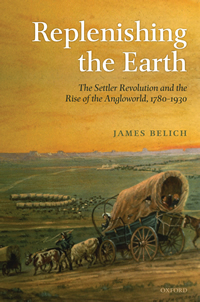
‘Replenishing the Earth’ by James Belich

Replenishing the Earth: The Settler Revolution and the Rise of the Anglo-World 1783-1939, Oxford University Press.

2009, 579 p.

Melbourne, formerly Port Phillip, is mentioned right from the opening words of this book.

Let us begin with two problems in urban history, exemplified by two pairs of cities:  Chicago and Melbourne and London and New York. (p.1)

Why did Chicago and Melbourne undergo such explosive growth, and why in 1890 were London and New York the only two mega-cities in the world?  And why are these four cities English-speaking? Given that there were other empires and cultures- the Portuguese, French, Dutch, Chinese, Russian- that could have rivalled or even exceeded the British empire, why didn’t they?

Replenishing the Earth is a big book that asks big questions and gives big answers.  Big ideas demand mental dexterity of readers, and Belich asks us to do some geographical somersaults as well.  He speaks not of  the “British Empire” as such, but of the Anglo-world, composed of two parallel, twinned structures (I wish I could show you the diagram- see Note 1 below)

To visualize this two-pair Anglo-world, imagine a malleable map like those used to illustrate pre-historical continental drift.  Place your thumbs above Florida, and your forefingers firmly in the Great Lakes.  Prise the United States apart along the line of the Appalachians, splitting it into Atlantic East, roughly the original thirteen colonies, and the vast American West.  The East, in our period, was an emigrant society as well as an immigrant society.  It was one of the world’s greatest sources of long-range migration and investment.  It was the American ‘old-land’, a metropolis equivalent to Britain.  Now gather up Australia, New Zealand, and with some hesitation, South Africa and place them in the Central Atlantic.  With Canada, the Dominions make up a water-linked ‘British West’. This West and old Britain combined to comprise ‘Greater Britain’, the white, un-coerced part of the British Empire, the British flank of the Anglo-world.  Here we have two metropolises or ‘oldlands’, the British Isles and the US East, and two Wests or constellations of ‘newlands’, land-joined in the American case and sea-joined in the British. p. 70

These two parallel ‘oldlands’  (i.e. Britain and Eastern America)  spawned what he calls a ‘settler revolution’ as people, technology and communications flooded into the ‘newlands’ (i.e what became the Dominions and Western America).  This might be thought of simply as good old-fashioned colonization but he separates out four phases that have their own rhythm:

  1. incremental colonization- the slow development of small settlements along trade routes and waterways, looking seaward with their interiors viewed as wild back-country
  2. explosive colonization.  This occurred from 1815 onwards with the mass transfer of technology, money, information, skills and people.  The settlers demanded oldland support, often on their own terms, and the whole scenario usually ended with a bang
  3. re-colonization.  Once things went pear-shaped, settlers cast about for an export that fed into oldland demand that would rescue their local economy- sheep, tallow, timber etc.  In this regard, “[t]he Anglo-world was built like a coral reef on layer after layer of fiscal corpses” (p. 206)  But this was not necessarily exploitative, but a matter of mutual dependency. By integrating themselves into the oldland economy, they saw themselves as part of ‘Greater Britain’ or ‘Greater America’, and “virtually metropolitan co-owners rather than subjects…” p. 180
  4. decolonization. This works only for the British scenario, but it marked the emergence of real as distinct from nominal Dominion independence.

His book focusses mainly on explosive colonization and re-colonization and he argues that the boom-bust waves run as an undercurrent through the histories of the newlands and their relationship with the oldlands.   He suggests that being aware of these rhythms is akin to being attuned to the seasons when describing agriculture- something that I had sensed myself in my own work with Judge Willis in Port Phillip during a time of financial bust, reflected in my several postings on this blog on the Twelve Apostles.

This book invites those who study settler pasts to add another colour to their palette. A booming settler society was very different from the same society in busts, or under re-colonization.  The mood was different, the atmosphere was different, the popular culture was different.  Social structure, crime levels, labour relationships, and gender relations in an explosive colonial society all differ significantly from those in a re-colonial one. (p. 548)

This book draws heavily on economic history: you only have to look at the secondary sources he has used to see that.   This is not the type of history with which I am particularly comfortable, but he adds to the ‘rational choice’ explanation of human economic activity another less measurable influence.   Immigrants, or their immediate forebears, had often shifted internally within Europe in preceding decades, and they were not moving as strangers into another people’s society, but were instead part of the cloning process whereby Anglophone language, institutions, credit and finance systems, plays, books, newspapers, fashions were transplanted into newland territories.  There were always the ‘boosters’ in these newland communities who spruiked the climate, the riches for the taking and the opportunities for settlers- and even the terminology that came to be used for the newcomers is important here-  but the mass transfer of people happened because of what happened in people’s heads when they weighed the possibilities of migration.  This, too, is an approach to history that I feel comfortable with.

His book focusses on the Anglo-phone world, but he makes -rather unclearly-  a distinction between Anglo-phone and Anglo-prone.  Quite apart from the linguistic punnery here, he is at pains to point out that many of the features he identifies are not exclusive to English-speaking peoples, but that they were more likely to display them than, say, French or Spanish societies. His book also encompasses Brazil, Argentina, Siberia, Algeria and Manchuria as alternative scenarios.

There are big ideas in this book, and I can’t do justice to them.  In fact, in a blogpost of this length I can’t even give Belich’s answer  to the questions he posed in his opening sentence above.  I am in awe of the breadth of reading that the author has undertaken and the sheer size of the explanation he offers.  I could not write this sort of history- I admire those who can- but I don’t know if I would necessarily want to, even if I could.  I found myself sitting up a little straighter once people and voices were brought into the spotlight, and I think that reflects my own historical leanings.

Note

You can see the map if you go to the Googlebooks page and search for “The Two-Pair ‘Anglo-World'”. This will take you to Page 70, from which you can go back one page to p.69 where the map is shown.

Other reviews of this book:

The Independent 3 July 2009

The Times Higher Education 27 August 2009

Andrew Smith’s blog (which is where I read of the book, then made the connection with the Keynote speaker at the recent AHA conference- that’s Australian Historical Association, by the way)
Another way to while away a half hour or two…

By looking at pictures.  Beautiful, clear, intimate, sensitive colour pictures.  They were taken by the Farm Security Administration/Office of War Information (and I find myself wondering about the conjunction of the names here) during the late 1930s and early 40s.  Wikipedia tells me that the Farm Security Administration was set up during the Depression to improve the conditions of sharecroppers, tenant farmers and very poor landowning farmers by resettling them in group farms on more suitable land.  My! this all sounds rather socialistic, and obviously the Conservative Coalition thought so too, as the program was reshaped to help poor farmers buy their own land.

Anyway- look at these beautiful colour pictures, and here’s an even larger black and white collection at the Library of Congress.  I’m off to indulge….

‘The Lion, the Eagle and Upper Canada’ by Jane Errington

The Lion, the Eagle and Upper Canada: A Developing Colonial Ideology

1987, 192 p & notes.

This book, developed from the author’s Ph D thesis of a similar title, won the Corey Prize for 1988.  So far I can still count the number of books I have read on Upper Canada on my fingers, but even I was aware while reading it that I was tiptoeing across what we would characterize in Australia as a “history war”.  Has Canada had its own history wars? I suspect, from this article, that it has.  No doubt I shall soon become more familiar with all this.

In her introduction Errington identifies the characterization of Canadian history that she is arguing against- i.e. that hardy British-American settlers fled the destructive influence of American democracy and republicanism and established a new, counter-revolutionary British society in Northern America that “rejected all things American while embracing 18th century British conservative values and traditions” (p. 4).

Instead, she argues, there were ongoing personal and intellectual links between settlers who had crossed to Canada, and the families and friends they left behind in America.  The major communications links with England passed through America; people crossed the border both ways, and there was a strong interest in federalist politics particularly as it played out in the nearby American state of New York.  She argues that rather than a horizontal line drawn between Canada and America, there was a cross-border sympathy between the Canadian reformers and their ideological brethren, the American federalists.  The settlers who crossed into Canada were not British themselves: they had been born in America and the vast majority of them never set foot in England.  She argues that Upper Canadian society was shaped by the dual influences of Great Britain and America, and that the political  controversies of the 1820s and 1830s had at their heart differing perceptions of the British constitution and parliamentary traditions- whether the principles, or the image,  of the British constitution should apply there.  There are resonances here with the same issue for Australian judges and governors at the same time:  the relevance of what we would now sneer as “one size fits all” law and policy.

Errington flags right from the beginning that she is taking a view from the top, restricting her analysis to the articulate elite:

This study is an attempt to understand what some Upper Canadians, those few individuals who were recognized as leaders of their communities, actually believed about themselves and about others, particularly the United States and Great Britain, and how their views of themselves intersected and depended upon their views of others and changed over time. (p.10)

She draws heavily on newspaper articles and the personal correspondence of a number of key individuals, particularly Richard Cartwright, John Strachan and  Stephen Miles whose perspectives appear throughout the book.  Perhaps it is because this area is new to me, but I found myself wishing that she had fleshed out these characters a little more, given that they were to be the chorus of voices heard throughout- perhaps in the way that Inga Clendinnen did in Dancing with Strangers, so that each time you encountered them again, it was like meeting an old friend.

I gather from some of the reviews I have read of this book, that it was felt that, by concentrating on the views of the elite,  she overlooked other arguments in making her own.  That didn’t worry me at all- it is the views of the elite that I need for my own purposes.   She does address the issue of her close focus in the introduction, but perhaps it was a methodological choice that she needed to prosecute more insistently.

I’ve already spoken of my interest in the way she integrated quotations into her analysis,  and I certainly felt as if I was reading a viewpoint, formed and promulgated over time by living, inconsistent, evolving people rather than a political stance delivered ready-made.  I like the way that she emphasizes the evolving and contingent nature of political ideas, the effect of generational change on political protest, and the way that British and trans-colonial ideas, events and politics played out at a local level.

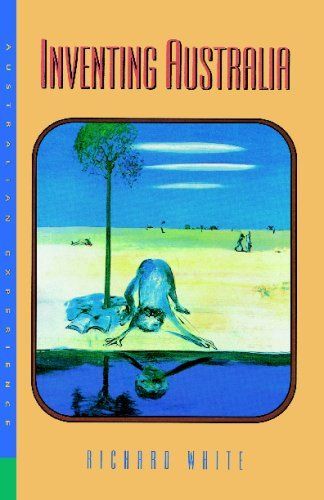
‘Inventing Australia’ by Richard White

1981, 171 p & notes

Inventing Australia is one of those books that appears in many, many bibliographies but I hadn’t read it until now.  The grammar of the title is important- Inventing Australia- because his argument is that the search for a distinctively Australian identity is an ongoing and never-ending one. It’s not like Benedict Anderson’s Imagined Communities where the tense of the title suggests that the concept of community identity has been developed and reified. 

In the introduction, White argues that

When we look at ideas about national identity, we need to ask, not whether they are true or false, but what their function is, whose creation they are, and whose interests they serve (p viii)

This seems unremarkable enough, as does much of his argument in the book because it has infiltrated our understanding of the creation of national identity so thoroughly that it is no longer particularly discernable as White’s argument alone.  I had to remind myself that the book was written in 1981 and although there have been several reprints and White has written other works, this particular book itself remains in the original edition and has not been updated.

The language that runs through the book speaks of classes, intelligentsia and bourgeoisie, which places it firmly within a 1970s/80s historiography.  It traces through the different images of  “Australia” that have been projected by different groups over time- early explorers like Dampier and Cook; Enlightenment philosophers, Social Darwinists, the critics and promoters of transporation, and the critics and promoters of immigration.  Sometimes the image of Australia was consciously crafted by a small group of the intelligentsia, as with the bohemians from the 1890s onwards,  who used their “brand” as a form of artistic protectionism for the local cultural industry. At other times images have been co-opted by conservative forces, as with the returning soldiers after WWI.  Much of this argument builds on, and has been taken further by other historians writing on these topics at much the same time.  I think that John Hirst’s Convict Society and its Enemies, written in 1983, is a more nuanced argument than the one that is presented here;  Graeme Davison had already noted the urban origins of what we think of as “bush” poets and artists in 1978 and Ken Inglis and Geoffrey Serle had already discussed the creation and co-option of the Anzac legend. It’s impossible to tease out, after thirty years, the genealogy of many of these arguments, and to work out what was completely new in White’s book and what has been built on further and incorporated into the work of other historians who followed him. 

However, what does emerge clearly is his insistence that many of the influences that fed into different depictions of Australian identity were Empire-wide and not Australian at all.  For example, he speaks of the approval given to the “bushman soldiers” in the colonial troops as a whole during WWI-  not just the ANZACS.  There  was an Empire-wide expectation of the Coming Man, exemplified by empire-wide  publications  called”Young Australia” and “Young Canada” that were part of a series that was customized for each country. He underscores the importance of “whiteness” in the conceptualisation of the Coming Man, again part of a wider movement.

He notes the shift from the search for a “national type” with its uneasy fascist over-tones to a promotion of “The Australian Way of Life”, just as vague and useful as an exclusionary device in post-war Australia as it is today.   Again, he emphasizes that this part of a more general Western trend, and one that was literally more conservative (in terms of keeping what we already have) and less likely to be co-opted by radicals.

The book finishes with the 1970s youth culture, dissatisfaction over Vietnam, New Left intellectuals, the women’s movement and multiculturalism.  Reading the book thirty years on, the ending seemed rather abrupt and many other later developments flood to mind – tourism,  changes in multiculturalism and immigration patterns, new media, the History Wars- the list goes on and on.  How would these events challenge or alter his hypothesis? I wonder.

Nonetheless, I’m pleased that he has resisted the temptation to keep adding new chapters to the book.  The full title of the book is Inventing Australia: Images and Identity 1688-1980.  Its chosen time frame  takes it right up to what were then current events for a book published in 1981. The argument is made for the time span he chose, and to keep updating it would lessen its force as a historical argument which makes sense within its own chronological parameters.

Uplifting Quotes for the Uninspired Historian #5

‘Being there’ for an historian is the feeling for the past that can only be matched by the hours, the days, the weeks, the months, the years I sit at the tables in the archives. It is the assurance that my extravagance with time here is rewarded with a sensitivity that comes in no other way. It is an overlaying of images one on the other. It is a realisation that knowledge of the past is cumulative and kaleidoscopic, extravagantly wasteful of my energy.

Greg Dening ‘Culture is talk. Living is story’  in Hsu-Ming Teo and Richard White Cultural History in Australia, Sydney, UNSW Press, 2003  p. 232

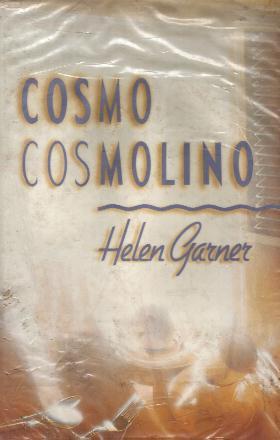
‘Cosmo Cosmolino’ by Helen Garner

1992, 221 p.

Helen Garner is thirteen years older than I am, and I feel as if I have been walking in her footsteps all my life.  Not following her lifestyle, mind you, but watching her with curiosity, as a life that I might have led had I been a little older and more confident. I felt as if I knew Dexter and Athena in The Children’s Bach– in fact, I’m sure I know where their house is!  When I was an undergraduate, still living at home with Mum and Dad, I’m sure that my fellow students were living a far more exciting Monkey Grip life than I was. Like Garner, I felt troubled by the challenge to feminism in The First Stone, and repelled and yet fascinated by Anu Singh in Joe Cinque’s Consolation.  Now that I’m growing older and facing the deaths of parents and friends, I see myself in The Spare Room.  But with Cosmo Cosmolino, published  in 1992 when Garner was fifty, my sense of identification breaks down.

The book contains three stories, tangentially linked.  Cosmo Cosmolino is the longest of the three, and although they are different characters, the lifestyle of its protagonists almost picks up, twenty years on from where the lifestyles of the people of  Monkey Grip left off.  The anarchic share-houses of the 70s are now just shells, containing wary, embittered middle-aged people, somewhat discomfited by the capitalist mores they found themselves adopting almost in spite of themselves, and younger drifters in a world of marginal working lives that is less tolerant of the artistic temperament than the 70s were.  These are people whose family relationships are just single strings rather than a densely woven fabric; there is a bleak loneliness about their situation and their outlook.  They are trying to find some meaning in their days, either through trying to recreate an idealized past of share-houses now gone, or through a fervid evangelical Christianity or a loopy new-age spirituality.

I’m not sure if my discomfort with this mushy angel-think is a reflection of my own cynicism, or whether it is because the book is nearly twenty years old.  Perhaps in the early 1990s, belief in angels was not so twee and flaky- after all, didn’t they market those bumper stickers “Magic Happens” back then? When were healing crystals and all that other dusty paraphernalia around?  There’s something pathetic about this book, and I suspect that it was not intended to be so.  I think that Garner is genuinely working through issues of spirituality and meaning.  It’s just not a quest that I find particularly compelling.

‘Bright Planet’ by Peter Mews

2005, 295 p.

I was browsing around my local library the other night and caught sight of “Bright Planet” and smiled.  I read it several years ago and loved it, and given that some of you may have been lured here by a search related to early Port Phillip, you might love it too.

I’m a difficult customer as far as historical fiction is concerned.  I feel smothered by too much research if  it means that the story is battling to escape, but on the other hand I am annoyed by small inaccuracies and a basic inauthenticity when twenty-first century ideas are put into nineteenth-century heads.  I first heard of this book during the brouhaha between Kate Grenville and Inga Clendinnen over Grenville’s book The Secret River, where it was held up as an example of a novelist using history well.

Bright Planet is the name of a ship- and it really is, too!  After reading this book, each time I came across Bright Planet in the shipping news column in Port Phillip newspapers, I’d have a little smile to myself.  It sails into Bareheep (one of the early names suggested for Melbourne, and strongly recognizable as Robyn Annear’s Bearbrass)  and the small town forms the backdrop for a succession of walk-on Port Phillip characters, Johnny Fawkner,  John Batman complete with his diseased nose and Mr Le Soeuf the Aboriginal protector.   There’s a slew of fictional characters as well, who could just be true, including Quiet Giles the botantist, who sails up what seems like the Yarra on a fictional expedition.  In best Voss-meets- Monty-Python tradition, there are a string of deaths through a whole range of misadventure, and it’s an irreverent romp through a young, bawdy town on the edge of the unknown.  It’s not true and it plays with the historical fiction genre.  It’s very carefully researched and, in its way is a critique of colonialism and imperial masculinity.  But don’t let that put you off: dammit-  it’s just downright good fun.

If I’ve piqued your interest, there’s a transcript of an interview with the author from the ABC’s Book Talk program.

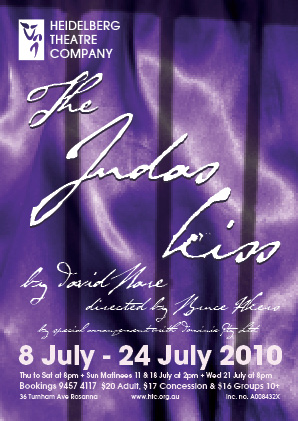
‘The Judas Kiss’ Heidelberg Theatre Company

Once again, I wish that I’d seen this before the final performance so that I could encourage you to go.  Alas, too late (again) .

Written by David Hare, the two-act  play concerns Oscar Wilde and his lover Lord Alf Douglas. Act One is set in a London hotel, just prior to Wilde’s arrest where his friend Robert Ross is trying to persuade him to leave for the continent; the second act is in Naples two years later where Bosie decides to leave the impoverished and broken Wilde to return to London and his family.

I find it hard to see anyone else other than Stephen Fry playing Wilde- surely a part that he was born to play, and there’s a danger that playing such a flamboyant figure can descend to parody. But Chris Baldock, playing Wilde made the part his own, to the point at the end of the play where there was absolute silence as the audience collectively held its breath, then exhaled.  In a wonderful performance,  Baldock as Wilde was on the stage for almost the whole time, burbling forth a stream of dialogue,  then lapsing occasionally into a deep, black silence that in itself spoke volumes.  Tim Constantine as Lord Douglas captured his petulance well, but also his insecurity and jealousy.

There was a warning about nude scenes and cigarettes, and I must admit that the nude scenes were rather more than I expected! Must be a David Hare trademark- wasn’t ‘Our Nic’ nude in her performance of Hare’s The Blue Room?  It’s just as well that the theatre itself is so well heated.

I don’t always go to HTC productions, but I have been to a few. There’s something quite warming about a local theatre: looking around the audience and always spying someone that you know, the sherry before the performance, the squeaky orange seats that, in this case, fell silent too at the end of the play.  This was certainly the best performance I’ve seen there, and I only wish that I’d gone earlier in the season so that I could tell more people about it.

An Invitation to the Ball

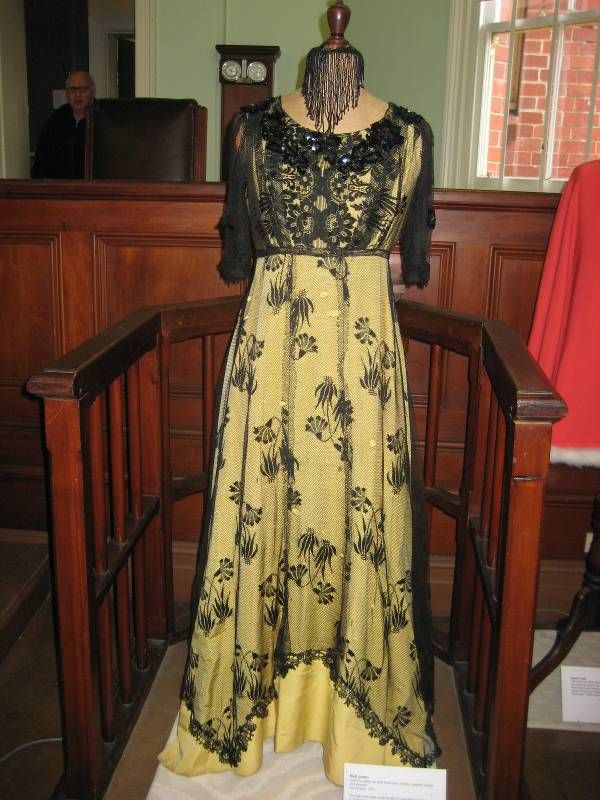
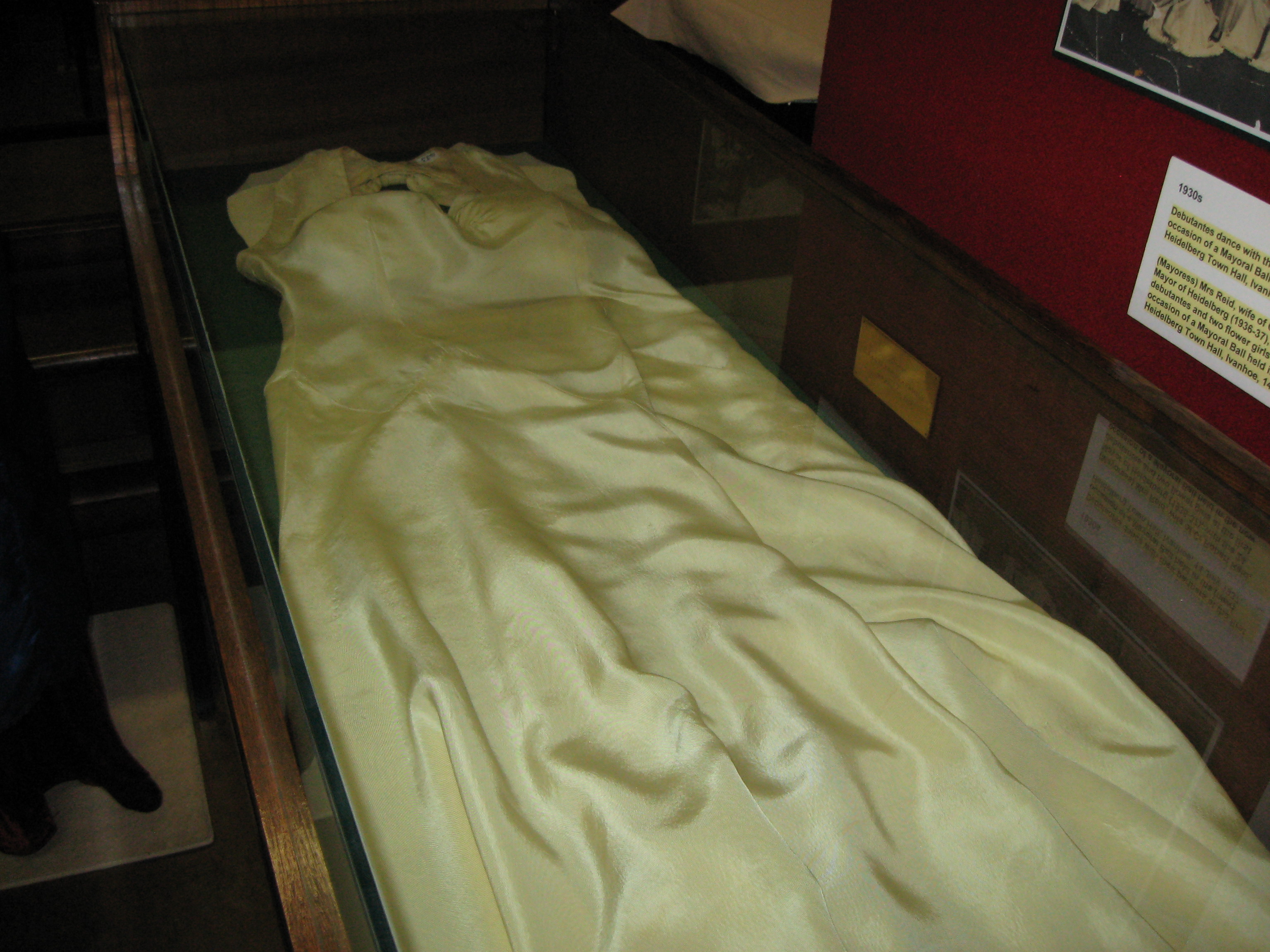
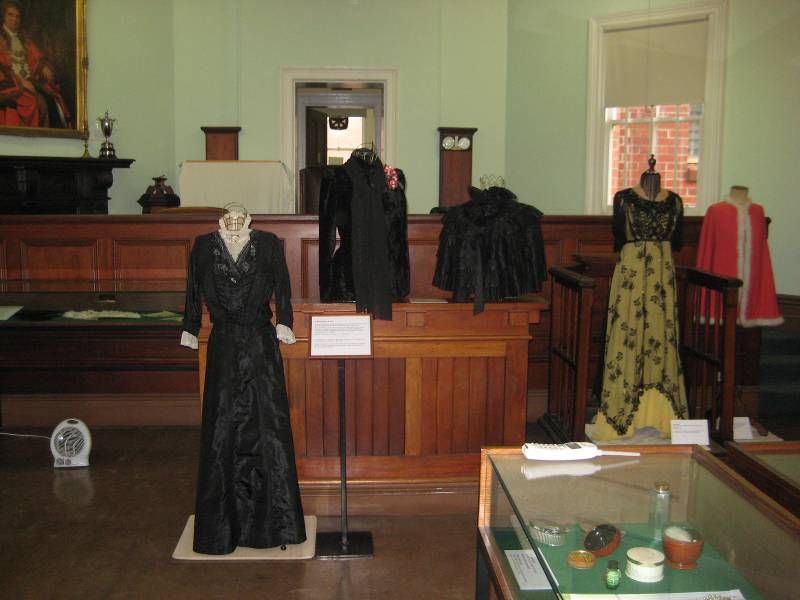
And now for a bit of shameless advertising. My local historical society has been hard at work recently putting together an exhibition called “An Invitation to the Ball”.  The inspiration for the exhibition arose when the curators were transferring our textiles collection into new textile archive boxes.  Many of the items had been donated forty years ago when the Society was in its infancy, and surveyed as a whole, we realized that we had a collection of beautiful objects.

There is, of course, the much more extensive costume exhibition on at the NGV at the moment, but what I really love about this exhibition is that the displays are interwoven into a broader history of the Heidelberg/Ivanhoe area.  The focus is on women’s formal wear between 1850 and 1950, and there are many connections between formal occasions and the nearby Heidelberg Town Hall, the site of many mayoral occasions, debutante balls, concerts – to say nothing of regular Saturday night dances.

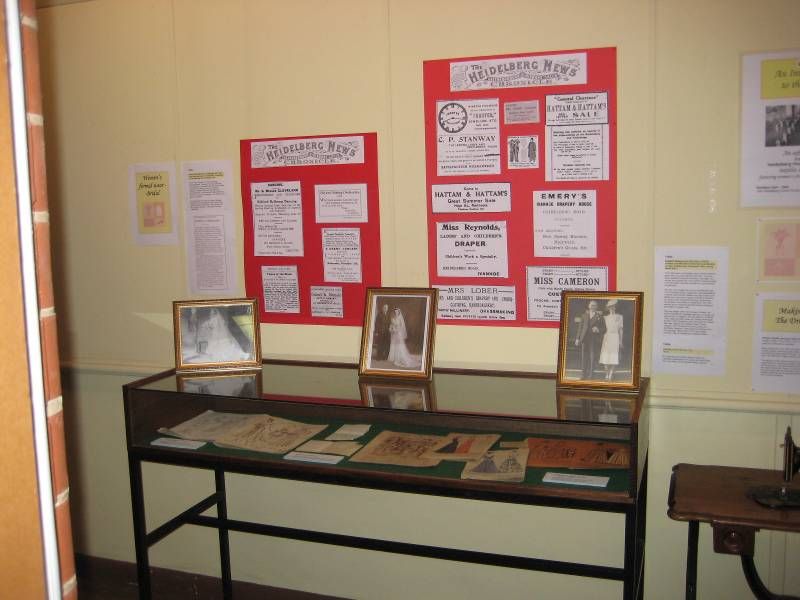
Because these are garments worn locally, we were able to trace through the original wearers and the occasions on which they were worn.  A search through our records and photographs found studio photographs and invitations for a debut ball held in the 1930s which, supplemented by an oral history memoir, are displayed beside the dress itself.  We were able to identify the lady mayoresses who wore particular gowns, and we found records of a number of formal occasions held in nearby facilities including “Sunday afternoons”, concerts and sporting festivals.

We were also able to locate, through our holdings of local newspapers,  advertisements for the web of haberdashers, drapers, outfitters and shoe shops in the local shopping centres- particularly the women dressmakers, all coyly named Miss or Mrs, and often formerly of Collins Street or other addresses.

The exhibition is open on Sundays 2-5 and will run until November 2010, so unlike most events that I write about here, it’s not closing soon!  Entry is $5.00 for adults, $2.00 for children under 16.  The Heidelberg Historical Society Museum is on the corner of Jika Street and Park Lane, Heidelberg. If you live in the northern suburbs you’ve probably driven past it dozens of times on the way to Burke Road. And who knows,  you may just even see me there!

Quote? Unquote?

I’m reading and very much enjoying a book by Jane Errington called The Lion, The Eagle and Upper Canada: a developing colonial ideology.  The book was awarded the Corey Prize in 1988, a prize for the best book on Canadian-US relations, jointly sponsored by the American Historical Association and the Canadian Historical Association.  Reviews that I have read about the book at time of publication have not been universally glowing, but I’m enjoying it nonetheless, oblivious as I am at this stage of the nuances of US-Canadian historiography and politics.

One thing I have noticed, though, is that she does not use block quotes but instead snips them up and integrates them into a paragraph. For example:

On 3 June 1814 Rev John Strachan preached a Thanksgiving Service to his congregation in York celebrating the deliverance of Great Britain from the devastating conflict in Europe. “Thankfully and devoutly” he declared, we “acknowledge the mercy and goodness of Almighty God; for protecting His Majesty and His dominions during the whole of this arduous contest; and for the signal and glorious victories obtained by its armies.” “Our joy is full,” he continued, “when we reflect that … Great Britain has been chiefly instrumental, through the blessings of God, in bringing about the happy changes which we now contemplate.” “Truly” she was “the preserver of the independence of Europe” and “the proclamation of peace,” he declared, would triumphantly bring her to “a new era of glory.” And though peace had yet to be won in North America, Strachan called upon Upper Canadians to “rejoice”. We have earned “the happiest time…now rising upon us,” he maintained. (p.97)

This quote is duly footnoted as “Strachan, A Sermon Preached at York on the third day of June, Being the Day Appointed for General Thanksgiving, 1814, 22-3, 38, 34.  It reads smoothly, and it’s only when you look closely that you notice the rather clunky double inverted commas.

Still, I find myself a little uneasy about it.  It reminds me of the technique of “The Week” magazine, to which I subscribe largely because of the generous discount for subscriptions.  As a way of distilling the essence of commentary (and perhaps to avoid copyright issues), the magazine likewise uses snippets of sentences in inverted commas, although sometimes I wonder why they choose such banal words to highlight in this way. For example, it summarizes Rex Jory’s column from “The Advertiser” in this way:

The perfect monopoly has struck again, says Rex Jory. The price of postage stamps “crept up” 5c to 60c last week, and what could we do about it? Nothing.  This is preposterous and outrageous. It’s bad enough that Australia Post can charge “pretty much what it likes” but it also “contemptuously” refuses to provide a weekend service.   etc etc.

Errington’s integration of snippets into a prose summary probably does justice to the sentiments expressed- possibly better than verbatim slabs would have done, but I feel wary- what if she’s misrepresenting what is said?  Although, short of slavishly writing out the whole document, how is any reader to know that paragraphs are not chosen selectively and skewed by ellipses and omissions?

I think, too, of the advice given in Ann McGrath and Ann Curthoy’s recent book How to Write History that People Want to Read that examiners and readers always skip over slab quotes anyway.  Do they? Do I?  I must admit that I think I do sometimes.  I think I’m looking for the analysis rather than the evidence.  Yet the fear of plagiarism or sloppiness prods me into backing myself up when I am writing, even though I don’t always read the evidence when somebody else backs themselves up the same way.  Errington’s technique weaves the analysis and evidence together in a way where it is less easy to skip.  I think I like it, but I’m still not sure.  A little writing challenge to meet, I’m sure.