Author Archives: residentjudge

‘British Colonial Policy in the Age of Peel and Russell’ by W.P. Morrell

First edition 1930; reprinted 1966, 554 p.

When you change the government, you change the country” Paul Keating once said.  You mightn’t detect it from the title, but this book is not only about colonial policy but also about the ramifications of a change of government on an issue of such importance to 19th British politics and imperial identity.

You’ve got to hand it to the historians of the 1930s when they chose their titles- there’s no tricksy double-barrelled postmodern titles with colons and parentheses here.  What you’re promised is what you get- British colonial policy under the conservative Prime Minister Sir Robert Peel (1841-1846) , and then under the Whig Prime Minister Lord John Russell (1846-1852).  There is some slight blurring of the lines though because the cabinet responsibility for the colonies rested with the Secretary of State for War and the Colonies, rather than the Prime Minister .  Although the Secretary of State  position was a bit of a revolving door during the 1830s with Secretaries coming and going in quick succession,it was more stable under the Peel and Russell administrations.  Lord Stanley acted as Secretary of State for nearly all of Peel’s time as Prime Minister, and Earl Grey was Russell’s Secretary of State for nearly the whole Russell government as well.  So the title could just as easily have been ‘British Colonial Policy in the Age of Stanley and Grey’, although of course the Prime Ministers held the ultimate authority.  Then of course, there was the Under-Secretary of State in the Colonial Office, Sir James Stephen, the civil servant who worked behind the scenes during both administrations.  Perhaps the title could expand to encompass Peel, Russell, Stanley, Grey and Stephen- but try fitting that onto the spine of the book!

Morrell identifies two main lobby groups who also exerted pressure on colonial policy. The humanitarians are well known because of  their influence on indigenous policy, and their anti-slavery and later anti-transportation activities. But the second lobby group, the Wakefieldians or the ‘Colonial Reformers’,  is less visible, and probably less appealing to 21st century activists.  Their systematic colonization cause is tied up with land policy, immigration and labour supply, and their intermixing of commercial and altruistic motivations is problematic for us today.  Their figurehead, Edward Gibbon Wakefield, was controversial and enigmatic then and now.  He had particular influence over a string of British politicians, including Earl Grey, Goderich, Molesworth, Gladstone and Lord Stanley, and because of their positions at the heart of the colonial debate in both conservative and Whig governments, his ideas were promulgated throughout the empire and especially in South Australia and New Zealand.

Structurally, the book is divided into two parts: Peel and Russell.  Within each part  there are chapters  devoted to a single colony- New Zealand, Australia, North America, South Africa, the Sugar Colonies, interspersed with more general chapters dealing with economic policy and transportation. Reflecting the author’s admiration for Earl Grey, the book closes with one chapter on his relationship with the Colonial Reformers and another on Grey’s place in imperial history.

Both Peel’s and Russell’s  administrations were united by a bipartisan acceptance of free trade economic policy, and this thread runs throughout the book.  It was a striking feature of the Peel administration, and it continued during Russell’s time as well.  So was Paul Keating right about a change of government changing the country? Yes, in that Peel’s administration strongly resisted self-government for the colonies and generally took the side of the plantation owners in the sugar colonies, and the Loyalists in Upper Canada.  Russell’s administration, on the other hand, was receptive to Wakefieldian ideas and amenable to discussions of representative and then responsible government,  even though Wakefield and the Colonial Reformers later turned against Earl Grey who had been their great hope as a fellow Colonial Reformer.  The analysis of colonial policy under the two administrations is a nuanced one that recognizes continuity but also detects difference, even if it is a matter of degree rather than stark contrast.

William Parker Morrell was a New Zealand historian, and he died in 1986. I sometimes wish that it was possible to take a book written many decades earlier- (and remember that this book was written in the 1930s) – and using the same structure and question, revisit it again in the light of more recent scholarship and interests.  Not rewrite the original, mind you, but just to look again from a different perspective, to see what has changed and what parts have taken on even more significance.
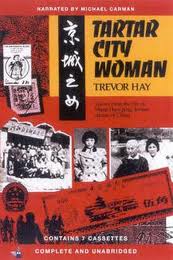
‘Tartar City Woman’ by Trevor Hay

1990, 178 p

I must admit that my heart sank a little when we received our November book for The-Ladies-Who-Say-Oooh bookgroup this month. Yet another book about a Chinese woman growing up in Communist China, I thought.  I’m over all these three-part family saga with grandmother, mother and daughter full of co-mingled admiration and resentment, alternately solved and exacerbated by the magical escape to the Wonderful West.  Well, there were elements of this here, but because this is a memoir of a woman, related by a man (rather than an autobiography), it thankfully lacked some of the emotional tantrum of such books.

Wang Hsin-Ping  grew up among the old gentry class in pre-Communist Peking.  Her father had emigrated to Australia and rather unaccountably disappears from the story completely, and after her mother died, she was brought up by her grandmother.  Members of the family seemed to be able to leave for the West fairly easily, and it was these family connections overseas that compromised her reputation during the various twistings and turnings of  Communist Party ideology as she grew up.  She was a forthright, intelligent young woman, thwarted in her career aspirations by her ambivalent attitude and suspect family allegiances.  Although she lived in a community of suspicion and fear- and I am not under-estimating the effect of this- she was not denounced; not sent out into the country; not beaten or starved or any of the litany of outrages that we often read of in totalitarian societies.  In fact, she testifies to a low-key subversion of authority, albeit over minor details. The peasant village sent her exiled 70 year old grandmother  back to the city because she was useless with her bound feet, and students sent to work in villages simply  returned to the city, in spite of the fact that without their ration books they would be dependent on others for food.

The book opens Trevor Hay’s own reflections on his attitude to China, particularly in the 1970s as he travelled there with an enthusiastic wide-eyed, left-leaning tour group, completely oblivious to Hsin-Ping’s journey in the other direction as she emigrates, seemingly easily, to Australia.  He meets Hsin Ping working in a Melbourne restaurant, and I can only assume that the book is the product of her reminscences and their conversations.  It is not co-written as such, at least in the authorship.

Yet there is a real distance between the teller and the recorder of the narrative. It is a rather cold, bloodless tale, with emotional relationships dispensed with in mere sentences.  Perhaps this is Hsin-Ping’s choice, but Hay does not problematize this in any way.  There is much detail about pedagogy and curriculum, and this ‘teacher’s eye’ view of the world perhaps mirrors the shared professional bond between Hsin-Ping  as an erstwhile classroom teacher and Hay’s own profession as academic in the education faculty at the University of Melbourne.  The book was useful in explaining the U-turns and contradictions in Chinese government policy.

Overall, I found this rather disappointing. It was not the family saga I expected, and for that I suppose I should be grateful, but it felt a rather stilted and incomplete picture of growing up in Communist China.

My rating: 6/10

Read because: it was the November for my face-to-face bookgroup AKA ‘The Ladies who say Oooohh’

Sourced from: CAE bookgroups.

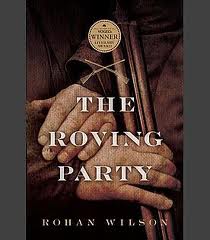
‘The Roving Party’ by Rohan Wilson

282 p. 2011

As a historian, there’s often a jolt when you encounter in fiction a character that you know from your own research.  This is the case with John Batman, one of the main characters of Rohan Wilson’s The Roving Party. Alongside the mirth that his name evokes he has become an emblematic figure, in the same vein as Captain Cook and Ned Kelly. His is a name attached to a picture-book depiction, freighted with a cargo of abstractions: discovery, dispossession, duplicity.  Bain Attwood’s recent book Possession:Batman’s Treaty and the Matter of History looks at the man and the mythology around him in more detail, and Melburnians continue to travel along Batman Ave, and pass Batman Park etc. etc.  For myself, I encountered John Batman in Judge Willis’ Melbourne- or more correctly, I encountered the legal proceedings involving his wife and children in Willis’ courtroom after Batman died with syphilis, insolvent and leaving seven children who were taken into the care of their guardian, Rev Thomson, the Church of England minister.

But the Batman of Wilson’s book is a younger man, employed in Tasmania as the leader of a roving party, funded by the government to capture and remove Aboriginal people from the settled districts as a means of conciliation between the settlers and the dispossessed tribes.  Batman himself offered his services  to Governor Arthur, citing his own familiarity with the countryside and his contact with Aboriginal people who would help him in his task.  These are the men and the situation we encounter in this book: Batman, four convicts, two black trackers from Sydney, a bumbling farmhand and Black Bill, a Panninher man brought up from childhood as a white man, battling the sodden and chilled Tasmanian bush in June 1829, charged with finding and bringing in the remnants of the Plindermairhemener people.

Black Bill is the central character in the book. He has thrown in his lot with John Batman, but, Manalargena the head warrior and Taralta the law-man of the Plindermairhemener have called him, asking him to join them.  They tell him-

…You listen my story.  Three wallaby near the river you see.  Not two and one but three.  Them brother lost, you understand.  They see plenty wallaby.  But no see brother.  Three wallaby near river eat the grass and drink the water but they forget.  Who is brother.  Who is hunter.  They forget this thing.  Now three wallaby.  No one sing.  Them all lost.  All same you see. (p.8)

Who is brother, who is hunter?  Other books sprang to my mind while reading this.  One is Cormac McCarthy’s All the Pretty Horses with the relentless drive of pursuit/escape, and the need to keep going day after day through a hostile and unforgiving environment.  The other is, rather curiously Moby Dick which, although as different in setting as it is almost possible to be, is driven by the same sense of obsession and fear. For having rejected  overtures to join the Plindermairhemener, Black Bill takes the pursuit and capture of Manalargena as his own personal quest and object, irrespective of the  official intent of the expedition.

All three books- McCarthy, Melville and now Wilson- are steeped in blood. In fact, I found it hard to pick up the book again each time, with each chapter opening with another dank Tasmanian winter morning, the cold, the bone-weariness and the hunger.  The violence is always present like mist, even though this is ostensibly a ‘reconciliation’ party.

Much is strange to us as 21st century white readers.  As with Kim Scott’s That Deadman Dance, we encounter Aboriginal language that is presented without translation, and at the end of the book we are brought face-to-face with the essential aboriginality of Bill’s wife “Katherine”, despite her English name.  In fact, there is an unknowingness between us as readers and all these characters.  Wilson does not attempt at all to get into their heads, to explain, to exonerate, to complicate as Kate Grenville tried to do in The Secret River.

Of course, this is Tasmanian Aboriginal history.  After Keith Windschuttle’s intervention, it is probably the most heavily politicized,  contested and trepidacious history there is.  Batman’s leadership of his roving party is part of the official record and Wilson has woven his story out of this ambiguous and shadowy byline in Batman’s larger life-story.  He makes no claims to truth beyond this and does not ask us to identify or judge.  The book’s relentlessness, violence and moral coldness has a nightmarish quality, and the writing is sure and powerful.  No wonder it has received such acclaim.

My rating: 9/10

Read because: my interest in early 19th century Australian history

Sourced from: La Trobe University library.

A-writing I will go

I’m off to Fish Creek for a couple of days with some of my postgrad colleagues for a writing retreat.  The Gods are smiling on us by sending lots of rain our way, hopefully enforcing an inside long-weekend.  Several of us attended a retreat conducted by Ron Adams from La Trobe last year, and we decided we’d like to do it again.

As one of the activities we’ve planned, we were asked to bring a couple of pages from a historian whose writing we admired.  So who to choose?  There is of course my beloved Richard Holmes, but then I realized that even though I gobbled up his Footsteps and Sidetracks, I haven’t actually read any of the biographies that he used as the basis for his meditations on biography and history.

What about Inga Clendinnen then? Certainly right up there in my constellation of historian stars, but Ron’s  workshop made much of the Clendinnen-Isaacs-Dening triumvirate, and I’d like to choose someone different.

Tom Griffiths I considered, and Lisa Ford too.  But in the end, I went for Kirsten McKenzie.  I haven’t reviewed her work in this blog because I read it before I started writing here.  Her book ‘Scandal in the Colonies’ was the book that made me start thinking about how I could deal with Judge Willis.  She combines incisive observations about colonial life, status and behaviour with real-life, sympathetically drawn examples.  The book is replete with beautifully crafted, pithy sentences, but the overall effect is light and readable.  You feel as if you’d like to meet the author, that there’s a sense of humour there.  She deals, as I want to do, with the nuances of behaviour as perceived by others at the time, that rumble underneath the official correspondence and are magnified and parodied  through the rumour mills and the  hysteria of the press.

So, off to Fish Creek I go- laptop in hand, no internet access (I hope) and Kirsten McKenzie tucked under my arm.

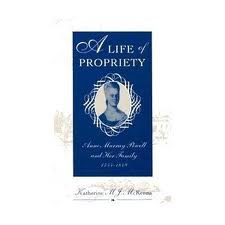
‘A Life of Propriety’ by Katherine M. J. McKenna

Katherine M.J. McKenna A Life of Propriety: Anne Murray Powell and her Family 1755-1849 , Montreal & Kingston, McGill-Queen’s University Press, 1994 , 260 p. & notes

Judges’ wives don’t tend to get much of a look-in in the judicial biographies written about their husbands. As you might expect, in such books the emphasis is on the judge and his interactions on the bench and amongst his judicial peers and government officials.  The wife and children- if they are acknowledged at all- tend to cluster off-stage in the folds of the curtains.

Not so in this book, which consciously focuses on Anna Murray Powell, the wife of  Chief Justice William Dummer Powell, of the Kings Bench Upper Canada. It was her husband’s position that gave Anna Powell her own prominence within York (Toronto) society, but I suspect that she would have been the subject of biography in any event.  The Powell family were prolific letter-writers, and more importantly, the letters were saved and now are scattered between archives in Ottawa, Toronto, Boston, New York and Washington.  Anne herself generated about 2,500 pages of letters alone, written over a span of 50 years, most particularly to her brother George Murray in New York.  These are rich letters for the social historian- full of family news and waspish commentary about York society- and they provide a solid basis for a study of Anna Powell and her family in her own right, not just as the wife of the Chief Justice.

Anna Murray Powell was born in Wells, England in 1755 to parents of a middle class background.  She emigrated at the age of 16 with her Aunt Elizabeth, who had herself emigrated to the New World at the age of thirteen and established a thriving millinery business in Boston.  On a trip back ‘home’, Aunt Elizabeth was horrified by the new ideals of middle-class female domesticity becoming popular in England, which did not sit well with her own ideas about female independence and business activity.  She did not have children of her own, and as seemed to be common at the time, ‘adopted’ her nieces and brought them back to Boston to manage her business.  What might have been a good solid business experience for a young man was greeted by Anne and her sister with reluctance and resentment.  She was mortified by working in ‘trade’ and she carried this sensitivity about her pre-marriage working life throughout her life, and indeed it may have contributed directly to the stiff-necked and inflexible ‘propriety’ that she demanded of her family, and all other York inhabitants in her social circle.

The book is divided into four parts. Part I ‘Learning and Living the Lessons of Propriety’ is largely biographical, tracing Anne’s childhood and adolescence, prolific childbearing years (nine births) and her establishment of her status within York society.  The narrative then bifurcates into a gender-based analysis of her family relations.  Part II ‘The Intersections of Male and Female Gender Roles’ examines Anne’s relationship with the men in the family: husband, brothers and sons.  Part III ‘The Transmission of Female Gender Roles’ examines education, marriage and childbirth within women’s lives in Upper Canada, and closes with a fascinating analysis of the lives of her three daughters.  Part IV ‘Conclusion’ deals with her life as widow and elderly matriarch- an aspect of women’s lives that is often dismissed in a few sentences- a life-stage which, as we (I) embark on an increasingly-lengthened old age will probably attract more historical scrutiny than it may have received in the past.

The book draws heavily on Barbara Welter’s 1966 article ‘The Cult of True Womanhood’ (American Quarterly, 18, 1966 p.151-74), a fairly dated article for such a recent book, and a choice that was questioned by several of the reviewers I have read.  McKenna cites Davidoff and Hall’s Family Fortunes, but it is the True Womanhood trope that she returns to most often.

Despite Anne’s strict insistence on ‘propriety’ and her incorporation of it into her own identity, you have to admit that her children were a bit of a disappointment.  The ‘good’ sons tended to die tragically, leaving the family with the duds.  Among her daughters, there was one ‘good’ daughter who trumped her mother in the fertility stakes, popping out ten children in an alarming succession. Another daughter remained the unmarried maiden aunt, a companion to her mother and built-in helpmate to her spawning sister.  The most fascinating chapter was that concerning the ‘unnatural’ daughter, Anne Murray Powell Junior.  It is  a very nineteenth-century take on the difficulties with parenting a wilful and troubled adolescent daughter.  The story of Anne Jnr.’s infatuation with John Beverley Robinson, the future attorney-general, has been told by other historians, but I suspect not with the sensitivity that McKenna brings to the situation.  It all ends tragically, and although the expectations and language of these unyielding 19th ‘pillars of society’ in their treatment of their daughter might not sit well with us today, the experience of parenting, loving, and losing transcends these differences.

Anne Murray Powell’s voice through her letters to her family is strong, censorious and inflexible.  Her letters are laced with a religious sentimentality which does not quite cover the snippiness, complaint and smugness that she expresses in almost the same breath.  Through the richness of the family archive, and through McKenna’s own insightful treatment, you feel as if you have been in the presence of a formidable woman.  I think I prefer her at a distance.

Sourced from : La Trobe University Library

Read because: it’s set in York at a time very close to my own research interest.


Vale Diana Gribble

Many of us will have heard or read that Di  Gribble, of the now-defunct McPhee-Gribble publishing house died several weeks ago.  I read and reviewed Hilary McPhee’s book Other People’s Words a few months back here and when I heard the news, I wondered what had happened after McPhee’s book had been published.  How did Di Gribble react? I wondered.  How did they feel about each other’s career in the wake of McPhee-Gribble’s demise?

Hilary McPhee answered many of my questions in a tribute that she wrote for The Drum recently.  I urge you to read it here.


Surprising things: a costume museum

Should someone suggest to you a visit to a private costume museum out at Bulleen,  then just say yes.

They’ll mean The Costume Collection, Yarra Park in Greenaway Street Bulleen.  You’ll drive down Greenaway Street (named for an early farmer in the district), past the factories and chain wire fences and you’ll think “This couldn’t possibly be right”.  But it is.

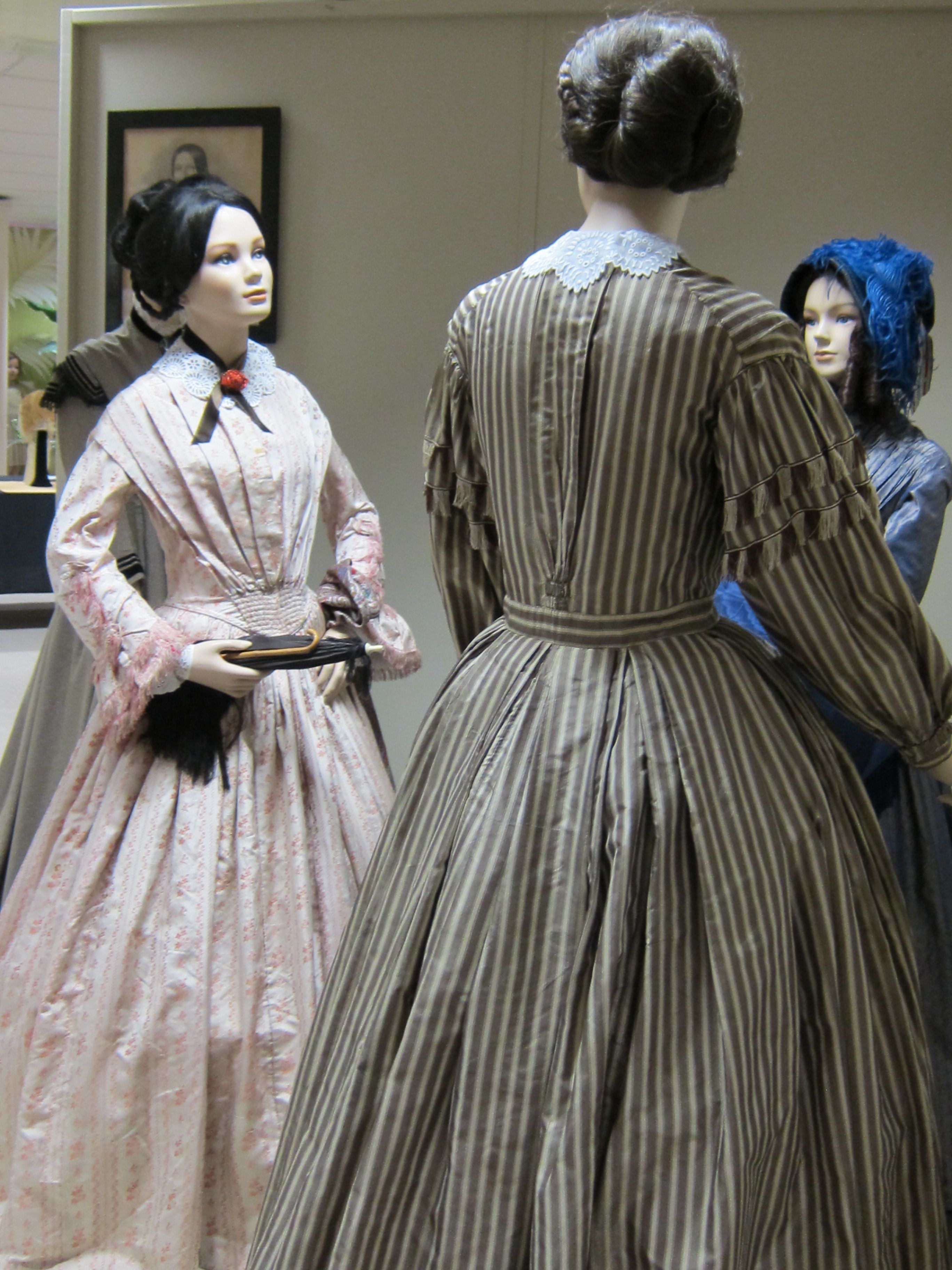
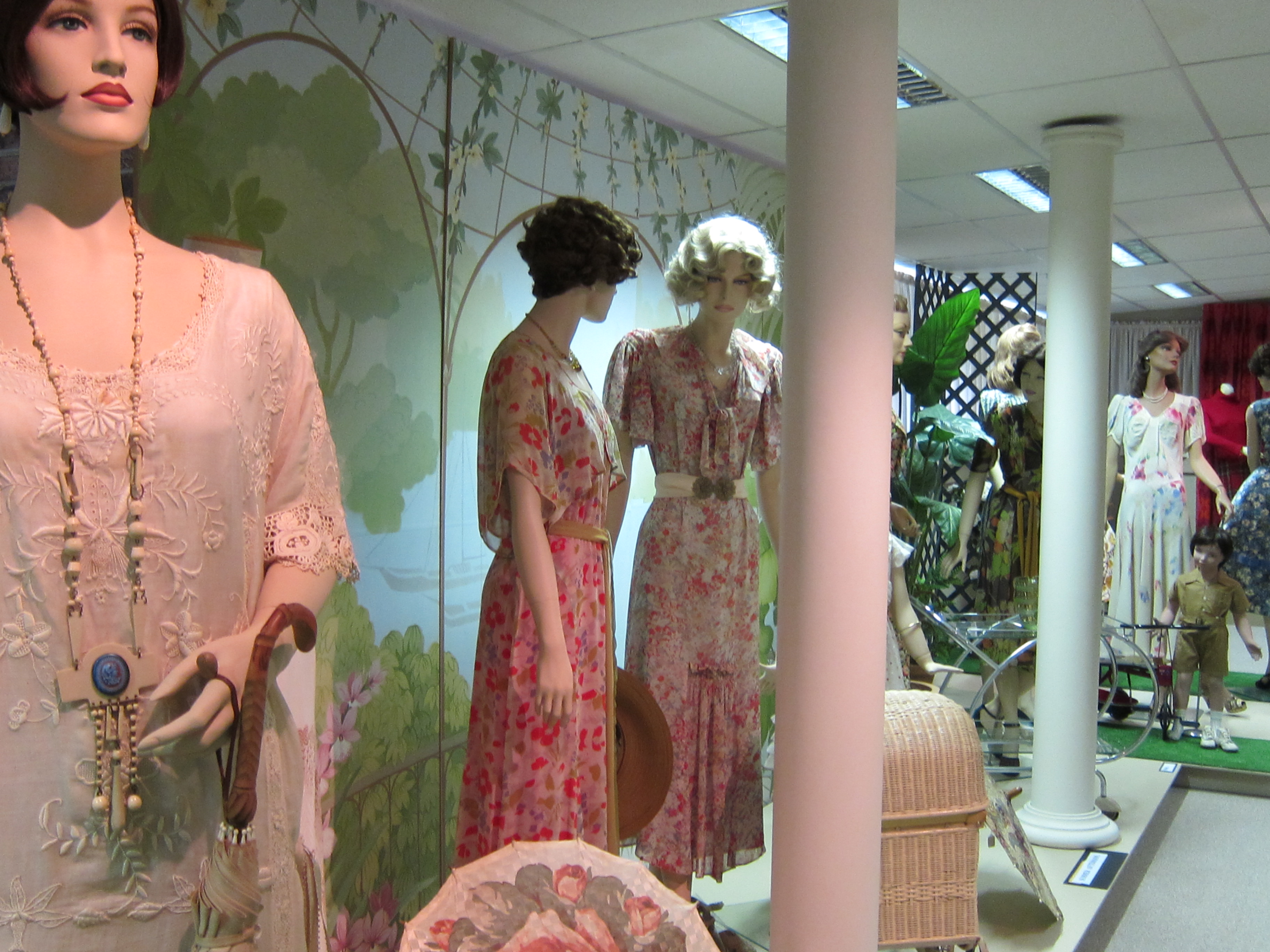
The owner and curator, Loel Thomson, describes her museum as “a hobby that grew”- hence the rather unconventional setting in a factory in a small industrial pocket beside the Yarra River.  The factory, however, provided many of the things her costume museum needed- space, few windows and an airconditioned and filtered atmosphere.  She has more than 10,000 items in her collection, though only a fraction of them are on display at any one time, and the display changes regularly.

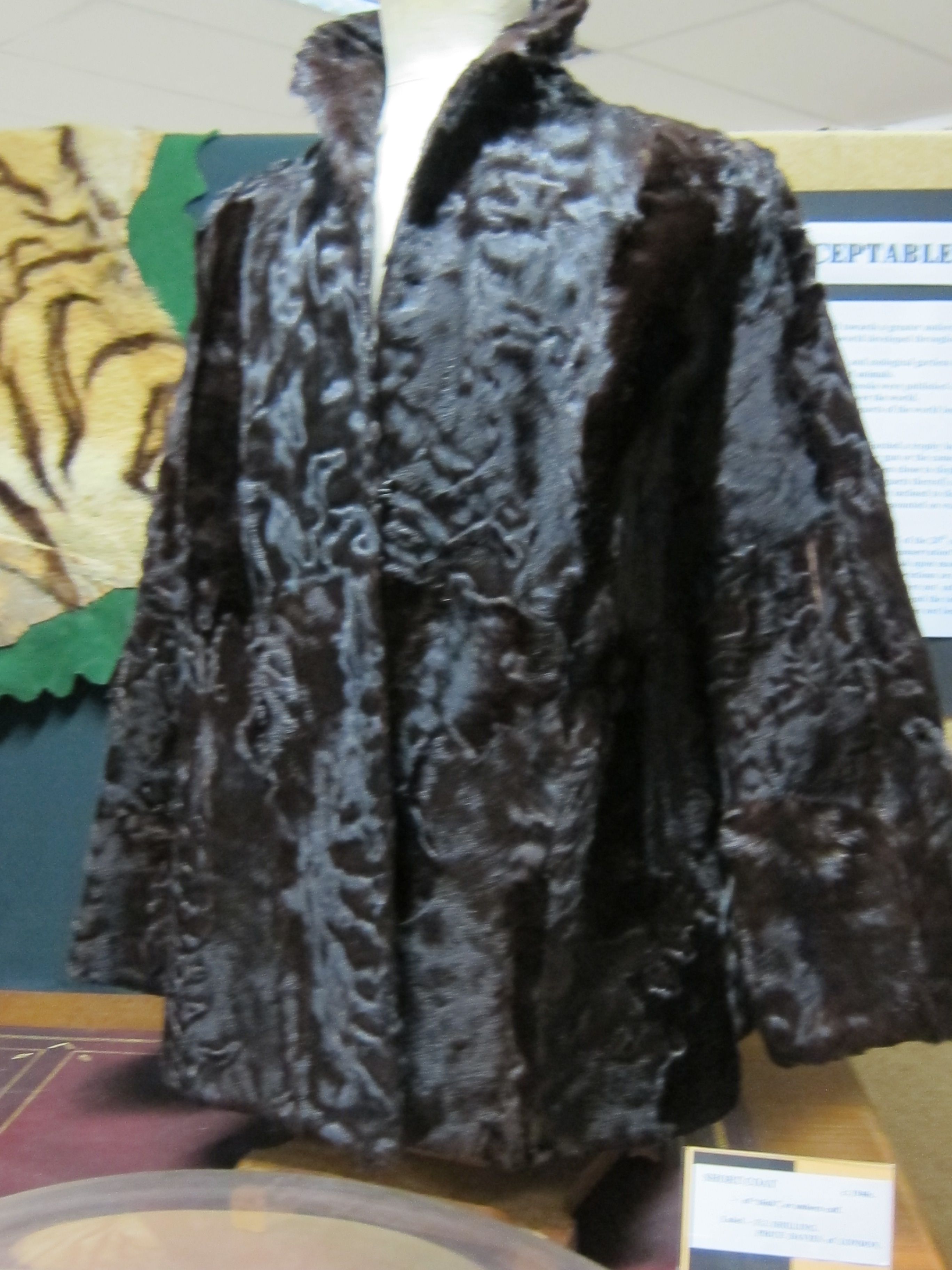
I loved the way the costumes were displayed.  Mostly you could walk around them to see them from all sides, and for those that were less accessible she had wardrobes and furniture of the period arranged so that mirrors reflected the costume from the side or rear.  There was a strong chronological aspect to the display, and it included children’s and men’s clothes as well.   A fascinating section featured ‘things we wouldn’t wear today’ showing furs and jewellery made from animal parts. There was  this ‘slink’ jacket-

that looked like fur jackets that I remember women wearing.  It’s only when you read the sign that you realize that ‘slink’ means ‘unborn calf’.  What travesties euphemisms cover!

Her aim in creating the museum is to collect everyday clothes that people wore.  Obviously the clothes were treasured enough for them to be preserved by family, or put away ‘for good’.  Many of them are purchased, commercially-produced items (she shows the labels) and although there are some formal wear costumes, most of them are day clothes.  She has a large library of magazines, pictures and books in order to research her displays, and in many cases she has been able to match private photographs of people wearing similar clothes,  or magazine advertisements,  to the costumes on show.

The museum is open only by appointment, so you’ll need to ring Loel Thomson herself on  9852 1794 and if there’s only a few of you she may be able to join you up with a larger group.  There’s a small entry charge by donation, which goes to charity.  It’s worth every cent and more.

There’s more photos from her collection here in a blog from February 2010- they are all beautiful too, and most of them were new to me so the display obviously changes quite substantially from time to time.  So- if you’re offered an opportunity to see it, or if you’d like to organize a trip for a group yourself- do!

Banyule homestead again

An article in the Age on Saturday 8th and my response to it.  You’ll need to scroll down a bit- obviously it wasn’t headline material!


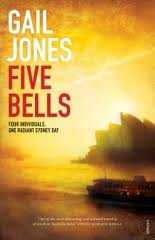
‘Five Bells’ by Gail Jones

2011, 216 pages

I don’t always read the epigraphs that grace the front pages of a book.  To be honest, I’m not really sure what purpose they serve- are they an encapsulation of the book in someone else’s words? are they a nod to writers who have come before? or are they a window into the texts that served as inspiration for the writer?  Probably all of the above, and I suspect that in this case, the latter is close to the mark.

The quotation from which the book takes its title is Kenneth Slessor’s poem Five Bells,  one of his best known poems, written after the death of a friend.  Gail Bell has chosen from the poem these lines.  The author has chosen:

Where have you gone? The tide is over you,

The turn of midnight water’s over you

As Time is over you, and mystery,

and Memory, the flood that does not flow.

‘Five Bells’ is a nautical term that measures the elapse of a four-hour watch on board ship, and the focus of time elapsing is pertinent here because we are very aware of it in the structure of this book.  The book is set on one summer Saturday, around Circular Quay (there’s that water theme again- and it emerges again throughout the book) as four people converge there from somewhere else, and the narrative swings from one character to another, in a sequence, not unlike the chiming of bells.  Round and round it goes, from Ellie to James to Catherine to Pei Xing then back to Ellie again as the day breaks clear and blue and creeps on to one of those night-time storms  that Sydney summers are noted for.  In this regard, it reminded me very much of Virginia Woolf’s The Waves, which took six friends, each writing from their own stream of consciousness.  However, here the characters in this book are observed minutely,  yet from a distance, rather than speaking in their own voices. Nonetheless,  it is very much an interior description, ranging over their memories, fears and disappointments across decades and continents.  In another nod to Woolf, there are echoes too of Mrs Dalloway in its single-day focus.

Her characters are each suffering loss of differing degrees: loss of relationships, loss of brother, loss of freedom, and exposure to tragedy.  Their stories are revealed gradually, as the spotlight of the narrative swings onto them before moving on to the next character.  There are resonances between the stories with multiple allusions Pasternak’s Doctor Zhivago,  eight year old girls etc. which at times felt a little forced, but I suppose evokes the same sense of connectedness and chance that we feel with the concept of ‘six degrees of separation’ and other such life coincidences.

Despite the rhythm and symmetry of the structure, the characters are not equally well-developed.  Catherine, the Irish tourist, never really became real to me, and although Pei Xing’s story was touching, I found it difficult to actually understand and thus accept her motivation for acting the way she did.  I think that Ellie and James, meeting again after twenty years, were the most clearly defined characters.

I must admit that I only made the connection with the maritime use of five bells when I googled it for this posting.  While I was reading it, I assumed that it referred to the characters and the circular way of telling their stories, like the rounds of a church bell.  There are four of them- who was the fifth? For much of the book I wondered if it was Sydney itself,  which with its harbour, the ferries,the Opera House,  Luna Park and Circular Quay is almost a character in its own right.  But then, in a marked change of pace near the end of the book, two other manifestations of what could be fifth character come into view.  This comes as rather a jolt.  I had been lulled into the almost soporific rhythm of the narrative and all of a sudden it changed direction.  I’m not really sure, though whether this sudden plot development was wise, or necessary to the book.  It changed the trajectory of the book and made some plot scenarios possible, but I think weakened the overall effect.

It is only a short book at 216 pages, and that is probably exactly the right length.  It is very carefully written with almost every phrase and image carefully burnished.  Perhaps a little too polished for my liking- I found myself almost  smothered by such intense, artistic writing- and so, while unsure about the necessity of the change of pace near the end, I greeted it as an escape into open air from a rather oppressive, perfumed interior.

I have set this post aside for a couple of days, unsure of how to sum up my response to the book.  Ambivalent, I’d have to say.  I admire the cleverness of the endeavour and the complexity of her allusions to other works of literature and acknowledge that there are some beautiful images and phrases.  But I need to balance that with my misgivings about the plot development at the end of the book, and my feeling of overload from a surfeit of fine writing.  Not sure.

My rating: Mmmm. 8/10??

Read because: My Australian Literature Online group had it as the September read

Copy sourced from: Yarra Plenty Regional Library and then, when I was unable to renew because it had a hold placed on it, La Trobe University Library.

We are Geelong

Thank you Red Symons- you’ve verified something for me.

Whenever I listened to the Geelong Football Club song (and we’ve heard it once or twice over the last 48 hours), I found myself puzzled by the first couple of lines. Was it being sung in unison? Why did it sound a bit “off”- as if it was supposed to have two parts, but only one was being sung? I kept trying to sing a different melody in my head over the top.  But in Red’s program this morning (heard rather fuzzily in my daylight-savings time dislocation where 7.30 a.m. was really only 6.30 a.m.) he mentioned that the Geelong song was inexplicably recorded – I can’t remember the correct musical expression- down a third (is that how you say it??) for the first lines.

Here’s the Geelong song  and here’s the way it is in Carmen.  I’m pleased to hear that it IS different- it’s not my imagination: just my paucity of musical theory and terminology to explain what I’m hearing.

I don’t need theory or terminology to hear that something is very, very wrong with Meatloaf (or Mr. Loaf as an article in The Age designated him last week).

Anyway, good on you Geelong.  Anything, anything to stop that triumphalist “Coll-ing-wood” chant.  It still turns my stomach after St Kilda’s grand final loss last year.