Author Archives: residentjudge

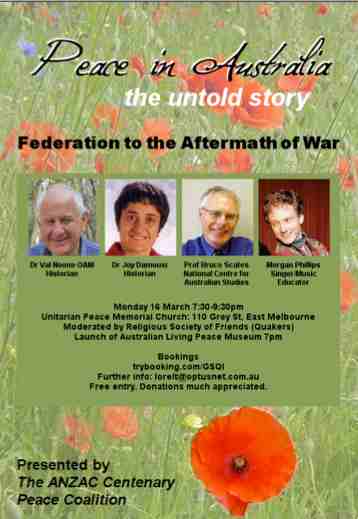
Peace in Australia: the untold story

PeaceConference

I’m going.

‘Broken Nation’ by Joan Beaumont

beaumont

2013, 655 p.

For someone who intended to eschew much of the hype about the centenary of WWI, I seem to have indulged rather more than I anticipated.  I attended the RHSV Victorians and the Home Front conference, I read The Kayles of Bushy Lodge (largely because it was written by a woman about the homefront during WWI) and I watched and very much enjoyed The War That Changed Us.   I was aware that Joan Beaumont’s Broken Nation had been well received, but what probably tipped me into reading it was Marilyn Lake’s comment in her ABR review  that

If you read only one book about Australia’s experience of World War I, as the deluge of commemorative publications marking the outbreak of the war becomes a veritable tsunami, make it Broken Nation, an account that joins the history of the war to the home front, and that details the barbarism of the battlefields as well as the desolation, despair, and bitter divisions that devastated the communities left behind.

I agree with Lake’s recommendation; I admire the book for its breadth but…oh, it was relentless reading.

In her opening paragraph Beaumont asks ‘why this book?’ given the already voluminous literature on Australian military history, especially in this centenary year. Her answer is this:

It has been written to provide what is still lacking in the literature: a comprehensive history of Australians at war in the period 1914-19 that integrates battles, the home front, diplomacy and memory. (p.xv)

It achieves this completely.  The book is structured into  six very long chapters, one for each year of the war.  Within these chapters, Beaumont moves chronologically month by month, crossing back and forth between battle, homefront,  diplomacy.  Even within these themes, she shuttles between battle as strategy and battle as lived experience by the men who were there; homefront in a political sense, homefront in a social sense; domestic politics and diplomatic politics on an international stage.

But for me, the battle scenes dominated and they dragged, particularly during the longest chapter ‘1917: The worst year’.  It took me some time to get into the mindset where a death and an injury were both counted as a ‘casualty’ without distinguishing between the two, because the effect of both was the loss of a soldier who could fight then and there.  I found myself inwardly groaning as I turned  page after page to see yet another map with arrows showing lines of attack.  There’s 36 maps in the book as a whole, (16 of them in the 1917 chapter) spread across battlefields at Gallipoli, the Western front and the Middle East, reinforcing the inexorable to-ing and fro-ing year after year.  The battle scenes are interspersed with diaries and letters from the men,  and visceral descriptions of sights, sounds and smells, but for me they were deadened by the weight of strategy and the stilted, chest-puffing language of military commendations.  Charles Bean has a lot to answer for.

But she also  moves away from the noise and shouting to consider  the process by which these sites have been memorialized.  She notes that many of the battles that the soldiers at the time chose to have memorialized through statues are not the ones that are uppermost in national memory today. For example, the 5th division, when asked in 1919 where it wanted the memorial celebrating its wartime achievements to be located chose not Fromelles, but Polygon Wood.  Our emphasis on Fromelles springs from the 1990s and the combined interventions of Prime Minister John Howard’s overseas war-memorial construction scheme and the archaeological persistence of retired schoolteacher Lambis Englezos.  This is true of many of the battles: what we have been moulded to memorialize, is not necessarily what the soldiers themselves wanted to remember and honour.

Even though the military sections weighed heavily with me, she does interweave it with the homefront and the broader diplomatic scene.  Her analysis of the homefront includes the political wranglings with Billy Hughes and conscription, and the effects on the economy and political life of the crackdown on unions and the War Precautions Act.  I’ve imbued the Labor Party lore of Billy Hughes ‘the rat’ but I hadn’t realized how much I dislike him on the broader international stage as well.  I enjoyed the final 1919 chapter very much, and its emphasis on the diplomatic tradeoffs at the end of the war.

Quite apart from the experience of reading the book, which I found draining, Beaumont makes some important points to counterbalance the type of history that is warping our present day politics and being pushed so insistently in this year of commemoration  as demonstrated in Henry Reynold’s recent excellent article Militarization Marches On.  She is at pains to point out that in many of the battles that we have appropriated to our national memory, Australians were not the only troops there.  We were part of the ‘colonial’ forces, for Britain to do with as she pleased, without consultation.

The title of the book is ‘Broken Nation’ which echoes Bill Gammage’s book The Broken Years.  She kicks back against the idea that Australia was ‘made’ through WWI. Instead, she argues, Australia – the Australia the soldiers sailed away from- was broken by WWI.  Not only was there the disproportionate loss of life, and the burden of injured soldiers, but there was “the less quantifiable embittering of public life” (p. 549).  The conscription debates had polarized Australia, and the rift did not heal easily. The war gave rise to xenophobia and insularity and fear of left-wing radicalism. It became an inward-looking society, focused on grief and the rancour of the war years. (p. 551)

The book started with a prologue that spoke of  Beaumont’s own great-uncle, Joe Russell.  He reappears once or twice during the book.  Other individuals pop up from time to time- Archie Barwick, Pompey Elliot- familiar names from the recent documentary The War That Changed Us.  I must confess that I preferred the grounded, person-based approach in the television documentary to Beaumont’s soaring birds-eye history.  But the reality is that we probably need both.  And in this book, the birds-eye history is in very good, sure hands indeed.

awwbadge_2014I’ve posted this review in the Australian Women Writers Challenge

‘The Lie’ by Hesh Kestin

the-lie-hesh-kestin

2014,  229 p.

I don’t normally read thrillers.  I don’t really like the genre, but I did read this book, largely on the basis of a brief review in The Age.  I still don’t like thrillers.

The book is set in Israel, which is what attracted me. Dahlia Barr (even the name annoys me) is a successful Israeli human rights lawyer, the daughter of an even more strident peace activist mother.  She is approached by the Israeli government to become a Special Advisor for Extraordinary Measures, overseeing the application of torture during interrogation.  Rather implausibly, the government figures that if a human rights lawyer gives the go-ahead, then it must be alright. Even more implausibly, she accepts the job, thinking that she could make a difference.

This resolution is soon put to the test when her own son, an IDF soldier, is kidnapped by Hezbollah, along with a Bedouin Arab who as a citizen of Israel, also serves in the IDF.  In a scenario that has become all too familiar in recent weeks, the two boys are tortured and video-taped to pressure the Israeli government into swapping the boys for the recently-arrested Edward Al-Masri, a Canadian professor returning to Israel.  He was apprehended at customs with a large wad of money, and is the first ‘enhanced interrogation’ case that Dahlia is called upon to oversee.  Her amazement on finding that he is, in fact, a childhood friend turns to resentment and flintiness when she learns that he may have information about the whereabouts of her abducted son.

Like many thrillers, this book is structured with a series of short chapters- in some cases, only a paragraph in length, each on a separate page. The action swings cinematically from scene to scene.  There’s a heavy reliance on conversation for characterization, supplemented in Dahlia’s case by a rather clumsy italicized internal dialogue.   Details in the plot are quite technical in places for verisimilitude, which means that they need to be explained in layman’s terms later.    No, I really don’t like thrillers much.

What I did like was the complication of Israeli identity and the setting. There is a twist at the end, which does give the book more depth, although even I guessed it before it was revealed (which, believe me, is a worry).

I don’t often review books that I’ve read from genres that I generally avoid, because (as you can see) most of my responses are to the genre, rather than the book itself. If, however, you do like thrillers, here’s a shout-out to a thriller set in Melbourne –Fire Damage– written by my friend Richard, available on Kindle.

Looking back at a historian looking forward

I had reason today to winkle out a reference drawing parallels between convictism and slavery.  It wasn’t difficult: several historians have written on the topic, and one of them was K. M. Dallas.

The name sounded familiar.  Then I remembered that  in The Tyranny of Distance Geoffrey Blainey had cited a lecture given to “a small, sceptical audience in Hobart in 1952”  by K. M. Dallas that “brilliantly probed” the mystery of why England decided to send convicts to the other side of the world. Dallas argued that Botany Bay had been intended as a maritime base for four promising trades: tea from China  via the Cape of Good Hope (thereby avoiding the pirate-infested straits near Sumatra); otter pelts from north-west America; whaling in the Indian and South Pacific Oceans, and a bit of quiet dabbling in smuggling and privateering in the Spanish trade that linked the Phillipines, Mexico and South America.  A fifth potential prize might have been the disruption of the Dutch monopoly of trade in the East Indies.   It’s an argument that appeals to me in its scope, and certainly Geoffrey Blainey took it up in his widely-published book.

So, having remembered who K. M. Dallas was,  I looked more closely at the article I downloaded today “Slavery in Australia – convicts, emigrants, Aborigines” from 1968.  It, too, is a wide-ranging article that explores different aspects of forced labour across the British Empire: the hulks moored in the Thames and sent to Bermuda to provide labour for naval improvements; pauper emigration to Canada, Newfoundland and New South Wales, and the forced labour of Aboriginal women by sealers (a view challenged recently by Lynette Russell- my review here) and Aboriginal men under a scheme of pastoral employment bounty.  It struck me that this is transnational history, decades before its time.

So who was K. M. Dallas?  His ADB entry tells me that his name was Kenneth McKenzie Dallas, and that he was born in Tasmania in 1902.  He became a teacher and taught in one-teacher schools while studying a commerce degree. He became a tutor for the Workers Educational Association, which was at that time associated with the University of Tasmania.  His ADB entry notes that

Dallas embodied the ideal WEA type: while of an intellectual cast, he focused on the action of social and economic forces. His discourse was always positive and informed, often enthralling, sometimes overbearing.

Always leftish in his politics, he moved further left with the burgeoning of fascism. His historical prescience deserted him in 1937 when he conducted the opening meeting at the New Norfolk Workers Educational Association.   There’s an article titled ‘Is War Coming? Not Inevitable says K. M. Dallas‘ in the Hobart Mercury of 23 June 1937

Mr. Dallas said that he was not sufficiently pessimistic to feel that another world war was inevitable. Imperialism had undergone a great change in the past 50 years. He felt that the Imperialistic spirit was passing, and that war would pass with it.

Among the forces making for war at present was the assumption that war was inevitable. There were also the war objectives of the Fascist Powers, which were backed by official announcements. Against the forces of war were the development of an organised will to peace, and the building up of peace as a political policy. People would enter the next war with their eyes open. He believed that, even assuming that the German and Italian Governments provoked war, they were not in a position to go to war at present. From the material point of view, those nations likely to provoke war were least equipped for that purpose, and in the circumstances he felt that a world war was most unlikely.

How tragically wrong he was.  He joined the Royal Australian Navy, saw action in the Mediterranean and took part in the first wave at Normandy.  On his return to Australia, he resumed his academic career as a lecturer in economics, encouraging and forming friendships with socially conscious undergraduates including Polish migrants and Asian students.   He was a member of the Australasian Book Society, and he enjoyed European films (surely a rarified taste in 1950s & 60s Tasmania?). He supported the Labor club at the university and the Australian Peace Council, but despite an adverse ASIO assessment  that refused him a passport (quickly overturned by Menzies), he was not a member of the Communist Party.

However, this did not prevent an exchange of letters in July-August 1950  in the Tasmanian Mercury where, after a funeral,  he was publicly challenged by a ‘Lesley Murdoch’ to declare whether he was a communist or not.  The resultant kerfuffle (here , here , here  and here) was prodded along by Dallas’ rather provocatively timed letter to the editor about the Korean War.  The interchange carried out in the columns of the Tasmanian Mercury reminds us of the perils of politically contentious views in a small community, even in the days of a less ubiquitous social media.

Unlike many other academics, he did not support Sydney Sparkes Orr, the professor of philosophy, when he was dismissed from the University of Tasmania.  This stance isolated him from many of his colleagues, but perhaps time has vindicated him in this too, with the publication of Cassandra Pybus’ Gross Moral Turpitude in 1999

I’m a bit put off by the description of him as “overbearing”, but I think that he wouldn’t be out of place at a history conference today.  Transnationalism, networks, environmentalism (he wrote a book on water)- he’d have plenty to say. Certainly, his ideas are interesting, and must have come (literally) from left field fifty years ago.

References:

[You may need to login to  a State or university library to access the articles]

Dallas, K. M. The first settlement in Australia considered in relation to sea-power in world politics [online]. Papers and Proceedings: Tasmanian Historical Research Association No. 3, 1952: 4-12.

Dallas, K. M. Slavery in Australia – convicts, emigrants, Aborigines [online]. Papers and Proceedings: Tasmanian Historical Research Association , Vol. 16, No. 2, Sept 1968: 61-76.

Dallas, K. M. The Origins of White Australia The Australian Quarterly  Vol 27, No 1 (March 1955) 43-55

Geoffrey Blainey The Tyranny of Distance  Sydney, Macmillan, 2001 p. 23-4

‘Chess’ by Catchment Players

Chess-Flyer03-1-482x1024

On any Saturday night you could go into the city to see Les Mis or Once or some other musical.  You’d see clever staging and very talented artists. You’d have to book well ahead, and you may have to pay well or you may end up in the gods which is where I often find myself sitting.  Increasingly the show will be one of the franchised, highly commercial ‘biggies’ doing the international circuits and you’ll probably find yourself saying “What? It’s coming back already?” or wondering why anything that succeeds on film inevitably ends up on the stage, or vice versa.

Or, you could go to your local community theatre on a Saturday night.  You’ll see talented artists, doing what they love, for the people who love them, and you’ll be proud and grateful that there are enough people like you to support our shared human love of singing and dance and performance.  And, in my case, I wish that I’d seen this earlier in the season so that I wasn’t blogging about the final performance.

Chess is loosely based on the Bobby Fisher/ Boris Spassky tournament of the Cold War era and the rivalry of Soviet grandmasters Viktor Korchnoi and Anatoly Karpov.  The lyrics are by Tim Rice (of Jesus Christ Superstar fame) and Benny and Bjorn from ABBA wrote the music.  It’s complex music: lots of words, lots of harmonies.   It’s an ambitious choice for a local theatre company.  The music is non-stop,  there are no set changes and there is very little dialogue.  The ensemble is on stage for much of the performance, and it’s very full on.

When you flip through the biographies in the program, you realize that the cast  have many connections.  Many have performed with other amateur theatre companies, several have undertaken tertiary studies in performance and musical theatre; others have connections with groups like the Production Company or have performed in television roles.

For me, the standout performers were Rosa McCarty (who played Florence) and Dennis Clements, who played Alexander Molokov.  Their diction was good; Rosa McCarty had beautiful, nuanced control over the softer songs, and Dennis Clements had good stage presence.  I had my eye on Courtney Crisfield in the ensemble, too. The whole cast worked hard, without a single flat spot. The chessboard scenes were tautly staged and impressive to watch although at times I felt as if the performers seemed rather more comfortable with singing than dancing.

Unfortunately the performance was poorly served by the design of the theatre itself. There was a live orchestra, but because it was located in a separate room off-stage, it was reliant on a sound system that thinned out the sound. There were some odd crackles and at times the singing sounded a bit shouty and overwhelming, making it hard to distinguish the competing lyrics.

This was an energetic and intelligent performance of a demanding work.  There’s a real intimacy in a small theatre, where the performance is on the same level as the front seats and where the performers are right there.  And as for the last note, a note that had so much riding on it- Rosa McCarty just soared, confidently-  brilliant!

Well done.


‘Galileo’s Daughter’ by Dava Sobel

galileos daughter

1999,  432 p.

The whole way through reading this book, I was thinking how much my husband (who had read it before I did) must have loathed it.  A man of scientific inclination, given to dot-points and resistant to ‘dumbing down’,  he grumbles when a plot line in a crime show or a documentary becomes clogged up with relationship-type stuff.  This book offends on both counts. Although titled Galileo’s Daughter, it is actually about Galileo and his discoveries and theories in astronomy,  explained simply for the non-scientists among us, and framed through the letters that his daughter wrote to Galileo.

Galileo had three illegitimate children through the same woman.  He was able to ‘buy’ legitimacy for his son, but to circumvent the disadvantages that illegitimacy and lack of dowry would confer on his two daughters, he placed them in a convent.  If you’ve read Mary Raven’s Virgins of Venice, you ‘ll know that convents were used as a way of solving the  dynastic problems of the Venetian (and other Italian state) noble families.  If a girl could not be married successfully and strategically, then a convent provided a means of providing for her, and in a deeply religious society, bolster the family’s heavenly credit through her lifetime of intercession on their behalf.   Convents  were not necessarily stark, isolated experiences.  They were often filled with educated, noble women who maintained an interest and knowledge of her family’s outside activities, albeit from behind a grille.

Galileo placed both his daughters with the Poor Clares in the Convent of San Matteo in Arcetri, Florence.  His eldest daughter, Virginia, took the name Suor Maria Celeste, while the younger daughter became Suor Arcangela.  The book reveals the letters that Suor Maria Celeste wrote to her father, translated by Sobel herself, interwoven with a narrative of Galileo’s development of his astronomical theories and the resultant conflict with the Inquisition.

Here is the historian’s lot writ large: a cache of letters from one party only.  However, continuous archives like this, where the letters were frequent- and these ones certainly were- allow for reconstruction of the missing side of the correspondence.  I was struck by the waste of this lively intelligence.  Although Suor Maria Celeste’s writing is larded with expressions of deference and spirituality that don’t sit comfortably with us today, she was well aware of her father’s work and made good copies of his correspondence.  She assisted him in more quotidian ways too: making repairs to his clothes, cooking jams etc. and making solicitous inquiries about his health.  Certainly this convent was more straitened than those described in Virgins of Venice, with the nuns often going hungry and poorly served by the priests who ‘ministered’ to them.

Although the story of Galileo’s clash with the Inquisition is well-known, Sobel argues that he was, and remained, a deeply religious man.  But she also reveals the rather duplicitous manoeuvres that Galileo made to appear to conform, while ensuring at the same time that his controversial theories, so blasphemous in the eyes of the Church, reached beyond the Inquisition’s grasp.  She creates a nuanced overview of theology, and Galileo’s challenge to it, and a clear (if rather simplified) explanation of his theories.

I must confess that I preferred the letters to the science in the book, and felt tempted at times to skip over those sections.  But I did feel genuinely saddened by the short and constrained life that this intelligent woman lived.  I enjoyed the book, even if my husband didn’t.

My rating: 8

Read because: It was a bookgroup (Ladies Who Say Oooh) selection.


‘Mr Pip’ by Lloyd Jones

mrpip

2006 256 p

Sometimes the challenge in reading a book lies in negotiating its different threads and clambering over complex language that is so clever and slippery that you’re constantly on your mettle as a reader.  But sometimes – ah, sweet relief!- the book itself is so easy to read that you just lie back and let it sweep you along, only to find yourself rewarded with layers and counterpoints that emerge long after you shut the book. Mr Pip, for me, was such a book.

Everyone called him Pop-Eye” is the opening sentence of Mr Pip, echoing Dickens’ immortal opening lines of Great Expectations,

My father’s family name being Pirrip, and my Christian name Philip, my infant tongue could make of both names nothing longer or more explicit than Pip. So, I called myself Pip, and came to be called Pip.

Pop-Eye, or Mr Watts, is the last remaining white man on Bougainville after the implementation of the blockade by Papua New Guinea in 1990 and the descent into civil war between the ‘rambos’ (village boys who joined the rebel insurgency) and the ‘redskins’ (PNG soldiers).  Fourteen year old Matilda lives on the island with her deeply religious mother Delores, her father having travelled to Townsville for work with the Australians and unable or unwilling to return because of the civil war.   Successive raids by the rambos and the redskins have left the village in tatters and Mr Watts offers to teach the school, in the absence of any other alternative teacher.

What Mr Watts brought to these children was Charles Dickens’ Great Expectations: a book which, at first sight, could hardly be more removed from the experience of these village children, or their parents.  Mr Watts invited the parents into the schoolroom, where they shared their own stories with the children, and the parents too, came to know of ‘Mr Pip’, Miss Havisham and Estella through their children.  Mr Watts was always an outsider.  He was quite frankly eccentric, pushing his demented village wife around the village in a shopping trolley.  But somehow he managed to interweave the experience of Pip and his great expectations into the shared knowledge of this small Pacific village.

The book changes direction abruptly and I don’t want to spoil it for you.

There is a coda to the book where Matilda, as an adult, revisits Mr Watts’ hometown, trying to fill in more of the paradox and mystery of ‘Pop-Eye’ and his wife.  What she learns there gives the narrative yet another twist, unsettling much of what has preceded this.

Despite its simple, flowing almost-fable-like language, this book has multiple levels.  I found myself thinking about it long after I’d finished it.

Rating: 9

Read because: CAE bookgroup selection read with The Ladies Who Say Oooh (my bookgroup)


So, Lady Franklin, now we know…

It was a rather poignant coincidence that I should be over in Hobart when the news broke of the discovery of one of the ships from Sir John Franklin’s expedition to the Arctic.

The discovery was announced by the Canadian Prime Minister, Stephen Harper, who has staked much personally and politically on the development of ‘the North’.  The political edge of his announcement was knife-sharp:

This is truly a historic moment for Canada. Franklin’s ships are an important part of Canadian history given that his expeditions, which took place nearly 200 years ago, laid the foundations of Canada’s Arctic sovereignty

There’s an interesting article about the discovery and a discussion of the political and historical ramifications here. As it points out, the territorial jockeying over the Arctic circle between Russia and Canada has taken on even more significance since the Ukraine crisis.

Canada has adopted Franklin as a national hero, but Tasmania has a claim on him as well, as he was Lieutenant Governor of Van Diemen’s Land between 1837-1843. (This time period coincides closely with Judge Willis‘ tenure as judge in the separate colony of New South Wales across Bass Strait). There’s a statue of Sir John in Franklin Park, the site of the original Government House.

IMG_1112a

The inscription, complete with verse by Tennyson reads:

THIS STATUE OF THE GREAT NAVIGATOR

REAR ADMIRAL SIR JOHN FRANKLIN

KCH: KR: DCL: FRS

WHO LOST HIS LIFE IN ACCOMPLISHING

THE DISCOVERY

OF THE NORTH WEST PASSAGE

IS ERECTED BY THE COLONISTS OF TASMANIA

IN AFFECTIONATE REMEMBRANCE OF

THEIR FORMER GOVERNOR

BORN 16 April 1786

DIED  11 June 1847

Not here! The white north hath thy bones and thou

Heroic sailor soul

Art passing on thy happier voyage now

Toward no earthly pole.

Kathleen Fitzpatrick wrote a lively and insightful entry on Sir John Franklin for the Australian Dictionary of Biography.  It’s well worth reading.  And of course, Lady Franklin, who made the search for any trace of her husband her life’s mission, features in several books that I’ve read and reviewed here.  There’s Richard Flanagan’s Wanting,  Penny Russell’s This Errant Lady, McGoogan’s Lady Franklin’s Revenge– and of course A.T.T. (after the thesis) (or maybe sooner) I’ll read Alison Alexander’s National Biography Award winner The Ambitions of Lady Jane Franklin.

Walking around Hobart after the Transnationalism Masterclass, I stepped into St David’s Cathedral, and what should be hanging on the wall but this flag.

IMG_1109a

The panel underneath reads:

Lady Jane Franklin, respected and influential wife of former Governor Sir James Franklin, gave this simple flag to Lieutenant W. R. Hobson RN in 1857. Hobson was second in command of Captain McClintock’s Franklin Relief expedition, organized by Lady Franklin to search for her husband, lost in the Arctic.  With one sledge drawn by four men and another drawn by seven dogs, Hobson crossed the  Northwest Passage from Cape Victoria [indistinct- to Cape Felix?] on King William Island and on 3 May 1859 came across cairns [indistinct- erected by?] Franklin and his followers, which proved both their discovery of the North West Passage and their eventual fate in 1847.

There’s a short podcast about the flag and how it came to be in the cathedral here.

The fate of Sir John Franklin gripped the imagination of Britons, but it evoked anxieties as well.  Stimulated by the recent news of the discovery of the wrecks, Laura MacCulloch, College Curator at Royal Holloway wrote a fascinating article on The Conversation website about Edwin Henry Lanseer’s confronting 1864 painting ‘Man Proposes, God Disposes’ that depicts of  grisly outcome of the doomed expedition.  Gory, yes, but more comforting perhaps than the rumours of cannibalism that so unnerved the British nation.

piv-57-s185-57-r43

On hearing of the discovery of one of Sir John Franklin’s ships- they’re not sure yet which one- I felt rather sad for Lady Jane.  All those unanswered questions; all that fruitless effort; all that time.

[If you have the stomach for it, there’s also an article about the exhumation and thawing of the bodies of three of Franklin’s sailors in 1986,  after 140 years.  The photographs are graphic, but fascinating.]


The Seymour Biography Lecture: Ray Monk

monk

“How Can I be a Logician before I’m a Human Being?” The Role of Biography in the Understanding of Intellectuals, Seymour Biography Lecture, 22 September 2014

“I don’t even know who this guy is….” I thought while RSVPing for the Seymour Biography lecture in Melbourne, held last night.  When I looked the books he’s written, I understand why.  While I’ve read many historical and literary biographies, I must confess to not being overly attracted to biographies of philosophers and scientists.  However, in my own work on Judge Willis, I share the problem of working on a man who has a body of work in the intellectual realm (in my own case, an accumulation of addresses to a jury and written judgements) which, while abstract and de-personalized (in a way that, perhaps, a fiction oeuvre for a writer is not), is also integral to his own identity.

Ray Monk is a Professor of Philosophy at the University of Southampton, coming from a background in the philosophy of mathematics. Although his four works are based on philosophers and, more recently, a scientist, he does not believe that biography necessarily contributes to an understanding of all philosophers and moreover, that you can’t evaluate the philosophy in terms of the life of its proponent.   However, he was attracted to write about Wittgenstein after reading two very different appraisals of Wittgenstein’s work and concluding that, if these writers had understood Wittgenstein as a man, they would not have developed particular misunderstands in their analysis.

In a very academic-y way, he investigated the methodology of biography writing before embarking on his biography of Wittgenstein.   In effect, he followed Biography 101, commencing with classical biographies,  Samuel Johnson and Boswell, Virginia Woolf, and ending up with Richard Ellman’s Oscar Wilde and Andrew Hodge’s Turing: The Enigma as exemplars for his own work.

In his presentation, he focussed on Johnson’s own reflections on biography that he expressed through two articles ‘Biography’ in The Rambler in 1750 and ‘On Biography’ in The Idler 1759.  He addressed five questions from Johnson:

1. What is the relation between biography of other genres, most particularly history and fiction?  His answer- there’s an overlap.

2. Who deserves a biography? Many philosophers don’t live sufficiently interesting lives to warrant a biography, he said.

3. What details to include? He mentioned that there were facts that he had omitted from his two-volume work on Russell – a publication that he seemed oddly apologetic about.  He explained that had he included them, they would have completely skewed the response to the book, and so he omitted them.

4. What are the moral responsibilities of the biographer? He identified three- to the subject; to the public and to the truth. Although he nominated the ultimate responsibility to the truth, he noted that surviving relatives often have a stake as well.

5. Can one know the inner life?  Johnson believed that this was not possible: “By conjecture only can one man judge of another’s motives or sentiments”. Monk disputed this very 18th century view, giving examples in his books where he had looked to action as a window on the inner life.

There is a particular challenge, I think, in writing biographies of intellectuals, as opposed to biographies of politicians or literary figures.  There is the content of their philosophy, as well as their own life as part of a familial, historical and intellectual milieu.  Monk noted the tendency of academic biographers, in particular, to give a quote from the philosopher’s work then in the following paragraph to proceed to paraphrase and explain it. Just leave the quote alone, he advised.

He noted that a biography is not just a collection of facts: that the facts need to be shaped, and that the biographer has a point of view. He finished with a very Wittgensteinian idea that is particularly applicable to biography-writing “The understanding that exists in seeing connections”.

There’s a very good review from the Guardian (10/11/12) of his Oppenheimer book which also discusses Monk as a biographer. You’ll get a good taste of the lecture from this article.

More:

I’ve been frustrated in the past that the Seymour Biography Lecture has been delivered in Canberra and, as far as I’m aware, not in Melbourne as well. But I’ve just found podcasts or transcripts of recent lectures on the NLA site. Ah, isn’t the internet a wonderful thing?

A day to myself in Hobart

A day to oneself in Hobart, before the Transnational Masterclass,  so what to do?  I know that I could do MONA, (the Museum of Old and New Art)  but I decided to save that for our next trip to Tasmania, when Mr Resident Judge would be with me.

So, instead, a little browse around the Tasmanian Museum and Art Gallery.  I was impressed.  It was free, for a start.  I find Melbourne Museum’s $12.00 entry fee discouraging, especially for a museum that I feel has little depth.  It may be doing good work behind the scenes, but there’s little evidence of it in its focus on ‘entertainment’.  So- a big tick for free entry to the TMAG  and a well-placed donation box to which I was happy to contribute. Continue reading