
Well, well, well- look at what’s back on the market.
Banyule Homestead.

The advertisement with more beautiful pictures is here. The auction is scheduled for 16 May 2015.
For more about the history of Banyule Homestead, please visit my other site:
Well, well, well- look at what’s back on the market.
Banyule Homestead.
The advertisement with more beautiful pictures is here. The auction is scheduled for 16 May 2015.
For more about the history of Banyule Homestead, please visit my other site:
We were sitting in the car on the way to the supermarket on Saturday morning, listening to the Coodabeens on the radio. The Coodabeen Champions is a comedy sports show which features Greg Champion’s parodies of popular songs, with the reworked lyrics often submitted by listeners. So there we were, humming away and laughing to a song from the 1970s, and when we turned to each other and asked “What was the name of the original song?” neither of us could remember. I hummed it, he whistled it (because I can’t whistle) but the chorus just wouldn’t spring to mind. I had a feeling that it was an Australian group (I had Black Sorrows lurking around there somewhere), although it sounded a bit like Jethro Tull’s ‘Thick as a Brick’.
Ah Google- what did we do before you? I downloaded a podcast of the second hour of the show, having deduced that we were listening at about 11.30 am. When I listened to it again, all I could remember was the line “the season goes so quickly” (which also featured in the parody) and that was enough for Dr. Google – the answer is: Seasons of Change by Blackfeather.
Blackfeather was a band that had many, many changes in lineup and in 1970 it recorded their album ‘At the Mountains of Madness’ with Infinity Records. According to the Australian Music History website
On this album was a song that was to become not only a hit for two different bands, but also proved to be the catalyst for another major problem within the band. The song “Seasons of Change” was recorded using a couple of musicians from the band Fraternity, Bon Scott and keyboardist John Bissett. Bon had sung some backing vocals and had played recorder on the track. He loved the song and asked could he record it with Fraternity. A deal was eventually struck that allowed Fraternity to record it and release it as a single on the understanding that Blackfeather would not release their version in competition. Unfortunately, against the bands wishes, the record company reneged on the deal as soon as they saw how popular the song was. This caused a major rift between the band and the record company which eventually led to more lineup changes.
I was only aware of the Blackfeather version:
So the Fraternity version, headed by Bon Scott (of later AC/DC fame) came as a surprise to me. It’s much slower, with a rather gentler Bon Scott than we’re used to seeing:
Well, well. The things that can be dragged up out of the past from a Saturday morning listen to the Coodabeens!
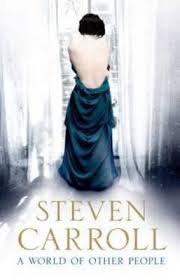
2013, 278 p.
I recognized the author’s name and remembered that I’d read some of his books before. I was drawn in by the prospect of a book set in the Blitz in 1941, a setting that I find fascinating, so I borrowed it. I only had to read about five pages in to remember that, yes, I have read several Steven Carroll books before and I had a love/hate relationship with every single one of them.
This book is no exception. Steven Carroll writes in the present tense, swapping from one character to another, and alternating between second and third person. I dislike the use of the second person and I have mixed feelings about present tense. His books are very visual, centred on a particular image to which he keeps returning. Like a sewing machine darning a hole, he keeps going back and forth, back and forth, embroidering and over-stitching an image or an event.
As soon as I remembered this narrative voice, I remembered how much I disliked it. Nonetheless, I kept reading and I’m glad (I think) that I did. It’s a beautifully written, poignant story and I felt sad to finish it.
Iris is a young Oxford Graduate and aspiring writer, employed as as a civil servant by day and aa fire-watcher by night during the Blitz. Along with a clutch of other people including the poet T. S. Eliot, she waits all night on the rooftop of the Faber and Faber building, watching for bomber planes and their fiery load, and directing the fire trucks to the conflagration. She doesn’t know it, but the Blitz proper has already ended, but one night she and her fellow watchers see a plane swoop down low -too low- over the city buildings. Minutes later they hear a dull explosion. She catches T. S. Eliot’s eye and realizes that she is seeing Eliot at work right there, in that moment, as writer as he grabs an experience that will later be transformed into poetry.
A year later, in the ruptured world of war-torn London, she meets Jim, an Australian pilot in Bomber Command, who has been invalided out of flying duties after an accident. They meet and fall in love. I shall say no more, lest I give the story away.
Books and writing are an important theme in the book, and T. S. Eliot and his poem ‘Little Gidding’ (which I must confess, I have never read) play an important part in the story. As a result, I think that much of the ‘cleverness’ of the book went right over my head, and so I just read it straight, completely unaware of any layers of meaning below the surface.
The book has obviously been carefully researched, but it wears it lightly. By inhabiting at various times both Jim and Iris’s consciousness, Carroll has given us well-rounded, complex characters, and the plot pulls you to what you know is going to be a tragic end. The ending solves a little conundrum set up in the opening pages in a very satisfying way.
This present-tense voice and habit of perseveration is obviously Carroll’s narrative ‘thing’ and it’s unfortunate for me that it grates so harshly. I feel as if he’s almost writing to a template, where the setting and events change but the voice goes on and on. Nonetheless, I enjoyed the book in spite of the way it was written, which I suppose is testament to the strength of the characters and story. I must remind myself next time I pick up a Steven Carroll book that I really don’t like the way he writes, and that I should just put it back onto the shelf.
Ah- another woman with her back to us. The image has little connection with the story.
Andrew Furhmann has written a far more detailed and intellectual review (full of spoilers) which can be read at the Sydney Review of Books. His review makes me feel rather embarrassed that I missed so much in my very surface reading of the book.
When observing legal doings in our current day, the thought often strikes me “What would Judge Willis do?” – if he hadn’t sailed from our shores 172 years ago, that is. As a Judge with a keen interest in his brother judges and the government of the day, I think he’d be very interested in what’s going on in Queensland at the moment.
You may remember that there was much controversy over the former Attorney General Jarrod Bleijie’s appointment of Tim Carmody to the Chief Justice position. Tim Carmody was the Chief Magistrate, so that was quite a leap up the judicial ladder. The President of the Bar Association resigned in protest at the appointment. Of course, there has been an election in the meantime, and a new if rather precarious government elected.
So, how will this controversially-appointed Chief Justice go? I wonder.
The Guardian has an interesting article by Richard Ackland, which reports some eye-brow raising comments made in a valedictory speech by retiring and well-respected Supreme Court judge, Alan Wilson. After thanking the Chief Justice for making the space available for the farewell function, he said that he would not have embarked on the proceeding if the Chief Justice had been presiding. But that was not the end of it, he said:
I wish to say some more things that will colour these proceedings in a way with which some may disagree, or find upsetting. I have agonised about this. In saying what follows I speak entirely for myself, and express only my own views and opinions without the foreknowledge or approval of any of the judges. None of them has seen these remarks, in draft or at all. I want to speak about the leadership of the court.
The speech is available in full here, and well worth a read.
I think Judge Willis would be in his element.
Posted in Uncategorized
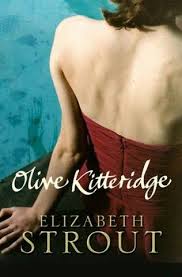
2008, 270 p
Thank heavens. After reading two stodgy books that cried out for the slash of an editor’s pen, here was a collection of short stories with crystal clear writing and every bit of fat decisively cut away. I’d starting reading a review of the recent series of Olive Kitteridge showing on television until I realized that it was Pay TV, which we do not have and will not have. It sounded like something I thought I would enjoy, but given that I wouldn’t be seeing it any time soon, I stopped reading the review after a few sentences.
So I was surprised to find that it was set in Maine, and not England, which for some reason I assumed (from the rather stodgy name ‘Olive Kitteridge’ perhaps? It sounds English to me). Nor was it set in the 1940s, which I also assumed. It is a series of short stories and Olive appears in each one of them- sometimes as the main character, sometimes just as a walk-on figure in the background. Olive is a large, acerbic, retired teacher who has lived in her small town for many years and taught mathematics to every young person in town. She’s brusque and clumsy, and you can see why her son has distanced himself from her and why people don’t really like her very much. Some of the stories are set in the near-present (9/11 has already occurred) and the stories skip around in time. Nonetheless, they’ve been well compiled with a scene in the opening story matching a similar scene in the last story in the book- a pleasing sense of symmetry.
These are short stories as I really like them (yes, Whispering Gums, I LIKE them!) with connections between them, but standing alone as well. Perfect length- about twenty pages, and just enough of them.
It’s absolutely just right.
Except for the cover. What is it with women’s backs? Stock images, no doubt. But this cover had absolutely nothing to do with any of these stories.
My rating: a resounding 10/10. Loved it.
Posted in Book reviews, Short stories
I love the first round of the footy season. To be more specific, I love the first five minutes of the first match of the first round of the footy season. For just five minutes, we’re all equal on zero points. The premiership is within grasp for every team- even the wooden spooners, who this year happen to be my team, St Kilda.
Oh dear, I think that it’s going to be a very long season or two or three for my Sainters. I confess to shedding a tear when we were beaten in our last Grand Final appearance in 2010 , fearing that I probably won’t live long enough to see them win another flag. I saw ‘another’ advisedly, because they’ve only won the premiership once in 118 years as an inaugural member of the Victorian Football League. Some years ago my children bought me a limited edition St Kilda poster which was part of a series produced by the AFL showing the number of premierships that each team has won.

Such elegant starkness, that one premiership. Not tacky and over-crowded like some of those other teams’ posters.
Anyway, first round and a rare phenomenon in recent years: a match at the MCG on a Saturday afternoon. Mr Judge barracks for Melbourne, and I suspect that this year I am going to have to look for comfort to Richmond and Melbourne, my two ‘second’ teams. So off we toddled to the ‘G on a balmy April afternoon, with the leaves in Yarra Park just beginning to turn, the slight whiff of bush burn-off in the air, the sun warm but not hot.
The AFL has repented of its sins in recent years by scheduling more matches at the MCG, lowering the prices of pies and, it seemed to me, reducing the number of nagging announcements about what you CAN’T do at the MCG. One thing I didn’t like, though, was the neon-lit injunction to ‘Make a Noise for the Demons’ that ran around the fence surrounding the oval before the match. They had similar announcements at the baseball match we went to in Toronto back in 2011, and I remember thinking that at least football fans didn’t have to be instructed to barrack. Maybe not.
Well not yesterday, anyway because what a match it was! You had the feeling that -perhaps- this is a football club that has languished at the bottom of the ladder for a few years just beginning to stir! “It’s a grand old flag….”


And look at the ladder proudly headed my two ‘second’ teams !

It’s not really being disloyal, is it? I’m just having a little flirtation while my true love is away on a very, very long holiday.
Saturday a few weeks back was a beautiful autumn day and the feeling of sheer panic over the thesis had abated (just for the moment) enough that I felt I could indulge myself with a day off. So onto the train we hopped for a day trip down south to ….Brighton. Why Brighton? Well, Brighton was established very early as a suburb of Melbourne-( as Heidelberg was)- and there are some interesting houses down there. Henry Dendy, an English speculator based in England,had purchased the land in August 1840 as part of the short-lived special survey scheme and arrived in February 1841 to take it up just before Gipps introduced regulations to prevent prime land being sold off at bargain basement price in March 1841. The land was laid out in a very Georgian style with crescent avenues and large blocks, but sales faltered and Dendy was forced to relinquish it. It was purchased by J. B. Were, Dendy’s agent and a well-known speculator who fell under Judge Willis’ eagle eye.
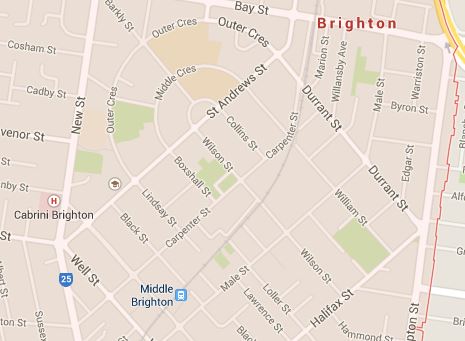
So we downloaded a historic walk (St Cuthbert’s trail) onto our phones from the very helpful Bayside City Council site and off we went. I had a yen for a cemetery (as one does), so we got off the train earlier and walked down to Brighton cemetery first.
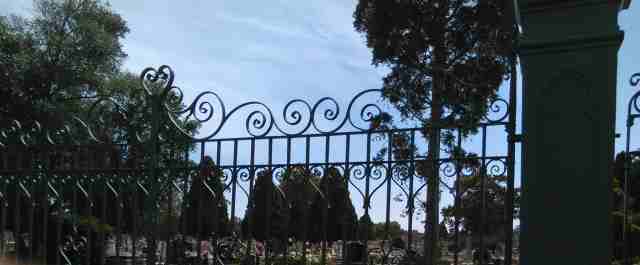
Brighton cemetery (which is actually in Caulfield South) is an old one, with land put aside in 1853 and possibly the first burial in 1855. According to a talk given by Jan Rigby from the Brighton Cemetorians to the Port Phillip Pioneers Group the very earliest graves were laid out at odd angles to the path, and I must confess that we found it hard to orient our way around the cemetery. Unfortunately the box containing pamphlets showing graves of interest was empty, and although I’d downloaded a map of the cemetery on my phone, it was difficult to read in the bright sunlight. Nonetheless, we found some interesting graves:


We were mystified by this tall memorial, with a beautifully rendered copper sculpture on the top.
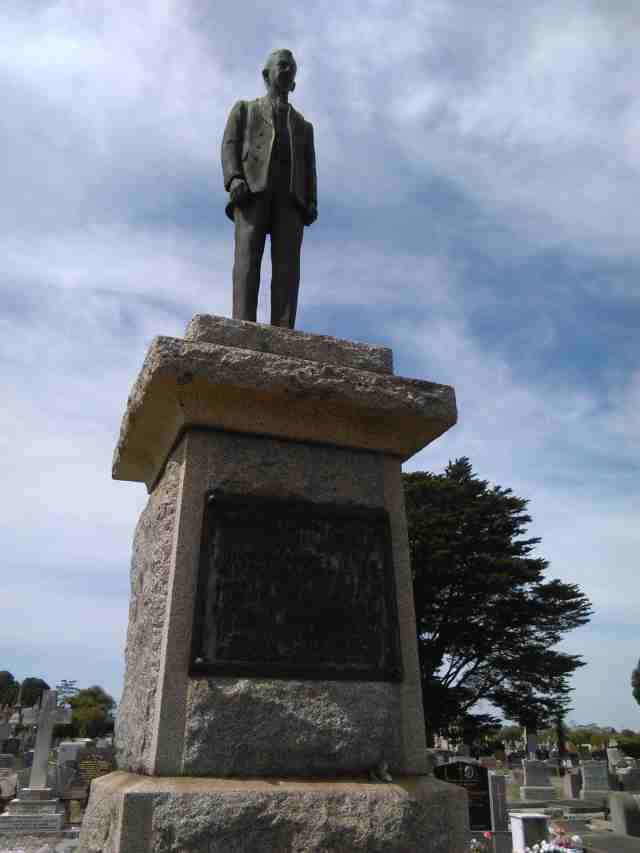
James Coppell Lee? Who was he? I looked him up when I returned home and found that he was the 19 year old son of the owners of the James Coppell Lee copper foundry, which is still operating- amazing! His workmates crafted the copper statue based, apparently, on his cousin because they had no photographs of him.
From the Argus, 29 December 1919
FISHING BOAT OVERTURNS.
YOUNG MAN DROWNED.
Forced by a blinding rainstorm to abandon a proposed fishing expedition off Mornington early on Saturday morning a party of youths attempted to turn their boat shorewards when the light craft was over whelmed by a big sea, and one of its occupants was drowned. Two other members of the party were rescued in an exhausted condition after a stem struggle in the surf
Thc victim of the accident was a youth, James Coppell Lee l8 years of age, whose parents reside at Pyrmont, Barkly street, St Kilda. He had been spending the holidays at Mornington, and with two companions, J Cook, l8 years of age, who lives in Fitzroy street, St Kilda, and P Ratchford, 20 years of age residing m High street. St Kilda, he decided upon a fishing cruise in the Bay. With this object the three youths hired a 15ft. rowing boat at 5 o clock on Tuesday evening. Setting out before dark, they cruised along the shore as far as Grice’s beach, four miles from Mornington, and pitched a camp there so as to permit of an early departure on Saturday morning for the schnapper grounds. Though a rather choppy sea was runnig the party pulled out to the reef and remained fishing there for considerably over an hour.
Under the influence of a fresh northerly at about 8 o’ clock on Saturday morning the sea rose, and as the driving rain began to sweep over this part of the Bay, the youths decided to run tor the shore to avoid the squall that appeared imminent. Their light boat tossed about to such an extent in the confused sea that a great strain was imposed on the rowers on the return journey. Nevertheless good progress was being made until the boat was opposite Mills’s beach Here an attempt was made to run the boat as closely as possible to the boat sheds but the prolonged rowing under such arduous conditions had weakened the rowers. Near the mouth of Tanti Creek, where large rollers were sweeping inshore, the boat was seen by people on the beach to be m a perilous position. Despite the efforts of the crew to keep its bow to the shore the incoming sea buffeted it broad side on, and a second later tho little craft was engulfed in an unusually large roller. Striking tlie boat abeam the wave spun it over and drove it swiftly into the shallows about 25 yards out from the beach
All three occupants were thrown into the water and the boat sank. Cook and Ratchford found bottom in about 5ft of water, but it is evident that Lee in some manner became entangled in the boat or some of the tackle, and went under with i.t A powerful undertow was running at this point but Cook made a plucky effort to drag Lee from under the boat. With water neck high, however, and the under current threatening to sweep him off his feet, the task of extrication was too much for Cook, who by this time saw that his other companion Ratchford, was in distress. A man whose name was ascertained to he Martin ran into the water and brought Cook and Ratchford to the shore. Several young men swam out in an endeavour to find Lee but their efforts did not meet with success It is understood that a second man helped in the rescue of Cook and Ratchford, but his name could not be obtained.Lee was said to have been the strongest swimmer in the party
Telegraphing on Saturday night our Mornington correspondent said that up to then Lee’s body had not been recovered. He was the son of Mr T Conpell Lee brass founder of La Trobe Street
Enough sadness. We caught a tram down to the Nepean Highway and had a very nice lunch at a deli place, then headed off for Middle Brighton. It was further than we thought, so we caught the bus. Dammit, it was an all-day ticket- we were determined to make the most of it.
From there we followed the St Cuthbert’s walk, which you can is online here anyway, so I won’t repeat it. It meandered around the curved avenues in Middle Brighton, around Firbank Grammar. One of the sites described on the walk was a house at 12 Middle Crescent, described as a single-storey Victorian villa built for a dairyman in 1877, when more conventional villas replaced the early 1840-50s cottages.

The house itself was unremarkable but I was struck by the house next to it, which was very similar and obviously being allowed to fall into disrepair sufficient to undermine any value of the house (as distinct from the land, that is, which was in a very prestigious spot).

The heritage-listed Brighton Civic Centre was a curious-looking building, erected in 1959 and probably more valued now than it might have been in the mid 1980s, I’d say.
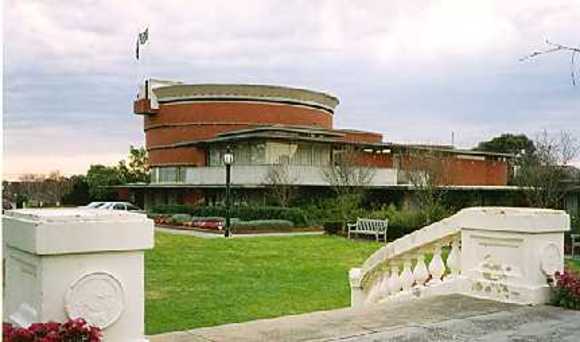

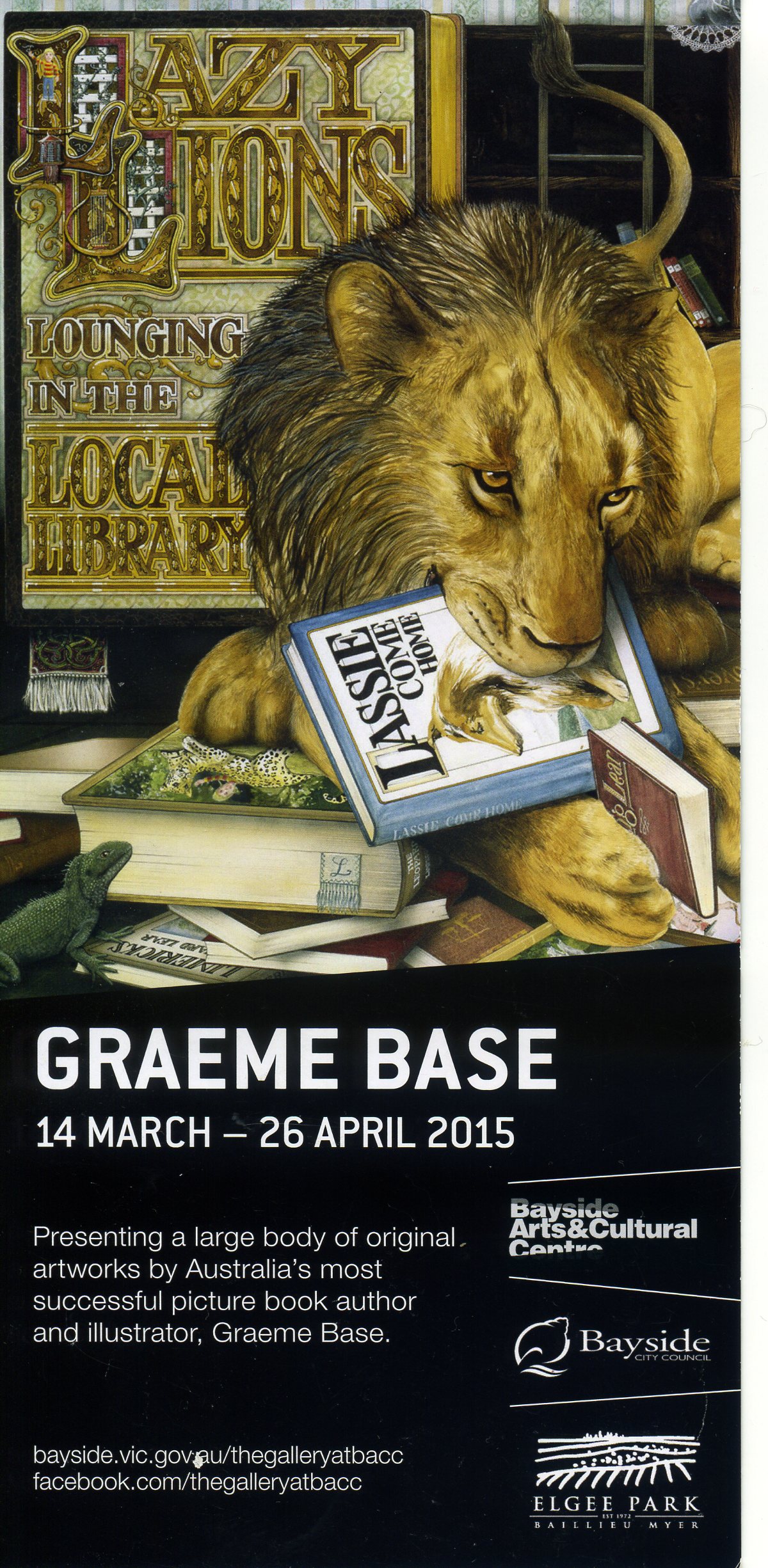
The Brighton Town Hall was featuring a free exhibition of works of Graeme Base, the writer and illustrator of the Animalia book which I remember reading to my children. The exhibition has several of the original paintings from that, as well as the many other books he has illustrated. The video of him from the 1980s talking about Animalia is worth it just for the mullet hairstyle! The exhibition is on until 26th April, but closed over Easter until Wednesday 8th April
Back onto the train, then “Home James and don’t spare the horses”. We’d had value from our day ticket- four trains (two each way), a tram and a bus, and a pleasant day was had by all.
I was about to write two blog posts about two separate works- a book and a film- until I realized that they were in many ways very similar. For both of them, I’d have to say that not much happened, really. Yet I had a totally different response to them: the book I loathed with a vengeance; the film I loved and even now will probably put right up top of the films I’ll see in 2015. The loathed one first….
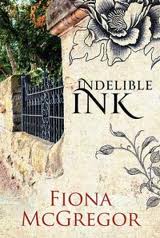
Indelible Ink, Fiona McGregor, 2013, 464 p.
My heart sank when this book was announced with a flourish at my book group as our next read. I have read it previously and disliked it. After reading it a second time, (now that’s dedication) I dislike it just as much. I didn’t blog about it the first time, even though I was doing the Australian Women Writers Challenge. Although my little review would not make any difference to anything, I didn’t feel right about bagging out a young novelist and so I just let it subside without trace on my blog. But it’s two years on, now; the dust has settled and I don’t have the same qualms about being critical.
I just didn’t buy the premise of this book from the start. I don’t need to like the characters in a book (and I found them all completely unlikeable) but in the midst of a contemporary, realist book I need to be persuaded that there’s a core of plausibility in the actions of the characters. The book has been likened favourably to The Slap and -how ’bout that- Christos Tsiolkas provided the front-cover blurb- and I can see the parallels of a family story, set in Sydney rather than Melbourne, with all the left-leaning, Radio National-type anxieties of affluent and self-absorbed inner suburban life. All of that’s true of Indelible Ink as well, but at least The Slap moved from character to character, and there was enough variety that you’d find one person at least that you’d recognize (and probably dislike). I think that it was the banality of the conversation that I bridled most against. Who’d want to be around these people? I felt that the author was looming over all, pressing all the ‘luvvie’ hot-buttons, just to get a rise out of her reader. Once again I found myself wishing that someone had ordered ‘cut! cut!’ by about 150 pages because this is a 300-page plot that doesn’t have 460 pages in it.
I know that many readers I respect have enjoyed this book- Lisa at ANZLitLovers thought highly of it; reviewers at the Australian Women Writers Challenge liked it; dammit, it even won the Age Book of the Year for 2011. I am so outnumbered here than I was relieved to find that Marieke Hardy from the First Tuesday Book Group and I are as one on this – thank God I’m not alone!
And so, on to what I loved….
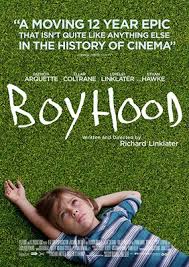
I’d heard this book mentioned in all the pre-Oscar hype and couldn’t quite see how you could make a film over twelve years. Well, you can – because here it is. It’s not like the 7-up series, where there are clear breaks between filming schedules. Instead, the boy Mason grows imperceptibly older, changing before your eyes.
Nothing happens, and yet much does. Perhaps it says something about my pessimistic, anxiety-driven nature but I kept expecting something to go wrong to impose some sort of narrative arc onto the film. I will confess that I did find myself checking my watch a few times during the film, although that was largely because I was wondering how much longer it would go before there was a climax of some sort. There was something rather omnipotent about looking down, watching time elapse, mistakes occur and resolve, expectations rise and subside, plans falter and opportunities arise.
My enjoyment of this film was confirmed the next day when I heard friends talking about their little grandson, who is determined to be one of the first kids at school each day. I thought back to the young Mason, and his little ways, and found myself washed over with affection both for the film character and for this little boy I’ve never met who wants to get to school early. I’ve thought of the film many times, as if I’ve lived someone else’s life. Quite apart from the hook of the twelve-year span, it was an intimate epic- big and small at the same time- and right up there as one of the best films I’ve seen in ages.
Posted in Book reviews, Film Reviews
Yes, it’s March and so it’s Banyule Festival again. And so there we were, all frocked up for Twilight Sounds at Sills Bend, my favourite place in the world and which should be on the Victorian Heritage Register. The weather was absolutely perfect: a still night, not cold. The crowds were there- probably the biggest turn-up in all the time I’ve been going. As you know, from my blog posts about Twilight Sounds in 2010, 2011, and 2013 I usually specialize in taking photographs of empty chairs at this gig, but not this year….


Excellent acts- all of them. Sweethearts first up- an all-girls big band from Geelong; then Emma Donovan (excellent!!) followed by Miss Murphy (who apparently won The Voice, but as popular culture tends to pass me by, I’d never heard of her). Much laughter and fun was elicited by Anna’s Go-Go dancing, when she had probably 700 people up dancing, with their Saturday Night Fever moves and Hillsong Hands waving in the air. Terrific idea; great fun.
Then bright and early on Sunday morning, there I was all ready to march in the Arty-Farty Parade down Burgundy Street, representing Heidelberg Historical Society. What do we want? HISTORY! When do we want it? YESTERDAY! Oh, you mean it’s not that sort of march?


After milling around on the oval for a while, waiting for the festival to be officially opened, over we trotted to Sills Bend itself which was all set up for the Arty Farty Festival.
But wait- there’s more!
Heidelberg Historical Society had its annual Bus Tour that afternoon and this time we headed off across town to the Essendon Incinerator. Yes. An Incinerator.
The Essendon Incinerator was designed by Walter Burley Griffin and opened in 1930. It was one of 13 that Griffin designed in Australia – seven of which are still standing- and the only one left in Victoria. The post-WWI influenza epidemic had raised anxieties about the dangers of tips, and when a young engineer called John Boadle invented a new form of incineration, it attracted the attention of a number of councils. Called the ‘reverbatory incineration’ technique, it involved dessicating the garbage before firing it at 2000 degrees in a closed furnace whose heat was intensified by being bounced back or ‘reverberated’ from a brick arch. The process generated little smoke or smell.


The garbage was conveyed onto the site in trucks which drove straight into the building. The load would be tipped into hoppers and hot air piped over it to dry out all moisture. Gravity dropped it into the incinerator where it would be fired, with the ash raked out from the bottom. Heat from the process was used to make and heat bitumen made from the ashes. The showers provided onsite for the workers (which was rather revolutionary at the time) were heated by the incinerators, and the hospital used the heat to sterilize bedpans.
The incinerator is on the site of the old Essendon tip. No-one wanted the incinerator built near them, and when it was argued that the people already living near the tip had paid cheap prices for their land anyway, it was decided to build it there. However, the first very bland and ugly design for the incinerator caused an uproar, and so Griffin and his partner Nicholls were called upon to redesign it. And so they did.
The building is quite beautiful- almost churchlike. It has many Griffin-esque touches like the raked roofline, cut-out geometric shapes in the windows, interesting plumbing details, and the use of reinforced concrete.
Despite its innovative design, it was not used for long. It required fuel-injection to light the incinerators and during WWII, shortages of fuel forced them to stop using it. After the war, they commencing tipping again into landfill sites, and the incinerator was not used again.
It’s fortunate that it has survived: many of them have not. Neighbouring Brunswick had one, but it has been demolished. The most famous one was at Pyrmont, and there was much unhappiness when it was demolished as its chimney was one of the landmarks of the harbour. The incinerator at Willoughby has been turned into an art centre, as has the Essendon one. It’s surrounded by trees and is a beautiful building.
You can read more about the Griffin incinerators here.
Posted in Heidelberg Historical Society, Sills Bend

So there I was at a packed Melbourne Unitarian Peace Memorial Church on Monday night for the second forum presented by the ANZAC Centenary Peace Coalition. Chaired by the Quakers, the night started with Joy Damousi who reminded us of the progressive social policies by which Australia defined herself at Federation: progressive social policy, female suffrage, the eight hour day, the basic wage, pensions. However, from 1907 onwards there was an increasing militarism, with compulsory military training for males between 12 -25 years of age from 1911. Both conscription and the peace movement existed prior to World War I.
The speakers were separated by a musical interlude by Morgan Phillips and his guitar accompanist. At this point they gave a rendition of that 1915 hit, “I Didn’t Raise My Boy to be a Soldier”
Val Noone was next, speaking about the Australian Peace Movement between 1914-18. He did this through seven snapshots of activists including Mark Feinberg from the International Workers of the World (IWW), Margaret Thorp the Quaker leader of the Womens Peace Army, Archbishop Daniel Mannix and a number of conscientious objectors. He noted that over time there was a change in attitude amongst the population at large, with a higher proportion voting against conscription in the second referendum.
The musical interlude to close off Val’s presentation was a song about the Christmas Truce in 1914. I’m not sure if this is the song that was sung, but it’s quite beautiful nonetheless:
Finally Bruce Scates, leader of the One Hundred Stories project, gave an emotional account of the True Cost of War, based on the repatriation records of WW I soldiers which have been digitized by the National Archives. What a rich historical resource they are- it’s amazing to think that they were slated for destruction, but fortunately saved. Monash University will be conducting a free online course commencing 13 April 2015 based on these archives to “forever change the way you see the Great War”. Have a look at Monash University’s One Hundred Stories site. You can sign up there for the course, or just spend some time looking at the stories which are presented as silent slides. He spoke of Frank Wilkinson (Story 11). For Frank, the war didn’t end on 11 November 1918.
His presentation was closed with “And the Band Played Waltzing Matilda”.
The night ended with a very Quaker-ish minute of silence. A fitting end.
Posted in ANZAC Centenary Peace Coalition
 The Resident Judge of Port Phillip