Author Archives: residentjudge

Movie: Absolutely Fabulous: The Movie

Much as I love Ab Fab, it’s best viewed in small doses. I think I enjoyed this trailer as much as I did the whole movie, to be honest. I am absolutely clueless about fashion and popular culture, so much of this went right over my head. But of course, it’s lovely seeing everyone again- Mother (who would have to be the most beautiful 90 year old around); Bubble; Marshall and Bo; Saffy and Lola. I found myself grinning away like an idiot just from the joy of seeing familiar faces again.  At least Eddie and Patsy (who’s pretty damned good for 70, too) can grow into their old age disgracefully and embarrassingly, which is of course the whole shtick.

But while half-an-hour of Ab Fab is perfect, a whole movie is too long. Really, I think you’d be better off sitting down with an Ab Fab box set and just enjoying it in its original and absolutely fabulous format.

Don Watson ‘QE63 Enemy Within: American Politics in the Time of Trump’

watson_enemywithin

2016,  63p.

It might seem strange to Americans that  Australia’s premier long-essay journal devotes a whole issue to Donald Trump (and I can’t see the interest being reciprocated in reverse) but as in other countries across the world, many Australians – and particularly those of Quarterly Essay persuasion- are horrified at the idea of President Trump.  So, too, is Don Watson, as he makes clear in this essay.

Don Watson wrote American Journeys eight years ago (see my review here) and he repeats, on a smaller scale, the methodology he used in that earlier book.  However, instead of criss-crossing America to explore its political and cultural paradoxes, Watson limits himself in this essay to the state of  Wisconsin.  However, his findings are similar on a smaller scale: that within the one state there can exist multiple Americas, and that American politics reflect this splintered reality.

Within the state of Wisconsin, there is Milwaukee, hollowed out by the collapse of American industrialisation. White Americans now number 37% of the population (half of what it was in the 1950s); Latinos a four-fold increase to 17% and African Americans making up 40%. Milwaukee votes Democrat, but the white-flight suburbs surrounding it are a staunch Republican voting block, fired up by prosperity evangelism. They are the support base  of  the current governor Scott Walker, who believes that God has chosen him to cut taxes and stop killing babies.

Then, in the same state, there is Madison – and how many books have I footnoted ‘University of Wisconsin- Madison’?- a university-dominated town with art galleries, museums, and the Capitol building.  Madison was the seat of Robert La Follette who took on the elites, the railroad trusts, the lumber bosses, the corporations and stood for an expanded democracy, guarantees of civil liberties, the right to form unions and against “any discrimination between races, classes and creeds”. (p. 28) It is this strain of American politics that responded to Bernie Sanders for whom, I suspect, Don Watson would vote  if he had the chance.

There are now, Watson claims, two red parties and two blue parties, and “the whole country has come to resemble a battleground, albeit one, like the Somme for long periods, in stalemate.” (p 3) The underlying truth is that “the United States is a concatenation of sulky tribes, provincial, ignorant and seething with ambition, frustration and resentment”. (p 4)

While not discounting the possibility of a Trump victory completely, Watson abhors the thought.

Clinton just has to win. If she loses, not only does the world get Donald Trump (and the US Supreme Court his appointments): the Democrats will have to live forever with their decision to make their nominee the most qualified presidential candidate in history, but also the person most disliked by the American public and possibly the only one that Trump could beat. (p. 66)

Clinton is, Watson says “a fully fledged, and some would say dangerous, foreign policy hawk with no demonstrated ability to think beyond the doctrine of exceptionalism to which she subscribes as a matter of faith” (p.62) But she has also, through Sanders’ presence, been pushed towards the progressive side with promises to invest in cities to lift people out of poverty, invest in infrastructure, create jobs, revive manufacturing and raise the minimum wage, with immigration reform, an end to student debt and paid family leave. (p 64).  And this, perhaps, is cause for cautious optimism.

Reawakening the old grassroots reformer deep inside could not only heap manifold blessings of the nation and consolidate a liberal Democratic ascendancy; it is surely alsO the best antidote to the dark forces now feeding on the country’s malaise. (p. 67)

This Quarterly Essay probably does not add much that is new to the commentary that Paul McGeogh has been providing in the Fairfax papers, or Guy Rundle in Crikey. It is good, however, to read an extended-length reflection on the American elections, even if it feeds into our despair over a decision that will affect us all, and upon which we can have no influence whatever.


Movie: ‘Neruda’

We caught this film last week at the Latin American Film Festival.  I actually knew who Pablo Neruda was, because we read several of his most famous poems in my Spanish conversation class at the local library.  He was a Chilean poet, who became famous through a collection of poems called Twenty Love Poems and a Song of Despair that he wrote in 1924at the age of nineteen. He went on to have a prominent political and diplomatic career.  He was a senator for the Chilean Communist Party, but when Communism was outlawed in Chile in 1948, he escaped to Argentina. His death has become increasingly controversial over recent years, with the Pinochet government assertion that Neruda died of cancer, being increasingly questioned.

This film is the imagined story of Neruda’s escape to Valparaiso and across the mountains to Argentina, pursued to a Javert-type policeman (think Les Miserables) who, although unfamiliar with him as a poet, sees the chase in very personal terms.

And no- I couldn’t follow the Spanish very well.

This Week in Port Phillip 1841: 25-31 August 1841

THE SAD TALE OF OF VEZELLA RAINBOW

It was not particularly common for the Port Phillip Herald to comment on the parlous circumstances facing impoverished individuals, but during much of June 1841 it conducted an appeal in its columns for donations to the widow of Trooper Rainbow, of the Mounted Police, who drowned when crossing the Goulburn River on 26 April 1841.  As the Sydney Herald reported, Trooper Rainbow had been with the Mounted Police for seven years, and was regarded as an active, steady man.

REAL DISTRESS. We beg to draw the attention of our humane readers to the case of the widow of Trooper Rainbow of the Mounted Police, who was lately unfotunately drowned when crossing the River Goulburn on duty. What makes this case one of peculiar sympathy is that while the bereaved woman has no claim whatever on the service, she has a babe in arms and expects shortly to again become a mother! Need we say more to call upon the liberality of the public to step forward at once to her relief? Subscriptions will be thankfully received at the Herald office.  (PPH 25/5/41 p. 2]

And so they were. For a month an article appeared in the Port Phillip Herald, listing the names of people who had donated to the appeal and the amount that they had donated.  I really can’t emphasize the rarity of a public subscription for a woman being reported like this.   Subscription lists for church buildings,  letters of support for Port Phillip personalities who were being attacked by Judge Willis, or benefits for clapped-out theatre performers- yes; but not a woman.

By 2nd July, the last advertisement appeared. It read

Rainbow1

Rainbow2

It’s a highly respectable donation list that raised £51. [A (male) overseer at that time might earn £100 per annum; single female servants were having to accept about £25 p.a. with board.]  Lieutenant Russell, was the most generous, with a donation of five pounds. It is likely that this Lieutenant Russell was the Lieutenant Russell who was commander of the Mounted Police, and other donations were given Trooper Rainbow’s fellow soldiers. Superintendent La Trobe was the next most generous with a donation of two guineas  (2 pounds and 2 shillings), and it is surprising to see Judge Willis’ donation of one pound because he rarely made public donations like this to individuals.

His donation is even more incongruous, because on 27th August, the Port Phillip Herald reported that Vezella Rainbow had been arrested for shoplifting.

The trial before Judge Willis was reported in the next edition (31 August). It was a jury trial, conducted on Friday August 26 before twelve good men of the town (women did not serve on juries). Trials moved pretty swiftly back then, and it was common to have three or four hearings within the one day. Juries made up their minds very quickly, often not even leaving the courtroom at all.   The prisoner was not called to the witness box and did not give evidence on their own behalf. Instead, it was up to the crown to prove the case through witnesses, and the question of ‘character’ often entered into consideration. In this case, the prosecution called three witnesses: Mr Codd the shop assistant, Mr Whitehead the shop-owner, and Constable Stapleton, who arrested her.

Vezella Rainbow, widow of the late Corporal Rainbow, was placed at the bar, charged with stealing a shawl, value two pounds, and five yards of Saxony cloth, value 18s.

Clement Codd, being sworn, deposed- I am shopman to Mr Robert Whitehead, Elizabeth-street; I saw the prisoner in his shop on Monday last; she purchased to ribband [sic] waistbands and paid for them four shillings, giving two half-crowns and being returned one shilling; did not ask to see any other goods; I was serving other customers at the time shewing them some shawls and Saxony dresses; the dress and shawl produced I identify to be the property of Mr Whitehead (here the witness received a caution from His Honor as to how he would swear to the identity of articles), I know them by private marks; I took them from the prisoner at the bar; she had them concealed under her shawl; they had been lying on the counter. I do not think Mrs Rainbow could have only taken them up to look at, without intending to take them away; they were concealed in such a way that when I took the dress from prisoner she denied having anything else in her possession; I had given her the change, she was putting it in a handkerchief and was about to leave the shop, when I perceived the articles with her.  After taking the things from her, I left them on the counter and went for a constable; I left Mr Whitehead in the shop; I marked the things and gave them to the constable who took the woman away; there are other Saxony dresses in the shop but none of the same description.

Cross examined by Mr Barry; there was another woman in the shop when the prisoner entered; subsequently a man came in; the woman who came in looked at some saxony dresses and then came out; brought back the man with her to buy her one, which he did.  The prisoner had a bundle under her arm; can’t say what it was; thinks it was a bundle rolled up in a yellow handkerchief: I marked the things after bringing back the constable; the prisoner was in conversation with the other persons in the shop: can’t say what they said: it was about articles of dress.  I particularly observed when the prisoner came into the shop that she had something under her arm; before I took the articles in question from Mrs Rainbow, she had not attempted to leave the shop: the articles she purchased still remained on the counter, when I perceived the dress with her: when I took the things she did not say any thing, but when going to the watchhouse, said the other woman had given them to her.

Robert Whitehead, being sworn, deposed, I keep a shop in Elizabeth-street; I know the prisoner at the bar; saw her in my shop on Monday evening last; I identify this shawl as being my property by the shop mark on it; I positively swear to the shawl.  I do not know any other shop that makes use of the same marks as I do; I saw Codd take the things from under prisoner’s shawl; just as a came into the shop; there was a man and a woman in the shop at the time the prisoner and another woman was conversing together; there was a man between them: I desired Codd to go for a constable, he brought one back with him. (The Judge here addressed the witness, stating, that although he did not mean or wish to impune his evidence, still there were many things he had stated required explanation.  His Honor compared different portions of the evidence and pointed out various discrepancies) another shopman was present, part of the time.

The witness was here cross examined by Mr Barry, but nothing particular was elicited.

Constable Stapleton, deposed to the facts of having taken the prisoner in charge, she being delivered up to him by Mr Whitehead, he also stated that the prisoner on being conveyed to the watchhouse said, that it was owing to bad company she got into the scrape.

Redmond Barry (yes, that same duelling Redmond Barry) acted as her defence counsel.

For the defence, Mr Barry addressed the jury as follows: I have no doubt Gentlemen, that after the evidence you have heard, you will proceed to discharge the defendant, for in my humble opinion there is no evidence to prove that the prisoner at the bar feloniously took the articles with intent to carry them away, which the law requires to constitute the crime, with which she is charged.  My client stands in a situation of peculiar delicacy; it is most distressing to witness it; and bear in mind gentlemen, the great disgrace she has already undergone by being arraigned at a bar of justice, on a charge of such a description.  Discrepancies of the most serious nature occur in the evidence to which I must request your particular attention, as they occur in the testimony of all the witnesses.  Gentlemen, the prisoner at the bar is the widow of the late corporal Rainbow, who was drowned in the Broken River, in the discharge of his public duty.  I can call innumerable witnesses as to the very good character of the unfortunate defendant, and you may well remember the great commiseration that was exhibited by the public towards Mrs Rainbow, on the death of her husband.  Indeed, gentlemen, I feel deeply affected by being obliged to come before you to plead in such a case as this; for the miserable prisoner at the bar is in such a state that she must soon give birth to an infant, who if you find the prisoner guilty, must first receive the pure air of heaven, the gift of the Almighty, in the murky dungeons of a loathsome prison, redolent of vice, obscenity and filth. I hope therefore you will immediately proceed to acquit my client, as I am sure you are already persuaded of the innocence of the prisoner, and as the entire of the evidence is so contradictory and unsatisfactory.  I shall leave the case in your hands, satisfied that it will meet with that consideration it so imperatively calls for.

It’s interesting to watch Judge Willis in action here.  He was very active during the case itself, pointing out the discrepancies in Mr Whitehead’s testimony and, according to a separate article in the same issue of the  Port Phillip Herald (31 August) Willis called up Codd immediately after the case and “proceeded to reprimand him in the strongest terms for gross prevarication in his testimony”. Willis read Codd’s  testimony at the Police Office and the Court back to him, pointing out the inconsistencies, and warned Codd that “he might be thankful for the clemency shewn him in not being committed to gaol for his gross prevarication”.   Notwithstanding these inconsistencies, and the  pound that Willis himself had donated for the unfortunate Mrs Rainbow a few weeks earlier, he then summed up very strongly against the prisoner:

The Judge summed up the case in an able manner, concluding by desiring the jury to divest their minds of any influence that the affecting address of Mr Barry might have on them, for notwithstanding the distressing circumstances of the case, as good and honest subjects they were bound to give their verdict, and assist as far as it lay in their power to have the law  carried into effect, justly and uprightly.  The jury after a few moments consideration found the prisoner guilty with a strong recommendation to “mercy”.

His Honor, in an affecting manner passed sentence on the prisoner, sentencing her to “six months imprisonment in her Majesty’s gaol of Melbourne”.  [PPH 31/8/41]

In his book Crime in the Port Phillip District (p. 198), Paul Mullaly reports that Vezella Rainbow (the spelling of her first name varies) was Freed by Servitude (i.e. an ex-convict) which may account for his hardline approach.  It was reported that “other Police had to take care of her children”.  On 15 April 1842, the Colonial Secretary wrote to La Trobe approving remission of sentences of 16 listed individuals including Vizle Rainbowe [sic] (VPRS Series 19 Unit29), so it does not appear that her sentence was reduced much, if at all.

HOW’S THE WEATHER?

Just as we’re experiencing here in 2016, the spring weather wass changeable. The warmest day for the month was 27th (69 degrees or 20.5C), followed by a strong gale the very next day.  The coolest temperature was 37F or 2.7C.

This Week in Port Phillip 1841: 17-24 August 1841

THE WATER CARTERS

At this stage, Melbourne was reliant on water carters for its water supply. Having recently spent some time in Nairobi where our house was reliant on tanked water for its domestic supply, I have a new appreciation for the angst caused by the non-appearance of the water delivery tank.

THE WATER CARTERS: Of late, several impositions have been attempted, and threats made by the carters who are in the habit of supplying the inhabitants of Melbourne with water. On Tuesday last one of these worthies was requested to bring a load to a resident in Bourke-street, which he willingly promised he would, and proceeded, as he said, direct to the pumps for the purpose. Hours, however, passed over, and no water cart made its appearance.  After waiting for so long a time, absolutely in the greatest want of the water, there was no other alternative left than to send through the streets and purchase a cask from another man. When a considerable period had elapsed after the so-much-required supply had been procured, the first carter arrived with his load, but as he had so disgracefully broken his agreement, and besides, as the water was not only then not required, but as there was no vessel for its reception, it was refused, and no payment of course would be made. Upon this announcement, the villain burst out into a violent storm of passion, discharged the water upon the path near the door, and threatened he would instantly have the person who had given him such offence summoned to the court.  Certainly there must, in a civilized colony, be some law wherewith to punish such vagabonds. It would be well for a case to be tried to solve the question. [PPH 17/8/41]

AN AFFAIR OF HONOUR

On 20th August the Port Phillip Herald reported a “hostile meeting” between “Mr B___ a gentleman of the bar” and Mr S_____.  These thinly disguised names would have been readily known to Port Phillip inhabitants: Redmond Barry (then aged 28) and Peter Snodgrass (aged 24).  As Edmund Finn, writing as ‘Garryowen’ described in his inimitable way:

In August 1841 occurred a hostile meeting, remarkable in consequence of the position attained in after time by the principals. Mr Peter Snodgrass was by no means the least pugnacious individual of an extinct generation, and it did not take much to get up a casus belli with him. Mr Redmond Barry was a gay and promising young Barrister, and the two were prominent members of the Melbourne Club. Barry had written a letter to a friend, who injudiciously showed it to Snodgrass, about whom it contained some reference, which was deemed to be personally offensive, and a challenge was the consequence.  The gage of battle was taken up, the preliminaries were quickly arranged, and in the rawness of a winter’s morning the meeting came off by the side of the “sad sea waves,” between Sandridge and the present Albert Park Railway Station.  Though the weather was the reverse of promising, Barry made his appearance on the ground done up with as much precision as if attending a Vice-regal levee.  Even then he wore the peculiarly fabricated bell-topper, which a future Melbourne Punch was destined to present to the public in illustrated variety; he was strap trousered, swallow-tail coated, white-vested, gloved and cravated to a nicety.  He even carried his Sir Charles Grandison deportment with him to the pistol’s mouth, and never in years after appeared to such grandiose advantage as on this occasion.  When they sighted each other at the recognized measurement, before Barry took the firing-iron from his supporter, he placed his hat with much polite tenderness on the green sward near him, ungloved, drew down his spotless wristbands, and saluted his wicked-looking antagonist with a profound obeisance that would do credit to any mandarin that ever learn salaaming in the Celestial Empire.  They taking his pistol and elevating himself into a majestic pose, he calmly awaited the word of command.  Snodgrass fussed and fidgetted a good deal- not from the nervousness of fear, for he was as brave as an English bull-dog, but rather from a desire to have the thing over with as little ceremonial nonsense as possible, for he was Barry’s antithesis as a student of the proprieties.  It was his over-eagerness on such occasions that caused his duelling to eventuate more than once in a fiasco, and unfitted him for the tender handling of hair-trigger pistols. By a laughable coincidence, the present “engagement” was terminated in a manner precisely similar to what happened at the duel of the year before, when a hair-trigger prematurely went off.  The same fire-arm was now in use, and just as the shooting-signal was about to go forth, the pistol held by Snodgrass, getting the start, was by some inadvertence discharged too soon, whereat Barry at once magnanimously fired into the air. Little could either of the duellers foresee what futurity had in store for both.  The one grew into the esteemed and popular forensic Advocate, and on to the eminent and universally-valued Judge; whilst the other, in the following year, was a gallant capturer of bushrangers, and ended his career as an active Member of Parliament, and a voluble if not eloquent Chairman of Committees in the Legislative Assembly.

redmond_barry_statue

Redmond Barry in his later, more sober years.

A NEW POST OFFICE

The new post office had opened on the corner of Bourke and Elizabeth Streets week earlier, having vacated its former premises in Little Collins Street.

Secondpostoffice

The Second Post Office by William Liardet. This post office in Little Collins Street was superseded by the ‘new’ post office on the corner of Bourke and Elizabeth Streets, which opened in August 1841.  State Library of Victoria

http://handle.slv.vic.gov.au/10381/151517

[Actually, looking at this picture- is that a beggar sitting against the wall, receiving alms from a lawyer??]

3rdpostoffice

The third post office, which opened in August 1841, is shown here in 1853, only six years before it was demolished for the first GPO which was built on the site. Note the deep gutter to the right of the image, built to try to control the unruly waters of Elizabeth Street. Original drawing by F. Thomas. State Library of Victoria

http://handle.slv.vic.gov.au/10381/261742

On August 17 the Port Phillip Herald praised the appearance of the letter-carrier, who seems to have cut quite a dash:

The scarlet coat, gold band on the hat, and leather case under the arm of the letter carrier, give a very gay appearance to the town of Melbourne, and to the gay lothario who sports them [PPH 17/8/41]

SOME BITS AND BOBS

An arrival in port

There was a 62 ton schooner called Truganini that arrived from Hobart. Interesting that the the woman we know as Truganini (Trugernanner) was at this stage in Melbourne, having come across with the Aboriginal Protector George Augustus Robinson.  I wonder how and why the boat was named Truganini?

A caution

An interesting advertisement:

CAUTION.  The public are hereby Cautioned against giving credit or harbouring my wife, Agnes Brown, she having decamped from her home, taking with her a watch, tea caddy, box and bed quilt on Thursday last.  Any person found harbouring her, will be dealt with according to law; and persons giving me such information as will lead to conviction, shall receive Five Pounds Reward.  James Brown. X his mark.

Until the passing of the English Divorce Act in 1857, divorces could only be granted by an Act of the British Parliament: an avenue restricted to very wealthy people. Only one petition for divorce was ever made in New South Wales (and that, interestingly enough, was on the part of the wife). Although legislation to protect Deserted Wives and Children was introduced in NSW in 1840, the emphasis was on men deserting their wives rather than the other way around.  However, as the advertisement above makes clear, women did not have property rights to any family goods, when they left a marriage, an illegal act in itself. A watch, a tea caddy, a box and a quilt: possibly  the watch and the contents of the tea caddy were all the portable property the couple held, while the quilt seems a particularly female object to take. [Memo to self: must go see the Quilt Exhibition at NGV Australia before it finishes in November].

And another interesting advertisement:

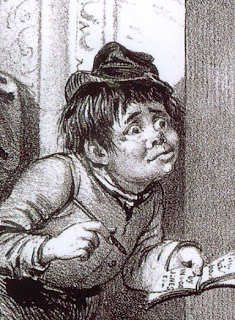
STRAYED about a fortnight ago- a boy about nine years old, had on light trowsers, blue cloth jacket, rather large pair of old worn out boots, dark hair, freckled features, round plump face; a small dog following blind of one eye.  The boy has strayed in a similar manner before and went in a fictitious name. He is supposed to be in the vicinity of Melbourne. Whoever will give information where he may be found to Mr Henny, Irish Harp, will be thankfully received. [PPH 17/8/41]

AND THE WEATHER?

Strong winds prevailing, weather cloudy or rainy.


‘Where Are Our Boys?’ by Martin Woods

OurBoys

Where Are our Boys: How Newsmaps Won the Great War Martin Woods

2016, 227p & notes

Now that I come to think of it,  maps don’t figure prominently in our graphic-rich environment much any more.  I’m old enough to remember wall maps strung up on a classroom wall, and I’m old-fashioned enough to still have a Melways in the car.  Our use of maps has become very functional and specific. Google Maps takes you right to where you’re looking and the  GPS in your car gives a one-dimensional snapshot of your immediate surroundings as you travel to your pre-selected destination. While there are still maps occasionally in newspapers and on television news – to pinpoint the sites of a specific event like an earthquake, tsunami or terrorist events, for example- I’m not particularly aware of maps that show a broad region and topographical features any more. Perhaps that’s why I’d be hard-pressed, I must confess, to tell you which countries border Syria- or even exactly where Syria is, even though it’s on the news every night.

However, few maps are completely neutral- or even accurate, as the ‘true size’ map makes clear.  Even that world map of my memory, with the pink Commonwealth countries, was an argument for Empire, and as the Worldmapper website shows, it is possible to revision the world according to different parameters, depending on the argument you want to make.  And as Martin Woods shows us in his book Where Are Our Boys? this was also true in the more map-oriented environment of World War I where Australian families, anxious about ‘our boys’ on the battlefields were exposed to maps in an unprecedented way.  ‘Newsmaps’, as Wood coins them, were newspaper maps that were placed in the news, often at the core of the commentary and became “the window through which most news was viewed and understood” (p. 1).  His book focuses on the production and reception of maps for an Australian readership during the years 1914-18 and thus reflects the narrative of the time  of ANZAC troops fighting within the bigger picture of a British war, and not the skewed nationalistic map of ANZAC commemoration-tourism that we hold today.

The opening chapter of the book places the WWI newsmaps into a longer cartographic tradition, springing from the late 16th century with the rediscovery of Ptolemy’s maps from c.90-179CE. and the expansion of printing techniques, particularly during the Dutch Golden Age, which enabled the production of maps to demonstrate exploration, urbanization and -especially- the bird’s eye view of battles and sieges. Maps were fundamental to military strategy, both for commanders and commentators.  However, these maps were separate artefacts to be unrolled and consulted alongside the news received either by despatch, word of mouth or, later, through the columns of newspapers.While the publication of maps as a separate product continued into the twentieth century, this book emphasizes the integration of the map into the newspaper itself as a ‘newsmap’.

As Chapter 2 ‘Remaking the Map of Europe’ shows, maps, generally imported from Britain, were popular with Australian readers.  Geography had been added to the school curriculum in the 1870s, and maps were used to track the progress of explorers across the Australian continent. Scouts and cadets learned map-reading skills, and the compulsory military training for men and boys aged 12-26 under the Commonwealth Defence Act of 1911 exposed more men to maps.

During the first decade of the twentieth century, newspaper consumption reached an all time high in Australia (p. 43). The first map produced in an Australian newspaper accompanied a report of the Crimean War in the Sydney Illustrated News published on 13 May 1854, and during the Boer War, maps were embedded into news articles or placed alongside correspondents’ reports.  This was a practice that continued with the Russo/Japanese War, the San Francisco earthquake and the Italo-Turkish war of 1911-12. In this way, Australians were exposed to a steady diet of maps to explain conflicts and risings in Europe during the first decades of the twentieth century.

The Balkans had been an area of concern in Australian newspapers from 1908 onwards, but for Australian readers on the other side of the world, the rapid transition to war came as a jolt.  At this stage, the whole world was the stage and Ch. 3 ‘Tinker, Tailor, Soldier, Sailor’ demonstrates, the maps were big too, with large wall and billboard maps produced for shared consumption, like the large billboard map outside the the Argus office.  Commercial maps were produced for home use  by companies like Robur Tea, or by the newspapers as a special feature.  Many of these maps were cheaply produced and ephemeral, hence their relative scarcity today.  As attention focussed on the French/German frontier and Belgium, the maps became smaller in scale, moving from one battle front to another.  The German colonies now came into contention and war maps now often had a breakout box showing Australia’s proximity to the Pacific colonies.

With all this emphasis on Europe, France and Belgium there was initial disbelief when the ANZACs were sent to Egypt instead of the European front (Chapter 4). As 21st century Australians, we now know the layout of the Gallipoli peninsular better than Australian readers did at the time, (notwithstanding our relative cartographic ignorance).  The actual location of the soldiers was not divulged until mid-May and the Dardenelles were rarely shown on world maps at the time. It was not until September that a detailed map of the Gallipoli peninsula was issued. Shortly afterward, the ‘War Map of the Dardenelles and Bosporus’ was forwarded to schools, where it was intended that it form the basis of classroom discussion. A Robur war map was available for subscribers giving a bird’s eye view, unconstrained by detail and optimistically misleading, complete with little flags to pin onto the map to show progress. But of course, as we know, there was little progress, and little sense of orderly movement in the heavily censored letters home. Maps issued after the withdrawal were more detailed and provided the topographic detail necessary to make sense of what had happened, especially H.E.C. Robinson’s  map ‘ANZAC: Date of Landing April 1915: Date of Evacuation Dec 19-20 1915’ which was issued as a fundraiser in April 1916 in time for the first anniversary of the landing.

In Chapter 5 ‘Reading the Front’, Woods emphasizes that maps were just one part of the printed deluge that swept across Commonwealth readers. Australia was part of an Empire-wide publishing market, and there was lots of analysis, with special ‘War Issues’, technical articles, campaign diaries and maps, poetry, sheet music and novels.  Special collections of maps were marketed as gifts.  War films were shown at cinemas, and he notes in particular animated battle maps that were shown as shorts before the main feature, where using stop-motion animation, simple flag armies were shown moving across the screen (my- it was a simpler time!). The social aspect of map reading is emphasized, deepening our understanding of the homefront response to the war.

With the shift to ‘Somewhere in France’ (Chapter 6) from 1916 onwards, readers were frustrated by the lack of detail about Verdun and and readers now were aware that lack of detail generally indicated enemy gains. Although the ANZACs landed in France in March 1916, little was noted in the newspapers for two months.  When maps for public consumption began being produced again,aerial photography added a new perspective to maps. Nonetheless, maps of the Western front were in themselves a form of fantasy which did not capture the obliteration of geography caused by trench warfare.   The London-based Daily Mail syndicated its birds-eye map across the world which showed villages and farms that were no longer there. Today – and especially during this and the next two years- Australians are aware of Menin Road, Polygon Wood and Passchendaele, but readers of the day saw them as part of the wider campaign and geography of ‘Flanders’.  There was genuine fear that Britain itself would be invaded, but by July 1918 the narrative had shifted. Instead of fear and gloom, there were more hyperbolic, nationalistic reports, and instead of the ebb-and-flow nature of the news, there were almost unalloyed good tidings.

By the latter half of 1918, as Ch 7 ‘Victory – In memorium’ shows, the newspapers displayed the discordancy of headlines urging victory, while the personal columns and lists of casualties revealed the ongoing sadness.  Henry B. Manderson (Melbourne) rather prematurely issued the ‘Victory Instant Reference Large Scale War Map of Western Europe and Australian Fighting Fronts’ in mid 1918, with an index of 7000 place names, and locations of Australian cemeteries.  The map came complete with British, French, Italian, Australian and American flags and instructions to

Cut the flags out, mount on pins, and from the information published in the newspapers each morning you may, by moving the flags, follow the movements of the various armies as they retreat or advance (p. 210)

Australian crowds anticipated the Armistice, with the Argus war billboard in front of the Argus building being torn down by jubilant crowds on 9th November.  Following the announcement of peace, maps were produced showing the reconfiguration of Europe, and local maps revealed Australia’s new interest in Germany’s Pacific holdings, especially Nauru. Within months the first battleground tourism maps were being produced, for Australians wealthy enough to make their own pilgrimages to visit the sites where their sons and husbands fell.

This is a clearly written,  beautifully produced book,with full colour maps on nearly every page. Its chronological approach presupposes a certain familiarity with the progress of WWI, but its emphasis is on the media depiction of the war and its homefront reception.   If I have one criticism, it is that I was not always aware that the map under discussion would be on the next page, and I would have appreciated a note in brackets, perhaps, indicating the page on which the map might be found if it was included.

I do find myself questioning, though, the subtitle “How Newsmaps Won the Great War”.  It’s a big claim, and not one that Woods addresses in detail. Certainly, as he notes:

The war of 1914-1918 was a modern, mechanised, media-fuelled global conflict, in which newsmaps were part of a campaign bolstering public confidence, punctuated by well-pitched moments of alarm… To a map- and news- literate early twentieth-century audience, the power of maps was undoubtedly more immediate and widespread than in any previous war (p. 224)

War maps did, as he claims, prove a template for reading the war as it unfolded, and military propaganda notwithstanding, “contemporary audiences were arguably better acquainted with the flow of events than most of us today, and more able to understand the context of the Great War.” (p. 227). They did, as he also claims, have an impact on the geographical imagination and educational curriculum and raised expectations of the possibilities of technology.  But newsmaps won the war? I’m not convinced. The war wasn’t won staring at the huge map on the Argus billboard, or moving the flag pins on a map on the other side of the world while Mother knitted socks- scenarios that Woods captures so well. As Woods has shown us, newsmaps did not drive actions, but instead were a commodity created for an audience  whose thoughts and prayers spanned the globe, unconstrained by geography.

Source: Review copy


‘Black Rock White City’ wins the Miles Franklin

In past years I’ve assiduously worked through the short list for the Miles Franklin, but it seems to have crept up on me this year. What was on the shortlist? Actually, I’ve read several of them without realizing it.

  • The Natural Way of Things by Charlotte Wood (my review here)
  • Hope Farm by Peggy Frew  (well, I did borrow it to read it, but didn’t get round to it)
  • Salt Creek by Lucy Treloar
  • Leap by Myfanwy Jones (my review here)

and the winner

  • Black Rock, White City by A. S. Patrić (my review here).  And I’m quietly chuffed to see that I thought ‘Miles Franklin material’ right back in August 2015, when I read it.

Movie: Truman

I’ve been learning Spanish for the last year and that was the main reason that I wanted to see this film. It’s odd- I came out of the cinema smugly happy with my ability to recognize a couple of words in each interaction, but looking at this YouTube trailer- it seems so fast!! I can’t understand a word of it! (I wonder if they slowed it down for the theatre??)

Anyway, Julian is an actor with advanced cancer who is visited by his friend Tomas on a four-day fleeting visit.  It reminded me just a little of Last Cab to Darwin in its combination of gentle humour and poignancy as a man faces the task of death.  Not a lot happens in the four days, but it’s a moving depiction of friendship and priorities.

Three and a half stars leaning towards four stars because I could follow the Spanish!

This Week in Port Phillip 1841: 9-16 August

There’s been a little story bubbling along in the papers over the last week or so about a “cowardly assault” on the Rev. A. C. Thomson, the Anglican minister of St James Anglican Church.  St James was the only Anglican church in Melbourne at this stage, and it was located at that time near the corner of Collins and Williams streets. It was then a small weatherboard building, with a school building attached.

St. James Church and School

St James Church and School by William Liardet (painted 1875), State Library of Victoria, http://www.slv.vic.gov.au

http://handle.slv.vic.gov.au/10381/151499

The original weatherboard building was replaced by a brick building which opened in 1842 but was not completed until 1847. This second brick building was relocated to its present site in 1914 where it is now known as St James Old Cathedral.

On 3rd August, the Port Phillip Herald reported that the Rev and his friend Mr Patterson had been the victims on an assault. [Apologies for the queries- it’s difficult to read]

COWARDLY ASSAULT. Yesterday evening as the Rev Mr Thomson and Mr Patterson, son of Dr Patterson, were proceeding along the newly erected fence [?outside?] Rev Thomson’s residence, the crash [of a ?] was heard at some distance, when the gentlemen immediately hastened [?] but the depredators fled hotly pursued.  Mr Patterson first came up with the [?] a struggle ensured which continued as Mr Thomson came to his assistance.  They eventually succeeded in taking whole, three in number, prisoners and [?] them in the watchhouse. [?] Rev Thomson and Mr Patterson were [?] by the ruffians with palings, but although hurt, we are glad to say, not seriously. We shall give the full particulars in our next [PPH 3/8/41]

And so, as promised, the next issue reported that the case was brought up in the Police Court on Tuesday, the lawyer Mr Carrington was acting for the prosecution.

Mr Carrington begged of their worships to postpone a case in which he was engaged for the prosecution. It was a case of assault on the Rev Mr Thompson [sic] committed by John Hunter, Campbell Hunter and Alexander Hunter on the night of Monday last, one of the party being unwell and unable to attend. Mr Meek and Mr Gourley consenting to go security for the appearance of the parties on Friday next (this day). The application was granted. [PPH 6/8/41]

So, who were these Hunter boys?  The Australian Dictionary of Biography lists John and Alexander under the omnibus title of the ‘Hunter Brothers’ (John, Alexander, James, Andrew and William) five of the six sons of Alexander Hunter of Edinburgh.  Paul de Serville in his book Port Phillip Gentlemen has John and Alexander as brothers, with Campbell listed as their cousin, who also rather confusingly had a brother John Hunter as well (this other John Hunter was part of the firm Watson & Hunter). From the shipping lists, Elizabeth Janson has the two brothers John and Alexander arriving in Port Phillip on 13 August 1840 on the Culdee.  They were all young: in 1841 Campbell was the eldest at 22, John was 21 and Alexander was 20. Campbell was to die only five years later, but John and Alexander’s lives demonstrated the mobility of Scots settlers throughout the empire, with John dying in Buenos Aires in 1868 and Alexander settling in South Africa, returning to Port Phillip then dying at sea in 1892 on his way back from Scotland.  In Port Phillip, they were part of the influx of Scots settlers, but there was little love lost between them and the Scots leaders of Melbourne society including Lyon Campbell and Farquahar McCrae.  Paul de Serville describes them as “high-spirited”, adding in parentheses that  “(the unkind might call some of them gentlemen larrikins)” (de Serville, p. 64)

Despite their high spirits (which may or may not have been bolstered by spirits of another kind), the Hunter boys would not particularly have appreciated being hauled before the Police Court along with all the other petty thieves and drunkards.  It’s no surprise, then, that things were smoothed over:

THE ASSAULT CASE. The three Messrs Hunter, who had been summonsed to appear at the Police Office on Friday, charged with an aggravated assault upon the Rev. Mr Thomson, on the night of Monday last, have settled the matter out of Court, by making a written apology to that gentleman, and an acknowledgement of their error through the local press.  We are glad that the matter has been thus settled without being brought before a Court of Justice; for although we are firmly convinced that nothing could have been pleaded as an excuse for so wanton an outrage on public decency, it would not have added much to the respectability of our province to have matters of this kind, where the parties implicated move in the most respectable sphere, brought before the Police Office. Mr Thomson has shown himself to be a Christian in every point of view, in waiving the prosecution, and we do sincerely trust that Tom and Jerry larks, as they are fashionably termed, of this description may never again disgrace the province of Australia Felix.  What fun there can possibly be in breaking into a Clergyman’s premises, and then knocking him down, and shamefully ill-using him, we confess ourselves entirely at a loss to discover; in our humble opinion, it is the ne plus ultra  of genuine blackguardism, and as such should meet with the most severe reprehension of every honest man; for ourselves we most candidly state that a repetition of such disgraceful conduct shall meet with the strongest condemnation and most public exposure, through the columns of this journal, no matter what the rank of the parties implicated may be; we have had by far too much of these pranks already.[PPH 10/8/41]

In his book Port Phillip Gentlemen, Paul de Serville notes that the Melbourne Club, “the most important social institution in Port Phillip” (p. 63) was made up of two groups.  The senior group in age and position were the inner circle of ‘good’ society, while the other group was younger and wilder, “the gentlemen rowdies of the Waterford school” (p. 66), a reference to the Marquess of Waterford, Henry Beresford, who was said to have ‘painted the town red’.

They were mainly squatters with some town allies: Peter Snodgrass, Gilbert Kennedy, Henry Fowler, Alexander Hunter, his brothers and cousins.  After long drinking parties, they fought duels, assaulted the constables, broke windows, removed signs and sawed down verandah posts. (de Serville, p. 66)

Poor old Rev Thomson was one of their victims, but it is interesting to note the ‘tut-tut but boys will be boys’ attitude of the Port Phillip Herald.  It’s a far cry from the moral panic provoked by petty crimes committed by former convicts or recent immigrant labourers. The concern seems to be mainly with the challenge to the respectability of Port Phillip if  “parties who move in the respectable sphere” were forced to face the indignity of the Police Court.  I find myself reminded of similar gentry larrikinism in Upper Canada, where the young scions of MPs and the ‘best’ families rampaged through the offices of William Lyon Mackenzie’s newspaper, throwing his type and printing press into the lake in the Types Riot. In both cases, these young men could avail themselves of means to escape the full wrath of the law that were unavailable to less well-resourced lads.

EMIGRANTS

Even though Melbourne was groaning at the seams with the sudden influx of a number of immigrant ships, I was interested by an advertisement in the Port Phillip Herald on 10 August by an Irish emigration agent, advertising his services in bringing immigrants out to Australia.  The advertisement was clearly aimed at settlers who had already made the trip themselves, and who might be contemplating encouraging other family members to join them here in Port Phillip.

FREE EMIGRATION

REGULAR PACKETS FOR AUSTRALIA. Under the management of Messrs Carter and Bonds in conjunction with Messrs John Gore and Co, Mr Robert Brooks and other merchants of London, interested in the colony.

JOHN BESNARD, Junr. CORK. SOLE AGENT FOR IRELAND.

These Packet ships are all first class, of large tonnage, have poops and first rate accommodations for Cabin, Intermediate and Steerage Passengers.  The Captains and Officers are carefully selected for character and experience, and a skilful Surgeon is appointed to each ship.  They will sail in the following order, and never deviate (wind and weather permitting) from the fixed day of sailing, viz:

For PORT PHILLIP FROM LONDON

March 1

May 1

July 1

September 1

November 1

FROM CORK

March 12

May 12

July 12

September 12

November 12

For SYDNEY April 1

June 1

August 1

October 1

December 1

April 12

June 12

August 12

October 12

December 12

Passengers from the East Coast of England and Scotland, reach London by Steam at a small expense. Cork has been selected as the final place of departure, on account of the superior advantages of its Harbour, and from its offering great convenience to Passengers than any Port in the British Channel; Passengers from the West of England and West Coast of Scotland, can join at Cork by the numerous Steamers which give cheap and rapid conveyance direct to that Port from Plymouth, Edmouth, Bristol, Liverpool, Glasgow etc.

Free passage, with Victualling and Bedding, will be granted by these Ships to a limited number of Emigrants of the following classes: viz- Agricultural Labourers, Shepherds, Carpenters, Smiths, Wheelwrights, Bricklayers, Masons and Female Domestic and Farm Servants, who are all much wanted in the colony, and will obtain high wages there.

A House has been fitted up for the reception of Bounty Emigrants, where they will be received on their arrival at Cork, and lodged free of cost; and should the Ship be prevented from sailing on the day named, by contrary winds or any other cause, they will be supported, as well as lodged.

A Matron has been appointed to attend to the comfort of the single females. The whole establishment will be under the superintendence of a respectable married couple.

Every person who may go out under the Colonial Government Bounty will be allowed (in case of need) to remain on board the Ship and be victualled for ten days after arrival in the Colony, in order to afford time for his or her engagement in service.  The undersigned has two Brothers residing in New South Wales, with whom he is in constant correspondence; he also receives the Sydney and Port Phillip papers regularly, and has made arrangement with two of the first Mercantile Houses at Sydney and Port Phillip to supply him with every information calculated to be of use to the Emigrant.

As these ships are to be dispatched under the superintendence of Mr Besnard, he pledges himself that nothing shall be left undone to secure the comforts of all parties proceeding by them, whether as Cabin, Intermediate or Steerage Passengers.

A Cow is carried in each Ship, especially for the benefit of Infants and Young Children

All particulars respecting the above ships, and the Australian Colonies, may be known on application to JOHN BESNARD, JUN. Australian Emigration Agent, Cork/.

Quite apart from the momentous nature of leaving to settle on literally the other side of the globe, this advertisement picked up on many of the anxieties attached to the prospect of the journey itself.  The Captain and staff were to be carefully selected, and although the presence of a surgeon was mandatory, their surgeon was to be ‘skillful’. Although the ship departed from Cork, Ireland  it was clearly intended to carry English and Scots, but not Irish passengers.  Bounty emigrants of limited means, selected for skills that had (until recently) been in demand in Port Phillip, did not have to fear being thrown on their own resources should the ship be delayed, and they would receive ten days’ shelter and food on board the ship on arrival after which, I assume, they had to make their own arrangements. Single women would be overseen by both a matron and a married couple, and young children had access to fresh cow’s milk!  Now that the readers of the Port Phillip Herald had arrived safely, surely it would be safe to encourage brothers and sisters, cousins, even elderly parents to come over as well!

HOW’S THE WEATHER?

The weather for the week was generally fine and clear, with slight rain on 14th August.  The top temperature for the week was 60F (15.5C) and the lowest temperature was 32 (0). The coldest day of the month was on the 9th.

However, the heavy rain of the previous week had led to flooding in many areas.  Even Judge Willis, a real stickler for punctuality, was delayed on his journey from Heidelberg by the impassable roads. And news from out Gisborne way indicated that it was flooded out there too.

 A settler who arrived on Sunday last from the Mount Macedon district, left his station on the Tuesday previous, and from the flooded state of the roads and creeks he had to cross, was detained three days on the journey; and then he had to swim two Creeks (Jackson’s and the Deep Creek) before he could reach Melbourne; our informant states that a considerable quantity of snow had lately fallen in that district (PPH 13/8/41)


‘The Wicked Boy: The Mystery of a Victorian Child Murderer’ by Kate Summerscale

summerscale

2016,  307 P & notes

Spoiler alert

When watching yet another episode of the interminable Midsomer Murders, it is our practice to time how long it takes until the murder takes place. (In fact, I was rather disconcerted that in a recent episode there was no murder as such- although there was a surfeit of dead bodies being buried in unusual places.)  The first 43 pages of this book reminded me of our Midsomer Murder countdowns until the body is found.  In this case, you know there’s going to be a murder and you know that one of two boys have done it, because the title of the book tells you so.  Set in summer 1895, thirteen year old Robert Coombes and his younger brother Nattie head off to watch the cricket at Lords,  visit the theatre,  inveigle an older family friend to come and stay with them and tell lies in order to get ready cash. All the while, their mother’s bedroom door remains shut.  You know what’s behind that door.

It’s testimony to Kate Summerscale’s skill as a writer that she is able to hold you for so long across this extended introduction, and to keep you reading once the murder is actually disclosed.  Like her earlier book, The Suspicions of Mr Whicher which I reviewed here, this is a really accomplished work of non-fiction writing that roams across courtroom reporting, social history, ‘penny dreadful’ juvenile fiction and the history of asylums. Her use of dialogue is drawn from the court transcripts, and if she sometimes follows rabbits down some rather strange and sometimes tangential rabbit holes, it’s because her fidelity to her sources forces her to draw on contextual material to flesh them out and do them justice.  The book does not show footnotes but it is strongly tethered in institutional sources – court documents, asylum records, army documentation- and heavily supported by secondary sources.

The lengthy epilogue marks quite a break as she, as author, comes out on stage.  She has followed the murderer to Australia, documented him at Gallipoli and followed him archivally back to Australia again, then abruptly she breaks into present-day history. All of a sudden she encounters people who knew him and who are deeply troubled by what she has found out. Now she is cognizant of present-day pain that her writing could cause, and the story takes her in a different direction that, as a story-teller, enables her to bring it to a close in a narratively and morally satisfying way.

This is skillful non-fiction writing that has similarities with The Suspicions of Mr Whicher in its choice of subject matter and approach. There is a risk, I suppose, that she’s becoming rather formulaic in her choice of Victorian subjects. But this book, despite its parallels with Whicher, has taken her to Broadmoor Asylum, where she has had to rethink her preconceptions of asylum life, and to the Australian concept of Gallipoli which was largely unknown to her. She has followed the facts and brought her researcher’s eye to material and a country that is new to her. She’s very good.