Author Archives: residentjudge

‘No One Writes to the Colonel’ by Gabriel Garcia Marquez

noonewritestothecolonel

1961, 68 p.

This is the second book examined in the online Coursera course I’m following on the works of Gabriel Garcia Marquez.  I say ‘following’ because I’m reading the books in English and rather slowly translating (sort of) the Spanish video transcripts on the site.  Responding to the forums in Spanish is completely beyond me.

The elderly Colonel lives with his unnamed wife in a small isolated village on a river. Each Friday the Colonel goes to wait on the delivery of mail from the riverboat, waiting for news of the pension he was promised in return for his leadership in the War of the Thousand Days.  He has been waiting fifteen years, and he and his wife are being submerged by a grinding poverty. Too proud to admit their poverty, he scrapes out the rust from the coffee can and adds it to the coffee, and his wife, more practical than he, badgers him to sell the clock, or the rooster.  But the rooster is not just a rooster: it is a fighting cock that belonged to their now-deceased son.

The village is unnamed and there is no specified time, although the filtering through of news of the Suez Canal places it in the late 1950s. The sense of menace builds up quietly as you become aware of the curfew and the  circumscribed communications.  It emerges most  starkly one Friday when the Colonel decided not to wait for the mail, but to go to the cock-fight instead.  There he encounters the man who shot his son.  It is his dignity and sense of hierarchy that emboldens him to disregard the gun pointed at him and to leave untouched.

The story is very much one of waiting and of time stretching out without end- similar to Waiting for Godot. I had been lulled into its somnolent rhythm and was quite surprised by the abrupt ending- an ending that leaves me rather nonplussed, I must admit.

‘The Heart Goes Last’ by Margaret Atwood

atwood_heartgoes

2015, 306 p.

I’m really not quite sure what to make of Margaret Atwood’s recent book The Heart Goes Last. It fits into the ‘dystopian fiction’ genre that she explored in The Handmaid’s Tale and Oryx and Crake which, although set in a recognizable but off-kilter future, explored human themes as well as sociological and ecological ones as well.  The Heart Goes Last  seemed to start in a similar vein, but became almost a futuristic farce as she piled one scenario onto another until the whole edifice threatened to fall down.

It all started recognizably enough. Stan and Charmain (we never learn their surname) were living in their car, having lost their home and well-paid jobs in what we would recognize as the 2007 global financial crisis. Living in their cramped car, tired, smelly, and frightened of marauding gangs, they jump at the chance to join the Positron Project which offers them a stable job and a fully-furnished house in the town of Consilience – half of the time.  The other half of the time they are prisoners in the Positron jail, a large prison complex that is the major economic driver of Consilience. Not that Sam and Charmain are criminals, and nor are most of the people in the jail.  The real criminals had been gradually weeded out earlier. What was more important than guilt or innocence was that they were consumers of prison services, and you don’t need to be a prisoner to do that.  So that the facilities are fully utilized, their house is occupied by their ‘alternate’ couple who have signed up for the same deal, shifting in and out of the house/prison arrangement.  So far so good, as far as I am concerned: there’s whole country-town economies in Australia based around jails and detention centres.  It is when both Charmain and Stan, independently, become infatuated with their alternates, that things become more complicated.

While taking her turn in prison, Charmain’s job involves the dispatch of bound and drugged prisoners, which she does with as much gentleness as she can without thinking too deeply about what she’s doing.  Stan is charged with looking after the Positron Project poultry farms, turning a blind eye to the men who pay to have sex with the chickens.  ‘What???’ I think, as Atwood lays down one of her farce cards.  Positron runs many enterprises out of its prison complex, including the manufacture of sex-bots, made to look as authentic as possible- evoking shades of the ‘synths’ in the recent television program Humans;  or built as Elvis or Marilyn Monroe look-alikes. But Positron goes further, pioneering surgery on living women to wipe their memories and ‘imprinting’ them onto their purchasing lovers, much as baby chickens are said to be imprinted, ensuring that they are completely loyal and acquiescent lovers.  ‘What???’ I think, as Atwood lays down yet another farce card.

I guess that this was my problem with this book. I’d go along quite happily, and then Atwood would just put one more element into the scenario, tipping it over into parody. Apparently it was written as an online serial, and perhaps that accounts for the feeling I had that Atwood was just playing with the reader, escalating the implausibility and adding yet another thing. Perhaps the need to keep stacking on the shocks is one of the perils of the serial genre.  To have a faceless corporate conglomerate leveraging the prison system for profit, and it becoming an end in itself, would have been enough for me.  I didn’t need the sex-bots, the sexual imprinting and the kinky sex as well.

My ranking: 7/10

This Week in Port Phillip 1841: 9-16 September 1841

Once the worst of winter had been left behind, thoughts turned to CRICKET! Of course, there was no VFL footy to fill in September, so let the cricket season begin!

The season has now set in for cricket playing, and we are right glad to see that the Melbournites are bestirring themselves to carry on the game with something like spirit.  The tradesmen, we learn, are about forming a cricket club; and we learn, also, that the members of the Melbourne and Port Phillip Clubs are about establishing another. This is as it should be: the two clubs will, we hope, have several matches during the season and may the best men win, say we.  We would strongly recommend these clubs to the attention of our fellow-colonists, as cricket is not only the very best description of gymnastic exercise, but even in a moral point of view it has its pleasures, by carrying the mind back the “the days of former years” in “merry England” and by “the association of ideas” bringing before us the companions of our youth, in whose society our cares were forgotten and our joys increased.  His Honor Mr La Trobe is known to be passionately fond of cricket, and we feel confident (as ‘a Batsman’ remarks in another column) that he will willingly follow in the footsteps of Sir Richard Bourke, and set apart a portion of land in the immediate vicinity of the town as a cricket-ground. A deputation should wait on him for that purpose immediately.” (PPH 10/9/41 p.2)

The aforementioned ‘a Batsman’ (who may well have been one of the writers of the Port Phillip Herald themselves) wrote in a letter to the Editor:

SIR- As I have with much pleasure observed that you take considerable interest in Cricket, and as the season for its practice is approaching I trust I need make no apology for affording, through the medium of your columns, a few remarks with may prove acceptable to all who feel anxious to see this manly, healthy and truly British game fairly established amongst us.  I would suggest to the gentlemen of the town and district the propriety of forming a Club, who should establish regular days for play, and who should make the laws of the Mary-le-Bone Club their guide, and adhere to them strictly at practice, as well as when playing matches.  The necessity of strict attention to the laws, even at ordinary practice, must be apparent to all who know any thing of the game.

In the event of the establishment of such a Club, I should hope that our much respected Superintendent might be induced to follow the example of Sir Richard Bourke, who appropriated a piece of ground in the town of Sydney for the use of players, and might ultimately patronize an institution formed for the encouragement of this noble game.

The want of public amusements has long been felt and acknowledged, and I feel assured that an attempt by the gentlemen of Melbourne to establish a manly and rational recreation, will be imitated by the humbler classes of the community, and will have the effect of enrolling amongst it supporters many who would otherwise have wasted their health and means in less legitimate sources of enjoyment.  I have the honour to be, Sir, your obedient servant, ‘A Batsman’.  (PPH 10 Sept p.3)

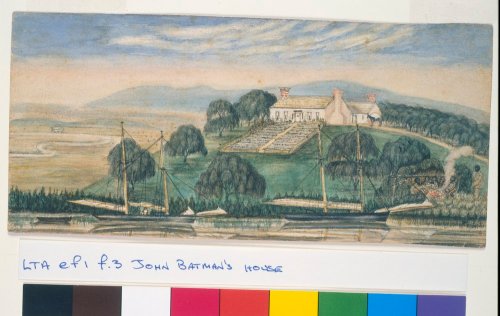
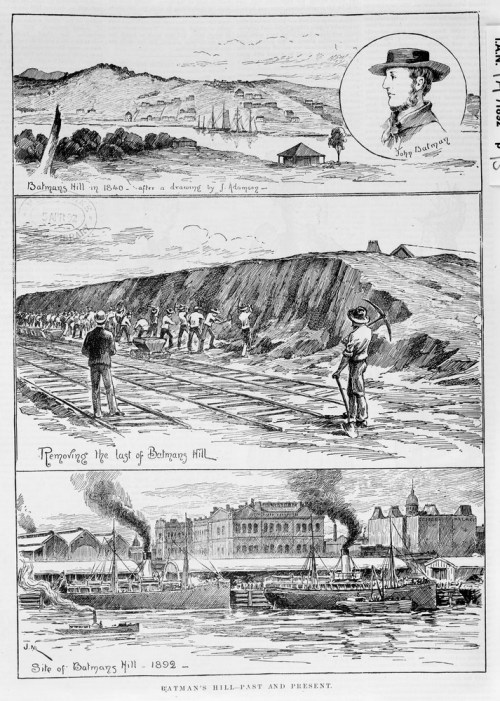
Edmund Finn, writing as ‘Garryowen’ tells us that the first informal cricket match took place on 22 November 1838 on the flat land at the foot of Batman’s Hill (i.e. roughly where Southern Cross Railway Station is now).  Following this match a number of the gentlemen from the Melbourne Club decided to form a club, with a subscription of one guinea which served well to keep the riff-raff out. Familiar names emerge here: A. Powlett, George Brunswick Smyth, William Meek, William Ryrie and William Highett and Peter Snodgrass.  An opposing club, the Melbourne Union Cricket Club was formed from men involved in retail lines of business and tradesmen and on 12 January 1839 the Gentlemen of the District took on the Tradesmen of the Town and were soundly beaten.  A second series in March 1839 pitted the Marrieds against the Bachelors.

These murmurings in September were to bear fruit on 1 November 1841 when the Melbourne Cricket Club was formed at the Exchange Hotel. In case I overlook it in November,  this club had a rather illustrious committee of management, chaired by  F.A Powlett as President,Henry F. Gurner as secretary and George Cavenagh the editor of the Port Phillip Herald (who always gave racing and cricket generous attention in his newspaper columns) as secretary. The committee included, among others, D.S. Campbell and Redmond Barry. They continued to play on the flat below Batman’s Hill until they took over a “more commodious and convenient” spot on the south of the Yarra, between the river and Emerald Hill (i.e. South Melbourne) [Garryowen p. 737-9].

Not completely the dog’s fault

Richard Broome, in his book Aboriginal Victorians, reminds us that indigenous people were a common sight in Melbourne during these first years of settlement.  The Port Phillip Herald of 10 September carried a report about a bulldog attacking a group of Aboriginal people in Flinder’s Lane- and, while reporting on the injuries sustained by a young indigenous woman, the article reveals quite a bit of sympathy for the dog:

FEROCIOUS BULL DOG: On Monday last a number of the natives, who daily throng the town, were congregated in Flinder’s-lane.  Unfortunately for humanity, a large and ferocious bull dog, excited by their yells, made a rush at them.  One of the Aborigines, a woman of about 20 years of age, was very seriously injured: her face, throat, neck and limbs being dreadfully lacerated: and it is more than likely that she would not have excaped with life had it not been for the timely and energetic assistance rendered by District Constable O’Neil who was passing at the moment.  The unfortunate woman was immediately conveyed to the hospital, where her wounds were dressed, and every assistance afforded her.  The bull dog was a splendid animal of the kind, and very large. (PPH 10/9/41 p. 2)

Wanted

I’ve been fascinated by an advertisement that appeared in several consecutive editions of the Port Phillip Herald:

WANTED: a Female Kangaroo.  Apply at the Herald office

A pet perhaps? Or did the advertiser have plans to send the kangaroo back ‘home’ as a curiosity – dead or alive?

How’s the weather?

Windy, it seems.  On 14 September the Port Phillip Herald reported that

The equinoctial gales have set in this season much earlier than usual.  On Saturday night, the storm was so severe that several large trees were blown down and the William lying in Hobson’s Bay drifted from her anchorage, but, we are glad to state, suffered no damage.  The gale was only partial not have extended even so far as Heidelberg but was in some places the severest felt for the past two years. (PPH p. 2)

The official weather report for 8th-14 September described it as

Fine, agreeable weather with light winds 8th, 9th, 10th, strong winds and gales with cloudy and rainy weather afterwards.

The top temperature for the period was 64 degrees (17.7), and the lowest 35 degrees (1.6- that’s cold for September), with the coldest day of the month falling on 13 September.

‘Mothering Sunday’ by Graham Swift

swift

2016, 132 p.

This small novella by Graham Swift is an exemplar of the genre, written by a master.  Swift takes a small image and spins it into something tight and intricate, but with threads that could lead into something larger.  In this case, the image is a woman lying naked among the tangled sheets in a sun-filled room in an empty house.

Her lover Paul has just stood up from the bed, and he looks back at her as he dresses.  It is 1924, Mothering Sunday.  In the drab and aching days after WWI, Paul is the only remaining son of the Sheringham family, with his two older brothers killed in the war. Jane is an orphan, a housemaid in a neighbouring house. Their relationship is an illicit secret, impossible to bring into the open.

For those few gentry families still clinging to a vanishing world of big houses and servants, Mothering Sunday is always an inconvenience. Their hired help are given the whole day off to visit their own mothers, leaving their employers to make their own arrangements. But, as an orphan, Jane has no mother to visit and so she has the whole day to herself- or so she thought.  Paul has other ideas.

This book is only 132 pages in length, and it is just right.  The language is explicit and fruity, but the narrative voice wistful and melancholy.  Swift foreshadows the ending right from the start, and the tension in moving towards that ending is so painful that I wouldn’t have wanted it to go for another page longer. It was so beautifully written, however, than I wouldn’t wish for a single page less, either.

Sourced from: Yarra Plenty Regional Library

My rating: 9/10

‘In the Darkroom’ by Susan Faludi

faludi

2016, 417p

As it happens I found myself reading, almost end-to-end, two memoirs written by daughters about their fathers.  Both fathers experienced World War II and both daughters, in their own ways, were affected at second-generation remove, by their fathers’ responses to the war.  Much as I enjoyed Magda Szubanski’s book, Reckoning,  I did find myself thinking once I started Susan Faludi’s book “now this woman can write!”  As authors, they’re not really comparable. Szubanski writes from the heart, where Faludi writes from the head, and Faludi’s skill in crafting her story is that of the polemicist as well as the story-teller.

Faludi’s father only really came back into her life in 2004 after decades of estrangement. As she says in her opening paragraph:

In the summer of 2004 I set out to investigate someone I scarcely knew, my father,  The project began with a grievance, the grievance of a daughter whose parent had absconded from her life.  I was in pursuit of a scofflaw, an artful dodger who had skipped out on so many things- obligation, affection, culpability, contrition. I was preparing an indictment, amassing discovery for a trial.  But somewhere along the line, the prosecutor became a witness. (p.1)

In the summer of 2004 she received an email from her father telling her that “I have had enough of impersonating a macho aggressive man that I have never been inside” and that he had had gender reassignment surgery. Now, instead of Stefan (or, when he was in America, Steven) he was now Stefanie. It was the first email she had received from her father in years. He had left the family while she was a teenager in 1977, and had returned to his birthplace Hungary after the fall of communism in 1989. “You said you were going to write my life story, and you never did” he taunted her. “It could be like Hans Christian Andersen,” he later told her, “When Andersen wrote a fairy tale, everything he put in it was real, but he surrounded it with fantasy.” (p. 21, p.1).

Faludi has not indulged the fantasy, but she has surrounded her father’s story with an extended reflection on identity: personal, gendered, racial and national. She is well placed as a feminist theorist to analyze the permutations of gender in her father’s  hyper-feminized Stefanie identity, and there is a rather creepy hint that her father was flaunting and almost flirting with his daughter. Her father is Jewish but during WWII, he refused to identify as such, and slipped across racial boundaries to pose as an Arrow Cross partisan, thereby rescuing his parents as his final act of filial responsibility to parents he resented and then rejected. She reflects on her father’s assertion of a latent female identity, and draws parallels with the recent reassertion of Magyar identity at a national level since the fall of Communism.  These observations and questions are framed at a theoretical level, and although the book does not have notes or footnotes, they draw on the writings and interviews with theorists, historians and medical and psychological practitioners, as well as other people who have undergone gender reassignment.

She describes her father as a ‘shape shifter’ and it is not lost on her that, as a photographer employed to touch-up photographs in pre-Photoshop days of the mid-twentieth century, her father has always played with ‘erasure and exposure'(p.35).  He shows her photographs where he has photoshopped his own features onto women’s bodies; he tells half-truths and he affects a vacuous neutrality as he distances himself from his own history.  I am reminded of the loss experienced by people who were close to the pre-operative person undergoing gender reassignment, as in the recent film and book The Danish Girl that I have reviewed previously.

As she points out Magyar (the Hungarian language) does not have gendered pronouns, and her father had always mixed them up in English. Faludi follows the practice of referring  to her father each time she mention him first as ‘my father’ and then ‘she’. It’s a bit disorienting at first, but it keeps you, like Faludi herself, constantly aware of this duality.

When reviewing Szubanski’s book, I mentioned my own sense of guilty complicity in the author’s minute scrutiny of her parent.  I didn’t feel the same way in this book.  Perhaps the historical, political, psychological and sociological theorizing with which Faludi laces the book removes it from the emotional to the intellectual realm, or perhaps it’s that Stefanie has clearly co-operated with, and even goaded, her daughter to write it.  In her preface, Faludi braced herself for her father’s response to the news that she had completed her first draft, assuming that

My father, who had made a career in commercial photography out of altering images and devoted a lifetime to self-alteration, would hate, I assumed, being depicted warts and all.

His response?

“I’m glad. You know more about my life than I do”.

Sourced from: Yarra Plenty Regional Library

Read because: Book review in newspaper

My rating: 9/10


Movie: ‘Tickled’

This is REALLY good! It’s a documentary about a NZ journalist who, while doodling around on the internet, stumbles onto a website about ‘competitive endurance tickling’. Watching people being tickled tickled his sense of humour and curiosity as well, so he emailed the owner of the site with a view to doing a documentary about it.  His investigations about something so ostensibly quirky and amusing took him into some very dark places.  It’s a very unnerving, discomfiting film and one of the best docos I’ve seen in a long time.

This Week in Port Phillip 1841: 1-8 September 1841

HOUNDS FOOT! HA, HA, HA!

The newspapers in Port Phillip often reported on Judge Willis’ performance on the Supreme Court bench, largely because there was little other ‘hard’ news to fill the columns with. Nonetheless, he did give them plenty to write about, especially when getting stuck into the barristers and attorneys who appeared before him. He took his responsibility for keeping the bar in line very seriously – and indeed, that was part of his judicial duty- but often made theatrical threats and gestures that make it easy to see him as a figure of fun.  His attacks on the court personnel make good newspaper copy, but it is telling that many of the people who were the recipients of his tongue-lashings signed petitions against him once there were moves to remove him.

One of Willis’ more theatrical outbursts was against Archibald Cuninghame – also spelled Cunninghame and Cunningham.  He had practiced at the Scottish bar for seven years when he emigrated to Sydney with his brother and two sisters in 1839, an example of the sibling migration patterns that I have spoken about earlier. While he did not necessarily see New South Wales as his permanent home, he did see the financial opportunities it offered, writing to his mother “I see a prospect not of making, a rapid fortune, but yet, of very good returns for my Capital”.  After overlanding down from Sydney, he quickly took out a licence to depasture stock and bought up 139 acres around Northcote (in Melbourne) at the 1840 government land auctions.  His two sisters travelled down to Melbourne in the Bright Planet (the ship that Peter Mews used as the springboard for his excellent book of the same name), while his brother took up the management of the station Wanregarwan, up on the Goulburn River. Archibald joined Redmond Barry, Edward Brewster, James Croke and Robert Pohlman as the first barristers admitted to the Port Phillip bar in April 1841.

At the end of August 1841, an advertisement appeared in several editions of the Port Phillip newspapers.

houndsfoot

Contact with horses was part of the gentlemanly image – and indeed, Judge Willis himself was an enthusiastic horse-rider while in British Guiana and certainly had his own horses in New South Wales.  However, that was riding them, not hawking them for stud services, and Willis took exception to the difference.

THE LAW AND THE ASS- On Friday last, previous to the commencement of the trials at the Supreme Court, his Honor, Judge Willis, produced a copy of the Herald Newspaper in which appeared an advertisement of an entire house, Hound’s Foot “to stand this season,” signed by Mr Cuninghame. His Honor expressed a hope (to the Crown Prosecutor) that this horse was not the property of Mr Cuninghame, the Barrister, who was an Officer of the Court. Mr Croke being unable to satisfy the interrogatory, his Honor proceeded to say that, if such was the case, it was exceedingly derogatory to the respectability of the bar, that it would look rather curious to see written upon the door of the “Horse and Jockey” “Law business transacted here”, and that he considered one as bad as the other.  Judge Willis proceeded to make some further remarks on the subject, but before concluding, requested to know from the gentlemen of the bar, how it would look to see an advertisement in the public papers headed “Montezuma, this splendid ass, will stand for the season at the stables of His Honor, Judge Willis, Heidelberg” would this add dignity to the bench. (PPH 31 August 1841)

Judge Willis certainly did live at Heidelberg, but I’m not aware whether he had an ass called Montezuma. But nor did Archibald Cuninghame have a stallion called Hounds Foot- it was his brother John up on the Goulburn.

THE JUDGE AND MR CUNINGHAME – As reported in our last number, his Honor Judge Willis remarked to Mr Croke that he hoped the celebrated imported horse “Hounds Foot” had not been advertised “for the season” by Mr Cuninghame the barrister, as such a circumstance would not add respectability to the bar.  The impression produced by His Honor’s remarks was that Mr Cunninghame the barrister had so advertised “Hounds Foot”. To shew that even Judges may err in their opinion of matters of this kind as well as in others, we may state that Mr Cuninghame has a brother residing on the Goulburn river; and as the advertisement, which attracted his Honor’s attention particularly states that the horse “will stand this season at the station of the proprietor, Mr Cuninghame, on the Goulburn river” (where Mr Cuninghame’s brother actually resides), we infer that the barrister of that name, who resides in town and follows his profession, is not the Mr Cuninghame “of the Goulburn river.” But Editors, like Judges, may err- who is wrong? (PPH 3 Sept 1841)

Humour by a powerful person is a dangerous thing.  Sometimes when I look at some of Willis’ more outrageous antics from the bench, I wonder if he was performing for the audience, in the same way that our politicians do before the despatch box.

Certainly Willis was very strict about any involvement in ‘trade’ amongst those solicitors and barristers who came before him seeking admittance to the court.  Probably the major fact that led to Willis’ dismissal was the campaign he waged against public officers and members being involved in land speculation and bill-trading. Neither of these activities were illegal, and in a new frontier colony, most people with capital deployed it in either land or financing in this way. Willis’ criticisms of high-ranking people in Melbourne for their involvement in such activities was, I believe, a direct cause for his dismissal.

But Willis’ riff on the Ass Montezuma suggests that he’s enjoying himself here at Cuninghame’s expense. I think of footage of powerful people making a joke, and the forced laughter of their minions around them. Historian Greg Dening wrote about William Bligh’s “bad language” in that people didn’t know how to take it. I would argue that Willis had “bad language” too, and the Hounds Foot incident, while farcical, highlights the difficulty of humour from the bench.

Certainly, the Port Phillip Gazette in its editorial columns, was becoming increasingly critical of Willis.  Its editor, the young George Arden, was clashing with Willis and within weeks publish a letter signed ‘Scrutator’ which would lead to an open conflict with the Judge.  But here’s the Gazette editorial on 4 September:

Mr Justice Willis has certainly the merit of being singular, if not sensible, in his opinions on matters connected with his own department, and he occasionally expresses his conceits in a manner and language that is equally awful to the officers of the Court and amusing to the public…If, however, it will serve the purpose of Mr Willis equally well, and he will condescend to permit us, with all just and proper humility, to tender our opinion on the subject, we will observe that it would be no matter of surprise to the public to hear that there was an ASS connected with the Bench, or that the amiable quadruped resided at Heidelberg, but the attempt of Mr Willis, trivial and vexatious as it was, considering the scanty foundations he had for his extraordinary comments, is viewed on every side with marked and universal disapprobation. (PPG 4 September 1841)

Mr Cuninghame recovered from his unmerited dressing-down and continued to serve in Willis’ court. As an equity lawyer (like Judge Willis himself), he was involved in discussions about the introduction of usury laws, and he was involved in many of the philanthropic and civic organisations of Melbourne.  He went to London in 1846 to represent the Port Phillip colonists in their campaign for Separation, and died there unmarried in 1856.

In fact, the whole little contretemps probably more harm to Willis’ reputation than it did to Cuninghame.

More information on Archibald Cuninghame: Marion Amies and Martin Sullivan ‘Manuscript: 3 Letters from Christian Cuninghame to Agnes Cochrane-Patrick Describing Life in the Port Phillip District’ LaTrobe Journal No. 30, December 1982 http://www3.slv.vic.gov.au/latrobejournal/issue/latrobe-30/t1-g-t4.html

AND THE WEATHER?

“Strong winds on the 3rd 4th and 5th; weather cloudy and uncertain; rain several days but inconsiderable in quantity.” Highest temperature 66F (18.8); lowest 38 (3.3)


Franklin ship ‘Terror’ found

I’m sitting here looking at the video of the discovery of Sir John Franklin’s ship, Terror that was found in – how appropriate- Terror Bay. Amazing- even the glass in the windows! Two years ago the Erebus was found, in much poorer condition than this most recent discovery and I wrote about it at the time here.  Academic Russell Potter, who released his book Finding Franklin: The Untold Story of a 165-Year Search on July 26, has written about the discovery on his blog and the Guardian has a very full report.

It’s all very exciting!


‘Leaf Storm’ by Gabriel Garcia Marquez

leafstorm

1955, (originally published as La Hojarasca)

Have I mentioned here that I am learning Spanish?  Not content with bursting my brain with learning verb conjugations (it has taken me an inordinately long time to move on from the present tense- quite a drawback for a historian!), or sitting puzzled over News in Slow Spanish (which although slow, is not slow enough for me!), I have enrolled in a Coursera course on the works of Gabriel Garcia Marquez which begins today.  One Hundred Years of Solitude is one of my favourite books and it seemed a good way to struggle with Spanish while reading something that interests me. No, I am not reading the books in Spanish: I’m having enough trouble reading the lecture notes and following the videos on the course because the ‘translate’ function doesn’t seem to be working for the subtitles.  As a result, if I get through even one week’s work in the six weeks allocated, I’ll be doing well. However, it has prompted me to plunge into a cram-reading of Gabriel Garcia Marquez.

It seems fitting, therefore, to start off with his novella Leaf Storm, which was his first published work.  It appeared in 1955 after a seven year search for a publisher. It is only short: about 90 pages although it is hard to tell on an e-reader. I kept feeling that I had read it before, which I have, because he picked up the same themes in much of his other work.  It’s as if he was trying the story on for size in novella form, which he later expanded into a whole body of work. It is set in Maconda, the fictional village to which he returns again and again.

The story starts with an epigraph from Antigone, and this short novella, like the earlier Greek story, focusess on a contested funeral. It is told from three perspectives: an unnamed small boy, his mother Isabel, and his grandfather, the Colonel.  The three people are sitting in a closed room with the body of the doctor, who had committed suicide, each with their own thoughts.  The child is preoccupied with the discomfort of his formal clothes and the wonder that he’d been kept from school to come sit with this body.  The daughter thinks about the dead doctor, and his strained relationships with the villagers, and his generally disapproved concubinage with their former servant.  The colonel gives the widest perspective of all, as he reflects on the hatred of the village for this doctor because of his refusal to treat wounded soldiers during one of the civil wars that convulsed the country after the arrival of industrialization.

It is hard now to appreciate the novelty of a multi-perspectival narrative because it is relatively common now.  However, the frequent references- even now, 66 years later,  to the 1950 film Rashamon as the prime example of a multi-perspective work, highlight the strangeness of the narrative technique that Gabriel Garcia Marquez developed at much the same time.

The novella itself is easy to read (in English!) but I must confess to not being able to easily detect the difference in voice between the Colonel and his daughter Isabel. However, as I often find with my favourite authors, Garcia Marquez is a master in being able to slip seamlessly between past and future without interrupting the narrative with asterisks or chapter headings.  The element of an eerie timelessness is here, and a sense of the teeming physicality of the village- both memorable features of his other work.

And so- onward to the next book!

Read because:  I’ve enrolled in the ‘Leer a Macondo’ Coursera course to challenge my budding Spanish.

Format: e-book The Gabriel Garcia Marquez Library: Fifteen of his best-loved books.


Vale Inga Clendinnen: Re-reading’Tiger’s Eye’

clendinnen2016

I began writing this review of Tigers Eye the other night, after re-reading it for my bookgroup. I was working on it last night, and I wondered how Inga Clendinnen was faring, knowing that she had been in poor health (but still mentally feisty) for some time.  Little did I know then that she had died that very day.  Inga Clendinnen is the historian who influenced me more than any other. I have read much of her work, all before I started writing this blog (Ambivalent Conquests;  Aztecs: an Interpretation; Reading the Holocaust;  True Stories (Boyer lectures); The History Question; Agamemnon’s Kiss and Dancing with Strangers.)  But her presence is here in my blog, in the only book of hers that I have reviewed since (In Search of the ‘Actual Man Underneath‘) and, more importantly, as the lodestar that has guided my perception of other histories written by other historians. I met her only once in recent years (and was so overcome that I was barely coherent!) but my respect for her is unbounded and my debt to her incalculable.  Vale, Inga Clendinnen.

***************

tigerseye

2001, 289 p.


So this is what I have been doing all this time- by courtesy of a physiological malfunction, taking a journey out, beyond and around myself, and into interior territories previously closed to me.  At the end of it, battered, possibly wiser, certainly wearier and, oddly, happier, I have returned to where I began: to history, with a deepened sense of what peculiar creatures we are, you and I, making our marks on paper, puzzling over the past and the present doings of our species, pursuing our peculiar passion for talking with strangers. (p. 289)

I first read Inga Clendinnen’s book Tiger’s Eye  in 2003 and it changed my life. I had been ill for about three years, able to only work part time, and after reading this beautifully written reflection on illness, memory and writing, I decided that I wanted to return to uni and my first academic love- history. I think that I could confidently say that you wouldn’t be reading this review on this blog if I had not read this book (oh dear, it all sounds a bit too Pauline Hansonish.) Before re-reading it for my bookgroup this month, I would have said that Tiger’s Eye was ‘about’  Clendinnen’s response to her illness.  Returning to it, I find it a much different book to that which I remembered, combining experiments in fiction, memoir and an exploration of the nature of memory.

So who is Inga Clendinnen? After commencing her academic career at the University of Melbourne, Inga Clendinnen was a history lecturer at ‘my’ university, La Trobe, between 1969 and 1989.  I had forgotten completely, until reminded by a friend, that she was the lecturer on the Mexican Revolution in Revolutions IA, the first history subject I did as an undergraduate in 1974. Along with Greg Dening, Donna Merwick and Rhys Isaac she became known as part of a group of historians dubbed the ‘Melbourne school’ by anthropologist Clifford Geertz.  Common to this group of historians is the practice of thick description, reflexivity, a deep reading of events and individuals’ responses, and a celebration of the act of writing. It is the type of history I admire and enjoy most. Clendinnen’s specialization was Mesoamerican studies, most particularly Aztec culture, but she is probably best known  in Australia for her works Reading the Holocaust and most recently Dancing with Strangers.

“Illness made me a writer” she says at the end of this book (p. 288). I think that she’s underselling her own earlier writing, but certainly Tiger’s Eye is an exploration of writing outside the history genre, while still drawing on the historian’s skills.  Ill in hospital, feeling trapped, helpless and under surveillance, she remembered a childhood story about a wizard who looked through the eyes of various animals- wolves, jaguars, ants- to see the world from their perspective.  On hearing the rumble of a tiger from the nearby Melbourne Zoo, she adopted the tiger’s eye as her motif:

… I too was in a cage, with feeding times and washing times and bars at the sides of my cot, and people coming to stare and prod, but the kaleidoscope of the horror of helplessness ceased to turn because I withdrew my consent from it.  Thereafter, whenever I felt the threat of the violation of self, I would invoke the vision of the tiger and the freedom that vision gave me, to be at once the superb gaze, and the object of the gaze: an incident in a tiger landscape. (p. 21)

She directs her gaze towards herself as patient, telling the story of the progression of her illness, observing her fellow patients and recounting the steps towards the liver transplant that halted her decline. She spends a considerable time ( perhaps a little too much time?)  recounting the hallucinations that electrified her befuddled post-surgical consciousness.  Once their vividness had abated, she realized that the hallucinations wove together memory and sensation from her own childhood and experience.  Much of the book is devoted to unpicking these experiences, testing the robustness of memory as a factual as distinct from emotional construct, and knitting her experiences up again into fictional experiments.

More of the book than I remembered is turned over to exploring – or as she puts it- ‘reading’ her parents.  Here I find myself conflicted.  I’ve commented on several occasions recently in this blog about my discomfort with children ploughing their parents’ lives, wanting to uncover the ‘real’ man or woman inhabiting the carapace of the parent figure. Clendinnen certainly does this, particularly with her mother, and her judgment is harsh. She directly links her curiosity over her mother, in particular, with her later career as historian:

… I can see that my pursuit of her has been a lifetime activity; that my early fascination with her impenetrability, and my pleasure in that impenetrability, has a great deal to do with my long happy life as a historian spent in pursuit of other more distant,less impervious impenetrabilities. … Now, when I am not many years younger than she was when she died, I am still sifting my handfuls of sand, still trying to make them stand and hold a shape I could call ‘my mother’. And still, for all my gatherings and pattings, she continues to fall apart like a sand lady.  If she is on the beach at all she is a mirage, an eye-baffling dazzle fleeing before me, receding faster than I can run. (p. 237, 238)

I was also surprised to find, on re-reading this book, how seriously she grappled with the issue of fiction-writing versus history writing.  This was, of course, the juxtaposition that roared into life in her argument with Kate Grenville over the writing of The Secret River, and which Clendinnen explored in more detail in her Quarterly Essay The History Question. But it’s here in this book too, five years earlier, as Clendinnen experiments with the two genres, finally admitting an element of defeat:

After years of doing it I think I am beginning to understand the work of writing history- the how of it, the why of it- but I still don’t understand the work of writing fiction.  There is a Spanish saying of which I am unreasonably fond: ‘No hay reglas,.’ ‘There are no rules here.’  That is the way fiction seems to me.  If there are rules, I don’t know them.

Engagement with professional history imposes rules.  One of those rules is that we must represent our chosen people as justly and completely as we are able.  We must try to understand them, and for that we need a supple imagination, but that is imagination’s only role.  With history I am bound like Gulliver by a thousand gossamers: epistemologically to the deceitful, accidental record, morally to the dead men and women I have chosen to re-present, and to the living men and women I want to read my words and to trust them. (p.244)

Finally, in re-reading Tiger’s Eye I was stopped again and again by the sheer beauty and power of her writing.  Here’s her description of visiting her aunt’s outhouse at night:

I liked the outhouse best on moonlit nights, because then the moonlight would come slicing through the slim black gumleaves like hard silver rain. (p.59)

Here, in one of her fictional pieces, is a mother putting on lipstick to visit her sister:

…she would draw her stumpy lipstick straight across her stretched lips and rub them hard together, so that when they showed again they were red with little spikes of deeper red running out along the wrinkles…(p96)

And in the same story, an unnerving description of an aunt’s ‘little game’ that mixes sensuality, intimacy and transgression.  The mother and her daughter visited Aunt Lall, who was bed-bound:

…sooner or later my mother would say she would die without a cup of tea and she would whisk out…and while she was out of the room Auntie Lall and I would do our secret thing.  She’d give me a little nod and a wink, and I’d climb up onto the bed, carefully, so I wouldn’t joggle her legs, and she’d take my hands into her warm soft ones and lace her fingers tightly with mine so our palms pressed together and I’d feel the hard bands of her rings…Then she’d slide the rings off, the ones that could still come off, and spin them on my fingers, and give the tip of each of my fingers a little kiss.  They were marvellous rings, heavy ones, old, all of them gold, with rubies and diamonds studded all round them. She’d stack them on my thumbs, raise her pencilled eyebrows and laugh silently, and I’d trace the pencilled line along the line of bone to the puckered skin and the harsh orange-red hair at her temple, and she would lift my limp hair away from my forehead as if it were precious.  As if it were beautiful.

We would do all these things silently, listening to my mother banging about in the kitchen.  Then the kettle would scream and the boiling water would crash into the teapot and I’d slide back into my chair just as my mother came in and banged down the tray so that the milk flew out of the jug and the teaspoons trembled… Carnal knowledge.  Whenever I come across that phrase now I think of Auntie Lall, because carnal knowledge was what she taught me: that there is a special love which sleeps in the flesh, and that special fingertips can waken it. (p. 104)

And so, on re-reading Tiger’s Eye, I find it a different book to what I remembered.  I’m perhaps more critical of the ‘Reading Mr Robinson’ section which takes up a large part of the book, now that I, too, have read Mr Robinson.  I can see the emergent shape of the Kate Grenville dispute, and I am surprised that so much of this book is fictional writing. But most of all, I celebrate Clendinnen’s artistry as a writer, thinker and historian: one of the best ones I know.

aww2016

I have included this book towards my tally on the Australian Women Writers Challenge 2016