This book should have ticked all my boxes: set in Melbourne, written by a much-loved Australian author, written with a nanna’s-eye (and I do embrace my nanna-dom). But it sounded as if it would be a bit slight, and I probably wouldn’t have read it had it not been an Ivanhoe Reading Circle selection, read and discussed amongst all the other nannas.
Even Garner herself sounded a bit ambivalent about the whole project, admitting that she wrote the book because she needed something to do, but didn’t have the energy to embark on one of her investigative non-fiction books. It traces the footy season of her grandson Amby’s under-16s footy team, at the J. J. Holland reserve in Kensington. As she always does, Garner conveys a strong sense of suburban place, and in this case, the football ground she describes so closely fitted with the oval that I walk through to my volunteer job in Kensington that I actually researched the club and found that, indeed, it is the J. J. Holland reserve. She’s there for the team’s matches; she’s there for their training sessions on cold weekday nights, and she’s there for the conversations in the car driving there and back.
Although ostensibly about football, it’s even more about young men growing into masculinity, and at under-16 Amby is at that liminal stage, with signs of the little boy still visible under the swagger of adolescence. Garner’s daughter lives next door, and she has a strong and enviable relationship with her grandchildren, especially Amby. At the same time, she is aging and feeling irrelevant and frustrated by her increasing deafness. In places she veers into idealization of these young men, seeing them as warriors, and even admitting to a slightly ‘off’ recognition of their adolescent sexuality (Garner has always been, and remains, perhaps more honest than she should be).
It is the football season that gives this book its beginning and ending, and the book was more a reflection than a plot-driven story. I had feared that it would be slight, and unfortunately it was.
My rating: 6.5/10
Sourced from: purchased e-book
Read because: October 2025 selection for the Ivanhoe Reading Circle.
The Global Story (BBC)The Death of Reading This episode was based on a recent essay by James Marriott ‘The Dawn of the Post-Literate Society’ which can be found on his Substack here. Both the essay and this discussion go back to the mid- 1700s when the spread of reading beyond the elites meant that power no longer had to be performed visually, but could be disseminated and reinforced by the written word. Marriott draws on Neil Postmans work ‘Amusing Ourselves to Death’, and argues that beyond the concern about the decline of reading in the 1990s, the spread of the smart phone from 2010 onward has led to a steep drop in educational standards. With the rise of TikTok and Instagram, we are returning to the primacy of visual display – a sort of counter-revolution in thinking and perception.
Journey Through Time Episode 48: The Paris Commune: Can the City of Light Govern Itself? After the uprising over the cannons on Montmatre, the radicals took over, but with no leader, they split almost immediately. Auguste Blanqui would have been the leader, but he was in prison (as indeed he was for whole decades of his life). Supplies were allowed in, but Paris was still lunder siege. Napoleon III’s column was pulled down, although it was later re-erected. Elections were held with 4 days to give the leaders legitimacy with the result that there was an anti-nationalist government but otherwise, the movement splintered. The new government started issuing executive orders (and don’t we know about THEM!) to separate church and state, provide rent relief and soldier pensions, provide free secular and compulsory co-education, cap salaries, and give workshops to co-ops. So far, all normal socialist fare, but also they imposed decimal time (10 day weeks, 10 hour days etc), banned night baking as a labour market reform for bakers, and banned croissants (can’t remember why). They treated legitimate and illegitimate children equally and had same and equal pay for teachers. The army was a citizen’s militia, and army discipline broke down almost immediately. 150,000 people per day fled Paris, where there was constant violence but no terror as such (in Revolutionary terms). From afar, Marx was interested but because he didn’t support the French International, he waited a while before writing about it. Women were influential in organizing, but they were not inspired by feminist or suffragist ideals. To get Auguste Blanqui released from prison, they took hostages which backfired on them. There were small mini-communes in the rural towns, but essentially Paris was on its own.
I’ve always been a bit puzzled by the ‘Shortest History’ part of the title of this series of books published by Black Inc dealing with world history, many written by Australian authors. Declaring to be the shortest history seems rather definitive and pugnacious, and almost a challenge to later authors to become even shorter. The blurb for the series claims that the books can be read in an afternoon -something that I doubt, in this case – but certainly they are a work of concision and discipline on the part of the author, in being able to confidently assert a fact or event in a single paragraph instead of hedging with qualifications, nuances and debates. Of course, much is elided in such an approach, but there is also a bracing forthrightness about a sweeping history that needs to tie together so many small details into an overarching narrative.
Don Watson comes to the task as a historian in his own right, political speechwriter, and a commentator on current-day American society and political culture. As well as his American Journeys published in 2008 (my review here), he has been a regular contributor to the Black Inc./Schwartz stable on American politics with three Quarterly Essays: No.4 Rabbit Syndrome: Australia and America (2001), No 63 Enemy Within: American Politics in the time of Trump (2016) (my review here) and most recently in 2024 with No. 95High Noon: Trump, Harris and America on the Brink, which I reviewed here. With The Shortest History…. he is writing as an outsider, and a long-term, well-informed watcher as well.
His outsider status is most apparent in the opening chapters of the book, where he makes clear that there were competing European powers – England, France, Spain, Netherlands, Sweden- that put ‘boots on the ground’ on what was to become American territory. Drawing the distinction between the 1776 establishment of the United States, and the history of ‘America’ starting in 1492, he goes even further back 20,000 years to the first peoples, and the early introduction of enslavement that followed early European ‘discovery’. In what, perhaps, might be characterized as ‘black armband history’, he continues to turn the spotlight around onto First Nations and Black experience as the narrative of United States history marches forward…always forward.
The book progresses chronologically, but the chapters are thematic. In his introduction Watson notes that:
While the history of the United States is to an uncommon degree a history of ideas, it is equally the story of men and women testing the truth of those ideas against experience: in politics, in churches, on frontiers, in cities, in industries, in battle, in homes, in schools, in Hollywood, in literature and in music. (p. xiv)
Watson places strong emphasis on ideas: on the intertwined Puritan ideas of harsh punishment and discipline set against competing ideals of individualistic self-reliance, which in turn existed alongside traditions of social justice, education, communitarianism and democracy. He notes the influence of Enlightenment philosophers and the scientific revolution in providing an intellectual framework for their grievances and the language to express it through the Declaration of Independence, Constitution and the Federalists papers. He puts his historian hat on to discuss Turner’s Frontier thesis on the ‘freedom’ of the frontier in the popular imagination and he notes the recurrent waves of religious ‘awakenings’ and the struggle between order and chaos-‘ the American id and the American superego’ (p 58). Challenging these were the ‘maniacal appetite for wealth’ whetted by the financial opportunities following the Civil War, and especially during the ‘Gilded Age’ of the 1890s which pushed aside “the restraining influences of conscience and religion, or the egalitarian principles implied in the country’s democratic creed” (p.94) The Civil War, in his telling, had a long advent of compromises on the part of the North, which was well aware of the incompatibility of slavery with the ideals espoused in the republic’s founding documents.
Although we know the political landscape in the United (huh!) States today as being Republican and Democrat, the meaning of both words has changed over time. To be ‘republican’ was to champion the idea of the American republic, and it was not necessarily democratic. The nature of the parties changed over time, with the immigrant influx between 1890 and 1920 shaping the cultural and political evolution of urban America:
The Democratic Party evolved into the party of both the burgeoning multiethnic cities and the reactionary South, while the Republicans remained the voice of white Protestant provincial America. (p. 112)
Looking at the policies of Presidents over time, particularly in the Progressive era, it is not easy to distinguish to which party the president belonged. For example Woodrow Wilson was a southerner from the Democratic Party, and a progressive as well as a segregationalist. Kennedy did not like Martin Luther King, and he had little interest in domestic politics. Nixon was mad, but he was the most liberal republican of the century excluding Teddy Roosevelt (p. 187). Some Presidents receive more attention than others. Probably because of current-day parallels, President Andrew Jackson receives more attention than he might have in a book written 30 years ago. For a former speechwriter for Labor Prime Minister Paul Keating, I was surprised that he was so critical of FDR. It seemed to me that the emphasis on presidential personality and actions received more emphasis in the latter part of the book, within the time of Watson’s own memory, I would guess. Interestingly for a historian, he ascribes ‘luck’ as an important factor that determined a President’s actions and reputation.
This is not just a political history because Watson interweaves popular culture, including music, Hollywood and literature, as well as broader social movements including Communism and anti-Communism, evangelical religion and protest movements. However, the political emphasis does mean that it is a predominantly male history, with political actors Eleanor Roosevelt and Hillary Clinton receiving more attention than other women in his narrative. As the book moves on, the early emphasis on indigenous and Black history is muted and where it is mentioned it is mainly in political terms. Particularly in the post-WW2 years, he integrates conformity, consumerism and commercialization into the “American Dream”, which was very much restricted to white America:
Nothing spoke more eloquently of the American dream than the bustling heartland towns, their Main Streets lined with mom-and-pop stores, barber shops, diners, ice cream parlours, theatres and movie houses, with Fords and Chryslers and De Soto Coronados parked in rows; and, just beyond them, unlikely numbers of regularly attended churches, schools, sports stadiums and public swimming pools (p. 154)
Watson started his book in the introduction, with the attack on the Capitol building on 6 January 2021. At first, I thought that this reflected Watson’s own expertise and reputation as a commentator on American affairs, but when he returns to 6 January at the end of the book as part of his argument, it is as a historian.
The United States was born with one foot in the Christian church and the other in commerce. It might equally be said that it had a foot in the high ideals of religion and the Enlightenment and a foot in the frontier philosophy of whatever it takes. The loathing felt for the liberal elites, and for intellectuals in general, was an old one, and the failure of liberals and intellectuals to understand either the people who loathed them or the degree of their loathing was just as old. The ‘Washington swamp’ was not new [and] …the coonskin hats and the shaman’s horns in the Capitol building were as if lifted from a picture in my childhood Davy Crockett book…All these gestures to contemporary grievance connected to threads of belief and myth, and patterns of ideological dispute, that are as old as the country itself. Extraordinary, even ‘unprecedented’ as the insurrection of 6 January 2021 seemed, it occurred in the same grindhouse of uncrossable divides and undying fixations.” p. 261
I guess that only time will tell if Watson’s decision to start and finish the book with Trump was a narrative framing, or whether it is a historical analysis in its own right. Only in coming years will we know whether Trump II marks a whole new phase, or whether as Watson suggests in 2025, the Trump presidency reflects a continuity that flows across the United States’ history. By its very nature, a ‘short history’ with its abridgments and encapsulation, is probably best placed to provide an answer.
The Rest is HistoryEpisode 580: The Irish Civil War: The Assassination of Sir Henry Wilson (Part 1) In this week’s episode, Tom and Dominic are joined by historian Ronan McGreevy, to discuss the pivotal assassination of Sir Henry Wilson, whose death launched the tumultuous Irish Civil War. Sir Henry Wilson was the MP for Northern Ireland, and an Irish Unionist. He had served in the British Army, and as a leading figure in the British Army he urged the British government to crack down on the IRA, a group which he saw as a military problem, rather than a political problem. On 22 June 1922 he was scheduled to open a memorial at Liverpool St station, which he did. On his return home, three men waited for him and shot him six times on his own doorstep. The gunmen escaped by taxi, but were surrounded by a mob. Two of the assassins were ex-soldiers themselves and part of the Irish diaspora. Meanwhile an election held in Ireland led to acceptance of the Treaty, but the anti-Treaty dissidents took over the Four Courts, where they were issued with an ultimatum by the (Irish) government to remove themselves. Among the dissidents, the issue was not so much partition, but the Oath that parliamentarians would have to pledge, not in words but in the level of independence that an Irish parliament would have. The IRA itself split, but the majority was anti-Treaty. Sectarian violence increased in Northern Ireland, and Wilson became the public face of the Unionist stance. So who ordered the assassination? Historian Ronan McGreevy, the guest on the podcast, has argued that it was the Irish Republican Brotherhood, a secret oath organization from 1858), headed by Michael Collins. The two assassins were hanged after a 1-day trial and the anti-Treaty dissidents were removed from the Four Courts. The Civil War had started.
Journey Through TimeThe Paris Commune: The City that ate its Zoo (Episode 2) With the so-called Government of National Defence negotiating with the Prussians, Paris now saw itself as the defender of France. One of the first things to be done was to hold an election, to affirm the legitimacy of the leaders. And who should be elected as Mayor of Montmartre but Georges Clemenceau, who was to end up as Prime Minister of France. Perhaps his anti-German sentiments during and after WWI sprang from this early experience with the Prussians. However, despite the stance taken by the Parisians, in the rural villages people wanted peace at any price so a divide sprang up between Paris and its surrounds. As the Prussians increased the siege, people ate first their horses, then their pets, rats and the zoo animals excluding the hippopotamus (too hard to kill and cut up) and the monkeys (too much like us). As with Gaza today, there was disease and incessant shelling, and eventually in January 1871 the Government of National Defence capitulated. Ruinous reparations were imposed on France as part of the surrender, and the Prussians would continue to occupy until the reparations were paid. Meanwhile the German Empire settled in at Versailles, just to rub salt into the wounds, and their insistence on parading through the streets angered the Parisians even more. Elections were held, and the rural/Paris split continued. The 300,000 armed guardsmen in Paris refused to surrender so the National Government at Versailles decided to confiscate their weapons. The Guardsmen and the parisian crowds moved the cannons onto Montmatre (the Sacre Coeur church wasn’t there then- it was a very poor neighbourhood) and in March 1871 the women rushed to Montmatre to stop the seizure of the cannons by the National Guard troops.
The Rest is Politics US edition I listen to this podcast every week, but there’s no point documenting it because things change so quickly. But Episode 132 The Mistakes that led to Trump is more historical, looking at the economic decisions that led to the populism that brought us The Orange One. (Just to ensure that I will never be admitted to US). The 1944 Bretton Woods agreement emphasized stability in the post-WW2 international economy, but in August 1971 Nixon took the US dollar off the gold standard, which at that time was a lowly $31 per ounce! The globalization and off-shoring mantra was that a rising tide lifts all boats, and China was admitted to the World Trade Organization as an emerging market, something that Donald J Trump opposed even then.
The EconomistThe Weekly Intelligence: Operation Midas. Wow. This podcast really got me thinking. It involves the corruption scandal in Ukraine, which led to the dismissal of President Zelensky’s Chief of Staff, Andrei Yermak. The police force in Ukraine is so corrupt that an alternate corruption watchdog structure was established, comprising the National Anti-Corruption Bureau of Ukraine (NABU) and the Specialized Anti-Corruption Prosecutor’s Office (SAPO). These were the two bodies that Zelensky was trying to get rid of, until such huge public and Western government pressure forced him to leave them alone. NABU and SAPO uncovered a huge corruption crisis where officials skimmed off millions from the state nuclear energy commission with scant regard to the effects of decaying and damaged infrastructure on the population. Why? Zelensky claimed that it was to get rid of Russian influence, but was it just to protect himself. I’d thought of Zelensky as one of the ‘good guys’ but perhaps there are no ‘good guys’ here. I’m sure that this destabilization is just what Russia wants, but is there a real and continuing problem of corruption in Ukraine?
Whenever I drive past the flashing lights of ambulances and police at a road accident, I think of the couple of minutes before that collision: the conversation that would have been abruptly cut short, the reason the occupants were in the car, how they would have got up that morning oblivious to how their lives were going to change in the next 12 hours.
This is pretty much the same impulse that led Leigh Sales to write this book. As a journalist, she had been on the media side of many interviews and stories about people whose lives changed dramatically. She had also had her own brush with death when a placental abruption in what had been a normal pregnancy led suddenly to a life-threatening situation, and fears for both her baby’s life and her own. Shaken by the experience, she came to believe that we are all vulnerable to sudden, unexpected change and yet we do not live that way. Why?
Her book revolves around the case studies of various people, some of who became caught up in ‘newsworthy’ events, others who experienced the death of a loved one (something that we all face) or had suffered a catastrophic injury or illness. The chapters are re-tellings of her interviews, interwoven with some ‘easy to digest’ research which veers at times into pop-psychology, and her own reflections of how she would have responded in similar circumstances.
Some of the people and the events described are well-known: Louise Hope, who as well as suffering from MS, was also one of the hostages in the Lindt Cafe siege in Sydney in September 2002; Walter Mikac who lost his wife and two daughters in the Port Arthur killings; James Scott, the ‘Mars Bar’ man who disappeared in Nepal and Stuart Diver, who survived the Thredbo landslide but his wife did not. Others are less well-known, Matt Richell, who died in a surfing accident, Juliet Darling whose husband was killed by her psychotic step-son and Michael Spence, the vice chancellor of the University of Sydney, whose wife died within 3 weeks of her cancer diagnosis, leaving him with five children.
As it happens, the first two case studies are both of people with deep Christian faith. In the case of Michael Spence, it was precisely because of his religious faith that she interviewed him, even though Sales herself is not a believer. As a former-believer myself, I found myself dreading that the book was going to become religious tract. It didn’t, but I still found it strange that she was to organize her case studies in this way, giving such prominence to faith and a belief in a higher purpose for suffering.
She locates herself as a journalist in these retellings, having presented many of the news stories herself. She tells us that she often becomes tearful during her interviews, perhaps as a counter to the perception of the sang-froid of the television presenter. The intensity of media scrutiny led several of her interviewees to engage a publicity agent to manage media appearances. This did not always work out well: you glimpse the newshound in her when she talks about James Scott, dubbed ‘Mars Bar Man’. He was advised by his agent not to name the chocolate that was his only food, in the hope that he could secure a sponsorship deal later. It wasn’t actually a Mars Bar, but instead a Cadbury’s chocolate, but when he fudged (terrible pun) the brand of the chocolate in an interview, the interviewee (Richard Carleton) sensed obfuscation and toughened his questions. Although Carleton came in for criticism for the ferocity of his questioning, Sales admitted that she would have done the same thing once she sensed evasiveness.
She returns several times to the idea that, having had one dreadful thing happen to you, you were inoculated against further trauma. Statistically, this is not logical even though emotionally, it is. She seems to feel that Louise Hope’s MS should have been enough, without the Lindt siege, and she spends some time on the idea of the ‘jinx’ on the women that Stuart Diver (Thredbo) has married, his second wife having died with breast cancer. Diver speaks of being a ‘memory locker’- capturing and keeping happy times for when the bad times come – but Sales seems somewhat resistant to such a stoic and clinical response to pain.
She devotes several chapters to people who helped: Detective Norris who accompanies a grieving wife to the morgue; counsellors Jane Howell and Wendy Liu at the morgue; Mary Jerram at the coroner’s office; pastor Father Steve who has a strong belief that families should see the body.
All of this is told in an intimate, rather confidential tone of voice. I used to listen to Chat 10 Looks 3, the podcast she made with political commentator Annabelle Crabb (still going, I see) and this book had much the same sort of feel to it. Interesting, personal but something that you could listen to (read) without much effort or challenge.
My rating: 7/10
Read because: Bookgroup Ladies selection. Now that the CAE has wound up, we have no identity!
Sourced from: Darebin Libraries Book Group collection.
The Rest is HistoryEpisode 614: Walt Disney: The Great American Storyteller. So there I was, on my evening walk through the suburban streets of Rosanna, laughing my head off at the start of this episode where Tom Holland regales us through a truly terrible rendition of ‘When You Wish Upon a Star’, while Dominic intones the words. But the reality is that this song is burned into my memory as the theme song of Disneyland, which I rarely got to hear as I was usually bundled straight into bed (at 7.30!) unless we were visiting family friends all the way out in Croydon- miles away! It took awhile to all pile into the car, and so I got to hear the song. Mum and Dad would put the back seat down, and we would lie down in the back, watching the orange sodium street lights until we were asleep.
Enough reminiscing. After murdering the song Tom and Dominic redeem themselves by really capturing just how new Walt Disney’s early animations were, starting with Steam Boat Willy in 1928. The sound was fully synchronised to the action, and the cartoon characters actually had their own personalities. The Three Little Pigs in 1933 introduced brilliant colour, and Snow White (1937) was seen as the supreme achievement in animation with thousands upon thousands of drawings. Pinocchio won an Oscar in 1940, and it was followed by Fantasia and Bambi, which presented a particular challenge in depicting animals realistically and yet with human features. They draw a parallel between Walt Disney and Steve Jobs (Apple) in that they both worked in a field where technology was in its infancy, they are linked to California, and moving on from their own ‘tinkering’ from interest, they became the public face of a wealthy corporation. But Walt Disney and his brother Roy were not wealthy at first, and the company nearly went broke during WW2. Losing the licensing rights for his first creation ‘Oswald the Lucky Rabbit’ spurred Walt Disney to ensure that he always maintained tight control of licensing- something that exists to this day. Politically, Disney became increasingly conservative, especially after a strike in 1941 over unionization, which was a PR disaster for them, and he publicly aligned himself with Joseph McCarthy. He continued to make films (Cinderella etc) but they were not of the same quality as his earlier films. By the 1950s he embraced television and produced the hugely popular Disneyland. He died in 1966, by which time opinion had turned against many of his films, which were accused of being infantalizing, commercial and sentimental. This criticism was strongly voiced by P. L. Travers, who resented Disney’s treatment of her Mary Poppins character. Really interesting – and a good recovery from that terrible opening song.
Episode 615 Disneyland: The Modern American Utopia This episode looks at the construction and place of Disneyland within Walt Disney’s imagination and American life. It was conceived during the 1940s, after the success of Snow White, when Disney was looking for something new. He was obsessed with train sets, and even had a life size train built in his house. He at first conceptualized Disneyland as a miniature travelling village, and in 1951 he sent out a team to investigate museum displays and historical recreation parks (which US is into in a big way). At this point Tom and Dominic become more historical as they trace though the development of pleasure gardens and entertainment parks, starting with the oldest park in Copenhagen in 1580 that was built beside the tourist attraction of a spring. The Vauxhall Gardens were established in London during the Restoration era. They kept the riff-raff out by charging 1 shilling, which is about $150 in today’s currency- similar to the price of a ticket to Disneyland. But by the mid-19th century it had gone downmarket, and it closed in 1859. The first carousel was built in 1790s France, and by 1861 a steam-driven carousel was opened in Boulton UK. Fred Savage was the Father of 1860s rides, developing the switchback ride by 1888. Disneyland was conceptualized as a theme park, rather than a park with rides. To cover the huge expense, Disney entered into an arrangement with ABC Television to present 26 television episodes, which became hugely popular. At the end of the 1950s he bought a huge parcel of land in Florida, where he planned to build Disney World as a housing village for his workers, but he died before this eventuated. On reflecting on Disneyland Tom and Dominic observe that it’s a reflection of one man’s biography and vision. It is a total immersion experience, with ‘cast members’ rather than workers, and the rides are stories, rather than thrills. There is an emphasis on order, just as there was in Vauxhall Gardens, and although it has the past and the future, there is no present.
There’s then a Bonus Episode with an interview with Bob Iger, the head of Disney today. It’s a bit boring, so don’t bother. But it is interesting that Disney is now a corporation that needs to provide shareholder value, and that it has now purchased the stories from other franchises.
Journey Through Time I’ve only just started listening to this podcast, hosted by historians David Olusoga and Sarah Churchwell, I started listening to the episodes about the Paris Commune, without really knowing quite what it was, or when it occurred. The Paris Commune: France’s Bloodiest Revolution Episode 1 looks at the 1871 Paris Commune where a combination of soldiers, students, women and artists governed Paris of 72 days, independent of the government. It is not as well known as the French Revolution of 1789, but it was more violent. Paris had been modernized since the French Revolution with Haussman’s massive public works program between 1853 and 1870. The Commune began with France’s humiliation at the hands of Bismarck’s Prussia, who had deliberately fomented war to forge German nationalism. Napoleon III took the bait, but ended up captured, with the Second Empire in ruins. The Third Empire was soon established outside Paris, but it just replicated the status quo. Bismarck surrounded the still-walled city of Paris, thinking that it would soon fall, and when it didn’t, he decided to starve them out. A large government delegation escaped Paris and set up outside. Meanwhile the Parisians were starving, and when they heard rumours that the government was about to surrender, a country-wide uprising occurred on the 31 October. However, the uprising quickly collapsed in the provinces, and so Paris now felt that it was fighting on alone.
The Documentary (BBC)The Shiralee: D’Arcy Niland’s 1955 Australian western. A western? I don’t remember it that way. The BBC blurb mentions the 1957 movie starring Peter Finch, but Bryan Brown also made a version in 1987. Anyway, Kate Mulvaney is doing a stage version with the Sydney Theatre Company (the run finished at the end of November 2025) and this is an audio diary account of her writing the screen play and watching the performance come together in rehearsal.
I am writing some weeks after I finished reading this book, and I really regret that I didn’t sit down and write it immediately afterwards. My response to it has dulled with time, but I do remember slamming it shut and announcing “Fantastic!!” I read it for the Ivanhoe Reading Circle immediately after finishing Sally Carson’s Crooked Cross (review here) and the two books complement each other beautifully. In fact, I think I will always link them mentally because they seemed to be a similar response to an uneasy, suffocating situation, separated by nearly ninety years.
The book is set in Dublin, at some unspecified time, two years after the National Alliance Party has passed the Emergency Powers Act, which gives expanded powers to the Garda National Services Bureau, (GNSB) a new secret police force. Eilish, the mother of four teenaged children, the last only a baby, answers the door to two policemen seeking her husband Larry, a teacher and trade union organizer. Within the first chapter, her husband disappears after a peaceful union march, and her attempts to find where he has been taken fail. Eilish is a mother, daughter, wife, scientist and a long-time resident of Dublin. For much of the book, and as the world becomes a sharper place, she concentrates on the mundane, the quotidian, trying to keep routines together. She holds on to the life that she had before, that she thought was immutable, too afraid to look beyond her house, her community, her family. Catching sight of herself in the mirror in the hallway
[f]or an instant she sees the past held in the open gaze of the mirror as though the mirror contains all it has seen seeing herself sleepwalking before the glass the mindless comings and goings throughout the years watching herself usher the children out of the car and they’re all ages before her and Mark has lost another shoe and Molly is refusing to wear a coat and Larry is asking if they’ve had their schoolbags and she sees how happiness hides in the humdrum how it abides in the everyday toing and froing as though happiness were a thing that should not be seen as though it were a note that cannot be heard until it sounds from the past seeing her own countless reflections vain and satisfied before the glass (p.43)
Her friend Carole, whose husband has also disappeared, urges her to resist and to look at what is going on around her as people in her street beginning hanging National Alliance Party flags from their windows, and as her house and car is vandalized. People stop talking:
…the brilliance of the act they take something from you and replace it with silence and you’re confronted by that silence every waking moment and cannot live you cease to be yourself and become a thing before this silence a thing waiting for the silence to end a thing on your knees begging and whispering to it all night and day a thing waiting for what was taken to be returned and only then can you resume your life but silence doesn’t end you see they leave open the possibility that what you want will be returned someday and so you remain reduced paralysed dollars an old knife and the silence doesn’t end because the silence is the source of their power that is its secret meaning silence is permanent. (p.165)
Eilish’s father Simon is living alone and subsiding into dementia, but he still has flashes of clarity which pierce through the domestic cotton-wool that Eilish is trying to cocoon herself within.
…if you change ownership of the institutions then you can change ownership of the facts you can alter the structure of belief what is agreed upon that is what they’re doing Eilish it’s really quite simple the NAP is trying to change what you and I call reality. If you say one thing is another thing and you say it enough times, then it must be so and if you keep saying it over and over people accept it as true this is an old idea of course it’s really nothing you but you’re watching it happen in your own time not in a book. (p 20)
Her sister Aine in Canada is urging her to leave while she can, but Eilish feels rooted to Dublin, still hoping that her husband Larry will return. She tries to protect her eldest son Mark by sending him away; and it is only when her thirteen year old son Bailey is killed -and she finds his body in the morgue, tortured- that she finds the strength to act. And here we come to Lynch’s purpose in writing the book. As the world hardened against refugees, he asks us to engage in ‘radical empathy’ by seeing the leaving and flight from a repressive regime from the perspective that it could happen to us, just as it has with Eilish, just as it has again and again throughout history:
…it is vanity to think that the world will end during your lifetime in some sudden event, that what ends is your life and only your life, that what is sung by the prophets is but the same song sung across time, the coming of the sword, the world devoured by fire, the sun gone down into the earth at noon and the world cast in darkness, the fury of some god incarnate in the mouth of the prophet ranging at the wickedness that will be cast out of sight and the prophet sings not of the end of the world but of what has been done and what will be done and what is being done to some but not others, that the world is always ending over and over again in one place but not another and that the end of the world is always a local event, it comes to your country and visits your town and knocks on the door of your house, and becomes to other but some distant warning, a brief report on the news, an echo of events that has passed into folklore… p. 304
There is only one perspective in this book- that of Eilish- and as you can tell from the quotes, it is told in a breathless, relentless suffocating urgency with no punctuation and few paragraphs. Yet, it was not hard to read once you relaxed into it- just as the people of Dublin relaxed into autocracy and violence, I guess. I can think of few books that frightened me as much as this one did. Absolutely fantastic.
It’s happened a couple of times that I have read two books in close succession, only to find that the books speak to each other, and are long afterwards fused together as a reading experience in my mind. This was the case with Crooked Cross, first published in 1934 and recently re-released by Persephone Books this year. It might be 90 years old, but it soon became a publishing phenomenon- and I can see why.
It must have been as close as possible to being contemporary when it was published in 1934, as it deals with a six-month period between Christmas Eve 1932 and Midsummer night 1933. Of course, we know what is going to happen, but neither the characters in this book nor its author do. As it is, there is something queasily anxious about Christmas Eve in a small mountain town in the Bavarian mountains, where the Kluger family – parents and three young adult children eldest son Helmy, daughter Lexa and much-indulged younger son Erich- are celebrating Christmas. The family has been in straitened circumstances: the father’s wages have been reduced and eldest son Helmy has been unemployed for several years. Giddy with the prospect of soon marrying her fiance Moritz, Lexa has resigned her job, while Erich has returned for Christmas from his seasonal job as a ski-instructor, with the occasional dalliances with clients on the side. In amongst the carols and the snow and the midnight church service, there is a photo of Hitler on the piano, adorned with holly. Just a mention, an aside, but National Socialism is to embed itself within the family, and change the trajectory of their lives.
Lexa finds herself forced to choose when her fiance Moritz, a converted Jew, is sacked from his position at the hospital, and is increasingly confined to a small flat where he lives with his father. Meanwhile, her two brothers, and eventually her father too, join the Nazi party which provides jobs and identity to a generation of men who were emasculated by the years after WWI. The party becomes more and more embedded and normalized in everyday life, and the cost of being outside the party and its ideology becomes steeper.
It is impossible not to draw parallels with current events, which is no doubt why this book has been republished now. It ended on a cliff-hanger, and I was excited to find the next book, The Prisoner, which was published in 1936, followed by A Traveller Came By which appeared in 1938. Unfortunately these books, which like Crooked Cross were published almost in real time, have not yet been re-released. As it is, they form a little time capsule of contemporary awareness, shaped only by events and perceptions at the time rather than historical fact seen in retrospect. They came to an end with the author’s death of breast cancer in 1941 at the age of just 38. She was not to know just how prescient she had been.
The Rest is HistoryEpisode 579 The Irish War of Independence: Showdown in London (Part 4) This episode looks at the Anglo-Irish Treaty, signed in December 1921. “Deals” are all the go with Donald Trump, and this episode reveals the intransigence and craftiness of ‘deal-makers’, in this case Lloyd George. David Lloyd George was a Welshman, from a non-conformist background (although he personally lost his faith). He despised Catholics, and as a Welshman couldn’t understand why Ireland objected so much to the United Kingdom. He was radical and charismatic, but he was dependent on the Conservatives (who were protestant and anti-catholic) to maintain his position. For some reason, Éamon de Valera refused to go to London to negotiate the treaty, sending instead a team including Michael Collins and Arthur Griffith, with instructions not to sign anything without checking with him first. But Lloyd George was a masterful negotiator who separated out Collins and Griffith from the rest and dealt with them individually, and Griffith was too quick to sign a document of agreement made as part of this separate negotiation. The ‘deal’ they came up is encapsulated in the border which lasts till today, and Lloyd George came out the winner, achieving his two ‘red lines’ of maintaining the unity of the empire, and devising a solution that was acceptable to the Conservatives on whom his government depended. De Valera was furious, especially over the oath that had been agreed to, and walked out when the deal was backed by the unofficial Irish government. On 14 April 1922 the armed IRA occupied the Four Courts in a challenge to the Collins/Griffith government.
Shadows of Utopia Tet Part 2: the My Lai Massacre This long episode doesn’t start with My Lai but instead with the village of Ha My on 25 February 1968, a few weeks before the My Lai massacre. By this time, the fighting was petering out, and the NLF flag had been taken down at Hue. A troop of soldiers, mainly South Korean but also with Australian and Thai soldiers called a meeting of the villagers to be addressed by the South Korean commander. The villagers, mainly women, old men and children, gathered hoping to receive some of the lollies that the US-aligned troops handed out. 135 villagers were shot.
By the time My Lai occurred, Westmoreland was confident of victory. There were 500,000 US troops in Vietnam, mostly draftees. They had a 12 month stint there, which Lachlan Peters emphasizes as it was too short to gain any real expertise or experience, and there was a constant churn of men eager to do their time and get home. My Lai was in a ‘free fire’ zone, where ‘shoot first, ask questions later’ was the modus operandi. Charlie Company was led by William Calley, who had benefitted from the churn of personnel to be promoted beyond his modest abilities. The troops were not trained in how to deal with civilians and non-combatants. On 16 March 1968 he led over five hours of pandemonium, arriving at 7.30 in the morning and killing between 350-500 villagers by lunchtime. The divisions had been split up from each other, but there was no attack on them by the Viet Cong. There was an immediate coverup. There’s not many heroes here, but one was helicopter pilot Hugh Thompson who challenged Calley, rescued the few people he could, and reported the action to his superiors. He received a Distinguished Flying Cross, but threw it away.
Lachlan then embarks on a (long) reflection on why the My Lai massacre occurred.
NY Times The DailyParenting a Trans Kid in Trump’s America. A policy which might (and that’s a big ‘might’) seem acceptable on the face of it can be challenged when it comes down to an individual person and their family. This podcast features two parents, both ministers in Christian churches in the South, who become increasingly conscious of their child’s unhappiness as she (they use the preferred pronoun ‘she’) approaches puberty. To give some breathing space for their child Allie to make up her mind, they begin to search for puberty-blocking hormones, only to find the options becoming increasingly narrowed as Trump’s policies on trans people take effect. Even moving to a ‘blue’ state sees the options dry up, out of fear of penalty and retribution.
Witness History (BBC) The Father of E-Books In 1971 Michael Hart had access to an ARPANet computer at a university for one week. He typed the Declaration of Independence into the computer and emailed it on to the 100 people who had access to the network. This was the genesis for his plan to make the world’s literature available online, starting with 100 books, then going on to the next 100. Project Gutenberg was born!
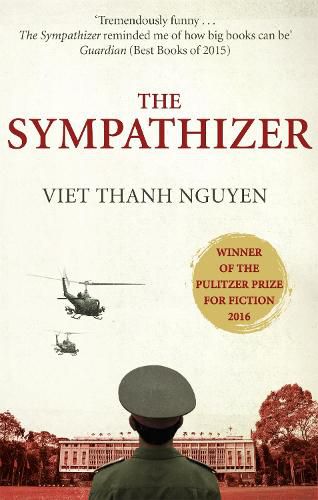
“Have you read The Sympathizer?” asked my son as we were planning our trip to Vietnam. Great book, he said although I did have a qualm or two as I packed it. Would it would be viewed as suitable reading matter should the Customs Officers at Ho Chi Minh city airport decide that my cases needed to be inspected? It is a great book, and no one had much interest in my suitcases at the airport after they had been scanned. It was the winner of the Pulitizer Prize for Fiction in 2016, and a worthy one too.
2016, 384 P.
Framed as a confession written by an unnamed Vietnamese double agent for the shadowy Commandant, the narrator is a Vietnamese army captain who is working under cover for the North Vietnamese. We do not know who the Commandant is, or in whose custody our narrator is, or why. He is obviously being told to rewrite his confession because there is something missing, so it is a slippery narrative.
Our narrator is a man of divided loyalties on many sides: his father was a French priest who took advantage of his young, now deceased mother, and he is shunned as not being ‘properly’ Vietnamese. His closest friends were Man and Bon, and they shared the scar on their hands that they made as blood brothers. They did not, however, share their politics, as Bon becomes an ardent South Vietnamese patriot in exile in America with our narrator. During the war, our narrator worked with the American troops, and after the war he infiltrates the South Vietnamese diaspora community based in America. He becomes a sort of cultural consultant for a film which sounds very much like ‘Apocalypse Now’ (and indeed, books about Coppolla and the making of the the movie are credited in his references) and at times the book is quite funny as the Auteur reveals his complete disregard for the Vietnamese people who are just fodder to his film-making vision.
But the confessor’s hands are not clean. When suspicion arises that there is a mole in the diapora community, he fingers a man he calls ‘the crapulent major’ instead, and assassinates him. When a journalist called Sonny moves in on a woman he has fallen in love with, he assassinates him too. According to this clearly self-serving and written-to-order confession, he is haunted by these two deaths, although early crimes committed in his presence are left unnamed.
The ending of the book is graphic, but I found myself wanting to push through to find out who the commandant, and his superior the commissar were and how he found himself in this situation- a sign that the narrative strength of the book could overcome my own squeamishness.
My enjoyment of the book was probably enhanced, having read it in Vietnam, immersed in museums commemorating the struggle for independence and the end of the war, and moving through areas that were just names in the news reports of the 1960s and 1970s. But even had I read it in cold old Melbourne, I still would have been fascinated by the split nature and slipperiness of the narrative, and the situation that led our confessor to write this tract.


 The Resident Judge of Port Phillip