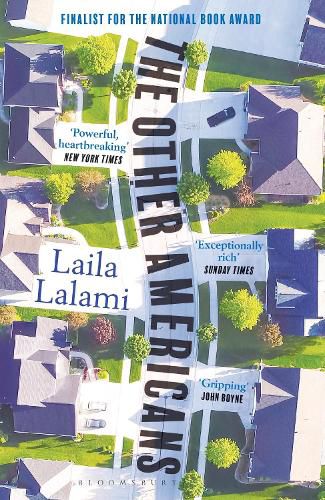
The front cover of this book shows a stylized drone-view type drawing of a suburb in America, with gabled houses surrounded by lush green lawn and trees. It looks just the way I imagine American suburbia to look, full of Leave-it-to-Beaver and Brady Bunch types. The ‘Other America’ in this book live in a rural town on the edge of the desert and the “other Americans” who live there are very different to this white, sanitized image.
Late at night in a small town in the Mojave Desert, California, middle-aged Driss Guerraoui, a cafe owner who originally emigrated from Morocco, is killed in a hit-and-run accident. It is assumed that it is accidental, but his daughter, Nora, believes that it was a deliberate ‘accident’ even though her grieving mother Maryam and sister Salma do not follow her in her obsession with finding the perpetrator. The local police are brought in, including Coleman, a female officer that we later learn is of African-American descent, and deputy sheriff Jeremy Gorecki, an ex-Iraq veteran who had grown up in the town and had long had a school-boy crush on Nora. Before the accident Nora had been living in Chicago, trying to carve out a career as a musician, and involved with a married man who had not followed through on his pledges to leave his wife. But when her father is killed, she returns to her home town and again becomes involved with the boys she went to school with, including Jeremy and A. J. and his father Anderson, who owned the bowling alley beside her father’s cafe. However, the accident did not go completely unseen. Efrain, an undocumented immigrant, saw the collision but fear of the authorities stopped him going to the police. He only came forward when Nora offered a generous reward, possible because of a bequest left to her by her father (a bequest resented deeply by her sister).
The story is told in a chorus of nine voices, including that of the dead man Driss. Because they are all telling the story from their own perspective, we learn much more than about just the accident and the investigation, which is rather an anti-climax as far as a police procedural goes. We see parallels between Driss and Efrain, both making a life in a new country; we learn of infidelities in Nora’s own family; we see racism and resentment being played out at multiple levels. Because they are told from each character’s point of view, we gain multiple perspectives on the same event but I feel that, as a writing technique, it’s a bit of a cop-out. The voices were not sufficiently different from each other and the author is relieved of the responsibility of tying them together. It has been done before, and it just felt a bit tired as a style.
My rating: 7/10
Sourced from: Yarra Plenty Regional Library
Read because: I have Leila Lelani’s new book reserved, and I thought I’d read one of her earlier works first.
Well, it only took five years between hearing a podcast about this book and being inspired to purchase it, and actually reading it. And even then, I was spurred to read it because I’d like to read Andrew Miller’s The Land in Winter, set in the winter of 1962-3, which was short-listed for last year’s Booker Prize. Interestingly, Miller’s book also won the Walter Scott Prize for Historical Fiction, with the events of sixty years ago now considered history.
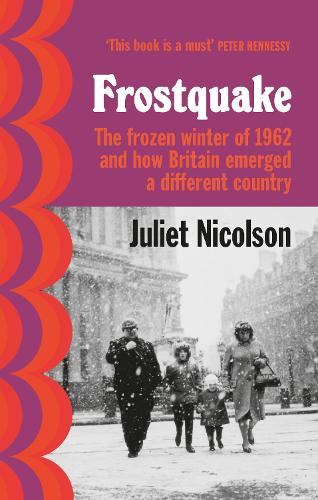
Frostquake, on the other hand, positions itself very clearly as ‘history’, telegraphed with the subtitle ‘The frozen winter of 1962 and how Britain emerged a different country’. In it, Nicolson argues that the winter of 62-63, the coldest since 1814, crystallised a tension between the old and the new. The old: Winston Churchill, Harold Macmillan, the continuations of the poverty of the Industrial Revolution, with 15 million people still lacking a plumbed-in bathroom. The new: JFK, Harold Wilson, the Beatles, consumer goods like televisions and refrigerators, glass office-blocks.
There are moments when society, however embedded, shifts on its axis. The long and lingering hardships of the paralysing winter of 1962-3 encouraged, even enabled, change: the very effect of shutting down empowered a thawing. Forces of social change that had been building over many years now found their moment of release as they broke through the icy surface. As the country froze it melted. (not sure about the page number because I read this as an e-book)
So what is a frostquake? One of the epigraphs to her book is a definition from an unnamed source:
Frostquake (n) A seismic event caused by a sudden cracking action in frozen soil. As water drains into the ground, it may freeze and expand, putting stress on its surroundings. This stress builds up until relieved explosively in the form of a frostquake (p. vii)
However, this book is not about weather or geology, although the snow and ice that started falling and forming for 10 weeks from Boxing Day 1962 through until to spring give the book its narrative parameters. Instead, this book is far more about people and their overlap with events on a national and world stage, drawn from conversations, memoirs and interviews. Some of these people are unknown: 19 year old Pauline Stone, driving through the mustard-like fog in her Mini Minor; Terri Quaye a 22-year old black jazz singer, Corporal Dennis Osbourne, travelling with his family on the Liverpool-to-Birmingham Express, which collided with the Glasgow-London express because of poor visibility. They each have a small story, of which the weather is just background.
But many of the people that Nicolson writes about are well known: Joanna Lumley talks about the cold at her boarding school; the Beatles are being transformed from scruffy, rather smelly hack musicians playing the clubs and careering from gig to gig into suited songsters who appear on the television; Mick Jagger and the Rolling Stones are London fixtures- Mick and Brian Jones sharing an Edith Grove flat, and with Mick taking on board the advice of Andrew Oldham, 19 year old window dresser at Mary Quant’s shop and music promoter “If you pretend to be wicked, you’ll get rich”. There’s the eruption of satire on the television, with comedians Peter Cook, Dudley Moore, Barry Humphries and Alan Bennett thriving into the 1970s and later. Author Antonia Fraser floats in and out, as does fellow author Penelope Fitzgerald. There’s a lengthy section on Sylvia Plath, who committed suicide in February 1963, in the depth of this cold winter.
Not only do other people, both famous and unknown, appear, so too does Nicolson’s own family. When she talks about spending Christmas of 1962 at her grandfather’s house at Sissinghurst, the penny dropped- Ah! She’s the daughter of Nigel Nicolson, who wrote Portrait of a Marriage, and the ‘Nicolson’ in the publishing company Weidenfeld & Nicolson. And so, she’s the granddaughter of Harold Nicolson, many-partied politician, who supported the decriminalization of homosexuality and the abolition of hanging, opposed the Munich Agreement with Hitler, published Lolita and disagreed with Anthony Eden’s Suez policy. And the granddaughter of Vita Sackville-West, who had died the previous summer.
Her upbringing in a political milieu is reflected in her attention to the Profumo Affair in particular, and the entanglement of the various characters who appear throughout the book. Nicolson herself received a pinch on the bottom from John Profumo, a one-time parliamentary colleague of her father, when he came to see the garden at Sissinghurst some thirty-years later. The glamour of JFK is here too, a contrast to the dowdiness of the Edwardian-figure of conservative Prime Minister Harold Macmillan whose career was derailed by the Profumo Affair. The anxiety of the Cuban Missile Crisis pervades the book, and Britain is being rebuffed from the European Economic Community by Charles de Gaulle.
The writing is quite beautiful. Here she is waking up on the day after Boxing Day 1962 as the snow begins to fall, the most snow they had ever seen in their lives:
The following morning we woke to the peculiar blue-bright light of reflected now filtering through the closed curtains. Instead of disappearing during the night as we had feared it would, the snow was still there, turning the landmarks of the garden- the walls, lawns, statues, urns- into something unrecognizable but unified. The sight was beautiful, its very transience on this familiar landscape making it even more precious. Snow muffled all sound and the silence felt dream-deep. Outside freezing snowballs melted the second they hit the napes of our necks and we tipped backwards on to the lawn, arms outstretched like acrobats, trusting that the mattress of snow would break our fall. Unlike a sandcastle on a beach, absorbed so soon by the waves, our imprints remained, hollows into which we could flop again and again. (Ch 7)
She returns to the silence of the snow-bound world at the end of the book, writing in the midst of COVID which brought its own silence to us. Writing in the winter of 2019-20, the daffodils and forsythia had just begun to blossom, and suddenly the earth felt lit up by yellow flowers.
Sixty years before the winter of 1962-3 the century had just turned and with it the old Victorian regime was dying. Sixty years after the winter of 1962-3 the world turned again, a little more sharply than it should have, unbalancing the stability we take for granted and throwing everyone into a state of profound shock….In December 2019, on a world map shown on every single news channel, a tiny red dot indicated a town in the heart of China, a million, million miles away from England, as the place where a brand new strain of a deadly virus had emerged, one that targeted the lungs, the enabler of breath, of oxygen and of life itself. Eight weeks later the dots had spread, and much of the world map was coloured red. In the autumn of 1962 many felt we were teetering of the edge of absolute destruction with nuclear weapons capable of wiping out mankind. And now, in the spring of 2020, the coronavirus, constantly visualized on screens as a spiky globe, an exotic species of underwater coral, a logo of frightening change, made us feel we were once again staring into the abyss, looking over the rim…. The country lanes were silent not this time because of the muffling of snow but by the absence of traffic. The world was in lockdown. The skies were blue, blue, blue, devoid of aeroplanes, not through mankind’s choice but for its survival. And the birds were going crazy in the sunshine. Nature seemed to have forgiven us not for doubting but for threatening its resilience and had returned once again with an astonishing beauty….Perhaps every half-century or so we need an intervention that is outside our control, an uninvited pause in order for resurrection to take place.
I enjoyed this book. I’m old enough to recognize the things she is writing about- indeed, the author and I are nearly contemporaries, and I do wonder if someone younger would enjoy it as much. It was not at all what I expected, which was a far more journalistic, meteorologically based account, but enjoyed the political and personal approach much more.
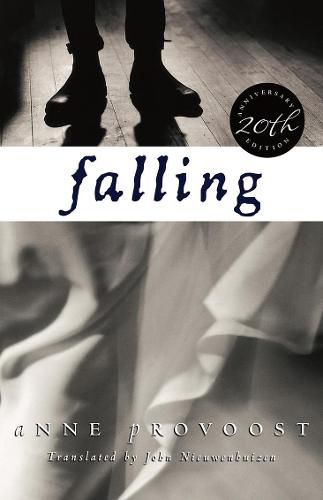
The twentieth anniversary republishing of this book has come and gone, it having first appeared in Dutch in 1995. I had heard of it, and knew that it dealt with Nazism, and assumed at first that it would be set during World War II. It came as a surprise, then, that it was set in the present day (in 1995) with themes that are probably even more resonant and urgent today than they were in 1995. My copy, collected no doubt from my local little library, had obviously been a school set-text, and the book won many Young Adult awards on its publication.
Lucas has accompanied his mother to Montourin, a small Belgian provincial town, to clean out his late grandfather’s house. The book opens with Lucas standing by the side of the road as his friend Caitlin is brought back from hospital after an accident that occurred three weeks earlier. The narrative then spirals back to explain who Lucas and Caitlin are, how she was injured, and Lucas’ part in that injury. It is written in first person, from Lucas’ viewpoint, thus aligning us as readers with his perspective of events in the weeks leading up to Caitlin’s injury.
On arriving at Montourin, he finds that there is an unspoken edge of hostility towards him and his family, exemplified by Soeur, an old nun in the nearby convent in which American-born Caitlin is staying. He does not understand why, and as he sees his mother sorting through and destroying his grandfather’s documents and belongings, he knows that something is being kept from him. He gradually learns that, after the death of one of his children during the hungry days of WW2 occupation, his grandfather denounced fifteen Jewish children and the nuns who were hiding him in the neighbouring convent, out of grief and resentment that these Jewish children were taking food rations that could have saved his daughter. Some in present-day Montourin shunned his grandfather for this action; others supported it.
Their support was generally unspoken, but outright admiration was voiced by Benoit, a young man older than Lucas, who combines menace, charisma and manipulation in his neo-Nazi outlook. Lucas is drawn into Benoit’s sphere and becomes involved, with varying degrees of culpability, in Benoit’s terrorist plans against the Moroccan refugees who have moved into the town. At the same time, he is attracted to the inscrutable Caitlin who fluctuates between flirt, friend and heartbreaker as she, too, seems to be becoming friendly with Benoit. But when Caitlin is involved in a single-car accident- the reasons for which are unclear- Lucas acts decisively, if precipitously, in a way that will change the rest of Caitlin’s life. I’m not really quite sure about the ending of the book, which is deliberately left obscure, but which struck me as a little melodramatic.
Since 1995 the presence of African refugees in Europe has only increased, as has the prominence and apparent electoral acceptability of neo-Nazi parties. This book is a warning against the slow slide towards fascism, especially for young men with no responsibilities who yearn acceptance from other young men. I can see why it would be chosen as an upper-school text, especially given its urgent relevance today. I’m not sure how it would be received by high school students though- it moves fairly slowly, and I wasn’t particularly satisfied by the ending.
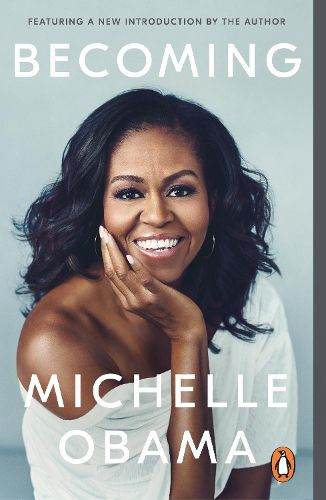
I had not had much interest in reading this book, deterred perhaps by the glamour shot on the front cover. Even though I very much enjoyed Barak Obama’s Dreams From My Father, I wasn’t particularly drawn to reading a First Lady’s life story, thank you very much. But it was a Book Group selection, and conscientious Book Grouper as I am, I resolved to read the book and I am so glad that I did. There was much more in this book that I might ever have anticipated.
The preface started with really good writing. It’s post-Presidency, and Michelle is alone in the house for almost the first time (excepting the security guards down in the garage). Her daughters are out, Barak is not at home, and she decides to make a grilled cheese sandwich. There’s no one to make it for her, no-one to say “Mrs Obama, let me get that”, no one to look askance at her desire for such homely comfort food. She sits on the back doorstep, and eats the sandwich.
The book proper is divided into three parts: Becoming Me, Becoming Us, and Becoming More. Becoming Me traces her early upbringing on the South Side of Chicago, where her remarkably hands-off parents bring her up to be an intelligent, independent young woman, super-organized and conscientious, ambitious and methodical. Becoming Us chronicles her relationship with Barak Obama, and her switch from corporate law to the non-profit sector. The ‘us’ expands to include her two daughters, born through IVF, and the tension she feels between being a professional woman, and a mother. Barak is becoming increasingly involved in politics, first as a state congressman, and then as presidential candidate, although she is often angry and resentful of the demands that politics make on their relationship. Becoming More takes us into the Obama presidency, and the weird home-life this imposes on their family. She needs to carve out her own identity as First Lady, even though this is a role that is not of her choosing, and she struggles to keep some sense of normality for her daughters.
The book is very honest. Barak comes over as a highly intelligent if selfish man, infuriating in his messiness, chronic lateness and lack of attention to detail. She for her part comes over as rather controlling and chronically insecure about whether she is good enough. The awareness of being a black woman in a predominantly white political milieu accompanies her always. She talks about the strains in their marriage as her life is subsumed into his ambitions, and her eventual decision to keep some sort of family routine of dinner and bedtime which Barak has to accommodate to, instead of the other way around. Her mother is a saint: I don’t know that I would get up at 5.00 a.m. to mind my grandchildren while my daughter went to the gym- if fact, I know that I wouldn’t (just in case any of my children get ideas).
She does not even try to hide her contempt for Donald Trump, which hardened even more when he won the Presidency. Trump’s actions in demolishing the East Wing seem even more egregious now, after reading about an engaged First Lady who opened the White House up to many people, through that very East Wing that no longer exists.
At first, I was so impressed with the writing in this book that I was rather disappointed when I learned that it had been ghost-written, or at least written with other people. Does that matter, I wonder? For me, probably yes, because I feel that her writing has been mediated through the other author, and I feel disappointed that the words are not hers. But this doesn’t detract from the honesty that pervades this book. She doesn’t once mention the word ‘feminist’ but the tensions between motherhood, professionalism and politics reflect the viewpoints of a modern, engaged intelligent woman that the world was lucky enough to have as First Lady for eight years.
My rating: A rather surprising 8.5
Read because: Reading Group Book
Sourced from: Darebin Library as part of their reading groups program.
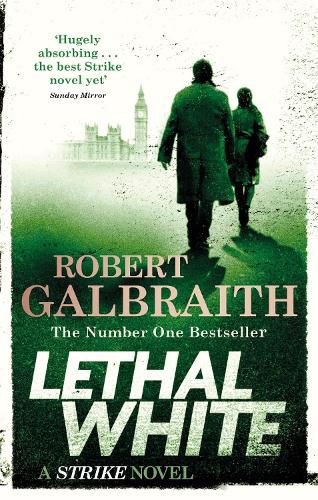
Cormoran Strike books, written by J. K. Rowling under the nom-de-plume Robert Galbraith, are for me a long-form type of comfort food. Very long-form, because like the Harry Potter books, these seem to be getting longer. Lethal White is the fourth in the series, and it comes in at a hefty 784 pages.
Detective stories are a genre, with recurring themes which are both part of their appeal and part of their frustration. In the case of the Cormoran Strike books, how long can Galbraith keep the unresolved sexual tension (UST) between Strike and Robin going? This book starts off with Robin’s wedding to the insipid Matthew. Surely a marriage should dampen any progress in the UST realm, but this is not to be. But how many more volumes can Galbraith keep this going? And surely if the UST becomes resolved, that will be the end of their relationship because who wants a married-couple detective agency? And on an unrelated theme, why doesn’t Comoran do something about his throbbing stump where his leg was amputated? Surely additional surgery is in order, or a new prosthesis or something! Moreover, how many more times is Robin going to end up in peril as the case draws to its close? Although, having said that, poor Nikki in ‘Silent Witness’ spends much of her time kidnapped and threatened- it seems to go with the territory that the female investigator- while her male counterparts need to work out how to ‘rescue’ her. But I guess that all these formulaic aspects are part of the genre.
Set during the London Olympic Games, Strike is approached by mentally ill man, Billy, who says that he saw a child being buried years ago. Is it true? At the same time, Strike contracted by politician Jasper Chiswell (Chizzle) to investigate blackmail for something that was not illegal years ago, but now is. As it turns out, the two cases are connected.
Meanwhile, Robin has married Matthew-and she is unhappy from the start. Strike encounters his past lover, Charlotte, who is now pregnant with twins and unhappily married too. Strike is in an uncommitted relationship with Lorelei, who wants more from the relationship than he can give.
Galbraith introduces a huge range of characters into the book, but somehow manages to keep control of them all. I like the way that the author has Comoran or Robin sit down and mentally draw the whole case together, neatly encapsulating it for this reader who can find herself completely confused. It’s like drawing a deep breath, before plunging underwater again. Within this complex ensemble, Galbraith has a number of pairs (fitting, really, for a parliamentary detective story where ‘pairing’ is part of the political scene)
Each chapter is headed by an epigraph from Henrik Ibsen’s play Rosmersholm (1886). I must admit that I don’t know the play, and Dr Beatrice Groves has done the work of drawing the links between Lethal White and Ibsen’s play. As with many of Galbraith’s books, the reason for the title is with-held until well into the book. In this case, we need to wait until Chapter 42 to learn that Lethal White is not a form of cocaine, or the nick-name of a thug, but instead is a horse disease.
I’m not normally a detective-fiction fan, but Galbraiths are different. I will keep turning to the Cormoran Strike series when I have tired of other genres or want to escape from non-fiction into a well-plotted if formulaic series that keeps me reading until far too late at night.
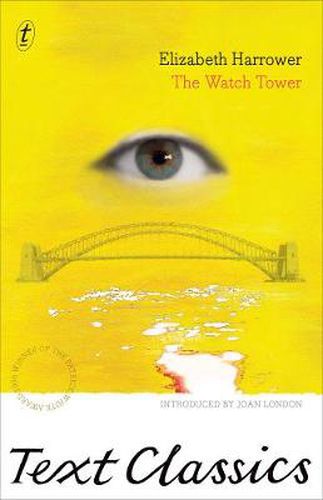
I often find that there is a sort of brittle formality about books written in early-mid twentieth-century Australia, echoing the slightly-British, self-conscious tone of newsreaders and documentary narrators that you hear in black-and-white footage from the 50s and 60s.This book, first published in 1966, and reissued by Text in 2012 starts off in a similar way. The scenario of two sisters, Laura and Clare, being brought into the headmistress’s office to hear of their father’s death and their removal from school evoked children’s books of the past (Frances Hodgson Burnett’s A Little Princess, anyone?) The focus at first is on sixteen-year old Laura, who had had aspirations to be a doctor like her father, and she is more conscious of the economic and social fall in their circumstances when their fey and selfish mother turns to Laura to be the breadwinner of the family. At this stage, neither Clare nor her mother are particularly well-rounded characters, Clare (seven years younger than Laura) being merely childish and her mother Stella a languorous, demanding presence who decides to sail back ‘home’ to England, leaving the girls to fend for themselves.
Instead of a medical degree at university, Laura finds herself packed off to business college and a secretarial job at a box factory, owned by Felix Shaw. Although she feels no great attraction to him, when Felix Shaw proposes to her – largely as an economic arrangement – she accepts, seeing it as a means of financial security for herself and her younger sister Clare. Felix offers to support Clare to go to university- a dream that Laura had had for herself- but this promise is soon broken once Laura and Felix are married. I can’t really decide whether Felix is a complex character or a caricature. He almost willfully makes unwise financial business decisions, selling off mildly successful companies to spivs and incompetents, while expecting Laura to pick up a heavier work burden as a result. They are not poor: they live in a large house overlooking Sydney Harbour, and he enjoys driving luxury cars dangerously while abusing everyone else on the road. He sells the house – the one thing that Laura loved- from under her to underline her financial impotence in this dependent relationship.
Harrower skillfully juxtaposes the glittering sunshine of the Harbour, with the darkness of their house. It is as if a shadow lies over this beautiful home and its extensive gardens. The book is set in the 1940’s and 50’s, and although neighbours are aware of the arguments next door, nothing is done to help them. In fact, in spite of living in the midst of other houses and working with other women, Laura and Clare are socially isolated, with Felix’s happiness their main concern.
The term ‘coercive control’ did not exist when Harrower wrote this book, but all the signs are there: the emotional blackmail over the prospect, later withdrawn, of Clare’s university education; the changeability of mood; the oscillation between extravagant generosity and meanness; the rigidity in expectations for the women in his life compared with his own recklessness. Felix is physically violent towards Laura, and the possibility of sexual violence towards her sister Clare lurks in the shadows.
Most insidious of all is Laura’s own coercion of Clare to remain in the family home as a peacemaker and mediator, and her adoption of Felix’s own sense of victimhood as a reason to make her stay. Felix has made his own wife the enforcer. At times Laura dreams of an escape, but faced with the consequences, she represses her own will and becomes an extension of Felix.
Meanwhile, as the novel progresses, Clare becomes the main focus when she resists the narrowing of her own horizons and as all of the colour leaches out of Laura. The arrival of Bernard, a young refugee, to stay in the house to convalesce breaks the spell, even though for a while it seems that he, too, is going to be lured into Felix’s orbit by the promise of academic support, similar to that offered to Clare. In fact, there is a latent thread of repressed homosexuality in most of Felix’s relationships with other men, be they fellow entrepreneurs or employees.
The threat of violence runs through this book and it is clearly felt by Laura and Clare as they scramble to meet Felix’s standards and demands. Knowing, as we do, the physical danger to women at the point where they finally decide to leave a coercive partner, as readers we feel unsafe as Laura, and increasingly, Clare contemplate an escape
The title ‘The Watch Tower’ is interesting, because it can be interpreted in many ways. It has connotations of punishment and incarceration, which the beautiful house on the Harbour becomes. But it also suggests a lookout as well, and as the book progresses Clare is increasingly looking out, to a wider world, even while Laura becomes more deeply entombed in her relationship with Felix.
So, for a book which I thought was going to be rather insipid and old-fashioned, I found a book that in many ways predates Jess Hill’s See What You Made Me Do (my review here). I read this as part of the Ivanhoe Reading Circle’s program, and one of the questions raised was whether we know of another Australian book of similar vintage that deals with the issue of what we now recognize and name as ‘coercive control’. I haven’t read it, but I suspect that Elizabeth von Arnim’s Vera treads similar ground (The Pastor’s Wife (my review here) does too, to a lesser extent. I can see why Michael Heyward at Text Publishing re-published this book. Unfortunately, it reads just as true today – possibly even more true now – as it would have sixty years ago.
My rating: 9/10
Sourced from: Brotherhood Books
Read because: November book selection for Ivanhoe Reading Circle.
When my son said that this was his favourite book of 2025, I took notice. When I told him that I had borrowed it from the library, he hedged a bit, saying that he didn’t know if I’d like it. He’s wrong: I loved it. I could barely put it down over the three days that I read it: sand, beach and grandchildren notwithstanding.
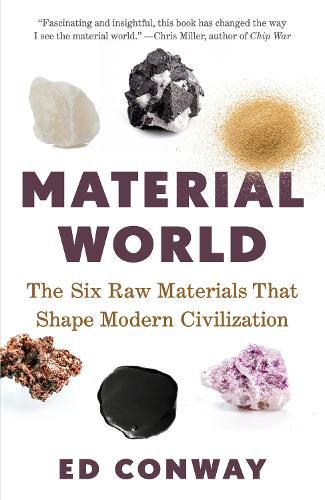
I’m not a particularly science-y person, but this book is far more than ‘just’ science. Like a Mark Kurlansky book (think Salt, Cod etc.) it combines science, history and travel, but it also packs quite a bit of political analysis as well. I’m writing this on 5 January 2025 as the reality of Trump’s bombing of Venezuela and imposition of US oil interests is sinking in, and Conway’s comments about autarky (i.e. the policy of being self-sufficient that underlies Trump’s ‘America First’ policy) seem particular apposite right now. Ed Conway is the economics and data editor of Sky News and a columnist for The Times (London), which are right-wing connections that do not engender my trust. However these contexts are not particularly apparent in Conway’s book, except perhaps for the ultimately optimistic viewpoint with which he ends the book. Quite apart from his politics, his journalist background equips him with the eagle eye for a good anecdote and the ability to bring the narrative back onto more general-reader territory when it threatens to wade into technologically and scientific details.
In the introduction he identifies himself as a denizen of what he calls ‘the ethereal world’:
…a rather lovely place, a world of ideas. In the ethereal world we sell services and management and administration; we build apps and websites; we transfer money from one column to another; we trade mostly in thoughts and advice, in haircuts and food delivery (p.13)
He distinguishes this from ‘The Material World’, which undergirds our everyday lives by actually making things work, often through companies whose names are unknown to us, but which are more important than the brands that use their output:
…operating stuff in the Material World….you have to dig and extract stuff and turn it into physical products…a difficult, dangerous and dirty business (p.14)
He chooses six raw materials – sand, salt, iron, copper, oil and lithium- which are not only important substances in the world, but are the primary building blocks of our world and have fuelled the prosperity of empires in the past. They are the very hardest to replace. These six materials form the basis of products several steps up the chain: sand, for instance, is the basis of silica which underpins optical fibre and the concrete and cement that makes modern high-rise cities possible. In analysing these materials, he traces back their ‘discovery’ to ancient civilizations, often by accident or through observation, before being intentionally created with processes that often form the basis of present methods. Concrete, for example, was ‘discovered’ three times: there is evidence of cement use in Neolithic ruins in Turkey that date back more than 10,000 years; the Bedouins created concrete-like structures in 6500BCE, and the Roman used a form of concrete in many of their buildings before the recipe was lost for hundreds of years following the fall of the Roman Empire. The discovery of On Architecture by Roman architect Vitruvius, and its translation into French and English, triggered the 18th and 19th century quest for new concoctions to replicate or surpass the Roman recipe (p. 75). Perhaps because he is a British journalist, he highlights deposits in the British Isles rather more than we would think of today, and both German and British ingenuity are highlighted, as well as American. Thomas Edison makes several appearances, but the complete absence of any women at all highlights the male-dominated nature of science and invention.
The structure of the book has a sense of symmetry that I find appealing: six raw materials examined in six parts, each with three chapters, an introduction to the book and a conclusion. I can’t vouch for the reliability of his information, but each time I exclaimed “Hey, did you know…?” to my much more scientifically-oriented husband, he already did know and what he knew aligned with the information in the book.
Unlike many in the media companies and publications he works for, Conrad does not deny the reality of climate change and the environmental degradation that occurs as part of the mining and extraction of his six materials. However, as he points out, the production of an environmentally harmful material was often prompted by the desire to replace an earlier, even more harmful energy source which would have brought about an even more devastating environmental impact. e.g. coal replacing wood, kerosene replacing whale oil, or polyethylene replacing gutta-percha from the rapidly disappearing Malaysian guttapercha tree. It is this pattern that contributes to his optimism about our ability to mitigate climate change in the long term, if we can overcome the short-termism of the political cycle and make financial and lifestyle sacrifices for an unborn generation- actions for which there is equivocal evidence so far.
However, he is not completely Panglossian. Australia, and Rio Tinto in particular come in for trenchant criticism over the destruction of the Juukan Gorge for the extraction of iron ore. As he points out, part of the luxury of living in the ‘Ethereal World’ is that we can shunt the environmental impacts of our lifestyle into the ‘Material World’ which often happens to be a third world country. Wealthier countries, like Chile and Australia to a lesser extent are starting to question the environmental costs when the extraction occurs in their country instead of someone else’s.
Despite the shift towards autarky promoted by Trump in particular, and turbo-charged by the world’s realization of the precariousness of supply chains during COVID, the story of these six materials is also the story of globalization. Here in Australia we see the shipping out of raw materials (especially to China), but the circulation is much broader than this, with the finished product integrating multiple processing steps from right across the globe. Such processes make the world more inter-connected than America/Australia/China first politicians might desire.
The Material World is – well, material- but it has political implications. While the rest of the world panics about China’s dominance of the battery supply chain, China panics about its reliance on the rest of the world for its raw materials- hence China’s Belt and Road strategy. Particularly in relation to the production of advanced silicon chips, security is uppermost in the attempt to prevent industrial espionage and to make sure that China does not gain this ability. Ironically, China is unlikely to develop the hyper-pure silicon from which the silicon chip ‘wafers’ are made because the crucibles to melt it are available (so far) only from a single site at Spruce Pine, in North Carolina, operated by only two companies, Sibelco (Belgium) and the Quartz Corp (Norway). This raises the unsettling question of the effects of a landslide on the road that winds to Spruce Pine, or the malicious spraying of the mines with a particular chemical. But this single source is unusual: there is usually another source or another product to take the place of a threatened material. His six materials highlight the international reach of companies based in one country, and the diversification of such companies into new processes as part of the evolution of products and materials.
This evolution of products and materials lies at the heart of the optimism of the book. We have worked out how to turn complex products into commonplace and increasingly cheap items (for example solar panels and semiconductors). Although he has chosen six materials for his analysis, they are intertwined: batteries are just as reliant on copper as they are on the lithium inside them; steel inside concrete is a better building product than either alone. Even though we need to keep extracting materials to make the very ambitious transition to net zero, with solutions like hydrogen and wind turbines requiring huge amounts of energy, there is one major difference. In the past we used fossil fuels to burn, but now we are using them to build.
For years, people assumed that it would be impossible to make iron and steel at the scale we can today. Rediscovering the recipe for concrete seemed like a pipe dream. Scientists doubted that we would ever be able to tame extreme ultraviolet light, let alone use it to mass produce silicon chips. Will we look back in a decade or two and wonder why we ever fretted about producing enough hydrogen to back up the world’s energy grids, or why we struggled to generate copious power from the hot rocks deep beneath the earth?…If there is one lesson you should take from our trip through the Material World, it is that with enough time, effort and collaboration, these things usually happen….Humankind has, since its very first days, left a visible imprint on the earth. There is no point pretending otherwise. It is part of our story. It has allowed us to live longer, more comfortable lives than ever before. It has enabled us to fill the planet with more individuals than anyone could have imagines, with 8 billion brains and 8 billion sets of hopes and dreams. We are also capable of living far more sustainable, cleaner lives, diminishing our destruction and contamination and living in closer harmony with the planet. We will do so not by eschewing or dismissing the Material World, but by embracing it and understanding it. (p. 443)
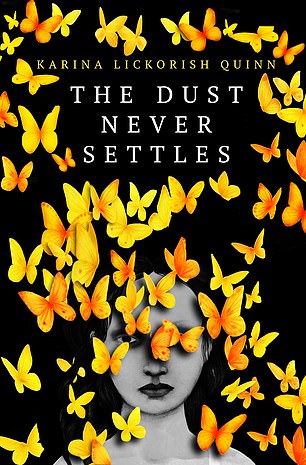
I don’t very often read a book just on the basis of a blurb alone, but in this case I did. Paul Lynch, the author ofProphet Song spoke highly of Quinn’s book in author interviews and his blurb describing it as ‘a mesmerising feat of imagination and a masterful debut’ graces the back cover. It’s a beautiful front cover, and the yellow butterflies evoke Gabriel Garcia Marquez, to whom this book owes quite a debt.
Anaïs Echeverría Gest has returned to her childhood home in Peru after an absence of several years in England. The family is expecting her to sign the papers authorizing the sale and inevitable demolition of her grandmother’s house, la Casa Echeverría in order to free up the inheritance. The house, which is a character in its own right, is a large yellow colonial mansion and garden overlooking the shacks and slums built by squatters on the dry plain behind the house called Los Polvos de Nadie y Nunca (the dusts of no-one and nothing) during the Agrarian Reforms of the 1960s. As soon as she steps over the threshold, she is assailed by the memories of the house- not just her life in that house, but the memories of the house itself- and the ghosts of family members and employees who had lived and worked there. Time seems to stretch and contract in the house; one minute the rooms are intact and the furniture dusted and lights illuminated, and the next minute the house is derelict and dark.
Anaïs has left her fiance Rupert Napier, a thoroughly English gentleman, in order to come home to Peru. She is curiously detached from Rupert, telling herself that she loves him but never really feeling it, and she is likewise ambivalent about her pregnancy. The future baby exists as a little pink fish in the corner of her vision, and as her pregnancy progresses the little fish changes shape until it is a huge, snapping lobster. When Rupert comes over to Peru, probably at the request of the extended family who are frustrated by Anaïs’ refusal to sign the papers, he brings with him all the Englishness of his family, an Englishness that Anaïs resented in her own English father’s refusal to acknowledge his second family in Peru, choosing instead to stay with his wife in England.
The house, built at the turn of the century, has seen multiple deaths, that are only just hinted at: a baby whose cries still echo through the house, the suicide of her Aunt Paloma and most importantly, the death of a 17 year old maid, Julia Álvarez Yupanqui who died when she fell (jumped?) from a window. As Julia falls from the window, the Earth falls away from her and is like a sheet of cloth; she sees Time “spread like an ocean, flowing this way and that, tossing up moments, driving them forwards on the crest of a wave then swallowing them again, pulling them back into the deep“. (p. 96) A disembodied presence, Julia wanders unseen through generations of the Echeverría family, right back to the Conquistadors and through centuries of dispossession, enslavement, poverty and violence. The people of Los Polvos, who saw her fall, believe that she has become a saint- and indeed, it seems that she has, as she walks unseen through history dispensing kindnesses as she passes.
It was not only the Polvorinos who saw her fall: Anaïs did too, crouched under a geranium bush. She becomes electively mute, and is seen by a succession of psychiatrists and doctors who try to make her talk. Anaïs could see the ghosts in the house and the adult Anaïs has a tenuous grasp on reality, and you are never really sure whether she is going mad.
So the story shifts back and forth between two realities: that English reality (denoted by chapters with English numerals) and the Peruvian reality in chapters with Spanish numbers. The Spanish chapters follow the disembodied Julia Álvarez Yupanqui and take us on a meandering journey through Peruvian history. There is an exhaustive list of characters in the appendix of the book, divided into the Echeverría family and a longer list of historical and imagined characters who feature in small, passing vignettes as Julia crosses the earth. These vignettes are beautifully written and draw you in just enough to feel disappointed as Julia passes by, leaving that narrative thread hanging loose. Reflecting the tragedy and complexity (and complicity) of various generations of the Echeverría family, there is a convoluted family tree that challenges the one found in One Hundred Years of Solitude with its seventeen Aureliano Buendías.
The complexity of this book is both its great strength, and its greatest weakness, particularly as the book goes on. The last quarter of the book is Julia’s journey through history, and Anaïs’ story drops away. I found myself having to consult the list of characters at the back of the book, having ‘met’ these characters earlier in the book but having forgotten them in the cavalcade of ghosts passing by. I enjoyed the frequent use of Spanish, which she paraphrases in the following sentences, but I don’t know if I would have felt that way had I not been able to read Spanish.
Because this book is just as much about time, land and colonialism as it is about individual people, it reminded me of Alexis Wright’s Carpentaria, which was similarly shape-shifting and which caused you to think “am I even understanding this?” In fact, I often said that out loud while I picked it up each night, enjoying the experience of reading it, but unable to hold it all in my head.
I like magical realism, but many people do not. This is a really ambitious, fearless book, and I suspect it is more memorable for its overall shape than for its details. It is flawed, but it’s very good.
My rating: 9/10
Read because: I loved Paul Lynch’s Prophet Song and I thought- if he loves this book, perhaps I will too. I did.
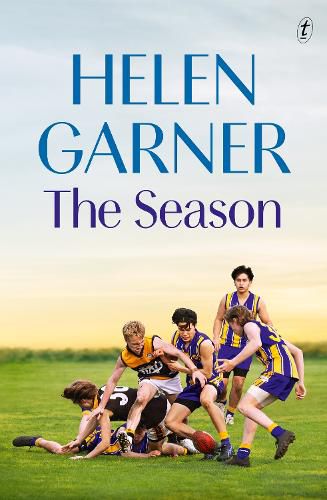
This book should have ticked all my boxes: set in Melbourne, written by a much-loved Australian author, written with a nanna’s-eye (and I do embrace my nanna-dom). But it sounded as if it would be a bit slight, and I probably wouldn’t have read it had it not been an Ivanhoe Reading Circle selection, read and discussed amongst all the other nannas.
Even Garner herself sounded a bit ambivalent about the whole project, admitting that she wrote the book because she needed something to do, but didn’t have the energy to embark on one of her investigative non-fiction books. It traces the footy season of her grandson Amby’s under-16s footy team, at the J. J. Holland reserve in Kensington. As she always does, Garner conveys a strong sense of suburban place, and in this case, the football ground she describes so closely fitted with the oval that I walk through to my volunteer job in Kensington that I actually researched the club and found that, indeed, it is the J. J. Holland reserve. She’s there for the team’s matches; she’s there for their training sessions on cold weekday nights, and she’s there for the conversations in the car driving there and back.
Although ostensibly about football, it’s even more about young men growing into masculinity, and at under-16 Amby is at that liminal stage, with signs of the little boy still visible under the swagger of adolescence. Garner’s daughter lives next door, and she has a strong and enviable relationship with her grandchildren, especially Amby. At the same time, she is aging and feeling irrelevant and frustrated by her increasing deafness. In places she veers into idealization of these young men, seeing them as warriors, and even admitting to a slightly ‘off’ recognition of their adolescent sexuality (Garner has always been, and remains, perhaps more honest than she should be).
It is the football season that gives this book its beginning and ending, and the book was more a reflection than a plot-driven story. I had feared that it would be slight, and unfortunately it was.
My rating: 6.5/10
Sourced from: purchased e-book
Read because: October 2025 selection for the Ivanhoe Reading Circle.
Whenever I drive past the flashing lights of ambulances and police at a road accident, I think of the couple of minutes before that collision: the conversation that would have been abruptly cut short, the reason the occupants were in the car, how they would have got up that morning oblivious to how their lives were going to change in the next 12 hours.
This is pretty much the same impulse that led Leigh Sales to write this book. As a journalist, she had been on the media side of many interviews and stories about people whose lives changed dramatically. She had also had her own brush with death when a placental abruption in what had been a normal pregnancy led suddenly to a life-threatening situation, and fears for both her baby’s life and her own. Shaken by the experience, she came to believe that we are all vulnerable to sudden, unexpected change and yet we do not live that way. Why?
Her book revolves around the case studies of various people, some of who became caught up in ‘newsworthy’ events, others who experienced the death of a loved one (something that we all face) or had suffered a catastrophic injury or illness. The chapters are re-tellings of her interviews, interwoven with some ‘easy to digest’ research which veers at times into pop-psychology, and her own reflections of how she would have responded in similar circumstances.
Some of the people and the events described are well-known: Louise Hope, who as well as suffering from MS, was also one of the hostages in the Lindt Cafe siege in Sydney in September 2002; Walter Mikac who lost his wife and two daughters in the Port Arthur killings; James Scott, the ‘Mars Bar’ man who disappeared in Nepal and Stuart Diver, who survived the Thredbo landslide but his wife did not. Others are less well-known, Matt Richell, who died in a surfing accident, Juliet Darling whose husband was killed by her psychotic step-son and Michael Spence, the vice chancellor of the University of Sydney, whose wife died within 3 weeks of her cancer diagnosis, leaving him with five children.
As it happens, the first two case studies are both of people with deep Christian faith. In the case of Michael Spence, it was precisely because of his religious faith that she interviewed him, even though Sales herself is not a believer. As a former-believer myself, I found myself dreading that the book was going to become religious tract. It didn’t, but I still found it strange that she was to organize her case studies in this way, giving such prominence to faith and a belief in a higher purpose for suffering.
She locates herself as a journalist in these retellings, having presented many of the news stories herself. She tells us that she often becomes tearful during her interviews, perhaps as a counter to the perception of the sang-froid of the television presenter. The intensity of media scrutiny led several of her interviewees to engage a publicity agent to manage media appearances. This did not always work out well: you glimpse the newshound in her when she talks about James Scott, dubbed ‘Mars Bar Man’. He was advised by his agent not to name the chocolate that was his only food, in the hope that he could secure a sponsorship deal later. It wasn’t actually a Mars Bar, but instead a Cadbury’s chocolate, but when he fudged (terrible pun) the brand of the chocolate in an interview, the interviewee (Richard Carleton) sensed obfuscation and toughened his questions. Although Carleton came in for criticism for the ferocity of his questioning, Sales admitted that she would have done the same thing once she sensed evasiveness.
She returns several times to the idea that, having had one dreadful thing happen to you, you were inoculated against further trauma. Statistically, this is not logical even though emotionally, it is. She seems to feel that Louise Hope’s MS should have been enough, without the Lindt siege, and she spends some time on the idea of the ‘jinx’ on the women that Stuart Diver (Thredbo) has married, his second wife having died with breast cancer. Diver speaks of being a ‘memory locker’- capturing and keeping happy times for when the bad times come – but Sales seems somewhat resistant to such a stoic and clinical response to pain.
She devotes several chapters to people who helped: Detective Norris who accompanies a grieving wife to the morgue; counsellors Jane Howell and Wendy Liu at the morgue; Mary Jerram at the coroner’s office; pastor Father Steve who has a strong belief that families should see the body.
All of this is told in an intimate, rather confidential tone of voice. I used to listen to Chat 10 Looks 3, the podcast she made with political commentator Annabelle Crabb (still going, I see) and this book had much the same sort of feel to it. Interesting, personal but something that you could listen to (read) without much effort or challenge.
My rating: 7/10
Read because: Bookgroup Ladies selection. Now that the CAE has wound up, we have no identity!
Sourced from: Darebin Libraries Book Group collection.


 The Resident Judge of Port Phillip