I hear with my little ear: Podcasts 8-15 May 2019

Forest 404 (BBC) I don’t know quite how I got onto this, but somehow or other it ended up on my phone. I don’t even quite know what it is: I think that there are stories, (of which this Episode 1 is the first) that are linked to soundscapes and related talks. Anyway, this first episode is set in the 24th century when a librarian, Pan, is charged not with conserving but destroying sound files from the 21st century, which are taking up too much storage space. After the Cataclysm (which waits to be explained), data storage space was recognized as finite, so all the sounds of the past, e.g. a Barak Obama speech, the words when man first walked on the moon etc, are being expunged. Then Pan comes across a recording of a rainforest, and even though she doesn’t know what it is, she finds herself drawn towards it.  I don’t know if I’ll persist with this, but the concept of ‘sound’ as artefact is ideal for the podcasting medium.

99% Invisible. Pharmaceutical companies direct their energies towards diseases where they are going to make profits – big profits. This program, Orphan Drugs is actually from November 2018, and it looks at the drugs that pharmaceutical companies decide not to continue manufacturing, even though they may have been life-changing for a small number of people. It tells the story of Abbey Meyers, whose son suffered with Tourette’s Syndrome, who finds herself as an advocate for orphan drugs, trying to lobby government and drug companies to continue to make these no-longer-lucrative drugs available. Of all people who stepped in to help with Jack Klugman and his brother, from Quincy M. E. (remember that?) who used the program to highlight the issue. But, as Abbey Meyers, be careful what you wish for. The resultant Orphan Drugs legislation, which she spent decades lobbying for, has had unintended consequences.
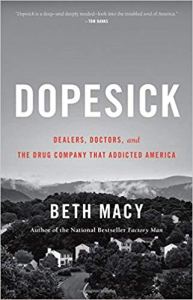
dopesick_macyConversations (ABC) And while we’re on the subject of Big Pharma, the estimable Richard Fidler interviewed Beth Macy, the author of Dopesick: Dealers, Doctors and the Drug Company that Addicted America.  In ‘Taking the Pulse of a Dopesick Nation‘, she tells the story of how drugs like oxycontin etc. were falsely marketed as being slow-release and therefore non-addictive, as the memory of the dangers of prescription medicine receded and ‘pain’ began to be seen as a treatable condition in its own right again in the 1990s.  The information that came with these prescription drugs warned not to break the coating of the pill, because, as it happened, it was only the coating that made them slow release. Ironically, she sees the only solution in treating addiction as a medical problem and using other drugs as a way of treating the ‘dopesick’ feeling after coming off these drugs, because abstinence and all-or-nothing thinking just doesn’t work. Very interesting and makes you disgusted at the lack of morals of Big Pharma.

While I was there at Conversations, I also heard Susan Orleans (who wrote The Orchid Thief) telling the story of the burning of the Los Angeles Central Library in 1986 – something that certain escapes my memory. Did you know that when books are wet, they either need to be dried out within 48 hours or frozen? That’s how thousands of books ended up in meat storage freezing facilities for years. You can hear it at ‘When the Library Burned

And although there was nothing particularly new in it, ‘How a milkmaid with cowpox changed history‘ was quite interesting in that it brought together a lot of stories about disease and vaccination.

Background Briefing The Night Parrot is the Holy Grail for bird watchers, and there have been a number of programs on the ABC celebrating the ‘discovery’ of the Night Parrot by bird watcher John Young. But in this program ‘Flight of Fancy: the mysterious case of the Night Parrot’, there are now real questions about the veracity of this ‘find’, and I can only assume that Our ABC did its legals before broadcasting this program, made by Ann Jones from ‘Offtrack’.

The Documentary BBC World Service Well, this was depressing listening from two very different places in the world. ‘Polands Partisan Ghosts‘ is about the adoption by the far right of the ‘Cursed Soldiers’ who were responsible for murder and arson in the time immediately following the Second World War. ‘India’s Forbidden Love‘ is about inter-faith and inter-caste marriages that are running up against the prejudices of the past, fanned by increased religious/national identity. Poland and India couldn’t be more different, but the rise of intolerance cloaked in nationalism right across the world frightens me.

‘From Secret Ballot to Democracy Sausage’ by Judith Brett

brett_democracy

2019, 183 plus notes

When she was a lecturer in politics at LaTrobe University, Judith Brett tells us, she used to ask her first-year students to talk about their first political memories as an ice-breaker activity in their first tutorial (p157). Many mentioned going with their parents to their local school while their parents voted. I must confess that my only memory of going with my parents when they voted was the election before I turned 18. It was 1972, and the Labor Party was about to be elected after 23 years of successive Coalition governments. I knew whom I would have voted for, had I been allowed, and to this day I wonder if my father voted Labor, just that once. I had a strong sense of “this will be me, next time” and I felt quite excited about it. But other elections? I just can’t remember. My family (including me) all played tennis on Saturdays: I assume that they nicked in to vote either before or after the tennis court.

I am proud of Australia’s electoral system, despite grizzling about the politicians it throws up, and fearful of the effects of lobbyists and deep pockets. Judith Brett, in From Secret Ballot to Democracy Sausage is too, and as we head into one of our more important elections, it’s good to read this book from one of Australia’s foremost political historians that affirms and celebrates the process. Sometimes we forget just how distinctive our system is. We have compulsory voting (as do Belgium, Luxembourg, Lichtenstein, Cyrus, Greece, two regions of Austria and one Swiss canon; Central and South America, Egypt, Fiji and Singapore) (fn1. p. 185). And more importantly, compulsory voting is popular, with 77% support in 2007 (p.151). We vote on Saturdays (not Mondays, Tuesdays or Fridays). We have preferential voting in the House of Representatives (in itself a rarity) and proportional representation in the Senate. Our elections are conducted by the Electoral Commission, who are public servants at arm’s length from government. We don’t have to queue for hours. And there are sausages and a cake stall.


[Back in 2010 at my local school]

This book is quite current, taking us right up to 2018, but two-thirds of the book is a historical analysis of how we ended up with the electoral system that we have today. Unlike America, which was first settled during the 17th century constitutional struggles between monarch and parliament and steeped in the ideas of John Locke, Australia’s first political institutions were established when the British Parliament was supreme, and beginning to expand its own franchise. Our philosophical roots lay in Jeremy Bentham who believed in government first, rights second (p6). As historian W.K. Hancock wrote:

The Australian democracy has come to look upon the State as a vast public utility, whose duty is to provide the greatest happiness for the greatest number…To the Australian, the State means collective power at the service of individualistic ‘rights’ and therefore he sees no opposition between his individualism and his reliance on governments (Hancock Australia, 1930 cited on p.7)

Newly expanding colonies needed infrastructure, and the government provided it. In fact, for the first 100 years or so, Australian taxpayers didn’t have to pay much for it: the British government did. We didn’t have income tax until 1915, and Britain paid for our defence. Why would people want to limit government expenditure on services that benefited them? (p.8)

Our first elections, starting in the 1840s on a limited franchise, followed the English model of public voting. They were held in a carnival-like atmosphere, ‘treating’ supporters with alcohol, and keeping up a running tally. It was the desire to largely  circumscribe the abuses of this system that led to the development of the secret ballot, complete with separate cubicles and a pre-printed ballot paper issued only at the booth, which came to be known as “the Australian ballot”. Brett highlights three South Australian electoral innovators whose contributions are often overlooked : Catherine Helen Spence who devoted years to her campaign for proportional representation, William Boothby who as Provincial Returning Officer bureaucratized and regularized electoral administration, and Mary Lee who campaigned tirelessly for women’s suffrage in South Australia. (I had always wondered why South Australia had an electoral district called ‘Boothby’ when Justice Boothby caused as much trouble as my own Judge Willis did. But it’s the son William, not the father Benjamin). Ironically, her table showing state-based changes to Legislative Assembly and Legislative Council franchises now shows South Australia as the laggard, with compulsory voting for Legislative Council elections in South Australia introduced only in 1985! (p. 138)

It was because South Australian women had had the vote since 1895 -and thus, should not be disadvantaged by losing their suffrage under Federation-  that the new Commonwealth Australian constitution allowed anyone enfranchised to vote at a state level to also vote in Commonwealth elections. A similar arrangement was made for Aboriginal voters. Disturbingly, right up until 1962 Aboriginal people could not vote in federal elections unless they were on the state roll or had served in the armed forces, thus leaving Western Australian, Queensland and Northern Territory Aborigines unable to vote. There’s a grubby little secret in her chapter “Women In Aborigines Out” where the Commonwealth had a ‘preponderant blood’ rule whereby “all persons in whom the aboriginal blood preponderates are disqualified”. It was left up to electoral officers to decide largely on the basis of skin colour and their own judgements about individual Aboriginal people’s capacities (p.68). It wasn’t at the 1967 referendum that the right to vote was extended to all ATSI subjects: it was the 1962 act. Aboriginal people were not subject to exactly the same voting laws as other Australians until 1983 (p.72).

In fact, one of the most contested features of Australia’s electoral system was the postal vote, which was allowed, disallowed and allowed again according to the vicissitudes of the different political parties. The Labor Party opposed postal voting because it removed the act of voting from the public booth into the private realm, where domestic power dynamics could lead to voters being pressured to vote against their wishes. Conservative parties supported postal voting, citing women’s interests, arguing that women were confined to their homes before and after the birth of children, and were not comfortable attending a polling booth alone.

One of the things that comes through clearly is that neither party acted from high principle in tweaking the system. Parties supported changes that they thought would have some advantage in it for them, although sometimes the consequences were unforeseen. And as her chapter ‘Liberals push back’ shows, hard right Liberals and libertarians have tried (and probably continue to try) to repeal compulsory voting. Likewise suggestions from the Liberal party that voter ID be introduced, and Howard’s attempts to reduce the time after the writs are issued for enrolment or change of details, are threats to our system of compulsory voting.  As far as undermining our system is concerned (especially from the Right), we need to be alert, and then alarmed.

The book has a light touch on what could otherwise be pretty turgid material.  There are enough ‘jump-forwards’ to keep the currency of her endeavour in mind, and particularly in the latter chapters, Brett herself comes forward more.  Just as with Rebecca Huntley’s Australia Fair (which I reviewed here), sometimes we need to be reminded, as Brett does in her final sentence, that

What the story of compulsory voting tells us is how very good we are at elections. We should celebrate it. (p. 183)

AWW2019 I have included this book on the Australian Women Writers Challenge for 2019.

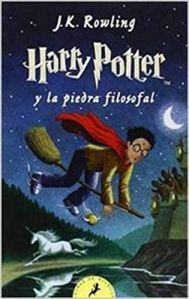
‘Harry Potter y la Piedra Filosofal’ by J.K.Rowling

HarryPotter1_spanish

1997, 259 pages, translated into Spanish by Alicia Dellepiane Rawson

Si! He terminado de leer mi primero Harry Potter!

Yes- all in Spanish, all 259 pages of it! It only took about six months. I hadn’t read the books or seen the films, and I quite enjoyed it. It’s very reminiscent of those British children’s books of the 1950s or 1960s (Swallows and Amazons, Enid Blyton) etc. with the perennial unhappy child’s wish of having parents other than the ones they do. I’ve gathered lots of new words about wands, brooms and spells. Now I just have to find the opportunity to use them.

I hear with my little ear: Podcasts 1-8 May 2019

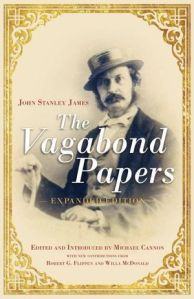
the-vagabond-papersRoyal Historical Society of Victoria. After reading Jill Giese’s The Maddest Place on Earth, I’ve become rather fascinated by the Vagabond, the alias for John Stanley James who also went by the name Julian Thomas.  The RHSV has a podcasts page with a list of recorded lectures over the last ten years or so. They’re taken direct from the lecture, so there are no bells and whistles here, but they’re a good way of catching up on things you might have missed – or as in the case of The Vagabond, of catching up on things that you didn’t know you were going to be interested in. In September 2016 RHSV hosted two speakers who contributed essays to the republished Vagabond Papers in 2016, supplementing the essay by Michael Cannon in the original 1969 edition. Robert Flippen, from Virginia, speaks about John Stanley James’ life in Virginia- a really engaging if somewhat evangelical talk. Willa McDonald, a lecturer in media from Macquarie University, talks about James’ career in New Caledonia, where he travelled as a journalist after his career faltered in Australia after such initial success. She speaks of him as a journalist, particularly in view of the immersive journalism that we’re used to today. The sound quality isn’t great- I found McDonald in particular a little hard to hear- but it’s all fascinating.
Russia if you’re listening (ABC). Oddly enough, I can’t find this program on the ABC website, but I can through the ABCListen app. Anyway, in episode 5 on 18 April he talked about Julian Assange, suggesting that Mueller would have a particular interest in him and his connections with Russia, and in episode 6 on 25th April, he talks about Trump’s lawyer and Mueller’s star witness Don McGahn- someone who’s been in the news a bit recently. Episode 7 looks at Oleg Deripaska, the Russian billionaire and his contacts with Paul Manafort. The podcasts seem to be easing off on the excessive sound embellishments, which is good.

TV series: I Know Who You Are

For the past few weeks I’ve been transfixed by a 16-part drama on SBS On Demand called “I Know Who You Are”, or in Spanish “Sé Quién Eres”. A law lecturer is found bloodied and dishevelled on a country road, claiming to have amnesia. It then transpires that the blood of his missing niece is found in his car, but he claims no memory of what had happened to either him or his niece.  There is a whole shoal of red herrings in this series, and everyone is horrible. Women, in particular, have very strong roles in the series, and all the characters are unforgettable.  My Spanish class was split over the ending, but I found it satisfactory. Spanish, with English subtitles and well worth spending the time on.

https://www.sbs.com.au/ondemand/program/i-know-who-you-are

Banyule homestead. A good resolution?

I fervently hope that this article is true and that this saga can be put aside for the next thirty years.

https://www.realestate.com.au/news/banyule-homestead-to-be-restored-and-lived-in-after-offmarket-sale/?rsf=syn:news:nca:hs:socref&fbclid=IwAR0CQxjxd33xpzkdfzYD_r8bgFAAB_eCNjnTwbKEuMdqx2MSmEzCvDhtOFs

I hear with my little ear: Podcasts 24- 30 April 2019

BBC World Outlook When I can’t sleep, I listen to BBC World. It repeats the news every half-hour and the accents of the presenters are very soothing. I’m usually vaguely interested in the stories, and if I’m interested enough, I look them up the next day. But last night, the program ‘How Did This Diver Cheat Death?” had me wide awake, almost unable to breathe for the tension. A diver in the North Sea, fixing oil drilling equipment on the sea bed, becomes entangled in the equipment. If the claustrophobia and darkness of Thai Cave rescue made you want to curl up inside (as it did for me), then this program will have the same effect. So perhaps listen to it at 2.00 in the afternoon, instead of 2.00 in the morning.

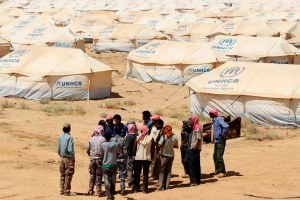
Sunday Extra (ABC) I always enjoy Correspondents’ Report, which has now been folded into the Sunday Extra program. This half-hour program has about three reports by ABC journalists from around the world, reporting on small, not-newsworthy events that encapsulate the place where they are living. In ‘The Last Days of the Islamic State’ Adam Harvey reports from the refugee camp at Deir ez Zor, Syria, where the women and children attached to ISIS are gathered, asking/demanding to be sent back to their home countries. He talks about toilets, something that I had wondered about, seeing all those rows of white UNHCR tents, and wondering what the sanitation was like. Just make sure you’re not eating while you’re listening to it, though

Big Ideas (ABC) An interesting program called ‘A Tale of two buildings’ about two ‘iconic’ Australian buildings: the Sydney Opera House and Australian Parliament House. I can remember sailing into Sydney Harbour, all the way from Melbourne! in 1970. (I was with a neighbour’s family and the mother of the family had ear problems which made flying difficult). I can remember being fascinated by the Sydney Opera House, which was still a few years off opening, at a time when the biggest talking point was still the sheer expense of it all. Helen Pitt, the author of the book “The House” (about the Opera House) and Ric Thorp, the Australian face of the international design company Mitchell Giurgola Thorp, that designed Parliament House, speak about these two buildings.  Thorp has some strong words about the mooted mega-expansion of the Australian War Memorial, which, as he points out, is a memorial, not a museum.

Conversations. I’ve just finished reading Jill Giese’s excellent Maddest Place on Earth. She talks with Sarah Konowski about the book in the program ‘Undercover at the Asylum’. It’s such a wide-ranging interview, that you barely need to read the book, but you’d be short-changing yourself because it’s a damned good read. But if you can’t, then listen to this.


Spanish Film Festival: La Misma Sangre (Common Blood)

The adult children of a middle-aged couple are shocked when their mother dies mysteriously in the kitchen of their suburban home. The son-in-law suspects that the father has killed her, and the daughters are faced with the dilemma of supporting their surviving parent as the accusations mount up.  It’s described as a thriller, but I saw it more as a family drama, although the end was pretty graphic.

The movie is subtitled in English (even though the trailer is not), but the Spanish wasn’t too fast.

Spanish Film Festival: El Reino (The Realm)

Manual Lopez-Vidal is a politician who has been on the take for years, and it has funded his affluent, elite lifestyle. Now that he is about to be exposed, he is determined to bring everyone else down with him.  At first a political movie, it takes on the aspect of a thriller as incriminating flashdrives are sought, found and handed on, and the closing scenes on a television set reminded me a bit of ‘The Hour’ as the tension rises.

Just as well it’s subtitled- I could barely catch a thing.

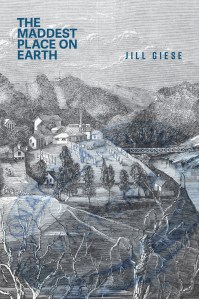
‘The Maddest Place on Earth’ by Jill Giese

Giese_The-Maddest-Place-on-Earth

2018, 220 p.

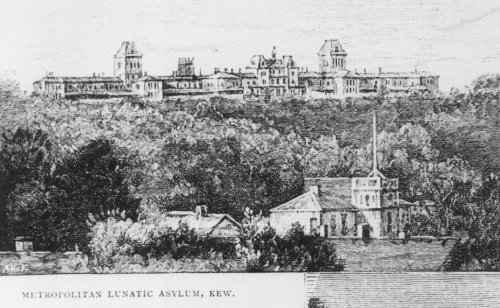
In the Epilogue of this book, clinical psychologist and author Jill Giese  writes that she jumped at the rare opportunity of an Open Day at Willsmere, the site of the old Kew Asylum. A little girl asked in that unfettered way that children do, ” If they were all crazy, why did they build them such a nice place to live?” As Giese notes, the most (and increasingly) visible sign of mental illness today is people lying on the streets of Melbourne, wrapped in blankets, begging for small change. Interestingly, it was the urge to give mentally ill people a shelter – an asylum- from the homelessness and penury of living in a blanket, that led to the construction of first the Yarra Bend Lunatic Asylum, and within six years, the construction of Kew Asylum, the first purpose-built asylum in Victoria. Both institutions – though plagued with overcrowding – were not established as the ‘Bedlam’-type places of horror that we might assume them to be.

KEWdraw

English: Engraving of the Metropolitan Lunatic Asylum, Kew. Buildings of Yarra Bend Asylum are seen in the foreground. c 1880. Source: Wikipedia

Victoria had what was perceived to be the highest level of mental illness in the world, hence the title “The Maddest Place on Earth”. In fact, at one of the numerous Royal Commissions held into asylums in Victoria during the 19th century, it was predicted that by 2050 every inhabitant of Victoria would be mad. A number of reasons were put forward: our meat-rich diet, the climate, the effect of the Gold Rush, excessive masturbation (although why Victorians would be especially prone to this was not explained) and the success of the Salvation Army in turning people’s minds to God.  Perhaps a better explanation was the “imported insanity” that arose from families ‘back home’ shipping their mentally-ill family members off to the colonies to avoid the scandal of madness. The Gold Rush could have both attracted and elicited madness in men who threw in everything to travel to the other side of the world, with failure more likely than success.

Giese tells the story of the Yarra Bend Asylum and the Kew Asylum but this is not your usual institutional history. Instead of taking a top-down approach, she uses  two main characters as the lens through which to view the asylum system in Victoria. Her first character, George Foley, was the son of an eminent artistic family in England. He suffered his first episode of mental illness while in art school, and suddenly “found himself” on a ship headed for Melbourne. He moved in and out of Yarra Bend and Kew Asylums, continuing to draw while incarcerated, and trying to hold together a precarious artistic existence when he was “outside”. The second character was journalist  Julian Thomas who, working under-cover as a ward attendant, wrote a series of columns for the Argus under the pen-name of “The Vagabond”.  He writes vividly and with humour, every bit the equal of a Mark Twain, or a nineteenth-century Louis Theroux.  Julian Thomas is well-known to historians of Australian (and particularly Victorian) history, but I hadn’t read his work before, and obviously Giese herself – a psychologist herself, rather than a historian-  was delighted to discover him for the first time.

Through George Foley, we catch a glimpse of the sharp edges of the itinerant artist’s life, even for a man clutching the slender thread of family reputation. At a time when there was no treatment for mental illness, he would be housed, fed and given meaningful work while in the asylum, only to flounder once he was released to his own resources again. He drew portraits of personnel within the asylum, including ‘The Vagabond’, who used a touched-up version of the portrait when he finally revealed his identity.  Through ‘The Vagabond’ we learn of meal-times with poorly cooked food, the dissonant music of the asylum band at the fortnightly balls held for inmates and staff, and the brutalizing effects of institutional life on the Kew Asylum attendants in particular.

Right from the establishment of Port Phillip, the presence of mentally ill people on the unmade streets of Melbourne was noted. Until the changes in asylum practice encouraged by the Quakers in the early 19th century in England, asylums had been dire places. Based on the new philosophy that asylums for the mentally ill should be built out of town, on hills in the fresh air, Yarra Bend quickly outgrew its construction in 1848 and was soon surrounded by a mosaic of cottages and even tents. The nearby Kew Asylum was opened in 1872 in a much grander E-shaped Italianate building,  Within five years Kew was the subject of a Royal Commission, which found overcrowding, disease and mistreatment. This was largely caused by a change in the criteria by which patients could be admitted to a ‘lunatic asylum’, which swelled the numbers of mentally ill patients with chronic patients with intellectual disabilities or dementia.  Despite the grandness of Kew Asylum, Yarra Bend stayed largely unchanged with its small cottage structure and more domestic, less institutionalized approach.  As Giese points out, Yarra Bend (despite its age and comparative neglect) came to be seen as the better model for dealing with mental illness with features like shelter, home-cooked food and meaningful, routinized work, that our mental health system could well emulate today.

Giese’s decision to use Foley and the Vagabond as her focus – one a patient, the other a staff member- is inspired. It would have been easy to have taken a patchwork approach, with small stories and vignettes stitched together into a fairly conventional institutional history, but for most of the book she avoids this methodology.  While she also traces through the career of Edward Paley, Inspector of Asylums, and recounts the numerous commissions of enquiry that, as too often happens today, masqueraded as action in themselves, she maintains her gaze on two individuals.  As a reader, you become invested in these two men. You read with a sinking heart of Foley’s struggle for mental stability and you see through the eyes of The Vagabond, in lengthy italized extracts from his columns.  Moreover, The Vagabond, too, has his secrets as Giese discovers at the end of the book.

This book won the Victorian Premier’s History Award for this book, and it fully deserves it. It is beautifully written, although perhaps a little fervent at times, and it is a deeply compassionate book. By foregrounding the long-term experience of George as patient, the Vagabond as attendant and journalist, and to a lesser extent Dr Paley as administrator, she gives a human face to mental illness as a lived experience. It’s a wonderful read.

My rating: 10/10.

Source: review copy from Australian Scholarly Publishing

AWW2019 I have included this book in the Australian Women Writers Challenge.