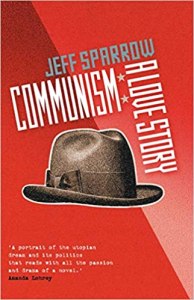
‘Communism: A Love Story’ by Jeff Sparrow

sparrow_communism

2007, 294 p.

‘Communism’ and ‘Love Story’- now they are two words that you don’t very often hear in the same sentence. Jeff Sparrow’s book centres on Guido Baracchi, a wealthy Melbourne political activist and Communist, described by historian Stuart Macintyre  as “the knight errant of Australian radicalism…a man of considerable wealth and emotional spontaneity, utterly without guile  or worldly ambition, of luminous innocence and limitless self-centredness” (cited on p. 5).

It’s hard to believe now, with liberalism under threat in many places, with Putin becoming such an unnerving presence and after Kruschev’s denunciation of Stalin in 1956, that Communism in the first half of the 20th century could have elicited passion -and yes, love-  amongst its followers. But as Sparrow explains:

Communism provided an alternative. It was, in many way, the alternative, the most important indicator that society could be remade. Between 1917 and 1989, its star shone bright and its star shone dim, but its continuing sparkle in the political firmament allowed millions to believe in a world beyond the free market. Even those who despised communism felt that while it existed, change- whether they wanted it or not- was a possibility.

Today that feeling is gone….With communism gone, few of us can articulate a different kind of society, another economic model or even a philosophical challenge to the buy-low, sell-high ethics of the market. (p. 3)

Guido Baracchi was born in Melbourne in 1887, the son of the Italian-born astronomer at the Melbourne Observatory who had responsibility for the Great Melbourne Telescope.  He provided his son Guido an education that would seem to almost guarantee ‘respectability’.  He went to kindergarten with later Governor-General Richard Casey, attended Melbourne Grammar School where later Prime Minister Stanley Melbourne Bruce was an older fellow-student, and studied at Melbourne University with later Prime Minister Robert Menzies. He was diametrically opposed to them politically.  He threw himself into student politics at Melbourne University, – through the Melbourne University Historical Society no less- was arrested for an anti-conscription speech he gave on the Yarra Bank in 1918, started the Victorian Labor College and edited ‘Industrial Solidarity, the journal of the International Industrial Workers, the successor to the banned Industrial Workers of the World. He was a foundation member of the Communist Party of Australia in 1920, and edited their journal Proletarian.

But if there was romance and idealism, there was also disillusionment, especially in the 1920s. Travelling to Europe in 1922 after the failure of his marriage, Baracchi worked as a professional revolutionary in Weimar Berlin, and was part of the disastrously failed uprising of the KPD (Communist Party of Germany) in 1923. Returning to Australia, he found the Australian communists in disarray.  The Melbourne branch had collapsed completely, many branches were dysfunctional, the Sydney branch was hollowed out. Those members still active were exhausted, others quarrelled over doctrine and Baracchi despaired of the leadership. In 1925, he suggested the dissolution of the CPA as a separate entity, urging the formation of a ginger group within the ALP instead. The leadership of the party expelled him, and he was to pay for this ‘disloyalty’ for years afterwards.

Although not part of the CPA, he travelled to Russia, where he stayed for a year, working as a translator in the Co-Operative Publishing Society for Foreign Workers.  Returning to Australia with his communist credentials burnished, he was eventually readmitted into the CPA. But he wasn’t to be there for long, because he was expelled in 1940 for Trotskyite tendencies. He turned his attention to the ALP instead, hoping to promote socialism within the party and died in 1975 after a day handing out how-to-vote cards for the Labor Party.

I’m not particularly familiar or interested in the intricacies of Marxist theory or the schisms and alliances between different branches of Marxism. However, Sparrow did not dwell on this, although I’m sure that a reader more versed in such things would pick up on observations and comments that just passed me by.

But this book is more than a book about Communism politics in 20th century Australia. Sparrow combines the political and the personal, and certainly Guido had a tumultuous love life, marrying and partnering several times.  There must have been something about him, though, because often his wives/partners got on well with their predecessors and successors. He shifted between Melbourne, Europe,  and back to Melbourne in 1924 to claim his considerable inheritance in nearby (to me) and highly respectable Ivanhoe – the thing that prompted me to read this book in the first place. He travelled through Russia, and later shifted to Sydney where he lived at Castlecrag, the estate designed by Walter Burley Griffin and his wife Marion Mahony Griffin.

He was thoroughly imbricated in the progressive intellectual network of the time. He had an affair with Katharine Susannah Pritchard, he was a close friend of Esmonde Higgins, the nephew of H.B. Higgins and sister to Nettie Palmer.  He had an affair with the poet Lesbia Harford; he lived with the playwright Betty Roland in Russia, and circulated with her amongst the artists at Montsalvat and Castlecrag. This is a story not just of one man, but of an intellectual milieu, over several decades.

This book brought me everything that I like most about biography: a clear and chronological narrative of events; rich context to make sense of them; depiction of a complex social network around the subject; an appraisal of emotional entanglements, and most importantly, a curiosity about the subject that acknowledges foibles, complexities and inexplicabilities. All this, written with sensitivity and insight- an excellent biography!

My rating: 9.5 / 10

Sourced from: La Trobe University Library
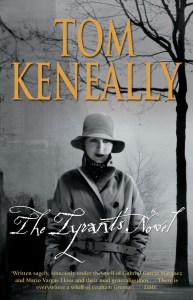
‘The Tyrant’s Novel’ by Tom Keneally

Keneally_tyrant

2003, 292 p.

I read this book soon after it was published in 2003, when the idea of locking up ‘illegal arrivals’ without visas in detention centres,  introduced in the 1990s by the Keating Government, had been ramped up to the the mandatory off-shore detention of all arrivals by boat under what was euphemistically called the ‘Pacific Solution‘.  The book  has only increased in power in the 17 years since, especially with the very public face of Iranian journalist Behrouz Boochani, whose book No Friend But the Mountains received widespread critical acclaim. It’s as if Keneally’s book has been brought to life.

Keneally’s novel is in three parts.  Part 1, ‘The Visitor’s Preface’, told in the first person, frames the novel. An unnamed journalist narrator accompanies a female colleague to a thinly disguised Villawood Detention Centre. There he meets ‘Alan Sheriff’, the name adopted by an Iraqi refugee incarcerated there, who proceeds to tell him “the saddest and silliest story you will ever hear”.

The bulk of the body is in Part 2, ‘Alan Sheriff’s Story’. It is also told in the first person as a memoir, although on occasions Alan breaks off to note the detention-centre conditions under which the story is being told.  ‘Alan Sheriff’ is a writer, who after the moderately successful publication of a book of short stories in an unnamed Middle Eastern country, had been working quietly on a novel. When tragedy strikes suddenly and without warning, he puts the novel aside, feeling that his life and work is futile in the face of his grief. Suddenly the summons arrives from Great Uncle (a thinly disguised Saddam Hussein) for him to write a novel within a month which will be published under Great Uncle’s name.  His loyalties to friends who have also become enmeshed in Great Uncle’s web of power, and his fears for their safety, push him to acquiesce.

The novel closes with ‘After-Tale’ which tells of how ‘Alan Sheriff’ has ended up in the detention centre.

Keneally has made a number of authorial decisions here which are interesting.  First, as an article by Caroline Baum reveals, the scenario in the detention centre and the friendship with ‘Alan Shepherd’ are real, and in her opinion, insufficiently disguised. Her article raises questions about the ethics of an author’s use of real people in what is purported to be fiction.

Second, he has decided to replace the Iraqi names of his characters with anglicized ones: Alan Sheriff, Matt McBrien, Andrew Kennedy, Sarah. This adds a sense of identification for an Australian westernized reader, but it is also jarring. I’m not sure if the trade off between making a reader think “This could be me” is worth in effect stripping his characters of all their cultural identity. In Keneally’s hands,  the story is based amongst people of an intellectual/entertainment industry elite, whose lifestyles are not that different from ours.

Third, he does not actually name Saddam Hussein, although in his afterword, he acknowledges his debt to Mark Bowden’s article “Tales of the Tyrant”in the Atlantic Monthly May 2002. Certainly, reading the article after finishing the novel (which I very much encourage you to do), you can see where Keneally has picked up the threads of his own story.

Things happen abruptly in this novel, so much so that you find yourself re-reading to see if you had understood it properly.  Keneally has a rather clumsy attempt at mirroring Shiite/Sunni theology through ‘mediationist’ and ‘intercessionists’, which only muddies the story. I’m not sure that I was convinced by Alan Sheriff’s abandonment of his own novel, and it is an important point in the plot. I can understand why Keneally has chosen to anglicize the names, but I feel condescended to as a reader; as if Keneally expects that I cannot identify with names from another culture.

However, the continued bloody-mindedness of our mandatory detention system has, if anything, worsened, and the increasing presence of so many ‘strongmen’ in politics world-wide means that this book is more relevant today than it was in 2003. Written with a clear political purpose at the time, those politics are even more urgent now.

My rating: 7.5

Sourced from: CAE Book Groups as a book group reading amongst The Ladies Who Say Oooh

Movie: Little Women


Ah- the good old pre-coronavirus days, when you could sit in a movie theatre with other people.

I suspect that this is a film of Little Women for viewers who have never read Little Women. It’s boisterous and far more feminist than the book or other film versions, and it breaks the mould by mixing in aspects of Louisa May Alcott’s own story as a writer, as well as using flashbacks and disrupting the narrative flow.

I enjoyed the film, but I bristled at some of the casting. At first I thought that Saoirse Ronan was all wrong as Jo, but by the end of the film she had made the role her own.  Meg was as wishy-washy as she seems in the book. Director Greta Gerwig emphasizes the emotional connection between Jo and Amy, who are seen more as soulmates and very similar to each other than I found in the book . Amy didn’t seem right to me either, too rounded and not self-centred enough. The Amy in my head is haughty and thin. Beth didn’t look sick enough.  And Laurie was just WET.  Professor Bauer was too good-looking, and Laurie’s grandfather wasn’t gruff enough.

However, after all these grizzles, I did enjoy the film, which I think will carve out its own place amongst the many versions of Little Women. How many Little Womens are enough, I wonder?

My rating: 4 out of 5

Viewed at: Palace Westgarth with about 10 other people in the theatre with me. So I would have been safe after all.

I hear with my little ear: Podcasts 1-7 March 2020

The Eleventh (ABC)How odd, hearing a podcast narrator speaking about events in November 1975 admitting that he wasn’t born at the time! This series is about the dismissal of the Whitlam government, claiming to have information that has only been revealed in the last few years, and nodding to the information that has yet to be released (drawing on, no doubt, Jenny Hocking’s The Dismissal Dossier: Everything you were never meant to know about November 1975, my review here). Episode 1 The Sweet Spot starts with the divisive effects of Vietnam War, and the U.S. anger at Australia’s call for both US and Vietnam to return to peace talks after the U.S. Christmas bombings. Episode 2 Black Orchids looks at the Whitlam government’s testy relationship with American spy agencies, and later Australia’s parallel agency after the bombings of Yugoslav travel agents in 1972, culminating in Attorney General Lionel Murphy’s raid on ASIO.

The History Listen (ABC) For some more mid-20th century history, the History Listen of 29 Oct 2019 examines The Bomb Lobby. The program looks at a small but powerful group of Liberal Party politicians who championed Australia having its own nuclear bomb. After the disappearance of Prime Minister Harold Holt (I feel conspiracy vibes coming on),  he was replaced by John Gorton, a strong pro-nuclear supporter with a policy of building a nuclear station at Jervis Bay, ostensibly for nuclear electricity supply, but scaleable for a weapon. I suspect that they are still amongst us.

The Documentary (BBC) The song “Wind of Change”, released in 1990, was only vaguely familiar to me, with its unusual whistled introduction. Perhaps I was too busy with young children in 1990 to listen to the radio.  In my own defence, although it was a huge hit in Europe, it only reached number 7 on the Australian weekly charts, and No. 43 for 1990.  Anyway, written before the fall of the Berlin Wall,  but released soon afterwards, this song encapsulated the hope felt for the end of the Cold War and the reunification of Germany. The program Wind of Change: Scorpions features interviews with the singers and listeners who speak about the personal and political importance of the song. And just think about where we are today.

And in case you can’t remember it, here’s the film clip.


The Heidelberg Busy Bee Quilt – Curator Talk

In 1895-6, a sewing group from the Scots Presbyterian Church in Heidelberg got together to create a ‘signature quilt’ as a fundraising activity. In 2018 it came into the care of Heidelberg Historical Society.  Who are the people whose signatures are on the quilt? Why are there signatures from Williamstown and Kangaroo Ground? What happened to the finished quilt?

Find out the answers to all these questions on Saturday 14 March at the Heidelberg Historical Society Court House Museum at a talk presented by Margaret Birtley, one of the three co-curators of the exhibition featuring the quilt and its story.

The museum is open 2-4, with the talk commencing at 2.45 p.m. Entry is $5.00


img621

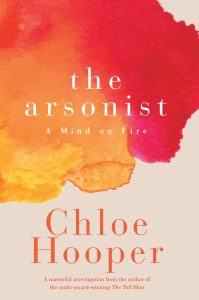
‘The Arsonist: A Mind on Fire’ by Chloe Hooper

hooper_arsonist

2018, 245 p.

This book was awarded the Judges Special Prize in the 2019 Community History Awards announced during History Week last year, which surprised me a little.  Not because it’s not a worthy recipient – it is – but I hadn’t thought of it as ‘history’ as such, although of course, one day it will be.  After all, journalism has been described as “the first rough draft of history”.

However I see this book more as journalism than history.  It explores the police case and resultant trial of Brendan Sokaluk, the man found guilty of intentionally lighting the Churchill fires on Black Saturday 2009.  I happened to read it in January 2020 during our summer of smoke (we haven’t yet coined a name for it, perhaps because we fear that the worst is yet to come).  The Murdoch media was (incorrectly) proclaiming arson as the major cause of the fires that have ravaged our east coast this season. However,on Black Saturday in 2009 – which I wrote about at the time here and here– there was a case of arson and it is explored in this book.

The book is divided into three parts. Part I ‘The Detectives’ follows the arson-squad detectives,  dispatched to Churchill while the appalling toll of 173 deaths from the Black Saturday fires was still mounting.  Here we very much see the fire’s immediate impact on both the environment, and on the people who faced it. The detectives inspect the site, they question Churchill residents, and the name ‘Brendan Sokaluk’ keeps arising. When they interview him, they suspect that they are being played, and that he is feigning incomprehension.

Part II ‘The Lawyers’, focuses mainly on the defence lawyer, Selena McCrikard, whom Hooper thanks in her acknowledgments for “her trust”.  Other workers at Victoria Legal Aid, are also thanked “for their time and candour”. Selena McCrikard, like the police, was not sure about Sokaluk’s intellectual capacity, and as part of her defence she uncovers a delayed diagnosis of autism, and a long and sad history of isolation, bullying and disadvantage. Brendan lives in his own squalid house, but his parents have tried to help him to be independent. He had worked in the gardening section at the local university, but his workmates distrusted and disliked him. It’s a pretty threadbare life.

Any sympathy evoked in Part II is put to the test in Part III ‘The Courtroom’, three years after the fires. Parallels spring to mind with Helen Garner, who has written several books based on court cases, but Hooper keeps her distance here, instead of writing herself into the story as Garner often does.  It is interesting to see fire expert Dr Kevin Tolhurst, who has appeared on our televisions and in our newspapers over the last few months, being hung out to dry in the court. The case lasted 23 days, and the jury deliberated for three days.

The book closes with a coda, when Hooper returns  to Churchill.  This is the second time she has been there, having visited it just a few days after Sokaluk was arrested. Returning to it after 2017 she found that the Hazelwood power station, the main employer in this economically depressed area, had been decommissioned after a series of suspicious fires had burnt the coalmine in 2014.  She closes her book with a reflection on fire and climate change. Arson cannot be stopped entirely, and “warmer summers in a changing climate will provide more opportunities for those drawn to lighting fires” (p. 240). The pylons that stretch from the LaTrobe Valley across Victoria, she notes, feed an electricity grid that was responsible for more deaths on Black Saturday than Brendan Sokaluk’s fire.

This is an elegantly written book, conveyed without the mental anguish and ethical turmoil that marks the work of Helen Garner, another non-fiction writer drawn to writing about crime and courthouses. Hooper does not try to pathologize Sokaluk: she leaves that to the courtroom experts.  Neither does she minimize the effect of Sokaluk’s actions on the people of Churchill. Instead, she leaves us with Shirley, who lost both her sons in the fire.  As in her earlier book, The Tall Man, Hooper peels back the layers of contemporary Australian society, and reminds us  – as if we have needed reminding this summer- that fire will continue (and even more) shape our view of ourselves as Australians.

My rating: 9/10

Sourced from: Yarra Plenty Regional Library

aww2020

I have read this as part of the Australian Women Writer’s Challenge 2020

Movie: Parasite

This won so many Academy Awards that we had to go to see it. I can certainly see that the film would be a film-afficionado’s delight, with beautifully composed shots and lots of visual imagery.  I’ve only just realized that it was directed by Bong Joon Ho, who directed Snowpiercer (which I saw, but omitted to comment on here in this blog, it seems.) It has similar themes about class and subversion.  While watching it, you are very much aware of its careful staging and lighting.

I’m pleased that a film other than one made in America or Britain was so well-received, and it probably reflects my Eurocentrism that I couldn’t tell you the name of any of the characters in the film other than ‘the poor family’ or ‘the rich husband’. And what an unlovely group of people they were, as a poor family ingratiates and plots its way into a rich family’s house. In the midst of architectural beauty and grinding poverty, everyone is either scrabbling to get ahead, or else completely oblivious to their privilege.

There is heaps of stuff on the internet explaining the story, or explaining why it is so important . I wonder if that says something about the film for a Western, non-cinemaphile audience?

My rating: 3.5 out of 5 (which probably shows that I am no film critic)

Viewed at: Cinema Nova, Cinema 3 (one of the big ones)

I hear with my little ear: Podcasts 24-29 February 2020

History Listen.  From 19 November 2019, Port Essington, World’s End is about the  garrison established by the British Government in Arnhem Land in 1838, the same time that Port Phillip was being ‘opened up’. This was the third attempt to establish a settlement in the Northern Territory, both to warn off other European powers and to act as ‘Australia’s Singapore’ as a trading port with Asia. Because it was only ever a military garrison, there was no land grab and relations with the indigenous people remained good.

Poncho_Front

It’s not me!! It’s from Wikimedia

Nothing on TV  Did you have a poncho during the 1970s too? Mine was lime green, white and orange acrylic. In Have You Seen My Poncho Cloak? our trusty guide Robyn Annear takes us back to the 1855, when poncho cloaks were all the rage. Who would have thunk. Her attention was attracted by a rash of advertisements after the Exhibition Ball when a stuff-up . This episode foreshadows some of the information in her recent Nothing New (my review here)


New Books Network At 75 minutes, this podcast is FAR too long. Hiding in Plain Sight is a new book by Erika Denise Edwards, herself an Afro-American, who was struck by the seeming invisibilty of people of African heritage who were descendants of African slaves in Argentina. Using the small town of Cordoba in Argentina as her case study, she traces  the way that African women used their positions as wives, mothers, daughters and concubines to ensure that they were officially registered as ‘white’.

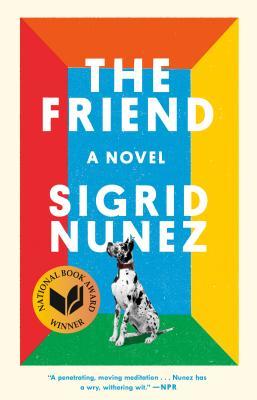
‘The Friend’ by Sigrid Nunez

Nunez_thefriend

2018, 224 p.

A bit of a spoiler ahead.

This is only a small book, and it feels as if you are reading a memoir or a diary, rather than a novel.  It is addressed to an unnamed, dead friend in the second person “you” throughout, and it is a series of short paragraphs, separated by time and asterisks. The unnamed narrator is a female writer, teaching creative writing at a university as many writers tend to do. Her friend, to whom the book is addressed, was her mentor, a fellow teacher and also a writer and he had committed suicide.

Her friend is/was an egotistical, priapic curmudgeon really, but she loved him- not sexually, but as a friend. He was onto Wife Number Three (all the wives are designated this way), and when Wife Number Three refuses to continue caring for the writer’s huge Great Dane, called Apollo, the narrator reluctantly takes over his care.  It’s a big ask- she’s living in a small, rent-controlled flat in Manhattan, where animals are forbidden. On one level the book is about her deepening love for the dog, which is almost a form of displacement for her love for her friend. But it’s also about death, suicide, and most of all about writing.  Writing as an individual practice; writing as a social practice; writing as an industry.  The book flutters with allusions to other authors, most particularly My Dog Tulip by J.R. Ackerley (which I had never heard of) and Disgrace by J. M. Coetzee, which I have read, and which shares a stubborn, unlovely old man. It is very much a reader’s and writer’s book, filtering the world through the words of other people, and using other people’s narratives as a way of making sense of things.

Near the end, there is a curious hiccough, that makes you wonder whether you read it correctly.  It is barely mentioned in the reviews that I have read of the book, which also seems strange.

It’s only a short book, and it quivers with emotion, making it an uncomfortable and yet compelling read.  I finished it wondering “what on earth WAS that book?”

My rating:  8/10

Sourced from: e-book from Yarra Plenty Regional Library.

Movie: H is for Happiness

Yes, it’s another of my ‘blink and you’ll miss it’ postings about a movie I have seen just before it finishes its run at the cinemas. I knew nothing about this movie, except that it was Australian. With a cast of Miriam  Margolyes, Richard Roxburgh, Emma Booth and Deborah Mailman, I thought that it must be doing something right. Set in Albany W.A. it’s the story of a 12 year old girl trying to heal the grief and anger in her family. She befriends her young classmate who is dealing with his own trouble through believing that he is living in another dimension, and endangering himself trying to return to another dimension.  It walks the narrow line between saccharine tweeness and an affecting, brilliantly acted depiction of family grief. Both child actors were excellent, and I’m sure young Wesley Patten will be the new Aaron Pederson in the next 10 years.

My rating: 3.5 / 5