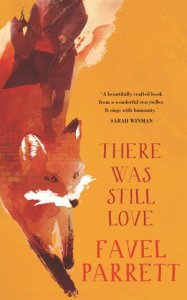
‘There Was Still Love” by Favel Parrett

parrett_there-was-still-love

2019, 210 p.

There is an unsettling synchronicity about writing a review of this book while our government is closing its borders and our lives are being upended and constricted by government fiat. The parallels between our current situation and the 20th century of Czechoslovakia are slim, however. I may not hold my grandchildren for six months, but the rupture in the lives of those who escaped the fall of the Iron Curtain and those who did not was far deeper. But, as the title says, there was still love.

There are three threads in this book. One of them takes place in Melbourne in 1980, with young Malá living in with her Czech grandparents, Mána and Bill, cocooned in the warmth of their love in a frugal and ordered household typical of many post-war refugees. At the same time, there is her cousin Ludek, also living with his grandmother Babi in Prague, completely unaware of his cousin’s existence. He yearns for his mother Alena to return from her tour of the West with a theatrical company, and doesn’t realize that the government is using him as the lure and tether to bring her back to Czechoslovakia.

It is only near the end of the book that you realize the link between these two stories of grandchildren, wrapped in the love of their grandmothers. The two grandmothers were sisters, and by sheer happenstance, one ended up in the West and the other in the East. Their lives diverged at that point, even though they ran along parallel lines.

There is no great build-up or denouement in the book, which is gentle and quiet. I will confess to finding it a little difficult to follow. The narrative swaps back and forth between Melbourne and Prague and across time, with the focus on different characters whose names rather too similar – Malá, Mana, Ludek and (admittedly, a surname, Liska). I found myself wondering why she chose to structure the book in this way. Perhaps it was to make more complex what was actually a simple, if profound story?

What comes through most in this book is, as the title suggests, love. Love between sisters separated by distance and ideology; love between mother and child, and most of all love between grandparent and grandchild – each time, flowing both ways.

My rating: 8.5/10

Sourced from: Yarra Plenty Regional Library.

aww2020I have included this in the Australian Women Writers Challenge 2020.
 

My non-trip in the days of coronavirus #10: Arequipa

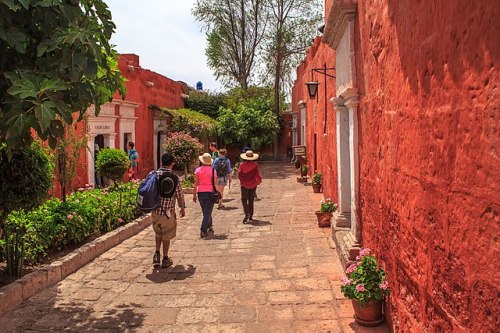
Close to the Plaza de Armas in Arequipa is the Santa Catalina Monastery. Built in 1579, it served as a cloister for Dominican nuns between the 16th and 18th century, and it still houses a small religious community.  Like much else in Arequipa, the buildings are made of volcanic sillar stone, which is porous and prone to cracking, and it was badly damaged in the earthquake in 2001. It was founded by Doña Maria de Guzman, a rich young widow who was the first prioress. All women admitted to the convent were expected to bring a dowry of $150,000USD in current-day money, and a list of 25 items including a statue, a painting, a lamp etc. No wonder it became enormously rich, until the Vatican sent someone out to clean it up (and send all the riches back to Spain).

(Familiar accent narrating the video!)

One of their most famous nuns is Sister Ana de Los Angeles, who entered the convent as a three year old in 1607 for her education. Her parents took her out at the age of ten or eleven in order to marry, but after receiving a vision of Saint Catherine of Siena, she wanted to return to the convent as a nun. (I’m sure that the prospect of being married off as a 10 year old had nothing to do with it). Her mother was furious, and refused to pay the dowry, so her brother paid it instead. She spent the rest of her life there, becoming noted for her ability to predict whether a sick patient would live or die. When she died in 1686 they didn’t need to embalm her because of the sweet perfume her body gave off, and after being exhumed 10 months after burial, she was still fresh. The sisters petitioned to have her proclaimed a saint, but 334 years later they’re still waiting (and she’s probably not quite so fresh).

santacatalina

Creator: Murray Foubister   Source: Wikimedia 

They have a beautiful website here, in both Spanish and English.

http://www.santacatalina.org.pe/index.php/en/

A 15 minute walk from the historic centre is the Casa Museo Mario Vargas Llosa.  In Chile, I was hunting down houses belonging to Pablo Neruda, in Cartagena I enjoyed a Gabriel Garcia Marquez tour, so while in Arequipa, why not check out this museum, located in the birthplace of Peru’s Nobel Prize winning author Mario Vargas Llosa. Only 48 people per day are allowed to visit.  I have read only one of his books, The Feast of the Goat, and his most well-known book is probably Aunt Julia and the Scriptwriter. He ran for the Presidency in 1990 but was defeated by Alberto Fujimori. Hmm…his politics are probably more right-wing than I’m comfortable with, but you can’t argue with his Nobel Prize, awarded 2010 for a huge body of work.  He was a former President of PEN International, and he was recently attacked by China for a column he wrote about coronavirus. Apparently they had a crisis meeting late last year to discuss the poor state of the museum, which has a heavy reliance on holograms but….if I were there, I’d go anyway.  Museums for writers should be encouraged, I reckon.


My non-trip in the time of coronavirus #9: Arequipa

Arequipa is known as the “Ciudad Blanca” (White City) because many of its public buildings are made of a beautiful white volcanic stone. It is the second most-populated city in Peru. It is surrounded by snow-covered volcanoes and it looks stunning.  As usual, there is a Plaza de Armas, built on the Spanish template. This one was built in the 17th century and has much more architectural unity than some of the other Plaza de Armas. It’s on the UNESCO World Heritage List.

This video is in Spanish, but you’ll get the idea:  (actually, it’s nice clear Spanish)

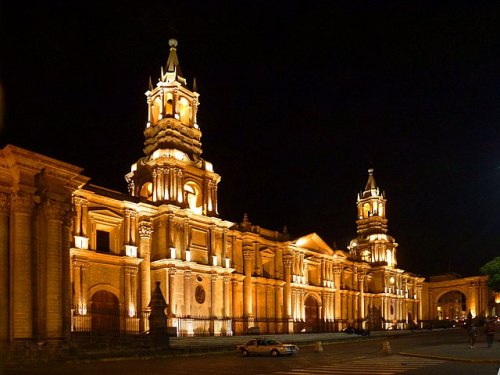
The Basilica Cathedral of Arequipa takes up the whole of one side of the square. It has been damaged several times by earthquakes, and after the most recent one in 2001 the  left tower was completely destroyed and the right tower was badly damaged.  The altar and the twelve pillars are made of Italian marble, the brass lamp in front of the altar is from Spain and the pulpit was carved in France. The organ was shipped out from Belgium, and is said to be the largest in South America, but it got damaged on the way out and doesn’t sound the best, apparently.

It looks spectacular at night

Cathedral_of_Arequipa,_Peru

Source: Wikimedia.   Creator: Bruno Locatelli

Historically, the Spanish population retained fidelity to the Spanish crown, even when the independence movement was afoot elsewhere.  In 1805 the Spanish crown gave the city the title “faithful” by Royal Charter. It remained under Spanish control under the Battle of Ayacucho in 1824 (which was later than many other cities). There has long been rivalry between Ayacucho and Lima.

Apparently, there is even a distinctive dialect, where they elongate the last vowel of the final word in every sentence.  And, unusually for South America, they use the ‘vos’ form of ‘you’ (replacing ‘tu’ and ‘usted).  They seem to use ‘vosotros’ too. I’d be doomed: I never bother learning the vosotros form.  Life is too short.

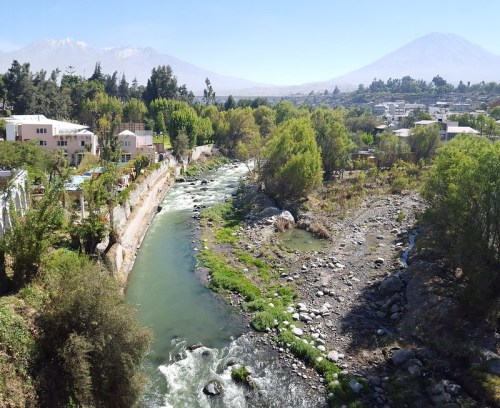
You’ve got to love a city that has the Chili River running through it. Unfortunately, all the city’s waste water is dumped into it.

chili_river

Flickr: Santiago Stucci

You can go white water rafting on the Rio Chili, about 20 minutes out of the city where I should imagine the water might be cleaner. It advertises itself as being for “all ages” but nah-  you young ones go ahead and I’ll mind the baby.

My non-trip in the time of coronavirus#8: Arequipa

We knew that Easter Week (Santa Semana) was very important in Peru, so we were keen to see some Easter festivities, little realizing that they would all be cancelled.

On the Friday morning, while still in Lima, we could have seen the Good Friday parade. A statue of “Del Señor de los Milagros” (the Lord of Miracles) is brought out from Lima Cathedral, preceded by women in white veils walking backwards bearing incense. He has been a feature of the Good Friday parades since….1999. That’s invented tradition for you.

We heard that the main cities for Santa Semana celebrations were Cusco, Ayacucho and Arequipa.  At this stage, we were planning to go to Cusco later, and apparently they throw eggs around in Ayacucho, so Arequipa it was.  We were going to fly out of Lima on Good Friday in the afternoon, in time to catch the evening festivities in Arequipa.

Actually, this beautifully filmed video is better than anything we would have seen:

They finish up with a ceremonial burning of Judas. This happens in other cities in Spain and in Mexico too, where they often substitute political figures

He’s a remarkably modern looking Judas, and they do start the fire in a curious place. I’m watching this with a horrified fascination. Boy, that got rid of him.

‘Eleanor Oliphant is Completely Fine’ by Gail Honeyman

honeyman_oliphant

2017, 383p.

Eleanor Oliphant is a lonely thirty-year old woman. Just not ‘self-contained’ or without friends, she is bone-achingly lonely:

There have been times when I felt that I might die of loneliness. People sometimes say they might die of boredom, that they’re dying for a cup of tea, but for me, dying of loneliness is not hyperbole. When I feel like that, my head drops and my shoulders slump and I ache, I physically ache, for human contact – I truly feel that I might tumble to the ground and pass away if someone doesn’t hold me, touch me. (p 269)

She works in the back-office of a design company in Glasgow, the only job she has ever had.  She is prickly, judgmental, oblivious and agonizingly awkward.  Nothing comes easily; she is suspicious and sees the worst in people, while affecting a supercilious superiority.  It is no wonder that she repels people, and becomes the butt of their jokes.  Except, perhaps, for Raymond from I.T., a disheveled ‘techie’ who calls for her help when a old man collapses in the street. In that act of kindness, Eleanor is gradually brought into a circle of other kind people – not saints, but just ordinary people acting with everyday kindness. Small things, like haircuts and a cat, gradually put some colour into a very bleak life.

We gradually put together Eleanor’s back-story. We learn that she has a burn scar on her face, that she has been the victim of domestic abuse, that she spent many years in foster care and  that she has weekly talks with her mother, who is a truly evil, cruel woman. Honeyman’s control of unfolding Eleanor’s story is masterful. At one stage I felt that it was all falling into place too easily, until a twist at the end that I will not reveal. Endings are often difficult, and I think that I enjoyed the first 3/4 of the book better than the last part.  I wish that the twist was explored more deeply, but on the other hand, I didn’t need it straightened out and explained either.

Eleanor’s voice is distinctive: arch and highly educated, it also reveals a sardonic but needy humour. Honeyman sustains this voice throughout, and as a reader you are both repelled and yet sympathetic towards her.

Although I normally avoid best-sellers that have stickers on the cover, I really enjoyed this book, and devoured it over a couple of days. I found myself laughing out loud in several places, and tears brimming just a few pages later.

My rating: 9

Sourced from: CAE bookgroups as our March 2020 read.

My non-trip in the time of coronavirus #7: Lima

I’m cheating a bit here, because if we had really gone on our trip, we would have moved on to Arequipa by now on Good Friday.  But given that our planning didn’t get much further than Arequipa, I’ll mentally linger in Lima for a bit longer.

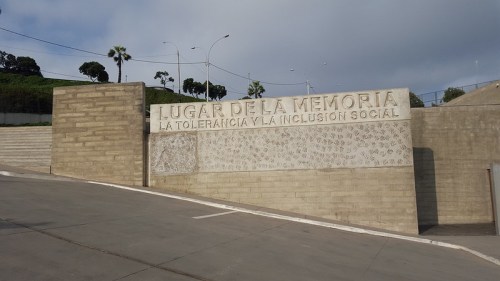
If I’d been there, I would have gone to LUM (Place of Memory, Tolerance and Social Inclusion- I must say that I don’t know how those words in Spanish fit into the acronym). On my travels I have found myself visiting a museum commemorating atrocities that have occurred in living memory : in Medellin with the Museo Case de la Memoria, The Museum of Human Rights and Memory in  Santiago,  ESMA in Buenos Aires, and the Rwanda Genocide Memorial in Kigali.  I often feel a bit ambivalent about visiting such museums: I’m aware that they spring from a political impetus and are often strongly contested and I fear that I’m being voyeuristic. But I’m also well aware of the importance of truth-telling, something that the Uluru Statement from the Heart implores us to do in relation to Australia’s indigenous history, and something that we seem unable to bring ourselves to do e.g. in the Australian War Memorial. So yes, if I were there, I would visit the museum in this spectacular building.

LUM  opened in 2014 to commemorate the dead and to address the country’s enduring polarisation over human rights abuses committed by both the Shining Path guerrillas and  the armed forces in the 1980s and 1990s. It was  funded principally by Germany and also the EU, Sweden and the UN development program. It came under fire almost immediately for being biassed towards Shining Path by the supporters of former president Alberto Fujimori (who is in jail now anyway). However, it was championed by Peruvian Nobel laureate Mario Vargas Llosa .

Here’s a video about it with English subtitles.

It’s closed at the moment, as is everything else in Peru, because of the coronavirus.  But there’s a good virtual tour you can do, accessed through the link below. Click on the black arrows to go forward, and the blue dots have more information.  It’s all in Spanish, but that’s what Google Translate is for. Or, if you’re learning Spanish as I am, there’s hours of reading here.

https://lum.cultura.pe/visita360


I hear with my little ear: Podcasts 1-8 April 2020

Heather Cox Richardson. Heather Cox Richardson is an American political historian who has been posting daily blogposts about American politics. Like the rest of us, she is shut in at home, so she has decided to do two weekly videos. The first is, I suspect, a quick run through of her American History 101 and a tie-in with her recent book How the South Won the Civil War. The other weekly video is a Q&A about recent political events in America. Given that I never studied American history, I’m interested in her Thursday (US time) American history series.  She just sits there and it all spiels out, so she’s obviously done this before. Now that I am actually on a phone plan that gives me plenty of data, I just stream it while I’m walking because there’s nothing to see other than a woman sitting in front of bookshelves.  But she’s very fluent, and clear and engaging. You can get the videos through her Facebook page. Excellent listening.

Rear Vision (ABC) Of course, I’m far more interested in Latin American history now that I’m learning Spanish. Rear Vision has a really good podcast from May 2018 that gives a summary of Latin American history in the twentieth and twenty-first century, especially in view of what seemed to be in 2018 a return to right wing government. (It hasn’t completely turned out that way, Jair Bolsonaro notwithstanding). Latin America makes a right turn is an excellent, if somewhat outdated, summary.

Somewhat more recent is the program A destructive mine and a civil war: Bougainville’s path to an independence vote.  Well, after the referendum they were supposed to go to the polls to elect their regional council in May this year- I doubt that will happen.  And the program Protests in Lebanon, also from November 2019 is about the protests against the sectarian carve up of politics in the Lebanese constitution.  It’s strange to listen to these programs now that the world has been turned upside down by coronavirus, but of course the issues won’t go away.

My non-trip in the time of coronavirus #6: Huaca Pucllana, Lima, Peru

Hey-  if I had been there, I would have wanted to go and see this!

lima-peru-attractions-600x400@2x

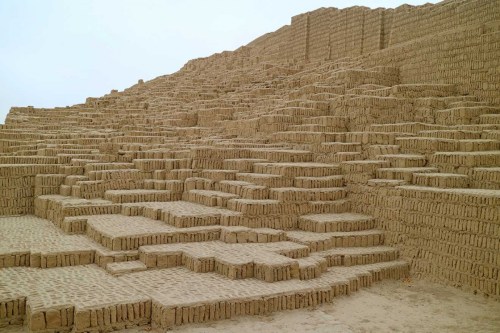
It’s a whacking great adobe and clay pyramid, built in Miraflores (where we were intending to stay). It was built as an important ceremonial and administrative center for the Lima Culture, a society which developed in the Peruvian Central Coast between the years of 200 AD and 700 AD.  It was built in two sections: the western half of the site was an important ceremonial center for religious rites, complete with a 22-metre-high, seven-level pyramid. The eastern half of the site was used as an administrative outpost for the surrounding irrigation zone and included several open spaces likely used for public meetings. The two sections were divided by a large wall. They were invaded by the Waris, who were invaded by the Ychmas, who were absorbed into the Incas.

Shame about the bloody great restaurant in the middle of it. What were they thinking? I wouldn’t have eaten there on principle.

My non-trip in the time of coronavirus #5: Lima, Peru

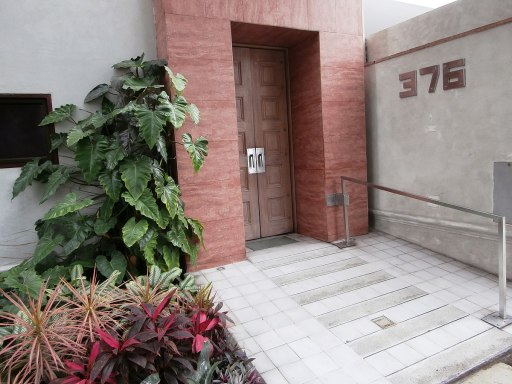
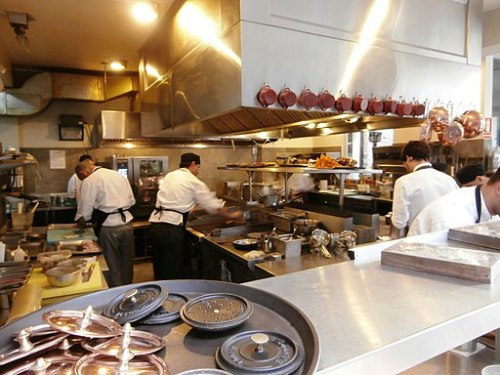
One of the reasons my son was happy to go back to Lima was that he’d be able to visit Centrale Restaurante, famous as No 6 in the list of the 50 best restaurants in the world. The plan was that he and Jesse would go there for lunch, while Nana minded baby Nina. We even made the reservation for 8th April.

Central_Restaurante_-_Lima,_Peru

Source: Wikimedia.  Centrale Restaurante

OLYMPUS DIGITAL CAMERA

Kitchen, Centrale Restaurante

Actually, I must admit that the food looks rather amazing.  Here’s a video, if you like videos of food:

Now, what could I do with Nina while they are gourmeting at the restaurant?  Pop her in the pusher, I think and head off to the  Amano Pre-Columbian Textile Museum in Miraflores, where we were going to stay. It was established by the Japanese businessman Mr. Yoshitaro Amano who began collecting pre-Columbian objects that had been discarded by tomb-raiders. He founded the Amano museum in 1964, one of the first purpose-built museums in Peru. The museum was remodelled after 50 years, after gaining the financial support of the Japanese Embassy, Sumitomo Metal Mining and the Miyasato company.

(Ah, that’s right- there’s a long history of Japanese in Peru.  there was that Peruvian president Alberto Fujimori, wasn’t there? Oh dear, that didn’t end well. It seems that he’s still in jail for corruption)

Let’s have a look around the museum.  There’s a virtual museum here, that I found that Google Arts and Culture

https://artsandculture.google.com/exhibit/permanent-exhibition%C2%A0/twLiPg1FFffbLw

It takes you chronologically through the different Peruvian societies up to and including the Inca, showing their skills in textiles. It’s quite striking when they start using brilliant colours. I assume that these are authentic- it’s amazing that they survived.

I hear with my little ear: Podcasts 25-31 March 2020

Suleiman_the_Magnificent_of_the_Ottoman_Empire

Suleiman the Magnificent (Wikimedia)

Fifteen Minute History Last year I did a U3A mini-course on the Ottoman Empire, and I listened to a very detailed series called “Empires of History – the Ottoman Series” that ran out of puff long before the Ottoman empire did. It was rather disconcerting listening to a podcast where the narrator pronounced “Anatolia” as Anna-toll-ee and pronounced “cavalry” as “Calvary”. But these two podcasts, called simply enough “History of the Ottoman Empire” are done by fair dinkum historians, and they’re detailed enough without being too detailed. Episode 26 is Part 1, talking about the rise of the Ottoman empire and Episode 27 is Part 2, where Barbara Petzen describes the concept of ‘fall’ in empire history, particularly in relation to the Ottoman Empire

And on a related, but not the same, topic, there is Carter Vaughn Findley, Humanities Distinguished Professor in the Department of History at the Ohio State University, in Episode 31: Who are the Turks?who points out that it is mainly language that unites ‘the Turks’, who are not one racial group at all. Which is a bit inconvenient for Turkish nationalists like Erdogan.

Boyer Lectures (ABC). I’m listening to the three-part 2019 Boyer Lectures, given by Rachel Perkins. She has a beautiful speaking voice, and as you might expect from the Boyer Lectures, these are beautifully crafted. Her lectures, subtitled ‘The End of the Silence’ refer back to the very first Boyer Lecture given by William Stanner, who spoke of the Great Australia Silence.  In Episode 1 she talks about the genesis of the Uluru statement, and in Episode 2 about the succession of previous attempts to have an Aboriginal ‘voice’.  (It makes me so cross: “tell us what you want” says the government, and then as soon as they do, in clear terms, the government says “well, not that”.) Episode 3  returns to the Uluru statement, and its call for a Makarrata Commission, and truth-telling about the Frontier Wars and the fundamental untruth that lies under European colonization.  Very good.

History Listen (ABC) Another oldie from November 2019, The Brazen Women of Silent Film features two different stories. The first is of Annette Kellerman, the swimmer and film star, who actually appeared nude in a 1916 movie. She could hold her breath for over three minutes! See also the excellent NFSA online exhibition “Annette Kellerman: Australia’s Fearless Mermaid.”  The second feature is about the McDonagh Sisters: Isabel, Phyllis and Paulette who formed their own film company and used Drummoyne House, which they were then running as an aged care hostel, as the setting for many of their films. I’d never heard of them, I must admit.