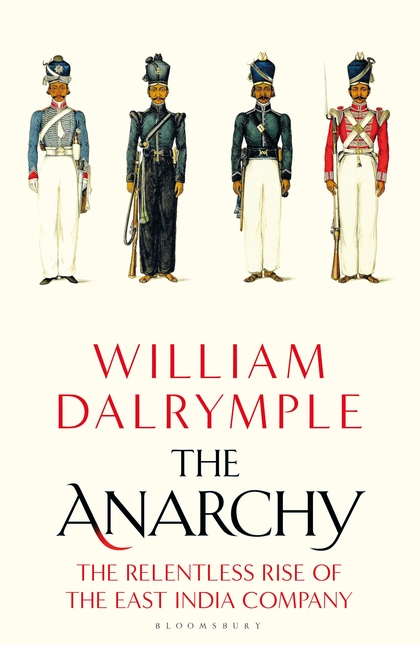
‘The Anarchy: The Relentless Rise of the East India Company’ by William Dalrymple

2019, 397 p plus notes

In 1608, who would have thought that India – with a population of 150 million and the source of one quarter of the world’s manufacturing – would be devastated by a small joint-stock company from England, a country that had just 5% of India’s population and contributed only 3% of the world’s manufacturing? But over the next 250 years, that is just what happened, as the East India Company steadily drained India’s wealth in goods and precious stones and cash, pouring it into the Company’s coffers for its shareholders. This is the story that William Dalrymple tells in his The Anarchy: The Relentless Rise of the East India Company.

When the East India Company was established in 1599 in Tudor England, there was no indication that it was to become the behemoth that it did. Other joint-stock companies had been founded, and it was competing with similar companies from other European nations, all jostling to establish trade routes with the East Indies. Its ports in India were founded almost as a consolation prize when the better-financed Dutch dominated the Moluccas. However, through ingratiating themselves with the enormously wealthy Mughals in India, only to later exploit their rivalries, the East India Company had found a source of wealth even more lucrative than the East Indies. The wealth flowed one way only: straight to London. The precious stones, the golden thrones, the eye-watering amounts of money: this is the pillage that Shashi Tharoor describes in his Inglorious Empire (my review here).

But England was not the only nation involved in India, and the amount of European activity and interference in what England saw as its own market surprised me. Technological changes in warfare technology added to the European-based rivalry between Britain and France throughout the eighteenth and early nineteenth century. This rivalry played out in the Carnatic Wars between the French and British armies stationed in India, using Indian troops, paid for with Indian money and lives. European technology also weighted the scales when the British extended their ‘assistance’ (at a price, of course) to different rulers vying for supremacy in India. I was surprised, too, by the involvement of European soldiers who adopted Indian names and headed various armies of Indian soldiers, on both the French and English sides.

Dalrymple tells his history through individuals, most particularly the East India Company merchants, the governors from England, and the Mughals, Nawabs, Rohillas, Sultans and Marathas whose assets were steadily stripped by the EIC. In telling his story, Dalrymple has his goodies and baddies. Robert Clive (yes, he of the Curry Powder) was a baddie, who had three stints in India, amassing huge personal wealth, facing (and staring down) a Parliamentary enquiry, and finally committing suicide. Warren Hastings, the first Governor of the Presidency of Fort William (Bengal) in Dalrymple’s eyes was a qualified goodie – and now I understand the nuances of Barry Jones’ response to the question ‘Who was the the first Governor General of India?’ Hastings, who was not beyond enriching himself either, was undermined by Sir Philip Francis -certainly a baddie in Dalrymple’s eyes (and incidently thought to be the author of the ‘Junius’ letters, much discussed in 19th British legal history). Francis was appointed to the supreme council of Bengal during Hastings’ Governor-Generalship. On his return to England, Francis began agitating for the impeachment of Warren Hastings which, after seven years, led to Hastings’ acquittal. Then there are the historic figures who are better known in other arenas. There’s Wellington (just plain old Arthur Wellesley at this stage) who led a number of battles, under the governor-generalship of his brother Richard. There’s General Cornwallis, who arrived in Calcutta in 1786 to replace Warren Hastings, after his surrender of the 13 Colonies to George Washington. He was determined to ensure that a settled colonial class would never emerge to challenge British rule in India as it had in America, and so he introduced a “whole raft of unembarrassedly racist legislation” (p.327) ensuring that the children of British men with Indian women would never be employed by the Company.

Dalrymple’s emphasis on individuals extends to the Indian protagonists in the story too. I’m ashamed to admit that as a European reader, I struggle to distinguish Indian and Muslim names. Dalrymple has gone to some lengths to support the reader in this. The narrative is prefaced by a lengthy list of Dramatis Personae, helpfully arranged more or less chronologically into categories: the British, the French, the Mughals, the Nawabs, the Rohillas, the Sultans of Mysore, the Marathas. Maps in the preface show the main cities, with the areas of influence by various chieftains, peshwahs and emperors identified. A paragraph after each name summarizes the main points of their story, and gives each one a distinct personality. The beautiful illustrations, inserted in three places in the book, also have an identifying paragraph. Most clearly defined of all is the Mughal Prince, Shah Alam, handsome, intelligent, and culture, who was tortured and blinded by the Rohillas. In fact, the violence in this book – who knows how accurate it was, depending on the chronicler – is really chilling.

The subtitle of Dalrymple’s book is “The Relentless Rise of the East India Company”. While it was certainly relentless, the rise was not without its setbacks. East India Company troops were defeated by the French-led troops on several occasions, and the company needed to be bailed out of bankruptcy in 1772 in exchange for greater British government oversight. This was always likely to be light-touch regulation, and many Parliamentarians had East India Company shares. And still the Company kept churning on, stripping Indian assets in order to distribute them for its British shareholders.

It’s interesting that Dalrymple chooses to end his book with the Battle of Delhi, with the defeat of the Marathas, in 1803. This left the Company the dominant military force and “the sinews of British supremacy” now established (p.382). He finishes at the high point of East India Company power, rather than with its removal from power after the Indian Mutiny as it is known in Britain, or the First War of Independence as it is known in India, and the final expiry of its charter in 1874.

Dalrymple’s purpose is not a ‘Rise and Fall’ story. Instead, it is a cautionary tale about corporations and power, as he makes clear in his epilogue. When corporations become too big to fail, as the East India Company was; or when they have Parliaments in their thrall through lobbyists and parliamentary shareholders; or when they can just buy military might and other people’s bodies – then much is at stake. As he says in his closing sentence: “Four hundred and twenty years after its founding, the story of the East India Company has never been more current.” (p.397)

My rating: 9/10

Sourced from: Yarra Plenty Regional Library
I hear with my little ear: Podcasts 1-8 November 2020

Heather Cox Richardson. Her podcast on Thursday 29 October was the last one before election day. If you haven’t listened to her before, this would be a good catchup one, because she went over things that she has said many times previously (hence, it was a little repetitious for rusted-on listeners like myself). Her podcast on Thursday 5th November was before the results had been announced, and she was soothing about waiting for the process to play itself out.

History Workshop. The Violence of Empire was originally broadcast in May 2019 and it features Kim Wagner – author of Amritsar 1919: An Empire of Fear and the Making of a Massacre. His book argues that colonial violence didn’t start after the war, and he draws a link between the Indian Rebellion/Mutiny/First War of Independence (it has various names) of 1857 and the Amritsar Massacre or Jallianwala Bagh Massacre where at least 379 (and some say 1000) were fired upon in a confined area by members of the British Indian Army. He rejects the politicized anti-British feeling of Shashi Tharoor’s Inglorious Empire (my review here) and likewise pro-Empire British historians (like Niall Ferguson, I guess), arguing for a more nuanced approach. His book seems to take a thick description, microhistory approach to the Massacre. Both the author and the interviewer assume that the listener knows about Amritsar (I had to look it up) and a bit more backgrounding wouldn’t have gone astray.

America if you’re listening. It’s the 5th November, and counting continues in the U.S. elections. I’d better hurry up and listen to these podcasts, because if Trump wins I’ll be too discouraged and depressed to do so. Episode 7 How Donald Trump turned the Presidency into a business looks at Trump’s use of his hotels and golf courses as a way of leveraging public money into his wallet. The man is shameless. Episode 8 How China fooled Donald Trump examines the way that once Xi Jinping worked out that all Trump wanted was a trade deal, then he could get away with anything- Hong Kong, Uighurs, the South China Sea etc. And the final Episode 9 How Coronavirus destroyed Trump’s MAGA promise traces through the last year, and Trump’s mishandling of the whole thing.

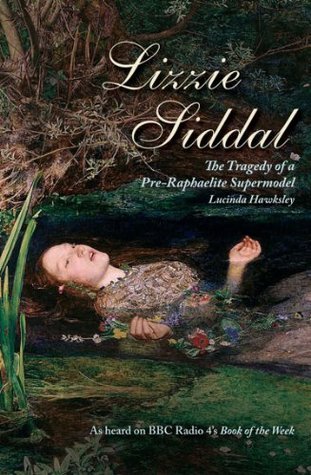
‘Lizzie Siddal: The Tragedy of a Pre-Raphaelite Supermodel’ by Lucinda Hawksley

You might not recognize the name, but you probably recognize the face of Lizzie Siddal. You will have seen her in John Millais’ painting Orphelia, deathly pale, her red hair flowing around her, her hands uplifted in supplication. It is the image that Lucinda Hawksley has chosen to use on the cover of her book about Lizzie’s life. In her subtitle ‘The Tragedy of a Pre-Raphaelite Supermodel’, Hawksley draws a not-completely satisfying parallel between Lizzie’s life and those of the supermodels of the 1990s. I might quibble with the supermodel concept, but certainly not with the designation of ‘tragedy’. Lizzie Siddal’s life trajectory took her far beyond her origins, but she was always insecure and wary, and eventually succumbed to addiction.

2004, 256 p.

Lizzie Siddal (originally spelled Siddall but changed on her husband’s suggestion to make it look more genteel) worked in Mrs Tozer’s hat shop in 1849 when she was approached by an artist, Walter Deverell, who was looking for an artists’ model for Viola in a painting of Twelfth Night that he was working on. Lizzie had had a ‘respectable’, religious lower class upbringing. In a scenario reminiscent of Tess of the D’Urbervilles, her father was engaged in a long and ultimately fruitless attempt to claim ownership of a convoluted family fortune. Her father worked as a cutler, and the children needed to work, but this did not mean that Lizzie leapt at the opportunity. Walter Deverell’s mother called on Lizzie’s family to assure them that Lizzie’s reputation would not be damaged by the modelling, as Mrs Deverell herself and her daughters would be present at all times. Thus Lizzie was launched into a milieu completely foreign to her.

Walter Deverell was amongst the circle (although not one of the original members) of the Pre-Raphaelite Brotherhood (PRB), a group of seven students who criticized the teaching of art in art schools, harking back to the rich colours and animated subject matter of Botticelli and other early Italian artists. It had all gone downhill since Raphael, they said, and so they adopted the name ‘Pre-Raphaelite’. The original group of 7 included John Everett Millais (who painted ‘Ophelia’), William Holman Hunt, Dante Gabriel Rossetti and his brother William, Thomas Woolner, Frederic George Stephens and James Collison. It expanded to include Ford Madox Brown, Walter Deverell, William Morris and Charles Allston Collins. They were always on the lookout for ‘stunners’ and in Lizzie Siddal they found one.

Unfortunately for Lizzie, she was not the only ‘stunner’ associated with the PRB. New women were being brought in all the time, and like Lizzie, often engaged in relationships with the artists. Lizzie fell in love with Dante Rossetti, who made moves to marry her (against his family’s wishes) but he then retreated over a number of years, embarking on relationships with other women within the circle, before returning to Lizzie. A destructive cycle was established: Dante would go off with another woman; Lizzie would increase her intake of laudanum, a commonly used drug, and refuse to eat; Dante would come rushing back to her bedside; she would improve; he would go off again.

As Hawksley points out, laudanum or ‘tincture of opium’ was a mixture of opium and alcohol that was widely available over the counter from greengrocers, barbers, ironmongers or at market stalls. Mothers spiked their babies’ bottles with in when they had to work and it was used to quell the symptoms of cholera, diarrhoea, gout, rheumatism, toothache, sprains and ulcers…and any number of other symptoms. Certainly, just do an image search on Google for Lizzie Siddal, and you’ll see her depiction in myriad paintings looking very much ‘on the nod’.

I wasn’t really aware of Lizzie Siddal’s story, and so I’m not going to divulge the ending, although you’re probably already well aware that it’s not going to end well. And, in keeping with the Victorian gothic sensibility that runs just under the surface of the whole book, just being dead wasn’t the end of the story.

Hawksley is fairly condemnatory of Lizzie Siddal, seeing her as emotionally manipulative, and using her possible eating disorder and addiction as a way of drawing Rossetti back to her. That might be true, but I think I’d cut her some slack in what I see as a mutually unhealthy relationship, where she had little other power.

Although focussing on Lizzie and Dante, this book has a wide range of supporting characters with familiar names – almost like a who’s who of the mid 19th century British artistic world. At times I feel that Hawksley pursued too many rabbits down rabbit holes for the sake of a good story, and I wished that she had indicated in the text whether the painting under discussion was included amongst the illustrations in the book. But Hawksley explains things well for a reader with only fragmentary knowledge of the PRB, and manages to keep a huge number of characters under control. I heard the author, who happens to be Charles Dickens’ great great great grand-daughter speaking in Birmingham when we were there in 2011.

Lizzie as supermodel? Certainly she was chosen because her looks – her striking (although unpopular at the time) red hair, her slim boyish figure, her languor – suited the medieval sensibility that the PRB was trying to create/recapture. Addictions and eating disorders are not unknown to supermodels. But I’m not sure that she had ‘fame’ in the sense that we granted to the supermodels of the 1990s, and certainly her respectability and reputation was compromised by mingling in ‘artistic’ circles. It’s hard to see positive agency in Lizzie’s life. So I think I’ll just leave the ‘supermodel’ aside, but I certainly acknowledge the ‘tragedy’.

My rating: 7/10

Sourced from: my own bookshelves. At last. I think we bought it in 2011 after hearing the author speak.

I hear with my little ear: Podcasts 25-31 October 2020

Sydney Writers Festival. Did you know that the Sydney Writers Festival has a site with podcasts by writers who would have participated in the Sydney Writers Festival in a COVID free world? I listened to Cassandra Pybus being interviewed by Jakelin Troy about her book Truganini which I reviewed here. She spoke about lots of things that I don’t remember from the book- I wonder if she was talking from her familiarity with the sources, or whether I just forgot?

The Last Archive. This podcast series is presented by American historian Jill Lepore whose book These Truths: A History of the United States I must read one of these days. In it, she poses the question “Who Killed Truth?”. In episode 1 The Clue of the Blue Bottle, she looks at a murder case from 1919 in Barre, Vermont where a young woman was strangled. Instead of crimes being seen as acts of god, there were now clues, and facts and photographs. It’s a case that was reported in great detail as far as the body was concerned, but the press reports of the trial itself glided over facts that were deemed “unfit for publication”.

Heather Cox Richardson The History and Politics Chat on Tuesday 27th November talks about the opinion polls. She points out that polls are useful for highlighting the issues that people are concerned about, but not for how people vote. She cautions that only Associated Press are in a position to ‘call’ a poll: the other polls are going unofficially on projections from exit polls. She points out that Americans can recall their votes- how weird! I am so grateful to live in a country with compulsory voting.

In Our Time BBC. A few episodes from their ‘Religion’ series. The Thirty Years War pitched Catholics against Protestants, Lutherans against Calvinists and Catholics against Catholics, although it wasn’t a war that the soldiers necessarily believed in from an ideological and political point of view, as 20th century wars are. Instead, it was pretty much soldiers for hire as various kingdoms fought themselves to a point where it was possible to sue for peace.

Papal Infallibility traces through the history of the doctrine of Papal Infallibility from its origins as a means of cementing the authority of the Bishop of Rome, through the Franciscans wanting to ensure that arrangements granted under one pope couldn’t be withdrawn by the next, through the Reformation- and most importantly the Counter Reformation- then the Enlightenment and more recent papal history. If you were Pope, you’d want to keep a handle on what the ‘infallible’ Popes before you had said, because if he could be wrong, so could you.

West Midlands History Beatrice Cadbury: The Heiress Who Gave Away Her Fortune is really good. It’s based on the book by Fiona Joseph. Born into the wealthy Quaker Cadbury family, Beatrice became increasingly uncomfortable about her unearned wealth, and after becoming a Christian Socialist, she tried to give it away. A peace activist, philanthropist and a woman who lived her faith and her politics.

Six degrees of separation: from Every Secret Thing to…

The first Saturday of the month seems to come around very quickly! We are usually given a starting book by Kate, who hosts the Six Degrees of Separation meme on her blog Books Are My Favourite and Best. But this time, she instructed us to start from the last book on last month’s chain, which for me, was Marie Munkara’s Every Secret Thing.

So, thinking of ‘secrets’, there’s Sebastian Barry’s The Secret Scripture, set in Ireland, where during the process of deinstitutionalization, a woman is discovered who has been incarcerated in an asylum for 60 years. The book explores how, and by whom, she came to be placed in the asylum- but I didn’t like the ending at all (and after 12 years, I have no memory at all of what the ending even was!)

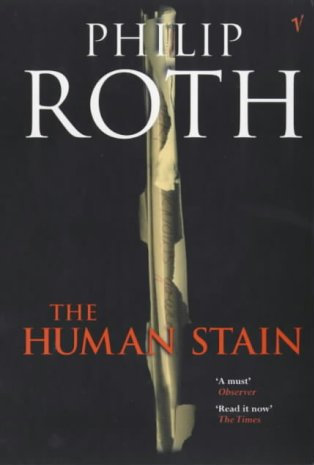
But I do remember the ending of Philip Roth’s The Human Stain, which is a book about secrets too. Roth’s books are often swaggering, male and very American, and this is no exception, telling the story of Coleman Silk, a successful, white Jewish professor who is accused of using a racist term in his classes. Narrated by Nathan Zuckerberg, who appears in several of Roth’s novels, it’s infuriatingly conservative but also incisive about sex, race, and Americanism.

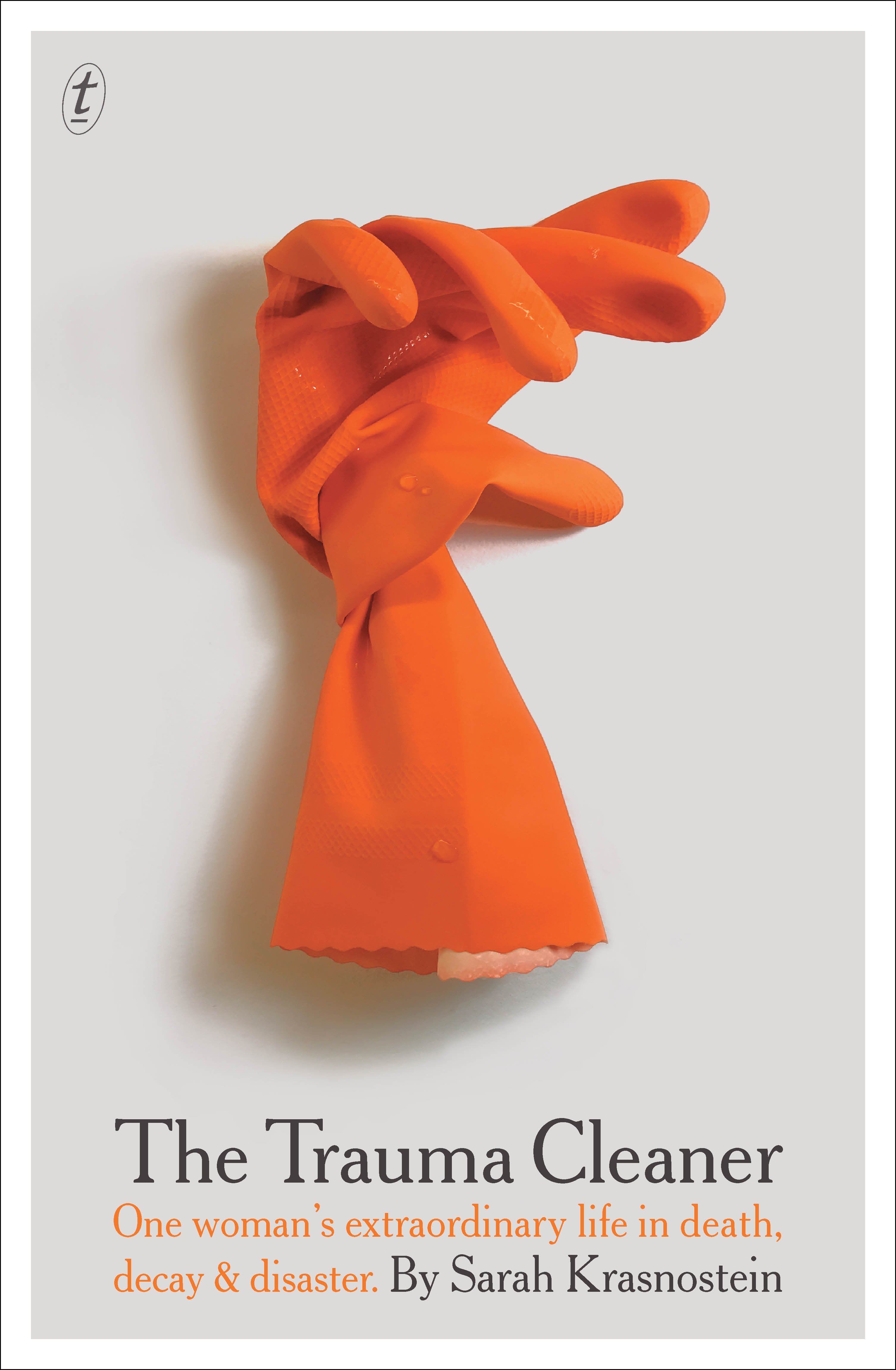
Speaking of stains, there’s some really gruesome stains in Sarah Krasnostein’s The Trauma Cleaner, the biography of Sandra Pankhurst, who runs an agency that does cleanups after a crime scene, a death or where hoarding has become perilous. Sandra Pankhurst, born Peter, has her own story of abuse and emotional deprivation before her gender reassignment surgery. It’s a fantastic book.

David Ebershoff’s The Danish Girl explores the marriage of two artists, Einar Wegerer and his American wife Greta Waud in the 1920s and 30s.  It was at Greta’s suggestion that Einar first cross-dressed within their marriage, and his increasing excursions as ‘Lily Elba’ culminated in the world’s first sex-change surgery.

Also set in Denmark is Johanna Adorjan’s An Exclusive Love, the story of the author’s Jewish grandparents who had emigrated from Hungary to Denmark after their terrible experiences during WWII. We learn in the opening sentences that they decided to commit suicide together in 1991, and in this book their granddaughter reconstructs the lives that they rarely spoke about later.

Thinking of grandparents and great-grandparents and aunts and great-aunts brings to mind The Eighth Life (For Brilka) by Nino Haratischvili. This was one of the big fat books I read during COVID lockdown and it was wonderful: a family saga, set in Georgia (near Russia, not in America) during the 20th century with various branches of the family tree sprouting off in all directions, but with such well-defined characters that you didn’t need a genealogical chart.

So look at that- all fiction this month!- and set in Australia, Ireland, America, Denmark and Georgia. Who said we couldn’t travel during these coronavirus days?

‘Fred and Edie’ by Jill Dawson

2000, 276 p.

I obviously bought this book at some stage but can’t remember why. Was it after a review that I had read; because of the steep reduction in price from $31.30 to $6.95, or on account of the striking cover? (am I so easily swayed?) For whatever reason, it has been on my shelf for some time.

The book was shortlisted for the Orange Prize and the Whitbread Novel of the Year in 2000. It is loosely based on the real-life murder case of Edith (Edie) Thompson and Freddy Bywaters, who were hanged in January 1923 for the murder of Edith’s husband Percy. It is written as a series of letters from Edie in her jail to Fred in his, where they are both awaiting trial. Hoping at first to smuggle the letters out, Edie decides not to actually convey them to Fred, which frees her to be more frank. The letters are interspersed with authentic newspaper articles from the time, and a first-person present-tense narrative that gives the back story.

Edith Thompson was nine years older than her lover, Freddy. Edith was a modern, intelligent, independent young lady with shingled hair, who earned a good wage in a millinery shop. At first Freddy was going out with her sister Avis, but he was attracted to Edie and came to live for a while with the unhappily-married Edith and Percy. After an altercation between the two men, Freddy left.

Some time later Edith and her husband Percy were walking home from a night at the theatre, when a man jumped out and stabbed Percy to death. Fred was arrested, and on being (incorrectly) told that he had confessed, Edith admitted that she knew that Freddy was the assailant and the nature of their relationship.

Even though Edith had no connection with the actual murder, the discovery of a cache of letters that Edith had written to Freddy was tendered to the court in evidence, revealing their affair and Edith’s attempt to poison and kill Percy by putting ground up glass in his food. They were both found guilty of murder. Freddy Bywaters protested Edith’s innocence, which ironically led to a surge in public pressure against his hanging. Edith’s position with the public – despite Bywater’s declarations and the lack of her involvement in the murder- was more equivocal. For many people, including the judge and jury, she was seen as the master-mind and an adulteress – and guilty. You can’t help thinking that she was executed for being a passionate, feisty adulteress (not a capital crime) rather than as a murderer.

Dawson has been able to use the real-life letters that were tendered in the court as a model for Edie’s voice in this fictionalized account. Edie’s awakening sexuality, even with the boorish Percy in her heightened sense of attraction, is well described, and the fictional letters capture well the giddiness and rashness of early infatuation.

There’s a fantastic website put together by one of her biographers Rene Weiss that can be found at https://edithjessiethompson.co.uk/ that includes all the authentic letters, an entire copy of Weiss’ book, photographs, and current news. I enjoyed the book in its own right, but I must admit that my admiration for Dawson’s book increased further when I saw the source material from which she drew to write her own fictional account.

My rating: 8/10

Sourced from: my very own bookshelves!

I hear with my little ear: Podcasts 17-24 October 2020

Heather Cox Richardson On 24 September, she finally finished her History of the Republican Party. She reminded us that Donald Trump was not the most conservative of the Republican candidates standing in 2016, and suggests that he was more angling for a TV career as a pundit, rather than President. He is not ideological: instead he makes himself what ever his supporters want him to be. She finished by suggesting that even if Trump wins, the Republican Party has painted itself into a corner, and that the older Lincolnesque Republicanism will re-emerge. I’m not so sanguine.

Her History and Politics Chat of October 21st looks in detail at Hunter Biden, and I certainly learned new things here: he is a History graduate and has a law degree from Yale; he joined the navy in his early 40s and was discharged but it was not a ‘dishonorable discharge’, and he was appointed to Burisma by George W. Bush. And certainly, there are just so many holes in the New York Post story.

America if You’re Listening. If Matt Bevan had given Trump a few leave passes in earlier episodes, he doesn’t here. Episode 6 Trump’s desperate measure to halt immigration is a sordid tale, and with his family separation policy, just possibly worse than what Australia is doing.

A. C. Grayling ‘The Good Book: A Humanist Bible’ I’ve been reading this book each morning, a chapter at a time, so it will take me until about 2023 to finish it! In the meantime, I jumped ahead to learn about why Grayling wrote it and why. This is actually a video, but I listened to it on my walk, as if it were a podcast. The Good Book is set out like a bible, with two columns on each page, verses and fairly short chapters, and it draws on humanist wisdom from many sources. I’m one of the people he complains about who want to know what bits came from where- but that’s what Google is for, isn’t it?

99% Invisible My son recommended this episode in particular to me, and it’s great! Goodnight Nobody looks at the popular children’s book Goodnight Moon (which I admit, I never read to my children but there’s a beautiful animated version narrated by Susan Saradon here). Despite its enormous popularity, it was not listed among the 10 most borrowed books from the New York Public Library, because it didn’t appear on its shelves until 1972. The formidable and yet revolutionary librarian Anne Carroll Moore started the children’s library at the NYPL at the turn of the century, and she had very clear ideas about children’s literature- and Goodnight Moon didn’t fit her criteria. A lovely podcast about reading and children.

‘Vida: A woman for our time’ by Jacqueline Kent

2020, 284 p.

Perhaps biographies are like buses….nothing for ages, and then two or three arrive all at once. Vida Goldstein, the subject of this 2020 biography by Jacqueline Kent, did not receive a full-length biography until 1993, when Janette Bomford published her book That Dangerous and Persuasive Woman: Vida Goldstein, which I reviewed here. She featured in Claire Wright’s You Daughters of Freedom in 2018, and appears as a minor character in Caroline Rasmussen’s recent joint biography of Maurice and Doris Blackburn The Blackburns (2019). She has always appeared as part of the network surrounding Stella (Miles) Frankin and Catherine Helen Spence, but in terms of full length biographical treatment, the two main works have appeared in the last 27 years.

In her introduction to this biography, Jacqueline Kent notes that Goldstein is briefly mentioned in almost every history of women in Australia, but “her name is not particularly well known outside scholarly circles”. (Voters in the federal seat of Goldstein, in the bayside areas of Melbourne might beg to differ. As Kent points out, the electoral division might be named after her, but it has never sent a female MP to the House of Representatives). Kent writes that her biography

…seeks to show how much Vida was not simply a woman of her times, but someone whose views and beliefs are refreshingly contemporary – and so who is equally a woman of our time.

(p.xv)

Kent has written other biographies, but she is best known for her biography of Australia’s first female Prime Minister, Julia Gillard The Making of Julia Gillard (2009) and a smaller work Take Your Best Shot: The Prime Ministership of Julia Gillard (2013). Gillard remains a touchstone throughout this biography of Vida Goldstein as well, with Kent inserting present-day comments drawing parallels between Goldstein and Gillard’s experiences in parentheses in various places throughout the text. This connection comes to the fore in the epilogue, where Kent claims that Vida and her colleagues would have been “delighted to see Julia Gillard confirmed as the country’s first woman prime minister” which she follows with a four-page summary of Gillard’s prime ministership. This presentism is foreshadowed in the subtitle ” A woman for our time”.

When writing her biography, Janette Bomford bemoaned the lack of a cache of personal papers that would reveal the inner Vida Goldstein. Kent has had to work from the same straitened resources, and a quick glance at the footnotes reveals Kent’s debt to Bomford’s earlier biography. As a result, I’m not going to reprise Goldstein’s life here – instead I refer you to my review of Bomford’s book – because the events are much the same, which is to be expected when both authors are working from the same sources. Kent briefly raises, but then shuts down, speculation that Goldstein may have had a lesbian relationship with her friend and colleague Cecilia John. I’m not sure that it is a useful suggestion as there is absolutely no evidence for it, but perhaps it was prompted by Kent’s attempt to frame Vida as “a woman for our time”.

So where, then, does the difference lie in the two biographies? Unfortunately, I must have borrowed Bomford’s book because I can’t find it on my shelves, so I don’t have the two texts on my desk to compare. I can only work from impressions.

First, Kent’s book seems more Melbourne-oriented than I remember Bomford’s book being. Although she travelled to both U.S. and U.K, and although she had connections with feminists in other states, Goldstein lived and worked at the Victorian level in trying to get female representation in Parliament. Although given importance in the text and forming stepping stones in her life’s chronology, these national and international personal networks do not play an integral part in Kent’s narrative. Instead, Goldstein comes over as rather isolated and toiling away single-handedly here in Victoria, estranged both from party politics (which she abhorred) and by her conflicts with other feminist groups and political forces.

Kent gives us a good picture of Victorian political and intellectual life in the first twenty five years of the twentieth century. Paradoxically, Victoria was the last state to grant female suffrage in 1911, and the right to stand for State Parliament in 1923, even though white women had been able to vote in federal elections and stand for Federal Parliament since 1902. Although the first suffrage society in Australia was the Victorian Women’s Suffrage Society in 1884, and despite Victoria’s relatively progressive intellectual life, the Legislative Council was able to stymie women’s suffrage and representation long after South Australia, Queensland and New South Wales had granted it. As a result, Goldstein’s many attempts to stand for Parliament involved federal elections, not state ones.

However, her main base of support was in Victoria, centred on the Book Lovers Library, run by her sister and brother-in-law in the city, and Oxford Chambers at 473-481 Bourke Street which for a while, became “something of a Goldstein compound” where the family members lived and worked. Her two newspapers, the Australian Woman’s Sphere (1900) and the later The Woman Voter (1909) were published in Melbourne.

Second, Kent gives full weight to Goldstein’s spiritual commitment, first to Rev Charles Strong’s Australian Church and then to First Church of Christ, Scientist, which was to remain her lodestar throughout her life. It was a commitment that caused tension with her friend Stella (Miles) Franklin, and it became increasingly important to Goldstein in her later life as a conscious choice in career direction. Perhaps it’s because I too am a Woman of a Certain Age, but I’m increasingly interested in how biographers deal with the latter years of their subject’s life. Kent handles this well, tracing through Goldstein’s contributions to public debate long after she had given up on unsuccessfully standing for Parliament.

Third, Kent’s biography has a lightness of touch that was less evident in Bomford’s more academic book. This is partly because of the parenthesized present-day asides, but also because Kent has a good eye for the visual image and the lively event. I’m not sure, though, that she has moved our understanding of Goldstein forward by much beyond what Bomford had already told us. But through the striking cover, the title with its present-day hook and the engaging writing style, Kent has probably broadened awareness of Vida Goldstein to a wider audience.

My rating: 7.5- maybe 8/10

Sourced from: Yarra Plenty Regional Library
I have included this on the Australian Women Writers Challenge 2020.

‘Searching for Charlotte’ by Kate Forsyth and Belinda Murrell

2020, 304 p.

On a mid-summer day, established Australian authors Kate Forsyth and Belinda Murrell are in the Queen Elizabeth Hall at Southbank, London. They had planned to meet outside to share a gin and tonic and conversation with Emma Darwin, Charles Darwin’s great great grand-daughter. Emma has written several historical fiction novels, but she has also published This is not a book about Charles Darwin, a hybrid of memoir, family history and fiction. Forced inside by pouring rain, Emma has words of advice for the two sister authors, who were embarking on a similar challenge:

In fiction I am empress of all I survey. I can make up my own rules. I only need make my story seem authentic. The problem with non fiction is that a well-documented archive can be a potential censor…The kind of book you are writing is akin in fiction in many ways, and that means that the inner life can be explored as well as the outer. The interior life is the novelists’ true work.

(p.162)

This book is, as Emma Darwin noted, “akin to fiction”. Or as Kate Forsyth noted “We are taking historical fact and framing it within our own personal lives, creating what might be called a hybrid memoir.” (p.241) I am glad that as authors, they are clear-eyed about what they are doing. This jointly-written book is not a straight biography: instead, like a Who Do You Think You Are? episode, this is just as much about the searchers and the search as it is about the quarry. As in Who Do You Think You Are? there is an emotional attachment through ancestry that draws out empathy, and a degree of identification that arises only because they are family.

In this case, the two authors, who are sisters and each a published author in her own right, feel a particular affinity for their great-great-great-great grandmother, Charlotte Waring Atkinson who wrote the first Australian children’s book A Mother’s Offering to her Children by a lady long resident in New South Wales in 1841. Charlotte’s daughter, Louisa Atkinson, published two books also under the name “an Australian lady”, as well as serialized works, and is recognized as a botanist and illustrator.

But there was more than this professional connection amongst authors set 180 years apart from each other. The story of James Atkinson, early settler and agriculturalist, his marriage to Charlotte, and the construction of the family property ‘Oldbury’ in the Southern Highlands of NSW was part of family lore. Much of the book involves the sisters travelling overseas in a type of investigative pilgrimage, visiting homes, churches and inhaling the spirit of Jane Austen and the Bronte sisters, whom they mentally link with Charlotte. There is a lot of imagination in this book, but it is clearly identified as such. I must confess to not feeling comfortable with these flights into fiction, but I would have bridled more if they weren’t edged with qualifiers like “perhaps” and “maybe”.

There is an almost innocent transparency about their speculations, even if I find myself balking at them. Historians and biographers weigh evidence all the time, but don’t often show the workings. In the chapter ‘Changing the World’, Kate Forsyth speculates about the possibility that Charles Darwin may have met with Charlotte during his trip to New South Wales. The genealogical origins of the Forsyth/Murrell project are very obvious here. Charles Darwin’s great great grandmother Anne Waring was the third cousin of Charlotte’s great grandfather Richard Waring, making Charles Darwin the 5th cousin once removed of Charlotte – surely a connection that only a genealogist could love. (p144) In family lore, Charles Darwin met with Charlotte in Sydney. However, there is no hard evidence that he did. His diaries are silent about it and the timing for him to ride to Berrima to visit her for just one night is tight. The clues that she offers are just that: clues, based on Darwin’s interest in the Waring family, and his use of Waring as a middle name for a child. Forsyth provides her evidence and holds it up for scrutiny, admitting that it is slight. It is.

Nonetheless, there is considerable research that has gone into the book, although the lack of reference to the footnotes section in the body of the work tends to obscure this. There is rich material here, without needing to be bolstered with the present-day framing narrative. Charlotte came out to Australia with a job lined up as a governess with Hannibal Macarthur, the nephew of John Macarthur and son-in-law of former governor Phillip Gidley King. On board, she met James Atkinson, one of the well known Atkinson brothers who were early settlers in New South Wales. They married, and had four children. Two years after her husband died she remarried, apparently hurriedly, to George Bruce Barton, a man who along with Charlotte suffered a bushranger attack. Forsyth and Murrell struggle to make sense of this hasty marriage to her fellow crime victim. Whatever Charlotte’s motives, it was a poor choice, as the marriage was abusive and they separated. This thrust Charlotte into the public eye as the defendant in a significant court case mounted against the executors of her first husband’s will over Charlotte’s fitness to be appointed guardian to her children (see Atkinson v Barton). She received a sympathetic hearing from Chief Justice Dowling and was granted guardianship (had my own Justice John Walpole Willis still been in Sydney at the time, I do wonder if she would have received the same outcome). Disapprobation attached to a remarried and separated woman fronting the courts against the highly respectable executors of the will, and it may have been this need for anonymity as well as income, that led her to write her book for children under the coy nom de plume “a lady long resident in New South Wales”.

Kate Forsyth contributes several chapters discussing A Mother’s Offering, taking it largely on its own merits and within the context of Australian literature. In fact, the question-and-answer format within a framing domestic story occurs in other settings across the empire in the mid 19th century as well. For example, here I reviewed Tales of a Grandmother by Mrs. A. Carmicheal, based on stories of St Vincent in the West Indies, published at exactly the same time- 1841- and also dealing with plant life, climate and geography, as well as the benefits of slavery. For many years the identity of the “lady long resident in New South Wales” was thought to be Lady Gordon Bremer until booklover and bibliographer Marcie Muir identified Charlotte as the author in 1980. Patricia Clarke’s biography Pioneer Writer: The Life of Louisa Atkinson, Novelist, Journalist, Naturalist publicized Muir’s discovery even further.

Forsyth reads A Mother’s Offering closely, noting Charlotte’s excursions into paleontology, mineralogy, conchology and cetology (p.243). She winces at Charlotte’s depictions of indigenous people and the imperial bombast of stories of shipwrecks and the death of “little Sally the black child”. She moves beyond A Mother’s Offering to examine P.P’s tales, mentioned briefly in a newspaper advertisement and which she suspects may be Amusing and Instructive Tales by Peter Prattle, reviewed in 1837 but given as a gift in 1832. A second Peter Prattle book Instructive Tales by Peter Prattle was listed as a ‘new publication’ in British newspapers in 1842. The evidence for Charlotte’s authorship of these other two books is, as Forsyth admits “circumstantial evidence, but suggestive nonetheless”(p.271). The book has been generously illustrated with colour plates from Charlotte’s sketchbook, showing her skill in drawing plants, birds and insects.

But Charlotte’s story is only one aspect of this book. Like Kate Grenville’s Searching for the Secret River, it is the story of a search. It is also the family story of two sisters who have their own careers as authors, and as such, it is also story about writing, both in the 1840s and in the 2020s. Their childhoods, their parents, unexpected family secrets and their responsibilities as part of the ‘sandwich generation’ between children and elderly parents are also interwoven into their search for Charlotte.

Ten of the chapters are written by Belinda, particularly at the start of the book, and eight by Kate. The chapters blend together fairly seamlessly, and I was not particularly aware whether I was reading a Belinda chapter or a Kate chapter. There are, for me, too many descriptions of food and sightseeing and at times it reads like a travel diary. Just like the television program Who Do You Think You Are? the search, and not just the discovery, becomes the story.

I think that a reader’s response to this book will depend heavily on how strictly they interpret the ‘rules’ of biography. For myself, I found the present-day family history rather unnecessary, the imaginative writing superfluous and the speculation unstable. However, for other readers I’m sure that the humanizing and integration of the past and present would have a strong appeal. The authors claimed to be taking historical facts and framing them within their own personal lives. That’s exactly what they have done.

Source: Review copy from NLA via Quikmark media

I have included this on the 2020 Australian Women Writers Challenge.

I hear with my little ear: Podcasts 9-16 October 2020

Conversations (ABC) I’ve just finished reading William Dalrymple’s The Anarchy and so I listened to Richard Fidler interviewing him on Conversations in a program called ‘William Dalrymple on the ruthless rise of the British East India Company‘. This conversation was more topical than the book itself, which is largely based on history, drawing parallels with current day corporations and the East India Company.

Heather Cox Richardson Although I’m running behind on HCR’s History chats, I’m right up to date with her History and Politics chats because so much is happening in America at the moment. This week she missed her History and Politics chat on the Tuesday, so she moved it to the Thursday instead. So on Thursday 16 October she gave a review of the American constitution and the respective roles of the Congress, Executive and Supreme Court. She comes right out and says that if Trump wins, that will be the end of Democracy in the United States. She predicts a period of violence in the wake of the election result no matter what happens. I just can’t believe that America has ended up here.

In her History chat of 17 September she picks up with George W. Bush’s presidency after the contested ballot of 2000. Now that the USSR had splintered there was no Manichean ‘baddies’ any more, so in effect that had to create them. She picks up on the comment of ‘a senior advisor to Bush’ to Ron Suskind “We’re an empire now, and when we act we create our own reality. And while you are studying that reality—judiciously, as you will—we’ll act again, creating other new realities, which you can study too, and that’s how things will sort out. We’re history’s actors, and you, all of you, will be left to just study what we do.” She goes on to talk about 9/11, Iraq, the Weapons of Mass Destruction, Hurricane Katrina, the Global Financial Crisis etc. etc. In 2008 McCain chose Sarah Palin as his running mate, thus further embedding Movement Conservatism into the Republican Party. When Barak Obama was elected, he was everything that Movement Conservatives hated, and it is here that you can see the planting of the tropes that Trump is pushing now: ‘voter fraud’, ‘socialism’ ‘UnAmericanism’.

The History Listen (ABC) Spies, Lies and Hairdryers is the story of Kay Marshall, who became an ASIO double agent during the Cold War, who became involved in the Skripov Affair (which I’d never heard of). She seemed so ordinary, and yet there she was hanging around Taronga Park zoo, with a copy of the Age in her hand, waiting to meet with a Soviet spy.