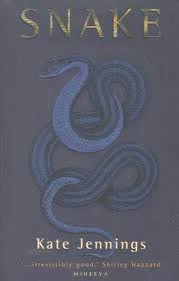
‘Snake’ by Kate Jennings

Kate Jennings Snake,  Melbourne, Minerva, 1996, 145 p.

Snake is a short book: only 145 pages and easily readable in one sitting.  It is a sharp, gritty book and you know from the opening pages that this is not going to be an easy reading experience.

The layout of the book is interesting.  It is in four unevenly sized parts, each divided with an engraved version of the snake of the front cover.  Part 1, only nine pages in length, is written in the second person and addressed to Rex, the father of the family. Immediately you are plunged into Australian Gothic:

Everybody likes you.  A good man.  Decent. But disappointed. Who wouldn’t be? That wife.  Those Children.

Your wife.  You love and cherish her.  You like to watch her unobserved, through a window, across a road or a paddock, as if you were a stranger and knew nothing about her.  You admire her springy hair, slow smile, muscled legs, confident bearing.  If this woman were your wife, your chest would swell with pride.

She is your wife, she despises you.  The coldness, the forbearing looks, the sarcastic asides, they are constant.  She emasculates you with the sure blade of her contempt.  The whirring of the whetstone wheel, the strident whine of steel being held to it, that is the background noise to the nightmare of your days  (p. 3)

Part 2 moves into third person, and is only a little longer- 11 pages and it takes us to their wedding, and already the ashes are in our mouth as we move through the unvoiced thoughts of the unlovely people who make up their extended family.

The longest section of the book is in Part 3, where there are short vignettes of the pettiness and the cruelties of everyday life in this blighted family:  Irene’s love letter to ‘the other man’ intentionally left where her husband Rex would find it; her moodiness and favouritism, the dog tragically left to die in a car. You know- as you’ve known from the opening pages, that this isn’t going to end well.

The final Part IV returns to the second-person voice, but this time it is addressed to Irene.  It is short- the shortest part of the book- and bitter.

All of the chapters in this book are short – in some cases the title is almost as long as the chapter itself!  The relationship of the title to the chapter is often oblique, as is the image of the snake that slides through the book both graphically and structurally.

Sue at Whispering Gums wrote a fantastic post about ‘taker-outers’ in books, and this book is just about as spare as you could get.  It is as dry and dessicated as the family it is describing, and all the more powerful for that.

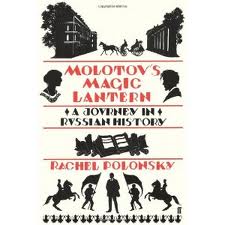
‘Molotov’s Magic Lantern: A Journey in Russian History’ by Rachel Polonsky

Rachel Polonsky Molotov’s Magic Lantern: A Journey in Russian History, London, Faber and Faber, 2010, 369 p.

One of my fellow students is writing a thesis about the status of family history and genealogy  within historiography more generally.  Is the  distinction always clearcut? I wonder.  After all, there are historians who write books that,  while not academic histories as such, combine elements of family history and broader history (Henry Reynolds’ Why Weren’t We Told? and Anne Summers The Lost Mother spring to mind).  In fact, just today I read a fascinating study by Cassandra Pybus of the negro ‘Commodore’ of Port Jackson (see citation below) where Pybus pursues, and  then interrogates, all those archival minutiae that are the family historian’s quest.  Richard Holmes’ Footsteps of a Romantic Biographer, which I enjoyed so much and have cited so often,  is a long reflection on methodology, arranged through the device of a journey.  Then  there are those popular historians/journalists who write books that combine history and travel (Simon Winchester Outposts, Bill Bryson even?).

So when I read a  glowing review of Rachel Polonsky’s  recent book Molotov’s Magic Lantern: A Journey in Russian History, I snapped it up.  Rachel Polonsky, Rachel Polonsky- where have I heard that name?  Then I remembered: she was involved in the recent academic brouhaha over Orlando Figes and Amazon reviews- see her perspective here.

Two personal libraries are the pillars of this book.  One of them was the library owned by Molotov, kept intact and largely untouched  (more through inertia than intent) in his apartment at the Romotov Lane building,  where Rachel Polonsky herself lived in while she was in Moscow many years later.

‘Have at it,’ the banker had said in his charming smoky drawl, dangling from one finger the keys to his apartment.  He had rung our doorbell early as he passed on his way down the stairs. ‘You’re the scholar, you’ll know what to make of it all.’

We had met the evening before at his welcome-to-Moscow party in one of the other Romotov apartments.  Over my champagne and his Jack Daniel’s, I told him, in my fumbling way, that I was some kind of fugitive academic, not really a journalist, working on a novel.. (p. 1)

…Our conversation picked up animation when he told me about Molotov’s library.  I already knew that the apartment he had moved into (immediately above our won) had been the Moscow home, in the last years of his long life, of Stalin’s most loyal surviving henchman. I did not know that some of Molotov’s possessions had remained in place- left there by the granddaughter who now let the apartment to international financiers- including hundreds of books, some inscribed to him or annotated in his hand, now apparently forgotten, in the lower shelves of closed bookcases in a back corridor. (p. 2)

And there it was- Molotov’s wood-paneled library- with a magic lantern in the corner that, when you cranked the handle, showed a succession of slide images; a carpet from the Shah of Iran on the floor, and books, books- some with the pages left uncut;  some inscribed to him; others underlined and annotated.

The second library was that of the Russian scholar, Edward Sands, who died a few weeks before the author took up her Cambridge fellowship.  He had died intestate, and not knowing what to do with the chaos of books and papers piled in his room among old shoes and half-empty medicine bottles, the bursar asked her to sort through them, working out which should go to the university library, and which should be given or thrown away. (p. 6)  Three years later, her husband called her from Moscow, encouraging her to join him.  She told herself and the fellowship that she would be back after a spell of 18 months working in the great libraries of Moscow and studying orientalism in Russian poetry.  Her eighteen months became ten years.  (p. 10)

These two libraries, then, are the foundations on which the book rests.  In her travels throughout the streets of Moscow,  down around the sea of Azov, up to the Finland border and across to Siberia and the Mongolian border, she reflects back on the  books and authors represented on the shelves of these two libraries.  There are many of them, but some are repeated again and again: Mandelstam, Akhmatova, Chekov, Dostoevsky, Pushkin, Shalamov, Marina Tsvetaeva.   Events and historical figures appear and re-appear as well: Molotov himself, Stalin, Lenin, Napoleon Bonaparte, Peter the Great, Tsar Alexander I, Catherine the Great- and with a burst of currency, Putin, Medvedev and the assassinated journalist Anna Politskovskaya.  Underpinning all this, like a ghastly merry-go-round tune is the repetition of repression, exile, and cruelty, repeated by the Cossacks, the Tsars, the Bolsheviks, Stalin- and she suggests, Putin too.  The reference of the rotating magic lantern in the title is apt- people and events flash before our eyes, disappear, only to reappear again later.

There are many, many names of people and places and Polonsky has supported her readers as much as she could with clear maps and a generous index. Ah- but there are so many names and I felt as if I needed to be taken up to the linchpin ones,  formally introduced to them and told “Remember this person- she’s going to be important”.   Unlike  more journalistic travel books (e.g. the Winchesters and Brysons), Polonsky did not give a rationale for the journeys she undertook, and so there was a sort of aimlessness to the book.  It could have been three chapters longer: it could have been three chapters less- the end came because she chose to end it there, but the journey itself did not demand it.

Her final chapter, however, does bring it all together.  By the end of the book, I realised that names and stories had become familiar, almost without my being aware of it.  I’m not particularly well-versed in Russian literature: I find myself becoming anxious over the profusion of characters and the similarity and length of the names, and this same concern that perhaps I’m not ‘getting it’ did steal over me at times with this book. But I closed it with a feeling that the deficit lay more in me than my guide, and I was sorry to leave my perceptive, erudite travelling companion.

References:

Cassandra Pybus ‘ The Old Commodore: A Transnational Life’   in Desley Deacon, Penny Russell and Angela Woollacott (eds) Transnational Ties: Australian Lives in the World, ANU e-press, 2008 available online at the publisher’s website [It has nothing at all to do with Russia, but it’s a fascinating read!]

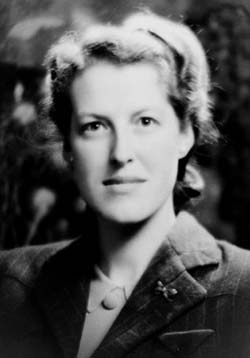
Margaret and Maggie

Some time ago, in reviewing Peter Cochrane’s book Colonial Ambition, I made an offhand reference to Margaret Kiddle’s book Men of Yesterday and had obviously intended writing a more considered post about Kiddle’s book at some later date.  Now that I come to write about it, I find myself flicking through my reading journals that predate this blog (which has largely usurped their function) and I am surprised and regretful that I didn’t write an entry about it.  It was a book that deeply affected me at the time and the only explanation I can think of for its omission is that I must have considered it ‘work’ reading as distinct from ‘leisure’ reading.  I’m increasingly finding that there is no boundary between the two- I don’t know whether that’s a good thing or not!

Men of Yesterday is framed by the poignancy of the circumstances by which it posthumously reached publication.  Its author, Margaret Kiddle was a tutor at the University of Melbourne, but described and downplayed herself as “not an academic”.  She died of renal failure, after years of illness and a decade of dialysis, at the age of 44 with her manuscript finished but unrevised.  She left for her literary executors (including Max Crawford and John Le Nauze)  a list of what she saw as essential revisions and this note:

I guess this is just another ‘Melba farewell’ but if not-

Max, as you will be going to Wisconsin, I suggest that if he will, John takes over the revision.

John- I should be very grateful if you would do it for me.

Acknowledgements: The file correspondence and comments on notes will help you- don’t forget to thank yourselves!…This book has been finished in dramatic circumstances- for publicity purposes cash in on them as much as you like- it may earn some money!  (cited in MacKellar, see below)

But this was no ‘Melba farewell’– it was the real thing, and the book needs no cashing in.   Margaret Kiddle was proud of her pioneer ancestors, and the book is almost an act of love to the experiences of her forebears.  It is a very human book and it has attracted its share of critique. As the pointedly-titled thesis What Kiddle forgot reminds us,  aboriginal dispossession and women’s roles were kept in the  background,  and it has attracted (perhaps unfairly)  a reputation  as  a book of its time and historiography.

I’ve been reunited with Margaret Kiddle through a beautifully written opening chapter in a book by Maggie MacKellar called Strangers in a Foreign Land.  It has been generously- indeed rather TOO generously??- downloaded into Google Books and the opening chapter, at least, is a cracker.  MacKellar describes her  rediscovery of Kiddle’s work as part of her own project on the Niel Black diaries and the book that follows is an edited and interwoven transcription of Niel Black’s diaries.   In her introductory chapter she reprises early Port Phillip and Western District history, interweaving it with Major Mitchell’s acclamation of Australia Felix as the culmination of his journey that started just several kilometres from her own home.  She explains, as all historians experience and many (too many?) describe, the rush of emotions in dealing with primary documents, with her consciousness of what she is reading heightened by the elemental summer smell of bushfire that seeps into the cloistered space of the State Library reading room.  Despite my own as yet unresolved feelings about historians’ use of themselves in the history they are telling,  I have no such qualms about  edited diaries and letters.  It is in the historian’s interaction and shaping of the primary documents that the engagement with larger historical questions emerges:  it is obtuse to pretend that the historian is not there reading, absorbing, making connections and talking back to the material.

Just from the extracts available online, this looks a beautifully presented book.  Time, and an awareness that I am becoming distracted,  prevent me from reading further, but the opening chapter is a delight in itself.

References

Kiddle, Margaret Men of Yesterday: A social history of the Western District 1834-1890 Melbourne, Melbourne University Press, 1961

MacKellar, Maggie Strangers in a Foreign Land: The Journals of Niel Black and Other Voices from the Western District,  Carlton Vic., Melbourne University Publishing, 2008

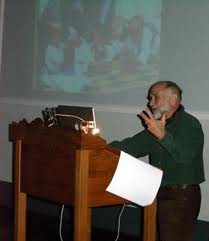
Vale Rhys Isaac

I heard yesterday that Rhys Isaac has died and I feel diminished, even though I could not in any way claim to ‘know’ him and even less could I say that he knew me.

Rhys was Emeritus Professor with the History program at La Trobe University, and even when I was an undergraduate student there in the 1970s, I remember seeing his name on the door.  He holds the distinction of being the only Australian historian to win a Pulitzer Prize for his book The Transformation of Virginia  1740-1790. The excitement that greeted the announcement of his prize is part of La Trobe History folklore-  many of the academics who were part of the faculty are still there and speak of the clamour of the press and the feeling of  shared pride as news of the prize filtered through.

Rhys was part of what has been known as the ‘Melbourne School’ of historians- rather a misnomer as many of them were based at La Trobe.  Rhys, along with Inga Clendinnen, Greg Dening, Donna Merwick, Ron Adams write  deeply textured, lyrical histories,  strongly influenced by the ‘anthropological turn’ of the 1970s.  Their works are things of beauty.

He, along with the other ‘Melbourne school’ historians have been generous in their encouragement of other historians and postgraduates.  Rhys often attended our postgrad seminars on Thursday nights; this is the sphere in which I came into contact with him and that’s how I’ll best remember him.  A small,  twinkly, elfin man he would wait until all the other questions had been exhausted before he’d raise his voice with a chortly laugh and you’d turn to him, knowing that his question would take the discussion somewhere else.  “Where IS he going with this?”  you’d think, and suddenly a whole new perspective would open up as he’d draw things from the paper that we’d just heard, weave them together then suddenly your mind would explode into question upon question.  You were aware of his rapier-sharp intelligence- he’d unsheathe it at times- but when he was dealing with postgrads in particular you felt as if you’d been helped to clamber up a step in your understanding, and the world looked bigger from there.

Rhys was a word-master.  He had an unusual accent, influenced by his lengthy stays in America and his South African background, and there was a certainty and deftness in his language.   On special occasions he wrote special pieces- unfortunately often as obituaries- which captured and honoured the essence of a person or event.   I only wish I could find the words, and a fuller knowledge of the man to do the same for him.  I need not fear, though.   I have enough faith in the influence he had on cohort after cohort of colleagues, graduates and writers to know that someone else  will.

Thank you Rhys.

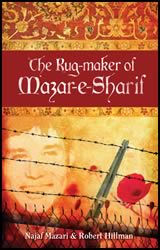
‘The Rugmaker of Mazar-e-Sharif’ by Najaf Mazari and Robert Hillman

2008,  262p

Right wing commentators have been insidiously successful in characterizing refugees as “illegals”- a term that is both inaccurate and dehumanizing.  The few images we see from detention centres reinforce the characterization of angry, defiant and confronting young men and their ‘demands’ often evoke a bristle of resentment.   It has struck me that the people I know who are most strident in their denunciation of refugees are often those people who would bribe and bully their way to the top of any putative ‘queue’ if their own families were under threat.

This is the first book that I have read about an Australian Afghan refugee, although I suspect that others will follow, just as the life-stories of Vietnamese boat people and Jewish refugees have before them.  The book is written in conjunction with Robert Hillman, whose book,  The Boy in the Green Suit I read recently with my bookgroup ladies- indeed this too, was a bookgroup choice. It was a happy coincidence: having read the two books in close succession I can see why Robert Hillman would have been attracted to his story, but also it reinforced for me that it is indeed Najaf’s voice that we are hearing here.

I suspect (on the basis of no evidence whatsoever!) that Hillman’s contribution came in the structuring of the book, rather than in the words or sentiments uttered.  The language itself is simple, and occasionally captures that shard-like truth that comes because the writer is not a native-speaker: “I did not know that I could feel this much sorrow without a body to bury”.  The book is not a straight chronological narrative- and here, perhaps Hillman’s familiarity with an Australian audience and the Australian publishing market comes into play- because it starts with Woomera which is well known, albeit somewhat uneasily among Australian readers, before returning to Afghanistan and the beginning of his journey.  A rather incongruous outburst of foreshadowing near the start of the book reassures us that there will be a wife and daughter in suburban Melbourne one day in the future, and the draw of the book is to find out how he gets to that happy situation.  His journey through Indonesia and onto the boat does not emerge until close to the end of the book by which time you are won over by his goodness and humanity.   The logistics of the financial transaction with the people smugglers is somewhat glossed over, but the journey on the small, overloaded boat is well described.  Perhaps, too, this is a statement that even though the means by which refugees arrive is a red-hot issue for Australians, it is only a small part of the overall story and by no means its defining feature.

As a reader, I was aware throughout that Mazari was not of my own culture.  His belief of God’s will, his acceptance of mystical explanations and the tenor of  his family and marriage relationships made this plain.  On the other hand, though, people obviously warmed to him as a person and there were small acts of kindness that changed the trajectory of his life.  There were petty cruelties too. I am appalled by the vision of women floating in those perversely ethereal blue burkas, but had not particularly considered the plight of young boys growing into adolescence who would be hoovered up into the politics of warfare.  No-one could be unaware of the civilian deaths, but seeing them played out within one family, over an extended period of time, brought home the drawn-out nature of this ongoing conflict.

You can read more about Najaf Mazari here and it makes me smile to see him there in his rug shop- I feel as if I know him.  I find myself reading about Afghanistan again with more interest and it has put the human back into these reports for me.  Quite an achievement.

Bringing ’em in

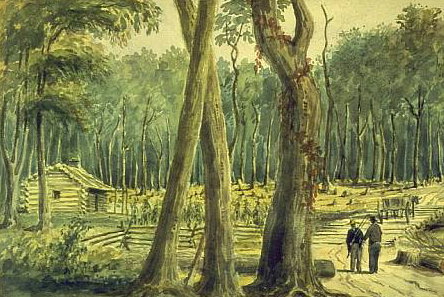
Pioneer homestead, Chatham Upper Canada 1828. P.J. Bainbrigge

Those of you following my academic progress (such as it is) will know that I’ve been turning my attention to Upper Canada, where Judge Willis presided on the Kings Bench in 1827-28.  It’s with an element of trepidation that I post anything about Upper Canada here at all on a blog ostensibly oriented towards Port Phillip in Australia, aware as I am of my lack of knowledge in the field.  Be that as it may, I find myself reading through bi-focal glasses now: alert to resonances in one colony that I’ve detected in the other, and conscious of parallel movements across the empire.

I’ve just finished reading an article by J.K. Johnson called ‘Land Policy and the Upper Canadian Elite Reconsidered: The Canadian Emigration Association, 1840-1841’ in an edited collection of essays in honour of the Canadian historian J. M.S. Careless. [Surely an unfortunate surname for any historian.  Careless himself reassured students in his survey of Canadian history course that they should not be concerned at having a lecturer called Careless, for a former head of the Department had been a Professor Wrong. (p. 21)]

Although this article falls beyond my 1827/8 pre-Rebellion interest in Upper Canada, I was drawn to read it because I was conscious of the emigration schemes operating within Port Phillip during the 1840s and was interested to compare them.  The ultimately-unsuccessful  Canadian Emigration Society was established in 1840 with a 2-pronged approach.  Prominent landowners in Britain (and particularly Scottish landlords)  would be encouraged to promote and support emigration to Upper Canada while, at the other end,  Upper Canadian landholders would offer free grants of 50 acres to incoming settlers.   There was a general feeling in Upper Canada that immigration per se was good for the colony, and the steep drop in incoming migrants after the 1837 Rebellion was viewed with alarm.  But, just as importantly, a number of well-connected Upper Canadians had amassed large landholdings as a speculative venture and their own land would increase in value if settlers could be attracted to the area.

There was a strong emphasis on land clearing.  I’m also reading Susanna Moodie’s Roughing it in the Bush, and I’m very much aware of the presence of the forest- it seems almost disloyal as an Australian to refer to it as ‘bush’.  The imperative to clear land was built into the Canadian Emigration Association Scheme:

“To such emigrants with families as shall come out under the auspices or with the special recommendation of the societies at home, it is proposed to give fifty acres each, upon condition of actual settlement and clearing a space of ten acres of the front of their locations, erecting a dwelling house etc for themselves, and clearing one-half of that portion of road lying in front of the lot of which their grant forms a part.  The use and possession of this land will be secured to them immediately, and after three years’ actual residence, and the performance of the conditions above specified, a deed in fee simple, without charge, will be given to them”

In an article in Historical Essays on Upper Canada: New Perspectives called ‘Forest into Farmland: Upper Canadian Clearing Rates 1822-1839′ Peter A. Russell notes that the rate of clearing forest was seen as a crucial index of a man’s  economic success and social advancement.  He noted that at first settlers needed to clear to provide immediate shelter for themselves and their families, while often working for wages on a more advanced settler’s tract. After a couple of years, the land had to be cleared again because of secondary regrowth.   Darrell A. Norris’ chapter in the same volume ‘Migration, Pioneer Settlement and the Life Course: The First Families of an Ontario Township’ noted that often families lived temporarily in more settled towns before shifting to the bush once they had sufficient working-age children to make a go of it.

I find myself comparing this with Port Phillip emigration at much the same time. There were bounty migrant schemes, but the emphasis there was on attracting labourers, both agricultural and industrial, and domestic servants.  There was a general reluctance for newcomers to shift into the country where there was much more of an emphasis on pastoral activity than farming, and it was mainly ex-convicts and single men who took on the role of sheep-hand, for which labour was most scarce.

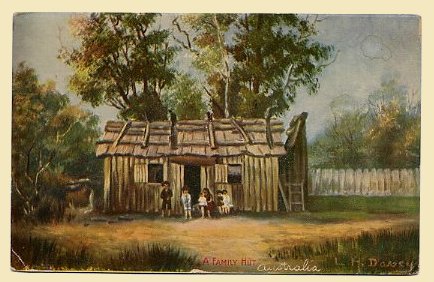
Postcard Family Hut Australia (1909)

Certainly ‘improvements’ were expected of selectors under the 1869 Selection Act- a house, boundary fences, clearing and cultivating at least 32 acres. (Some interesting, later images here)   Of course, the type of land dictated the emphasis given to clearing. Sparsely timbered plains posed no problem, but especially in Gippsland, the bush took on a daunting scale more similar to that in Canada.  But once it had been ring-barked and burnt,  the battle seemed won.  As one Gippsland selector W. M. Elliot, rejoiced at the end of his life

not a vestige remains of the vast forest that once so stubbornly resisted our labours.  Hill and vale covered in verdure as far as the eye can see! (cited in Dingle p. 67)

In the end, the Canadian Emigration Association was eclipsed by other developments.  The main proponent, Dr Thomas Rolph, became attracted by other (likewise unsuccessful) large-scale land development schemes whereby huge tracts of land would be purchased in England and sold to settlers, and by the early 1840s emigration had picked up of its own accord.  In Port Phillip, the bounty scheme almost bankrupted the government in a time of depression and by the early 1850s the gold rush made such schemes redundant.

References:

J. K. Johnson ‘Land Policy and the Upper Canadian Elite Reconsidered: The Canadian Emigration Association, 1840-1841’ in David Keane & Colin Read (eds) Old Ontario: Essays in Honour of J. M. S. Careless, Toronto and Oxford, Dundurn Press, 1990.  pp. 217-233

Peter A. Russell ‘Forest into Farmland: Upper Canadian Clearing Rates 1822-1839’ in (Ed.) J. K. Johnson and Bruce G. Wilson Historical Essays on Upper Canada: New Perspectives I ,Ottawa Canada, Carleton University Press, 1989. pp.131-149

Darrell A. Norris ‘Migration, Pioneer Settlement and the Life Course: The First Families of an Ontario Township.’ (Ed.) J. K. Johnson and Bruce G. Wilson Historical Essays on Upper Canada: New Perspectives I ,Ottawa Canada, Carleton University Press, 1989. Pp. 175-201

Tony Dingle Settling, NSW Australia, Fairfax Syme and Weldon, 1984

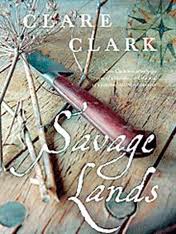
‘Savage Lands’ by Clare Clark

2010,  374 p.

Okay- I confess that I was attracted to this book by the cover, and by the blurbs by Amanda Foreman who assured me that “Clare Clark writes with the eyes of a historian and the soul of a novelist” and Hilary Mantel who told me that [Clark] “meets the eighteenth century on its own terms; knocks the wig off, twists its private parts and spits in its eye…”.  Twist and spit on, I say.  I’ve since found that it was longlisted for the 2010 Orange Prize.

In his book  Replenishing the Earth: The Settler Revolution and the Rise of the Angloworld 1783-1939, James Belich emphasizes the importance of not the  ‘founding fathers’ but the ‘birth mothers’ in ensuring the demographic progress of a settler society.  This book has the birth mothers of Louisiana as its focus, and women’s bodies are at the centre of its focus, as sexual partners,  wives, women in labour, women as objects of desire.

Its main character, Elizabeth Savaret is one of the ‘casket girls’ sent out from France to find a husband amongst the French settlers in Louisiana.  She is a sensitive, educated woman as the frequent (and possibly unnecessary) references to Montaigne throughout the book attest.  In this government-sanctioned marital lottery any husband will do, it seems, but in one of the breathtaking jumps in plot that Clark negotiates, Elizabeth falls deeply, passionately in love with her husband Jean-Claue Babelon.  We do not read about their first meeting, their courtship, their marriage- only that she has been awakened to her own sexuality and that she adores every part of the man who is now her husband.

At this point, I may have been a little sceptical about such slavish adoration. But, having just turned from reading the article about Lucy Peel’s journal, I was struck by the similarities with Lucy’s own declaration of her love for her husband (albeit in a letter to her mother):

the separation of husband and wife must be dreadful, for the love between them is, or ought to be, “Strong as Death” and the longer they live together the harder it would be to part, at least I feel it would be so, for much as I loved Edmund when I married him I have treble the affection for him now, I did not know half his good qualities, he has never spoken an angry word to me and manages my hasty temper so well that I almost fancy at times that I have become a most amiable person.  (J.I. Little ‘Gender and Gentility on the Lower Canadian Frontier: Lucy Peel’s Journal, 1833-36, Journal of the Canadian Historical Association, 1999 Vol 10 p. 66)

It is not just Elizabeth who has fallen in love with Jean-Claude, however.  A younger man, Auguste Guichard, encountered the trader Jean-Claude in the tangled wilderness of Louisiana. Auguste had been left by earlier explorers as a hostage to an Indian tribe while they were passing through the territory and he spent years there, growing up learning the language and observing the tribal practices, neither part of the tribe but no longer completely French either.  When Jean-Claude stumbled onto the scene, Auguste too fell in love with him, not necessarily in a home-erotic way but more as a type of hero-worship.  He returned to ‘civilization’ with Jean-Claude where, in the glow of Jean-Claude’s presence, he fell in love with Elizabeth too in an inchoate fashion.

In this love triangle, it is Jean-Claude who is the least fully realized character. He does not deserve the love of either Elizabeth or Auguste as they both come to recognize, and they are both implicated in his betrayal and suffer for it.  This brings the first part of the book to a close, and as I turned over to Part II (portentously titled ‘After’) , I found myself aware that something momentous had happened in their lives, but I wasn’t quite sure what it was.

In another of her breathtaking plot parachutes, Clark then fast-forwards fifteen years and gradually colours in the circumstances and consequences of the act that closed Part I of the book.   Life has continued on for both Elizabeth and Auguste, but they are bound by their mutual guilt.  The changing circumstances of the Louisiana settlement and its relationship with the Parisian metropole bring them again into each other’s constellation.

This is a very female book, with heavy emphasis on childbirth, miscarriage and sexuality.  The women in the book are drawn well, not just in their own individual characters but in the nature of female companionship and rivalry.  Auguste is more inscrutable and shadowy, but that could be a response to his marginal status between French and Native American communities.  But the main character of this book is the Louisiana forest and swampland, and here Clark’s writing is quite beautiful.  Perhaps it is a little overdone and at times repetitious, but for me it acted as a reminder of the contingency of the settlement by dragging me back to the hostility and sheer dominance of the landscape:

In the wilderness savages lurked in the shadows and the prodigious forest nosed and slid and crept and coiled upward without ceasing.  The licentious suck of it rotted the roots of the trees and pushed blindly up through the decaying luxuriance of its half-digested self, an eruption of snaking coils and crude excrescences bursting from the thick black slime.  Its fecundity was as grotesque as it was shameless.  It throbbed in the ceaseless thrum of the cicadas, in the suck and gasp of the reed-choked bayou.  It draped itself from the trees, smearing their trunks with velvet, hanging in gluttonous hanks from their branches and exploding into pale, fleshy mushrooms at their roots.  There was no shape to the forest, no order.  There was only the ungovernable profusion, blotting out the light, gorging on the lush compost of the dead. (p. 299)

Swamp-porn anyone? (Oh dear? Will that attract spammers and dodgy search terms?)

So where does the buck stop?

We’ve had the rather unedifying spectacle of our airports filling up with disgruntled would-be passengers, unable to book into their Virgin Blue flights because the computer is down.  But it’s not Virgin Blue’s fault- oh no- it’s Navitaire, the company contracted to run the reservation system.  And who are Navitaire? Ah!  They’re a subsidiary of the outsourcing company Accenture.  Is this where the buck stops? Are we there yet?

Ah, footy!

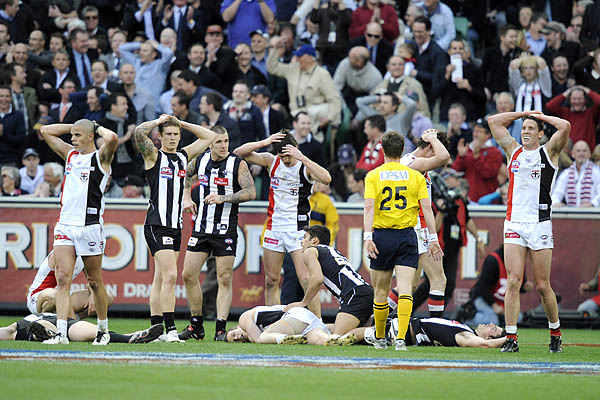
Simon says “Hands on Heads!”

What a beautiful game! We didn’t lose! And we get to do it all again next week!

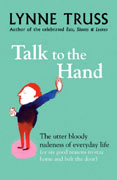
‘Talk to the Hand’ by Lynne Truss

2005,  210 p

Lynne Truss is  right in many ways: we are surrounded by obnoxiousness, rudeness and aggression every day, exemplified by the Jerry-Springeresque “talk to the hand coz the face ain’t listening”.  I must admit that no-one has ever said that to me directly, but unhappily I know exactly what it means.

Truss herself admits that the book is a “big systematic moan about modern life” and that’s what it is.  It is only a short book, which is a blessing in a way- it’s a bit like sitting through a boxed DVD set of “Grumpy Old Women”  and even for me there’s a limit to such unmitigated grumbling.

Her six good reasons to stay home are:

1. the absence of ‘thank you’ or ‘sorry’ (one of my own moans is the ubiquitous “if anyone takes offence…” )

2. the way that companies push their demands back onto you as your responsibility ( my contribution: the con of ‘self-serve’ in petrol stations which is slower for everyone and means that my oil is never checked and my tyres are always flabby)

3. the invasion of personal space (yes, the mobile phone in the train).

4. the “F### off” response ( I hate it but must also confess to being too ready to drop the F word myself. It’s a bad habit that I would like to work on)

5.  Disrespect and non-deference  (I agree: I don’t necessarily want my first name used by everyone)

6.  the idea that someone else will clean up your messes (my own teeth-grinding trigger- junk food packaging thrown out of a car window).

We can all add our own-  for example, it makes my blood boil when an unsolicited phonecall rings you then puts you on hold!!!  I don’t thank John Howard for much, but tougher gun laws and the do-not-call register are two good things.

She makes the point that her book is not an etiquette or manners book, and now having read about the 19th century literature of this type, she’s right about that too.  An etiquette book is premised on helping you as an individual to join the  others, by doing the right things.  The 19th century version was based on the precept that you could judge an individual by the way they behave, and that there is a connection between manners and morals.  The outside world and the people in it was a world that the reader desperately wanted to be part of. If changes had to be made to one’s behaviour and demeanour in order to be accepted, that was a price gladly paid.

All this is reversed here.  As she says, many people think that it is harmful, unhelpful and simply wrong to judge a person by the way s/he behaves (p. 193).  Instead of the outside world being something we want to join, it’s them out there who are the problem.

It’s ironic that the 19th century version of the etiquette book was based on making “me” part of “them”. In the 21st century version,  it’s all about me- with  our ‘i’pads, and ‘My’ spaces and, heaven help us, ‘My’ school (which I still haven’t looked at because I don’t want my visit to count as approval of the whole concept).  But now it’s me against “them” who are so obnoxious because they all care only about their own “me”. And let’s face it, who’d want to be them?

All these pronouns are confusing me (or I).