2010, 167 p.
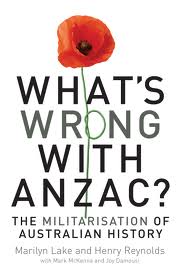
I doubt that this book will be reissued in the next two years. I’m sure that the publishers have had an asterisk against 2014 and 2015 as bumper years for military history, with the centenary of WW I in 2014 and the Gallipoli centenary in 2015. This book, originally published in 2010, is not likely to sit comfortably on the shelves with big books with big blokey authors that would have been scheduled specially to take advantage of all this interest. But many of the sentiments expressed by the historians who have contributed to it will continue to bubble along underneath all the ceremony, emotion and hyperbole. You can find it manifested in the Honest History website.
In 2009 historian Marilyn Lake was invited by the History Teachers Association of Victoria and the University of Melbourne to give a lecture on ‘The Myth of Anzac’ in a series on mythologies. A condensed version of the address was published in The Age soon afterwards.
In it, she argued that in the 21st century Australia should reclaim the values of equality and justice which in an earlier era was thought to define a distinctive ‘Australian’ ethos. She suggested that it was inappropriate for “a modern democratic nation to adopt an Imperial, masculinist, militarist event as the focus of our national self-definition in the twenty-first century.” (p.3)
A furore erupted online- a “mixture of hostility and support, personal abuse and thoughtful reflection”. In her introduction to this book, she briefly mentions the abuse but outlines in more detail some of the more reflective responses posted onto the Comments section of the Age website.
This book is a compilation, then, of chapters written by a number of authors (both male and female) in response to the questions raised by Lake’s article and the commentary that surrounded it. Continue reading →
Well, well, I see that Banyule Homestead is on the market with expressions of interest closing on the 8th May 2014. It looks absolutely magnificent.
I note with some concern that the advertisement refers to “scope for a 3/4 lot land sub-division (STCA). “ I hope that any new buyer of Banyule Homestead knows that it is a property loved and valued by many, many people in the community. My dearest wish is that the new purchaser nurtures the property in its entireity as a landmark of Melbourne, splendid in its surroundings.
We watch.
For more about Banyule Homestead, visit my other blog at
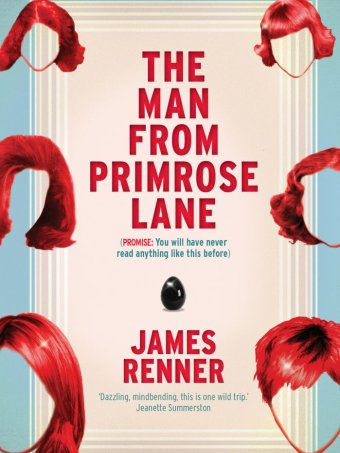
I’m going to be very old-fashioned and curmudgeonly, but I REALLY didn’t like this book. I really can’t talk very much about it without divulging spoilers.
Oh, alright – just the start then….an old recluse is murdered. He had been shot in the stomach and his fingers had been cut off and minced in the blender. He always wore mittens and seemed to have no friends or family. David Neff, who had written a best-selling true crime book some years earlier is alerted to the case by his publisher, who is concerned that David is spiralling into depression after the apparent suicide of his wife four years earlier. Who is this old man? Why does he always wear mittens?…..and then you’ll have to read the rest (if you still want to after this review).
The book is a mash-up, I suppose, of several different writing genres. It’s all very self-referential and tricksy, but at the end of it, that’s just how I felt- tricked. Call me thin-skinned, but having the author jeering at the reader for wanting some sort of resolution at the end is a bit rich.
It is, apparently, going to be made into a film and it will probably work better on the screen than it does on the page.
The book is a one-off. The blurb on the front brags that ‘you’ve never read anything like this before!’. Well, that’s for sure and I certainly won’t in the future. It’s the equivalent of a sight gag: it only works the first time.
My rating: 3/10
Sourced from: CAE bookgroups.
Read because: it was a bookgroup selection with The Ladies Who Say Oooh. In this case, the Ladies Said “Eeewwww”. Boy, I’m glad that I didn’t choose this book!
I happened to hear Shannon Lush on the radio the other day- she of the handy household hint and stain removal. How Olde Worlde, I thought: household advice on the ‘wireless’! It brought to mind my mother, who listened religiously to Martha Gardner on the radio. My mother was of the class and generation of women for whom ‘housewife’ was a conscious career choice, a source of pride, learning and improvement. There were new products to try and master, old skills to polish and pass on, recipes to experiment with, and new trends and fashions to encompass. The household hint genre of newspaper columns, books and radio and television programs fed right into this view of housework.
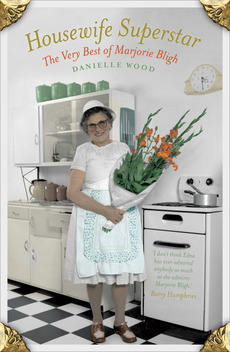
I have never heard of Marjorie Bligh, who seems to have been a Tasmanian phenomenon. I guess that each Australian capital city had their own version. Tasmania’s Marjorie Bligh is said to have been the origin of Barry Humphrey’s Edna Everage, before she became a Dame (humph!) and while she was still Norm’s wife, Valmai’s friend and Kenny’s mother. One of the author’s quests in this book was to probe this claim.
Marjorie had three authorial name changes from Marjorie Blackwell to Marjorie Cooper to Marjorie Bligh as she moved through three marriages. It is a sign of her own individual presence and what we would now call her ‘brand’ that her followers recognized her and followed her through these different guises. Her first marriage was an unhappy one ending in divorce, something more devastating and noteworthy then than now, and she was widowed twice. The author, Danielle Wood, treats these marriages with respect but with a clear eye as well. She allows Marjorie to tell her own story, to withhold and to embellish, but it is quite easy for the reader to fill in the silences and to imagine the other perspectives that others in her story might tell.
Marjorie Pearsall was born in 1917 in Ross, in the Tasmanian midlands. The convict architectural heritage of the town would not have been a tourist drawcard at that time. Her father died when Marjorie was three. Marjorie, as she told it in her own autobiographical writings, was always an industrious homebody, making money for the straitened family through running errands for the teachers, cleaning the school room, knitting and sewing. She was a perfectionist and had ‘stickability’ (p. 31). After leaving school she worked as a ‘help’ until she met her first husband Cliff, whom she married in 1938. In a world seemingly untouched by war, they shifted to Campbelltown.
It was there that she set her sights on the Agricultural Show. In 1958 she surpassed her record of the preceding two years, winning prizes in seventy-eight categories. Her passion was the creation of her dream home, Climar (the combination of Cliff and Marjorie’s names), an Art-Deco inspired brick house, now on the Heritage register (for all the good that will do, as Banyule has taught me) and rather oddly dated for its completion date of 1955. My ex-husband’s family lived in a very similar house that was built in the late 30s-early 1940s- perhaps architectural trends took longer to reach Tasmania? You can see a photo of Climar here (there are many other photographs related to Marjorie Bligh on this site as well.)
There seems to have been a falling out with the Agricultural Show committee in 1958 over the awarding of the W. T. Findlay cup for most points awarded, and she withdrew from exhibitions in 1960, 1961 and 1962 and in this hiatus in her show career she turned to writing. Marjorie Blackwell at Home was her first book, published in 1965. It was to be republished in three editions . In 1973 under the name At Home with Marjorie Cooper, and then again in 1998 as At Home with Marjorie Bligh. The first edition was 310 pages in length, comprising 44 sections covering food, flowers, gardens, children’s parties, pets and stains. “All these things” Marjorie wrote assertively in the foreword “are dear to the heart and the majority of all women.”
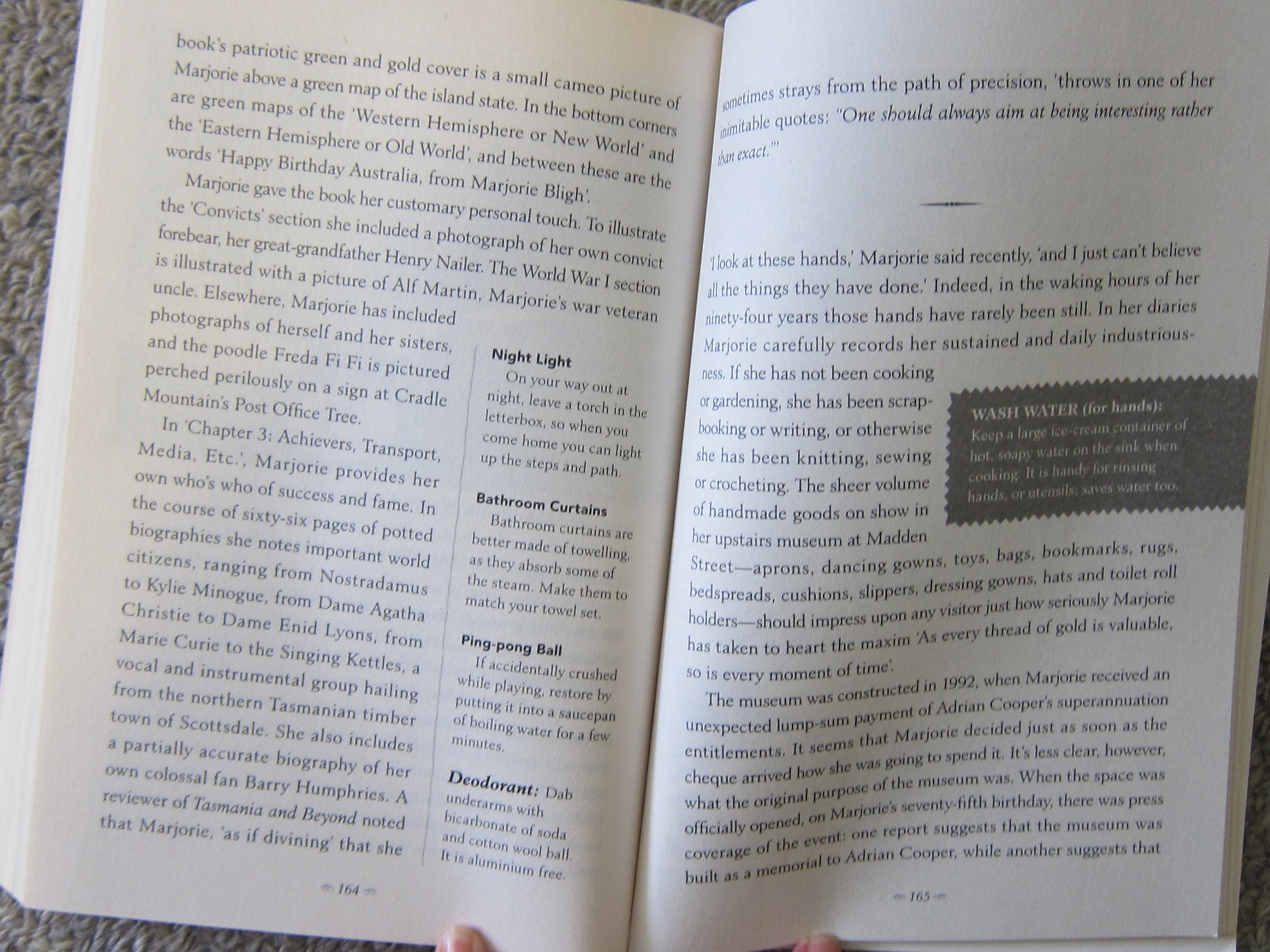
“Assertively” is the operative word here. Danielle Wood’s book is sprinkled with the dictates and aphorisms of Marjorie Blackwell/Cooper/Bligh, gleaned from this and her other publications. There’s a rather threatening confidence in the way that Marjorie frames her advice implying that of course you would WANT to prevent the cock from crowing (by placing a lath above his head so that his comb brushes against it) or WANT TO walk to country dances wearing a rubbish bag with two holes cut in it, drawn up to your waist with the pull-tie to protect the hem of your gown from the mud.
They’re small slices of life from another world. Some examples: try putting sticky tape on your toddler’s hands and watching ‘him’ being delightful as he tries to pull it off; use a slice of beetroot to rub on your cheeks if you run out of rouge; make a nice apron for yourself by sewing together nine men’s ties. Her worldview is that of “wilful waste brings woeful want” (a family aphorism that I grew up with as well) borne not only from straitened circumstances but also almost as a form of resistance to the deluge of manufactured consumerist goods that now engulf us. However, I still struggle to imagine WHY you would want to crochet a cover for a 5 litre icecream container (so handy for transporting small cakes and scones) out of used bread wraps.
Wood (or her publishers) have decided that these excerpts from Marjorie’s writings drawn from her books and autobiographies should be inserted throughout the book. Hence, as well as small break-out boxes on the side of the text, the narrative is interrupted for pages at a time with a lengthy extract. I’m not sure if I liked it or not. I found myself distracted by reading the excerpt, but on the other hand it captured well this nagging, insistent soundtrack of what I perceived as Marjorie’s imperious, bossy narrative voice.
By the end of Marjorie’s long career, I think that she had become an unwitting parody of herself. Danielle Wood obviously has great affection for her, but is somewhat wary of her as well. In the foreword, she describes her as “formidable”.
As I write, she is ninety four years old, and almost certainly muttering into her coffee cup about the dire consequences that will befall me if I fail to finish this book before she dies.
She did. The book was published in 2011 and Marjorie died in September 2013.
In her conclusion, Wood reflects on her own ambivalent feelings about Marjorie (p.206)
Though I have spent hundreds of hours with her books and diaries, and talked with her, I still struggle to get a fix on Marjorie. At times on the page, I have found her difficult to warm to. But while she is often self-serving in her explanations of past events, she is also honest enough to supply the facts that allow readers to construct alternative understandings. In person, I have always enjoyed her frankness, humour and generosity. But I have always known, too, that she would have me on toast in a flash if I vexed her or let her down. It has been difficult to reconcile the written Marjorie with the living one, and simultaneously to understand the multiple versions of Marjorie that have manifested during her ninety four years.
The book is lightly written and yet insightful. It’s quite a difficult task to render gently and with respect someone who has, with the passing of time, almost become a spoof. Wood lets Marjorie speak for herself, and lets the reader fill in the silences and omissions. Ironically, with the return to ‘natural’ products and deep-green environmentalism, Marjorie could become an unlikely poster-girl for sustainability, and some may wish that there was an index to this book to locate an unlikely household hint. It is a book which chuckles to itself, but quietly.
One of the real advantages of Steve only working four days a week is that every weekend is a long weekend. We’re taking advantage of the beautiful autumn weather to take a weekend down at Phillip Island. Yes, THAT Phillip Island which Matthew Guy is getting all het up about. My, he’s as cross as patch, isn’t he? I think he doth protest too much. Something very fishy about it all, I reckon. What a joke that IBAC can’t investigate politicians.
Nonetheless, I really don’t know why we don’t come down here more often. It’s only 90 minutes from Melbourne, on freeways the whole way. It really is quite beautiful.
We’re staying at a Genesta B&B in Cowes. Very nice it is, too. Full marks for having a top sheet and summer blanket that can be used instead of the pretty but stiflingly hot doona. I can’t work out why more places don’t do the same.
It’s on a quiet side street that abuts onto Westernport Bay, about three minutes walk away. Have you ever wondered why Westernport bay is actually located east of Port Phillip Bay? That’s because Bass, who named it, did not venture any further west than this before heading back up along the eastern coast. This bay WAS west of the coast that he had charted. Apparently the Bunurong name for it is Warn’marring. Given that Westernport Bay is east of Melbourne, that would be a pretty good case for renaming it, I reckon.
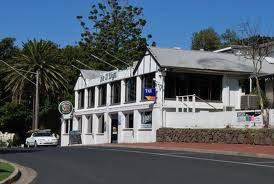
If you’ve been to Phillip Island (and most people in Melbourne have been at some stage), you’ll probably remember the Isle of Wight Hotel overlooking the pier.
Rather ordinary, I must admit, but I saw photographs of it at the local Historical Society this morning, and it was originally a mock-tudor hotel built in the early 1930s. It was rather attractive, and reminiscent of the guest houses that used to be in Marysville. It was built to replace an earlier wooden hotel that had been on the site and burnt down.
Well, it ain’t there now. The site has been empty for four years. Is that a burning rat I smell?
The empty site
Yep, it probably is the best site on the island
Whatever they build there will have quite a view
Phillip Island is well known for its penguins and koalas. It’s a very popular destination for bus tours of international tourists who want a day trip to see furry animals.
We went to see the Penguins last night. I can’t quite remember the controversy over the Seal Rocks Centre or whatever it was…something about Jeff Kennett? Well, whatever it was then, it’s now a huge slick place full of shops and merchandise and cafeterias. Still, the penguins are the real show. The lights on the beach are dimmer than I remember them being, and you sit in two large ampitheatres facing the sea. At first you can’t see the penguins at all (although you can hear them), then they seem to just materialize out of the waves. They huddle in a little cluster like shy, giggling, stagestruck toddlers, they scuttle up in a group into the sand dunes. There were three main groups of them that we saw- there may have been more, but we decided to leave by then. The sky was clear and the stars magnificent. I was rather proud that I was able to identify Mars when it rose.
Then today over to Churchill Island. It’s a beautiful, tranquil spot. Thank you, Dick Hamer, for purchasing it for us all. Lt. Grant established the first farm there in 1801 although they can’t locate the exact site. Now surely that’s a 3-day job for Time Team, I reckon- the first white agricultural site in what is now Victoria? The first permanent settlers between 1860 and 1866 were Samuel and Winifred Pickersgill, but he lost possession of it in a card game. It was taken over by John and Sarah Rogers who lived there until 1872, when it was purchased by the successful stonemason and ex-Lord Mayor of Melbourne Samuel Amess. He built the holiday house that is the main building there today. You can read more about the history of Churchill Island here. I must dust off my copy of A.G.L. Shaw’s The History of the Port Phillip District when I get home and re-read those first chapters.
Steve outside the Amess house
A moonah tree. The Bunurong saw them as as sacred
The moonah trees have unusual trunks. They look almost as if they are plaited stone.
Beside a cairn celebrating Lt. Grant and his wheat crop
In 1954 the Melbourne Metropolitan Board of Works produced a film showing the planning challenges that faced Melbourne, that “vast metropolis of one and a half million people”. The 17 minute film is available in full here:
I was surprised to see so many women in the footage of the city, and despondent to see the absolute dearth of women in the planning offices of the MMBW. I had a chuckle at the apocalyptic music that accompanied scenes of traffic jams and am puzzled by the footage of new suburbs which look a bit like West Heidelberg or perhaps Ashwood with their housing commission homes. The images of the slums must predate their demolition and replacement by the inner city high-rise Housing Commission flats.
I wonder what happened to the survey conducted by all those university students? I mourn the loss of planning for the “rural zone around the city”.
Once upon a time, the Port Phillip Herald was available online. It was on a site called “Paper of Record” prior to the evolution of our wonderful Trove. Then all of a sudden it disappeared- just like that!- swallowed by the Google Gargantua.
But miracle of miracles- it resurfaced! There it was on Google News Archive, along with hundreds of other historic newspapers, mainly from North America, but with a smattering of English, Scots and other newspapers as well.
Then all of a sudden (again) they changed the Google News page and it disappeared again. Oh woe.
But I’ve relocated it! It was there all the time! And as a reminder to myself: here’s the link as of 25th March 2014.
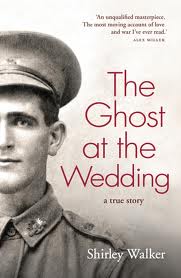
It has often struck me that I am part of a blessed generation that has lived in a time of peace and ,with only a few blips of recession, continued economic growth. My father was too young to have fought in World War II, my brothers too young for Vietnam, and unless world war breaks out within the next ten years, my son is unlikely to have to fight (and indeed, I find it hard to imagine the scenario that would prompt him to volunteer to do so). An earlier, blighted generation, however, experienced World War I, the Depression and World War II again in what must have seemed an almost never-ending succession of difficulties and disasters. Jessie Walker, who is the subject of this book, stood at the pier to wave off her brothers and their friends in World War I and then sent off her own sons and younger brothers to the Second World War. It is a war story, but told from the point of view of the women left behind.
The author, Shirley Walker, describes this book as “a memoir of my mother-in-law, Jessie and… an imaginative reconstruction of her family’s truth“. She has used letters, diaries, service records and family documents but she writes “the inner life of each character, especially that of Jessie” from the imagination. She draws on the existing paintings that Jessie created in later life as a way of reconstructing Jessie’s inner life, but imagines and describes other paintings never made. The mother-in-law and daughter-in-law relationship is often tentative- it is, after all, the love of the same man in the different guises of son and husband that links them- and you sense Shirley Walker’s sensitivity to the wider family in writing this book. She has changed some names to protect some family members.
The book opens in 1983 with Jessie in a nursing home, and from here the chronology of the book skips back and forth. The author (the daughter in law) identifies herself as “I” and Jessie’s story is told in the third person. There is limited dialogue. Although Jessie is the focus of the book, it also describes at third-hand or through letters, the war experiences of sons, fathers, nephews and uncles. It is a book very much grounded in Jessie’s life with her husband and sons on the peninsular island that emerges from the waters of the Clarence River, but it traverses much further.
It is a beautifully written, lyrical book. The men of the Walker family were alive to the sights and sounds around them, and it comes through in Shirley Walker’s retelling. The book comes with high praise from the novelist Alex Millar whose blurb reads:
An unqualified masterpiece. The most moving account of love and war I’ve ever read.
I must confess, though, that even though I was saddened by the book and the thought of so much death across several generations, I was not moved to tears. Perhaps it was the author’s restraint in telling another’s story, or perhaps it was the ethical distance that her relationship with the subject imposed on the author, already a published academic.
Like Lisa at ANZ Litlovers, I would have appreciated a family tree, as different generations were named after their forebears. I’m still a little perplexed by the title, which does not seem to refer to any particular wedding, but perhaps that is intentional. The story here of one individual woman is a generational story, and as such, one that I hope women yet unborn never have to experience.
We are sure to read many biographies and histories of World War I this year, and next year, the centenary of Gallipoli which has assumed such importance in popular Australian historiography. There is, among some historians, an uneasiness about the overwhelming prominence given to ANZAC -hence the Honest History website which notes:
There is much more to Australian history than the Anzac tradition; there is much more to our war history than nostalgia and tales of heroism. Honest History is being set up to get those two messages across. Our approach is ‘not only Anzac, but also [many other strands of Australian history]’. We see history as complex with many interwoven, competing evidence-based strands. This sort of history should be the mainstream; hyperinflation of a particular strand is an anachronism. Editorial and moderation policy, Honest History website
The bookshops already seem to be stuffed full of Big Books of War, generally written by men, many of whom have a journalistic background. I’m thinking Les Carlyon, Peter Fitzsimons etc. and of course, the author of the biggest Big Book of War of them all, Charles Bean. Where women have written about war, the focus tends to be less on battles and more on the men themselves; less on valour and bravery and more on loss and suffering. (I must confess to not having read Patsy Adam-Smith’s The Anzacs, and so I don’t know whether this holds true for her book or not). The Ghost at the Wedding fits into this more person-centred approach that encompasses both the warfront and the homefront, those who stayed behind and those who returned.
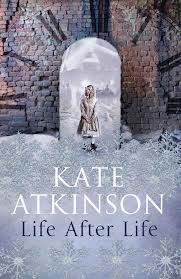
This should be my absolute favourite, top-of-the-list read for 2014, even though the year has just started. After all, it’s written by Kate Atkinson, an author whose books, across various genres, I really enjoy. It’s a time travel book and I love those too, even though it feels a little bit adolescent. It has the Sliding Doors/Groundhog Day thing going on as well, which is also good, although my enjoyment of these two movies became a bit rocky when I began thinking “But hold on, how….?” and questioning the logistics of it all. In terms of subject matter, much of this book is based during the Blitz, which has attracted me ever since I read Sarah Waters’ The Night Watch. So, all in all, it should have been a 10 out of 10 winner.
Spoiler alert
The reason why it isn’t a 10/10 winner confronted me on the opening pages. On November 1930 Ursula enters a German cafe and joins a table laden with cakes where a blonde woman is draped over a fleshy, “softly repellent” man. She places her handbag under the table and settles amongst the others at the table, then reaches down for a handkerchief from her bag. She pulls out a gun and shoots the Fuhrer dead. Darkness falls.
This is the first of multiple deaths that Ursula experiences in this book, each marked by the appearance of snow before darkness falls. She is strangled by her umbilical cord at birth: or she is not. She catches Spanish influenza: or she does not. She is beaten to death by a brutal husband: or she is not. She is killed in an air-raid attack during the Blitz: or she is not. It takes a little while to adjust to these constantly-reset scenarios, and by the end of the book I found myself turning frequently to the table of contents that lists the dates of the different episodes. Once I’d realized what was happening, I was happy to go along with the premise and there were few times when the death, or not-death, did not seem completely natural or plausible.
With the exception of the Hitler scenario which opened the book, that is. I found the whole scenario that placed Ursula in Germany unconvincing, and by tying this fictional character to a real-life historical figure Atkinsin rather clumsily and half-heartedly opened up the ’what-if’ historical can of worms. She doesn’t really DO anything with this historical question (which I do enjoy rather guiltily as an historian) and the book as a fictional work doesn’t really need to venture into historiographical waters.
Most of the scenarios are fairly short, until she reaches 1939-40. The Blitz takes up a large proportion of the book and I found myself wishing that Atkinson could get herself out of this narrative quagmire somehow. She does, with the same sleight of hand as she does elsewhere in the book, and even though I like Blitz stories, I was glad that she could leave them behind eventually.
By the time I finished this fairly lengthy book, I found myself pondering just how well Atkinson had developed Ursula as a character. The old writing adage is “show, don’t tell” as far as character development is concerned, and certainly the plot-driven structure of this book means that there is a lot of showing, again and again. Ursula’s responses to these various scenarios all ring true, so Atkinson must have succeeded in creating enough of a character for me, as reader, to judge fidelity against. This is character revealed through events, and through events that occur to Ursula alone. Do we become ourselves only through the events that befall us, I wonder? I found myself wishing that the spotlight could shift away from Ursula for a moment, to encompass the views of other characters as well.
And so, my enjoyment of this book that seems at first sight to tick all my boxes, is somewhat alloyed. I still very much like Kate Atkinson as a writer, and the book brought me a great deal of pleasure. But a 10 out of 10? Probably not….
My score: 8.5/10 ???
Read because: CAE book group selection. I missed the meeting- I wish I’d been there to discuss it further!
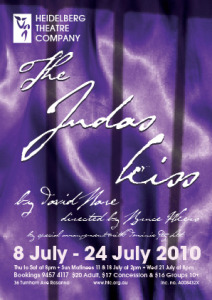
I saw this play a couple of years ago, and I see that it is currently being staged by Mockingbird Theatre with the same lead actor between 15-22 March 2014 at Theatre Works 14 Acland St, St Kilda.
Once again, I wish that I’d seen this before the final performance so that I could encourage you to go. Alas, too late (again) .
Written by David Hare, the two-act play concerns Oscar Wilde and his lover Lord Alf Douglas. Act One is set in a London hotel, just prior to Wilde’s arrest where his friend Robert Ross is trying to persuade him to leave for the continent; the second act is in Naples two years later where Bosie decides to leave the impoverished and broken Wilde to return to London and his family.
I find it hard to see anyone else other than Stephen Fry playing Wilde- surely a part that he was born to play, and there’s a danger that playing such a flamboyant figure can descend to parody. But Chris Baldock, playing Wilde made the part his own, to the point at the end of the…






 The Resident Judge of Port Phillip