Pudding people first at Christmas

magicpudding

I have had half of last years Christmas pudding in the freezer all year. “Must eat that pudding sometime” I’d think each time it tumbled out. So here I was in December, thinking about Christmas lunch, wondering if it would be TOO bad to serve up half an elderly pudding? I decided that perhaps, all things considered, it might be.  The reality is that I’m the only person in the family who really likes plum pudding, which is why there was probably half a pudding in the freezer in the first place.    Did I really want to make another pudding only to add yet another half-pudding to the freezer?  (I suppose at this rate, by Christmas 2015 I’d have a whole pudding in two bits!)

Then I spied a recipe in the Age for a Christmas Bombe.  That sounds interesting- a mashup of pannetone, ice-cream, plum pudding and pavlova. Delicious or disgusting?  It looked good in the picture.

JM-wide2-bombe-20141209120837749359-620x0

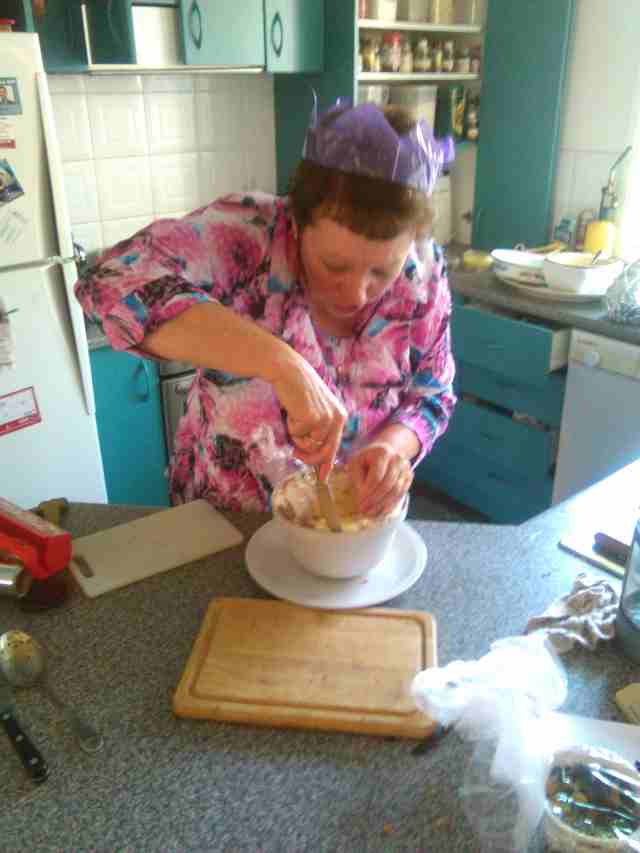
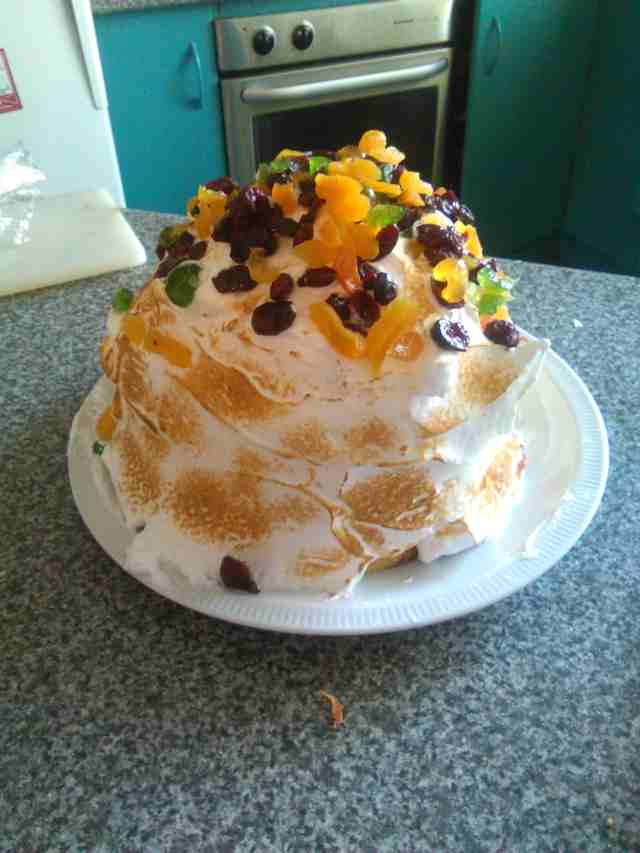
So by Christmas morning, there was a  pannetone-lined basin filled with plum-pudding icecream securely tucked away in Dad’s freezer (my freezer is too full of old puddings, you see….) ready for the great bombe-ing later in the day.  The table was set, waiting for my guests.
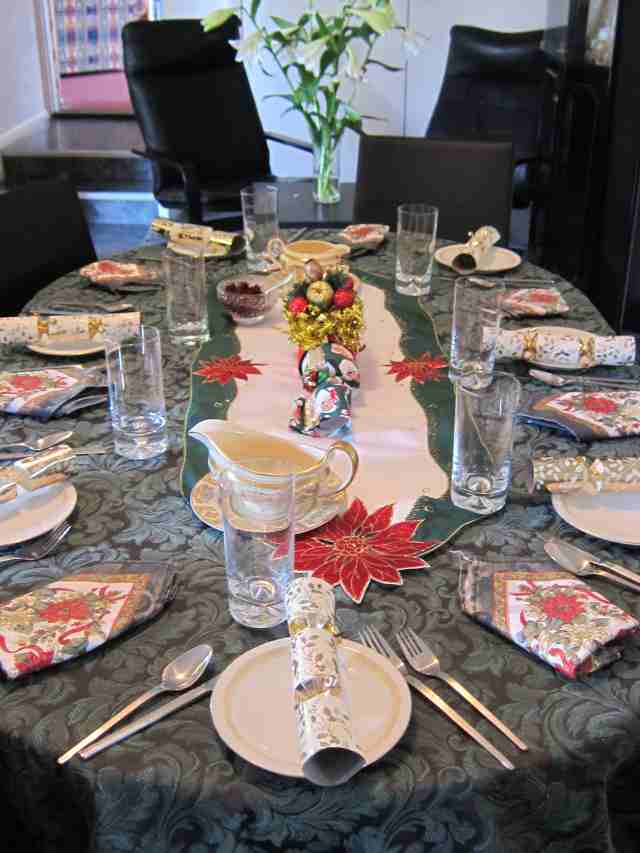
IMG_1209a

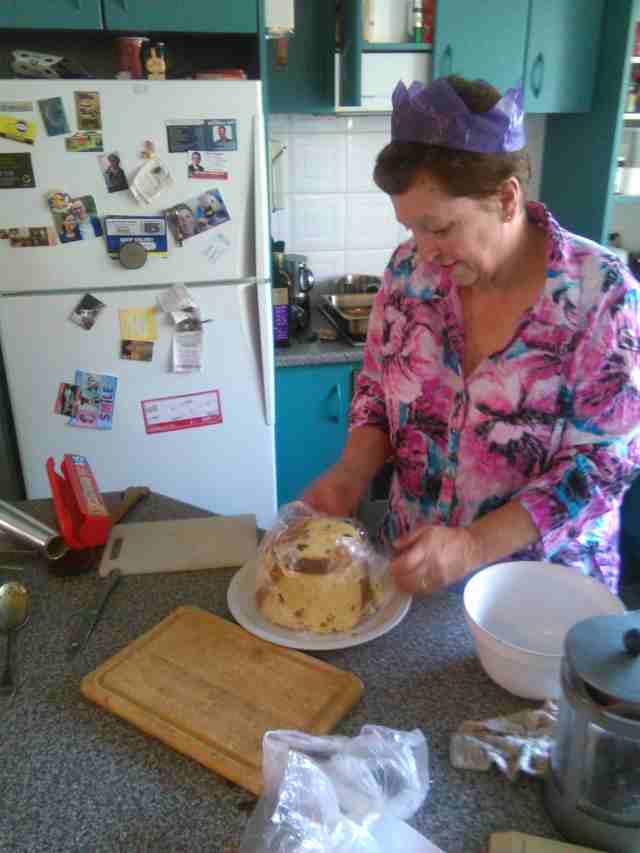
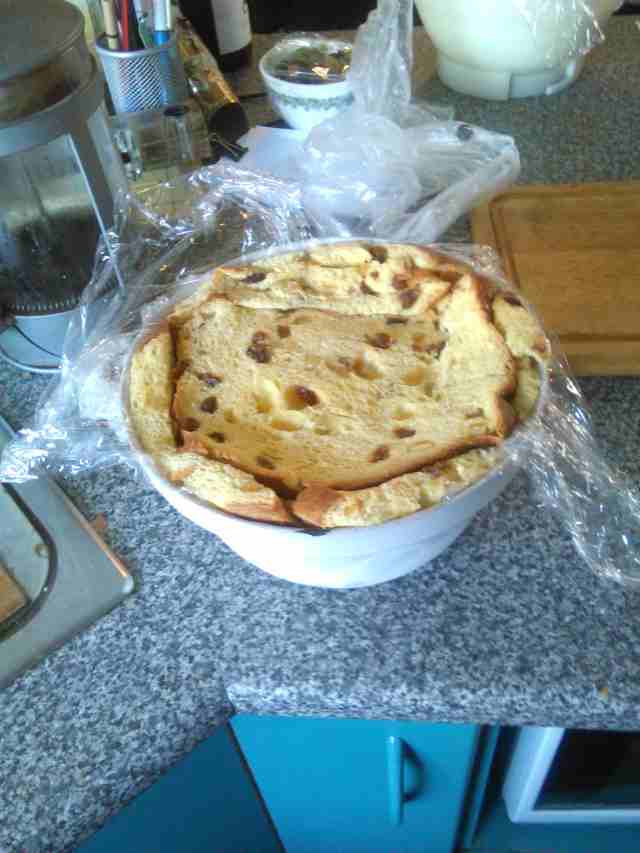
So, first thing to get the pudding out of the bowl.
IMG_20141225_144805a

Sh*t! It won’t come out!!!

IMG_20141225_144858a

Oh yes it did. (Phew!)

IMG_20141225_144942a

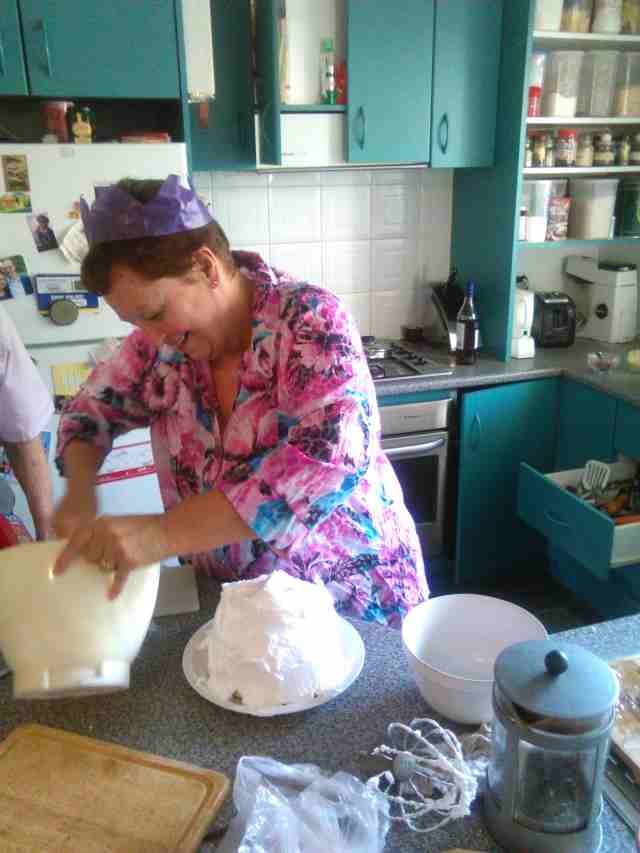
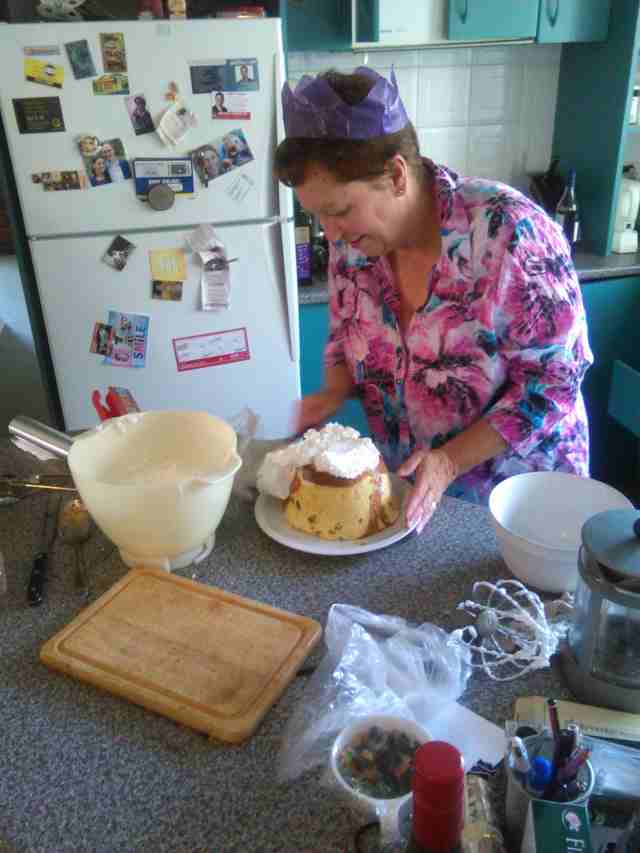
Now the great smothering with meringue.
IMG_20141225_145020a

IMG_20141225_145204a

Someone can always be trusted to clean the bowl and lick the beaters. (In this case, my 85 year old father!)
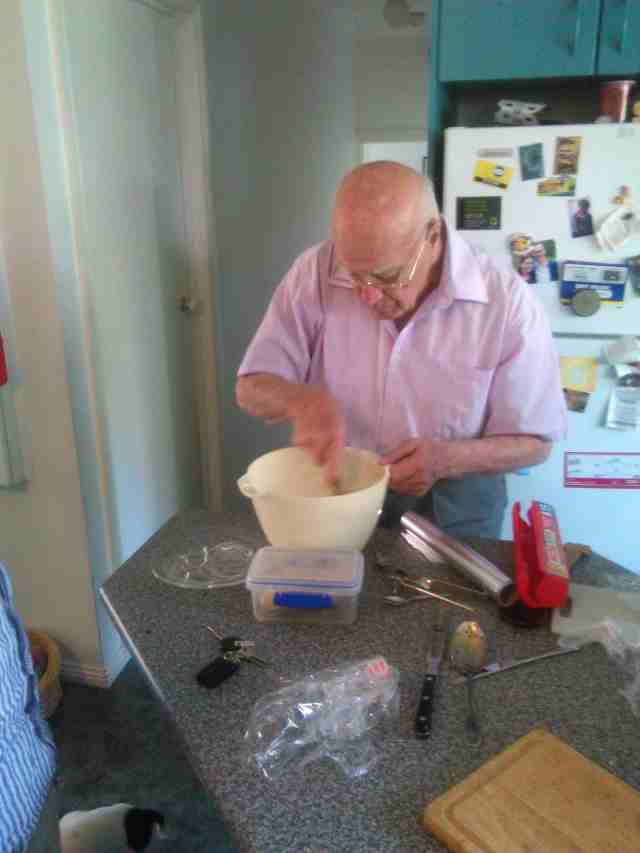
IMG_20141225_145336a

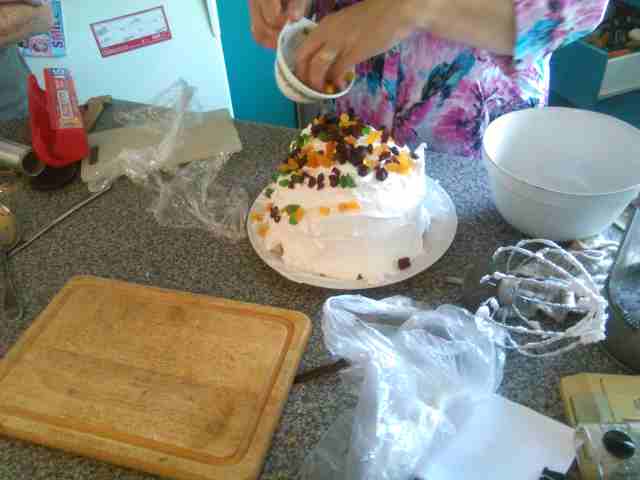
Hey, this doesn’t look too bad.

IMG_20141225_145330a

Now, for the Great Flaming.   I don’t have a kitchen blowtorch, but my stepson has two.  Not kitchen ones, though.  Which shall I go for?  The industrial-strength flame-thrower? Or the little one?

IMG_1214a

Will the big one shoot my pudding into the venetian blinds, incinerating us all?  Will the small one take an hour as a feeble flicker s-l-o-w-l-y adds a tinge of colour to the meringue?

I’m not brave.  The little one it is.
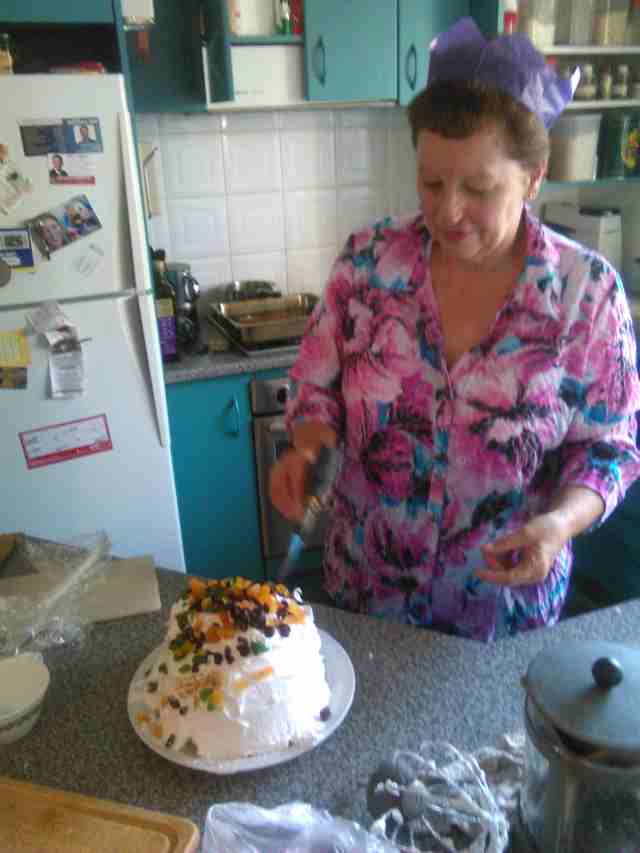
IMG_20141225_145509a

If I’m going to immolate myself as well as the pudding, you’re all coming with me.
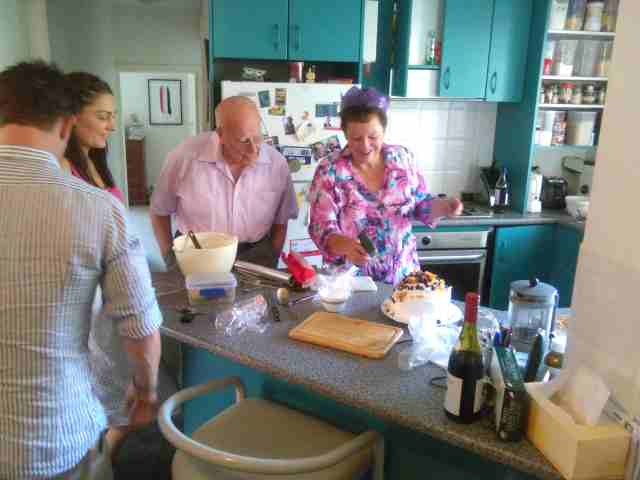
IMG_20141225_145501a

Damn. We’ve forgotten how to turn the blowtorch off.  Oh well, it will run out of gas soon.
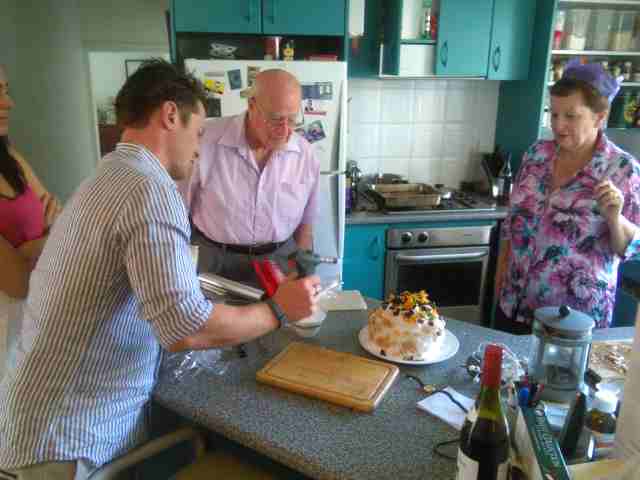
IMG_20141225_145556a

And here it is!!

IMG_20141225_145849a

Guess what? I’ve got half a Christmas Bombe in the freezer.  But, unlike Albert, the  Magic Pudding, this cut-and-come-again pudding probably won’t still be here this time next year.

After all, now that we have an Andrews Labor Government,  it’s all about pudding.
Christmas in Port Phillip 1841

We haven’t visited Judge Willis’ Port Phillip for a while.  Now that Christmas is here, let’s read an article about Christmas that was published in the Port Phillip Patriot of 1841, Judge Willis’ first year in the Port Phillip District.

CHRISTMAS IN AUSTRALIA  (Author not identified)

…Hitherto…no one has attempted to give us a sketch of an “Australian Christmas”. This festive season, in our country, has not yet been described, and in order to make up for a deficiency so glaring, I shall endeavour to convey to the reader unacquainted with our genial clime, an idea of the twenty-fifth of December in this portion of the Southern hemisphere…

…The inhabitants of this colony have adopted a great many of those customs of their ancestors and the Australians look forward to the arrival of Christmas with the same degree of fondness and veneration as a Briton. Variations in the mode of living and a difference of soil and climate may cause this season to be celebrated with less precision and minuteness here than in England. We certainly have not the same associations [?] of antiquity to instigate us, and fill us with any degree of enthusiastic ardour, yet our love of Christmas is by no means of an ordinary description…

The author then indulges in some reminiscences of Christmas back ‘home’ before remembering that it’s Christmas in Australia that he’s writing about.

During the week immediately preceding the twenty-fifth of December, every family in the whole colony appears to be thrown into a state of bustle and activity. The farmer hurries to the metropolis with his eggs, his poultry, and the produce of his lands, and purchases an ample supply of Christmas dainties for the due celebration of the approaching holiday. Raisins, currants, wines, spirits, and a large variety of other niceties, which it would be impossible for me to enumerate, are obtained by the active housewife to adorn and set off the Christmas dinner. Every one is employed in providing for the eventful day, and the ordinary avocations of society seem to be almost forgotten.

I was particularly interested in some of the comments below, most particularly the mention of Aborigines  bearing Christmas Bush.  In his book Aboriginal Victorians, Richard Broome reminds us that early Melbourne (c. 1835- approx 1841) was an Aboriginal town, with the visible presence of Aboriginal people quite a common sight.  (See Section III p. 15 of Broome’s book, available through Google preview here). Although Superintendant La Trobe issued orders in September 1840 that ‘no Aboriginal blacks of the District are to visit the township of Melbourne under any pretext whatever’, this directive was impossible to enforce.   I wonder if there was some sort of exchange going on here, with the aborigines  collecting the Christmas bush and bringing it into town, knowing that it was prized by the settlers for decorating their houses?  Were the aborigines ‘in crowds’ or were they wandering through the crowds of settlers, I wonder?

Christmas-eve at length arrives, and the scene which it presents both in town and country is of a very peculiar and pleasing description. The aborigines themselves seem influenced by the day, and may be seen in crowds strolling through the town, bearing “Christmas bushes” for the purpose of adorning the houses.

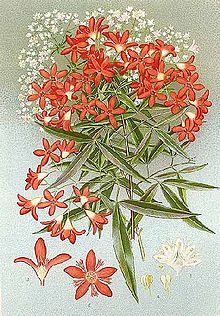
I must admit that I’m not familiar with Christmas Bush, and the writer mentions that it is no longer common around Melbourne.  I assume that he’s referring to Ceratopetalum gummiferum, but I note that it now only seems to be found in New South Wales.

[These “Christmas bushes” are plucked from a beautiful tree which is now becoming very scarce in the vicinity of our towns. This tree usually attains the height of about twenty feet, and when in full bloom has a very picturesque appearance. The bark is smooth and frequently mottled, the leaves vary from two to three inches in length, are rather narrow, and terminate in a point, have the edge indented like a saw, and are of a glossy dark-green colour. The flowers are of the cruciform species, similar in shape to a cabbage blossom, and when in full vigour are of a fine red colour. Indeed, I think the whole vegetable kingdom could scarcely furnish a more appropriate shrub than this for the purpose of adorning our houses on Christmas Day.]

Christmasbush

Here in Melbourne the weather on Christmas Day  tends to be highly variable.  I remember hot Christmas Days, but I also remember huge hail storms and some pretty ordinary weather.  Nonetheless, it was the novelty of a hot Christmas that impresses our author.

… In Australia the difference of climate causes the scene to bear a different and less animating aspect. Instead of the cool breezes and snow storms of an English winter, the sultry winds of summer and the scorching rays of an almost vertical sun, effectually put a stop to all sorts of amusement. In the towns, clouds of dust occasionally darken the atmosphere and render the weather peculiarly disagreeable. Under these circumstances every one is constrained to rest quietly within his doors, and wait patiently until the approach of night may in some degree moderate the oppressive blast. Even then there is a warmth in the air- a calm, sultry heat, which renders it totally impossible for any one to arouse himself to exertion. Instead of blazing fires glowing in the hearth, every fire-place is ornamented with evergreens; and instead of sitting opposite the burning ‘yule clog’ the peasant seats himself quietly in the open air on the outside of his humble cottage.

Well, this little ‘peasant’ here in 2014 won’t be sitting quietly in the open air outside my humble cottage.  She will, however, be relaxing on Christmas night after lunch with her family.  Happy Christmas readers – or whatever salutation you prefer.

Australian Women Writers Challenge 2014 Finished

Well, it’s the end of the year and time for toting up my reads for The Australian Women Writers Challenge again.  I had intended to read more histories written by women, and I’m rather disappointed to see that I hadn’t really read as much as I thought I had.  I do, however, have an excuse as this thesis really does need to be written.  In fact, the high number of fiction books gives a hint as to why it hasn’t been finished this year as planned.

Here they are, then:

FICTION

The Golden Age by Joan London

When It Rains by Maggie Mackellar

The Kayles of Bushy Lodge by Vera G. Dwyer

All the Birds, Singing by Evie Wyld

After the Fire, A Small Still Voice by Evie Wyld

Letter to George Clooney by Debra Adelaide

NON-FICTION  (Memoirs, biographies, non-fiction)

Velocity by Mandy Sayer

The Tainted Trial of Farah Jama Julie Szego

Boy, Lost by Kristina Olsson

Night Games Anna Krein

Housewife Superstar Danielle Wood

The Ghost at the Wedding Shirley Walker

Mrs Cook: the Real and Imagined Life of the Captain’s Wife Marele Day

Madness by Kate Richards

HISTORY

Shattered Anzacs Marina Larsson

What’s Wrong with ANZAC?  Marilyn Lake and Henry Reynolds

The Forgotten Rebels of Eureka Clare Wright

Broken Nation Joan Beaumont

And my favourites?  The Golden Age for fiction; a dead heat between Boy, Lost and Madness for non-fiction and Shattered Anzacs for history.

awwbadge_2014Posted to Australian Women Writers Challenge 2014

Imagine there’s no countries

I don’t normally get my history from the New Scientist, but there was an interesting article in the 6 September 2014 issue called “Imagine there’s no countries…” written by Debora MacKenzie.  Her article incorporated some historical approaches (Benedict Anderson etc) but also highlighted findings from the social sciences related to nationhood.  For example, here’s some rather disjointed observations from the article that attracted my attention:

Robert Dunbar of Oxford University has found that one individual can keep track of social interactions linking no more than about 150 people. He came up with this figure through studies of villages and army units throughout history and the average tally of Facebook friends (!!).  Society transcended that number by the invention of hierarchy, which meant that leaders could coordinate large groups without anyone having to keep personal track of more than 150 people.

Peter Turchin of the University of Connecticut notes that Eurasion empires grew largest where fighting was fiercest, suggesting that war was a major factor in political enlargement.  Picking up on the idea that hierarchy facilitated larger groups than the 150 figure, Turchin suggests that in addition to their immediate circle, an individual interacted with one person from a higher level in the hierarchy, and typically eight people from lower levels.

These hierarchies, of course, are not nation states.  A number of historians have concluded that states define nations, not the other way round.  For example, in France in 1789, half its residents did not speak French; while in Italy in 1860 at reunification, only 2.5% only spoke standard Italian.

When nation-states fail, they break down into civil war.  Civil wars are often blamed on ethnic or sectarian tensions, but there are other nation-states that combine multiple ethnicities and religions.  What makes the difference, the article suggests, is bureaucracy.  An interesting thought, especially given the rage that conservatives, in particular, direct towards ‘red tape’.  While we might complain about lengthy processes, queues etc. a return to  the alternative of patronage, bribery and ‘who you know’  being the basis of service provision  is pretty unappealing.

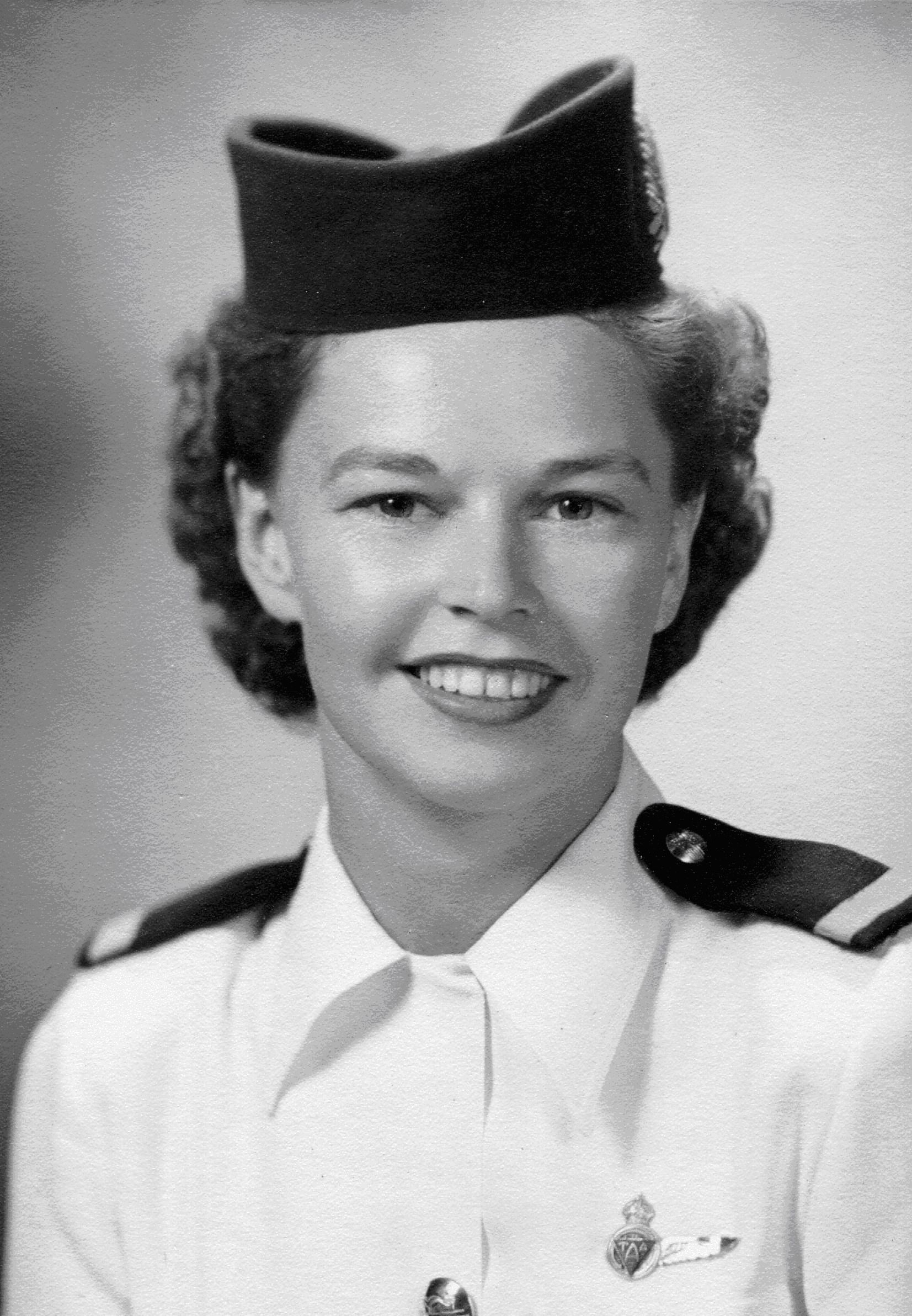
My mum 08/09/25- 17/12/10

Four years ago today.

011

Mum was an airhostess with TAA before she married.

ANZLHS Conference Day 3, December 13 2014

And so to the final day. Only two sessions today, then off to the airport and home.

The first session, titled rather intriguingly POST-COLONIAL COLONIAL ADOPTIONS, covered the rather disparate areas of  doctors’ professional organizations, enquiries into ‘lunacy’ institutions and the Vice Admiralty court.

Gabrielle Wolf’s paper looked at the Medical Board of Victoria which had had to wait over seventy years to be granted the right to strike off medical practitioners for ‘infamous conduct’, even though the parallel board in England had had this power since the mid 19th century. When, in 1933 it  finally was enabled to do so, it took some three years before the first doctor was struck off- a Dr Cohen who was found guilty of disreputable billing practices.

The second paper by  Fiona Davis also addressed a critique of the medical profession, this time through the West Australian Royal Commission into Lunacy in 1928.  This inquiry was instituted through the needling of an ex-patient  W. E.  Courthope, an articulate and educated activist, who had been briefly committed to Claremont, Western Australia’s largest asylum. The commission, headed by a Victorian expert who was himself deeply embedded in the parallel system in that state, was not lengthy but it did take testimony directly from patients. Courthope was given latitude by the Commissioners to provide lengthy testimony to the commission,  possibly as a means by which his state of mind could be brought into question.  The commission mainly exonerated the staff and recommended business as usual. Courthope left for England, where he became engaged in labour activism.

The final paper in this session was delivered by Bevan Marten, who discussed the Vice Admiralty Court which had empire-wide jurisdiction but relied on local colonial personnel.  The appointment of the Governor as Vice Admiral seems to have been fairly straightforward, but the establishment of the Vice Admiralty Court and the judges to sit in it  was ill-defined.  The whole concept seems to have been a rather haphazard undertaking with indeterminate roles and processes that seemed to be discovered more in the breach than by outright direction. Nonetheless, ‘my’ Judge John Walpole Willis managed to become embroiled in the question of appointments to the Vice Admiralty Court, and Bevan’s presentation helped to explain why there seemed to be such uncertainty about judicial involvement in the court.

The last session, and the one for which I was scheduled was headed ‘COLONIAL OFFICE CASE STUDIES’, but because one of the presenters was absent, it combined the speaker from the other stream.  I was preceded by Mel Keenan who gave a fascinating paper about the attempted annexation of New Guinea territory by Queensland, and the discomfort that Governor Gordon of Fiji and many at the Colonial Office felt over this prospect. Gordon argued that Queensland in particular was unfit for the task, given its treatment of South Sea Islanders indentured as ‘blackbirds’. Although the Colonial Office disallowed the Queensland annexation, it very shortly annexed the territory itself, for fear of German activity in the region.

Then in my own paper I looked at two cases- one in British Guiana and the other in Port Phillip- where the Special Magistrates and Protectors appointed by the Colonial Office to oversee the protection of ex-slave Apprenticed Labourers and Aborigines were subjected to the scrutiny of the Supreme Court through Judge John Walpole Willis.

The final paper for the session and the conference was quite different both in time-span and approach to much of the rest of the conference. It was delivered by Louis Sicking from Amsterdam. He examined the phenomenon of funduqs, fondacos and feitorias which acted as a medieval form of consultate established by the Amalfi, Venetian, Catalan, Genoan and Portuguese traders during the early Modern period around the Meditteranean.  His final graphic showed the harbour front at Canton harbour, with the factors of the European powers, each in their own European building with flag flying at the front. It hadn’t been timetabled this way, but as the very last presentation of the conference,  it made a striking visual and historical link between this century-old trade and the colonialism that the conference had addressed through the theme of ‘Law’s Empire or Empire’s Law?’.

And so, home James and don’t spare the horses. Well actually, the engines were held because after embarking and settling in, we all had to disembark because of a technical fault, only to be called back to re-embark about fifteen minutes later.  I’m writing this on my tablet as the plane nears Melbourne. My ears are popping, the seat belt sign is on, the turbulence is rocking the plane and I think that finally the ANZLHS conference is over for this year.

ANZLHS Conference Day 2, 12 November

Up bright and early for Day 2.  I’m not staying at the conference venue, but at a motel some 800 yards away. When I booked it I anticipated that I would be able to walk to the conference venue but my thrifty ways have been thwarted by the Pacific Highway!  I soon realized that there was no way that I would be able to cross the four lane highway during peak hour, so I’ve had to resort to getting a taxi the whole 800 metres.  I guess you could say that this little chicken DIDN’T cross the road!

During the first session I room-hopped between presentations because there were several that I wanted to attend.  While you do get to hear the papers you want, it is nonetheless a rather disjointed experience.  I started with John Orth’s presentation on The Rule of Law, which has been defined by the Oxford Companion of Law as “a concept of the utmost importance but having no defined nor readily definable content”.  As an American historian, he spoke mainly about the American concept of ‘rule of law’ and how it has been embodied through the constitution and its checks and balances.

Then off to hear Grant Morris who has recently published a biography of  the 19th century NZ judge, Justice Prendergast, well known in New Zealand for his hostile attitude towards the Treaty of Waitangi.  I was particularly interested to hear his perspective on legal biography in NZ (although I must confess to only having read one of the biographies that he mentioned).

Finally, off I scuttled to hear John McLaren whose  recent book ‘Dewigged Bothered and Bewildered’ deals with  19th century colonial judges who had been  removed from office, including my own Judge Willis.  His presentation dealt with a 20th century judge this time, the Irish judge Sir Michael McDonnell, who was Chief Justice of Palestine between 1927-1936.  It was an interesting paper, which drew connections between the British administration of justice in Palestine Mandate, and their handling of justice in Ireland between 1910-1921.

I stayed put in the one room for the second session which dealt with ENVIRONMENTS OF EMPIRE.  Libby Connors started with a disturbing account of environmental oversight (or lack thereof) in Gladstone harbour.  Her paper dealt with the industrialization of the harbour, especially after being declared a State Development Area, and the shortcomings in state and national law in complying with international protection protocols to protect the reef.  All rather discouraging.

Rachel Young’s paper on the concept of ‘timber’ as a legal category explored the question of whether the English doctrine of waste (i.e. that tenants could not clear trees from their landlord’s land) applied to Australia:  whether law devised for oak, ash and elm trees also applied to stringybarks and mallee.

Finally,  Nicole Graham noted that Australian law is not English, but is only ‘local’ in that it is not-English and is perhaps better understood as a variation of English law rather than something completely different.  After all, English law also has agricultural, pastoral and mining components, even though they differ.  She suggested that ‘Antipodean Law’ might be a better description. not so much of  a place, but a relation.

The session I attended after lunch(SHAPING THE FAMILY UNIT)  had only two papers.  Henry Kha gave an overview of divorce law and public policy in Victorian England, explaining the divorce process before and after the Matrimonial Causes Act of 1857.

Bettina Bradbury looked at property and inheritance cases that were referred from Lower Canada, Cape Colony, Victoria and New Zealand to the Judicial Committee of the Privy Council.   She described a number of cases, many of which focussed on wills, where the mobility between colonies often made complex situations even more complicated.

Then, to finish the day,  the final plenary lecture, given by Mike Grossberg from Indiana.  He picked up on Joan Scott’s famous observation about gender as “a useful category of historical analysis’ and suggested that age, likewise, form a ‘useful category of analysis’ in legal history.  He focused on childhood in this paper.   He grounded his presentation in stories , most particularly Joseph who  unsuccessfully sued his aunt and uncle for placing him into an institution where he remained, it seems, for the rest of his life;  Pearl S. Buck’s daughter, and Charley Ross who was kidnapped.  Even WonderWoman got a look in!

ANZLHS conference Day 1, December 11 2014

Well, here I am up in Coffs Harbour, at the Australian and New Zealand Law and History Society conference. It’s a terrific conference- not too many delegates, friendly and a diverse range of interesting papers.  It’s being held at a resort on the beachfront, which is certainly a more picturesque setting than most conferences enjoy.  It’s humid and thunderstorms and torrential rain sweep in from the ocean, then the clouds clear and the rainforest steams in the sun. I’m not giving my paper until the last session of the last day but I suppose that someone has to be last, and this time it’s me. Continue reading

‘The Golden Age’ by Joan London

goldenage

2014, 156 p.

I don’t know how Joan London managed it, but by only page 32 into this book, my eyes were brimming with tears.   It was a feeling that stayed with me  right until I turned the last page – a deep sadness that not once threatened to tip into sentimentality.

The (real life) Golden Age was a former hotel in suburban Perth during the 1950s.  At a time before the Salk vaccine put an end to the fear of polio, rehabilitation hospitals were established for children affected by polio.  The door stayed open all night and parents were welcomed but many  –  fearful, distressed and bound to work and their other children- came only at set times, or barely at all.  They were frightened by the illness and the future for their hurt, sick, too-aware children.

Thirteen year old Frank is almost too old for this children’s home but too young for adult hospitals. He is the only child of Jewish Holocaust survivors, cultivated educated Middle European migrants who have already lost so much, finding their way in a new country.  He falls in love with the frail, thin, Elsa who tumbles from her harried family into the quiet world of the Golden Age.

The horrific scenario of young bodies stilled, weakened and contorted by polio is lulled into a quiet, soothing, muffled presence.  This is a serene book, told in very short chapters like snapshots.  They are laid out before us, intersecting each other:  gentle, soothing middle-aged Sister Penny who takes lovers when she can;  Albert Sutton who runs away; the older boy Sullivan, an accomplished athlete and poet who dies in an iron lung; and Frank’s own parents, his father a successful Budapest businessman now driving soft drink trucks and  his mother the angry, coiled-tight concert pianist who plays a twilight concert in the yard of the Golden Age with the factory lights blazing next door.  The thread that connects them is Frank and Elsa, shyly negotiating new feelings.

This book reminded me of two other books: Atonement by Ian McEwan and The Go-Between by L. P. Hartley.  Both those books are suffused with summer heat and bathed in regret and nostalgia.  So too is The Golden Age.  It is a beautifully crafted book, quiet, confident and sad.  It’s very good.

awwbadge_2014I really must tally up my books for the Australian Women Writers challenge.

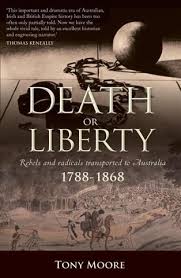
‘Death or Liberty: Rebels and radicals transported to Australia 1788-1868’ by Tony Moore

deathorliberty

2010, 398 p.

Many books, history books included, have a page of acknowledgments.  Along with the usual thanks to colleagues and family, appreciation is often expressed to librarians and archivists who have offered assistance along the way.

In this book, the author Tony Moore makes another acknowledgment.  It is to the commissioning editor of Murdoch Books,  Diana Hill, who selected him to fulfil the brief for this book.  Commissioned books, of course, are nothing new: institutions and individuals have often  paid a writer to document and argue their significance to a wider audience.  But this commission is slightly different in that it was for a narrative concept- transported rebels to Australia- left to the historian chosen to flesh out. When  Tony Moore spoke at the Australian Peace Coalition seminar I attended recently, he noted that the ABC has since commissioned a documentary series based on the book. Certainly the book and the topic is ripe for a television series.  It has, in effect, five self-contained episodes, studded with articulate, interesting people, and ripping yarns of defiance, escape, coincidence and courage.

As Moore notes in his introduction:

This is the story of how the British Government banished to the ends of the Earth political enemies viewed by authorities with the same alarm as today’s ‘terrorists’: Jacobins, democrats and republicans; machine breakers, food rioters, trade unionists and Chartists; Irish, Scots, Canadian and even American rebels.  While criminals in the eyes of the law, many of these prisoners were heroes and martyrs to their own communities, and are still revered in their homelands as freedom fighters and patriots, progressive thinkers, democrats and reformers.  Yet in Australia, the land of their exile, memory of these rebels and their causes has dimmed  (p. 8)

He notes that when he was growing up, Australian history seemed bland and uninteresting, especially compared with European, American, African and Asian history with blood, revolutions, wars etc. He later came to learn that Australia had its own robust history of dissent and resistance to authority, and the blood and war was there all along.

We elide the nuances when we uncritically celebrate the convict trope of the “poor downtrodden peasant transported for stealing just a ribbon!”  and we are largely unaware of the political prisoners transported to Australia: 3600 of them out of a total of 162,000 sent between 1787 and 1868 when transportation finally ceased in Western Australia.  Of these political prisoners, 2500 were from Ireland, 1200 from England Scotland and Wales and 151 from North America.  It is these political prisoners that Moore deals with in this book. Continue reading