Movie: Suffragette

It’s been a long time since I saw the 1974 BBC series Shoulder to Shoulder about the British suffragette movement. I watched it myself on television at the time and the next year our lecturer in Women’s History screened it for us at special night-time viewings (class timetables then didn’t stretch to watching videos).  As noted by a recent article noting the 40th anniversary of the BBC series on the LSE blogsite and a report on the accompanying symposium celebrating the anniversary, the story of the suffragettes was largely forgotten in 1974 and has languished in the BBC archives since.   Hah! the wonders of YouTube! (Apparently the whole series is available).

It’s precisely because the suffragette story is so rarely depicted on the screen that I’m more willing than many to cut the current movie ‘Suffragette’ some slack.  My 87 year-old father had not heard of the suffragettes; I don’t think my daughter would know about them either. The gasps at the end of the film at the rollcall of dates when female suffrage was achieved internationally suggests that it’s a battle that we overlook.

The film- and let’s remember that it is only a 2 hour film- focusses on a fictional working-class laundress who becomes swept up with the suffrage movement, culminating at the racecourse on the 1913 Derby Day. The movie deals with the Pankhursts only obliquely; it consciously chooses a working-class protagonist instead of one of the more articulate middle-class leaders.  It does not, it’s true, deal with women of colour, or the colonialist attitudes of the leaders; nor does it deal with the philosophical splits between the leadership.  It tells the story of one woman, and in a nod to our everywoman sensibilities today, she’s a fictional, bit-part woman.  I’m satisfied that the film takes a broad sweep at a plot level, even if at an emotional level it didn’t explore Maud Watt’s change in sensibility sufficiently. Let’s not drown this movie with expectations and our disappointment in what it is not.

Let it just tell the story. All of the nuances and disputes and historical arguments can be explored in detail once the suffragette story is  worn smooth with retelling.  Forty years on from the first BBC telling in Shoulder to Shoulder, with the story largely forgotten and so many people completely unaware of it, the time for complexity is not yet.

By the way there’s some silent British Parthe footage of British Derby day in a 7 minute clip, showing both before and after. It’s silent, and it shows  the day from the start, leading to an odd buildup in tension, knowing , as we do, how it ends.  I encourage you to watch the whole thing but if it’s spectacle you want, it’s at 6.04.

‘The Convent’ by Maureen McCarthy

mccarthy

2012, 418

You know, the tourism industry should fall to its knees sometimes and thank local activists who save significant buildings and places from being privatized and subdivided into exclusive housing that most Melburnians will never set foot in.  Then somehow it becomes a tourist precinct, and money can be made from it, and people forget and wonder that it was ever under threat.

Abbotsford Convent is such a place. On a bend of the Yarra River, the land was valued by the Wurundjeri people who frequently met nearby where the Yarra River and Merri Creeks merged.  John Orr built Abbotsford House there and Edward Curr (who was a prominent opponent to Judge Willis) lived at the nearby St Heliers property  between 1842-1850.  By 1863 the Sisters of the Good Shepherd had consolidated their purchases of Abbotsford House and St Heliers and established a convent there.  In 1900 it was the largest charitable institution in the Southern Hemisphere, housing up to 1000 residents. For a century it provided accommodation, schooling and work for female orphans, wards of the state and girls considered to be in “moral danger”, financing its activities through farming, its industrial school and the Magdalen laundry service.  It was a place of dedication for the nuns who lived there, but many of its residents- particularly those in the laundry- had sad and bitter stories to tell.  In 1975 it was sold and used for the following 20 years by different education providers.  In 1997 it was onsold to developers, who planned to build 289 apartments on the site.  The Abbotsford Convent Coalition fought hard against this plan, and in 2004 it was gifted to the public by the State Government.  It now houses studios, office spaces and cafes and is the site for a lively program of performances and markets.

The Abbotsford Convent is the setting for Maureen McCarthy’s book named, appropriately enough, The Convent.  Based on her own family history, the book covers four generations of women whose lives intersected with the convent and the nuns who lived there.  Nineteen-year old Peach takes up a summer job at the convent when she receives a letter from her birth-grandmother, Ellen.  Peach has always known that she was adopted, and has until now felt no real curiosity about her birth-mother.  We learn that her grandmother Ellen had been raised at Abbotsford Convent after her mother Sadie had been declared an unfit mother in WWI Melbourne.  Ellen’s daughter Cecilia had been a nun at the the same convent.  The book shifts from one character to another, and between time periods spanning the early decades of the twentieth to the twenty-first century.

Books that rotate their focus between characters  call on a certain amount of goodwill on the part of the reader.  I found myself far more engaged by the stories of Cecilia and Sadie, and almost resented being brought back to the rather quotidian life of  19 year old Peach (and is it too trite to complain that I really disliked the name ‘Peach’ even though I know why it was used?) I felt that Cecilia, the nun, was sensitively drawn and McCarthy’s research into cloistered life, although somewhat heavy-handed, made Cecilia a rounded and nuanced character.

McCarthy is best known as a Young Adult writer.  The subject matter of the book transcends that genre, but the book was weighed down for an adult reader by the rather too obvious narrative scaffolding that supported the dialogue, and the rather laboured descriptions.  It reminded me very much of Rod Jones’ The Mothers (which I reviewed here) and it’s interesting that I found both these books, so similar in their content, to be too simply told.  Could it be that because both these stories had their origins in their author’s own family history, the overriding concern was to treat the story with respect, and that this affected the telling?  I have no idea, but with the exception of Cecilia’s chapters, I couldn’t shake my awareness that this book was written for a much younger audience than I.

There’s an interview with the author at:

http://www.abc.net.au/radionational/programs/booksandarts/the-convent/4395928

aww2016 I have read this as part of the Australian Women Writers Challenge 2016.

‘You’ll be sorry when I’m dead’ by Marieke Hardy

hardy

2011, 295 p.

Celebrity is a trade-off.   The celebrity figure gaily trumpets “look at me!”, and accrues public recognition, freebies, attention and the aura of self-possession. In return s/he is subjected to the audience’s misplaced sense of identification and friendship, or conversely, approbation and smug censoriousness. And so I sit watching ABC’s Book Club (until a few years ago the First Tuesday Book Club, a handy reminder to tune in) alternately tut-tutting at Marieke Hardy’s fey girlishness with those plaits and tats one minute, and wishing a moment later that I was so winsome and witty myself. It was probably this ambivalence that led me to pick up her book You’ll Be Sorry When I’m Dead. Having read it, I’m still ambivalent, although probably with a more affectionate glow than previously.

As you might expect, it’s well-written and funny. Its chapters are similar to long-form pieces that you might read in a Saturday newspaper magazine  and indeed several of them have been published in that format previously. She’s self-deprecating and self-assured; she delights in being wicked and revels in her exhibitionism. She tells of her obsession with prostitution, her fumbling attempts at swinging, and her mortification at travelling with her parents at the age of thirty-five. Many of her stories are Melbourne-centred, as in her tribute to VFL footy ‘Maroon and Blue’, one of my favourite stories. She flits around the edge of showbusiness through  her family pedigree and her own child-actor CV and laughs at her own adolescent pursuit of one of the ‘stars’ of Young Talent Time. Some stories have more depth: her story ‘Forevz’ reminded me of Helen Garner’s The Spare Room – in fact, there were quite a few stories here which evoked Helen Garner for me, for some reason. The placement of the stories seems quite random, as does the insertion of testimonials from some of the people she has written about (an affectation I could have done without, really).

Like the celebrity persona she projects, there’s a mixture of show-off and razor-sharp penetration. I found myself laughing out loud in places, tearful at times, and rolling my eyes in other places. It’s a good dip-into book, and just as in ABC Book Club, you don’t really know what she’s going to come out with next.


Movie: 99 Homes

If you’re in Melbourne and if you hurry, you’ll catch 99 Homes at the Nova in Carlton. It’s brilliant.

Set in America in wake of the sub-prime housing market crash, it’s about decent people losing their houses.  It’s a mixture of Mephistopheles, Zola and Thomas Hardy combined as a recently-unemployed single father struggles to regain possession of his home and becomes forced into becoming something and someone he detests.

Brilliant, but sick-of-your-stomach, anxious, clammy, rage-inducing viewing.

This Week in the Port Phillip District 1841: January 1-8 1841

COMING SOON….A RESIDENT JUDGE

Even though Superintendent La Trobe and the people of Port Phillip didn’t realize it, on 1 January 1841 Governor Gipps took up his pen to formally notify the Secretary of State at the Colonial Office in London that Justice John Walpole Willis had been appointed to Port Phillip as the first Resident Judge of the Supreme Court of NSW for the district. Gipps’ letter to La Trobe informing him of the appointment was actually written on 29th December, but it hadn’t arrived in Melbourne yet.  So, let the period of the Resident Judges begin!

THE WRECK OF THE CLONMEL.

The year started with a bang, literally, for the steam-ship Clonmel which ran aground on a sand spit at the entrance to Corner Inlet  200km south-east of Melbourne, at 5.00 a.m. on the misty morning of 2 January 1841.

clonmelmap

See also: http://mapcarta.com/16688280

The five-year old Clonmel was a new addition to the shipping route   between Launceston, Port Phillip and Sydney, having only arrived in Sydney in October 1840. This importance of this intra-town communication through shipping at this time cannot be overstated.   A wooden-hulled, masted paddle steamer, it carried 75 passengers and crew, and this was only its second*  voyage on its circuit between the three ports.  Daybreak revealed that the beach was about half a mile away, and that a heavy surf was running. Several trips by whale boat initially, and then with the assistance of quarter boats, deposited every soul in safety on the beach by 2.00 p.m. that afternoon. Sail awnings were brought on shore and a camp of tents was established for the ladies.  Provisions sufficient for ten days were also brought from the boat, including livestock, hams, bread, flour, biscuit, rice, tea, sugar and wine.  A sketch by Robert Russell showing the huts of the Clomnel survivors can be seen here.  [Accession number: MS 9555]

Water was located, but found to be brackish.  Safely onshore, the Captain harangued the passengers about the need for discipline and the punctual obedience of orders. Two-hourly watches were posted and the provisions were securely stowed under a boat turned upside down to guard against petty depredations and the effect of the weather.

The next day,  two passengers Mr D.C. Simson and Mr Edwards and five unnamed seamen headed off to get help. First they inspected the wreck of the ship as they passed, and then headed towards Sealers Cove where they rested overnight. At 3.00 a.m. on 4th January, they awoke early to fill buckets with water to continue their journey when they observed “the natives coming down upon us.” They hurried on board and headed for Wilsons Promontory, which they sighted at about 10.00 a.m.  They arrived in a small bay at Westernport at 8.00 p.m. that night.  The following day they reached Port Phillip Heads by 2.00 p.m. but because there was a strong ebb tide, they needed to wait for a flood tide.  They were approached by a cutter The Sisters which towed them into Williamstown at 11.00 p.m. making a total of 65 hours since their departure from Corner Inlet.

All passengers were safe, although Mr Robinson lost the £3000 of Union Bank notes he had in his custody.  The newly-wed Mr and Mrs Cashmore lost a large quantity of goods that they were bringing for their new establishment to be opened on the corner of Collins and Elizabeth Street.  (Source: Port Phillip Herald 8 January 1841;  http://perdurabo10.tripod.com/ships/id296.html )

See the Victorian Heritage Database entry for the wreck of the Clonmel (which still lies on the ocean floor) here.

TICKETS OF LEAVE

Even though the people of Port Phillip prided themselves that they were not a ‘convict’ colony like Van Diemens Land or Sydney, there were convict gangs, ‘assigned servants’ and ticket-of-leave prisoners in Melbourne.

On New Years Day a general muster of the ticket of leave men of the district took place at the Police office. They presented the appearance of a clean and orderly set of men, and were each passed in review before the police magistrate; such of them as resided in the town were sworn in special constables, a very excellent and salutary arrangement (Port Phillip Herald 5 January 1841)

It’s hard to know what to make of the final sentence- sarcasm, most likely. Nonetheless, many of the early police in Melbourne were of convict background and many were quickly dismissed for drunkenness. Edmund Finn, writing as ‘Garryowen’ in his Chronicles of Early Melbourne describes the ordinary policemen of the first few years as “mostly convicts freed by servitude, with now and then a ticket-of-leave holder.” (p. 52)

A NEW CHURCH

On 1 January the new Independent Chapel was formally opened for Divine Worship. “The design of the Chapel is both neat and tasteful, and its internal fittings up render it extremely commodious.” Three sermons were preached on that day by Reverends Waterfield, Forbes and Orton.

A booklet called The Collins Street Independent Church (available here) shows a small brick church building 20 X 30 ft in size, erected at a cost of £231. It was later extended, but pulled down in 1866 to construct the current-day St Michael’s on the corner of Russell and Collins Streets.

HOW’S THE WEATHER?

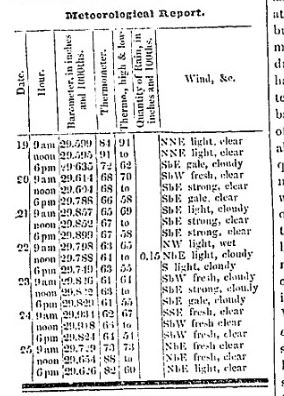
According to the Port Phillip Herald, in the days between 29 December- 4th January, there was a fairly mild start to the year, with the first of January the warmest day with a top temperature of 86 degrees F (30 degrees C)

PPH5Jan41

The Abstract of the Meteorological Journal kept at Melbourne, Port Phillip was reprinted in the Government Gazette at roughly monthly intervals. The January report is in Gazette 22, Friday March 19 1841.  It reports that in the week 1st-7th January, there was “dry weather, frequently cloudy” with “strong southerly winds”. The highest temperature recorded on this week was 92 degrees on the 7th.

Notes:

*The Victorian Heritage Database and other sources say that it was its third journey. I can only find two.  The plan was for the Clonmel to run a circuit between Sydney, Melbourne, Launceston then return.  The first journey from Sydney was planned to terminate at Melbourne, but was extended to Launceston after all (which might be where the confusion lies between two and three journeys). The wreck occurred on the second journey from Sydney.

References:

Port Phillip Herald 1, 5 and 8 January 1841


2015 in review and a new feature!

The WordPress.com stats helper monkeys prepared a 2015 annual report for this blog.

Here’s an excerpt:

The concert hall at the Sydney Opera House holds 2,700 people. This blog was viewed about 36,000 times in 2015. If it were a concert at Sydney Opera House, it would take about 13 sold-out performances for that many people to see it.

Click here to see the complete report.

Ah! The posting about the eggs of the conical sea-snail- the blog-post that keeps on giving! Who would have thunk that so many people wondered what the squishy jelly on the beach was?

I’ve been blogging since July 2008 and like any long-term endeavour, my blog has changed direction over those eight years. It started as a research blog to support my thesis on Justice John Walpole Willis, the first Resident Judge of the Supreme Court of NSW in the Port Phillip District. Hence the name,  “The Resident Judge of Port Phillip” which I must confess is rather cringe-inducing at times. The blog has since become a repository for book reviews and comments about films I’ve seen, the odd history-based discussion, and observations about life in Melbourne now.

I’ve decided as a New Years Resolution (and we all know how long they last!) to start a weekly feature looking back at what was happening in Melbourne and the Port Phillip District more generally 175 years ago. Why 175 years? Because that’s when the first Resident Judge was appointed, and a Resident Judge continued to preside between 1841-1852, when the position of Chief Justice of the Supreme Court of Victoria was gazetted. That gives me eleven years of posts, should I not abandon the project (which may yet come to pass!): twelve if I want to extend it to the actual issuing of the formal commission.

Meanwhile, the book reviews and commentaries on film, history generally and Melbourne in particular will continue.

‘My History’ by Antonia Fraser


fraser

2015, 320 p

Clever little title for a historian’s memoir, this. “ My history” in terms of background, family, early life etc and “my history” in terms of Fraser’s professional identity and published works.  I generally enjoy reading historians’ memoirs. They usually have the skills to put together a satisfying narrative arc ( or at least, you’d hope that they do). I enjoy reading about their intellectual and academic growth, and their perspectives on the writing process. I quite like the namedropping if it’s an area I’m familiar with (and read through gritted teeth if it’s not).

I’ve read quite a few Antonia Fraser books, all before I began blogging (Six Wives of Henry XVIII; The Gunpowder Plot; Marie Antoinette: The Journey). Oddly, though, I’ve never really thought of myself as a fan and I find myself recoiling a bit from the very proper and so terribly British persona she projects when I’ve seen her interviewed. However, I also read, and blogged The Perilous Question which I thought was excellent, and because it was based on a phenomenon -in this case, the 1832 Reform Act- rather than a person,  quite a different endeavour to her other books.

She was born in 1932 as Antonia Pakenham, the daughter of the 7th Earl of Longford, named after Willa Cather’s book My Antonia and pronounces her name that way (AN-ton-ee-a). Her parents sound interesting: her mother was a Unitarian and a later convert to Catholicism, along with her husband and children. Antonia’s parents were both Socialists and both well ensconced within the gentry, a combination which I find fascinating. In many ways, she ‘grew into’ her parents as she became older. She attended Dragon School and St Mary’s School Ascot and went to Oxford University through Lady Margaret Hall. However, she describes herself as a less-than-brilliant student and went to work at the publishers Weidenfeld and Nicholson as an all-purpose assistant.

Despite this less than stellar academic career, she was always drawn to history, most particularly the story of Mary Queen of Scots. It was only when her mother, herself a historian, mooted writing a biography of Mary Queen of Scots that Antonia threw herself into what had been until then desultory research, to fend off her mother’s interest in what she saw as “her” topic. It was the first of Fraser’s books, published in 1969, followed by other biographical works with a particular focus on royalty, but she widened her scope over time. She has also written crime novels and an account of her relationship with playwright Harold Pinter, her second husband.

Lady Antonia Fraser is titled three times over: first as the daughter of the Lord of Longford; then through her first marriage to Sir Hugh Fraser, the Tory politician (to whom she says she was attracted because of his politics on the colonies), then finally as the recipient of a DBE (Dame Commander of the Order of the British Empire) in 2011 for her services to literature.

There’s quite a bit of name-dropping in this book, and the first chapter was disconcertingly genealogically-based. Fortunately, it picked up after clambering around in the branches of family trees and I found her account of her racketty-gentry upbringing interesting (although quite foreign to this antipodean reader). At the end of the book she discusses some of the difficulties of biography-writing, most particularly the telescoping of time when the subject’s life grinds to a slow pace. Like all biographers, she speaks of the emotional experience of seeing letters written by her subject, and her love of “optical research” (i.e. touring around visiting places of significance in her subjects’ lives).

In all, a capably written memoir, as you might expect, but one that underscores that Fraser is not firmly ensconced within the world of academia. It gives an interesting perspective on a WWII gentry upbringing, and although it didn’t make me fall in love with Fraser as a biographer (as Richard Holmes’ memoirs did here and here), it did me a new respect for her biographical works.  I’m not sure if she’s still working- born in 1932 she’s getting on a bit- but she certainly has a solid body of work to her name.

‘Histories of the Hanged’ by David Anderson

anderson_hanged

2005, 406 p.

(I commenced this review in November immediately after finishing the book: I am now writing it nearly two months later, drawing mainly on the impressions that I took away from the book. I regret not writing this review earlier, because much of the nuance has escaped me.)

It was been a strange experience, reading this book in Kenya at this particular time.  The city teems with Kikuyu people whose parents (if not they themselves) would have most certainly be touched by the Mau-Mau rebellion in one way or another.  The battle for reparations from the British government now plays out in British courts  (see here and here)  and in September 2015 the British government funded the erection of a commemorative sculpture in Uhuru Park as part of reparation payments.  Most pertinently for me at the moment, the response to Mau Mau described in this book has resonances in the current political and legislative response to ISIS and religiously-inspired terrorism that we’re witnessing today.

So what was the Mau Mau rebellion, or uprising or revolt or Kenya Emergency (which ever term you want to use?) It was a military conflict that took place in Kenya between 1952 and 1960. As David Anderson, the author of this book explained in a short article for History Today:

The end of British colonial rule in Kenya was bloody and brutal. In October 1952 a state of emergency was declared to fight the Kikuyu insurgents known as Mau Mau. The rebellion was defeated by 1956, but emergency powers remained until January 1960.

The British made extensive use of detention without trial and applied the death penalty to a wide range of offences. The official rebel death toll was above 10,000, but the real figure may have been double this, while the rebels assassinated over 2,000 African ‘collaborators’. The story of this struggle has been presented in Kenya as one of nationalist heroism, and in Britain as an episode in the deconstruction of empire: but both views are under challenge. …

This gritty struggle divided the Kikuyu communities of central Kenya: many people were unwilling to support violence, and Kikuyu Christians in particular stood against the rebels. The British nurtured a ‘loyalist’ movement, recruiting more than 60,000 Kikuyu men: much Mau Mau violence was aimed at these ‘collaborators’. Loyalists gained considerably in terms of property, land and political rights, while rebels and their supporters were imprisoned and dispossessed.

– See more at: http://www.historytoday.com/david-anderson/burying-bones-past#sthash.pwr8RgXn.dpuf


Anderson commences his account by contextualizing it within the politics of empire and colonialism generally. World War II had given a huge boost to the settler economy, and capital was flowing into White Highland farm mechanization, boosting the confidence of white settlers to contemplate forcing Kikuyu squatters from what had been their traditional lands, thereby triggering the Mau Mau rebellions. He points out that in the 1950s Britain was moving towards independence generally for the former colonies, but that in both Rhodesia and South Africa, the white minority had managed to entrench its power and it seemed likely that a similar phenomenon would occur in Kenya as well.

Anderson draws upon court reports, both from the Supreme Court and the Special Emergency Assize Courts in order to populate his book with individuals, on all sides.  This emphasis on the individual, instead of the ‘mob’ is important, as it always is when fear of the ‘other’ is being evoked and whipped up.  The names of the Mau Mau generals are well known, but through the meticulously detailed court records, he finds the  shadowy and nameless “subalterns of the movement”: the food carriers, the oath administrators and the ordinary foot soldiers in the forest.

In Anderson’s focus on court records and processes, I found resonances with my own work looking at colonial courts during the 1830s-40s.  In Kenya in the 1950s, as in colonial courtrooms more than a century earlier, the court became the site in which the different political impulses of society were aired, but often shut down just as quickly to ensure that the political dimension of unrest was ignored. As in the 1830s slave colonies, Governors had to use legislation and special tribunals to circumvent settler (or in the case of the slave colonies, planter) dominance of the bench, and a small number of  judges sometimes raised their voices, albeit futilely, against legislative and political overreach. Many other judges, however, acted as the ultimate manifestation of systemic injustice  and repression, and became the state-legitimated enforcers of settler power.  In a foreshadowing of the emphasis of many governments today to ensure that punishments for terrorist offences are not ‘complicated’ by legal ‘niceties’ in the conventional legal system, the Special Emergency Assize Courts were promulgated in Kenya to ensure swift, uncompromising, consistent sentencing intended to quash Mau Mau action.

Local white settlers saw Mau Mau as a savage, depraved tribal cult. Certainly, this was intimate, close-up violence. However, in a foreshadowing of our current conceptualization of Islamic radicalization as an ‘evil’ that can be ‘cured’, Louis Leakey and other ethnographers advised the local and British governments instead that Mau Mau was an illness, innate to the African in transition. Emphasis was laid on confession and rehabilitation, which led in turn, to large-scale detention camps- a prospect not entirely impossible today in our present-day quest to stamp out extremism. The outlines of Abu Ghraib are detectable in the detention camps that swallowed up huge numbers of the population.

As Anderson presents it, there was violence on all sides, including within the Kikuyi themselves . It was, as he says “a story of atrocity and excess on both sides, a dirty war from which no one emerged with much pride, and certainly no glory.” p. 2  He questions the role of Jomo Kenyatta in the rebellion, and notes his influence in shutting down any discussion of Mau Mau in the years immediately following. Anderson is obviously ambivalent about the recent memorialization of Mau Mau as an expression of political liberation.

Anderson’s work in this book, as well as that Caroline Elkins in her book Imperial Reckoning: The Untold Story of Britain’s Gulag in Kenya, are part of the ongoing debate about the nature and scope of  the Mau Mau rebellion. I read this book as an outsider, unfamiliar with the field, and I found Anderson’s writing engaging and easily accessible.  I know too little to assess his arguments, but I very much enjoyed his emphasis on the individual and the myriad influences that led all sides to act as they did. It strikes me as a balanced, nuanced appraisal, grounded in primary documents, with an eye to providing an informed and sober contribution to  current politics.

Bernard Porter has written a detailed review of both Anderson and Elkins’ work in the LRB that is far more erudite and detailed than anything I could hope to write.  There’s also an excellent podcast on Mau Mau at http://www.radiolab.org/story/mau-mau/


‘Flood of Fire’ by Amitav Ghosh

ghosh_floodoffire

2015, 607 p.

Yes, I know that I vowed after reading River of Smoke that I’d only read trilogies that were finished, so that there wouldn’t be a long gap between volumes. But I’d already read the first two books; Flood of Fire was sitting there on the library shelf;  and I did enjoy the first two, didn’t I?  And so,  having checked my own blogposts, and armed with the Wikipedia synopsis of the first two books, once more I ventured forth into this final, 600 page volume.

I found that I really needed the synopsis because this book draws together the narrative of the first two volumes. Sea of Poppies had focussed on the passengers on the refurbished slave-trader boat the Ibis; the second volume River of Smoke shifted to two other boats in the fleet, the Anahita and the Redruth. In this final volume, characters from both preceding books are thrown together, on opposing sides, in the First Opium War of 1839-1842.  As with the other books in the trilogy, it is exhaustively researched (evidenced by the long reference list at the end) and pointedly political.  As a work of informed, fictionalized history it flirts with the boundaries between fact and fiction, especially with the character of Neel Rattan Halder, who even now,  after I spent ages looking on the internet, I’m not sure was an invention or not. (Ghosh’s epilogue suggests that he is a historical figure who generated a rich documentary archive- but I’m not sure. Is the epilogue part of the story too?)  There’s an interesting interview with Ghosh posted here on his website where he discusses methodology.

As with the earlier books, there is re-invention (such a strong theme in colonial social history, as Kirsten McKenzie had shown in her work) and slippage between racial boundaries, caste and political loyalties. These themes are shot through with a trenchant critique of colonialism and the free trade philosophy trumpeted by British commercial interests to justify the opium trade. Ghosh’s historical argument is more overt in this book than in the preceding ones, where it was played out mainly through his characters.  Nonetheless, here too, he uses characters, most especially Zachary Reed and his illicit relationship with Mrs Burnham, to exemplify the transformation of seduction into blackmail,  a metaphor for the way that opium itself lured, then became an instrument of power and coercion.

Even though I admire the historical thoroughness of the book, I did find myself bogged down in the descriptions of battle, even though Ghosh was John Keegan-esque in depicting the visceral assault of the battlefield.  There was a long build-up to the battle scenes as Ghosh rotated between a small number of key characters, and I was on the verge of finding the long wind-up tedious and wishing that he’d just get on with it.

I think that I’ve had enough of the Ibis trilogy, and I suspect from the afterword that Ghosh might have too.  He leaves the door open for other books with an open-ended conclusion, but he seems to suggest that the whole thing is such a huge endeavour that no one person came finish the huge, complex embroidery that he has begun.  I think that’s how I’m happy to leave it: sated, and full of admiration for the narrative and research sweep that he has laid out before us.

Australian Women Writers Challenge 2015 wrap up

aww-badge-2015-200x300.

Well, I probably should have posted this ages ago because I met the challenge some time earlier.  I had vowed to concentrate on histories written by Australian women, and I didn’t do particularly well at that. A resolution for 2016 perhaps? Nonetheless… here’s the wrap-up, roughly in the order in which I read them,  for what it’s worth.

Fiction

Burial Rites by Hannah Kent

Indelible Ink by Fiona McGregor

Heat and Light by Ellen van Neerven

Foreign Soil by Maxine Beneba Clarke

A Short History of Richardby Klein by Amanda Lohrey

The Anchoress  by Robyn Cadwallader

The Girl with the Dogs by Anna Funder

The Other Side of the World by Stephanie Bishop

Only the Animals by Ceridwen Dovey

Medea’s Curse by Anne Buist

The Fine Colour of Rust by P. A. O’Reilly

Nine Days   by Toni Jordan

The Strays by Emily Bitto

Charades by Janette Turner Hospital

Non-Fiction

In Good Faith? Governing Indigenous Australia through God Charity and Empire 1822-1855 by Jessie Mitchell

Restless Men: Masculinity and Robinson Crusoe 1788-1840 by Karen Dowling

This House of Grief by Helen Garner

The Invisible History of the Human Race by Christine Keneally

Melbourne by Sophie Cunningham

Savage or Civilized? Manners in Colonial History by Penny Russell

The Hanged Man and the Body Thief: Finding Lives in a Museum Mystery by Alexandra Roginsky

The Boyds: a family biography by Brenda Niall

Warrior by Libby Connors