A pergola anniversary

A year ago I wrote about the sad demise of my pergola on the back deck, brought down (literally) by a rampant wisteria.  I grieved its loss.  It was a verdant, shady space and it seemed stark and uninviting once the pergola and greenery were removed.

wisteria3

The original wisteria in all its glory

IMG_1529a

Oh dear. All fall down

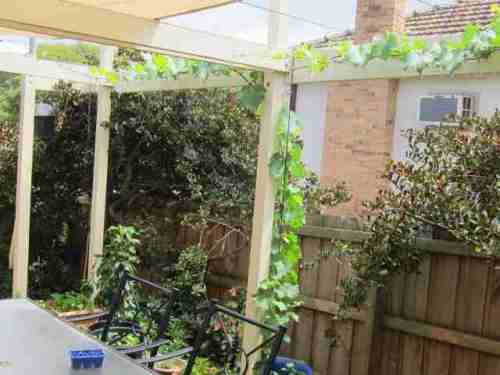
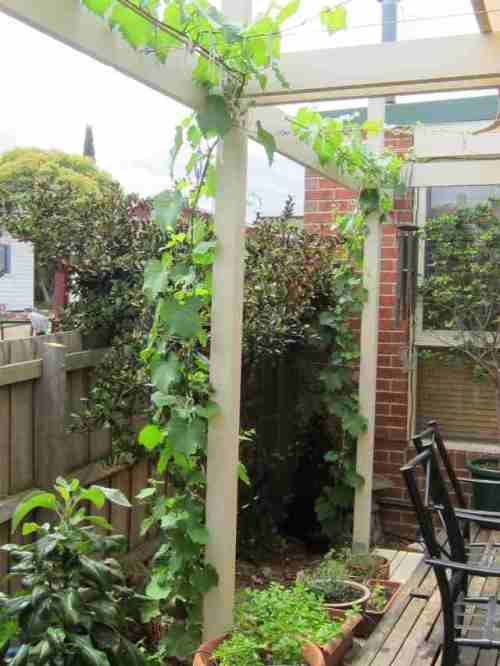
But time heals all things, even pergolas, and Mr Judge has built a pergola that will outlast me. It will outlast the house.  It may well outlast the apocalypse.  It has a small shade sail that will have to suffice until the greenery re-establishes itself.

IMG_2048a

IMG_2050a

Having learnt at first hand the ferocity of a feral wisteria, we opted for an ornamental grape instead. Hopefully it will turn a rich shade of red during autumn.  Its growth has been phenomenal.  We only planted it in October and it has grown about 3 cm a day and is still growing. We’re now starting to train it along the wires.

IMG_2049a

IMG_2052a


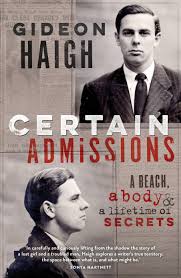
‘Certain Admissions’ by Gideon Haigh

haigh

2015, 293 p.

Spoiler alert.

Mass journalism and crime have gone together, ever since those lurid, shrieking sensation newspapers of nineteenth-century England.  Certain crimes draw attention, especially those involving children and beautiful young women and  the whole case, from arrest through courtroom to punishment, becomes a media sensation in itself.  Journalists and writers are drawn to such cases: think, for instance of Helen Garner turning up in court day after day for her book on Robert Farquarhson This House of Grief , or John Bryson’s book Evil Angels on Lindy Chamberlain which ended up a feature-length film (and one which bestowed on us Meryl Streep’s classic “a dingo took my boi-boi”).  Gideon Haigh is a prolific journalist with thirty books to his credit. Many of these relate to his great love, cricket, but several examine corporate business life as well, with books on BHP, Bankers Trust and James Hardie. With this book Certain Admissions: A Beach, a Body and a Lifetime of Secrets, he turns to the true crime genre, in a book that echoes Garners’ work, and also that of Senior Crown Prosecutor Mark Tedeschi and biographer Suzanne Falkiner with their books on Eugenia Falleni .

Spoiler

I hadn’t heard of John Bryan Kerr or the murder of Beth Williams on Albert Park Beach in December 1949.  Apparently though, the case is well-known amongst the legal profession and police and it became a trope of popular culture- Graham Kennedy, for instance, joked about it many decades later in a reference that obviously went over my head.  Twenty-four year old John Bryan Kerr- handsome, with a mellifluous voice and confident bearing- was accused of murdering the twenty-year old typist, whom he had met under the Flinders Street clocks and whose body was found dragged into the shallows of Albert Park Beach. A confession was tendered by the police, but refuted by Kerr; the case went to the courts three times; Kerr continued to maintain his innocence throughout his imprisonment where he became a poster-boy for rehabilitation, and he was dogged by notoriety for the rest of his life.

Haigh starts  his narrative on the steps of Flinders Street Station, the quintessential Melbourne meeting place.  Witness statements are able to reconstruct Beth Williams’ interactions with various people as she stood there waiting, but from that point there are two different narratives.  The first is the one produced after questioning by two old-school coppers, Bluey Adams and Cyril Cutter.  It was a  remarkably short confession statement, considering the time that it took to elicit it, and Kerr disclaimed any involvement with it from the start.  The second narrative was the one that he gave the court, three times, with barely a deviation, and the one that he maintained in the many newspaper articles and letters that were written after his release from jail.

The pictures in the middle of the book reinforced the sensational nature of the trial and its aftermath.  People crowded to get into the courthouse and newspapers ran long series publishing his letters to his parents.  Even in jail, where usually the identity of prisoners is suppressed in any publicity, he featured in stories about rehabilitation programs being introduced into the prison system.  Always handsome, he photographed well.

The story is told chronologically over fifty years, but like all good journalists, Haigh teases out complications and counter-narratives.  He looks at the accused and the victim, but also at the police and the milieu in which they operated, and the legal counsel and judges who were involved in all three cases.  As a reader you lean one way and then another (and I suspect, Haigh as an author did the same thing).  There are no footnotes- that would have made it a different sort of story- although he does give his sources at the back of the book, many of which reside at the Public Record Office.

This is very good non-fiction, but it’s not history, nor is it the cutting, reflective, literary rumination of a Helen Garner (see here her July 2015 essay on darkness and crime).  The links between sources and his assertions are not specific enough for history and the narrative rambles off into digressions and asides before returning to the main story.  He offers observations and raises broader questions about the nature of confession and celebrity, but these are not mounted into an overarching argument. Frustratingly, the book lacks the index that would mark out the bare bones of his search, and a ‘search’ is very much the way the story is framed. Increasingly as the narrative nears recent decades, he inserts himself into the story, and it comes as a jolt to recognize familiar names -Ron Iddles, Barry Beach- as the story is brought forward into the spotlight of more recent crimes, most particularly that of Jill Meagher. These are not criticisms: instead, they are the hallmarks of the journalistic approach that Haigh employs so skillfully.

As time goes on, people ail and die; the case splutters back to life with media attention then fades again; there is in the end no definitive answer.  A lesser writer would have seen this as defeat, but Haigh takes this in his stride.  The consummate journalist, he is thorough and clear and  he admits to his limitations, making you feel as a reader that you are in the hands of a professional.  It’s a very good book.

This Week in Port Phillip 1841: January 16-23 1841

RETURN OF THE CLONMEL SURVIVORS

On the 15th and 16th January, the two ships sent to rescue the Clonmel survivors arrived back in Port Phillip, after the wreck of the Clonmel a fortnight earlier.

MELBOURNE   THE CLONMEL. The Sisters, from the Clonmel, arrived on Friday, and the Will Watch on Saturday, bringing up the crew and passengers of that ill fated vessel. From what we can learn, it seems that the steamer having gone ashore during a spring tide, is now embedded in the sand at some considerable distance from the outer edge of the sand spit at low water mark; she is consequently comparatively safe from the waves. Her hull is sunk in the sand so that there is ten feet water in the hold, the cargo, it least so much of it as would damage from salt water, is consequently destroyed. As she swings at high water, and had not when the vessel left sustained any very material injury, sanguine hopes are entertained that she will ultimately be got off. We confess however, that there is but a remote possibility that a consummation so devoutly to be wished will ever be effected. The engines at all events are safe, and it may be that when the cargo is removed, the Clonmel will float again ; this. however, is rather to be hoped than expected. The rumours regarding the misconduct of the crew which have been afloat since the intelligence of her loss arrived have, we are glad to say, proved to be groundless. Some trifling peculations were committed, and one individual is in custody, charged with the commission of a petty theft but no robberies of such magnitude as were stated ever occurred. The natives made their appearance only once to the shipwrecked mariners, just before the Sisters and Will Watch sailed, but they offered no molestation of any description. What brought the steamer into such a predicament remains still unexplained. It is obvious even to persons unacquainted with nautical matters, that provided the vessel had been steered her course, she never could have been carried so far out of the way by the force of the current. We refrained from observations of this nature when Captain Tollervey and his officers were not present to answer for themselves, but we are conscious we are only giving utterance to the general feeling, when we say, that if as much attention had been paid to the navigation of the vessel as to the the comforts of the saloon, a catastrophe so very injurious to the interests of this community could not have occurred. The goods on board were chiefly the property of Messrs. J. M. Chisholm & Co., Mr. Cashmore & Co., Hamilton & Goodwin, Turnbull Orr & Co., and Capt. Cain. A small portion only, we fear, was insured

Geelong Advertiser 23 January 1841

THE CLONMEL– WINNERS!

But the wreck of the Clonmel wasn’t bad for everyone. Captain Lewis, who captained one of the ships that picked up the survivors, entered Corner Inlet and noticed a huge expanse of water.  In a reminder to us of how new the white settlement of Port Phillip was, hopes of the mythical inland sea were kindled:
Captain Lewis is all but certain that this Inlet communicates with a large inland sea, which he discovered and entered from shallow inlet, where the Clonmel at present lies. Time did not permit to examine the communication between corner inlet and the inland sea, but from his observations from the mast head, he is of opinion it is about a mile wide without a bar…. Thus, then, there is every probability of a most valuable tract of country being made available for colonial enterprise, should the Government order the necessary surveys.
Port Phillip Herald 19 January 1841
THE CLONMEL– LOSERS!
The wreck of the Clonmel wasn’t good for Mrs Beard though, who had previously worked as Superintendent on the vessel. She now had to find a new position.
Mrs Beard, lately Stewardess of the Steamer Clonmel begs to inform the respectable portion of Melbourne, that having, in consequent of the wreck of that vessel, lost all she possessed, and being a Widow without incumbrance, she will be most willing to engage herself as either a Lady’s Maid, Housekeeper, or Forewoman in a shop. The most respectable references can be given
Port Phillip Herald 19 January 1841

THE TRADESMEN’S BALL  After so much excitement in the last week (the regatta, the races, the cricket, the ball) , on Wednesday 18th January the inaugural Tradesmen’s Annual Ball was held at the Caledonian Hotel. This hotel, which was located somewhat out of town on the south-west corner of  Swanston and Lonsdale Streets, had originally been the large residence of the Rev.Clow and comprised 13 rooms as well as outhouses.  It was a commonly-used venue for large entertainments.  As might be deduced from the name of the ball, it was not a vice-regal occasion, and did not attract the clientele of ‘good’ Port Phillip Society. Nonetheless, a good time seems to have been had by all:

There were upwards of 80 couples present, dancing commenced at 9 o’clock, and after enjoying the pleasures of the ballroom until 12, the whole party partook of a rich banquet served up in that sumptuous and tasteful style for which my host of the Caledonians is so justly celebrated. Dancing, in all its varieties, was renewed and kept up with, if possible increased animation, until the golden tints which streaked the instant horizon proclaimed that the night was spent… Throughout the entire evening not the least commotion or unpleasant consequences took place.

Port Phillip Herald 19 January 1841

DEATH ON HOLIDAYS

But it was a very bad start of the year for Mr William Ker Senr. and his family when their New Year’s vacation was cut short by an untimely death on Saturday 16th January

SUDDEN DEATH.  On Saturday last, Mr Ker proceeded to the beach with his family intending to erect a tent for their temporary residence during the summer. He left his family at the Marine Hotel and went for the purpose of erecting the tent. Being absent for some time, Mrs Ker walked in the direction he went and not far from the Marine Hotel she discovered the body of her husband in the water, rolling about in the surf.”

Port Phillip Herald 19 January 1841

The Marine Hotel at this time was in Sandridge (Port Melbourne), and I’m rather amused by the description of the water there as ‘surf’.  A post-mortem was carried out by Dr Cussen, the colonial surgeon, who found “very extensive tubercular disease of the brain, accompanied by a serious effusion.”

At first I wondered whether this was a holiday-trip-gone-wrong, with Mr Ker the fore-runner of those Mornington Peninsula campers in their tents and caravans on the foreshore today? Or were Mr Ker and his family homeless and taking advantage of the balmy summer weather to live by the sea instead of in the township?  After all, as Bill Garner reminds us in his book Born in a Tent, living under canvas remained an important form of housing in Australia for much longer than we realize.  On reflection, I think the former. Some days later a well-attended funeral service was held for Mr Ker in the newly opened Independent Chapel, so it would seem that the family was well-established in Port Phillip and that it was likely to have been a beach-side holiday.

SCOTS PRESBYTERIAN CHURCH

On 22 January the foundation stone was laid for the Scottish Presbyterian Church on the corner of Collins and Russell Street, the site of the present Scots Church (constructed between 1871-1874 to replace this 1841 building). Although they had been in Port Phillip right from the start, the Presbyterians were the last to establish a permanent church, after holding services in several other locations (including this one) up until this time. See an image of the original church here and the plans and ground elevation here.

The Port Phillip Herald of 26th of January reported that it was a rainy day but that a “goodly concourse of the Presbyterian population and friends of the cause” attended, including several ladies who had come a considerable distance to be present. During the ceremony a bottle was deposited below the foundation stone with a copy of Mr Kerr’s Almanac for 1841, copies of the daily newspapers and a certificate.

HOW’S THE WEATHER?

No daily weather report this time, but the Meteorological Journal reprinted in the Government Gazette shows that the highest temperature for the week was 94 degrees (34.4 celsius) on the 19th January with the lowest recorded 55 (12.8 degrees). The week was described as “dry clear weather, but horizon seldom free from clouds; strong winds and squalls from South still frequent”.

A fillum about the fillums (II) ‘Women He’s Undressed’

I don’t know why it took me so long to see this film. Perhaps it’s because I’m not really a fan of black-and-white musicals and comedies of the 1940s and 1950s. I hadn’t heard of Orry-Kelly at all, but I guess I’m not alone in that.  It’s largely because Orry-Kelly, three time Oscar winner for costume design is largely unknown in his home country that film maker Gillian Armstrong was drawn to make this documentary about him.

Orry George Kelly (his name was shortened and hyphenated as part of the Hollywood branding: he was ‘Jack’ to his friends) was born and grew up in small-town Kiama on the NSW coast in 1897, at a time and place not friendly to men attracted to gorgeousness and other men.  He was drawn to America to pursue an acting career, where he lived for some time with the actor who would become Cary Grant.  It was not made public at the time, or for decades afterwards, that he was in a relationship with Cary Grant, and interestingly, his Wikipedia entry is likewise delicate about the liaison.  It was through Grant’s influence that Orry-Kelly became Chief Costume designer at Warner Brothers.He designed the costumes for 285 films; at one stage he did fifty films in a year.

Orry-Kelly wrote his memoirs, which have only recently been published. I think that it would be a fascinating read.  ACMI,  which is screening Women He’s Undressed for a few weeks more is showing an accompanying exhibition.  Many of the photographs are annotated by quotes from his memoir, where he displays an incisive, if lacerating wit.

Women He’s Undressed is a documentary, framed by a rather dorky but affectionate current-day staging of the biographical aspects (you are never in any doubt at all that you’re watching a re-creation!), supplemented by talking heads including Jane Fonda, Angela Lansbury, Catherine Martin and other costume designers. And there’s film clips- lots of them- from the movies that featured his designs: Some Like it Hot, 42nd Street, Casablanca, Auntie Mame.  You look at the clips with new eyes.

It’s only on at ACMI for two more Saturdays, I think. Pop into the free exhibition while you’re there.

Swanning around

I headed down to the caravan at West Rosebud for a lovely day by the seaside.  My family has gone down there for the past fifty-six years.  Unfortunately Mr Judge is not a beach person, which saddens me, because I’d love to spend a week or two down there, especially once the crowds go.

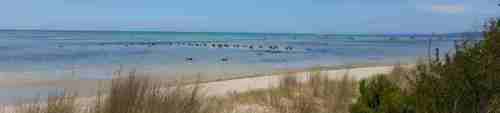
But what’s with all the black swans? There’s often one or two swans doing swanny things, but I’ve never before seen quite this many.

swans

As I am the fount of all wisdom about conical sand-snails, I felt duty-bound to investigate the presence of so many black swans, so up to the Rangers’ Office I went. Apparently they are attracted to the sea-grass beds which have grown particularly well this year.  The mild weather leading up to Christmas has also encouraged them.

swans3

I didn’t realize that there were so many swans in Port Phillip.  However, I’ve since learned Swan Bay is across the bay on the Bellarine Peninsula opposite, so named by Matthew Flinders for the huge number of black swans he found there. Apparently they continue to frequent the place in their thousands.

I’m quietly amused at the title of David Mitchell’s book Black Swan Green, and the excitement with which something is acclaimed as a “black swan event”.  There’s nothing unusual about a black swan in Australia.


A fillum about the fillums (I): Tehran Taxi

A movie shot almost completely inside a tax from a dashboard mounted camera? Ah, but this is not any ordinary taxi, and the driver is no ordinary taxi-driver (indeed, he’s not a taxi-driver at all).  Instead, he is the Iranian film maker Jafar Panahi, who in 2010 was placed under house arrest and banned from making films for twenty years by the Iranian authorities.

He drives his car as a taxi, people get in and people get out. One is his niece (who actually accepted the award for this film at the Berlin International Film Festival on her uncle’s behalf) but the others are unnamed, amateur actors.  The car door opens and shuts, as people enter and leave the taxi. A petty thief, an undercover video seller, a teacher, a lawyer, two women with goldfish, a couple injured in a motorcycle accident all share the taxi, sometimes interacting with each other, other times staring out the window. I stared out the window too, fascinated by glimpses of Tehran through the windows- such a European city, with sealed roads, traffic lights, tunnels- all the infrastructure of a modern city.

But gradually things are not as they seem.  I won’t say more.  If there’s any chance of catching it- do.  (It’s on at ACMI in Melbourne at the moment.) Very, very good-  4.5 stars

Death or Liberty on television

Tune in, readers, for Death or Liberty on ABC1 at 9.30 on Thursday 14th January.

I reviewed the book here in 2014.

Splish splash! Water Stories at PROV

The Public Records Office of Victoria (PROV) website has some thoughtfully curated online exhibitions.  They’ve been designed with school curricula in mind, but they’re interesting in their own right.  I’ve been enjoying one on Water in Melbourne called Water Stories. It starts with the Yarra River,( as all good narratives of Melbourne must!) then extends into the various water supply, navigation and sewerage schemes that were developed in the wake of the prosperity of the Gold Rush. Some were far-sighted (Yan Yean, for example in 1856) and others were more reactive, driven by the determination to shrug off the epithet of ‘Smellbourne’ that critics attached to Melbourne. The display then shifts to the major parks and gardens that were planned to beautify the city, several by La Trobe back in the 1850s, which are treasured by Melburnians today.

Click the link below:

https://embed.culturalspot.org/embed/exhibit/water-stories/lAIyzP8Lo1pmKw?hl=en-GB


This Week in Port Phillip 1841: January 8-15 1841

The habit of kicking back over January was established by 1841, and it was all happening this week! On Tuesday 12 January there was the Regatta on the bay.

High indeed were the expectations of our fellow colonists of every rank and age and bustling the scene of general preparation to celebrate the first Regatta, but the pleasure of the reality and the fond reflection upon its varied and enchanting amusements have eclipsed the brightest anticipations of its most sanguine admirers and rich and abundant is the fund which Memory has [?] stored up for future enjoyment (Port Phillip Herald 15 January 1841]

There were four races in all for different crafts:four-oared gigs; first class boats and five-oared whale boats.  As is the case today, there was just as much interest in watching the spectators as watching the spectacle:

regatta

(Port Phillip Herald 15 January 1841)

Then on Wednesday 13th it was the Hurdle Race at 1.00 p.m. “The course marked out is selected on the other side of the river Yarra Yarra, near the beach, and about half a mile to the left of Mr Liardet’s hotel“. (PPH 12 January 1841) Mr Liardet’s hotel was at Port Melbourne.

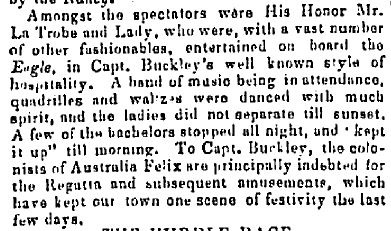
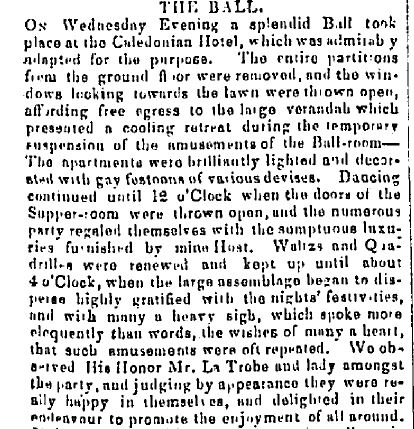
A “ vast assemblage had collected to witness the sports” at the beach where a limited number of horses competed against each other in three heats.  The writer for the Port Phillip Herald became very excited about the whole thing but it really doesn’t bear repeating 175 years later.  More interesting was the ball that was held that evening:

ball

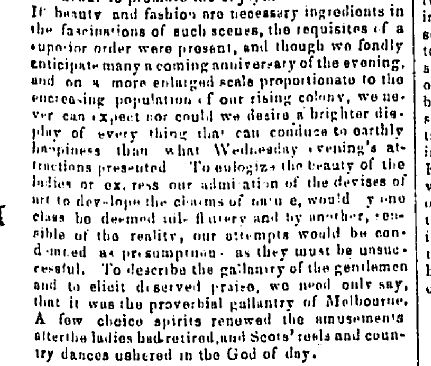
The presence of Superintendent La Trobe and Mrs La Trobe is important because they conferred an aura of respectability to the proceedings. If they were there, then all the Port Phillip worthies would have wanted to be there too.  Just like our clubs today, these balls went until late at night (or rather, early the next morning), with this one breaking up at about 4.00 a.m.

ball2

The cricket match was held on Thursday 14th January, “on the usual ground” .This was, at this stage, at the foot of Batman’s Hill, near the site of the present day Southern Cross station.  However, the match was abandoned “owing to the boisterous state of the weather“, to be continued on the following Saturday.

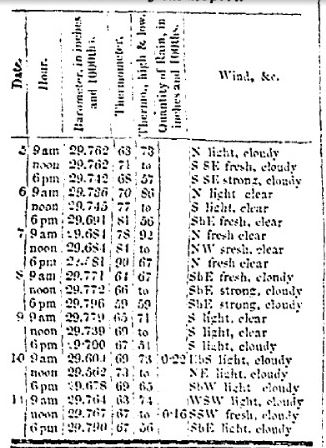
WEATHER REPORT

So how was the weather?  How frustrating- it doesn’t go up to 14th January!

PPH15Jan1841

Port Phillip Herald 15 January 1841.

It was 92 degrees (33 celsius) on 7th January, followed by a 67 degree (19 celsius) on the 8th.  How Melbourne!

And according the report of the week from the Meteorological Journal for Port Phillip, published some two months later (19 March 1841)  in the Government Gazette,

Weather generally dull and cloudy; rain in small quantities 9th, 10th and 14th; strong winds and squalls from S continuing frequent; N. W. gale 14th.

The highest temperature for the period 8th-14th January was 89 degrees (31.7 celsius) on 7th January, and the lowest was 51 degrees (10.6 celsius).

‘In My Mother’s Hands’ by Biff Ward

ward_biff

2014, 288p.

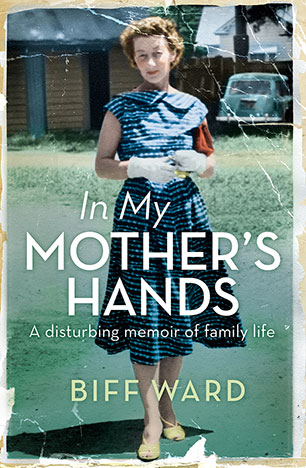
Look carefully at that front cover. A well-dressed, attractive woman stands in front of a suburban house, her hair permed, in a stylish dress with white gloves.  Those gloves are important: they encase the gouged, ravaged hands of Biff Ward’s mother Margaret.  Despite the nostalgia-infused image of Margaret Ward on the cover, this is the story of a troubled and desperate woman and mother, told by her daughter.

Biff ( a childhood rendering of ‘Elizabeth’) Ward is the daughter of Russel Ward, the noted Australian historian who wrote The Australian Legend. This book was a hugely influential study of the Australian Character (the question that keeps on giving), published more than fifty years ago. Although perhaps not so well known today, The Australian Legend and its author were examined anew at a symposium in 2007 (proceedings found in the Journal of Australian Colonial History 10.2 (2008) with a summary here) and re-addressed each year through the Russel Ward Annual Lecture  (see Babette Smith’s lecture here)

Although Biff’s memoir focusses on her mother, it is just as much a study of her father and of the family dynamics that operated when dealing with mental illness, shame and fear in the context of  the 1950s and 1960s. Biff and her brother Mark had always known of the existence of an earlier child, Alison, who had died at the age of four months,but the conditions surrounding Alison’s death were murky. What was clear, though, was that their mother Margaret was a deeply disturbed woman.  Those gloved hands, torn and rubbed raw by Margaret herself, also throttled Biff as Margaret crept to her younger daughter’s bedside one night, and it was when Margaret threatened the lives of her two remaining children while her husband was absent at a conference, that Russel Ward finally had her committed. Although Biff felt that they were dealing with the nightmare of their mother’s illness in secrecy,  many people were aware of it, as Biff herself recognizes later.  In reading a short story ‘Friends in Perspective’ published by Gwen Kelly in a Meanjin article  in 1990 (available for Victorian readers through SLV), Biff realizes that  both Russel and Margaret were the topic of gossip and judgment throughout the small academic communities at ANU in Canberra and UNE in New England.  She has the maturity and grace to recognize that the academic wives may well have been reaching out to her mother as well, instead of just gossiping about her.

She captures small university-town life well, and places her father within the academic milieu of the  communist-phobic 1950s and 1960s.  She draws on Russel Ward’s own letters to his parents and sisters that documented Margaret’s progress, and to a lesser degree on Ward’s own autobiography which largely elides Alison’s death and Margaret’s illness. I found it interesting to read about the smallness of the Australian History fraternity at the time, and the intellectual isolation of local academics in a  world where international conferences and networks were luxuries.

Biff did not write this memoir until both her parents had died. She is well aware that she is exposing her mother, and perhaps from a sense of moral even-handedness, she exposes her father’s sexual addiction as well. Even writing as an adult, as Biff does, it is impossible to tease out cause and effect in this addiction, but it does raise the issue of omission in memoir. Is there more? or less? of an imperative to reveal the flaws of a public figure, as distinct from someone unknown? (I’m reminded here of journalist Laurie Oakes’ exposure of politican Cheryl Kernot’s extramarital affair when she omitted it in her own autobiography).  Although Ward’s revelations about both parents are startling, the tone is wistful rather than vindictive, and while she censures both parents at times, her compassion shines through.

There’s a fairly lengthy extract from the book here, which will give you a taste of the easy  narrative that, at the same time, reveals so much darkness and pain. You’ll spend quite some time turning to that image on the front cover.

Other reviews:

Sue at Whispering Gums and Jonathan at Me Fail? I Fly! have written sensitive reviews of this book

aww2016 I’ve reviewed this as part of the Australian Women Writers Challenge for 2016.

My rating: 9/10

Sourced from : Yarra Plenty Regional Library e-book . Read in one sitting on an international flight!