Movie: ‘Tickled’

This is REALLY good! It’s a documentary about a NZ journalist who, while doodling around on the internet, stumbles onto a website about ‘competitive endurance tickling’. Watching people being tickled tickled his sense of humour and curiosity as well, so he emailed the owner of the site with a view to doing a documentary about it.  His investigations about something so ostensibly quirky and amusing took him into some very dark places.  It’s a very unnerving, discomfiting film and one of the best docos I’ve seen in a long time.

This Week in Port Phillip 1841: 1-8 September 1841

HOUNDS FOOT! HA, HA, HA!

The newspapers in Port Phillip often reported on Judge Willis’ performance on the Supreme Court bench, largely because there was little other ‘hard’ news to fill the columns with. Nonetheless, he did give them plenty to write about, especially when getting stuck into the barristers and attorneys who appeared before him. He took his responsibility for keeping the bar in line very seriously – and indeed, that was part of his judicial duty- but often made theatrical threats and gestures that make it easy to see him as a figure of fun.  His attacks on the court personnel make good newspaper copy, but it is telling that many of the people who were the recipients of his tongue-lashings signed petitions against him once there were moves to remove him.

One of Willis’ more theatrical outbursts was against Archibald Cuninghame – also spelled Cunninghame and Cunningham.  He had practiced at the Scottish bar for seven years when he emigrated to Sydney with his brother and two sisters in 1839, an example of the sibling migration patterns that I have spoken about earlier. While he did not necessarily see New South Wales as his permanent home, he did see the financial opportunities it offered, writing to his mother “I see a prospect not of making, a rapid fortune, but yet, of very good returns for my Capital”.  After overlanding down from Sydney, he quickly took out a licence to depasture stock and bought up 139 acres around Northcote (in Melbourne) at the 1840 government land auctions.  His two sisters travelled down to Melbourne in the Bright Planet (the ship that Peter Mews used as the springboard for his excellent book of the same name), while his brother took up the management of the station Wanregarwan, up on the Goulburn River. Archibald joined Redmond Barry, Edward Brewster, James Croke and Robert Pohlman as the first barristers admitted to the Port Phillip bar in April 1841.

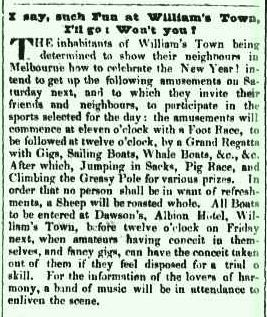
At the end of August 1841, an advertisement appeared in several editions of the Port Phillip newspapers.

houndsfoot

Contact with horses was part of the gentlemanly image – and indeed, Judge Willis himself was an enthusiastic horse-rider while in British Guiana and certainly had his own horses in New South Wales.  However, that was riding them, not hawking them for stud services, and Willis took exception to the difference.

THE LAW AND THE ASS- On Friday last, previous to the commencement of the trials at the Supreme Court, his Honor, Judge Willis, produced a copy of the Herald Newspaper in which appeared an advertisement of an entire house, Hound’s Foot “to stand this season,” signed by Mr Cuninghame. His Honor expressed a hope (to the Crown Prosecutor) that this horse was not the property of Mr Cuninghame, the Barrister, who was an Officer of the Court. Mr Croke being unable to satisfy the interrogatory, his Honor proceeded to say that, if such was the case, it was exceedingly derogatory to the respectability of the bar, that it would look rather curious to see written upon the door of the “Horse and Jockey” “Law business transacted here”, and that he considered one as bad as the other.  Judge Willis proceeded to make some further remarks on the subject, but before concluding, requested to know from the gentlemen of the bar, how it would look to see an advertisement in the public papers headed “Montezuma, this splendid ass, will stand for the season at the stables of His Honor, Judge Willis, Heidelberg” would this add dignity to the bench. (PPH 31 August 1841)

Judge Willis certainly did live at Heidelberg, but I’m not aware whether he had an ass called Montezuma. But nor did Archibald Cuninghame have a stallion called Hounds Foot- it was his brother John up on the Goulburn.

THE JUDGE AND MR CUNINGHAME – As reported in our last number, his Honor Judge Willis remarked to Mr Croke that he hoped the celebrated imported horse “Hounds Foot” had not been advertised “for the season” by Mr Cuninghame the barrister, as such a circumstance would not add respectability to the bar.  The impression produced by His Honor’s remarks was that Mr Cunninghame the barrister had so advertised “Hounds Foot”. To shew that even Judges may err in their opinion of matters of this kind as well as in others, we may state that Mr Cuninghame has a brother residing on the Goulburn river; and as the advertisement, which attracted his Honor’s attention particularly states that the horse “will stand this season at the station of the proprietor, Mr Cuninghame, on the Goulburn river” (where Mr Cuninghame’s brother actually resides), we infer that the barrister of that name, who resides in town and follows his profession, is not the Mr Cuninghame “of the Goulburn river.” But Editors, like Judges, may err- who is wrong? (PPH 3 Sept 1841)

Humour by a powerful person is a dangerous thing.  Sometimes when I look at some of Willis’ more outrageous antics from the bench, I wonder if he was performing for the audience, in the same way that our politicians do before the despatch box.

Certainly Willis was very strict about any involvement in ‘trade’ amongst those solicitors and barristers who came before him seeking admittance to the court.  Probably the major fact that led to Willis’ dismissal was the campaign he waged against public officers and members being involved in land speculation and bill-trading. Neither of these activities were illegal, and in a new frontier colony, most people with capital deployed it in either land or financing in this way. Willis’ criticisms of high-ranking people in Melbourne for their involvement in such activities was, I believe, a direct cause for his dismissal.

But Willis’ riff on the Ass Montezuma suggests that he’s enjoying himself here at Cuninghame’s expense. I think of footage of powerful people making a joke, and the forced laughter of their minions around them. Historian Greg Dening wrote about William Bligh’s “bad language” in that people didn’t know how to take it. I would argue that Willis had “bad language” too, and the Hounds Foot incident, while farcical, highlights the difficulty of humour from the bench.

Certainly, the Port Phillip Gazette in its editorial columns, was becoming increasingly critical of Willis.  Its editor, the young George Arden, was clashing with Willis and within weeks publish a letter signed ‘Scrutator’ which would lead to an open conflict with the Judge.  But here’s the Gazette editorial on 4 September:

Mr Justice Willis has certainly the merit of being singular, if not sensible, in his opinions on matters connected with his own department, and he occasionally expresses his conceits in a manner and language that is equally awful to the officers of the Court and amusing to the public…If, however, it will serve the purpose of Mr Willis equally well, and he will condescend to permit us, with all just and proper humility, to tender our opinion on the subject, we will observe that it would be no matter of surprise to the public to hear that there was an ASS connected with the Bench, or that the amiable quadruped resided at Heidelberg, but the attempt of Mr Willis, trivial and vexatious as it was, considering the scanty foundations he had for his extraordinary comments, is viewed on every side with marked and universal disapprobation. (PPG 4 September 1841)

Mr Cuninghame recovered from his unmerited dressing-down and continued to serve in Willis’ court. As an equity lawyer (like Judge Willis himself), he was involved in discussions about the introduction of usury laws, and he was involved in many of the philanthropic and civic organisations of Melbourne.  He went to London in 1846 to represent the Port Phillip colonists in their campaign for Separation, and died there unmarried in 1856.

In fact, the whole little contretemps probably more harm to Willis’ reputation than it did to Cuninghame.

More information on Archibald Cuninghame: Marion Amies and Martin Sullivan ‘Manuscript: 3 Letters from Christian Cuninghame to Agnes Cochrane-Patrick Describing Life in the Port Phillip District’ LaTrobe Journal No. 30, December 1982 http://www3.slv.vic.gov.au/latrobejournal/issue/latrobe-30/t1-g-t4.html

AND THE WEATHER?

“Strong winds on the 3rd 4th and 5th; weather cloudy and uncertain; rain several days but inconsiderable in quantity.” Highest temperature 66F (18.8); lowest 38 (3.3)


Franklin ship ‘Terror’ found

I’m sitting here looking at the video of the discovery of Sir John Franklin’s ship, Terror that was found in – how appropriate- Terror Bay. Amazing- even the glass in the windows! Two years ago the Erebus was found, in much poorer condition than this most recent discovery and I wrote about it at the time here.  Academic Russell Potter, who released his book Finding Franklin: The Untold Story of a 165-Year Search on July 26, has written about the discovery on his blog and the Guardian has a very full report.

It’s all very exciting!


‘Leaf Storm’ by Gabriel Garcia Marquez

leafstorm

1955, (originally published as La Hojarasca)

Have I mentioned here that I am learning Spanish?  Not content with bursting my brain with learning verb conjugations (it has taken me an inordinately long time to move on from the present tense- quite a drawback for a historian!), or sitting puzzled over News in Slow Spanish (which although slow, is not slow enough for me!), I have enrolled in a Coursera course on the works of Gabriel Garcia Marquez which begins today.  One Hundred Years of Solitude is one of my favourite books and it seemed a good way to struggle with Spanish while reading something that interests me. No, I am not reading the books in Spanish: I’m having enough trouble reading the lecture notes and following the videos on the course because the ‘translate’ function doesn’t seem to be working for the subtitles.  As a result, if I get through even one week’s work in the six weeks allocated, I’ll be doing well. However, it has prompted me to plunge into a cram-reading of Gabriel Garcia Marquez.

It seems fitting, therefore, to start off with his novella Leaf Storm, which was his first published work.  It appeared in 1955 after a seven year search for a publisher. It is only short: about 90 pages although it is hard to tell on an e-reader. I kept feeling that I had read it before, which I have, because he picked up the same themes in much of his other work.  It’s as if he was trying the story on for size in novella form, which he later expanded into a whole body of work. It is set in Maconda, the fictional village to which he returns again and again.

The story starts with an epigraph from Antigone, and this short novella, like the earlier Greek story, focusess on a contested funeral. It is told from three perspectives: an unnamed small boy, his mother Isabel, and his grandfather, the Colonel.  The three people are sitting in a closed room with the body of the doctor, who had committed suicide, each with their own thoughts.  The child is preoccupied with the discomfort of his formal clothes and the wonder that he’d been kept from school to come sit with this body.  The daughter thinks about the dead doctor, and his strained relationships with the villagers, and his generally disapproved concubinage with their former servant.  The colonel gives the widest perspective of all, as he reflects on the hatred of the village for this doctor because of his refusal to treat wounded soldiers during one of the civil wars that convulsed the country after the arrival of industrialization.

It is hard now to appreciate the novelty of a multi-perspectival narrative because it is relatively common now.  However, the frequent references- even now, 66 years later,  to the 1950 film Rashamon as the prime example of a multi-perspective work, highlight the strangeness of the narrative technique that Gabriel Garcia Marquez developed at much the same time.

The novella itself is easy to read (in English!) but I must confess to not being able to easily detect the difference in voice between the Colonel and his daughter Isabel. However, as I often find with my favourite authors, Garcia Marquez is a master in being able to slip seamlessly between past and future without interrupting the narrative with asterisks or chapter headings.  The element of an eerie timelessness is here, and a sense of the teeming physicality of the village- both memorable features of his other work.

And so- onward to the next book!

Read because:  I’ve enrolled in the ‘Leer a Macondo’ Coursera course to challenge my budding Spanish.

Format: e-book The Gabriel Garcia Marquez Library: Fifteen of his best-loved books.


Vale Inga Clendinnen: Re-reading’Tiger’s Eye’

clendinnen2016

I began writing this review of Tigers Eye the other night, after re-reading it for my bookgroup. I was working on it last night, and I wondered how Inga Clendinnen was faring, knowing that she had been in poor health (but still mentally feisty) for some time.  Little did I know then that she had died that very day.  Inga Clendinnen is the historian who influenced me more than any other. I have read much of her work, all before I started writing this blog (Ambivalent Conquests;  Aztecs: an Interpretation; Reading the Holocaust;  True Stories (Boyer lectures); The History Question; Agamemnon’s Kiss and Dancing with Strangers.)  But her presence is here in my blog, in the only book of hers that I have reviewed since (In Search of the ‘Actual Man Underneath‘) and, more importantly, as the lodestar that has guided my perception of other histories written by other historians. I met her only once in recent years (and was so overcome that I was barely coherent!) but my respect for her is unbounded and my debt to her incalculable.  Vale, Inga Clendinnen.

***************

tigerseye

2001, 289 p.


So this is what I have been doing all this time- by courtesy of a physiological malfunction, taking a journey out, beyond and around myself, and into interior territories previously closed to me.  At the end of it, battered, possibly wiser, certainly wearier and, oddly, happier, I have returned to where I began: to history, with a deepened sense of what peculiar creatures we are, you and I, making our marks on paper, puzzling over the past and the present doings of our species, pursuing our peculiar passion for talking with strangers. (p. 289)

I first read Inga Clendinnen’s book Tiger’s Eye  in 2003 and it changed my life. I had been ill for about three years, able to only work part time, and after reading this beautifully written reflection on illness, memory and writing, I decided that I wanted to return to uni and my first academic love- history. I think that I could confidently say that you wouldn’t be reading this review on this blog if I had not read this book (oh dear, it all sounds a bit too Pauline Hansonish.) Before re-reading it for my bookgroup this month, I would have said that Tiger’s Eye was ‘about’  Clendinnen’s response to her illness.  Returning to it, I find it a much different book to that which I remembered, combining experiments in fiction, memoir and an exploration of the nature of memory.

So who is Inga Clendinnen? After commencing her academic career at the University of Melbourne, Inga Clendinnen was a history lecturer at ‘my’ university, La Trobe, between 1969 and 1989.  I had forgotten completely, until reminded by a friend, that she was the lecturer on the Mexican Revolution in Revolutions IA, the first history subject I did as an undergraduate in 1974. Along with Greg Dening, Donna Merwick and Rhys Isaac she became known as part of a group of historians dubbed the ‘Melbourne school’ by anthropologist Clifford Geertz.  Common to this group of historians is the practice of thick description, reflexivity, a deep reading of events and individuals’ responses, and a celebration of the act of writing. It is the type of history I admire and enjoy most. Clendinnen’s specialization was Mesoamerican studies, most particularly Aztec culture, but she is probably best known  in Australia for her works Reading the Holocaust and most recently Dancing with Strangers.

“Illness made me a writer” she says at the end of this book (p. 288). I think that she’s underselling her own earlier writing, but certainly Tiger’s Eye is an exploration of writing outside the history genre, while still drawing on the historian’s skills.  Ill in hospital, feeling trapped, helpless and under surveillance, she remembered a childhood story about a wizard who looked through the eyes of various animals- wolves, jaguars, ants- to see the world from their perspective.  On hearing the rumble of a tiger from the nearby Melbourne Zoo, she adopted the tiger’s eye as her motif:

… I too was in a cage, with feeding times and washing times and bars at the sides of my cot, and people coming to stare and prod, but the kaleidoscope of the horror of helplessness ceased to turn because I withdrew my consent from it.  Thereafter, whenever I felt the threat of the violation of self, I would invoke the vision of the tiger and the freedom that vision gave me, to be at once the superb gaze, and the object of the gaze: an incident in a tiger landscape. (p. 21)

She directs her gaze towards herself as patient, telling the story of the progression of her illness, observing her fellow patients and recounting the steps towards the liver transplant that halted her decline. She spends a considerable time ( perhaps a little too much time?)  recounting the hallucinations that electrified her befuddled post-surgical consciousness.  Once their vividness had abated, she realized that the hallucinations wove together memory and sensation from her own childhood and experience.  Much of the book is devoted to unpicking these experiences, testing the robustness of memory as a factual as distinct from emotional construct, and knitting her experiences up again into fictional experiments.

More of the book than I remembered is turned over to exploring – or as she puts it- ‘reading’ her parents.  Here I find myself conflicted.  I’ve commented on several occasions recently in this blog about my discomfort with children ploughing their parents’ lives, wanting to uncover the ‘real’ man or woman inhabiting the carapace of the parent figure. Clendinnen certainly does this, particularly with her mother, and her judgment is harsh. She directly links her curiosity over her mother, in particular, with her later career as historian:

… I can see that my pursuit of her has been a lifetime activity; that my early fascination with her impenetrability, and my pleasure in that impenetrability, has a great deal to do with my long happy life as a historian spent in pursuit of other more distant,less impervious impenetrabilities. … Now, when I am not many years younger than she was when she died, I am still sifting my handfuls of sand, still trying to make them stand and hold a shape I could call ‘my mother’. And still, for all my gatherings and pattings, she continues to fall apart like a sand lady.  If she is on the beach at all she is a mirage, an eye-baffling dazzle fleeing before me, receding faster than I can run. (p. 237, 238)

I was also surprised to find, on re-reading this book, how seriously she grappled with the issue of fiction-writing versus history writing.  This was, of course, the juxtaposition that roared into life in her argument with Kate Grenville over the writing of The Secret River, and which Clendinnen explored in more detail in her Quarterly Essay The History Question. But it’s here in this book too, five years earlier, as Clendinnen experiments with the two genres, finally admitting an element of defeat:

After years of doing it I think I am beginning to understand the work of writing history- the how of it, the why of it- but I still don’t understand the work of writing fiction.  There is a Spanish saying of which I am unreasonably fond: ‘No hay reglas,.’ ‘There are no rules here.’  That is the way fiction seems to me.  If there are rules, I don’t know them.

Engagement with professional history imposes rules.  One of those rules is that we must represent our chosen people as justly and completely as we are able.  We must try to understand them, and for that we need a supple imagination, but that is imagination’s only role.  With history I am bound like Gulliver by a thousand gossamers: epistemologically to the deceitful, accidental record, morally to the dead men and women I have chosen to re-present, and to the living men and women I want to read my words and to trust them. (p.244)

Finally, in re-reading Tiger’s Eye I was stopped again and again by the sheer beauty and power of her writing.  Here’s her description of visiting her aunt’s outhouse at night:

I liked the outhouse best on moonlit nights, because then the moonlight would come slicing through the slim black gumleaves like hard silver rain. (p.59)

Here, in one of her fictional pieces, is a mother putting on lipstick to visit her sister:

…she would draw her stumpy lipstick straight across her stretched lips and rub them hard together, so that when they showed again they were red with little spikes of deeper red running out along the wrinkles…(p96)

And in the same story, an unnerving description of an aunt’s ‘little game’ that mixes sensuality, intimacy and transgression.  The mother and her daughter visited Aunt Lall, who was bed-bound:

…sooner or later my mother would say she would die without a cup of tea and she would whisk out…and while she was out of the room Auntie Lall and I would do our secret thing.  She’d give me a little nod and a wink, and I’d climb up onto the bed, carefully, so I wouldn’t joggle her legs, and she’d take my hands into her warm soft ones and lace her fingers tightly with mine so our palms pressed together and I’d feel the hard bands of her rings…Then she’d slide the rings off, the ones that could still come off, and spin them on my fingers, and give the tip of each of my fingers a little kiss.  They were marvellous rings, heavy ones, old, all of them gold, with rubies and diamonds studded all round them. She’d stack them on my thumbs, raise her pencilled eyebrows and laugh silently, and I’d trace the pencilled line along the line of bone to the puckered skin and the harsh orange-red hair at her temple, and she would lift my limp hair away from my forehead as if it were precious.  As if it were beautiful.

We would do all these things silently, listening to my mother banging about in the kitchen.  Then the kettle would scream and the boiling water would crash into the teapot and I’d slide back into my chair just as my mother came in and banged down the tray so that the milk flew out of the jug and the teaspoons trembled… Carnal knowledge.  Whenever I come across that phrase now I think of Auntie Lall, because carnal knowledge was what she taught me: that there is a special love which sleeps in the flesh, and that special fingertips can waken it. (p. 104)

And so, on re-reading Tiger’s Eye, I find it a different book to what I remembered.  I’m perhaps more critical of the ‘Reading Mr Robinson’ section which takes up a large part of the book, now that I, too, have read Mr Robinson.  I can see the emergent shape of the Kate Grenville dispute, and I am surprised that so much of this book is fictional writing. But most of all, I celebrate Clendinnen’s artistry as a writer, thinker and historian: one of the best ones I know.

aww2016

I have included this book towards my tally on the Australian Women Writers Challenge 2016


Movie: Absolutely Fabulous: The Movie

Much as I love Ab Fab, it’s best viewed in small doses. I think I enjoyed this trailer as much as I did the whole movie, to be honest. I am absolutely clueless about fashion and popular culture, so much of this went right over my head. But of course, it’s lovely seeing everyone again- Mother (who would have to be the most beautiful 90 year old around); Bubble; Marshall and Bo; Saffy and Lola. I found myself grinning away like an idiot just from the joy of seeing familiar faces again.  At least Eddie and Patsy (who’s pretty damned good for 70, too) can grow into their old age disgracefully and embarrassingly, which is of course the whole shtick.

But while half-an-hour of Ab Fab is perfect, a whole movie is too long. Really, I think you’d be better off sitting down with an Ab Fab box set and just enjoying it in its original and absolutely fabulous format.

Don Watson ‘QE63 Enemy Within: American Politics in the Time of Trump’

watson_enemywithin

2016,  63p.

It might seem strange to Americans that  Australia’s premier long-essay journal devotes a whole issue to Donald Trump (and I can’t see the interest being reciprocated in reverse) but as in other countries across the world, many Australians – and particularly those of Quarterly Essay persuasion- are horrified at the idea of President Trump.  So, too, is Don Watson, as he makes clear in this essay.

Don Watson wrote American Journeys eight years ago (see my review here) and he repeats, on a smaller scale, the methodology he used in that earlier book.  However, instead of criss-crossing America to explore its political and cultural paradoxes, Watson limits himself in this essay to the state of  Wisconsin.  However, his findings are similar on a smaller scale: that within the one state there can exist multiple Americas, and that American politics reflect this splintered reality.

Within the state of Wisconsin, there is Milwaukee, hollowed out by the collapse of American industrialisation. White Americans now number 37% of the population (half of what it was in the 1950s); Latinos a four-fold increase to 17% and African Americans making up 40%. Milwaukee votes Democrat, but the white-flight suburbs surrounding it are a staunch Republican voting block, fired up by prosperity evangelism. They are the support base  of  the current governor Scott Walker, who believes that God has chosen him to cut taxes and stop killing babies.

Then, in the same state, there is Madison – and how many books have I footnoted ‘University of Wisconsin- Madison’?- a university-dominated town with art galleries, museums, and the Capitol building.  Madison was the seat of Robert La Follette who took on the elites, the railroad trusts, the lumber bosses, the corporations and stood for an expanded democracy, guarantees of civil liberties, the right to form unions and against “any discrimination between races, classes and creeds”. (p. 28) It is this strain of American politics that responded to Bernie Sanders for whom, I suspect, Don Watson would vote  if he had the chance.

There are now, Watson claims, two red parties and two blue parties, and “the whole country has come to resemble a battleground, albeit one, like the Somme for long periods, in stalemate.” (p 3) The underlying truth is that “the United States is a concatenation of sulky tribes, provincial, ignorant and seething with ambition, frustration and resentment”. (p 4)

While not discounting the possibility of a Trump victory completely, Watson abhors the thought.

Clinton just has to win. If she loses, not only does the world get Donald Trump (and the US Supreme Court his appointments): the Democrats will have to live forever with their decision to make their nominee the most qualified presidential candidate in history, but also the person most disliked by the American public and possibly the only one that Trump could beat. (p. 66)

Clinton is, Watson says “a fully fledged, and some would say dangerous, foreign policy hawk with no demonstrated ability to think beyond the doctrine of exceptionalism to which she subscribes as a matter of faith” (p.62) But she has also, through Sanders’ presence, been pushed towards the progressive side with promises to invest in cities to lift people out of poverty, invest in infrastructure, create jobs, revive manufacturing and raise the minimum wage, with immigration reform, an end to student debt and paid family leave. (p 64).  And this, perhaps, is cause for cautious optimism.

Reawakening the old grassroots reformer deep inside could not only heap manifold blessings of the nation and consolidate a liberal Democratic ascendancy; it is surely alsO the best antidote to the dark forces now feeding on the country’s malaise. (p. 67)

This Quarterly Essay probably does not add much that is new to the commentary that Paul McGeogh has been providing in the Fairfax papers, or Guy Rundle in Crikey. It is good, however, to read an extended-length reflection on the American elections, even if it feeds into our despair over a decision that will affect us all, and upon which we can have no influence whatever.


Movie: ‘Neruda’

We caught this film last week at the Latin American Film Festival.  I actually knew who Pablo Neruda was, because we read several of his most famous poems in my Spanish conversation class at the local library.  He was a Chilean poet, who became famous through a collection of poems called Twenty Love Poems and a Song of Despair that he wrote in 1924at the age of nineteen. He went on to have a prominent political and diplomatic career.  He was a senator for the Chilean Communist Party, but when Communism was outlawed in Chile in 1948, he escaped to Argentina. His death has become increasingly controversial over recent years, with the Pinochet government assertion that Neruda died of cancer, being increasingly questioned.

This film is the imagined story of Neruda’s escape to Valparaiso and across the mountains to Argentina, pursued to a Javert-type policeman (think Les Miserables) who, although unfamiliar with him as a poet, sees the chase in very personal terms.

And no- I couldn’t follow the Spanish very well.

This Week in Port Phillip 1841: 25-31 August 1841

THE SAD TALE OF OF VEZELLA RAINBOW

It was not particularly common for the Port Phillip Herald to comment on the parlous circumstances facing impoverished individuals, but during much of June 1841 it conducted an appeal in its columns for donations to the widow of Trooper Rainbow, of the Mounted Police, who drowned when crossing the Goulburn River on 26 April 1841.  As the Sydney Herald reported, Trooper Rainbow had been with the Mounted Police for seven years, and was regarded as an active, steady man.

REAL DISTRESS. We beg to draw the attention of our humane readers to the case of the widow of Trooper Rainbow of the Mounted Police, who was lately unfotunately drowned when crossing the River Goulburn on duty. What makes this case one of peculiar sympathy is that while the bereaved woman has no claim whatever on the service, she has a babe in arms and expects shortly to again become a mother! Need we say more to call upon the liberality of the public to step forward at once to her relief? Subscriptions will be thankfully received at the Herald office.  (PPH 25/5/41 p. 2]

And so they were. For a month an article appeared in the Port Phillip Herald, listing the names of people who had donated to the appeal and the amount that they had donated.  I really can’t emphasize the rarity of a public subscription for a woman being reported like this.   Subscription lists for church buildings,  letters of support for Port Phillip personalities who were being attacked by Judge Willis, or benefits for clapped-out theatre performers- yes; but not a woman.

By 2nd July, the last advertisement appeared. It read

Rainbow1

Rainbow2

It’s a highly respectable donation list that raised £51. [A (male) overseer at that time might earn £100 per annum; single female servants were having to accept about £25 p.a. with board.]  Lieutenant Russell, was the most generous, with a donation of five pounds. It is likely that this Lieutenant Russell was the Lieutenant Russell who was commander of the Mounted Police, and other donations were given Trooper Rainbow’s fellow soldiers. Superintendent La Trobe was the next most generous with a donation of two guineas  (2 pounds and 2 shillings), and it is surprising to see Judge Willis’ donation of one pound because he rarely made public donations like this to individuals.

His donation is even more incongruous, because on 27th August, the Port Phillip Herald reported that Vezella Rainbow had been arrested for shoplifting.

The trial before Judge Willis was reported in the next edition (31 August). It was a jury trial, conducted on Friday August 26 before twelve good men of the town (women did not serve on juries). Trials moved pretty swiftly back then, and it was common to have three or four hearings within the one day. Juries made up their minds very quickly, often not even leaving the courtroom at all.   The prisoner was not called to the witness box and did not give evidence on their own behalf. Instead, it was up to the crown to prove the case through witnesses, and the question of ‘character’ often entered into consideration. In this case, the prosecution called three witnesses: Mr Codd the shop assistant, Mr Whitehead the shop-owner, and Constable Stapleton, who arrested her.

Vezella Rainbow, widow of the late Corporal Rainbow, was placed at the bar, charged with stealing a shawl, value two pounds, and five yards of Saxony cloth, value 18s.

Clement Codd, being sworn, deposed- I am shopman to Mr Robert Whitehead, Elizabeth-street; I saw the prisoner in his shop on Monday last; she purchased to ribband [sic] waistbands and paid for them four shillings, giving two half-crowns and being returned one shilling; did not ask to see any other goods; I was serving other customers at the time shewing them some shawls and Saxony dresses; the dress and shawl produced I identify to be the property of Mr Whitehead (here the witness received a caution from His Honor as to how he would swear to the identity of articles), I know them by private marks; I took them from the prisoner at the bar; she had them concealed under her shawl; they had been lying on the counter. I do not think Mrs Rainbow could have only taken them up to look at, without intending to take them away; they were concealed in such a way that when I took the dress from prisoner she denied having anything else in her possession; I had given her the change, she was putting it in a handkerchief and was about to leave the shop, when I perceived the articles with her.  After taking the things from her, I left them on the counter and went for a constable; I left Mr Whitehead in the shop; I marked the things and gave them to the constable who took the woman away; there are other Saxony dresses in the shop but none of the same description.

Cross examined by Mr Barry; there was another woman in the shop when the prisoner entered; subsequently a man came in; the woman who came in looked at some saxony dresses and then came out; brought back the man with her to buy her one, which he did.  The prisoner had a bundle under her arm; can’t say what it was; thinks it was a bundle rolled up in a yellow handkerchief: I marked the things after bringing back the constable; the prisoner was in conversation with the other persons in the shop: can’t say what they said: it was about articles of dress.  I particularly observed when the prisoner came into the shop that she had something under her arm; before I took the articles in question from Mrs Rainbow, she had not attempted to leave the shop: the articles she purchased still remained on the counter, when I perceived the dress with her: when I took the things she did not say any thing, but when going to the watchhouse, said the other woman had given them to her.

Robert Whitehead, being sworn, deposed, I keep a shop in Elizabeth-street; I know the prisoner at the bar; saw her in my shop on Monday evening last; I identify this shawl as being my property by the shop mark on it; I positively swear to the shawl.  I do not know any other shop that makes use of the same marks as I do; I saw Codd take the things from under prisoner’s shawl; just as a came into the shop; there was a man and a woman in the shop at the time the prisoner and another woman was conversing together; there was a man between them: I desired Codd to go for a constable, he brought one back with him. (The Judge here addressed the witness, stating, that although he did not mean or wish to impune his evidence, still there were many things he had stated required explanation.  His Honor compared different portions of the evidence and pointed out various discrepancies) another shopman was present, part of the time.

The witness was here cross examined by Mr Barry, but nothing particular was elicited.

Constable Stapleton, deposed to the facts of having taken the prisoner in charge, she being delivered up to him by Mr Whitehead, he also stated that the prisoner on being conveyed to the watchhouse said, that it was owing to bad company she got into the scrape.

Redmond Barry (yes, that same duelling Redmond Barry) acted as her defence counsel.

For the defence, Mr Barry addressed the jury as follows: I have no doubt Gentlemen, that after the evidence you have heard, you will proceed to discharge the defendant, for in my humble opinion there is no evidence to prove that the prisoner at the bar feloniously took the articles with intent to carry them away, which the law requires to constitute the crime, with which she is charged.  My client stands in a situation of peculiar delicacy; it is most distressing to witness it; and bear in mind gentlemen, the great disgrace she has already undergone by being arraigned at a bar of justice, on a charge of such a description.  Discrepancies of the most serious nature occur in the evidence to which I must request your particular attention, as they occur in the testimony of all the witnesses.  Gentlemen, the prisoner at the bar is the widow of the late corporal Rainbow, who was drowned in the Broken River, in the discharge of his public duty.  I can call innumerable witnesses as to the very good character of the unfortunate defendant, and you may well remember the great commiseration that was exhibited by the public towards Mrs Rainbow, on the death of her husband.  Indeed, gentlemen, I feel deeply affected by being obliged to come before you to plead in such a case as this; for the miserable prisoner at the bar is in such a state that she must soon give birth to an infant, who if you find the prisoner guilty, must first receive the pure air of heaven, the gift of the Almighty, in the murky dungeons of a loathsome prison, redolent of vice, obscenity and filth. I hope therefore you will immediately proceed to acquit my client, as I am sure you are already persuaded of the innocence of the prisoner, and as the entire of the evidence is so contradictory and unsatisfactory.  I shall leave the case in your hands, satisfied that it will meet with that consideration it so imperatively calls for.

It’s interesting to watch Judge Willis in action here.  He was very active during the case itself, pointing out the discrepancies in Mr Whitehead’s testimony and, according to a separate article in the same issue of the  Port Phillip Herald (31 August) Willis called up Codd immediately after the case and “proceeded to reprimand him in the strongest terms for gross prevarication in his testimony”. Willis read Codd’s  testimony at the Police Office and the Court back to him, pointing out the inconsistencies, and warned Codd that “he might be thankful for the clemency shewn him in not being committed to gaol for his gross prevarication”.   Notwithstanding these inconsistencies, and the  pound that Willis himself had donated for the unfortunate Mrs Rainbow a few weeks earlier, he then summed up very strongly against the prisoner:

The Judge summed up the case in an able manner, concluding by desiring the jury to divest their minds of any influence that the affecting address of Mr Barry might have on them, for notwithstanding the distressing circumstances of the case, as good and honest subjects they were bound to give their verdict, and assist as far as it lay in their power to have the law  carried into effect, justly and uprightly.  The jury after a few moments consideration found the prisoner guilty with a strong recommendation to “mercy”.

His Honor, in an affecting manner passed sentence on the prisoner, sentencing her to “six months imprisonment in her Majesty’s gaol of Melbourne”.  [PPH 31/8/41]

In his book Crime in the Port Phillip District (p. 198), Paul Mullaly reports that Vezella Rainbow (the spelling of her first name varies) was Freed by Servitude (i.e. an ex-convict) which may account for his hardline approach.  It was reported that “other Police had to take care of her children”.  On 15 April 1842, the Colonial Secretary wrote to La Trobe approving remission of sentences of 16 listed individuals including Vizle Rainbowe [sic] (VPRS Series 19 Unit29), so it does not appear that her sentence was reduced much, if at all.

HOW’S THE WEATHER?

Just as we’re experiencing here in 2016, the spring weather wass changeable. The warmest day for the month was 27th (69 degrees or 20.5C), followed by a strong gale the very next day.  The coolest temperature was 37F or 2.7C.

This Week in Port Phillip 1841: 17-24 August 1841

THE WATER CARTERS

At this stage, Melbourne was reliant on water carters for its water supply. Having recently spent some time in Nairobi where our house was reliant on tanked water for its domestic supply, I have a new appreciation for the angst caused by the non-appearance of the water delivery tank.

THE WATER CARTERS: Of late, several impositions have been attempted, and threats made by the carters who are in the habit of supplying the inhabitants of Melbourne with water. On Tuesday last one of these worthies was requested to bring a load to a resident in Bourke-street, which he willingly promised he would, and proceeded, as he said, direct to the pumps for the purpose. Hours, however, passed over, and no water cart made its appearance.  After waiting for so long a time, absolutely in the greatest want of the water, there was no other alternative left than to send through the streets and purchase a cask from another man. When a considerable period had elapsed after the so-much-required supply had been procured, the first carter arrived with his load, but as he had so disgracefully broken his agreement, and besides, as the water was not only then not required, but as there was no vessel for its reception, it was refused, and no payment of course would be made. Upon this announcement, the villain burst out into a violent storm of passion, discharged the water upon the path near the door, and threatened he would instantly have the person who had given him such offence summoned to the court.  Certainly there must, in a civilized colony, be some law wherewith to punish such vagabonds. It would be well for a case to be tried to solve the question. [PPH 17/8/41]

AN AFFAIR OF HONOUR

On 20th August the Port Phillip Herald reported a “hostile meeting” between “Mr B___ a gentleman of the bar” and Mr S_____.  These thinly disguised names would have been readily known to Port Phillip inhabitants: Redmond Barry (then aged 28) and Peter Snodgrass (aged 24).  As Edmund Finn, writing as ‘Garryowen’ described in his inimitable way:

In August 1841 occurred a hostile meeting, remarkable in consequence of the position attained in after time by the principals. Mr Peter Snodgrass was by no means the least pugnacious individual of an extinct generation, and it did not take much to get up a casus belli with him. Mr Redmond Barry was a gay and promising young Barrister, and the two were prominent members of the Melbourne Club. Barry had written a letter to a friend, who injudiciously showed it to Snodgrass, about whom it contained some reference, which was deemed to be personally offensive, and a challenge was the consequence.  The gage of battle was taken up, the preliminaries were quickly arranged, and in the rawness of a winter’s morning the meeting came off by the side of the “sad sea waves,” between Sandridge and the present Albert Park Railway Station.  Though the weather was the reverse of promising, Barry made his appearance on the ground done up with as much precision as if attending a Vice-regal levee.  Even then he wore the peculiarly fabricated bell-topper, which a future Melbourne Punch was destined to present to the public in illustrated variety; he was strap trousered, swallow-tail coated, white-vested, gloved and cravated to a nicety.  He even carried his Sir Charles Grandison deportment with him to the pistol’s mouth, and never in years after appeared to such grandiose advantage as on this occasion.  When they sighted each other at the recognized measurement, before Barry took the firing-iron from his supporter, he placed his hat with much polite tenderness on the green sward near him, ungloved, drew down his spotless wristbands, and saluted his wicked-looking antagonist with a profound obeisance that would do credit to any mandarin that ever learn salaaming in the Celestial Empire.  They taking his pistol and elevating himself into a majestic pose, he calmly awaited the word of command.  Snodgrass fussed and fidgetted a good deal- not from the nervousness of fear, for he was as brave as an English bull-dog, but rather from a desire to have the thing over with as little ceremonial nonsense as possible, for he was Barry’s antithesis as a student of the proprieties.  It was his over-eagerness on such occasions that caused his duelling to eventuate more than once in a fiasco, and unfitted him for the tender handling of hair-trigger pistols. By a laughable coincidence, the present “engagement” was terminated in a manner precisely similar to what happened at the duel of the year before, when a hair-trigger prematurely went off.  The same fire-arm was now in use, and just as the shooting-signal was about to go forth, the pistol held by Snodgrass, getting the start, was by some inadvertence discharged too soon, whereat Barry at once magnanimously fired into the air. Little could either of the duellers foresee what futurity had in store for both.  The one grew into the esteemed and popular forensic Advocate, and on to the eminent and universally-valued Judge; whilst the other, in the following year, was a gallant capturer of bushrangers, and ended his career as an active Member of Parliament, and a voluble if not eloquent Chairman of Committees in the Legislative Assembly.

redmond_barry_statue

Redmond Barry in his later, more sober years.

A NEW POST OFFICE

The new post office had opened on the corner of Bourke and Elizabeth Streets week earlier, having vacated its former premises in Little Collins Street.

Secondpostoffice

The Second Post Office by William Liardet. This post office in Little Collins Street was superseded by the ‘new’ post office on the corner of Bourke and Elizabeth Streets, which opened in August 1841.  State Library of Victoria

http://handle.slv.vic.gov.au/10381/151517

[Actually, looking at this picture- is that a beggar sitting against the wall, receiving alms from a lawyer??]

3rdpostoffice

The third post office, which opened in August 1841, is shown here in 1853, only six years before it was demolished for the first GPO which was built on the site. Note the deep gutter to the right of the image, built to try to control the unruly waters of Elizabeth Street. Original drawing by F. Thomas. State Library of Victoria

http://handle.slv.vic.gov.au/10381/261742

On August 17 the Port Phillip Herald praised the appearance of the letter-carrier, who seems to have cut quite a dash:

The scarlet coat, gold band on the hat, and leather case under the arm of the letter carrier, give a very gay appearance to the town of Melbourne, and to the gay lothario who sports them [PPH 17/8/41]

SOME BITS AND BOBS

An arrival in port

There was a 62 ton schooner called Truganini that arrived from Hobart. Interesting that the the woman we know as Truganini (Trugernanner) was at this stage in Melbourne, having come across with the Aboriginal Protector George Augustus Robinson.  I wonder how and why the boat was named Truganini?

A caution

An interesting advertisement:

CAUTION.  The public are hereby Cautioned against giving credit or harbouring my wife, Agnes Brown, she having decamped from her home, taking with her a watch, tea caddy, box and bed quilt on Thursday last.  Any person found harbouring her, will be dealt with according to law; and persons giving me such information as will lead to conviction, shall receive Five Pounds Reward.  James Brown. X his mark.

Until the passing of the English Divorce Act in 1857, divorces could only be granted by an Act of the British Parliament: an avenue restricted to very wealthy people. Only one petition for divorce was ever made in New South Wales (and that, interestingly enough, was on the part of the wife). Although legislation to protect Deserted Wives and Children was introduced in NSW in 1840, the emphasis was on men deserting their wives rather than the other way around.  However, as the advertisement above makes clear, women did not have property rights to any family goods, when they left a marriage, an illegal act in itself. A watch, a tea caddy, a box and a quilt: possibly  the watch and the contents of the tea caddy were all the portable property the couple held, while the quilt seems a particularly female object to take. [Memo to self: must go see the Quilt Exhibition at NGV Australia before it finishes in November].

And another interesting advertisement:

STRAYED about a fortnight ago- a boy about nine years old, had on light trowsers, blue cloth jacket, rather large pair of old worn out boots, dark hair, freckled features, round plump face; a small dog following blind of one eye.  The boy has strayed in a similar manner before and went in a fictitious name. He is supposed to be in the vicinity of Melbourne. Whoever will give information where he may be found to Mr Henny, Irish Harp, will be thankfully received. [PPH 17/8/41]

AND THE WEATHER?

Strong winds prevailing, weather cloudy or rainy.