Category Archives: Uncategorized

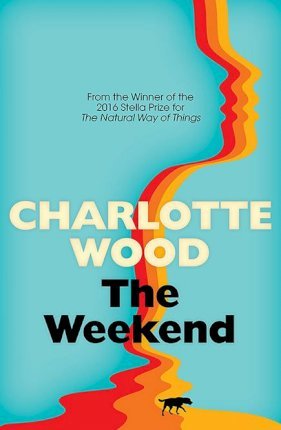
‘The Weekend’ by Charlotte Wood

2021, 288 p.

I’m trying to resist the temptation to think that this book was written to order: ” This’ll attract sales -how about a book about aging women that book groups can discuss!?” It certainly felt as if it were aimed at an educated, older female audience of readers. Aging, women’s friendships, betrayal… all set in a beachside setting over the Christmas weekend on the central coast of NSW.

Jude, Wendy and Adele, all in their seventies, have been going to Silvie’s beachside house for Christmas for years, and they head there again. But this time it is different: Silvie has died, and they have come to clean out the house for sale. The 1970s house has seen better days despite its ocean views, with its creaking inclinator (i.e. lift) obviating the need to scramble up the steep cliffside driveway, and it is full of the greasy, musty, scurf and accumulated detritus of a long residence. Jude, successful restaurant manager, has arrived to work; widowed public intellectual Wendy has brought her sick, old, mangy dog Finn, and washed-up actress Adele has come as an escape from her female partner who has been quite insistent that their relationship is at an end. They are all well aware that this phase of their life and friendship has come to an end.

They have been friends for over forty years, and I guess that in that time you could accumulate a long list of slights and peeves. They are judgmental of each other and hold secrets and deceptions from each other. Jude is the long-term mistress of the married Daniel, with whom she spends a week a year at the beach-house after the other women have gone home. Rather implausibly, these long-term friends have never met Daniel, although they are aware of his existence. Wendy is in the final stages of her academic career, but she feels that she still has one final book in her. She had two children, now adults, with her husband Lance, and after his death her friend Sylvie brought her the puppy Finn, who by now is a blind, deaf, incontinent and confused dog, who should have been put down long before. Adele has not worked for some time, but still dresses in skin-tight tops to reveal her cleavage and takes pride in her athleticism. However, years of sporadic theatre work have left her financially distressed and she has not worked in a long time, even though some other actresses her age have continued to do so.

The story is set over just a couple of days, and it felt rather like a play. I read this immediately after reading Demon Copperhead, which was such an exhilarating experience that this felt particularly jejune in comparison. It was a particularly ‘interior’ book, with lots of backstory and cogitation, revolving around relationships and choices and responses to aging and loss. She did capture the setting well: I could ‘see’ the house, and even the characters, in my mind’s eye, and there was a veracity in the complexity and ambivalence in their relationship together. I was surprised that Wood herself is ‘only’ 58 because she wrote well about aging women’s bodies and the indignities that they subject us to. But I can’t help feeling that she was writing to a particular audience- me- and perhaps the stereotypes she held up were just a little bit too close to home.

My rating: 7/10

Read because: CAE bookgroup

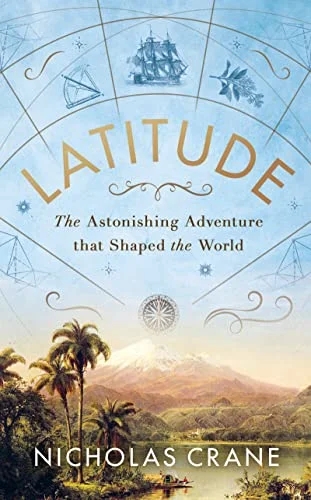
‘Latitude: The Astonishing Adventure that Shaped the World’ by Nicholas Crane

2021, 234 p.

There seemed to be a spate of books a few years back with a noun, followed by a subtitle that made a claim to greatness (“a world history” or “the fish that changed the world”). Nicholas Crane, who presented documentaries like ‘Coast’ or ‘Great British Journeys’, takes a similar approach in the title to his book. In this case, though, there is an element of truth, as the significance of latitude is that it does tell us the shape of the world, and in the 1700’s that was a big question. They knew that the earth wasn’t a perfect sphere, but was it stretched at the poles, or as Isaac Newton suggested, did it bulge out in the middle? To answer the question, the French government dispatched two expeditions, one to the Arctic Circle led by Maupertuis in 1735, and another to South America that same year, in order to compare results. Latitude is the story of the South American expedition.

In 1735 South America was part of Spain’s colonial holdings. The Wars of Independence would not occur for another 90-odd years and South America had not been divided up into the countries that we know today. After a voyage that took them to Martinique, Saint-Domingue (now the benighted Haiti), Cartegena de Indias and Panama, they finally made land at Guayaquil and headed towards Quito in what is now Ecuador. There were ten men in the French Geodesic Mission to the Equator, attended by four servants. They were headed by three members of the French Academy: Bouger, La Condamine and Godin. They were supported by Jean-Joseph Verguin, the principal surveyor, Jean-Louis de Morainville, an artist, a clockmaker technician, Theodore Hugo (whose role became increasingly important as their equipment faltered) and Joseph de Jussieu, doctor and botanist. The three final men in the French contingent were “a mixed bag of mates and favours” (p.11) – cousins, nephews of friends, a surgeon. However, having a French expedition on Spanish land was diplomatically tricky so, in order to encourage Spain’s co-operation, the French government offered services in measuring the longitude and latitude of key locations on the coast of Peru and the inclusion of “two intelligent Spaniards”. They were Jorge Juan y Santacilia and Antonio de Ulloa and de la Torre-Guiral, both graduates of the Academy of Navy Guards and trained in mathematics, astronomy, navigation, trigonometry, cartography and firearms. (p. 17)

There were lots of egos in amongst this group, and several of them were curious scientists who were perfectly happy to go off on frolics of their own to undertake their own experiments. The expedition split up, came together, split up again as personalities grated and egos clashed. Their main purpose was to undertake a geodesic survey which, despite Crane’s best efforts, I never really quite understood (don’t bother explaining it to me- I really don’t care). I gather that it involved the placement of triangles on high peaks with a clear sight line between them, measuring, then lots of computation. This tied in with astronomical surveys as well, undertaken using a zenith sector which required the observer to lie on the floor beneath the eyepiece of an immensely long, precisely aligned telescope erected in an observatory with a hole in the roof and a pendulum clock on the wall. There were also experiments about the speed of sound which I didn’t quite understand.

The trouble was that these high peaks were the Andes, with all the attendant perils of altitude sickness, frostbite, avalanche etc. There was a lot of scaling mountains, completely dependent on indigenous porters (as colonial mountain-expeditions always are )and the scientists were typically boorish in their dismissal of local knowledge about safe altitude levels. The triangles could be erected, then knocked down by wind or snow, requiring them to be put in place again. They took readings, but found discrepancies and so would repeat the measurements again, adding year after year to their expedition. Meanwhile they continually ran out of money, got involved in a brawl that led to murder, and they seriously insulted the Spanish contingent.

And what did they have to show for it, ten years later? Well, not all the men returned, but those who did not only proved Newton right, but they also undertook ground-breaking research on rubber and malaria, completed the first detailed survey of an Inca site, described platinum, took thousands of measurements and made thousands of botanical observations. But, as the final chapter which wraps up ‘what happened next’, several of them seemed infected by travel-restlessness (a pre-existing condition which had probably prompted them to go on the expedition in the first place), while others returned to France to die of amoebic dysentery, experimental hernia surgery (always the scientist), falling from scaffolding repairing a church or just old age.

This book is told in a rollicking narrative style, and the different characters are well-differentiated. What I couldn’t understand though, is why a book about geography, written by a geographer, had only two maps with minuscule writing located at the front of the book. I was flipping back and forth constantly, squinting trying to read the writing on the map. If only there had been legible maps tracing their journey placed appropriately within the text, I am sure that I would have followed their voyage more easily. Nonetheless, it was an enjoyable read which demonstrates both men’s (because they were all men) endurance and determination, and their selfishness, self-aggrandizement and inability to work together for ten whole years.

My rating: 7.5

Sourced from: Yarra Plenty Regional Library. And why?- a beautiful cover and it looked interesting.

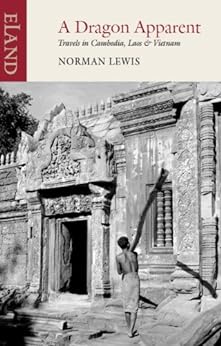
‘A Dragon Apparent: Travels in Cambodia, Laos and Vietnam’ by Norman Lewis

1951 , 336 p/

Any travel book written in 1951 will have aged, and this book is no exception. Indeed, the author Norman Lewis was well-aware that he was writing in the midst of history, noting in his preface that the stalemate in Indo-China had broken after four years, and that as the proofs of his book were being corrected in January 1951, the Viet-Minh were closing in on Hanoi.

It seems certain that before the book appears further important changes will have taken place.

He wasn’t wrong. One of the poignancies of this book is our knowledge, seventy years on, that the world he describes here was about to be obliterated. In the preface to the 1982 version of his book, Lewis writes:

…the greatest holocaust ever to be visited on the East…consumed not only the present, but the past; an obliteration of cultures and values as much as physical things. From the ashes that remained no phoenix would ever rise. Not enough survive even to recreate the memory of what the world had lost.

1982 preface

This meandering book is the story of Lewis’ travels through Vietnam, Cambodia and Laos. By 1951, France had offered independence to its former colonies, but although nominally independent, France still controlled foreign policy, and the French army was stationed throughout. Lewis was not there under the aegis of any press company, and after consulting with the French authorities, he was reliant on their goodwill to enable him to hitch rides under French protection across the three countries. The French Army at the time was at war with the Viet Minh, and so his whole narrative is permeated by a sense of oppression and coercion.

As a British writer, he has internalized much of the colonizers’ racism that sees people as a certain ‘type’. He spends considerable time with different tribes, the Mois, the Meos and the Rhades,distinguishing them from other tribal groups, and there is an elegiac sense that these groups will not survive. He is particularly critical of missionaries and their blithe confidence that they are doing good, and he castigates the planters and their cosy relationship with the French occupiers.

He is reliant on the army to get him from one place to another and he speaks only French and English. There is a lot of waiting around, angling for his next ride. As a result, he interacts mainly with French administrators and residents and those local officials that the French government have been willing to leave in place. He gains access to high places, but always with the permission and imprimatur of the French colonizers. It was almost with surprise that he found a young Cambodian boy who could speak “passable” French, which enabled him to understand more of a local dance performance than he would otherwise. It was only in the last chapter that he gains access to the Viet Minh, through the agency of Dinh, who he met in a doctor’s waiting room. Here he witnesses the influence of China and the Soviet Union in supporting the independence struggle against the French.

It is very much a book of its time in its Eurocentric classifications and descriptions of people and groups. For example, here’s his description of Dinh, his contact with the Viet Minh:

He introduced himself as Dinh- an assumed name, he assured me with a wry smile. I was interested to notice, in support of a theory I was beginning to form, that for a Vietnamese he was very ‘unmongolian’ in appearnce. He was thin-lipped and cadaverous and there was an unusual narrowness across the cheekbones. If not a Frenchman he could certainly have passed for a Slav. There had been many Caucasian characteristics about the other Vietnamese intellectually and revolutionaries I had met, and I was wondering whether whatever physical mutation it was that produced this decrease in mongolian peculiarities encouraged at the same time the emergence of certain well-known Western traits, such as a restless aggressiveness, an impatience with mere contemplation, and a taste for action.

Ch. 20

So what was the appeal for me in reading this racist, 70 year old text? For me, it was his descriptions of landscape. Take, for example, his description of Ta Phrom temple in Siem Reap:

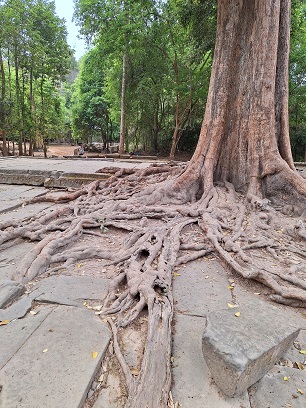
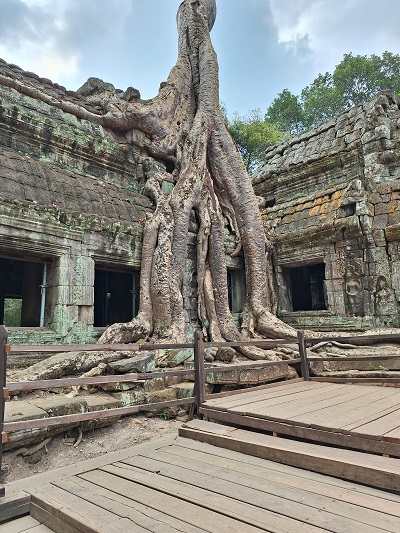
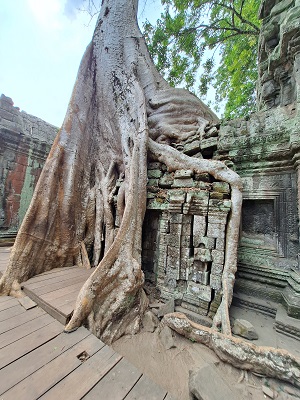
Ta Prohm is an arrested cataclysm. In its invasion, the forest has not broken through it, but poured over the top, and the many courtyards have become cavities and holes in the forest’s false bottom. In places the cloisters are quite dark, where the windows have been covered with subsidences of earth, humus and trees. Otherwise they are illuminated with an aquarium light, filtered through screens of roots and green lianas.

Entering the courtyards, one comes into a new kind of vegetable world; not the one of branches and leaves with which one is familiar, but that of roots. Ta Prohm is an exhibition of the mysterious subterranean life of plants, of which it offers an infinite variety of cross-sections. Huge trees have seeded themselves on the roots of the squat towers and their soaring trunks are obscured from sight; but here one can study in comfort the drama of those secret and conspiratorial activities that labour to support their titanic growth.

Down, then, come the roots, pale, swelling and muscular. There is a grossness in the sight; a recollection of sagging ropes of lava, a parody of the bulging limbs of circus freaks, shamefully revealed. The approach is exploratory. The roots follow the outlines of the masonry; duplicating pilasters and pillars; never seeking to bridge a gap and always preserving a smooth living contact with the stone surfaces; burlesquing in their ropy bulk the architectural [motifs] which they cover. It is only long after the hold has been secured that the deadly wrestling bout begins. As the roots swell their grip contracts. Whole blocks of masonry are torn out, and brandished in mid-air. A section of wall is cracked, disjoint/ed and held in suspension like a gibbeted corpse; prevented by the roots’ embrace from disintegration. There are roots which appear suddenly, bursting through the flagstones to wander twenty yards like huge boa constrictors, before plunging through the upended stones to earth again.

Ch. 15

Absolutely brilliant writing. I found myself rethinking my perceptions -“grossness”- yes, that was the unease that I felt while I was there. Even though many of the villages and landscapes he describes may have disappeared, there is enough remaining that you think “Ah, yes, that’s how it was!” Although I’m not a great aficionado of travel narratives, I think that this is what good travel writing does best: it puts on paper something that you felt, or detected, and it captures it, just right, in words that you wish you thought of yourself.

My rating: 8/10 (taking it on its own terms)

Read because: I was travelling in Cambodia.

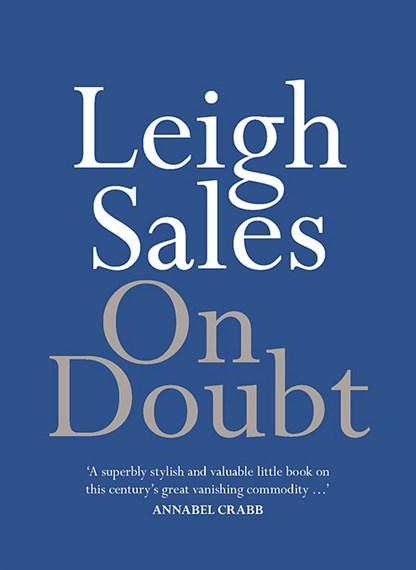
‘On Doubt’ by Leigh Sales

2020, 128 p

If nothing else, having to prepare talks for my Unitarian fellowship makes me read things I might not have read otherwise. On Doubt, by journalist Leigh Sales is part of the ‘On…’ series published by Hachette, and like the other books in the series, it is only short: in this case only 128 pages.

As a journalist, Sales has had plenty of experience with politicians who come onto her program, pumped up full of talking points and bombast. Her exploration of ‘doubt’ is largely through a political lens, but in Part I she starts by talking personally about her own curiosity and rebelliousness as a child. She rarely accepted anything as a given, and although converting to evangelical Christianity as a teenager, she soon rejected the ‘truths’ of religion that had to be accepted on faith, as well.

In Part 2 she turns to politics, struck by the certainty of Sarah Palin who boasted that she “didn’t blink” when asked to be George W. Bush’s vice president, despite her complete lack of experience. She notes that much of our media today is comprised of commentary rather than research or reporting, marked by point-scoring and moral certitude. This is most manifest in the US television that we receive here in Australia but she reports a similar unedifying spectacle between Gerard Henderson from the Sydney Institute and Robert Manne, who often writes for the Schwartz stable of publications. In the part of the book that was most useful to me, she quotes Pierre Abelard from the 11th century who wrote that the path to truth lies in the systematic application of doubt, and that those who have sought the truth begin from a premise of doubt, not certainty.

However, the expression of self-doubt is not seen as a virtue in politics. She was stunned when former Treasurer Wayne Swan revealed that he (and he assumed, most other people) had times of self-doubt. She compares this with George W. Bush who relied on his gut-feelings, bolstered by his religious faith, to the extent that even the people who surrounded him became uneasy. She talks about gut-feeling, citing Malcolm Gladwell’s Blink which asserts that people who are expert in their field (and that’s probably a very important qualification) use ‘thin slicing’ to instantly identify patterns in current situations, enabling them to make decision in the blink of an eye. But she also recognizes ‘the yips’ that assail someone who is very competent when they start to overthink something that they are already expert in- like playing the piano (for her maybe! Oh, to be good enough to get the yips!)

In Part IV she talk about people like her father, who leave nothing to chance, citing his mantra “Preparation and planning prevent piss-poor performance”. While bridling against the certainty and inflexibility that this approach guarantees, she observes that her own “what if” thinking, shot through with doubt, can lead to anxiety and a lack of all-consuming passion.

She finishes off in Part V with a post-script written in 2017, eight years after the original book. In those eight years, she suggests, we have become accustomed to distortion through social media, and we accept with equanimity the shrugs of corporate bosses and the misrepresentations of politicians. While refusing to divulge her own political leanings, she decries the idea of ‘balance’ which gives equal time to both sides.

As you can see, this book is a bit of a grab-bag of observations, not all of which are closely tied to the theme of ‘doubt’. It could almost do with another post-script, given the rise of deep fakes and AI which frighten me for the way that they undercut even what we have seen (or think we have seen). However, it’s an easy enough read- not unlike a long-form article that remains at a largely surface level and with its main interest in the political realm.

My rating: 6.5/10

Sourced from: borrowed e-book from Yarra Plenty Regional Library.

I hear with my little ear: Podcasts 8-15 March 2023

Emperors of Rome Episode CV Spartacus the Gladiator. Did you know that I have never watched ‘Spartacus’? He led a rebellion in 73BCE and it took three years for the republic to finally crush it. At first the Romans just saw it as a petty rebellion, but over time they realized that they had to take it more seriously. There had been previous slave wars in Sicily on the large estates during 2BCE but Spartacus’ rebellion took place on the mainland of Italy. Spartacus was from Thrace, and he had previously served as a soldier with the Romans, but he ended up as a prisoner (because of desertion?). He was sent to the Gladiator School in Capua. His uprising had initial success, and originally grew to between 70,000 and 120,000 slaves. There were two other leaders of the rebellion, but you don’t hear much about them.

History Extra From Russia to Texas: the Search for a Jewish Homeland. We’re watching the search for a Jewish homeland (or rather, the assertion of a Jewish homeland) playing out on our screens night after night. At the turn of the 20th century, millions of European Jews were seeking an escape from antisemitic persecution, especially from Russia, where they were restricted to the Pale of Settlement. The idea of Zionism had arisen a few years previously, and there was a flood of emigration to New York, where there were no immigration quotas, and over a million Jews had congregated in the Lower East Side. Things were getting desperate and when Uganda offered a homeland, the Jewish community was split between those who wanted Palestine-or-nothing, and those who saw Uganda as a short term fix. Actually, it wasn’t even Uganda, it was Kenya, which shows how nebulous the thinking was. Australia was approached too, but it rejected the proposal. Galveston had recently been devastated by a huge storm, and when it was suggested that Jewish people could immigrate there, the idea was attractive because so many other people had left town.

The Rest is History Episode 420 Britain in the 1970s: Thatcher Enters the Ring is the final episode in this 4 part series. Five days before the October 1974 election there was a bomb blast in a Guilford pub. People felt impotent to stop the IRA bombing, even though there were arrests (which ended up being the wrong people arrested anyway). Ted Heath, the Tory opposition leader, presented himself as the leader of a unity government, supported by the very visible Margaret Thatcher, and promised to cap the interest rate on loans at 9.5% (a very un-Torylike action). Liberal leader Jeremy Thorpe travelled on the hustings by hovercraft, and when it sank, it seems a metaphor for the country. It rained all the time, and people were sick of these Heath/Wilson electoral contests- this was the fourth time they went head to head. The Daily Mail did a special on Wilson’s finances, digging up the dirt on school fees and Swiss bank accounts, but they didn’t publish, preferring to leave it hanging over his head. Wilson ended up with a 3 seat majority. Then 5 weeks after the election there was another bombing, this time in Birmingham, and again they arrested the wrong people. Heath refused to give up the leadership of the Conservatives, even though he had lost four times in a row. Another Conservative, Keith Joseph decided to challenge, but after a disastrous speech in Birmingham, he stepped back from the leadership challenge and Margaret Thatcher stepped forward. And literally, the rest is history.

The Daily A Journey through Putin’s Russia This was recorded on the day that Russians went to the polls, but everyone knows what the result is going to be. Even though the West expected Putin to suffer from the deaths in the Ukraine war, and the economic sanctions that were imposed as part of the West’s response, he has a 86% approval rating and 75% of people think that Russia is heading in the right direction- his highest number ever. His generous compensation payments to the families of impoverished Russian men who volunteer for the Army mean that even bereaved families support Putin, seeing it as a war against the West.

In case you’re looking for me…

I’m not in Melbourne any more, Toto, but I’m up in Cambodia again. You can follow my travel blog at:

https://landofincreasingsunshine.wordpress.com

Movie: The Zone of Interest

I don’t know if I’ve ever seen such an unsettling movie and one where the sound plays such an important role. Right from the electronic scream in the opening moments, the sound track and small details (like the smudge of smoke against the sky) provide all the horror that you know exists. Not a great deal happens in the movie: it’s more like watching a painting or the stage in a play. Frightening. Surely it will win an Academy Award for sound, if not for other categories as well.

My rating: 5/5 stars

Movie: Anatomy of a Fall

Subscribe to continue reading

Subscribe to get access to the rest of this post and other subscriber-only content.

‘The Great Fire’ by Shirley Hazzard

2003, 314 p

I was disappointed by this book. It won the Miles Franklin and the National Book Award for Fiction in 2004, and was short-listed for the Orange Prize. So why, 150 pages in, could I not remember or care about any of the characters? why was I exhausted by her pretentious prose, re-reading sentence after sentence thinking “what on earth does THAT mean?” To deny the external and unpredictable made self-possession hardly worth the price (p. 10) or a place being differently aware in that murmurous season (p. 59), or That vulnerability should make a man strong. That there could be thought without helplessness; without that very helplessness in which their women were marooned, as if, by existing at all, one had become a victim. (p. 292). Oh mercy.

You might think from the title that this is about the Great Fire of London, but it’s not- instead the Great Fire is the conflagration of two World Wars.

The 1947 setting, in post World War II Asia, is an interesting one from an Australian perspective. The English protagonist Aldred Leith, who had sustained injuries during the war, has been dispatched to write reports on China, and then occupied Japan; while Australian Peter Exley, whom he had met during the war and rescued, is working as a war crimes lawyer after the dropping of the bomb on Hiroshima. The story traces through their progress through Japan and Hong Kong. Aldred falls in love with the 17 year old daughter of the Brigadier in charge of the army base in which he is staying. She is devoted to nursing her chronically and fatally ill brother Benedict, but she reciprocates Aldred’s feelings, and yearns to join him, especially when her parents, who disapprove of the relationship, take her to New Zealand. It was at this point that I began to be interested in the book and the characters fell into place.

The book, written in 2003, has captured well the stiff formality of language of the 1940s, and is replete with small details of clothing, setting, communication etc. The theme of Empire runs throughout, especially in the ashes of World War II which has devastated England and will wrench apart the Empire on which the sun never sets. Hazzard generally sees Australia as a parochial outpost, to which people are exiled- a reflection of her own attitudes to Australia, I suspect.

But her descriptions are so laboured and unnecessarily complex, and I felt as if I was drowning in a sea of unnecessary, pretentious words. And no Miles Franklin winner should take 150 pages to engage its reader, and even after finishing the other 150 pages, I really don’t know if it was worth the effort.

My rating: 6/10

Read because: CAE bookgroup selection.

I hear with my little ear: Podcasts 1-7 February 2024

February already!

Expanding Eyes. Continuing on with A Midsummer Night’s Dream before going to see the play in the Botanic Gardens, Episode 99: Night Rule goes through the scene of Puck and the “love juice” which he manages to place on the eyes of the wrong people: on Titania, who instantly falls in love with Bottom wearing his ass’s head, and Lysander who is woken by the treacherous Helen, and instantly falls in love with her. Helen, who is infatuated with Demetrius, gives a rather pathetic speech where she begs him to treat her like his dog. He’s not worth it, Helen.

Episode 100 A Milestone, the Lovers and Fairies’ Conflicts Resolved. Michael Dolzani starts this episode by talking about imagination in Shakespeares’ work and the difficulties in trying to pin Shakespeare down to a specific theological approach. Duke Theseus’ oration about imagination here reflects Hamlet’s “there’s a divinity that shapes our ends” but it’s not as clearcut as that. There are many opposites in this play, and when Dolzani was teaching this play, he would get his students to identify them: reason/desire, order/chaos, masculine/feminine, reality/imagination. At the end of Act III, everyone is asleep and Puck and Theseus get the opportunity to undo the mischief they have caused. In Act IV, Oberon has ‘won’ and he has taken the child that Titania wanted to protect. Act V returns to Theseus, and it is here that he gives his speech about imagination.

Episode 101 A Midsummer’s Night Dream: What is the purpose of Act V? Good question, because this is where the lovers are all back with the people they are supposed to be with, and the rude mechanicals put on their play. Dolzani reminds us that this is a festive comedy, and the slapstick in their production of the play is a crowd-pleaser. However, at the end, Bottom asks whether the whole thing is a dream- a theme that Shakespeare addresses often. Is life real? Are we all just puppets, and who is the puppeteer? Dolzani reminds us that the play put on by the rude mechanicals has multiple audiences: the court, the fairies and us. Is someone watching US? (cue spooky music)

[By the time I’ve written this, I have seen the play and gained much by listening to these lectures – because that’s in effect what they are, complete with the rustle of paper as he turns the pages. He repeats himself a bit, so much so that I wondered if I was listening to an episode I’d heard before, but the repetition worked well for me in keeping the continuity when I was listening to episodes several days apart.]

History Hit I’ve finally finished the series on Napoleon. Episode 4 Napoleon: The Myth features Andrew Roberts (who appeared in the first episode) as he traces through Napoleon’s exile on St Helena, 2000 miles from any other land. He had 29 people in his entourage, and he spent his time writing The Memorial of Saint Helena where he himself crafted the ‘great man’ personae. He died after 6 years, and there are suggestions of arsenic poisoning, but tests have shown that all his family had high levels of arsenic as well, which could be ingested through many number of environmental sources. He was buried on St Helena, but in 1840 he was disinterred by Louis-Phillipe who was hoping for some reflected glory. Roberts thinks that Napoleon kept the best bits of the French Revolution, but there was such bloodshed. He thinks that Napoleon is unfairly stigmatized by the “Napoleonic Wars” because five of the seven such wars were started by the anti-Napoleon coalition. The coat, the medals, the bi-corn hat was all part of a carefully cultivated image on Napoleon’s part- and in promoting this visual image, you’d have to say that he succeeded brilliantly.

Prohibition. This episode comes from the American History Hit series. Under the Prohibition legislation passed in 1920, it was made illegal to manufacture, transport or sell alcohol, although not to actually drink it. Featuring Sarah Churchwell, Professor of American Literature and Public Understanding of the Humanities at the School of Advanced Study, University of London, UK. [Public Understanding?? Whatever happened to HISTORY?] she identifies prohibition as one of the three political movements that arose out of second wave Revivalism in America, the others being abolition and the suffrage. In 1920, 90-95% of the American population identified as being Christian, and so prohibition was framed as a moral campaign, led by women concerned about the link between alcohol, poverty and domestic violence, and the Anti-Saloon League, a powerful lobby group. It was spectacularly unsuccessful. New York ended up with 100,000 speakeasys, and organized crime moved into the trade. The government ended up adding poison to ‘rubbing alcohol’ to deter people from drinking it, which was not a good look, and with the coming of the Depression, the government became aware of the taxation revenue it was foregoing. So the Prohibition legislation was repealed in 1933, the first time a constitutional amendment was amended by a later amendment.

Sydney Writers Festival. Diary of an Invasion. I’m not really sure why this turned up in my podcast feed because events have largely overtaken it. Ukrainian novelist Andrey Kurkov has been writing about daily life in Kyiv, and here he talks with Matt Bevan who, much though I like him, doesn’t do a particularly good job of posing questions to him (in fact, he sounds surprisingly nervous). Kurkov emphasizes that there are many Russian-speakers in Ukraine, but many of them have distanced themselves from their Russian identity as Putin insists that there is no such thing as ‘Ukrainian’ history or language. The head of the Wagner group, Yevgeny Prigozhin was still alive at that time, and Kurkov discusses his role as an alternative political persona to Putin- but we all know how that ended. Badly.

Things Fell Apart (BBC) Episode 2: We’re Coming After You Honey. In 2006 a barmaid in a yachtclub was befriended by the Wittermore family, whose daughter was very sick with Chronic Fatigue. The barmaid (Judy) had worked as a medical researcher, and the family set her up in a research facility that they funded in order to search for a cure for CFS. She found traces of XMRV, a mouse virus, in the blood samples of CFS sufferers, and her research which she presented with 13 other authors, was published in ‘Science’ magazine. However, other researchers were not able to replicate her findings and the study was retracted. Judy angrily asserted that Big Pharma was attacking her research as an outsider to the medical establishment, and when she refused to hand over her cell lines on which the research was based, the Wittermore family sacked her. She stole the cell line and her notes from the laboratory, and ended up arrested and bankrupt. Eight years later, in May 2020, she appeared in the viral (haha) video ‘Plandemic’ accusing Big Pharma and Fauci of collusion in inflecting the population in order to sell vaccines. Interesting.