Category Archives: Uncategorized

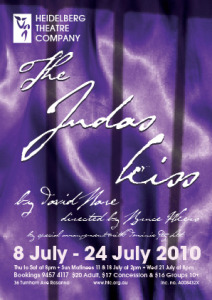
‘The Judas Kiss’ Heidelberg Theatre Company

I saw this play a couple of years ago, and I see that it is currently being staged by Mockingbird Theatre with the same lead actor between 15-22 March 2014 at Theatre Works 14 Acland St, St Kilda.

residentjudge's avatarThe Resident Judge of Port Phillip

Once again, I wish that I’d seen this before the final performance so that I could encourage you to go.  Alas, too late (again) .

Written by David Hare, the two-act  play concerns Oscar Wilde and his lover Lord Alf Douglas. Act One is set in a London hotel, just prior to Wilde’s arrest where his friend Robert Ross is trying to persuade him to leave for the continent; the second act is in Naples two years later where Bosie decides to leave the impoverished and broken Wilde to return to London and his family.

I find it hard to see anyone else other than Stephen Fry playing Wilde- surely a part that he was born to play, and there’s a danger that playing such a flamboyant figure can descend to parody. But Chris Baldock, playing Wilde made the part his own, to the point at the end of the…

View original post 203 more words

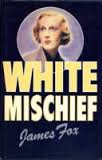
‘White Mischief’ by James Fox

whitemischief

As a historian of British colonial societies, particularly focussing on the colonizers rather than the colonized, you often come across people who are parodies of themselves.  At time I feel that way about my own subject, Judge Willis.   It is even more true of the people who populate the pages of this book which highlights the decadence and moral vapidity of this bunch of British expatriate misfits in Kenya during World War II.

In the early hours of January 24th 1941 the body of Josslyn Hay, the Earl of Errol was discovered in a crashed car at a junction near Karen.  At first it was thought that he had run off the road, but closer inspection revealed that he had been shot at close range behind the ear.   The main suspect was Jock Delves Broughton, the sixty year old husband of the young and beautiful Diana, who was having an open affair with Josslyn Hay.  He was charged with the crime and the case heard in the Kenya Supreme Court. He was acquitted of the crime but many felt that he had, in fact, committed the murder or arranged for it to be committed, and even Hay himself confessed and denied the crime from time to time.  Multiple books and articles have been devoted to the question of Who Killed Josslyn Hay, but this is possibly the best known of them, forming is the basis of the recent film starring Greta Schacci and Charles Dance.

The British government officially took control of the Kenya Protectorate in 1895 in order to compete with German imperial expansion in East Africa.  To counter the German railway from the port of Tanga in what is now Tanzania, the British quickly began construction of the 580 mile long  Mombasa to Lake Victoria railway (on which I am travelling at this very minute).  Nairobi was established in 1899 as the last possible rail depot before the track climbed the Kikuyu escarpment overlooking the Rift Valley.  A scheme was produced in 1901 by the Commissioner of East Africa to encourage settlers to farm the land, thereby creating profits for the railway through haulage costs.  The first wave of settlers arrived in 1903 from Britain, Canada, Australia and South Africa, and they were followed by a second wave, drawn from the Edwardian aristocracy and British officer class.  They included peers of the realm and their younger brothers who were victims of primogeniture, millionaires and wasters who had cruelled their chances in England through scandal and bankruptcy.  Kenya was particularly attractive to the aristocrats.  The Kenyan highlands had an English or Scottish air and there were servants aplenty to protect them from hard work on their own behalf.  All this was at the expense of the African population.

This is a different type of colonialism to that which I have encountered in my studies of the 1820s-40s.  There is no frontier as such, just lines on a map drawn up in part of the scramble for African amongst the European powers.  They feared sunshine and madness, but for these aristocrats at least, there was not the contingency of life and death on a distant frontier.  The experience of the 19th century gave them a bombastic confidence in the treaties that they could produce almost by template by this stage, and all the qualms of the humanitarians that constrained (officially at least) the excesses of colonialism had been soothed and put at rest.  The ready availability of divorce for those who could afford it led to a succession of ill-fated marriages, and the alcohol, drug use and promiscuity of the Bright Young Things  back in England translated well to a Kenyan context. I’m finding many familiar names from 1840s colonialism, one generation on.  They are a quite different class of colonist to their parents and grandparents.This familiarity with an older type of colonialism has perhaps made me somewhat more tolerant of this bunch of indulged and heedless sybarites than other readers might be.  They are truly awful.

The book is presented as creative non-fiction, and I have no reason to distrust this framing narrative.  The author, James Fox, was a journalist working alongside the cultural critic Cyril Connolly who was himself the contemporary of many of the main protagonists.  Connolly had been obsessed by the story for many years and they co-wrote a newspaper article about it, which flushed out many ex-Kenyans and family members who had their own take on What Really Happened.  Connolly had died before penning his own account, and Fox took possession of his notebooks and continued the quest. This book is the result.

It is divided into two sections: The Murder and the Quest.  In the first section he introduces each of the main characters and their possible motives for wanting Joss Hay (also known as Errol) dead. He also argues against himself, pointing out the holes in the argument that might place them as the murderer.  In this regard, the lengthy ‘Cast of Characters’ at the start of the book is particularly useful, especially in tracking the marriages, divorces and intermarriages and the frequent change of title as peers ascended the table of precedence.  So too is the index, which is extensive.

In the second section, James Fox himself takes centre stage as he tracks down those participants still living or their descendants, culminating in what he thinks is the definite answer.  Of course, the continued publication of recent books suggests that many others think that Fox and Connolly have got it wrong.

It is hard to get past one’s revulsion for these larger-than-life characters and their lifestyle.  But I have recently met someone who could be a dead-ringer for any of these characters, holding tight to a vanished lifestyle and discredited politics.   The continued interest in the question suggests that this particular past is not yet a foreign country (to paraphrase L.P. Hartley), or at least that there are some who wish to hold on to it still.

Off to the Land of Increasing Sunshine

My daughter and I are  off to visit the Lad and his Lady in Kenya.  I’m blogging the great adventure at http://landofincreasingsunshine.wordpress.com/

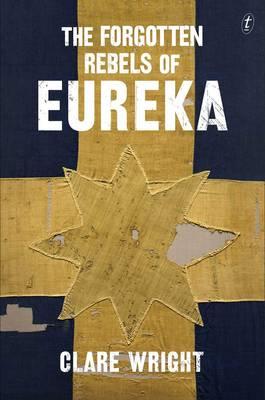
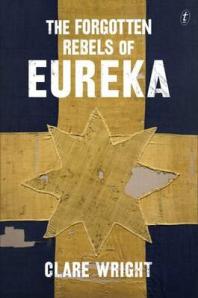
‘The Forgotten Rebels of Eureka’ by Clare Wright

the-forgotten-rebels-of-eureka

2013,  458 p & notes

All Australian schoolchildren – and perhaps Victorian ones in particular- at some stage (and often more than once) encounter the Eureka Rebellion.  It’s quite a flashpoint in a constitutional history that has rather a dearth of such things.  Ballarat has made good tourist use of it. The  Sovereign Hill Tourist Park has leveraged its sound-and-light show from it for many years, complete with burning hotels and gunshot.  As well I know, having visited Ballarat many times.  We used to go to there every September for the South Street Eisteddfod, first to see a niece on the stage, then to see  a daughter. Bakery Hill (now dominated by McDonalds) and the stylized stockade on the site that is now the Museum of Australian Democracy are very familiar to me.  But even for those not subjected to the icy Ballarat winds every September, Eureka is something that you tend to ‘do’ at school and tuck away as part of your Australian consciousness.

Clare Wright’s book The Forgotten Rebels of Eureka is big, bold and different.  Published by Text Publishing in hardback only so far, it takes the Eureka uprising and puts people into it: particularly women and children, but also storekeepers, commandants, theatre owners, newspaper proprietors and publicans.  It’s a noisy book.  Her opening sentence to Chapter One is

You could hear Ballarat before seeing it. (p. 19)

and voices clamour in this book for attention.  It teems with personalities, some of whom recur frequently, others who are encountered once then pass by.  Wright is the politest of guides: she takes you to her main informants and introduces you to them properly.  It’s a technique that Inga Clendinnen used so masterfully in Dancing with Strangers, and Wright uses it well too. Not only do you have a leap of recognition when you meet them again, but you’re able to detect change of mood and circumstance and gain some sense of people living through an event instead of being just stationary props.  And they talk!  Letters, diaries, memoirs-  Wright has combed carefully and weaves their words into her text as italicized phrases, only rarely and deliberately breaking her narrative to provide block quotations.  While the book is crafted from primary sources, she carries on a conversation with other historians as well, both in the text and in the footnotes that, commendably,  Text has not stinted on,  in what could probably be marketed as ‘popular history’ (whatever that means).

The book opens on Monday 4th December 1854.  On the preceding morning at 3.00 a.m.  troops and police had stormed the hastily constructed stockade in a twenty-minute attack.  The numbers killed are still debated. But the goldfields themselves that morning were quiet.

In Part I, ‘ Transitions’, she rewinds to November 1853 as one of her main informants, Charles Evans (thought to be Samuel Lazarus until Wright’s own research identified him correctly) arrives in Ballarat.  He was just one of a flood of gold seekers who arrived in Melbourne,  and Wright traces through the arrival experience as the tide pulls him, along with a bobbing host of other characters, to Ballarat.

Part II, Transformations, takes the year 1854 as its site of analysis, drawing a vivid, bustling, LOUD picture of goldfields life.  But its not the ‘digger and his mate’ experience of an S. T. Gill watercolour.  As she points out, Ballarat was not the male-dominated diggings of our imagination.  With 6650 women, 2150 children and 10,700 men, it had the highest female proportion of any of the Victorian goldfields.  While there were shafts and tailings and mud, there were also clothes lines sagging with washing,buying and selling, visiting, entertaining, and babies being conceived and born as a shadowplay on the walls of flimsy tents.

Part III ‘Transgressions’ moves to Spring 1854  and the burning of Bentley’s hotel and its aftermath in the courtrooms of Melbourne.  We’ve been in this hotel before, with Catherine Bentley, the publican’s wife.   Wright takes us to the military camp on (of course) Camp Hill and the administrative play between the newly-arrived Governor Hotham and the military and police contingents.   The action moves inexorably to Sunday morning 3rd December 1854 where it slows down, then unfolds in a nightmare slow-motion.  She does not spend much time on the battle itself- leaving that to others- but instead watches the raw, keening grief afterwards.  In a rapid shift of tine, her concluding section ‘A Day at the Races’ has a brisk “move on” feel to it as the events of Bloody Sunday are commemorated, forgotten, rediscovered, burnished, embroidered and used for various purposes.  An epilogue bids farewell to the characters we have met as they drift away from the gold fields into other endeavours, or become entwined into family trees diligently tended by their genealogist descendants.

While Eureka is the flashpoint, the real strength of the book is peopling the event and the wider context with flesh and blood, often unknown characters.  The emphasis is very much on women, and writing them back into the story that they always inhabited- but it’s not just about women.  There is a conscious emphasis on Jewish emigrants, American gold-seekers and a consciousness of the Aboriginal people whose lands were deluged by this flood of humanity. Nor is it just about the rebels, because she distinguishes carefully between the military and the police and explicates carefully the politics of Eureka from the government perspective as well.

Nonetheless, there is a very strong feminist intent to the book.  It is, perhaps a little strained, as in her explanation of the drifting away of men from the stockade in the hours immediately preceding the attack and her suggestion that rape might have been one of the outrages committed in the aftermath.  Both of these are offered only as suggestions- and historians can make suggestions, with evidence- but at this point the murmurings and conversations of her informants who have borne her so confidently through the rest of the narrative drop away, and it is only her voice left speaking.

And a distinctive voice it is.  Clare Wright often appears on Australian history documentaries- for example, in Utopia Girls– where her narrative voice is warm, with a burble of humour.  It struck me when reading this book that it is a particularly visual work, staged and narrated much as a lengthy documentary might be.  The chapters are divided into scenes, marked with asterisks, as the action swings from one character to another, and many conclude with ‘cliff-hanger’ comments that lead onto the next scene.  It is sustained throughout the whole book, which at 458 pages is a lot of talking.  It is such an insistent, strong voice that I think that your response to the book would be very much influenced by how you respond to the teller.

That said, this is one of those books that would make you look at familiar events with new eyes.  It is a compelling read that is well-researched and scholarly and at the same time very, very human.

Yvonne Perkins at Stumbling Through the Past has written a very detailed review- well worth reading.

This is my first review for the Australian Women Writers Challenge 2014.
awwbadge_2014

I’m b-a-a-c-k (Australian Women Writers Challenge 2014)

A new year, and time to sign up to the Australian Women Writers Challenge for 2014.  It’s the third year that I’ve been involved in this, and its website is turning into a handy little resource for reviews on Australian women’s writing.

The challenge was provoked by the Miles Franklin shortlist of a few years ago that was comprised solely of male writers.  I strongly suspect that a similar situation may arise again this year with the Holy Trinity of Franklin, Winton and Tsiolkas all releasing books during 2013.  We shall see.

Anyway, I’m in again.

The ‘fairytale’ is over

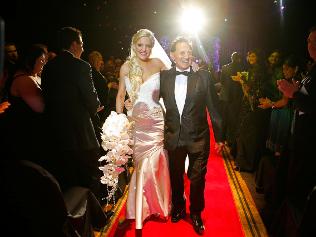
Well, who would have thunk it? Geoffrey and Brynne Edelsten’s marriage is over.

geoffrey-edelsten-brynne-gordon

Here are the wedding celebrations described with breathless enthusiasm in 2009, and here’s a rather sad analysis of the same celebration written by a guest some four years later now that it’s over.

Celebrity gossip is my rather grubby secret vice- indulged mainly at the check-out, the hairdressers and doctors with the odd furtive glance at internet links on The Age website-  and I don’t normally write about it here.  But bad hair transplant, curious suntan and Brynne notwithstanding, I do have rather a soft spot for Geoffrey Edelsten.

It was a couple of days before Christmas in 1988 (I think- might have been 1989) and I developed the mother of all sore throats.  Ye Gods- each swallow felt like a knife and I felt absolutely terrible.  I could barely open my mouth; the taste was terrible; as soon as I lay down I felt as if I was going to suffocate…. oh, it was dreadful.   In desperation I went to the walk-up 24 hour clinic in Kingsbury that was owned by none other than the famous Dr Edelsten.  I think that it must have been at the nadir of his fortunes: it was a very humble grey brick surgery in two old houses on a busy corner.  It had the chandelier, but that was about all, with threadbare carpet, hard chairs and the ubiquitous doctor’s-surgery magazines. There were no other patients, and the whole place looked rather tired and crumpled- as did the doctor himself.

It was quinsy, which sounds all very Victorian and old-fashioned.  People used to die of it- in fact, I read a description of Queen Elizabeth I’s death and even though I know that she was supposed to have died of poisoning (perhaps from her face powder), I reckon it was quinsy.  Alison Weir (Elizabeth the Queen, 1998 p.481-4) says that her final illness began with “slight swellings- probably ulcers- in the throat” and she complained to Nottingham “My Lord, I am tied with a chain of iron around my neck. I am tied, and the case is altered with me”. Apparently she just lay on cushions on the floor, “holding her finger continually in her mouth, with her eyes open and fixed to the ground”.  Well, that sounds like me Christmas 1988. Eventually Queen Elizabeth’s ulcer burst and she felt much better (although went on to die a few days later), just as mine burst on Boxing Day (and I lived to tell the tale, obviously).  Instant relief.

The good doctor made his diagnosis and gave me a hefty injection of antibiotics (there was no way that I could swallow a tablet).  And another the next morning and evening, and the morning and evening after that.  By now it was Christmas Day and there he was, alone in that surgery at 8.00 in the morning and there he was still alone in that surgery at 7.00 p.m. that night.  Not once did I see another patient there.

I’ve had quinsy a couple of times since, although never as bad as that first time- touch wood I haven’t had it for the last ten years or so.  I still get nervous at the sign of a sore throat.  I haven’t forgotten that kind doctor in his empty surgery and in spite of all that has happened to him, I feel rather sad for him.

Uplifting Quotes for the Uninspired Historian #18

June Philipp was a historian at La Trobe University during the 1980s.  I’ve heard her spoken of on several occasions, linked with Greg Dening, Rhys Isaac and Inga Clendinnen of the ‘Melbourne School’ of ethnographic history that appeals to me so much.   I was interested in a methodological paper that she wrote in Historical Studies in 1983.

Human action is generated within a social and cultural context whose forms- relations, roles, rules, values, rituals, symbols- shape its logic and project its meanings… Social actions from the past have been preserved in a piecemeal way by having been written down in the form of action descriptions- glimpses of people in the past doing things…. Action has an external dimension, and past action may be observed (though indirectly) as behaviour, as a sequence of physical movements, but its import is not immediately accessible to observers in the present who happen to look back.  It is the ‘inside’ of action that matters most and which the historian must seek to discover…  (p. 350)

Action-oriented history is an empirical study and, in one of its aspects, it is descriptive.  The first aim of the historian is to divest the account of what happened, as much as possible, of interpretation: of the interpretative overtones in which it is clothed by its past recital and by the historian in its re-telling.  The intent is to rehearse and display the actions.  The facts are then construed: actions are scrutinised and analysed patiently in search of clusters or patterns which signify institutionalised forms.  The historian then tries to grasp the meaning being expressed through those forms by the historical actors…  (p.351)

Getting inside actions or episodes in a means of reconstructing the experience and the meanings expressed by people in the past who were conversing in public, amongst themselves.  Getting inside episodes assumes that the primary aim of historical analysis is the recovery, partial although it must be, of the lived reality of people in their past.  To discount that reality is, in all likelihood, to fabricate a history which will try to breathe life into our concepts, models and categories so that they may pass for actuality… (p.352)

June Philipp ‘Traditional historical narrative and action-oriented (or ethnographic) history.’ Historical Studies, 1983, Vol 20, No. 80 pp.339-352

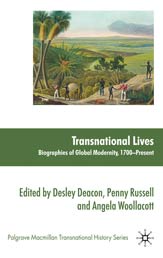
‘Transnational Lives: Biographies of Global Modernity 1700-Present’

‘Transnational Lives: Biographies of Global Modernity 1700-Present’ edited by Desley Deacon, Penny Russell and Angela Woollacott

transnational

2010, 285 p.

It’s when you’re reading through a Dictionary of National Biography ( and there’s many online: Australian, Canadian, New Zealand etc) that you often realize that even though one dictionary might ‘claim’  a particular individual as theirs,  other dictionaries of other nations could write their own account of the subject’s life as well because whole decades of the subjects’ lives  are sometimes spent in another country.  We’re well aware of the technological advances in transport and communications that contribute to the mobility of people and ideas beyond national borders today, but such forces were in play in centuries past too.  It is in this spirit that Transnational Lives presents twenty-one essays on diverse lives that cross national, racial and cartographic boundaries. (Click link for Chapter Listing) Continue reading

‘Eugenia: A Man’ by Suzanne Falkiner

I recently read Mark Tedeschi’s book Eugenia.  It raised quite a few methodological and narrative questions for me, and so I was interested to see how other writers dealt with the same material.  You might  want to read my review of Tedeschi’s book too, because my response to this book was formed after reading it.

eugenia_falkiner

1988, 243 p.

The blurb on the back of this book reads:

In the spring of 1917 an apprentice from the Cumberland Paper Mills, just outside Sydney, was walking along a bush track beside the Lane Cover River when he discovered the partially burnt body of an unidentified woman.  The arrest three years later of a 45 year old Italian woman, Eugenia Falleni, for murder, led to an investigation that fascinated the people of Australia.

Known in the newspapers as the ‘Man-Woman Case’, the trial revealed that from the time she had left New Zealand and gone to sea as a cabin boy, Eugenia had lived at least 20 years of her life in the guise of a man.

There is a entry on Eugenia Falleni in the Australian Dictionary of Biography if you’re not already familiar with her story.

The title of the book is quite definitive- “Eugenia- a Man.”  The image Falkiner has used for the front cover shows Harry Crawford as a young man and is taken from a photographic postcard created between 1900 and 1917 in Sydney.  On the back of the postcard are the words “I am sending you my photo for (a) keepsake, with love from H. Crawford”.  We do not know who wrote these words, as Harry Crawford himself was illiterate; nor do we know to whom they were written.

This book is written is two parts.  Part I, comprising twenty one chapters,traverses Eugenia’s life: her early life, his marriage, the crime and the trials.  It doesn’t take long to get to the death: just 25 pages. Unlike the Tedeschi book, Falkiner is careful to note the source of her information in the text itself (without footnotes), and I must admit that I felt more comfortable with such an approach.  I knew who said what, and when.  Also, this book differs from the Tedeschi book in that it is absolutely silent about what happened on Eight Hours Day when the death of Annie Birkett occurred.

Much of Part I is taken from the trial transcripts, especially those printed in the newspapers.  The press took a close and rather prurient interest in the trial: you only need do a Trove search to find the many print columns devoted to the trial. Falkiner goes through each of the witnesses in turn, and spends almost as much time on the magistrate’s court hearing as the Supreme Court trial.  Like Tedeschi, she is critical of Eugenia’s defence lawyer McDonnell, but it is the appraisal of an onlooker rather than the critique of an insider, as Tedeschi Q. C.  is.

There are occasional chapters during Part I where the author herself comes onto centre stage.  She explains at the outset how she came to be interested in Eugenia; she visits the locations where the death occurred; she traces the houses where various characters lived.  The ‘quest’ narrative is quite a common framing narrative for us now, both in fiction and through shows like ‘Who Do You Think You Are?’ and I must admit that it’s becoming a little hackneyed- but perhaps less so in 1988 when this book was written.

In Part II, the author shares the limelight with Falleni as she tries to get behind the trial to find some sense of Falleni as a person.  She tracks down relatives,  visits them in New Zealand, she even visits Eugenia’s birthplace in Italy.

Histories always exist within an historiographical context, and this is true of Falkiner’s book as well.  You can sense the presence of the 1980s in her interest in the migrant experience and the gender roles of  men and women in the early twentieth century.  She does address the issue of trans-sexuality, but in nowhere near the depth that it might be explored today (and in Tedeschi’s book)  and not at all from the perspective of lesbian history or queer theory.  A recent review written as background material for the play ‘Passing’  tackled the author for her sentimentalized view of Eugenia:

Falkiner’s book is perhaps the most detailed study of Eugenia Falleni’s life but its insight value is diluted by Falkiner’s sentimentality and subjectivity. Falkiner projects unabashed sympathy and no small amount of pop-psychology about gender and sexuality towards her subject – she frames Eugenia as a misunderstood gentle soul suffering from a vague kind of gender identity crisis to such a point that Annie Birkett’s murder, which Eugenia was tried and convicted for and later admitted guilt to, is relegated as a footnote.  (From Passing Research Notes: ‘Trans theory- a brief guide)

I’m not sure that in 1988 there was the  interest or theoretical frameworks at the popular level for queer theory analysis.  If there is sentimentality, I think that it springs from the emotional investment that any biographer makes in her subject, especially where the research springs bottom-up from interest in the individual and their story rather than from a top-down interest in a theoretical phenomenon.  I’ve been aware recently of research into European migrants to Australia at the turn of the century from the perspective of whiteness studies, which is a 21st century twist on the 1980s’-era multiculturalism that Falkiner explores in her book.  One thing that came through very clearly was the marginality and fluidity of a working class existence where housing, jobs and, in Eugenia’s case, identities were temporary and rootless.  I was surprised, in both this book and in Tedeschi’s, about the silence about World War I and its effect on working-class communities and men.  Perhaps the silence is in the documents, but it did strike me as strange.

The book itself is a very easy read, not dissimilar in tone and approach to a Good Weekend article in the weekend’s newspaper.  Perhaps it doesn’t have the little stabs of insight of a Helen Garner (e.g. Joe Cinque’s Consolation) or Chloe Hooper’s The Tall Man, but it is similar to both of them in that the book deals with a crime and the consequences in court and afterward, and the observer’s response.

Should you read this book, or Tedeschi’s?  I’d say “read them both”- perhaps reading this one first.

awwbadge_2013

Sydney Review of Books

As a rule, it takes me until Sunday night to finish reading The Age that arrives on Saturday. My favourite section is ‘Life and Style'( which used to be A2) but it seems that the life and style- the restaurants, the interviews, the film tie-ins etc-  are nudging the book reviews into a smaller and smaller space. It will barely worth the anticipation soon.

I used to look forward to the Australian Literary Review that came out at the start of each month with The Australian but it seemed that the reviews increasingly became just a platform for the right-wing stance of the The Australian generally.  So, when it no longer appeared, it was no great loss either.

I subscribe the the Australian Review of Books but to my shame, I often don’t get round to reading them until months later.  My son would eye the unopened magazine covetously (along with the similarly unopened-yet The Monthly, Griffith Review and Quarterly Review) saying “Oh, come on, I just want to read….” but no, I paid for it, so I’m going to open it in my own good time thank you very much.  I subscribed to the London Review of Books, lured by a very tempting  no-obligation introductory subscription price.  But- oh dear- such long articles; so much reading- each one took almost a week! And six month’s worth of London Review of Books have been added, unopened, to the ‘one day’ pile and the subscription has been allowed to lapse.

And now here’s another one- the Sydney Review of Books.  It is edited by James Ley, and here’s what it has to say about itself:

The Sydney Review of Books is an online journal devoted to long-form literary criticism. It is motivated by the belief that in-depth analysis and robust critical discussion are crucial to the development of Australia’s literary culture. We decided to embark on this project because of our concerns about the reduced space for serious literary criticism in the mainstream media, and the newspapers in particular, given their uncertain future. We intend the Sydney Review of Books to be a venue in which Australian writers and critics can engage with books at length, a venue in which to rediscover the intimate connection between the art of criticism and the art of the essay. The Review’s focus is Australian writing, but it also considers the work of significant overseas authors.

Sydney Review of Books has been developed with the support of the Writing and Society Research Centre at the University of Western Sydney. It is also supported by grants from the Australia Council and Copyright Agency Limited. It has been conceived as a free online publication, in order to maximise its reach. We publish new essays and reviews on a weekly basis and, in offering a selection of high quality criticism by some of the best critics and writers in the country, we hope to enlist your support as readers to ensure that the Review can continue as a dynamic contributor to our literary culture.


It looks good.  And it doesn’t have to sit on a pile, wrapped in a cover, shaming me.