Category Archives: Uncategorized

This Week in Port Phillip 1841: February 8-15

HENRY DENDY ARRIVES

During this week Mr Henry Dendy arrived from England, bearing an entitlement to select 5120 acres of Port Phillip land under the Special Survey legislation that had been enacted in England.  This legislation enabled prospective settlers, while in England, to pre-purchase a general entitlement to land at one pound per acre, pay for it in England, then come out to Australia to select the specific land that he wanted to buy.  When news of this scheme reached New South Wales (and particularly Port Phillip as its most rapidly expanding frontier), Gipps, La Trobe and local purchasers were horrified at the thought of the best land being gobbled up before their eyes. Gipps quickly passed regulations in March 1841 to restrict Special Surveys to land more than 5 miles from the closest surveyed township, and to limit waterfront purchases to only 1 mile of 4 square miles of purchases, to avoid whole riverbanks being monopolized by one purchaser. After Gipps severely criticized the scheme to the Colonial Office, it was abandoned in August 1841.  Nonetheless, in these short months eight Special Surveys were instituted, three in what is now suburban Melbourne: Frederick Unwin’s Special Survey in Templestowe, Henry Elgar’s survey in Box Hill, and Henry Dendy- whose arrival was noted on 12 February 1841- who snaffled what is now prime blue-ribbon residential land in Brighton.

THE FIRST G.P.O IS COMMENCED

Initially John Batman took care of the mail deliveries, but in 1841 a dedicated post office building was commenced on the corner of Bourke and Elizabeth Streets, the site of the building that we still call the GPO even though it has been turned into shopping.   It included an eight room cottage for the postmaster (which seems rather generous) and a lobby and offices facing Bourke Street.  As time went on, it suffered from the frequent flooding of Elizabeth Street but in February 1841, the good people of Melbourne were very pleased with the building which they felt reflected credit on Mr Rattenbury, the Clerk of Public Works. They were particularly pleased at the design for the inward-mail post boxes:

 The plan adopted in America with so much advantage will be introduced of having a set of pigeon holes corresponding with the letters of the alphabet, which will be painted on the panes of one of the windows, so that any person going to the office may, by looking into the pigeon hole opposite the initial of his surname, be enabled to perceive whether there be any letters therein, and if none, of course he need not delay or trouble the postmaster by making enquiries.

NUISANCE DOGS

The Port Phillip Herald applauded the decision by the magistrates that stray dogs should be killed, but didn’t like the way it was implemented:

A number of those quadrupeds, which were destroyed about a fortnight since, were thrown upon a heap at the bottom of Elizabeth-street and loosely covered with earth. The consequence has been that they were speedily disinterred by the pigs and the stench arising from the mass of putrefaction has been insufferable

AN EXTREME CASE OF CHARITY

Settlers traveling to New South Wales without the bonds of family and neighbours from ‘home’ were vulnerable if their plans for a new life were disrupted by death or illness.

We rejoice that it is seldom our duty to revert to cases of poverty in Melbourne, but an instance has come under our notice of pecuniary distress, under circumstances which irresistibly urge upon us the necessity of appealing to the public sympathy. By one of the late vessels from England there arrived a Mr McLean, his wife and seven children, and eight days after their arrival Mr McLean died, leaving his family totally unprovided for. Mrs McLean is an entire stranger, without a friend or the means of subsistence and to add to her distress she is on the eve of her confinement. She is at present in a wretched hovel, in the rear of Mr Ley’s the Watchmaker, and only prevented from starving by some slender support furnished by the neighbours. Under the circumstances we trust the feeling of humanity is too strong in the breasts of our fellow colonists to require greater excitement than that produced by the mere mention of the case to ensure some assistance. Even a shilling will be of service, and there are few amongst us who could not spare something to mitigate the suffering of an unfortunate stranger amongst us. (PPH 12 Feb 1841)

HOW’S THE WEATHER?

Hot, actually. It surprises me, given that many of the new members of Port Phillip Society came direct from ‘home’,that  there weren’t more complaints about the weather and particularly about the heat. Also, given that white settlement in Melbourne had only started six years earlier, there must have been a degree of learning still going on about the weather patterns.

But at this time in 1841, the weather was so exceptional that it attracted the attention of the Port Phillip Herald of 16 February:

During the last few days the inhabitants of Melbourne have experienced some of the most intensely hot weather that has ever been experienced by the settlers in Australia Felix; the atmosphere has been dry and oppressive, accompanied by heat so well-known and so much dreaded. We have been informed that on Saturday evening the thermometer stood at 100 degrees in the shade at Mr Mills’ brewery, and since Wednesday it has never been below 93 during the day. The want of rain has been severely felt in the interior; in some places we are informed, not a blade of grass can be seen, and the most fearful consequences to the stock &c is anticipated, if the ground does not receive timely moisture. A storm passed over the town on the afternoon of Thursday with successions of [most?] vivid lightning, accompanied by peals of the most startling thunder; the electric [fluid?] struck a tree on the summit of the Eastern Hill and deposited it in several parts of the bark; a man who was standing near narrowly escaped with his life.

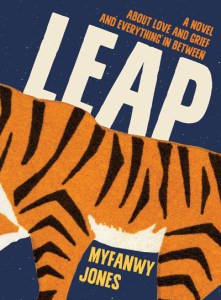


‘Leap’ by Myfanwy Jones

Leap

2015, 324 p.

There are two epigraphs to this book. The first is from Emily Dickenson on the weariness of grief. The second is from Parkourpedia the online encyclopedia of parkour, the practice of running and leaping on urban structures. Running, Climbing, Jumping are the three parts of this book, as two people make the leap from crippling grief to living again.

Joe lives in a share house in the northern suburbs of Melbourne and works multiple jobs in cafes in High Street (Northcote?) at night. Much of his time is spent in the darkness, either working or barrelling along bridges and streets as he practices his parkour moves.  His girlfriend has died some little time earlier and he blames himself.

Elise, on the other side of town, is a middle-class, middle-aged graphic designer and she too is grappling with grief.  Her daughter has died; her husband Adam has left her. She goes to the zoo weekly and paints the tigers.  They are beautiful, but they are powerful too, and it is her awareness of their coiled savagery that attracts her.

The narrative alternates between the two characters and gradually enlarges its focus, just as the two characters do also.  Joe embarks on a crepuscular relationship with a nurse who has joined their share house, referred to only as ‘she’ or ‘the nurse’, and his friendship deepens with Lena, a workmate at one of the restaurants.  Elise reaches out to her friend Jill after the breakup of her marriage (as women often do) and begins to make plans for travel while her ex-husband Adam, increasingly vulnerable as the reality of the separation sinks in, begins to share with Elise the grief he had suppressed after their daughter’s death.

‘The Leap’ is the image that gives this book its title and acts as the metaphor that ties  the two stories together for much of the narrative.  Joe plans a carefully-executed leap from a bridge as a skilled parkour manoeuvre, while Elise contemplates the power of the leap of a tiger.  They are both obsessed by the thought of the leap, and there is page after page of detail of either parkour or tigers.  I soon found myself just skipping over it, which mounted up to quite a bit of missed text by the end of the book.  I could have put the book down at any point, really, but what kept me reading was my curiosity over whether the two characters would actually bring the two ‘leaps’ into reality and whether the author would do it with finesse.

The book was listed as one of the ‘Summer Reads’, set in Victoria and suggested by the State Library of Victoria, and it is a light enough read.  I generally soak up books set in my own home town but in this case, the Melbourne setting was not enough to quell my impatience with a book that seemed, paradoxically, both over-egged and yet thin.


Off yet again to the Land of Increasing Sunshine

I have embraced my new vocation as a Lady’s Travelling Companion, and am off to Perth, Singapore, Mumbai en route (circuitously) to Nairobi. I have taken up writing about my travels, with some hesitation, on my earlier blog The Land of Increasing Sunshine.

This Week in Port Phillip 1841: January 16-23 1841

RETURN OF THE CLONMEL SURVIVORS

On the 15th and 16th January, the two ships sent to rescue the Clonmel survivors arrived back in Port Phillip, after the wreck of the Clonmel a fortnight earlier.

MELBOURNE   THE CLONMEL. The Sisters, from the Clonmel, arrived on Friday, and the Will Watch on Saturday, bringing up the crew and passengers of that ill fated vessel. From what we can learn, it seems that the steamer having gone ashore during a spring tide, is now embedded in the sand at some considerable distance from the outer edge of the sand spit at low water mark; she is consequently comparatively safe from the waves. Her hull is sunk in the sand so that there is ten feet water in the hold, the cargo, it least so much of it as would damage from salt water, is consequently destroyed. As she swings at high water, and had not when the vessel left sustained any very material injury, sanguine hopes are entertained that she will ultimately be got off. We confess however, that there is but a remote possibility that a consummation so devoutly to be wished will ever be effected. The engines at all events are safe, and it may be that when the cargo is removed, the Clonmel will float again ; this. however, is rather to be hoped than expected. The rumours regarding the misconduct of the crew which have been afloat since the intelligence of her loss arrived have, we are glad to say, proved to be groundless. Some trifling peculations were committed, and one individual is in custody, charged with the commission of a petty theft but no robberies of such magnitude as were stated ever occurred. The natives made their appearance only once to the shipwrecked mariners, just before the Sisters and Will Watch sailed, but they offered no molestation of any description. What brought the steamer into such a predicament remains still unexplained. It is obvious even to persons unacquainted with nautical matters, that provided the vessel had been steered her course, she never could have been carried so far out of the way by the force of the current. We refrained from observations of this nature when Captain Tollervey and his officers were not present to answer for themselves, but we are conscious we are only giving utterance to the general feeling, when we say, that if as much attention had been paid to the navigation of the vessel as to the the comforts of the saloon, a catastrophe so very injurious to the interests of this community could not have occurred. The goods on board were chiefly the property of Messrs. J. M. Chisholm & Co., Mr. Cashmore & Co., Hamilton & Goodwin, Turnbull Orr & Co., and Capt. Cain. A small portion only, we fear, was insured

Geelong Advertiser 23 January 1841

THE CLONMEL– WINNERS!

But the wreck of the Clonmel wasn’t bad for everyone. Captain Lewis, who captained one of the ships that picked up the survivors, entered Corner Inlet and noticed a huge expanse of water.  In a reminder to us of how new the white settlement of Port Phillip was, hopes of the mythical inland sea were kindled:
Captain Lewis is all but certain that this Inlet communicates with a large inland sea, which he discovered and entered from shallow inlet, where the Clonmel at present lies. Time did not permit to examine the communication between corner inlet and the inland sea, but from his observations from the mast head, he is of opinion it is about a mile wide without a bar…. Thus, then, there is every probability of a most valuable tract of country being made available for colonial enterprise, should the Government order the necessary surveys.
Port Phillip Herald 19 January 1841
THE CLONMEL– LOSERS!
The wreck of the Clonmel wasn’t good for Mrs Beard though, who had previously worked as Superintendent on the vessel. She now had to find a new position.
Mrs Beard, lately Stewardess of the Steamer Clonmel begs to inform the respectable portion of Melbourne, that having, in consequent of the wreck of that vessel, lost all she possessed, and being a Widow without incumbrance, she will be most willing to engage herself as either a Lady’s Maid, Housekeeper, or Forewoman in a shop. The most respectable references can be given
Port Phillip Herald 19 January 1841

THE TRADESMEN’S BALL  After so much excitement in the last week (the regatta, the races, the cricket, the ball) , on Wednesday 18th January the inaugural Tradesmen’s Annual Ball was held at the Caledonian Hotel. This hotel, which was located somewhat out of town on the south-west corner of  Swanston and Lonsdale Streets, had originally been the large residence of the Rev.Clow and comprised 13 rooms as well as outhouses.  It was a commonly-used venue for large entertainments.  As might be deduced from the name of the ball, it was not a vice-regal occasion, and did not attract the clientele of ‘good’ Port Phillip Society. Nonetheless, a good time seems to have been had by all:

There were upwards of 80 couples present, dancing commenced at 9 o’clock, and after enjoying the pleasures of the ballroom until 12, the whole party partook of a rich banquet served up in that sumptuous and tasteful style for which my host of the Caledonians is so justly celebrated. Dancing, in all its varieties, was renewed and kept up with, if possible increased animation, until the golden tints which streaked the instant horizon proclaimed that the night was spent… Throughout the entire evening not the least commotion or unpleasant consequences took place.

Port Phillip Herald 19 January 1841

DEATH ON HOLIDAYS

But it was a very bad start of the year for Mr William Ker Senr. and his family when their New Year’s vacation was cut short by an untimely death on Saturday 16th January

SUDDEN DEATH.  On Saturday last, Mr Ker proceeded to the beach with his family intending to erect a tent for their temporary residence during the summer. He left his family at the Marine Hotel and went for the purpose of erecting the tent. Being absent for some time, Mrs Ker walked in the direction he went and not far from the Marine Hotel she discovered the body of her husband in the water, rolling about in the surf.”

Port Phillip Herald 19 January 1841

The Marine Hotel at this time was in Sandridge (Port Melbourne), and I’m rather amused by the description of the water there as ‘surf’.  A post-mortem was carried out by Dr Cussen, the colonial surgeon, who found “very extensive tubercular disease of the brain, accompanied by a serious effusion.”

At first I wondered whether this was a holiday-trip-gone-wrong, with Mr Ker the fore-runner of those Mornington Peninsula campers in their tents and caravans on the foreshore today? Or were Mr Ker and his family homeless and taking advantage of the balmy summer weather to live by the sea instead of in the township?  After all, as Bill Garner reminds us in his book Born in a Tent, living under canvas remained an important form of housing in Australia for much longer than we realize.  On reflection, I think the former. Some days later a well-attended funeral service was held for Mr Ker in the newly opened Independent Chapel, so it would seem that the family was well-established in Port Phillip and that it was likely to have been a beach-side holiday.

SCOTS PRESBYTERIAN CHURCH

On 22 January the foundation stone was laid for the Scottish Presbyterian Church on the corner of Collins and Russell Street, the site of the present Scots Church (constructed between 1871-1874 to replace this 1841 building). Although they had been in Port Phillip right from the start, the Presbyterians were the last to establish a permanent church, after holding services in several other locations (including this one) up until this time. See an image of the original church here and the plans and ground elevation here.

The Port Phillip Herald of 26th of January reported that it was a rainy day but that a “goodly concourse of the Presbyterian population and friends of the cause” attended, including several ladies who had come a considerable distance to be present. During the ceremony a bottle was deposited below the foundation stone with a copy of Mr Kerr’s Almanac for 1841, copies of the daily newspapers and a certificate.

HOW’S THE WEATHER?

No daily weather report this time, but the Meteorological Journal reprinted in the Government Gazette shows that the highest temperature for the week was 94 degrees (34.4 celsius) on the 19th January with the lowest recorded 55 (12.8 degrees). The week was described as “dry clear weather, but horizon seldom free from clouds; strong winds and squalls from South still frequent”.

Death or Liberty on television

Tune in, readers, for Death or Liberty on ABC1 at 9.30 on Thursday 14th January.

I reviewed the book here in 2014.

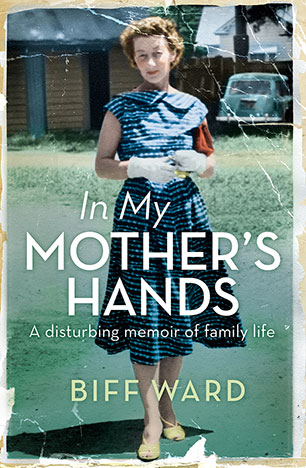
‘In My Mother’s Hands’ by Biff Ward

ward_biff

2014, 288p.

Look carefully at that front cover. A well-dressed, attractive woman stands in front of a suburban house, her hair permed, in a stylish dress with white gloves.  Those gloves are important: they encase the gouged, ravaged hands of Biff Ward’s mother Margaret.  Despite the nostalgia-infused image of Margaret Ward on the cover, this is the story of a troubled and desperate woman and mother, told by her daughter.

Biff ( a childhood rendering of ‘Elizabeth’) Ward is the daughter of Russel Ward, the noted Australian historian who wrote The Australian Legend. This book was a hugely influential study of the Australian Character (the question that keeps on giving), published more than fifty years ago. Although perhaps not so well known today, The Australian Legend and its author were examined anew at a symposium in 2007 (proceedings found in the Journal of Australian Colonial History 10.2 (2008) with a summary here) and re-addressed each year through the Russel Ward Annual Lecture  (see Babette Smith’s lecture here)

Although Biff’s memoir focusses on her mother, it is just as much a study of her father and of the family dynamics that operated when dealing with mental illness, shame and fear in the context of  the 1950s and 1960s. Biff and her brother Mark had always known of the existence of an earlier child, Alison, who had died at the age of four months,but the conditions surrounding Alison’s death were murky. What was clear, though, was that their mother Margaret was a deeply disturbed woman.  Those gloved hands, torn and rubbed raw by Margaret herself, also throttled Biff as Margaret crept to her younger daughter’s bedside one night, and it was when Margaret threatened the lives of her two remaining children while her husband was absent at a conference, that Russel Ward finally had her committed. Although Biff felt that they were dealing with the nightmare of their mother’s illness in secrecy,  many people were aware of it, as Biff herself recognizes later.  In reading a short story ‘Friends in Perspective’ published by Gwen Kelly in a Meanjin article  in 1990 (available for Victorian readers through SLV), Biff realizes that  both Russel and Margaret were the topic of gossip and judgment throughout the small academic communities at ANU in Canberra and UNE in New England.  She has the maturity and grace to recognize that the academic wives may well have been reaching out to her mother as well, instead of just gossiping about her.

She captures small university-town life well, and places her father within the academic milieu of the  communist-phobic 1950s and 1960s.  She draws on Russel Ward’s own letters to his parents and sisters that documented Margaret’s progress, and to a lesser degree on Ward’s own autobiography which largely elides Alison’s death and Margaret’s illness. I found it interesting to read about the smallness of the Australian History fraternity at the time, and the intellectual isolation of local academics in a  world where international conferences and networks were luxuries.

Biff did not write this memoir until both her parents had died. She is well aware that she is exposing her mother, and perhaps from a sense of moral even-handedness, she exposes her father’s sexual addiction as well. Even writing as an adult, as Biff does, it is impossible to tease out cause and effect in this addiction, but it does raise the issue of omission in memoir. Is there more? or less? of an imperative to reveal the flaws of a public figure, as distinct from someone unknown? (I’m reminded here of journalist Laurie Oakes’ exposure of politican Cheryl Kernot’s extramarital affair when she omitted it in her own autobiography).  Although Ward’s revelations about both parents are startling, the tone is wistful rather than vindictive, and while she censures both parents at times, her compassion shines through.

There’s a fairly lengthy extract from the book here, which will give you a taste of the easy  narrative that, at the same time, reveals so much darkness and pain. You’ll spend quite some time turning to that image on the front cover.

Other reviews:

Sue at Whispering Gums and Jonathan at Me Fail? I Fly! have written sensitive reviews of this book

aww2016 I’ve reviewed this as part of the Australian Women Writers Challenge for 2016.

My rating: 9/10

Sourced from : Yarra Plenty Regional Library e-book . Read in one sitting on an international flight!


‘You’ll be sorry when I’m dead’ by Marieke Hardy

hardy

2011, 295 p.

Celebrity is a trade-off.   The celebrity figure gaily trumpets “look at me!”, and accrues public recognition, freebies, attention and the aura of self-possession. In return s/he is subjected to the audience’s misplaced sense of identification and friendship, or conversely, approbation and smug censoriousness. And so I sit watching ABC’s Book Club (until a few years ago the First Tuesday Book Club, a handy reminder to tune in) alternately tut-tutting at Marieke Hardy’s fey girlishness with those plaits and tats one minute, and wishing a moment later that I was so winsome and witty myself. It was probably this ambivalence that led me to pick up her book You’ll Be Sorry When I’m Dead. Having read it, I’m still ambivalent, although probably with a more affectionate glow than previously.

As you might expect, it’s well-written and funny. Its chapters are similar to long-form pieces that you might read in a Saturday newspaper magazine  and indeed several of them have been published in that format previously. She’s self-deprecating and self-assured; she delights in being wicked and revels in her exhibitionism. She tells of her obsession with prostitution, her fumbling attempts at swinging, and her mortification at travelling with her parents at the age of thirty-five. Many of her stories are Melbourne-centred, as in her tribute to VFL footy ‘Maroon and Blue’, one of my favourite stories. She flits around the edge of showbusiness through  her family pedigree and her own child-actor CV and laughs at her own adolescent pursuit of one of the ‘stars’ of Young Talent Time. Some stories have more depth: her story ‘Forevz’ reminded me of Helen Garner’s The Spare Room – in fact, there were quite a few stories here which evoked Helen Garner for me, for some reason. The placement of the stories seems quite random, as does the insertion of testimonials from some of the people she has written about (an affectation I could have done without, really).

Like the celebrity persona she projects, there’s a mixture of show-off and razor-sharp penetration. I found myself laughing out loud in places, tearful at times, and rolling my eyes in other places. It’s a good dip-into book, and just as in ABC Book Club, you don’t really know what she’s going to come out with next.


2015 in review and a new feature!

The WordPress.com stats helper monkeys prepared a 2015 annual report for this blog.

Here’s an excerpt:

The concert hall at the Sydney Opera House holds 2,700 people. This blog was viewed about 36,000 times in 2015. If it were a concert at Sydney Opera House, it would take about 13 sold-out performances for that many people to see it.

Click here to see the complete report.

Ah! The posting about the eggs of the conical sea-snail- the blog-post that keeps on giving! Who would have thunk that so many people wondered what the squishy jelly on the beach was?

I’ve been blogging since July 2008 and like any long-term endeavour, my blog has changed direction over those eight years. It started as a research blog to support my thesis on Justice John Walpole Willis, the first Resident Judge of the Supreme Court of NSW in the Port Phillip District. Hence the name,  “The Resident Judge of Port Phillip” which I must confess is rather cringe-inducing at times. The blog has since become a repository for book reviews and comments about films I’ve seen, the odd history-based discussion, and observations about life in Melbourne now.

I’ve decided as a New Years Resolution (and we all know how long they last!) to start a weekly feature looking back at what was happening in Melbourne and the Port Phillip District more generally 175 years ago. Why 175 years? Because that’s when the first Resident Judge was appointed, and a Resident Judge continued to preside between 1841-1852, when the position of Chief Justice of the Supreme Court of Victoria was gazetted. That gives me eleven years of posts, should I not abandon the project (which may yet come to pass!): twelve if I want to extend it to the actual issuing of the formal commission.

Meanwhile, the book reviews and commentaries on film, history generally and Melbourne in particular will continue.

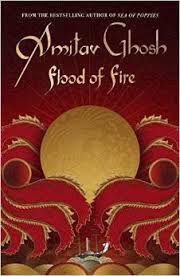
‘Flood of Fire’ by Amitav Ghosh

ghosh_floodoffire

2015, 607 p.

Yes, I know that I vowed after reading River of Smoke that I’d only read trilogies that were finished, so that there wouldn’t be a long gap between volumes. But I’d already read the first two books; Flood of Fire was sitting there on the library shelf;  and I did enjoy the first two, didn’t I?  And so,  having checked my own blogposts, and armed with the Wikipedia synopsis of the first two books, once more I ventured forth into this final, 600 page volume.

I found that I really needed the synopsis because this book draws together the narrative of the first two volumes. Sea of Poppies had focussed on the passengers on the refurbished slave-trader boat the Ibis; the second volume River of Smoke shifted to two other boats in the fleet, the Anahita and the Redruth. In this final volume, characters from both preceding books are thrown together, on opposing sides, in the First Opium War of 1839-1842.  As with the other books in the trilogy, it is exhaustively researched (evidenced by the long reference list at the end) and pointedly political.  As a work of informed, fictionalized history it flirts with the boundaries between fact and fiction, especially with the character of Neel Rattan Halder, who even now,  after I spent ages looking on the internet, I’m not sure was an invention or not. (Ghosh’s epilogue suggests that he is a historical figure who generated a rich documentary archive- but I’m not sure. Is the epilogue part of the story too?)  There’s an interesting interview with Ghosh posted here on his website where he discusses methodology.

As with the earlier books, there is re-invention (such a strong theme in colonial social history, as Kirsten McKenzie had shown in her work) and slippage between racial boundaries, caste and political loyalties. These themes are shot through with a trenchant critique of colonialism and the free trade philosophy trumpeted by British commercial interests to justify the opium trade. Ghosh’s historical argument is more overt in this book than in the preceding ones, where it was played out mainly through his characters.  Nonetheless, here too, he uses characters, most especially Zachary Reed and his illicit relationship with Mrs Burnham, to exemplify the transformation of seduction into blackmail,  a metaphor for the way that opium itself lured, then became an instrument of power and coercion.

Even though I admire the historical thoroughness of the book, I did find myself bogged down in the descriptions of battle, even though Ghosh was John Keegan-esque in depicting the visceral assault of the battlefield.  There was a long build-up to the battle scenes as Ghosh rotated between a small number of key characters, and I was on the verge of finding the long wind-up tedious and wishing that he’d just get on with it.

I think that I’ve had enough of the Ibis trilogy, and I suspect from the afterword that Ghosh might have too.  He leaves the door open for other books with an open-ended conclusion, but he seems to suggest that the whole thing is such a huge endeavour that no one person came finish the huge, complex embroidery that he has begun.  I think that’s how I’m happy to leave it: sated, and full of admiration for the narrative and research sweep that he has laid out before us.

Australian Women Writers Challenge 2015 wrap up

aww-badge-2015-200x300.

Well, I probably should have posted this ages ago because I met the challenge some time earlier.  I had vowed to concentrate on histories written by Australian women, and I didn’t do particularly well at that. A resolution for 2016 perhaps? Nonetheless… here’s the wrap-up, roughly in the order in which I read them,  for what it’s worth.

Fiction

Burial Rites by Hannah Kent

Indelible Ink by Fiona McGregor

Heat and Light by Ellen van Neerven

Foreign Soil by Maxine Beneba Clarke

A Short History of Richardby Klein by Amanda Lohrey

The Anchoress  by Robyn Cadwallader

The Girl with the Dogs by Anna Funder

The Other Side of the World by Stephanie Bishop

Only the Animals by Ceridwen Dovey

Medea’s Curse by Anne Buist

The Fine Colour of Rust by P. A. O’Reilly

Nine Days   by Toni Jordan

The Strays by Emily Bitto

Charades by Janette Turner Hospital

Non-Fiction

In Good Faith? Governing Indigenous Australia through God Charity and Empire 1822-1855 by Jessie Mitchell

Restless Men: Masculinity and Robinson Crusoe 1788-1840 by Karen Dowling

This House of Grief by Helen Garner

The Invisible History of the Human Race by Christine Keneally

Melbourne by Sophie Cunningham

Savage or Civilized? Manners in Colonial History by Penny Russell

The Hanged Man and the Body Thief: Finding Lives in a Museum Mystery by Alexandra Roginsky

The Boyds: a family biography by Brenda Niall

Warrior by Libby Connors