Category Archives: Uncategorized

Death or Liberty on television

Tune in, readers, for Death or Liberty on ABC1 at 9.30 on Thursday 14th January.

I reviewed the book here in 2014.

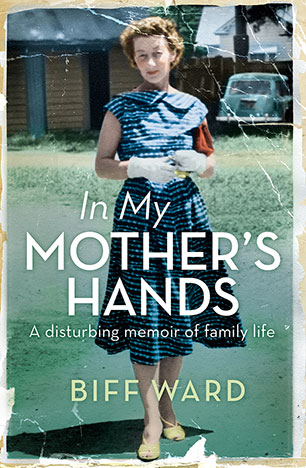
‘In My Mother’s Hands’ by Biff Ward

ward_biff

2014, 288p.

Look carefully at that front cover. A well-dressed, attractive woman stands in front of a suburban house, her hair permed, in a stylish dress with white gloves.  Those gloves are important: they encase the gouged, ravaged hands of Biff Ward’s mother Margaret.  Despite the nostalgia-infused image of Margaret Ward on the cover, this is the story of a troubled and desperate woman and mother, told by her daughter.

Biff ( a childhood rendering of ‘Elizabeth’) Ward is the daughter of Russel Ward, the noted Australian historian who wrote The Australian Legend. This book was a hugely influential study of the Australian Character (the question that keeps on giving), published more than fifty years ago. Although perhaps not so well known today, The Australian Legend and its author were examined anew at a symposium in 2007 (proceedings found in the Journal of Australian Colonial History 10.2 (2008) with a summary here) and re-addressed each year through the Russel Ward Annual Lecture  (see Babette Smith’s lecture here)

Although Biff’s memoir focusses on her mother, it is just as much a study of her father and of the family dynamics that operated when dealing with mental illness, shame and fear in the context of  the 1950s and 1960s. Biff and her brother Mark had always known of the existence of an earlier child, Alison, who had died at the age of four months,but the conditions surrounding Alison’s death were murky. What was clear, though, was that their mother Margaret was a deeply disturbed woman.  Those gloved hands, torn and rubbed raw by Margaret herself, also throttled Biff as Margaret crept to her younger daughter’s bedside one night, and it was when Margaret threatened the lives of her two remaining children while her husband was absent at a conference, that Russel Ward finally had her committed. Although Biff felt that they were dealing with the nightmare of their mother’s illness in secrecy,  many people were aware of it, as Biff herself recognizes later.  In reading a short story ‘Friends in Perspective’ published by Gwen Kelly in a Meanjin article  in 1990 (available for Victorian readers through SLV), Biff realizes that  both Russel and Margaret were the topic of gossip and judgment throughout the small academic communities at ANU in Canberra and UNE in New England.  She has the maturity and grace to recognize that the academic wives may well have been reaching out to her mother as well, instead of just gossiping about her.

She captures small university-town life well, and places her father within the academic milieu of the  communist-phobic 1950s and 1960s.  She draws on Russel Ward’s own letters to his parents and sisters that documented Margaret’s progress, and to a lesser degree on Ward’s own autobiography which largely elides Alison’s death and Margaret’s illness. I found it interesting to read about the smallness of the Australian History fraternity at the time, and the intellectual isolation of local academics in a  world where international conferences and networks were luxuries.

Biff did not write this memoir until both her parents had died. She is well aware that she is exposing her mother, and perhaps from a sense of moral even-handedness, she exposes her father’s sexual addiction as well. Even writing as an adult, as Biff does, it is impossible to tease out cause and effect in this addiction, but it does raise the issue of omission in memoir. Is there more? or less? of an imperative to reveal the flaws of a public figure, as distinct from someone unknown? (I’m reminded here of journalist Laurie Oakes’ exposure of politican Cheryl Kernot’s extramarital affair when she omitted it in her own autobiography).  Although Ward’s revelations about both parents are startling, the tone is wistful rather than vindictive, and while she censures both parents at times, her compassion shines through.

There’s a fairly lengthy extract from the book here, which will give you a taste of the easy  narrative that, at the same time, reveals so much darkness and pain. You’ll spend quite some time turning to that image on the front cover.

Other reviews:

Sue at Whispering Gums and Jonathan at Me Fail? I Fly! have written sensitive reviews of this book

aww2016 I’ve reviewed this as part of the Australian Women Writers Challenge for 2016.

My rating: 9/10

Sourced from : Yarra Plenty Regional Library e-book . Read in one sitting on an international flight!


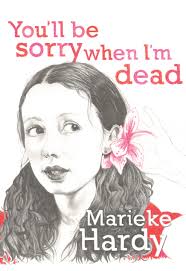
‘You’ll be sorry when I’m dead’ by Marieke Hardy

hardy

2011, 295 p.

Celebrity is a trade-off.   The celebrity figure gaily trumpets “look at me!”, and accrues public recognition, freebies, attention and the aura of self-possession. In return s/he is subjected to the audience’s misplaced sense of identification and friendship, or conversely, approbation and smug censoriousness. And so I sit watching ABC’s Book Club (until a few years ago the First Tuesday Book Club, a handy reminder to tune in) alternately tut-tutting at Marieke Hardy’s fey girlishness with those plaits and tats one minute, and wishing a moment later that I was so winsome and witty myself. It was probably this ambivalence that led me to pick up her book You’ll Be Sorry When I’m Dead. Having read it, I’m still ambivalent, although probably with a more affectionate glow than previously.

As you might expect, it’s well-written and funny. Its chapters are similar to long-form pieces that you might read in a Saturday newspaper magazine  and indeed several of them have been published in that format previously. She’s self-deprecating and self-assured; she delights in being wicked and revels in her exhibitionism. She tells of her obsession with prostitution, her fumbling attempts at swinging, and her mortification at travelling with her parents at the age of thirty-five. Many of her stories are Melbourne-centred, as in her tribute to VFL footy ‘Maroon and Blue’, one of my favourite stories. She flits around the edge of showbusiness through  her family pedigree and her own child-actor CV and laughs at her own adolescent pursuit of one of the ‘stars’ of Young Talent Time. Some stories have more depth: her story ‘Forevz’ reminded me of Helen Garner’s The Spare Room – in fact, there were quite a few stories here which evoked Helen Garner for me, for some reason. The placement of the stories seems quite random, as does the insertion of testimonials from some of the people she has written about (an affectation I could have done without, really).

Like the celebrity persona she projects, there’s a mixture of show-off and razor-sharp penetration. I found myself laughing out loud in places, tearful at times, and rolling my eyes in other places. It’s a good dip-into book, and just as in ABC Book Club, you don’t really know what she’s going to come out with next.


2015 in review and a new feature!

The WordPress.com stats helper monkeys prepared a 2015 annual report for this blog.

Here’s an excerpt:

The concert hall at the Sydney Opera House holds 2,700 people. This blog was viewed about 36,000 times in 2015. If it were a concert at Sydney Opera House, it would take about 13 sold-out performances for that many people to see it.

Click here to see the complete report.

Ah! The posting about the eggs of the conical sea-snail- the blog-post that keeps on giving! Who would have thunk that so many people wondered what the squishy jelly on the beach was?

I’ve been blogging since July 2008 and like any long-term endeavour, my blog has changed direction over those eight years. It started as a research blog to support my thesis on Justice John Walpole Willis, the first Resident Judge of the Supreme Court of NSW in the Port Phillip District. Hence the name,  “The Resident Judge of Port Phillip” which I must confess is rather cringe-inducing at times. The blog has since become a repository for book reviews and comments about films I’ve seen, the odd history-based discussion, and observations about life in Melbourne now.

I’ve decided as a New Years Resolution (and we all know how long they last!) to start a weekly feature looking back at what was happening in Melbourne and the Port Phillip District more generally 175 years ago. Why 175 years? Because that’s when the first Resident Judge was appointed, and a Resident Judge continued to preside between 1841-1852, when the position of Chief Justice of the Supreme Court of Victoria was gazetted. That gives me eleven years of posts, should I not abandon the project (which may yet come to pass!): twelve if I want to extend it to the actual issuing of the formal commission.

Meanwhile, the book reviews and commentaries on film, history generally and Melbourne in particular will continue.

‘Flood of Fire’ by Amitav Ghosh

ghosh_floodoffire

2015, 607 p.

Yes, I know that I vowed after reading River of Smoke that I’d only read trilogies that were finished, so that there wouldn’t be a long gap between volumes. But I’d already read the first two books; Flood of Fire was sitting there on the library shelf;  and I did enjoy the first two, didn’t I?  And so,  having checked my own blogposts, and armed with the Wikipedia synopsis of the first two books, once more I ventured forth into this final, 600 page volume.

I found that I really needed the synopsis because this book draws together the narrative of the first two volumes. Sea of Poppies had focussed on the passengers on the refurbished slave-trader boat the Ibis; the second volume River of Smoke shifted to two other boats in the fleet, the Anahita and the Redruth. In this final volume, characters from both preceding books are thrown together, on opposing sides, in the First Opium War of 1839-1842.  As with the other books in the trilogy, it is exhaustively researched (evidenced by the long reference list at the end) and pointedly political.  As a work of informed, fictionalized history it flirts with the boundaries between fact and fiction, especially with the character of Neel Rattan Halder, who even now,  after I spent ages looking on the internet, I’m not sure was an invention or not. (Ghosh’s epilogue suggests that he is a historical figure who generated a rich documentary archive- but I’m not sure. Is the epilogue part of the story too?)  There’s an interesting interview with Ghosh posted here on his website where he discusses methodology.

As with the earlier books, there is re-invention (such a strong theme in colonial social history, as Kirsten McKenzie had shown in her work) and slippage between racial boundaries, caste and political loyalties. These themes are shot through with a trenchant critique of colonialism and the free trade philosophy trumpeted by British commercial interests to justify the opium trade. Ghosh’s historical argument is more overt in this book than in the preceding ones, where it was played out mainly through his characters.  Nonetheless, here too, he uses characters, most especially Zachary Reed and his illicit relationship with Mrs Burnham, to exemplify the transformation of seduction into blackmail,  a metaphor for the way that opium itself lured, then became an instrument of power and coercion.

Even though I admire the historical thoroughness of the book, I did find myself bogged down in the descriptions of battle, even though Ghosh was John Keegan-esque in depicting the visceral assault of the battlefield.  There was a long build-up to the battle scenes as Ghosh rotated between a small number of key characters, and I was on the verge of finding the long wind-up tedious and wishing that he’d just get on with it.

I think that I’ve had enough of the Ibis trilogy, and I suspect from the afterword that Ghosh might have too.  He leaves the door open for other books with an open-ended conclusion, but he seems to suggest that the whole thing is such a huge endeavour that no one person came finish the huge, complex embroidery that he has begun.  I think that’s how I’m happy to leave it: sated, and full of admiration for the narrative and research sweep that he has laid out before us.

Australian Women Writers Challenge 2015 wrap up

aww-badge-2015-200x300.

Well, I probably should have posted this ages ago because I met the challenge some time earlier.  I had vowed to concentrate on histories written by Australian women, and I didn’t do particularly well at that. A resolution for 2016 perhaps? Nonetheless… here’s the wrap-up, roughly in the order in which I read them,  for what it’s worth.

Fiction

Burial Rites by Hannah Kent

Indelible Ink by Fiona McGregor

Heat and Light by Ellen van Neerven

Foreign Soil by Maxine Beneba Clarke

A Short History of Richardby Klein by Amanda Lohrey

The Anchoress  by Robyn Cadwallader

The Girl with the Dogs by Anna Funder

The Other Side of the World by Stephanie Bishop

Only the Animals by Ceridwen Dovey

Medea’s Curse by Anne Buist

The Fine Colour of Rust by P. A. O’Reilly

Nine Days   by Toni Jordan

The Strays by Emily Bitto

Charades by Janette Turner Hospital

Non-Fiction

In Good Faith? Governing Indigenous Australia through God Charity and Empire 1822-1855 by Jessie Mitchell

Restless Men: Masculinity and Robinson Crusoe 1788-1840 by Karen Dowling

This House of Grief by Helen Garner

The Invisible History of the Human Race by Christine Keneally

Melbourne by Sophie Cunningham

Savage or Civilized? Manners in Colonial History by Penny Russell

The Hanged Man and the Body Thief: Finding Lives in a Museum Mystery by Alexandra Roginsky

The Boyds: a family biography by Brenda Niall

Warrior by Libby Connors

‘Charades’ by Janette Turner Hospital

charades

1988,  345 p

I hadn’t heard of this book at all, although I’ve read several of Janette Turner Hospital’s books previously (see here and here for reviews).  It was written in 1988 which is, after all, quite some time ago, and was included in the New York Times Book Review‘s fifty most notable novels of 1988. It was long-listed for the Booker Prize, and shortlisted for the Miles Franklin, the Banjo and the Adelaide Festival National Fiction Awards.

Stripped back to its bare bones, it’s the story of a rather lecherous Canadian university lecturer in physics, Koenig, who embarks on a relationship with a young student who, between bouts of frantic and sweaty lovemaking, regales him with stories of her search for her father and her unconventional mother.  The stories distract Koenig from his own woes about his wife’s breakdown, the end of his marriage and his son’s conversion to the Moonies.

That’s the simple version.  It’s also a riff on Scheharazade, story-telling and truth.  It’s all a bit contrived: we have the rather twee twist on ‘Charade’ as the young student’s name.  Add to this some rather laboured complications of physics and the uncertainty principle. Hence we have Bea, her mother, or ‘B’ (as in the B-narrative) and Kay, her ‘aunt’ (as in K, the symbol for constant value in physics), Nicholas Truman (true-man) and the mysterious Verity.

It’s not an easy book, and I very nearly abandoned it after Part I. But just at that point, either it improved or I succumbed to it, and I’m glad that I did. As a reader, you have to tolerate leaps between the frame story and flashbacks, and to have one story immediately contradicted by an alternate story.  At this point, you just have to hold on and trust Turner Hospital that she’s going to hold it all together- and she does, largely.

I could have done without all the physics, which nearly tipped me over the edge.  There are elements of this book that she repeats in later work (looking for lost parents; mobility and dislocation; the Queensland setting; bohemianism etc) and I think that she has become more refined and controlled in her writing over the decades.  But the book is worth persevering with, and is a satisfying read as you reach the end.  The word ‘virtuoso’ is often used to describe her work and it’s apposite: she flies high and takes risks.  It’s exhilarating, but not comfortable.

Posted to the Australian Women Writers challenge site as surely my final contribution for the year!

aww-badge-2015-200x300

Adela Pankhurst

Suffragettes are all the go, with the movie being released here in Australia tomorrow (although there have been previews).  Jeff Sparrow wrote an interesting article about Adela Pankhurst in the Guardian here. 

Adela may only be mentioned briefly  in the movie but after being despatched to the colonies, she took up a prominent position in Australian politics, especially during World War I. If you do a search on Trove under her name from 1914 onwards, you’ll find many reports of her speeches and activities.  Here’s just a taste:

Capture

Table Talk,  Melbourne, 16 July, 1914, p. 41.


Hearing voices

All of my research of Upper Canada, British Guiana, Sydney and Port Phillip has involved written documents: letters, court documents, despatches, newspapers, diaries.  It’s a rather quiet world.  You can detect voices in letters and the court depositions perhaps, but generally you’re hearing with your eyes, rather than your ears.

I’ve long been fascinated to know what those early generations of settlers sounded like.  For those settlers who came from the United Kingdom, where accents can be pinpointed to a small, particular location, how long did such a distinctive accent last?  Crikey’s Full Sic blog today has an article by Richard Ingold ‘So where did the Aussie accent really come from?’ He draws fairly heavily on Bruce Moore’s book Speaking Our Language, the introduction to which you can read here, and which was reviewed well by Mark Bahnisch on Larvatus Prodeo.

Moore, who is Director of the National Dictionary Centre at ANU,  argues in Speaking our Language that convicts, administrators, military personnel and later, free settlers, spoke a variety of accents, especially from south-eastern England.  In such an environment, the elements of pronunciation that were especially associated with a particular dialect were eliminated, often within a generation.  This ‘levelling’ process led to an established Australian accent by the early 1830s.  It was only then that dialectical words that were marginal in British accents became incorporated into Australian English, especially during the tumult of the Gold Rushes and afterwards.  But importantly, these words were superimposed onto an already existent, levelled Australian accent. The negative reaction to the Australian Accent, particularly in the wake of the creation of Received Pronunciation in England, did not arise until the 1880s. This fits in with the emphasis on elocution in Joy Damousi’s book Colonial Voices, and rings true when I think of that peculiar, strangled, rather British accent that is heard in old Australian documentaries.

Ingold’s article also cites Peter Trudgell’s far more technical book New-Dialect Formation: The Inevitability of Colonial Englishes. Published in 2004, Trudgell concentrates particularly on Australian, New Zealand and South African English and argues that these varieties of colonial English are similar to each other because they were formed out of similar mixtures, according to the same principles.  He stretches the process out over two generations, but it is still, nonetheless, a fairly rapid process.

My research based in New South Wales centres on the years 1837-1843. If Moore is correct, then the voices on the street would be levelled Australian voices, although in circles being supplemented by a succession of appointments from elsewhere in the empire, this may have been less apparent.  Interesting thought.

Movie: ‘Truth’

I was disappointed in this one.

Based on her book Truth and Duty: The Press, the President, and the Privilege of Power (2004), this is the story of Mary Mapes, the producer of Sixty Minutes in America. She produced the segment, presented by Dan Rather, that questioned  George W. Bush’s selection for enlistment and later performance in the Texas Air National Guard which allowed him to avoid being drafted for Vietnam.  The film follows the uncovering and verification of documents and the search for evidence to back up the story. After the segment was aired, questions were raised about the authenticity of the documents, and three CBS producers, including Mapes, were fired. Dan Rather resigned soon after.

I must confess that I’m not particularly aware of the role of producers in news programs and the distinction between a producer and a presenter.  I looked through the list of producers in the Wikipedia entry on Four Corners (probably the Australian program most comparable to that depicted in the film) and while some names were familiar, others weren’t.

I had been hoping that this film would be more like the excellent BBC Series The Hour  (alas, we’ll never know what happened to Freddie…) or Good Night and Good LuckTruth did not have the tautness of either of these programs and was too schmaltzy. Although you’re left with questions at the end of the film, you feel more suffocated than lacerated.

It’s a brilliant cast, with Cate Blanchett and an increasingly wrinkly Robert Redford, but the roles didn’t seem to stretch them at all. It was a surprise to see Noni Hazlehurst there- yes our Noni- and she played her small role really well.

So, a rather lukewarm 3/5 from me.