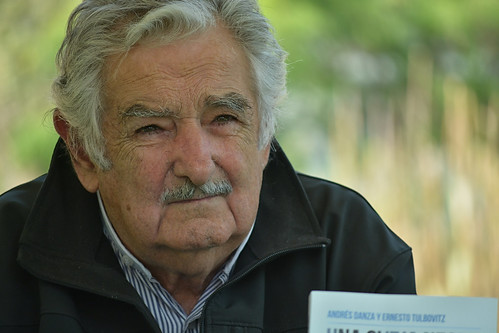
“Pepe” Mujica Cordano was a Uruguayan politician, revolutionary and farmer who served as the 40th president of Uruguay from 2010 to 2015. He died on 13 May 2025. He was imprisoned for 14 years and tortured as a member of the Tupamaros guerillas, and on his release he threw himself into politics. The times suited him: there were a number of left-wing Latin American governments at the time, and the economic situation was good for Uruguay. He never took a salary while he was President, and tootled around in his little blue Volkswagon, continuing to live in his very humble house. After his Presidency, he remained much as he had been while President, giving wide-ranging and wise interviews to journalists.
Today, the United States has a grifter and braggart as President. You could not find a more stark contrast than Pepe Mujica.
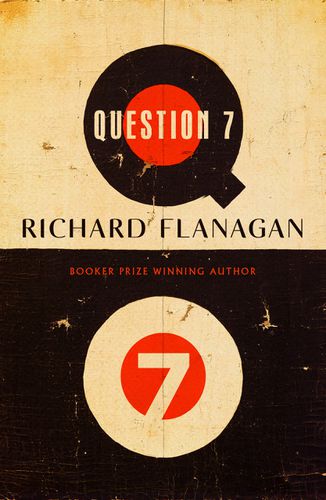
When I first heard about Richard Flanagan’s Question 7, I thought “But that’s just a rehash of everything he’s already written”. It’s true that there are flashes of his earlier work, almost as if he’s tipping his hat to it in passing. The Tasmanian section evokes The Sound of One Hand Clapping, Wanting and Gould’s Book of Fish, his mentions of his father’s wartime experience sparks memories of Narrow Road to the Deep North and his mother’s death was explored in The Living Sea of Waking Dreams, and the final chapter brings to life Death of a River Guide. But this makes the book sound like a glorified ‘greatest hits’ and it’s much, much more than that. It’s brilliant.
The title is taken from a Chekhov story, where a question is posed in the form of those schoolroom maths questions that still give me a sinking feeling in my stomach:
Wednesday, June 17, 1881, a train had to leave station A at 3am in order to reach station B at 11pm; just as the train was about to depart, however, an order came that the train had to reach station B by 7pm. Who loves longer, a man or a woman?”
Who, indeed. The real question is love, not the train or the timetable, and it’s a question that is unanswerable. So too, is the question of causality that brings each of us where we are.
Without Rebecca West’s kiss H. G. Wells would not have run off to Switzerland to write a book in which everything burns, and without H. G. Wells’s book Leo Slizard would never have conceived of a nuclear chain reaction and without conceiving of a nuclear chain reaction he would never have grown terrified and without growing terrified Leo Szilard would never have persuaded Einstein to lobby Roosevelt and without Einstein lobbying Roosevelt there would have been no Manhattan Project, and without the Manhattan Project there is no lever at 8.15 am on 6 August 1945 for Thomas Ferebee to release 31,000 feet over Hiroshima, there is no bomb on Hiroshima and no bomb on Nagasaki and 100,000 people or 160,000 people or 200,000 people live and my father dies. Poetry may make nothing happen, but a novel destroyed Hiroshima, and without Hiroshima there is no me and these words erase themselves and me with them. (p.237-8)
We meet all these contingencies and people in this book, written as a series of small shards within ten chapters: the Enola Gay pilot Thomas Ferebee, physicist Leo Slizard, the writers H.G. Wells and Rebecca West, his parents, his childhood in Roseberry, Tasmania, the Burma Railway and indigenous dispossession. Themes arise, drop and rise again, and parts of the book are an extended reflection on death and memory, encountered over and over. It’s hard to fit in into any one genre: it’s history, non-fiction, memoir and philosophy all rolled into one. The most compelling writing in the book comes at the end, when he tells his experience of nearly dying – indeed, did he die and is all this just a dream?- that he fictionalized in Death of a River Guide. My dinner was ready, and I was being summoned with increasing impatience, but I had to keep reading, even though I knew that clearly, he did, survive – and if it was a dream, then we’re all enmeshed in it too.
I have always loved Richard Flanagan’s right from Gould’s Book of Fish, which was the first of his books that I read. I’ve read interviews as part of the publicity for this book, where Flanagan said that he didn’t know if he’d write another book and I must admit that I closed it, feeling that he had written himself completely into the book, wondering how he could ever write anything else after this.
The best book that I have read in ages.
My rating: 11/10
Sourced from: borrowed for a friend (for far too long!)
History Extra How Roman Roads Transformed Europe. You know, I don’t think that I’ve ever been on a Roman road, although would I have recognized it if I was? (I haven’t travelled much in Europe, just in England and a bit in the south of Spain). Catherine Fletcher, author of The Roads To Rome: A History notes that there were eight main roads heading out of Rome itself during Roman times, and that they weren’t always straight if there was a big geographical problem in front of it. Romans could travel 30 miles a day on a Roman road, and they were later used in the Crusades as a way of quick army deployment. Napoleon dreamt of a road to Moscow, and Fascists were rather attracted to them too.
The Coming StormSeason 2: Episode 5 The Photocopier. Somehow or other Gabriel Gatehouse gets an invitation of a meeting of a start-up called Praxis that is full of all the tech-bros who are planning to start up a new state, with no bureaucracy but governed by block chain. Praxis, and other groups like it, draw on the book The Sovereign Individual by William Rees-Mogg in the 1990s which predicts the fall of the nation-state and the rise of the cybereconomy. (Yes, the father of the politician Jacob Rees-Mogg). There’s a connection with Jeff Giesea (former Trump supporter but no longer) and Peter Thiele, both tech entrepreneurs- this is all rather scary stuff.
The Rest is History Episode 295 The Rise of the Nazis: The Beer Hall Putsch Nazi Germany haunts all popular leaders in a democracy. Hitler didn’t win outright- he was given power because he was the biggest party in a systerm of horse-trading. How far back do we have to go to find the origins of Nazism? Historian Richard Evans looks to Bismarck in 1871, who built force, violence and the army into the German constitution. There was the theory of ‘germandom’ where Germans had the right to be united under the one Reich although Germany was a late-comer to imperialism. A sense of pan-Germanism arose, expressed through a ‘Band of Brothers’, Boy Scout sort of mentality. The Social Democrats were the biggest party but were never really trusted. During the 1880s and 1890s Darwinism had emphasized life as struggle and weakness, and this fed into a disdain for weakness. Judaism came to be seen as a racial rather than religious category, and antisemitism increased. The Germans didn’t think that they had started WWI. and they didn’t believe that they were defeated as such, even though they had lost the war. In 1919 Hitler was still in the army and started giving lectures for the National Socialist Workers Party, which he was good at, and he became their star speaker. In particular he used medical imagery for his anti-semitism (e.g. poisoning the blood etc). The Weimar republic at that time was headed by a monarchist but the fear of revolution, heightened by the Spartacist Uprising, helped to unite a society that might otherwise fractured. Germany had borrowed heavily to fight the war, because they assumed that they would win, and when they defaulted on their French loans, the French govt took over the Ruhr. All groups in German society, both left and right, had their own militias, and there was a general anti-government sentiment. At the Beer Hall riot, Ludendorf was influential but Hitler, who did not at this stage see himself as a leader, took the rap. The court case was manipulated in that Hitler had a choice of location and judge, and it provided an opportunity for Hitler to give a four-hour speech. At this stage there was a capitulation of all of the forces that should have been guardrails against Hitler. The President died, and there were elections at which the Nazi party received 3% of the vote. It started to work on increasing its presence amongst farmers and northerners but no one really thought that the Nazi Party could take power unless there was an unforeseen calamity. And then the Depression hit.
Rear VisionHow to end conflict- the art of peacemaking Peacemaking is front of mind in Gaza and Ukraine (neither of which I have high hopes for). The current day UN and United States definition is that peace = not fighting, however, in many other traditions peace is seen as a way of living together so that each has dignity. In medieval times, war was a way of settling rights, and it always ended in negotiation and compromise- but without blame between Christian nations. This changed with Versailles, when the idea of war guilt was introduced (which arguably, led to WW2). After WW2 there was the creation of the United Nations, and the idea of mediation between warring parties either through the UN or a sponsor nation. This doesn’t always work, especially as it tends to involve the imposition of democratic structures prematurely e.g. Rwanda. South Africa and Ireland are examples where good leadership was able to bring about peace, where it was recognized that you are negotiating with your enemy (not your friend) and that risk and compromise is inevitable. Some of the speakers spoke about the need to include people who have been designated ‘terrorists’ into the peace negotiations, otherwise they will just act as spoilers.
In the Shadow of Utopia In rounding out his first season after THREE YEARS of broadcasting- what a long-term commitment!- Lachlan Peters gives a roughly one-hour summary of everything that has gone before, both as a form of revision for those who have been listening to the whole series, and as a quick catch-up for those who are joining it here. Season One Recap: Cambodian history from Angkor to Independence is a really good episode, although I do wonder whether it moved too quickly for those who weren’t familiar with it. He has been talking throughout about the concept of a ‘hurricane’ leading to Pol Pot, with pressure coming from foreign pressures, combining with internal patterns. In going through his quick chronology, which he does very well, there are three underlying themes (i) geography with Vietnam on one side and what would become Thailand on the other (ii) the style of leadership stemming from God Kings and patronage and (iii) external factors like the Enlightenment in shaping French colonialism, Marxism and the Cold War. Well worth listening to.
Is it wrong to judge a book by a cover? Sometimes, but bear in mind that the publisher chooses a cover that will attract what they perceive to be the audience. I don’t think that I’m this audience. As soon as I saw the picture of the woman in the Akubra hat against a background of the Australian outback, I thought of all those rural romances and inspirational biographies (Sara Henderson et al) that I avoid like the plague.
German-born Frauke Bolten was a reluctant migrant to Australia. She arrived at a small outback airstrip in blistering heat at Kununurra in northern Western Australia with her children, her husband Friedrich having purchased a property on the Ord River Scheme without even discussing it with her. As a woman of faith who believed in her wedding vow to “obey”, she negotiated a two-year trial of living there with her husband (which turned out to be forty years) and the company of a nanny to assist with the children. She and her husband had previously farmed in Rhodesia, before returning to Germany to establish a farm and family which she thought would establish them back home forever. This new endeavour in Western Australia, grudgingly undertaken on her part, threw up many challenges at first, largely through her husband’s pigheadedness and ill-advised innovation, then as the children left home for boarding school in the city and the financial problems mounted, Friedrich’s depression increased.
And then her husband committed suicide. Shocked and heartbroken, she found herself resisting the assumption by the families ‘back home’ that she would of course return home: the widow, the daughter, the daughter-in-law forever. Her children did not want to return to Germany either, and so they stayed. She remarried Robert Robert Boshammer, ten years her junior and of similar German heritage. From a small-scale backyard tourist venture she started selling diamonds from the nearby Argyle Diamond mine, gradually increasing the business to a large tourist enterprise in the town. Further tragedy was to come, with her son Peter committing suicide too, and the suicide of Doris, who managed the shop for her. As her children married and went on to have children, Frauke herself had to confront cancer.
The book is co-written with journalist Sue Smethurst, and I found myself wondering what Smethurst added to the book because the prose itself is very clichéd and pedestrian. Perhaps her assistance came in negotiating the narration of the suicides, a subject that needs to be treated carefully.
This is Bolten-Boshammer’s story, but it a very blinkered and shallow one. Both in Rhodesia and Kununurra, she lived in a German-centred community, seemingly oblivious to the social and political environment in which she was living. There is not a word of the bubbling tension that will emerge with independent Zimbabwe, or the edgy relationship in Kununarra between its large indigenous population and its white community, attracted by the technological hubris of the Ord River Scheme. It felt a bit like reading of the British ex-pats in Happy Valley in Kenya, with their own self-contained world that tried to re-create ‘home’ in a starkly different environment that existed in a bubble, completely independent of the country around them. Their Christmas customs, the gap year holidays back in Germany for her children where they clearly had enough German language to communicate with their family, the values she drew from her religion and from her culture- these are all German.
The writing itself was flat and banal. It felt like a series of photocopied Christmas letters, with their forced jollity, catching up with the children’s latest ventures, the marriages, the grandchildren, the celebrations. I know that English is Frauke’s second language, but there’s no idiosyncrasy of phrase here: it’s just turgid sludge.
I complained the whole way through.
My rating: 4/10
Read because: It was an Ivanhoe Reading Circle selection. I am really surprised that this book was on the program because the books are usually of much better quality than this. The presenter for the night did a wonderful job in extracting the few good points about it.
Sourced from: purchased e-book. Thank God I didn’t spend the money on trying to track down a hard copy.
History Hit. The Clinton Body Count to the QAnon Shaman: Conspiracy Theories in American Politics Gabriel Gatehouse, from the BBC, has a second series of The Coming Storm, which I listened to back in 2022. This episode is a bit of a rehash of the first series, which focussed on the conspiracies swirling around the Clintons, but brought up to the January 6 riot and its fall-out. He says that now conspiracies revolve more around “hidden actors”, which has an element of truth to it (says she, frustrated by the influence of lobbyists and miners on Australian politics).
The Rest is History. Episode 454 Fall of the Sioux: Death of Crazy Horse (Part 1) From their own summary: “Though the Battle of the Little Bighorn seemed for the triumphant Lakota and their allies – the largest gathering of Plains Indians ever assembled – a miraculous victory, it was for them the beginning of the end. A great council was held near the battlefield in which they made the fateful decision to split up. Meanwhile, in Washington, Custer’s death and the military defeat of the army was being politicised, and the public rallied against the Lakota. Red Cloud, their political leader through so many of their struggles, was replaced with a puppet interloper. Then, during the winter of 1877, a contingent of ruthless and fiercely effective U.S. officers, including General Crook and General Miles, chased and harried the retreating Sioux contingents through the snows, leaving them starving, beleaguered and desperate. At last, in March 1877 the once formidable war chiefs Crazy Horse and Sitting Bull found themselves cornered, and their people left with little choice but to admit defeat. What then would be their fate?Dominic and Tom … discuss the annihilation of the Plains Indians and the dissolution of their extraordinary culture and nomadic way of life, along with the tragic death and downfall of one of the most mesmerising and mysterious characters of the entire story: Crazy Horse. “
We Live Here Now (The Atlantic)Thank you for Calling President Trump The presence of their neighbours from the ‘Eagles Nest’ at the vigils outside the Washington DC jail attracted the attention of politicians, most particularly Sebastian Gorka, who took up the cause of Ashli Babbitt with enthusiasm. As part of the vigil, people would telephone in, and these calls were often broadcast out loud. President (at this stage ex-president) called in as well.
I Bet It’s a January 6 case There were over 1500 arrests after January 6, and in a small jurisdiction like Washington DC, many locals were called up for jury duty in January 6 cases. And so, Lauren gets the call up and she is part of the jury that convicts Taylor Johnatakis for obstruction of an official proceeding; civil disorder’ and assaulting, resisting, or impeding certain officer and a handful of misdemeanors. His sentence was more than seven years. (Trump walked away scot-free). Lauren feels bad about it, and Hanna Rosin visits his wife, Marie and after learning that he has five kids, that his wife is a sad, forgiving woman, and that they may well lose their house, then Hanna feels bad about it too.
Shadows of UtopiaEpisode 13 The Royal Crusade for Independence. This episode is only 1.5 hours long, and it comes three years (!!) after Lachlan Peters embarked on this project. It deals with the year 1953. By this time, the IndoChina was becoming known in France as the ‘Dirty War’. All sides- the French, the Nationalists, the Viet Minh were appallingly violent, and this violence was spreading across all three territories of Indochina. The narrative divides in half here: looking at the diverging paths of Saloth Sar (the future Pol Pot) and King Sihanouk. Saloth Sar returned to Cambodia, charged by the Communist students back in France with compiling a report about the different groups, and which group they should throw their weight behind. He wrote back to Paris saying that the Khmer Viet Minh was the only viable force, but that the Cambodians should work for independence from within the tent. He joined the Kymer Viet Minh, but found that despite the name, the group was dominated by the Vietnamese who looked down on them. Meanwhile, Sihanouk decided that he was going to get independence from the French for ‘his’ country, so he got involved with international diplomacy which was getting increasingly complex now that it was overlaid by Cold War diplomacy. In the end the French, who were domestically becoming increasingly uncomfortable with this ‘dirty war’, decided that they had to go along with Sihanouk’s proposal because of the Communist threat, so independence was declared in November 1953. But the Nationalists led by Than and his Kymer Srei and the Viet Minh did not accept Sihanouk’s takeover. So we had Sihanouk with French and US support against the Khner Viet Minh supported by Vietnam, China and Russia.
Global Roaming (ABC) I enjoy Global Roaming with Geraldine Doogue and Hamish Macdonald, two of my favourite ABC journalists. Maori vs the King: Who owns NZ? picks up on the large recent protests in New Zealand (involving both Maori and Pakeha) over the bill before their Parliament to rewrite the terms of the Treaty of Waitangi. Although there is little chance of this bill being passed, the fact that it even came before Parliament says a lot about the times we are living in. Features Taiha Molyneux, Māori News Editor Radio New Zealand .
Rear Vision (ABC)Treaty of Waitangi It might be flawed, it might be contested, and is continually being discussed and reconceptualized but I think that the attempts to ‘rewrite’ the Treaty itself are absolutely appalling. I suspect that NZ politicians were emboldened by our recent Voice referendum over the ditch. It’s interesting that two of the speakers in this episode have died so it really does take on a historical perspective. The speakers are Judith Binney, was Emeritus Professor of History at the University of Auckland. She died 15 February 2011, Claudia Orange is a historian and Director of History and Pacific Cultures at Te Papa, the national museum of New Zealand and Dr Ranginui Walker was a Māori academic and writer. He died 29 February 2016. I just had a look at the Waitangi Tribunal reports page: it’s telling that of the five ‘urgent’ reports issued there, four of them arise from this year.
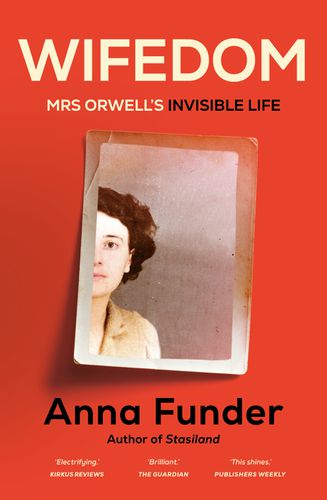
Sometimes a writer takes on a task, knowing that it is risky. Funder did, and in a way, Orwell himself made her do it. After the age of 30, he writes, people almost abandon the sense of being individuals at all, and live for others or are smothered under drudgery. Not writers, however, who belong to a minority class of gifted, wilful people who are determined to live their own lives to the end. Was this true of Funder herself? An award-winning Australian writer and historian, she knew that despite intending to share the responsibilities of life and parenthood with her husband Craig, she had been doing the lion’s share. As a writer and a wife, she found herself envying the titantic male writers for the
…unpaid, invisible work of a woman [to create] the time and -neat, warmed and cushion-plumped- space for their work….To benefit from the work of someone who is invisible and unpaid and whom it is not necessary to thank because it is their inescapable purpose in life to attend to you, is to be able to imagine that you accomplished what you did alone and unaided…Invisible workers require no pay or gratitude, beyond perhaps an entire, heartfelt sentence in a preface, thanking ‘my wife’. ..As a writer, the unseen work of a great writer’s wife fascinates me, as I say- out of envy. I would like a wife like Eileen, I think, and then I realise that to think like a writer is to think like a man…But as a woman and a wife her life terrifies me. (p. 53, p.55)
When she read a piece that Orwell had written in his private notebook, close to his final illness, she recoiled from the misogyny and repugnance that he showed towards his wife: that same wife who had made his writing possible. She turned her attention from Orwell to his wife Eileen. She had thought of fictionalizing her picture of their marriage, but the publication of Sylvia Topp’s Eileen: The Making of George Orwell in 2005 and the recent discovery of six letters from Eileen to her friend Norah caused her to change her mind. Eileen’s voice had been suppressed for so long, and she didn’t want these six, so rare, letters to be swallowed up into the maw of source material. And so she writes this book as a ‘counter-fiction’, marking out Eileen’s words in italics so that they keep their own integrity and distinctiveness, but fictionalizing the context in which they are written as she traces their marriage from 1935 and their first meeting through to Orwell’s death in January 1950.
A long-time admirer of George Orwell’s work, Anna Funder had immersed herself in Orwell scholarship, reveling in his essays, combing through his six biographies, doing the Orwell Pilgrimage to Catalonia and Jura, and revisiting his books. She is aware of the risk she is running, in these ‘cancel culture’ times
…Orwell’s work is precious to me. I didn’t want to take it, or him, down in any way. I worried he might risk being ‘cancelled’ by the story I’m telling. Though she, of course, has been cancelled already- by patriarchy. I needed to find a way to hold them all- work, man and wife- in a constellation in my mind, each part keeping the other in place. (p. 23)
There is a lot going on in this book. She mounts a feminist attack against patriarchy; she reflects on the writing process and the needs of writers; she combines Orwell’s biography and her own autobiography; she trails Orwell and Eileen through their marriage chronologically, and she takes Orwell’s other (male) biographers to task for their unthinking acceptance of the minor role of “my wife”. Is there too much going on here? Perhaps, although by drawing on her own reflections on the writing process and the role of her partner in a prize-winning, internationally recognized writing career is to provide a new perspective on this other writing career of a largely-ignored writer nearly one hundred years ago.
As it happens, I read this book immediately after reading Orwell’s Homage to Catalonia. I had been disconcerted by Orwell’s erasure of Eileen through the sparing references to “my wife”, but having now read Funder’s account of their time in Spain, I feel angry that his account stands unchallenged. All those passive sentences of how urgently-needed supplies miraculously appeared or arrangements were made, suddenly made sense. Even the scene in which Eileen appears in the hotel lobby to warn Blair that he was in danger elides completely the fact that she had been waiting literally days for him and downplays the very real peril that Eileen herself was facing. That self-deprecating humour and false humility is all a charade.
Like Funder, I am angered too by the manipulation of quotes and shuffling of facts by his earlier biographers in lionizing the man and expunging Eileen. Funder has obviously read these biographies with one finger holding open the footnotes page, and she has followed up each one.
From a 21st century perspective, in the light of ‘me too’ and awareness of ‘coercive control’, Orwell does not come out of her analysis well. As his late-life reflection on the “incorrigible dirtiness” and “terrible, devouring sexuality” of women (p.11) shows, he had a deeply embedded repugnance for women. He was constantly unfaithful, and by immuring themselves away in a dishevelled cottage in the country – at his insistence- far from the city, he separated her from her friends and their milieu. He thought nothing of going off to follow his own desires and interests: over to Spain to report on the Civil War, off to Europe while Eileen is dying, absent again when she was facing court to gain custody of their adopted son. She was his typist, his editor, his sounding board; she cooked, she gave up her comforts for his. She pandered to his ‘bronchitis’ while he largely ignored her pain from cancer. He was jealous of their friend Georges’ infatuation with her, yet he revelled in the ‘permission’ she granted for him to have affairs – a permission harangued and co-erced from her, or freely given? He pursues her friends (because they are her friends?) and “pounces” on women, after her death, in order replace her and the day-to-day burdens she had carried, as quickly as possible.
But without wanting to excuse him- who knows what goes on in a marriage? The story goes that Orwell instantly declared on meeting her “Eileen O’Shaughnessy is the girl I want to marry”. Conversely, Eileen told her friend “I told myself that when I was thirty, I would accept the first man who asked me to marry him.” What was her attraction to him? She had won a scholarship to Oxford where she read English alongside Auden, Spender and MacNeice, but failed to get a first (no women were given firsts in 1927, the year she graduated), and she relinquished her own writing. She was undertaking a Master Of Psychology at University College London, but this too was sublimated to Orwell’s demands for quiet, food, the country lifestyle. She seemed heedless to her own safety during the Blitz, and opted for the cheapest treatment of her cancer, a treatment that killed her. People and relationships are complex.
I enjoyed this book a great deal. I appreciated Funder’s rigour in interrogating Orwell’s biographies and biographers, I liked the respect with which she treated Eileen’s own words in the letters. Once you move beyond a slavish chronology, all biographies are an argument, and Funder’s argument is right there on the cover with the title “Wifedom: Mrs Orwell’s Invisible Life”. I could have had a little less of Funder’s 21st century writerly angst, but it comes from a place of knowledge and identification. Reading it immediately after Homage to Catalonia convinced me completely of Funder’s thesis: that “my wife” was a real, living, intelligent woman who was a fundamental, and completely obscured, part of one of the most lionized literary marriages.
My rating: 9/10
Read because: Ivanhoe Reading Circle September selection. It was an open meeting, and the paper presented by Meredith Churchyard was excellent.
History ExtraImperial Spectacle: Inside Britain’s 1924 ‘Empire Exhibition’. In this episode Matthew Parker takes us to the Empire Exhibition at Wembley Park. The 200 acre site was ten times the size of the exhibition at the Crystal Palace in 1851, and it included the Wembley Stadium, which still stands. It was opened in April 1924 by King George V on radio, and he was heard by 10 million listeners worldwide. Held after World War I, it was an expression of gratitude for the Empire’s contribution to the war effort. Europe and the banking system was in tatters, and it was hoped that the Empire, at that time at its territorial height, could replace it. With the rise of fascism in Europe, the Exhibition tried to engage the working class, but there was a rather patronizing snobbery when describing the appeal of trashy exhibitions to them. Even then there seemed something rather old-fashioned about the Exhibition with its ‘living exhibits’ of exotic races. It closed in October 1924 but re-opened the following summer, running from May 1925 through to September.
7.00 a.m. White Australians of a progressive bent are challenged by Alice Springs. The footage from a few months back of young kids rioting and trying to break into heavily reinforced hotel doors was confronting, and the Country-Liberal Party’s recent election victory in the Northern Territory with an openly ‘tough on crime’ policy, knowing full well that it will fall mainly on indigenous kids, raises many reservations. Yorta Yorta journalist Daniel James has a three-part series on 7.00 a.m. Episode 1: This is Alice Springs: Children of the Intervention takes up back to the Howard government Intervention, which is widely blamed by First Nations people today for being the root cause of the problems today. Is it? I don’t know, but it’s repeated again and again here, and I have to take it at face value. Episode 2: This is Alice Springs: The Coppers Race relations and the futility and delay of looking to white systems of justice came to the fore with the police shooting of Warlpiri teenager Kumanjayi Walker. Zachary Rolfe was acquitted, and the coronial inquest continues at the end of November this year. Episode 3: This is Alice Springs: Mparntwe picks up after the Country-Liberal Party victory, when many people in Alice Springs are packing up and leaving town (I can’t help thinking that this is the purpose of the CLP policy). Daniel James interviews one of the locals who is staying to teach kids to be ringers on cattle stations ( and here I found myself thinking of Ann McGrath’s Born in the Cattle). But even this example is not quite what it seems. An interesting, thought-provoking series.
The Rest is History Ep. 450 Custer’s Last Stand: Death in the Black Hills (Part 5) Once again, I’ll use the podcast’s description of the episode: “In the wake of the barbaric Washita River massacre, George Custer found himself drifting; addicted to gambling, at odds with his wife, and failing in his efforts to take advantage of the American gold rush in New York. Finally, Custer was sent to Kentucky to suppress the terrible post war fighting there, but again found himself alienated from many of his companions by his controversial views on Reconstruction. Restless and dissatisfied, the chance for danger and action finally came Custer’s way, thanks to the ambitions of the Northern Pacific Railway. With plans to build it right across Lakota territory, the venture was intended to and would fatally threaten their way of life, by spelling the death of the bison. With this threat on the horizon, the mighty Lakota war leaders, Sitting Bull and Crazy Horse lead violent raids against the survey party sent to prospect the land, hampering and halting their efforts. So it was that in 1873 another expedition was sent, and with it went George Custer, bringing him into contact for the first time with the two mighty warriors who would shape his destiny. A fearful, bloody game of cat and mouse would ensue, culminating in an epic confrontation…” They point out that the Black Hills were considered “unceded Indian Territory”, a rather ambiguous status, but they were not traditional, sacred lands as we understanding Indigenous Country here in Australia. Rumours about gold finds also increased the population pressure.
Shell GameThis is a six-part series hosted by journalist Evan Ratliff, although you’re never really sure whether you’re listening to HIM or not. He created a voice clone using AI which pretty much sounds like him, except for the long pauses between utterances: something that I’m sure will be overcome in the future. He has great fun trying it out on cold-callers until he starts to feel a bit guilty, given that it’s someone’s job, so he then turns to scammers without any feelings of guilt. Ironically, the scammers are happy to play along because they’re just paid to keep people on the line. The rise of therapy-language (“thank you for reaching out” etc) makes it fairly easy to give the appearance of sincerity, and he tries it out with AI-generated therapists, and then with a ‘real’ therapist through Better Help. But even though he’s having fun with all this, even he draws the line with using his voice clone with his father who is battling cancer. Ironically, his father embraces the whole idea of a voice clone and embarks on some cloning of his own. Shell Game was named one of the the best podcasts of 2024 by New York Magazine, and it’s good.
In the Shadows of Utopia From Cambodge to Kampuchea I’m really enjoying this series, but the length of episodes is becoming ridiculous. This one went for 2 hrs and 45 minutes. It covers the period 1930 – 1945 and I learned just so much. After 75 years of French rule, there was little appetite in Cambodia to rebel against the French (unlike in Vietnam). In Vietnam Ho Chi Minh was part of Comintern, itself under Russian influence, but rather resentful that he was forced to call his party the Indo-Chinese Communist Party, even though there was virtually no activity anywhere other than Vietnam. Indo-China generally was affected by both the Japanese expansionism and the fall of the French government to become the Nazi-endorsed Vichy Government. In both Vichy France and in Cambodia itself, there was a harking back to the glories of the past: in France it was Joan of Arc, and in Cambodia it was Angkor. After yet another Thai/Cambodian war, where territory was lost once again, Japan stepped in and gave both Battambang and Siem Reap back to the Thai government (but not Angkor itself). In 1941 King Monivon lay dying at Bokor Hill Station (which I didn’t get round to seeing- but next time!), humiliated by the loss of his territory, and on his death, the French chose his grandson, Nordom Sihanouk to be King. He was only 19 years old and a bit of a playboy. Meanwhile, in 1936 the first Khmer-language newspaper started, edited by Son Ngoc Thanh. It increasingly took a pro-Japanese and anti-colonial line. In 1942 the French tried to impose the Gregorian calendar and a romanized alphabet (Oh! if only they had succeeded!!) and this led to strong resistance from the Monks. On 20 July 1942 the newspaper led a protest of perhaps 1000-2000 people, of whom about half were monks. The editor was arrested, along with 200 other people, including members of the Indo-Chinese community party. The editor Thanh escaped jail, but his letters reveal his naivete and lack of meaningful support for an uprising against the French, looking to Japan as the saviour of the “yellow nations”. The US bombed Phnom Penh as the war turned against the Japanese. In response, the Japanese began training local militias and they interned French officials (a bit of a surprise because these were Vichy French officials). Sihanouk declared independence at the request of the Japanese. Six weeks later, Thanh returned and was made foreign minister, and later Prime Minister after the defeat of the Japanese. There was strong distrust between Thanh and Sihanouk, and by now the French were talking about coming back. Thanh was arrested, and Sihanouk welcomed the French back. There was now a split between those nationalists who saw their future allied with Vietnam, and others who were keen to claim Khmer identity.
Meanwhile, in Vietnam, Ho Chi Minh declared Vietnamese independence. The Indo-Chinese Communist Party embedded itself within the peasantry, who were suffering from a Japanese-induced famine. The Viet Minh arose after a series of brutal repressions, and soon after the Japanese defeat, Ho Chi Minh declared independence from the Japanese, hoping that the Allies wouldn’t oppose it. But the French are coming back.
Phew- a lot there! While I was in Phnom Penh I saw where the director of the National Museum died at the hands of Japanese interrogators, and I just assumed that the Japanese had taken over as part of their sweep down through Asia. It had never occurred to me that Cambodia would welcome the Japanese, as a way of freeing themselves from the French.
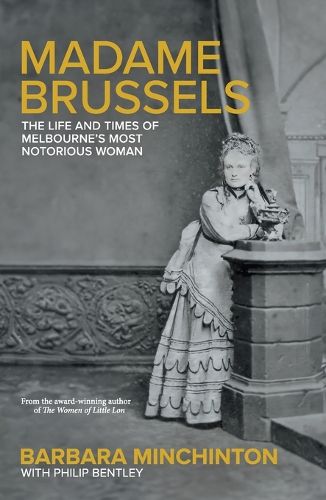
This book is both companion and expansion of Barbara Minchinton’s The Women of Little Lon (my review here) which looked at the sex work industry in nineteenth century Melbourne. Madame Brussels is one of the brothel keepers that Minchin described in the earlier book as part of the ecology and economy of Melbourne’s brothel precinct, but here she deals with Madame Brussels as biography, rather than one name among others.
Madame Brussels is probably the best known of Melbourne’s ‘flash madams’, now immortalized with her own lane and roof-top bar. She was certainly well known in the late 19th century, too, through her political and policing contacts that largely shielded her from prosecution, court appearances and notoriety. Caroline Hodgson nee Lohmar was born in Germany, married in UK and arrived in Melbourne with her husband ‘Stud’ Hodgson in 1871, shortly after her marriage. She rode the exhilaration of the ‘Marvellous Melbourne’ land boom, suffered the 1890s recession, and was increasingly hemmed in by the ever-tightening moral strictures of the early 20th century.
Soon after her arrival in Melbourne her husband left her to work as a policeman ‘up-country’, returning twenty years later in the depth of the 1890s depression in poor health. Left in a strange city as a deserted wife, she opened a boarding house in Lonsdale Street and gradually began accumulating property adjoining her original purchase, later purchasing property in South Melbourne, Middle Park and Beaconsfield Parade in St Kilda. She presided over her brothels, but there is no evidence that she worked as a sex worker herself. Her brothel attracted politicians and magistrates and there were rumours that Alfred Plumpton, then music critic for The Age and composer, was her lover. Although she appeared in court several times, she was always well represented and almost magically the magistrate’s bench filled up with worthy JPs who were not otherwise active in the courts (but may well have been active in her brothel). She remarried after her first husband’s death, but this marriage to fellow-German Jacob Pohl was no more successful than her first, as he soon left her to live in South Africa for several years. After a couple of years’ absence from the brothel scene, she started up again but times and politics had changed.
In the years preceding the turn of the century she became increasingly name-checked by moral reformers, particularly Henry Varley, and became a regular object of scandal in John Norton’s Truth newspaper (which had plenty of the former, and little of the latter, despite the name). In April 1907, after appearing in court charged under new laws with “owing and operating a disorderly house”, she closed her brothel in Lonsdale Street, and died soon after in 1908. Despite an extravagant funeral, she had little to show for the wealth which had passed through her hands.
As might be expected of a notorious entrepreneur, the sources for her life are skewed by real estate transaction documents and court appearances reported breathlessly by the newspapers. There is a genealogical record, although it is patchy: for example, it is not clear whether her ‘adopted’ daughter Irene was actually her own daughter. There are the annual ‘in memoriam’ notices that she placed in the newspapers after her first husband’s death, as was the practice in the early 20th century. But in terms of letters, diaries etc, there is nothing.
In an afterword Phillip Bentley, who is credited as co-author writes:
…we have remained resolute our desire for all conjecture to have a basis in fact and so have resisted the temptation to speculate on how she overcame her early education towards ‘moral earnestness, humility, self-sacrifice and obedience to authority’ in order to become Melbourne’s most famous brothel madam of the nineteenth century (p. 253)
I’m not absolutely convinced that the authors fulfilled this resolution. There are many times that they raise questions which they leave hanging in the absence of evidence, but the questions are raised nonetheless, couched in “may” and “could” statements. The chapter ‘A Curious Gentlemen’s Club’ I found particularly unconvincing, where the question of flagellation is raised, largely on the basis of her first husband’s uncle’s involvement in the ‘Cannibal Club’ and the presence in Melbourne of journalist George Augustus Sala, who was said to have coined the phrase ‘Marvellous Melbourne’ as well as being the anonymous author of flagellation pornography. As the final paragraph of the ten-page chapter says:
In all the records and writings and newspaper reports examined to date there is no suggestion that Caroline’s establishments offered anything other than ordinary common-or-garden variety male-female sex. There are no wild rumours, no snide passing remarks from journalists or parliamentarians under privilege, in fact no hints at all of anything alone the lines of the ‘fladge brothels’ in London. That does not mean it was not happening of course: it means that if it was, we simply can’t see it. (p. 82)
Likewise the chapter where they raise the question of whether her first husband Stud was homosexual raises the question but then admits “There is no way we can know for certain whether Stud was gay” (p.140). I’m not sure that raising questions, identifying parallels and possible networks is sufficiently rigorous, although surely a temptation when writing a life of such notoriety which provided relatively barren and biassed documentary evidence.
This book stands on its own two feet, but I think that I appreciated it more for having previously read The Women of Little Lon, a book which has firmer evidentiary foundations than this one. But I guess that’s part of the challenge of biography: finding the individual person while confronting the dearth of evidence. Even Phillip Bentley admits that perhaps they have not unpacked her personality as much as they would have liked (p. 253), but certainly the authors have succeeded in bringing out the person behind the name now adopted by popular culture with such glee.

 The Resident Judge of Port Phillip