Category Archives: Uncategorized

Movie: ‘Ruin’

On Saturday afternoon (3 December 2016) I caught the final screening of ‘Ruin’ at ACMI.  This Australian film is filmed and set entirely in Cambodia and although described as a ‘romance’, it’s a very bleak one. A volatile, violent young man meets a very young prostitute who has escaped from her pimp who bashes her and threatens to kill her. In a gritty, violent road movie- or more correctly, river movie- and in the midst of brutality and exploitation, they gradually fall in love.  If you watch the trailer, you’ll see that there’s lots of slow-motion shots, lots of water, a nausea-inducing hand-held camera throughout and unsettling, droning music.  I suspect that it’s going to stay with me for far longer than I want it to.

This Week in Port Phillip 1841: 9-16 November 1841

Mr Arden breathes again

You might remember that back in early October, Judge Willis had George Arden, the editor of the Port Phillip Gazette, ‘bound over’ with recognizances of £400 and two lots of sureties of £200 pounds as a form of editorial good behaviour bond to ensure that he stopped printing attacks on Judge Willis in his newspaper.

The three newspaper editors spoke to Governor Gipps about the matter when he was in Melbourne, and on 8 November, now that the ‘excitement’ had subsided and in a spirit of post-Gubnatorial bonhomie, Willis announced that he would annul the recognizances:

My object, which was peace, is accomplished… I will only say, that [the recognizances] they have ever appeared to me inconsistent with the respect due to the office of the Resident Judge, and contrary to that due and equal administration of justice, which the Resident Judge is bound to see observed. I am quite willing, however that they should be buried in oblivion; I merely refer to them that my conduct may in every respect be understood.  I wish to act on all occasions with that candour, which I hope to meet with from others, and which should ever pervade all intercourse in civilized society..[ PPH 9/11/41]

George Arden himself wrote in his own newspaper in an editorial headed ‘The Last Defence of Judge Willis’:

…the feud existing between the Press and the Resident Judge is apparently closed. Mr Justice Willis has placed himself on his last defence and, although his remarks were utterly uncalled for, and certainly unrequired, we have no wish that he should not enjoy the full benefit of his explanation… We do not place that extreme value on enjoying the ultimate position of an argument- which is evidently clung to in the most tenacious manner by Mr Willis- and care not, therefore, if he have, as he desires to have, the last word… We have all, however, our imperfections- none more so than the gentleman who has in this instance been brought into so protracted a struggle with the power of a Judge and the talent of a Willis… [PPG 10/11/41]

So, all’s well that ends well.  For now.

The Commissioners for the Melbourne Market

The elections over, the new Commissioners for the Melbourne Market met to discuss future prospects for the market.  At the time there was only one general market (later known as the Western Market), taking up the city block bounded by Market, Collins and William Streets and Flinders Lane. It would remain there for ninety years. There was an informal arrangement that cattleyards close to Flagstaff Hill could be used as a temporary cattle market and La Trobe agreed that a site for a permanent cattle market should be selected on the Sydney Road, in a line with Elizabeth Street.  Land was set aside on the present site of St Paul’s Cathedral for a Hay and Corn Market, but this later shifted to a site  known as ‘Haymarket’ on the corner of Exhibition (then Stephen Street) and Little Collins Street on 1 August 1846. This expanded to a larger market known as the Eastern Market on the block bounded by Exhibition (Stephen), Little Collins and Bourke Street.

In the short term, it was decided to fence in the Market Reserve at the Market/Collins/William/Flinders Lane site  (i.e. the Western Market) and to divide it into two or more compartments and allow stands to be erected. Rules for the market were promulgated. The market would open by the ringing of a bell at 7.00 a.m. from 1 September- 28 (or 29th in leap year) February, and an hour later at 8.00 a.m. from 1 March- 31 August.  The market would close at sunset, but articles for sale on the Wednesday and Saturday market days could be admitted at any hours of the night before.  The north-east portion of the market would be set aside for the sale of apparel, hardware, crockery and groceries; the south-east portion would house butchers and dairy foods, eggs and fish.  Potatoes would be sold at the north west corner, and in the south west corner would be fruit, vegetables and garden produce.

The second municipal body in Port Phillip

As a proud Heidelbergian, I wish I could brag that the Heidelberg Road Trust was the oldest municipal body in the Port Phillip District.  Unfortunately it’s not true.  But it does run a close second, with the election of the Trustees on 16 November taking place just fourteen days after the election of the Market Commissioners on 2 November.  As Max Lay writes in the e-melbourne encyclopedia:

The road to Heidelberg was Melbourne’s first major road. It originally began at the top of Bourke Street, tracked across to Smith Street, followed the top of the Collingwood escarpment and then (as Plenty Road and later Great Heidelberg Road) followed the current routes of Queen’s Parade, Heidelberg Road, Upper Heidelberg Road and Lower Plenty Road. The route was well established by 1839, surveyed through to Eltham by Townsend in 1840 and opened in 1841.

On 17th November, the Port Phillip Gazette reported:

HEIDELBERG ROAD In pursuance of an advertisement from the Police Magistrate, convening a meeting of the proprietors along the line of the Plenty Road, for the purpose of electing trustees for the same, a meeting was held at the Exchange Rooms yesterday at two p.m. W Verner, Esq. JP presiding magistrate.  The following gentlemen were duly elected trustees in conformity with the Act of Council:- T. Wills Esq, W. Verner Esq, G Porter Esq. We believe this to be the first and only instance of the Act of Council having been brought into operation, with reference to the construction of  parish roads.

‘The Tasmanians’ or ‘Van Diemen’s Land Blacks’

Over the last few weeks, news had been percolating into Melbourne about an “outrage” at the Coal Mining Company’s station at Cape Paterson where two of the “Van Diemen’s Land aborigines”  named Bob and Jack, brought over by the Chief Inspector George Augustus Robinson, had burnt settlers’ huts and turned out the women (PPH 15/10/41).  This was one of the first newspaper references to the small group of Tasmanian indigenous people that Kate Auty and Lynette Russell have called ‘The Tasmanians’ in their recent book Hunt Them, Hang Them, instead of the term ‘Van Diemen’s Land Blacks’ which was more current at the time. ‘Bob’ and ‘Jack’ were Tunnerminnerwait and Maulboyheener, of whom I have written previously.

On 11 November, the Port Phillip Patriot reported:

THE BLACKS. Mr Powlett, the Commissioner of Crown Lands, returned to town on Friday evening last, after having been unsuccessful in the attempt to capture Mr Robinson’s Van Diemen’s Land blacks, who have recently been committing serious depredations in the neighbourhood of Western Port.  On one occasion Mr Powlett and his party had the ruffians actually in view, but the intervention of a low swampy scrub between the pursuers and pursued, enabled the blacks to make their escape.  Mr Powlett has again resumed the search, and there is every reason to believe many days will not elapse ere the marauders will be captured or destroyed [PPP 11/11/41]

The Port Phillip Herald gave a fuller description:

THE VAN DIEMENS LAND BLACKS. Mr Powlett, the Commissioner,  returned to town on Friday evening, unsuccessful in his endeavours to take the blacks.  It appears, however, that they have had a narrow escape from capture: after tracking for two days, Mr Powlett, at the head of a strong detachment of police and natives,  got sight of the parties late in the evening of a wet day,  at the edge of a low swampy scrub; every possible exertion was made to come up with them, but ineffectually, owing to the nature of the ground, in which the horses sank to their knees, and the thick scrub into which they escaped; in the pursuit, it seems they must have separated for their whistling was heard by the police while searching the scrub, making signals to one and other; their escape was greatly owing to the late hour of the evening at which they were seen. Finding themselves so hard pushed, the natives have seized a whale boat of Mr Anderson, and put to sea: information has, however been received by Mr. Powlett since his arrival in town, that they have returned to the main land, and he started for the scene of action yesterday; the police and natives had been left in the vicinity of the place where the outrages have been committed.  It now appears certain that this party, which consists of two  men and three women have committed two murders, wounded one  man dangerously and three  slightly; their capture, however, Mr Powlett expects will be effected in the course of the ensuing week, as the police are determined to run them down. [PPH 9/11/41]

The Port Phillip Gazette was particularly critical that the aborigines had been ‘imported’ from Van Diemen’s Land by George Augustus Robinson:

THE NATIVES. The outrages which have of late been committed in the neighbourhood of Western Port by a party of aborigines, are incontestably traced to have been perpetuated by a gang of imported blacks. As if it were not sufficient for our settlers to be harassed by some of the turbulent tribes of their own shores, they have now to guard themselves against the experienced and semi-educated savages of a neighbouring colony, who were expelled from their native haunts in consequence of their atrocities. If this is to be the sole benefit of a Protector General being appointed, to travel with his predatory tribes wheresoever he may list, the sooner the Government grant promotion to that officer the better for this province.  A Protector “Field Marshal” might perhaps cause the whole of this band to decamp northward [PPG 10/11/41]

This isn’t the end of this story either- we’ll be following this one through

But here IS the end of a good story (narratively speaking)

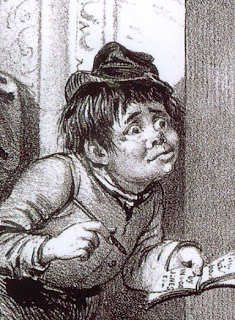
I generally endeavour to write about things that DID happen in Port Phillip, but I just can’t resist this event that didn’t happen. During the 1840s ‘the boy Jones’ was so notorious throughout the Empire  that it wasn’t even necessary for a newspaper article to name him- just ‘the boy Jones’ was enough.
boyjones1

Edmund (Edward) Jones was a recurrent intruder into Buckingham Palace between 1838 and 1841.  His first incursion was in 1838 when, at the age of about 14, he entered the place disguised as a chimney sweep. After a chase he was captured with Queen Victoria’s underwear stuffed down his trousers. He was acquitted by a jury but on 30 November 1840, nine days after the birth of Queen Victoria’s first child, he was back, entering and leaving the palace undetected.  The next day he broke in again and was arrested after being discovered under a sofa.  He was sentenced to three months in prison. He was released on 2 March 1841 and within a fortnight was back in the royal apartments yet again.  This time he was sentenced to 3 months hard labour.

Which brings up to the middle of 1841.  And adding about three months for a journey from England to Port Phillip…could he have arrived HERE? Well, the Port Phillip Patriot thought so when it announced the arrival of the Boy Jones as an immigrant by the Diamond on 4 November:

the Government having availed themselves of this plan to rid themselves effectually of the presence of a youth whom no precaution they could take sufficed to exclude from the presence of royalty, and from whom danger to the person of our most gracious Sovereign was with some reason apprehended. Jones was offered a handsome salary to exhibit temporarily on the boards of some theatre some time before his departure from London, but his father very wisely objected to the engagement unless the agreement were more permanent.  We have not heard how Master Jones is to dispose of his services in the colony, but as we have no Queen here, nor anyone who may not be approached without difficulty, we apprehend his peculiar talent for undertakings of this nature will avail him very little [PPP 11/11/41]

Alas [?] it wasn’t true, the the Port Phillip Patriot itself admitted a few weeks later when later editions of the London papers arrived (PPP 29/11/41 p.2)  Although Jones did end up in Victoria eventually, dying in Bairnsdale in 1893 when he fell from a bridge, drunk. However, the prospect of young Jones coming out on the Diamond was rumoured in England as well.  As the Sydney Herald reported on 18 November 1841, the Times published the following article:

The boy Edward Jones, who, it will be remembered, has on three different occasions effected a mysterious entrance into Buckingham Palace (and, according to his own account, a fourth, but on which occasion he escaped without detection), was on the 14th of last month liberated from Tothill-street gaol; his period of imprisonment having expired.  While in prison he was quiet and orderly, and even exemplary in his conduct, so much so, that the governor had not in any one instance cause of complaint.

Since the liberation of this youth, who has gained so much notoriety, he has been frequently seen on Constitution-hill, and in the immediate neighbourhood of Buckingham Palace, which being communicated to the authorities, orders were given to the police to watch his movements, which was accordingly done; but there was nothing in his manner or behaviour different from those who daily frequent the parks in hopes of gaining a sight of royalty.  Still it appears he was deemed a dangerous character, and meditated another entrance into the palace.  Without, therefore, going into details and rumours of suspicion, we may state that Edward Jones the uninvited visitor Queen Victoria, has been taken quietly in hand by the proper authorities, and placed on board the Diamond emigration ship, bound to Australia, or some other of the English colonies, being apprenticed as a seaman for five years. His father thinks it is only for three years, that he is going to Port William, and will in a twelvemonth return, when he will receive wages, and be allowed to remain at home with his friends for a short time.  He (the boy’s father) also thinks that his son left London for Gravesend on Friday last, but it is stated by others that, although the Diamond sailed from Gravesend on Friday, Jones, accompanied by an officer of the Thames Police, only left London by railway on Monday last, and that orders were given to those in whose charge he was, not to lose sight of him until he was place on board the Diamond in the harbour of Cork. On the day Jones left the prison, one of the agents or manager of a minor theatre (his father says) called and offered him £4 per week to appear on the stage for a fortnight and, at the end of that time a “benefit”, but the boy declined exhibiting himself for so short a period. Jones complains of the mode in which he was treated in Tothill-street prison, and attributes it entirely to the orders of the Government.

The Port Phillip Patriot backtracked from its claim on 20 December 1841, when it cited the Waterford Mail which had recently arrived via the Agostina:

The boy Jones of Palace-visiting notoriety would not be taken on board the Diamond at Cork for Port Phillip.  The master, Captain Taylor refused a handsome sum as an apprentice fee, which the Bow-street officer who accompanied him here offered. [PPP 20/12/41]

[There’s a book about The Boy Jones- Jan Bondeson. Queen Victoria’s Stalker: The Strange Story of the Boy Jones. Amberley, 2010.  There’s also a How Stuff Works podcast here and here (24/8/16) that seems to be based on the information in the book if you can stand the flippant presentation and the advertisements]

And the weather?

Fresh and strong breezes generally, fine agreeable weather. Top temperature for the week 78 (25.5C) and lowest 43 (6.1C)


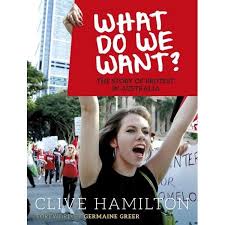
‘What Do We Want?’ by Clive Hamilton

hamilton

2016,  190 p & notes.

I quite often attend demonstrations. Climate change, the war in Iraq, anti-Kennett, Hiroshima commemoration, refugees – I’m there.

It’s often struck me as I gaze around at the people, many of whom are my baby-boomer age and at the police who generally just look bored, that demonstrating in Melbourne CBD in the 2000s is a fairly cost-free enterprise for me. I’m reassured that I won’t be arrested (a middle-aged woman isn’t much of a threat) and I’m certain that I won’t be killed. I am very much aware that there are other places in the world where this isn’t the case, and I suspect that although I’m happy to let the whole world see my principles and causes here in safe Melbourne, I’d suppress or maybe even jettison them in a more dangerous environment.  But as Clive Hamilton shows us in this book, protest in Australia has not always been as cost-free as it is now. Continue reading

Movie: High Rise

When, within the first ten minutes or so of the movie starting I saw a head sawed in half vertically and the skin peeled off, THEN I remembered that this was a J. G. Ballard story. I do not like J. G. Ballard stories (except perhaps for Empire of the Sun).  This was a dystopian, violent nightmare of a movie that I didn’t understand one little bit.

All those four and five star ratings! No, this was too bleak and ugly for this little old lady. I certainly wouldn’t recommend it.


This Week in Port Phillip 1841: November 1-8 1841

Election time!

The excitement just keeps coming: last week the visit of Governor Gipps and now, this week, the first election in Port Phillip. An election – not for the Legislative Council (that wouldn’t happen until 1843) or for the Melbourne Town Corporation (which wouldn’t happen until late 1842)-  but instead for the Melbourne Market Commissioners.

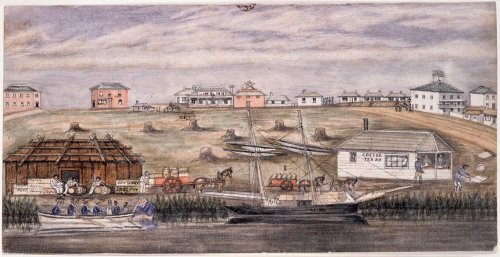
A reserve for a market had been set aside on the original grid survey, close to the wharf and bounded by  Market, Collins and William streets and Flinders Lane. Liardet’s picture of the market space, show below and painted from memory some forty years later, is striking in its depiction of the stumps of felled trees in the large square space that was used for the market.

the-landing-place-and-market-reserve-in-1839

The Landing Place and Market Reserve in 1839 by W.F.E. Liardet (1878) State Library of Victoria

In October 1839 the NSW Legislative Council passed an act (3 Vic No. 19) permitting the establishment of markets in towns other than Sydney and Parramatta, where there had been markets for some time. By 1840, with its population and trade steadily increasing, the good people of Melbourne wanted a market too. In August 1841  after the stipulated request from householders, the NSW government authorized the election of market commissioners  by public election.

Under the act, the number of commissioners was fixed to the size of the population. If the population was more than 4000 (which Melbourne was), then at least 3 wards would be created with two commissioners each. As a result Melbourne was divided nearly into four wards with the dividing lines being Bourke and Elizabeth Streets, a division which was maintained through most of the 19th century. The franchise was low – an annual rental of £20 or freeholders to the value of £200 – for males only, of course. Bernard Barrett in The Civic Frontier (p 23) estimates that of a total population of about 9000, about 3000 qualified under the property franchise. [You’ll note that Barrett’s number of 9000 was much higher than the numbers reported in the 1841 census. In fact, it’s hard to pin down exactly what the population of Melbourne was. The Geelong Advertiser of 17 July reported a total of 11,728 for the Port Phillip District and 4479 in Melbourne. I’m sure that this election would only have covered Melbourne. Quite frankly, I don’t know.]

In the week or so leading up to the vote, advertisements were placed in the newspapers, requesting a particular candidate to stand. By 2 November, the candidates were:

North West Ward: Messrs F McCrae and Stephen

South West Ward: Messrs Arden, Kerr, Fawkner and Nodin

North East Messrs Simpson, Barry, Dobson and Cavenagh

South West Messrs Porter, Pears and Locks.

The newspaper editors and proprietors are well represented here (Arden, Kerr, Fawkner all in the SouthWest ward, and Cavenagh).  Under the Act, the arrangements for voting were:

Section 18: That every person being qualified and registered as aforesaid and intending to vote at such election shall deliver to the presiding officer a ticket with the names of the persons written thereon for whom he intends to vote, the number of such persons not being greater than the number of persons to be elected, otherwise the said vote to be null and void, and the said ticket so signed by the person presenting it after being read aloud by the presiding officer shall be forthwith deposited in a box, and shall not be withdrawn therefrom until the same shall be delivered to the scrutineers.

Section 14 At the hour of three o’clock on the day of election the box shall be delivered to the scrutineers who shall within forty-eight hours afterwards certify in writing to the police magistrate the names of the persons elected.  [PPG 23/10/41]

As was the custom at the time, this was an open election where after a voter filled in the ballot and his selections read aloud. This was seen to be a public check on the process, as the voter could challenge it immediately if the wrong names were announced and any attempts to ‘steal’ the election could be publicly challenged.

And so, as the Port Phillip Patriot ( the paper with connections to William Kerr and John Fawkner) recorded:

THE ELECTION. Tuesday, the 2nd November, being the day appointed for the election of the Commissioners of the Melbourne Market, at an early hour Thomas Wills Esq. JP, the gentleman appointed by His Excellency to preside at the election, accompanied by Skene Craig Esq, one of the scrutineers, took his seat on the bench at the police office, which Major St John had kindly vacated for the day.  The several candidates who had been put in nomination were also invited to take their seats on the bench.

The number of voters who had registered their qualification was very small as compared with the number whose names should have been on the list, but indeed, it was obvious that up to the last moment (notwithstanding that the press had been laboring to attract public attention to the subject,) the great bulk of the people were not aware whether they were entitled to vote, or even of the Ward in which they were respectively resident.  Generally speaking there was the usual listless apathy displayed which is characteristic of the people in these money-making colonies, but Mr Fawkner and his supporters formed an exception to the rule, the candidate himself being decorated with a blue sash, and his voters distinguished by breast knots of blue ribbon.  Indeed, in Mr Fawkner’s case, the customary festivities of an English election were in some degree observed, open house being kept in the William Tell for all such electors as displayed “the ribbons o’blue” and the walls being placarded in all directions with “Vote for Fawkner and Economy”.  [PPP 4/11/41]

The Port Phillip Gazette (with connections to George Arden) wrote in a similar vein:

As early as possible in the day, Mr Wills JP, appointed by the Governor to act as president on the occasion, took his seat on the Bench, accompanied by Mr Skene Craig, one of the scrutineers; they were joined at a subsequent period of the morning by Mr J. B. Were and Captain Cole.  Among the candidates were also present: Mr W Kerr, Mr J Stephen, Mr J Peers, Mr G Arden and Mr J. P. Fawkner.  As soon as the doors of the Court were thrown open, the electors who had incurred their rights of voting by previous registration, came up in considerable numbers to present their tickets in the prescribed form. Although great good feeling and order was preserved, there was an absence of spirit and a lack of promptness, which resulted probably from the novelty of the power vested in their hands by free citizens. Some little display of blue ribbons, and what we deprecate as being less harmless, some approach to hilarious excess was visible among the electors …The polling was quickest  between the hours of eleven and twelve, flagging after that period, until the close of the proceedings which took place at three o’clock.[PPG 3/11/41]

As was the Port Phillip Gazette’s wont, it had great fun at the Patriot’s expense through a Bob Short anecdote. This article, featuring an ignorant  ‘Bob Short’ (a thinly disguised John Fawkner) and his friends, was an ongoing joke that ran through the Gazette’s pages, playing no doubt on the pre-decimal currency idiom of ‘a few bob short of a pound’ to suggest dim-wittedness.  Is this the start of the traditional Australian sausage sizzle at the election booth?

“HERE’S YER BOB SHORT SAUSAGES!” Such was the shout which startled the electors upon “the first dawn of civic freedom” on Tuesday last. Anxious to obtain a view of the mouthpiece, we elbowed our way through the crowd and observed a man who is professionally known as the “Flying Pieman” covered from heel to truck with blue ribbons, while upon his arm hung a basket, containing about twenty pounds weight of the spicey [sic] article denominated “Bob Short Sausages” and which some of the supporters of that worthy were purchasing and masticating with much apparent gout; while others screwed their faces into divers contortions as morsel after morsel found its way down their throats, and swallowed more in honour of their champion than from any particular relish, or press of appetite.  The articles certainly looked very suspicious; but whether manufactured of the canine or feline race, were admirable representations of that choice Melbourne Commissioner “Bob Short”. [PPG 6/11/41]

Despite this being the first chance for Melbourne householders to flex their electoral muscles, few bothered to vote.  Only 328, or about 10% of eligible householders according to Barrett’s figures, bothered to enrol.

As the Port Phillip Gazette editorialized on 6 November:

…we cannot refrain from remarking on and lamenting the unnatural apathy which has marked the conduct of the residents in carrying out an affair of the first municipal consequence…The qualification for a vote was so low ( £20 rental)  as to render it virtually universal in its operation. Every householder, from the lowest to the highest, had the opportunity of exercising a privilege which, as it was the earliest occasion of its introduction into the colony of New South Wales, should have been claimed with avidity worthy of its character, and in accordance with the enterprise of the people of Port Phillip. [PPG 6/11/41]

The successful candidates were North-west ward: Farquahar McCrae, John Stephen (no election needed as there were only two candidates); South-west ward: George Arden, John P. Fawkner; North-east Ward, James Simpson, William Dobson; and South-east ward: George Porter, John Jones Peers.

The Port Phillip Herald reported that: “The scrutineers have thought it best not to make known the number of votes for each candidate, the tickets and numbers have therefore been sealed up to prevent disclosure” [PPH 5/11/41].  However, the Port Phillip Patriot did give the figures for the south-west ward (where Fawkner, the paper’s proprietor won): Fawkner 62  Arden 47  Kerr 26  Nodin 21.  Twenty four had neglected to vote; and several votes were in dispute.[PPP 4/11/41]

Guy Fawkes Night

Readers of a certain age in Melbourne will remember Guy Fawkes night, building bonfires and setting off crackers.  Although still celebrated in England, it’s largely forgotten in Melbourne now.  It was, however, celebrated in Port Phillip:

GUY FAUX “Pray remember the 5th of November” &c. In humble imitation of the mother country, the rising generation of the province carried out the usual ceremonies and proceedings which obtain in the vicinity of the [?source?] of its origin, and Mr Guido Faux was effigied throughout all parts of the town, and in the evening was consumed at sundry bonfires amidst various specimens of the pyrotechnic art[PPG 6/11/41]

Pony up!

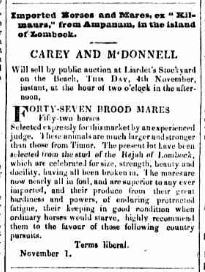
There was an influx of Timor ponies into Port Phillip in early November, and they were sold at auction on 4th November.

ponies

The Port Phillip Patriot reported:

HORSES “The Lombock horses for spirit and powers of endurance resemble those of Timor, but they are in addition much larger and stronger. The present lot have been selected by an experienced judge from the stud of the Rajah of Lombock, and their sale will doubtless attract a numerous concourse of the admirers of “blood, bone and beauty”.

On 8th November, the Patriot reported that the majority of them  sold at prices varying from £13 to £22 each. A second consignment of 112 ponies landed on  The Georgiana,  from Copang, in the Island of Timor. This later group, reported to be in “a very reduced condition” sold for between £8 and £15, while the remaining Lombock horses sold at average price of £14 per head. [PPP 11 November]

A song for November

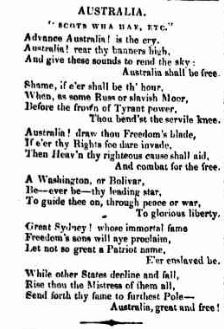
The Port Phillip Patriot was characterized as the most radical of the three Port Phillip newspapers. I was surprised by this poem published on 4th November which, while extolling the freedom and liberty of Australia, praised the champions of independence Washington and Bolivar as leading stars. Not sure that Her Majesty would be too amused…

scotswa

It’s to be sung to the tune ‘Scot Wha Hay’. So, here’s the tune- feel free to sing along!


And the weather?

Fresh breezes and strong winds; weather generally cloudy with frequent rain, but in inconsiderable quantities. The top temperature for the week was  a balmy 79 (26) with a low of 44 (6.6)  The coldest day for November was recorded on 7th.

Reference:

Bernard Barrett The Civic Frontier, 1979, Melbourne University Press, Melbourne.


1916 at the Brunswick Mechanics Institute

Given my track record of writing about events after they’ve closed, I probably won’t write about this until after it’s finished. So, in case you haven’t heard about it and you might wish that you had, I’m going to see ‘1916’ at the Brunswick Mechanics Institute tomorrow tonight

1916

from the Metanoiatheatre website:

1916

October 25November 5

Anti-Conscription Brunswick Chapter

1916 is about the first No Case for conscription that took place in 1916. The play is set three months prior to the vote, in Brunswick, starring two characters who are feminists and peace movement activists Adele Pankhurst and Vida Goldstein. 1916 will include the rollicking music of the era.   

Written by | Neil Cole

Produced by| Brunswick-Coburg Anti-Conscription Commemoration Campaign

Directed by | Natasha Broadstock

Starring | Harlene Hercules and Marissa Bennett

Tues – Sat 8pm | Sun 2pm

$30

Movie: The Arbor

Don’t read this posting. Go straight to iview instead and watch this movie/documentary before 1.58 a.m. on November 3, 2016 while it’s still available. It’s one of the most powerful pieces of cinema that I’ve seen in years.

I hadn’t heard of Andrea Dunbar. She was a young British writer who followed the adage ‘write what you know’. What she knew was the wasteland of a Bradford housing estate in Thatcher’s Britain of the 1980s, where the eponymous Brafferton Arbor was a bleak patch of blighted grass, surrounded by terraced public housing with boarded windows.  Her first play was performed at the Royal Court Theatre in London when she was a 20 year old single mother, and her follow-up  Rita Sue and Bob Too was developed as a film in 1987.  She was dead by 1990 at the age of 29, leaving three children by three different fathers.

This film is based on interviews with the family, most particularly her two daughters, conducted by the filmmaker Clio Barnard. The oral interviews have been lip-synced by actors.  I only learned this later, and spent most of the movie, transfixed, wondering whether I was watching a movie or a documentary.  It was only when I recognized the actor who plays Inspector Barnaby in the new Midsomer Murders, and marvelling at his accent, that I realized that it wasn’t a documentary. It is interspersed with documentary footage from the 1980s of Andrea Dunbar, and a performance in 2010 of her play ‘The Arbor’ on the estate itself, watched by the current residents.  I was amused that this extract from the film had subtitles: I found myself craving them on several occasions:

It is a very dark film about intergenerational poverty and harm. Her two daughters have diametrically opposed views of their mother, and it’s so easy to judge.  Absolutely brilliant.

Movie: Love & Friendship

Well, this is all a bit confusing! The young Jane Austen did write a novella called Love and Freindship [sic] reviewed here by Whispering Gums (who is an insightful guide to all things Austen) but this film by Whit Stillman is actually a rendering of another Austen novel completely, Lady Susan, also reviewed by Whispering Gums.  I suspect that Stillman was riffing off the other double-barrelled Austen titles (Pride and Prejudice; Sense and Sensibility) and perhaps he thought that nobody would notice.

Kate Beckinsale is absolutely luminous in this film as Lady Susan Vernon, the rather merry widow who has been cast onto her own resources to find financial security for her rather wet daughter and herself. She is quick witted, acerbic and ambitious and uses her skills and beauty artfully.  It’s a rather arch and knowing romp and thoroughly good fun, without being in the least ponderous.

Of course, the historian in me never quite goes away, and I found myself drawing links between the film and the financial dilemma of the female without means that I saw lived out through the life of the real-life Judge Willis’ sister Jane (known to the family as Jenny). I strongly suspect that she did not have the beauty, and she showed little evidence of the wiles of Lady Susan. Nonetheless, as with Austen’s other works, it’s an interesting commentary on early 1800s social and gender relations offered up to the historian’s eyes almost unwittingly.

I enjoyed this review of the movie:

http://www.newyorker.com/culture/richard-brody/whit-stillmans-love-friendship-subverting-the-social-order-with-style

This Week in Port Phillip 1841: 26-30 September

Census results

Given that in September 2016 we’ve had the census uppermost in our thoughts, you might be interested in the results of the 1841 census. Mind you, the Port Phillip Gazette scoffed at the figures recorded for Melbourne, boldly declaring that:

If [the figures] are all as incorrect as Melbourne, this document is sheer humbug [PPG 29/9/41 p.3]

LOCATION MALE INHABITANTS FEMALE INHABITANTS GENERAL TOTALS NUMBER OF HOUSES
Melbourne 2676 1803  4479 769
Geelong  304  150   454  70
Total Melb & Geelong  4933 839
Rest of NSW 48,584 4052

What would they say on ‘Gruen’?

‘Gruen’ is a weekly ABC program that dissects advertising and marketing, and the angles and techniques used to persuade consumers.  I wonder what they’d think of these advertisements?

The first, for the grocery store Albion House, places itself as on the side of the embattled settler while at the same time trying to entice him into buying:

ALBION HOUSE. AN ESSENTIAL PUBLIC GOOD. The depressed state of the times, the stagnant state of commerce, the scarcity of cash, the great reduction in wages, the number of persons thrown upon our shores sixteen thousand miles from their friends and native homes, having no employment and but little cash in their possession, have long cried aloud for a reduction in the high prices of the necessaries of life; indeed it is whispered in the cottage, it is muttered in the cheerless unfurnished cot, “Give us cheaper food; let us have a reduction in the prices of the measures of life, or we starve!” Their demands are satisfied, their cries are heard, and they have now an opportunity of procuring not only the necessaries of life, but also many little comforts that have existed only in desire without the means of procuring them, because of the highness of prices.  C. S. BARRETT & CO having recently taken those extensive premises lately occupied by Mr Empson, draper, Collins-street, which they have opened with a very large stock of grocery, tea and provisions of every description, direct from England; and, that the public may not be deceived, they have named in The Albion House, where the above named articles may be purchased at prices astonishingly below anything as yet submitted to the inhabitants of Melbourne. [PP Gazette 29/9/16 p.1]

Or how about this advertisement for a laundry service? Mangling…a ‘beautiful science’ no less!

IMPORTANT TO FAMILIES. W. Herbert begs to acquaint the inhabitants of Melbourne and the surrounding district that he has opened those premises lately occupied by Mr Melbourne, Hairdresser, Little Flinders-street and invites the attention of the public to the circumstance that he, with Mrs H and female servants, intend Washing, Mangling &c for those families who will honour him with their patronage; and having brought a Patent Mangle with him, will be able to accomplish this beautiful science in first-rate style.  W. H. is aware of the scarcity of money, and therefore will work for the lowest figure; but he must have cash, as nothing else will keep the Mangle going: a man has been engaged for the express purpose of keeping it in constant motion; and as steady women are engaged for the washing department, W. H trusts he will have a share of patronage for so novel a business or profession.  The prices will be as follows:

Washing and Ironing per doz….4/6

Mangling per ditto…………….0/6

Mrs Herbert has female servants that may be hired by the hour or day to wash and clean as charwomen.  [PPG 29/9/16 p.2]

A new variation on the ‘dogs-as-nuisance’ theme

dogs

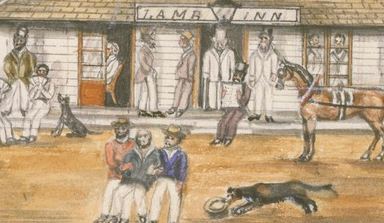
Detail from Liardet’s picture of the Lamb Inn, Collin’s street. Note the dogs.  Source: SLV

The Port Phillip newspapers have had plenty to say in their columns about the nuisance posed to the inhabitants of Melbourne by stray dogs. But even the attempts to curb the numbers of dogs by offering a bounty seems to have backfired:

PUBLIC NUISANCE.  We have to call the attention of [Police Magistrate] Major St John to the disgraceful conduct of the constables in leaving the carcasses of the dogs they have killed for the sake of their tails, putrefying on the sides of the street.  We would suggest that in order to abate the evil, the reward given for the tails of unregistered dogs shall not be issued in any case, unless the claimant can show that the carcasses of the animals have been disposed of in such a manner as to prevent the possibility of their becoming a public nuisance. [Port Phillip Patriot 30/9/41 p.2]

Family Jars

The Police Intelligence columns are the gift that keeps on giving. Obviously the whole family, including the women, got into this one:

FAMILY JARS. Peter Connell was charged with cracking the head of Stephen Moore with a ginger beer bottle. From what could be gathered from the statement of Connoll, whose head was bound in a Turkey red handkerchief, it appeared that on Saturday, about half-past one o’clock, he was requested by Moore, who is a neighbour, to remove a water cask then reclining against a fence near his door.This being complied with, Connell’s servant pulled down some of the fencing, and made a thoroughfare through the premises; to this he objected whereupon Mrs C. came out and emphatically laid down the law on the case; this was rebutted by Mrs M., who declared that a free passage and female rights were her motto, and on that she would stand. Connell and Moore then came upon the ground, and issue was quickly joined, and scuffling, thrashing and the cracking with the ginger beer bottle followed.[(PP Gazette 29/9/41 p3]

 The ‘Scrutator’ letter

On 29 September George Arden, the young editor of the Port Phillip Gazette published a letter which criticized Judge Willis , supposedly penned by ‘Scrutator’.  After starting with a complaint about Judge Willis’s ban on raffles, the letter moved onto a wide-ranging attack on Willis’ fitness as a judge. The authorship of the letter was never questioned but Arden’s role as editor in publishing it certainly was, suggesting that Arden himself probably wrote the letter (as did most of the other editors when wanting to stir the pot a bit). In fact, as we’ll see as time goes on, Willis’ heavy-handed response to press criticism was to be one of the loudest complaints against him, both by Melbourne inhabitants and eventually, by the government as well.  So, because this letter was so important for Judge Willis’ career and for the public debate for the next six months or so, I’ll transcribe it in full (but I give you permission to skip reading it and just jump down to my comments below!):

TO THE EDITOR OF THE GAZETTE: SIR- In consequence of some sensible remarks which appeared in your last paper, as to the impropriety of Judge Willis directing the Crown Prosecutor to take steps to prevent raffles, I beg to direct your attention to a habit of His Honor’s which is not only unbecoming in a Judge, but which has done much injury, and the baneful consequences of which will extend more widely over the colony, unless at once stopped by the interposition of an independent press: I allude to His Honor’s practice of giving his opinion and directing the proceedings, not only in matters collateral, but even in those totally unconnected, with the question he is called upon to decide.  To one who has attended the English courts of justice, and observed the scrupulous caution with which the judges therein refrain from allusions to all portions of a case except that immediately at issue, and even then declining to make any remarks upon- not to say decide- any point to which their attention has not been directed by full an deliberate discussion, Judge Willis’s conduct is in most startling contrast.  No opportunity escapes him for scattering his dicts, for stating what he conceives to be the law and merits of every subject, no matter how extraneous to that under consideration, if it happens to strike his fertile fancy.  Who has not censured the un-called for stigmas he carelessly heaps on the conduct and character of Magistrates, Barristers, Attorneys, Witnesses, Suitors, or any one whose name may have been unfortunately mentioned in his court? the praise he never awards, except to those who flatter and cringe to him, is nearly as disgusting as the unmeasured censure he so copiously visits on the other wretched individuals who are dragged beneath the outpourings of his bilious temperament; and should he ever find a dearth of legitimate victims, Simpsons, Carringtons, Editors &c with what a master hand, supported by what ancient authorities, will he summon from the peaceful repose of a newspaper advertisement a Cunningham or a McNall, …entire horses, donkeys, raffles, and gambling. But, Sir, what is equally to be lamented, though not so generally known, is his practice of advising upon titles to land, the validity of grants from the crown- stating that deeds are inoperative, conditions not being complied with- that the land fund having been applied to immigration, and not to the consolidated fund, all the Governor’s conveyances are illegal, and even if they were not, lands sold before the Governor has dated his grant can never pass the property to the purchased; in fact, whether in or out of court, the sole result of his unfortunate temper and his distorted judgment is raising disputes and fomenting instead of suppressing litigation. Is this a fit or proper person to fill the highest judicial chair in the province? Judge he is not, nor ever will be, being in every case so much a creature of deluding impulse.  To those who are so connected with him as to be obliged to bear the burthen of his acquaintance, the endless disparaging terms in which he speaks of his late brother Judges, the gentlemen of the bar, and all with whom he came in contact in Sydney; the egotism and vanity which actuate his very look and expression, have demonstrated that the fountain of his acts is drawn not from the pure sources of liberal learning and enlightened knowledge, but the sterile rock of ignorance and self conceit; coupling these with his penurious miserly habits (for never was he, whom from his position and salary should be an example of liberality, known to see a friend within his poverty-stricken doors) is he, I would ask a proper person to have been sent to a young colony as its Judge? Yet, Sir, Some hope remains that this paralyzing member of an otherwise healthy community may ere long be removed, under the [indistinct] fearless catchcry of an independent press. I have the honour to be Sir &c &c &c. SCRUTATOR. [PPG 29/9/41 P.3

In transcribing this letter,I’m struck anew by how barbed it is, even for the time. Even though the three Port Phillip newspapers were published legitimately and regularly, they were a mixture between, using the example of 20th century Melbourne, the Herald Sun and Truth magazine, or to bring us into the 21st century, very similar to the internet’s mixture of hard news and utter scurrility.  Judges were criticized in the press (it seems to me, more than today but I’m not sure) but then, as now, it would have been a dangerous undertaking, particularly in a district that had only one judge.

Looking at the letter, ‘Scrutator’ starts off by criticizing Willis for making extraneous commentary from the bench, asserting that the judges in England did not do so.  That’s not true: the judge’s speech at the opening of term was a time-honoured occasion for moral commentary, usually about the evils of alcohol and godlessness (but gambling could conceivably fit under such a tirade). That said, Willis used the opportunity to make such commentary excessively. ‘Scrutator’ then makes criticisms that were to be echoed two years later when the whole Willis thing blew up. Willis’ attacks on magistrates, barristers and individuals like Simpson and Carrington were all listed as reasons for his dismissal and ended up being aired in the Judicial Committee of the Privy Council in Whitehall.  Even Houndsfoot the stallion and Montezuma the donkey get a look in!

More pointed, though, is ‘Scrutator’s’ report of Willis’ private conversation, and here we get into murky territory.  Arden was most certainly not part of Willis’ social or conversational circle- so who was telling him all this?  And the content of this reported conversation at a time when the property bubble was just about to pop was incendiary, then as a final kick to the shins was a dig about Willis’ dearth of friends and lack of gentlemanly sociability.

How’s the weather?

This week the weather was more settled, with light winds generally and bright and clear after 24th September.  The 28th and 29th were the warmest days of the month, with a top temperature for September of 76F (24.4 C) and a low for the week of 45 (7.2C)


This Week in Port Phillip 1841: 9-16 September 1841

Once the worst of winter had been left behind, thoughts turned to CRICKET! Of course, there was no VFL footy to fill in September, so let the cricket season begin!

The season has now set in for cricket playing, and we are right glad to see that the Melbournites are bestirring themselves to carry on the game with something like spirit.  The tradesmen, we learn, are about forming a cricket club; and we learn, also, that the members of the Melbourne and Port Phillip Clubs are about establishing another. This is as it should be: the two clubs will, we hope, have several matches during the season and may the best men win, say we.  We would strongly recommend these clubs to the attention of our fellow-colonists, as cricket is not only the very best description of gymnastic exercise, but even in a moral point of view it has its pleasures, by carrying the mind back the “the days of former years” in “merry England” and by “the association of ideas” bringing before us the companions of our youth, in whose society our cares were forgotten and our joys increased.  His Honor Mr La Trobe is known to be passionately fond of cricket, and we feel confident (as ‘a Batsman’ remarks in another column) that he will willingly follow in the footsteps of Sir Richard Bourke, and set apart a portion of land in the immediate vicinity of the town as a cricket-ground. A deputation should wait on him for that purpose immediately.” (PPH 10/9/41 p.2)

The aforementioned ‘a Batsman’ (who may well have been one of the writers of the Port Phillip Herald themselves) wrote in a letter to the Editor:

SIR- As I have with much pleasure observed that you take considerable interest in Cricket, and as the season for its practice is approaching I trust I need make no apology for affording, through the medium of your columns, a few remarks with may prove acceptable to all who feel anxious to see this manly, healthy and truly British game fairly established amongst us.  I would suggest to the gentlemen of the town and district the propriety of forming a Club, who should establish regular days for play, and who should make the laws of the Mary-le-Bone Club their guide, and adhere to them strictly at practice, as well as when playing matches.  The necessity of strict attention to the laws, even at ordinary practice, must be apparent to all who know any thing of the game.

In the event of the establishment of such a Club, I should hope that our much respected Superintendent might be induced to follow the example of Sir Richard Bourke, who appropriated a piece of ground in the town of Sydney for the use of players, and might ultimately patronize an institution formed for the encouragement of this noble game.

The want of public amusements has long been felt and acknowledged, and I feel assured that an attempt by the gentlemen of Melbourne to establish a manly and rational recreation, will be imitated by the humbler classes of the community, and will have the effect of enrolling amongst it supporters many who would otherwise have wasted their health and means in less legitimate sources of enjoyment.  I have the honour to be, Sir, your obedient servant, ‘A Batsman’.  (PPH 10 Sept p.3)

Edmund Finn, writing as ‘Garryowen’ tells us that the first informal cricket match took place on 22 November 1838 on the flat land at the foot of Batman’s Hill (i.e. roughly where Southern Cross Railway Station is now).  Following this match a number of the gentlemen from the Melbourne Club decided to form a club, with a subscription of one guinea which served well to keep the riff-raff out. Familiar names emerge here: A. Powlett, George Brunswick Smyth, William Meek, William Ryrie and William Highett and Peter Snodgrass.  An opposing club, the Melbourne Union Cricket Club was formed from men involved in retail lines of business and tradesmen and on 12 January 1839 the Gentlemen of the District took on the Tradesmen of the Town and were soundly beaten.  A second series in March 1839 pitted the Marrieds against the Bachelors.

These murmurings in September were to bear fruit on 1 November 1841 when the Melbourne Cricket Club was formed at the Exchange Hotel. In case I overlook it in November,  this club had a rather illustrious committee of management, chaired by  F.A Powlett as President,Henry F. Gurner as secretary and George Cavenagh the editor of the Port Phillip Herald (who always gave racing and cricket generous attention in his newspaper columns) as secretary. The committee included, among others, D.S. Campbell and Redmond Barry. They continued to play on the flat below Batman’s Hill until they took over a “more commodious and convenient” spot on the south of the Yarra, between the river and Emerald Hill (i.e. South Melbourne) [Garryowen p. 737-9].

Not completely the dog’s fault

Richard Broome, in his book Aboriginal Victorians, reminds us that indigenous people were a common sight in Melbourne during these first years of settlement.  The Port Phillip Herald of 10 September carried a report about a bulldog attacking a group of Aboriginal people in Flinder’s Lane- and, while reporting on the injuries sustained by a young indigenous woman, the article reveals quite a bit of sympathy for the dog:

FEROCIOUS BULL DOG: On Monday last a number of the natives, who daily throng the town, were congregated in Flinder’s-lane.  Unfortunately for humanity, a large and ferocious bull dog, excited by their yells, made a rush at them.  One of the Aborigines, a woman of about 20 years of age, was very seriously injured: her face, throat, neck and limbs being dreadfully lacerated: and it is more than likely that she would not have excaped with life had it not been for the timely and energetic assistance rendered by District Constable O’Neil who was passing at the moment.  The unfortunate woman was immediately conveyed to the hospital, where her wounds were dressed, and every assistance afforded her.  The bull dog was a splendid animal of the kind, and very large. (PPH 10/9/41 p. 2)

Wanted

I’ve been fascinated by an advertisement that appeared in several consecutive editions of the Port Phillip Herald:

WANTED: a Female Kangaroo.  Apply at the Herald office

A pet perhaps? Or did the advertiser have plans to send the kangaroo back ‘home’ as a curiosity – dead or alive?

How’s the weather?

Windy, it seems.  On 14 September the Port Phillip Herald reported that

The equinoctial gales have set in this season much earlier than usual.  On Saturday night, the storm was so severe that several large trees were blown down and the William lying in Hobson’s Bay drifted from her anchorage, but, we are glad to state, suffered no damage.  The gale was only partial not have extended even so far as Heidelberg but was in some places the severest felt for the past two years. (PPH p. 2)

The official weather report for 8th-14 September described it as

Fine, agreeable weather with light winds 8th, 9th, 10th, strong winds and gales with cloudy and rainy weather afterwards.

The top temperature for the period was 64 degrees (17.7), and the lowest 35 degrees (1.6- that’s cold for September), with the coldest day of the month falling on 13 September.