Category Archives: Uncategorized

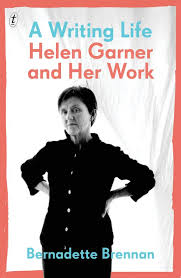
‘A Writing Life: Helen Garner and Her Work’ by Bernadette Brennan

Brennan

2017, 298 p. & notes

This book is exactly what the title promises: a study of Helen Garner and her work.  It’s not, and nor does it purport to be, a full biography but is instead a ‘literary portrait’, firmly based on and in Garner’s own writings and writing practices.

The author (who, judging from her picture on the back page is much younger than I thought she would be) uses the publication sequence of Garner’s books as its organizing principle, but it seems in both the introduction and conclusion that she at one stage contemplated a different structure.

It is too simple to say that Garner’s body of work is one book, but everything she has written is interrelated. Over a period of forty years she has revisited themes, relationships, situations, characters and questions. Because houses, and their domestic spaces of intimacy and negotiation sit at the core of all Garner’s fiction, I originally thought to structure this study around Garner’s primary spaces: bedrooms, kitchens, courtrooms and public institutions… Such readings, however, do not lend themselves to a full and coherent appreciation of Garner’s development as a writer…. In the end I decided to structure this portrait so that each chapter, dedicated primarily to literary analysis, can be read as a room describing Garner’s house of writing. Some rooms have alcoves, others debouch into wider spaces; all are connected by passageways. (p. 7)

I must confess that I forgot about this intended motif until the author returned to it in the closing pages of the book, where she alludes to Henry James’ metaphor of the house of fiction, and Garner as a ‘watcher’ through windows. I don’t find it a particularly useful structure, and as it would seem, neither did the author, as it is left largely untouched through most of the text.

Instead, the book is presented in two parts: Part 1 Letters to Axel and Part II Questions of Judgment.  ‘Axel’ was Axel Clarke, the son of  historian Manning and linguist Dymphna Clark and a close friend from university days to whom Garner wrote often and honestly. His archive of letters to and from Garner, deposited in the National Library of Australia are a significant resource for Brennan. He died in 1990, after a long friendship with Garner tinged with tension  over her ‘use’ of his illness with a brain tumour in ‘Recording Angel’, one of the stories in Cosmo Cosmolino (1992), the last of the works analysed in Part I.   The ‘letters to Axel’ form a useful organizing device, although ‘1942-1992’ or ‘The First Fifty Years’ would have done just as well.  Each of the seven chapters focuses on a major work and Brennan  interweaves personal details, gleaned from Garner’s own works and interviews, and literary analysis based on the books themselves.

Part II, Questions of Judgment starts with The First Stone, the first non-fiction book that took Garner into the courtroom as the basis for her narrative, a practice that she has followed in Joe Cinque’s Consolation, This House of Grief and most recently in her Monthly essay ‘Why She Broke‘.  The chapter on The First Stone is the longest in the book and it marks not only Garner’s shift into long-form non-fiction writing, but also her most contentious book that provoked questions among her critics about her commitment to feminism and how that feminism was defined, and her attitude towards younger women.  Readers who do not like Garner’s work often criticize her insertion of herself into both her fictional and non-fictional writing, and Brennan (among others) is critical of Garner’s personal intervention in the form of letters to Master Alan Gregory, the man accused of sexual harassment. I had not realized the legal tightrope that her publishers trod with this book, and it took its toll on her relationship with Hilary McPhee.  It is a book that still evokes controversy. Most of the books in this second part are non-fiction, which is the genre in which Garner has predominantly worked in the last decades. The exception is The Spare Room, which is the novelized retelling of a real life experience when a friend undergoing an alternative treatment for cancer stayed with her. Brennan’s book closes with Everywhere I Look, Garner’s recent collection of essays.

It is not necessary to have read Garner’s books to enjoy this literary portrait, but it certainly helps to have done so.  Critiques of short story and essay collections are always difficult to write and read because the act of describing them often eviscerates them, and  several of Garner’s publications fall into this genre. Nonetheless, Brennan gives enough of the flavour of Garner’s works to jog the memory or provide sufficient background for her analysis to make sense.

It is not an authorized biography as such, in that Garner had veto power over it. She made available to Brennan her diaries, letters and drafts that are currently embargoed at the NLA, and participated in interviews with the author. It’s a rich, textured archive.

This is not a biography, and yet we do learn about  Helen Garner those things she chooses to reveal about herself, either through interviews or mostly through her own writing.  We read about her difficult relationship with her father, her life in share-house Carlton that prompted Monkey Grip, her three marriages, her daughter and grandchildren.  There are things we do not learn, too, most particularly who the ‘Philip’ character who floats through her early fictional writing was based on.  I did not realize the persistence of Garner’s religious quest, thinking that she had left it behind after Cosmo Cosmolino (which I reviewed here and did not enjoy). I remember, but did not fully appreciate, the virulence of the debate about The First Stone and was unaware of the legal and literary maneuvering that preceded its publication.  In my review of Postcards from Surfers, I wondered about how a book of short stories was put together, and in Brennan’s book I saw the collaboration between editor and author in constructing a ‘work’ of short stories as a distinct entity.  Through her diaries it is clear that the naive, ‘I-know-nothing-about-the-legal-system-but…’ stance that comes through in her courtroom non-fiction is a deliberate, and somewhat disingenuous choice.

Most of all, though, I am left with a sense of the writer at work– and work it surely is. The reading, the thinking, the writing and rewriting, rewriting, rewriting. The author’s drawing together of observations from other writers and thinkers – most particularly that scholar of the art of biography, Janet Malcolm. The richness and texture of thought and reflection. The edginess and vulnerability of putting yourself out there as an author. The web of connections between people in the local intellectual and literary scene.  A life lived in the mind, but also in the everyday. A particular way of looking.  All the things that I appreciate most in Garner’s work.

My rating: 8.5

Source: Yarra Plenty Regional Library
aww2017-badge

I have posted this review at the Australian Women Writers Challenge 2017.

 

A new adventure!

I’m off for a fortnight to Chile and Cuba. Think of it.  A 61 year old woman. There by herself. Very rudimentary Spanish. What could possibly go wrong?

Join my on my (mis)adventures at my other blog Land of Increasing Sunshine – or, in approximate Spanish La Tierra Más Soleada

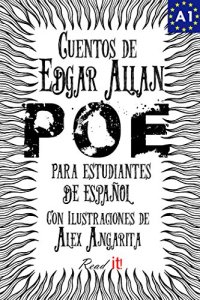
‘Cuentos de Edgar Allan Poe para estudiantes de espanol. Nivel A1’

poe

There’s a little test you can do of your language skill against the Common European Framework of Reference for Languages (CEFRL). “I’ll try that with my Spanish!” I thought, only to end up thoroughly deflated at the realization that I came out at level A1 – absolute, absolute beginner. Or as Wikipedia helpfully puts it:

He is able to understand and use daily expressions of very frequent use as well as simple phrases intended to satisfy needs of immediate type. You can introduce yourself and others, ask for and give basic personal information about your home, your belongings and the people you know. You can relate in an elementary way whenever your interlocutor speaks slowly and clearly and is willing to cooperate.

Well, on second thoughts, that’s about it.  Apparently this level takes approximately 100 hours of study and that would be just about right too.  (Actually, I’ve probably spent more time than that, so I must confess to being a laggard. I’ll blame my advanced age.)

So I downloaded Cuentos de Edgar Allan Poe for the princely sum of $2.04 AUD and found that, yes, it’s exactly the right level.  I had to look up about five words in each page, which was enough to keep me on my toes, but not so much that I felt overwhelmed.  I don’t know if the stories became simpler, or whether I improved as I went along, but it seemed that the later stories were easier to read than those at the start of the book.

It helped that I can’t remember reading any Edgar Allan Poe beyond, perhaps, in short story collections at school.  There were seven stories here: The Black Cat, Berenice, The Fall of the House of Usher, The Pit and the Pendulum, The Mask of the Red Death, The Facts in the Case of Mister Valdemar and Ligeia.  The whole book was only 68 pages in length, so each of the stories was relatively short. There were lots of deserted houses, ghostly women and glittering eyes and my favourite was probably The Pit and the Pendulum.  I did double check some of the stories in Wikipedia to make sure that I had actually understood them, and yes- they were abridged, but they captured the essence of the story with enough tension and mystery to make it worthwhile.

So, if you’re an absolute beginner too- this is $2.00 very well spent.

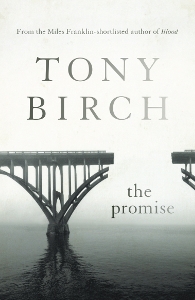
‘The Promise’ by Tony Birch

birch_promise

2014, 219 p.

I was prompted to read this book as part of Lisa’s Indigenous Literature Week at ANZLitLovers.  I’ve read several books by Tony Birch previously, one a novel Blood and the other, Shadowboxing a series of linked short stories. I think of him as a local, who can often be spotted around Melbourne and occasionally I’ve seen him down at our local shopping centre, oddly enough.  While his works are fictional, you sense that the author’s own lifestory hovers nearby. Birch’s indigenous heritage seems to be treated as just one aspect of his character, as it is in amongst the narrators in this series of short stories too. Class, education and a wounded masculinity are just as much markers of identity in his characters as their indigeneity,  where if it features at all, it is mentioned almost in passing. It’s not that it’s downplayed or ignored, but it’s interwoven through his characters’ other experiences and world-views.  (There’s an excellent reflection on Birch and his aboriginality in Eve Vincent’s review of ‘The Promise’ in SRB)

All of these twelve short stories are told in the first person, and although it is not the same character, it is pretty much the same voice. Several of the stories involve young boys, left pretty much to their own devices in the scrubby, abandoned frontiers of an urban landscape in the absence of parents: under freeways, along river banks, playing in the shadows of Housing Commission high-rise buildings  and in deserted bowling alleys. Where the narrator is a grown man, he is often standing on the edge of a loss of a relationship, scorched by grief and toeing the line of defeat or deciding to ‘move on’. His characters are not generally written about in literature. They are workers whose jobs are a means to an end, rather than their own enterprise or a profession. Some of them dance on the edge of criminality, alcoholism and addiction and  families are often absent or fractured.

My favourite amongst the stories is ‘The Money Shot’, about a trio of thieves about to do a ‘job’ only to find that one of their group has to literally mind the baby.  There’s a humour in this story that is not found in the others. In another story, ‘The Lovers’, a waiter in a restaurant speculates about a couple who come in every week.

Birch is good at capturing a moment, a dilemma, a decision and co-opting your sympathy as a reader, almost against your better judgement. However, in several of these stories I found myself turning the page, only to find that the story had ended. I don’t need a resolution, or for everything to be tied up neatly, but the incompleteness of some of these stories frustrated me.  This was more true of the early stories in the collection, and I don’t know if the later stories became more rounded, or whether I’d become accustomed to having the narrative yanked away so abruptly.  So, I think of these stories more as shards, sharp-edged and needing to be handled carefully (just as their main characters are), rather than rounded wholes in themselves.  I just can’t help thinking, though, that some of them are a ‘promise’ left unfulfilled.

My rating: 6.5

Sourced from : Yarra Plenty Regional Library

Colonial Frontier Massacres in Eastern Australia 1788-1872

The University of Newcastle has a fantastic new site showing colonial massacres on the frontier in Eastern Australia. You can access it at

https://c21ch.newcastle.edu.au/colonialmassacres/

The map shows the approximate location of massacres of both indigenous people and settlers in the eastern states. As the creators explain in the introduction, their criteria for a massacre is six people.  Why six? To lose six people (or 20%) from a  ‘hearth’ group of twenty people renders that group vulnerable to further attack and diminishes their ability to hunt for food, reproduce and carry out their ceremonial obligations. The data is drawn from a range of sources including newspapers, parliamentary reports, the memoirs and correspondence of settlers, missionaries and Protectors, and oral and visual Aboriginal accounts.  The reliability of the source is rated with a star system.

The site makes quite clear that it is a work in progress, and subject to change through ongoing research.  Fascinating, and sobering.

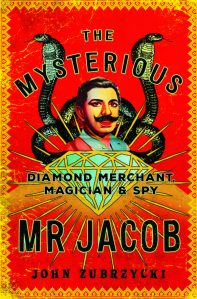
‘The Mysterious Mr Jacob’ by John Zubrzycki

Mr-jacob_COVER-600x913

2007, 262 p & notes

Transit Lounge

In 1912 it was said that when the real story of Alexander Malcolm Jacob was written, it would be invested with more wonder and mystery than “even in our strangest dreams we never imagined it could possess.”(p.247)

Well, it took a hundred years, but in this book John Zubrzycki has probably got as close to the “real” story as anyone else is likely to do. Mr Jacob – diamond merchant, magician and spy – was happy to embroider and dissemble about his actual origins, but for the civil servants of the British Raj who escaped to the Indian hills of Simla to escape the summer heat, Mr Jacob was a celebrity. His shop was full of  gems, curiosities and wonders, he lived in a opulent mansion ‘Belvedere’ and he was sought out for his magic and mystical skills and political contacts. He appeared in multiple newspaper articles, essays, books and Rudyard Kipling’s Kim  (albeit, not under his own name but as Lurgan Sahib).  He dealt with Indian princes and maneuvered the shadow world of British spies operating in the Far East, and yet he ended up largely impoverished, living on a rather miserly pension before his death in 1921 aged 71.

Many rumours spread about his origins –  Jewish? Greek? Polish? Italian? – but Zubrzycki has tracked his birthplace down to a small town in Turkey, near the Syrian border. He was actually Catholic, but in a world obsessed with spiritualism, he attracted Theosophists and the adherents of Madame Blavatsky. He arrived in Bombay in 1865 penniless, and within 12 years had achieved celebrity status. His greatest, and as it turned out, most damaging challenge was to sell the Imperial diamond, the largest brilliant-cut diamond in the world, to Mahboob Ali Khan, the sixth Nizam of Hyderabad in 1891.  Fabulously wealthy and opium-addicted, the Nizam liked gems, and Jacob undertook to bring him the diamond from Europe on approval, hoping to make a hefty profit for his efforts. But the sale ended up in court and here, if perhaps anywhere, Zubryzycki got closest to discovering what may be the truth about Alexander Jacob.

The book is framed as the author’s search for the ‘real’ Mr Jacob, and the author strolls onto the page quite frequently as he hunts for locations, searches for documents and seeks an elusive photograph of him. It certainly seems as if Mr Jacob is reaching out from the grave, sometimes thwarting some of his efforts (as in when he finally tracked down Mr Jacob’s grave only to find that it had just been destroyed), and permitting “just in time” discoveries at other times (as when he found the decrepit Belvedere mansion, just before its demolition).  In this case, Australian readers benefit from the six year lag between the book’s publication in 2011 and its recent release through Transit Press in Australia, as in the meantime he found the much-sought-after photo to add a physical presence to such an elusive subject. The author has an engaging style, whipping up interest at the start of each chapter, and if he digresses it’s because they’re such interesting alleyways into which he is being drawn.

We are taken on a fascinating journey into an India of  the scarcely-imaginable wealth of its Indian Princes and the rather disdainful manipulation of British colonial politics. There is a fluidity in Mr Jacob’s life as he defies national definitions and flits in the shadows of spies and diplomats.  There’s little attempt- and I dare say, little scope- for any exploration of Mr Jacob’s personal life, and in this he is just as slippery and elusive as in his professional life. It’s a rattling good yarn, as Mr Jacob knew himself in his various retellings and embellishments, and you can’t help but be imbued with Zubryzycki’s passion for such an enigmatic character.

My rating: 8/10

Sourced from: review copy from Transit Lounge Publishing.


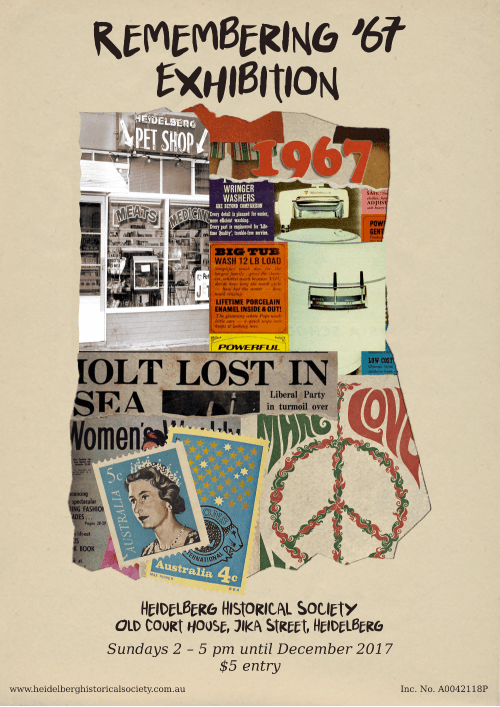
Exhibition: ‘Remembering ’67’

For the first few months of this year, much of my time was spent working with the team that has put together the ‘Remembering ’67’ exhibition at the Heidelberg Historical Society. This year is our 50th anniversary, and we celebrated as a society last weekend at the Centre, Ivanhoe with Graeme Davison as speaker at a really enjoyable luncheon.

But our celebrations don’t end there! We’re celebrating the WHOLE YEAR of 1967, as experienced in the City of Heidelberg.  Our exhibition would be of special interest to people who were in Heidelberg at the time, but it’s broader than that, encompassing housing, schooling, shops, entertainment, and childhood.

We’re open every Sunday between 2.00 and 5.00 p.m. (and your Resident Judge will even be there on the 2nd Sunday of each month: I’m there this coming Sunday too!) It’s at the Heidelberg Historical Society Museum, Jika Street Heidelberg until December

A4_poster_new

An online exhibition – Another Night

There’s an interesting curated story on the Victorian Collections website called ‘Another Night’. Inspired by Geoffrey Blainey’s Black Kettle and Full Moon, this narrative links different objects on the Victorian Collections website related to lighting and night-time.

Victorian Collections is a repository for digital images from different museums and historical societies in Victoria. It includes both paper-based images and photographs of catalogued physical objects.

The curator, Kitty Owens, has put together a selection of postcards and photographs and images of candles and lamps.  There’s a fascinating photograph of the inside of the Richardson’s house at Harmony Vale in the Dandenongs around 1895. It’s a fairly humble house, with the family gathered around the fireplace and the light spilling in from the window.  It’s very different to the image of Villa Fortuna, an opulent mansion stuffed with furniture and objets d’art, lit by (curiously mis-matched) chandeliers. There’s photos and an artefact from a ‘switching-on’ ceremony when the electricity came through. I’m not aware of local NBN-switching on ceremonies- perhaps we’re all too jaded.

Well worth a look!

https://victoriancollections.net.au/stories/another-night

Exhibition: ‘Remembering the ‘Burbs 1850-1960’

I know that I always write about exhibitions just as they’re closing the door and turning off the lights, but with this one, there’s still a month to go see it. It’s at the Royal Historical Society in a’Beckett Street (close to Flagstaff Gardens) and it’s called ‘Remembering the ‘Burbs 1950-1960’

2016-remember-the-burbs-425x600

It’s a tie-in with the book that RHSV released just prior to Christmas ‘Remembering Melbourne’, which draws on images from RHSV’s own collection and the collections of twenty suburban historical societies to capture ‘Lost Melbourne’.  As their website says,

Remembering the ‘Burbs showcases the images supplied by these historical societies.
The images of suburban housing, work, industry, commerce, community service and
recreation – collectively trace the development of Melbourne’s suburbs between 1850 and 1960 as its population expanded from the city’s confines.

The exhibition has a snapshot of each of these twenty suburbs. Walking around, you can do a historic perambulation of suburban Melbourne, all in the same room!

Well worth a look if you’re in Melbourne in April.  It closes on the 28th April – see! plenty of time!

‘1787: The Lost Chapters of Australia’s Beginnings’ by Nick Brodie

brodie1787

2016, 304 p.

When you see Nick Brodie’s book on a bookstore shelf along with other Australian titles, with its dominant ‘1787’ emblazoned on the front, you tend to do a bit of double-take. Did someone make a mistake? Wasn’t it 1788?  There has been a constant and increasing uneasiness with 26 January being celebrated as Australia Day (something I’ve written about several times in this blog) but in this book Brodie bumps all this debate to one side, exhorting us that “‘If we broaden our gaze, our story will get bigger”. 

There are some history books where, having read them, you know there has been a shift in your awareness.  You return to ideas and concepts that you had never questioned before, and see them anew.  I’m thinking, for example, of Bill Gammage’s The Biggest Estate in the World and to a lesser extent Bruce Pascoe’s Dark Emu; I’m thinking of Greg Dening’s Mr Bligh’s Bad Language,  Zoe Laidlaw’s Colonial Connections or the first of Henry Reynold’s work that you might read. Tom Griffith’s book Hunters and Collectors changed my mind about museums, and as a more distant example,  I suppose that Geoffrey Blainey’s The Tyranny of Distance would have had a similar effect at the time of publication.  To this list, now I’d have to add Nick Brodie’s  1787.  He eschews the idea of our continent sitting isolated at the bottom of the globe and instead knits Australia into  Eurasia and a trading network frontier that connected the northern and southern hemispheres. Although the book is called ‘1787’ (a curious choice given his challenge to what he calls  “the arbitrariness of epochs”) it spans the seventeenth and eighteenth centuries, and expands its view to the  current peripheries of Australasia, including New Zealand (have I offended?), Tasmania, New Guinea and the Torres Strait.

He does seem rather fixated on the emphasis on 1788, or rather, he keeps asserting that ‘we’ are. Certainly the Australian history I was taught did include the Dutch and the Macassans and  I suspect that his somewhat conspiratorial view of the ‘lost’ness  these ‘hidden documents’ is a little overblown.

However, what Brodie does in this book is create a narrative from the writings of Spanish, Dutch, Portuguese and French mariners and contextualize those encounters into a broader Eurasian trade and Enlightenment-culture picture. He starts his book with the narrative of Don Diego de Prado y Tovar, an officer under the command of Pedro Fernandes de Quiros, who travelled the Pacific during 1606 and encountered the fringes of New Guinea. He highlights that  Islamic, European and Chinese powers converged in the islands to the north of Australia, and spends quite a bit of time on Tasman’s expedition for the VOC (Dutch East India Company). He shows that Dampier led not one, but two voyages to New Holland, and while respectful (as one must be) of Cook’s seamanship, he writes a detailed narrative of Cook’s largely unsuccessful attempts at interaction with the indigenous inhabitants . He is very aware of the constructed nature of the documents he works from.   He looks carefully at Cook’s corrections and amendments between the drafts and published copies of his journals, and considers them against Banks’ writings as well.  He cites directly from primary texts; he slows down for particular episodes; he makes pithy and stop-you-in-your-tracks observations.

I had not realized that Cook went to Van Diemen’s Land, and for me the really new part of this book came in the section ‘Forward Operating Bases’ which places Van Diemen’s Land and New Zealand as the bases of repeated encounters. The usual post-1788 narrative is that both VDL and New Zealand were settled from Sydney, but his enumeration of repeated visits by English and French expeditions that deliberately sailed for Adventure Bay( 1773 and 1777) and Frederick Henry Bay (1772) in Van Diemen’s Land and Ship Cove in New Zealand (1770, 1773 -several times-1774, 1777) challenges that view.  Ships in an expedition became separated from each other; they returned to shelter in the hope that the other ship would do likewise; they deliberately let loose farm animals in the hope that they would breed and form a land-based food supply, and they tried to encourage agriculture.

None of these journeys are accidental drop-ins: instead they are a manifestation of both the trade and knowledge networks that criss-crossed the globe.  Nor were the indigenous people they encountered always completely ignorant either: knowledge spread within Australasia as well.

Brodie has an engaging, easy tone and he sustained the energy of his writing throughout.  I do wish that there had been a map beyond the  16th and 17th century reproductions he includes within the colour plates in the middle of the book.  It’s written for a general readership, with no footnotes.

There is much to admire here, but as I found when reading his earlier book Kin, there is a brashness and self-promotion in his approach that does not sit well with me. He doesn’t need to engage in the sniping at unnamed historians who have ‘duped’ their readers and colleagues by fixing only on 1788, and I find his condescension towards other historians, their readers, and anyone who has ever studied Australian history, unpleasant. ‘Dupe’ can be a noun as well as a verb, and no-one likes to be told that they have been stupidly misled.   It is a stance spelled out in the ‘not-a-prologue’ (his chapter heading, not mine),  repeated over again in opening each chapter and reiterated in the ‘not-an-epilogue’. His insistence on his contrarian, “me against the historians” argument becomes wearing after a while.  I had thought, with Kin, that it was a reflection of his young age and impatience.  Perhaps it still is.  Despite his sneering at ‘historians’, he is an academically trained and recognized historian himself, and he’s too good to engage in such blatant self-promotion.  He’s a prolific worker (with already another book in the wings), stunningly telegenetic, and good at publicity.  It amazes me that he hasn’t been snapped up for television work.

That said, this is one of those books that makes you see things differently.  By shifting the frame to Van Diemens Land and New Zealand, he shifts Australian history subtly on its axis, and he does, it’s true, reframe the whole Captain Cook/ 1788 story. That’s quite an achievement.