Category Archives: Uncategorized

Strange things from the box of photos No.2

We’re going through photos that we can show at Dad’s memorial.  One Australia Day several years ago I wrote about the Bicentennial Beacon, and Dad’s fortuitous involvement. And lo and behold, I found a photo!

You can read about it and see the newly discovered photo here.

Strange things from the box of photos No.1

We’re going through boxes of photographs, in preparing for Dad’s memorial service. We started doing it the other day and rushed through it, because we were finding it hard. We did put aside a pile of photographs that have since inadvertently been placed back into the pile of boxes, so I’m going through them again, more slowly. Very slowly. It’s hard to stop being the historian!

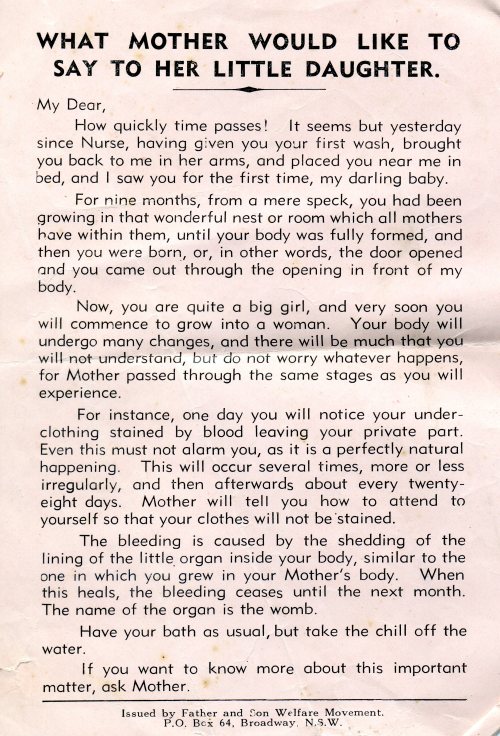
I was interested by this leaflet, issued by the Father and Son Welfare Movement. It starts off in the mother’s voice, but seems to become very abstract and third-person by the end. “The opening in front of my body” seems an odd place to be born from: no wonder some children thought they came from their mother’s belly button!  It was presumably a different place from “your private part” (singular).  It reads as if this little letter was designed to be left somewhere to be discovered by the young daughter.

I’m mystified to know why and by whom this leaflet was kept. It was in an old case of photos and documents belonging to my parents, but everything in it predates their wedding (and my birth as their daughter). Curiouser and curiouser.

img562

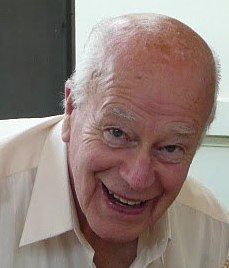
John Lumley 22.2.29- 25.1.18

My dad died last week from congestive heart failure and renal failure. He lived with us, in the back unit adjoining ours, and I feel as if he is present everywhere I look.  With the assistance of Banksia Palliative Care and Kincare, we nursed him at home to the end. We will miss him so much.

P1010788


Movie: Darkest Hour

I always stay to watch the credits at the end of a film, even with the cinema staff sweeping around me. The credits at the end of ‘Darkest Hour’ list 93-year-old historian John Lukacs, and I found myself wondering just how he feels about this movie. He was the author of the absolutely brilliant Five Days in London: May 1940, which tells in almost hour-by-hour detail the decisions faced by the British government as France and Belgium fell to the Nazis.  I  think he would have fully supported the film’s emphasis on Churchill’s personality and the uncertainty that surrounded the decision to stand up to Hitler, I wonder how he felt about some of the scenes in the movie.

I’ve often quoted the adage that I gleaned from somewhere when watching a film ‘based on true events’: think of the most dramatic scene in the movie and that’s the bit that’s made up. It certainly holds true here. About 2/3 of the way through a scene on the Underground made me think “Oh hold on – surely this isn’t true”- and sure enough, it’s not.

It’s a beautifully lit film and Gary Oldman is brilliant – although I think it’s easier to ‘nail’ a well-known, true-life character by impersonation than to build a completely fictional character up from scratch.  The music was perhaps a little too obtrusive.

I found myself looking for current-day political statements in the film. I don’t think that it necessarily set out to bring a message, but the funding decisions for films surely look for resonances amongst their audience.  So the message here? Perhaps the paucity of modern courage and leadership (although, of course, if the whole thing had gone pear-shaped …..) and a reassuring message that ‘the people know best’. A message for Brexit times, maybe?

Georgiana McCrae

During this week, Bill of the Australian Legend blog is running Australian Women Writers Gen 1 Week.  He defines Gen 1 as “those writers who came before the 1890s and the Sydney Bulletin ‘Bush Realism’ school, although many of them continued writing into the first part of the 20th century.”  To be honest, I was surprised when he asked me to write about Georgiana McCrae, whom I have generally considered as a source, rather than a writer. She did not write for publication, and had it not been for the efforts of her family (for good or bad), she may well have stayed in the shadows of family history.  Nonetheless, let’s consider Georgiana McCrae.

Georgiana McCrae

During this summer break, tens of thousands of Melburnians traveling to the beaches of the Mornington Peninsula will pass the beachside town of McCrae, with its holiday houses nestling among the gums on Arthurs Seat and its caravans clustered along the foreshore.
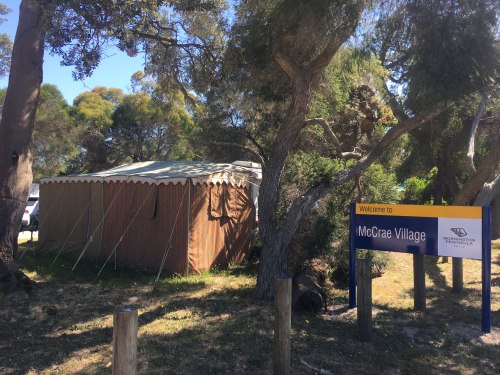
MccraeBeachIt is named for Andrew and Georgiana McCrae, who lived there for just six years between 1845 and 1851.  People today would be more familiar with Georgiana, rather than her husband Andrew, largely on the basis of her writings about Port Phillip, which have come to us thanks to the efforts of her family in protecting and promoting her legacy.
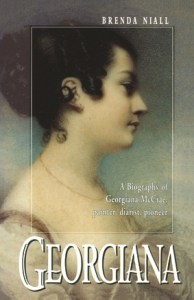
GeorgianaMcCraeNiallSo, who was this Georgia McCrae?  Her biographer Brenda Niall, describes her like this:

She was a Duke’s daughter, illegitimate but acknowledged by her father; she had been a child in Regency London; a professional portrait painter in 1820s Edinburgh; a lawyer’s wife in London and in Melbourne; the sole architect of the two houses she and her husband built; a central figure in Melbourne’s early social and artistic life; a settler’s wife on a Port Phillip cattle run; the mother of nine children; a witty, perceptive diarist and recorder of her times. (Brenda Niall, Georgiana, p. 2)

In many ways, Georgiana’s life reads like a romance novel.  She  was born in London in 1804 as the illegitimate daughter of the 5th Duke of Gordon.  Her illegitimacy did not prevent her father the Duke from acknowledging her and financially supporting her, even if he was not involved in her day-to-day upbringing.  Within the moral latitude that the aristocracy appropriated for themselves and among themselves, the Duke had fathered a second illegitimate family as well, likewise acknowledged and provided for.

Georgiana and her mother were installed at Somers Town in London, between St Pancras and Euston, where she circulated amongst the French royalist refugees who had fled Napoleonic France and congregated in the area.  This immersion in French culture lent to her writing and world view a wealth of French expressions that were to later sit rather incongruously with her descriptions of little, burgeoning Port Phillip on the other side of the globe.

It was at Somers Town that she trained as a painter under the tutelage of John Varley, John Glover, Dominic Serres and portrait and miniature painter Charles Hayter. She exhibited at the Royal Academy, garnering several prizes.
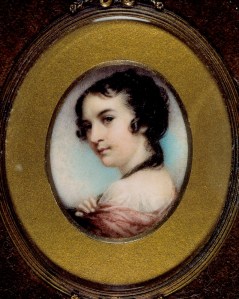
McCrae_selfportrait

Georgiana McCrae self-portrait. She painted both this self-portrait and the one used on Brenda Niall’s book. Source: State Library of Victoria.

After her mother was severely injured in an accident, Georgiana moved to live with her grandfather at Gordon Castle in north-east Scotland.  After her grandfather’s death, her father and his childless wife took up at the Castle, and Georgiana lived with them, continuing to paint and exhibit.   So- we have the Duke,  and we have Gordon Castle: now add a vindictive stepmother (for lack of a better term, given the convolutions of her family tree ) who thwarted Georgiana’s romantic prospects with ‘Perico’, a Catholic kinsman of the Gordons.  In September 1830 Georgiana married another Gordon relative, lawyer Andrew Murison McCrae instead, a relationship which never seemed to have had the passion of her relationship with Perico. After Georgiana’s father died, control of the family money passed to her stepmother, and with dampened prospects of an inheritance and on the basis of enthusiastic reports from Andrew’s friend Major Thomas Mitchell, they decided to emigrate to Port Phillip along with their four children.
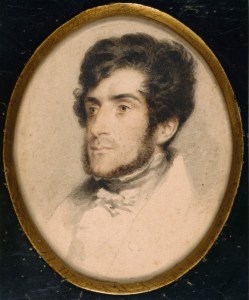
Andrew Murison McCrae aged 30

Andrew Murison McCrae, aged 30, painted by Georgiana McCrae. Source: State Library of Victoria.

Arriving on the Argyle on 1 March 1841, Georgiana then enters into the historiography of Port Phillip, then a newly-opened district of the colony of New South Wales. Georgiana’s Journal, edited by her grandson Hugh McCrae and published as part of the Victorian centennial celebrations in 1934, has long been seen as a witty  ‘womans-eye’ view of Port Phillip society.  But all is not as it seems. In her PhD thesis, Therese Weber painstakingly compares the original documents written by Georgiana McCrae with the published versions of Georgiana’s journal.  Unfortunately Weber’s thesis is only available at State Library of Victoria, but Marguerite Hancock drew heavily on the thesis when writing her foreword to the fifth edition of Georgiana’s Journal, which is still the most readily available version of Georgiana’s writing that you can access today.
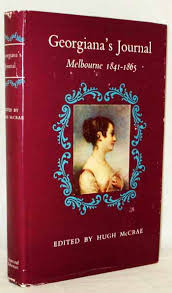
hughmccrae2

The third edition of ‘Georgiana’s Jounal’ edited by Hugh McCrae

As  Hancock (following Weber) points out, grandson Hugh McCrae was a poet and when he extensively edited Georgiana’s journal, he freely added his own artistic flourishes.  Georgiana wrote in short sentences and phrases, separated by dashes, but Hugh McCrae transformed it into flowing prose, as you can see on p.9-12 of Hancock’s foreword, available through the LaTrobe Society here.  Moreover, the colonial children and grandchildren of Georgiana McCrae were far more sensitive to her illegitimacy than she was herself, and her illegitimacy and aristocratic connections were carefully expunged.  But murkier still: McCrae was not even working from the original manuscripts. Georgiana herself had rewritten the journals in 1864, burning the originals, including one volume that her son destroyed at Georgiana’s request.  She did further work on her recollections in the 1880s. On the basis of these changes, both on the part of Georgiana and her grandson, Therese Weber asserts that  the published Georgiana’s Journal  edited by Hugh McCrae “can no longer be read as the journal of Georgiana McCrae”.

Be that as it may, Georgiana’s Journal  does capture Port Phillip from the point of view of a well-connected, intelligent member of ‘good’ society. The whole McCrae family of brothers and sisters emigrated across to Australia, as was common particularly amongst Scots migrants. We gain an insight into the webs of connection among the women of an extended family and their husbands’ networks amongst the commercial and professional milieu of a small colonial settlement.  After a period of renting a house right in the middle of town, Andrew and Georgiana built a house ‘Mayfield’ to Georgiana’s design in Abbotsford.   I stand amazed at the energy of these women and their children who would think nothing of striding across the fields for a three kilometre walk into town.  Georgiana attended all the balls and levees and was a friend of Superintendent (later Governor) La Trobe and his French wife Sophie, although her grandson-editor embroidered this relationship somewhat.  She had another three children in Port Phillip, the births of whom she describes in a matter-of-fact fashion.  In her entry for December 28, 1841 (in Hugh McCrae’s version) she wrote about the visit of Captain Cole, the suitor of Georgiana’s sister-in-law Thomas Anne, who was also present:

Captain Cole [came] to tea, and whether for the sake of prolonging his stay beside his lady-love, or from actual thirst, he took no less than nine of our small teacups full of tea.  While pouring out the seventh cup I could hardly conceal the effects of a twinge of pain, but the captain and Thomas Anne didn’t make a move till 10.00 p.m.  The moment they were gone, I hurried off to my room at Landall’s, and sent Jane for Dr Myer (his house at the end of Great Bourke Street East- Gardner’s Cottages.) Soon after eleven, Jane and the doctor arrived. At 3.00 a.m. I gave birth to a fine girl.  The doctor, on his way home, tapped at the window of Mr McCrae’s bedroom and hold him what had happened while he had been asleep.

Like many others in Port Phillip during 1842-1843, the McCrae family was seriously affected by the 1840’s depression. Andrew McCrae made several poor financial decisions during his life and in 1843 he ‘took up’ – that famous Australian euphemism-  the 20,500 acres (8,296ha) Arthurs Seat run on Bunurong land on the Mornington Peninsula.  Although a very beautiful location, it is poor quality farming land and the pastoral enterprise was not a great success.  Andrew built a homestead there, again to Georgiana’s design, and she very reluctantly lived there between 1845-1851. It was a considerable distance from Melbourne, but it was enlivened by frequent visitors from the cultural elite of Port Phillip.
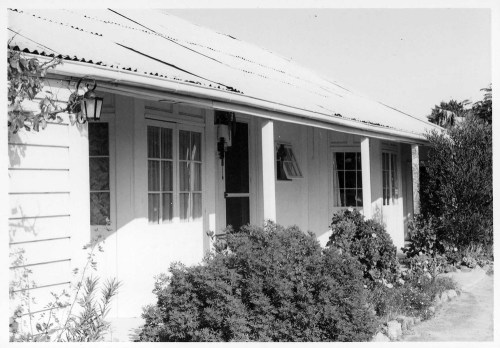
McCrae. McCrae Cottage Homestead Charles St.1964

McCrae Cottage 1964. Photographer John T. Collins. Source: State Library of Victoria
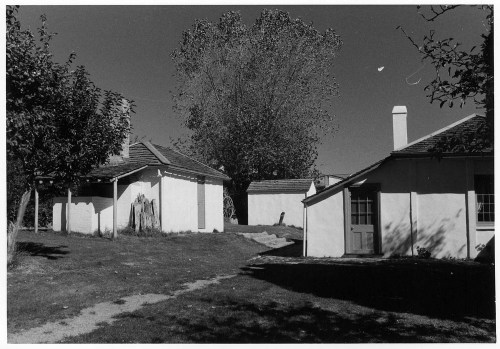
McCrae. McCrae Cottage.2

McCrae Cottage and outhouses 1972 after the re-shingling of the roof. Photographer John T. Collins. Source: State Library of Victoria

The marriage between Georgiana and Andrew was not a particularly happy one, and it’s interesting to observe a lukewarm marriage under the Marriage and Matrimonial Causes Act of 1864. They had spent a considerable time apart during their marriage: Andrew had travelled to Port Phillip two years before she joined him with the children; he shifted to the Arthurs Seat run almost two years before she joined him there, and in the 1850s he accepted the position of police magistrate at Port Albert and Kilmore, leaving the family in Melbourne. Even when they were living together, Andrew was often absent for social occasions. In 1867 Georgiana looked into obtaining a judicial separation, but it was not possible to meet the stringent grounds available.  The situation was alleviated by Andrew leaving Australia for ‘home’ for a seven year period. He did finally return to Melbourne, but died soon after.

After Andrew’s death, Georgiana lived with her children, as was common practice.  Although she could have made a sufficient income through her painting to alleviate the family’s financial distress, Andrew and the extended McCrae family took a dim view of painting ‘for money’.  It’s possible that had she done so, she would be widely celebrated as an Australian artist.  It is pleasing to see her listed on the Design&Art Australia database.

Georgiana was a prolific and lively correspondent, and the reminiscences that she brought together as an extended narrative are evocative and couched in that formal, ‘old-lady’ tone of the nineteenth century.  Her diaries, especially before grandson Hugh got to them, have a brusque matter-of-factness about them.  The literary waters are muddied by her descendants’ attempts to promote and protect her legacy, but it was largely because of Hugh’s publication of his reworked grandmother’s diaries in the form of Georgiana’s Journals that McCrae Homestead was saved from demolition. Apparently the mother of the developer had read Hugh McCrae’s book, and insisted that the house should be retained.  The house was later purchased by the family who donated to the National Trust as ‘McCrae Homestead’, even though the family who followed the McCrae’s brief six year sojourn stayed there for eighty years.  Dromana West was renamed as McCrae in the 1930s.
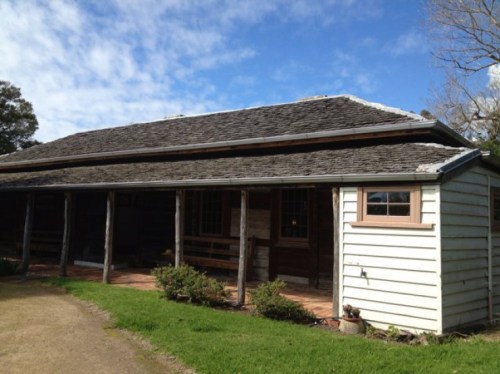
MccraeHomestead

Despite the reworkings of her manuscripts, Georgiana McCrae gives social historians of early Port Phillip a glimpse into the cultural, commercial and professional elite of a newly-forming colonial district from a strongly-networked woman’s perspective. It’s a refreshing counterbalance to the more common narratives of rural isolation on the one hand and entrepreneurial masculine boosterism on the other.

Sources

Georgiana’s Journal ed. Hugh McCrae, 2nd edition, 1966

Georgiana’s Journal 5th edition. Foreword by Marguerite Hancock, 2013 available through LaTrobe society website here.

Norman Cowper, ‘McCrae, Georgiana Huntly (1804–1890)’, Australian Dictionary of Biography, National Centre of Biography, Australian National University, http://adb.anu.edu.au/biography/mccrae-georgiana-huntly-2392/text3157, published first in hardcopy 1967, accessed online 16 January 2018.

Design and Art Australia Online Georgiana Huntly McCrae

Leo Gamble,  Georgiana McCrae Kingston Historical Website  http://localhistory.kingston.vic.gov.au/htm/article/577.htm

Brenda Niall,  Georgiana: A Biography of Georgiana McCrae, painter, diarist, pioneer, 1994



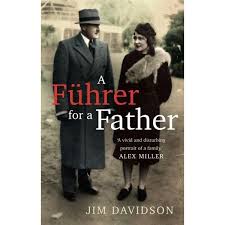
‘A Fuhrer for a Father’ by Jim Davidson

furhrerforfather

2017, 256 p.

After reading a string memoirs written by women that seemed to excoriate their mothers, I decided not to read any more. I probably should have stuck to my decision when I picked up historian and Meanjin editor Jim Davidson’s A Fuhrer for a Father.  But perhaps a memoir about a father written by a son might be different, I thought.  Indeed, beyond Germaine Greer’s Daddy We Hardly Knew You (which I haven’t read) and Raymond Gaita’s Romulus My Father (which I have), I’m hard pressed to think of other similar books, written by sons about their fathers. [However, I see that Shaun Carney and Mark Colvin have both recently released books that exactly fit this category].  Furthermore, I knew that Jim Davidson is open about his homosexuality, and the question of a father’s acceptance of his son’s sexuality is an interesting one, particularly when the father is a domestic and forceful martinet with a string of relationships with women.  And besides, a historian can bring a particular eye to memoir, able to interweave the personal  with the broader historical picture, as Graeme Davison did so well in Lost Relations So, read it I did.

For the first half of the book, I appreciated Davidson’s depiction of 1950s-60s upper middle-class suburban life in Melbourne that had echoes of Barry Humphrey’s Sandy Stone character and, although set in an earlier period, My Brother Jack.  It is the juxtaposition of the theoretical and domestic that is highlighted in the subtitle of the book:  “The domestic face of colonialism”. When Donaldson read the historian AP Thornton’s remark that everybody has experienced imperialism in the shape of childhood, he rose from the desk and danced around the room (p. 53). For as a historian, this is how he conceptualized his father: a symbol and wielder of imperialism as a form of power. Born in South Africa, his father worked in Fiji as a surveyor on a gold mine, travelled to New Guinea, and later in life became involved financially in the sale of Aboriginal artwork.  Within his family he was strident, manipulative, bullying and controlling, not only with his first wife (and Jim Davidson’s mother) Olga, but also with his ‘second family’ of Eve and his half-brothers Garry and Hank. The juxtaposition of colonialism and domesticity is a powerful and rich observation, and Davidson explores it in the first part of the book and reverts to it again at the end:

Imperial dominance rested on patriarchy – was almost its outward projection. This book has been an exploration of one telling example of that nexus….For Jim [i.e. his father] became an anachronism, an unbending projection of the past. His idea of indigenous people had been engendered by family experience of Africa, the romances of Rider haggard, and his own quest for the exotic in the Islands. (Arnhem Land was an autumn romance). Everything was firm, unequivocal, and placed him at the centre of events, which he felt enabled and entitled to control. The contest with various opponents was the thing; his women and children were just auxiliaries. Livestock. (p 251)

However, much of the last half of the book is a long, petulant complaint of one grown man as son against another grown man, his father.  While there is always an element of remaining the child in relation to your parents, in many ways Davidson seemed content to remain the dependent.  Money became a particularly fraught expression of their relationship. There are long complaints about being ‘written out of the family’ and especially being written out of the will.  Yet at the age of 48, his father was still giving him money for overseas trips, and he did not demur at the $10,000 being handed to him by his father here and there (as he interprets it, as a guilt payment for the will that was to follow.) At a more mundane level there are interminable reports of Christmas Dinners replete with bad behaviour on all sides, including Davidson, who hurls his Christmas presents at the recipients before storming out and deliberately choosing presents with nettles of malice.  It’s unpleasant, petty and reflects poorly on everyone.  Even his closing words reveal Davidson’s relishing of the ultimate last word:

I suspect [my father] rather fancied a book being written about him; the devil would be in the detail. Well, here it is…Not quite the book he wanted. (p.255)

Not one of my better book choices.


Somewhat missing in action….

There’s been very little going on in this blog recently because I’ve been busy working away polishing up my presentation for Heidelberg Historical Society tomorrow night (Tuesday 12th). On the 20th December it will be the 100th anniversary of the second Conscription Referendum, and I thought it might be interesting to look at it from the perspective of a rather middle-class suburb like Ivanhoe and Heidelberg.

And tomorrow night’s the night! It will be at the Ivanhoe Uniting Church Community Centre in Seddon Street Ivanhoe at 8.00 p.m.  if you should just happen to be driving past.

Mind you- I’ve known about this since about November 2016. So why then was I finishing it off at 1.00 a.m. this morning? You’d think I’d know better by now.

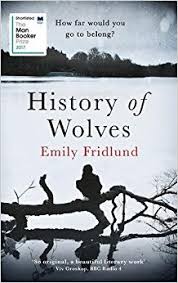
‘History of Wolves’ by Emily Fridlund

fridlund

2017, 275 p.

This book was short-listed for the 2017 Man Booker Prize but I really can’t work out why. It does well enough as a first novel – and perhaps that is its appeal – but it doesn’t have the depth or skill that I would expect in a shortlist for an award of the calibre of the Man Booker. (That said, the Booker shortlist is not necessarily a fool-proof guide to quality!)   Its shortlisting only serves to highlight its shortcomings.

Fourteen year old Linda lives in the backwoods of northern Minnesota with her parents, the last stragglers of a hippy commune that had disintegrated over the years. We learn from the opening pages that a little boy, Paul, has died and the rest of the book explains how. We learn that Linda is ostracized by her school mates, a fact which perhaps prompted the rather irrelevant blurb on the front cover “How far would you go to belong?” (yes, yes…I know that the author is not responsible for the marketing….) She hangs around the more unpopular kids and teachers, and it was her history teacher Mr Grierson who encouraged her to submit a project on wolves to the History Odyssey tournament. Her statement “An alpha animal may be alpha only at certain times for a specific reason” resonated for her beyond the topic of wolves. When a young Christian Scientist couple, Leo and Patra and their young son Paul shift into a cottage on the lake, Linda gravitates towards them and through babysitting Paul feels that she is part of the nuclear family that she lacks. When Paul dies- again no spoiler because we are told that he dies from the start – Linda tells herself, without quite believing it, that “It’s not what you do but what you think that matters”.

The descriptions of landscape are excellent, especially those of the snow that blankets the lake and isolates them even further.  But there are too many themes in the book (belonging, dominance, the distinction between act and intent) and the writer labours them.  It’s not a bad book by any means and, indeed, I enjoyed reading it, but the marketing world of the Man Booker Prize has shifted it beyond its grade, and done it a disservice.

My rating: 6.5

Sourced from: Yarra Plenty Regional Library.

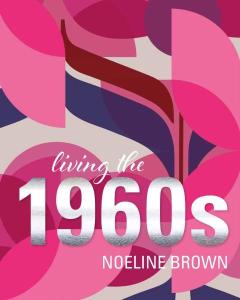
‘Living the 1960s’ by Noeline Brown

living-the-1960s

2017, 177 p. NLA Publishing

In choosing Noeline Brown to write this book, the NLA was obviously going for popular culture and a dry sense of humour- and they got it. I can remember Noeline Brown in the Mavis Bramston show : indeed, she was Mavis Bramston in the pilot and first five shows. When she went off to England (as most 1960s show business and music people did) she was  replaced by Maggie Dence who became better known as the face (and hat) of Mavis Bramston.

I must confess that this slap-stick style of humour doesn’t really appeal to me, and Noeline Brown’s career, most of which was on commercial television, mostly passed me by.  I remember her in Gough Whitlam’s ‘It’s Time’ advertisement and I was aware of her in the support that she gave to Graeme Kennedy as his health failed. She has been an Ambassador for the Aging, and recently received a lifetime achievement award from Actors Equity.

There are eight chapters in the book: politics, the arts, music, fashion, family life, our town, women and sport. The text is conversational in tone, and interweaves  Brown’s own personal anecdotes between snippets of information.  It’s largely a young-person-at-the-time’s guide to the social life of the 1960s, and as might be expected from a stage and television personality, very much based in the realm of music and the popular arts.  It’s a very light touch, with no theoretical framework or bibliography at all. It’s an easy and undemanding read and the sort of book that can be picked up for a chapter or two, then put down.

The book is generously illustrated with images from the National Library’s collection, and includes political ephemera, photographs by Rennie Ellis and Wolfgang Seivers, and magazine advertisements and photographs ( drawn most particularly The Australian Women’s Weekly). The layout is beautiful, as is the case with most NLA books. There are small breakout boxes of timelines and facts, and page-length featured topics, but the photographs do most of the work. It focuses mainly on Sydney and Melbourne, is probably more focused towards women, and rural life is barely touched at all.

The book, with Brown’s narrative as voice-over, felt very much like a back-to-the-sixties television documentary, full of nostalgia and wry amusement.

Source: NLA publishing review copy through Quikmark Media

aww2017-badge

I have posted this review to the Australian Women Writer’s Challenge site.

[P.S.  A little plug for something close to my heart:  If you’re interested in local history of the ’60s in Melbourne, and if it’s still November 2017, why not visit Heidelberg Historical Society’s ‘Remembering ’67’ exhibition? It’s open on Sundays 2p.m. – 5.p.m on 12th, 19th, 26th November at the Heidelberg Historical Society Museum, Jika St Heidelberg, entry $5.00]


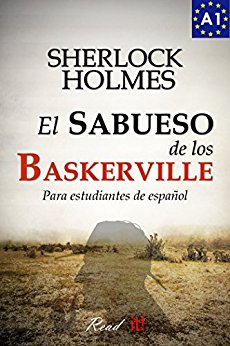
‘El Sabueso de los Baskerville’ por Sir Arthur Conan Doyle

sabuesobaskervilles

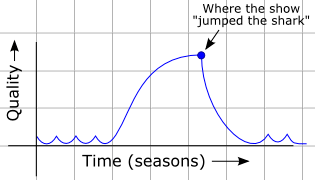
Ah! This is the Sherlock Holmes I like. None of that Benedict Cumberbatch smart-arsery and supercilliousness.  Really, I think that the new Sherlock Holmes episodes are too post-modern for their own good.  Is that the fin of a shark I see circling?

jumpsharkgraph

This Sherlock Holmes only arrives at the end to announce his words of wisdom and solve the mystery in words simple enough for me to follow (even in basic-level Spanish)

You know, I don’t think that I’ve ever read the Hound of the Baskervilles before. Country houses on the moor; mysterious servants and neighbours and an eerie howl that pierces the fog in dark nights. What more could you want?