Category Archives: Uncategorized

A couple of days in the Wimmera: Part I

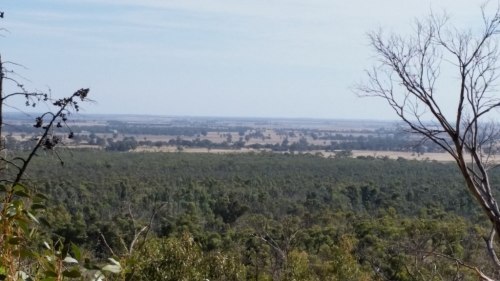
In our retired state, we are no longer restricted to school holidays for trips away but we seem to have found new shackles: the U3A timetable! Steve conducts classes in beginner French at our local U3A so he prefers not to miss classes. Fortunately, our U3A terms do not start until the week after school returns, to give members who’ve been minding their grandchildren for a fortnight a bit of breathing space.  So, now that school is back, off to the Wimmera we headed for a couple of days. For those not familiar with the Wimmera, it’s located to the northwest of Melbourne, near the border of South Australia, and it’s a flat, arid dryland farming area.

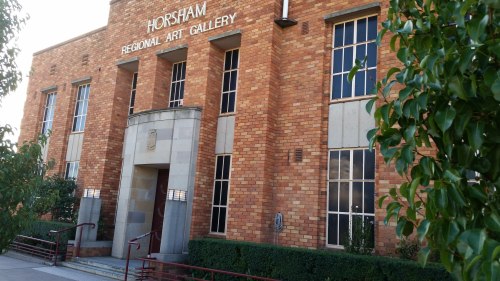
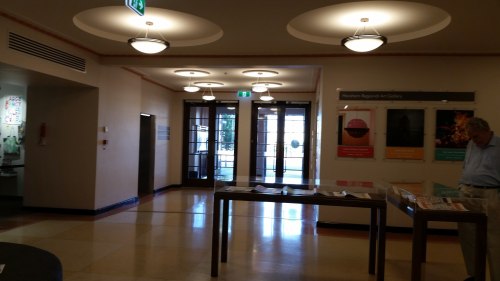
We spent our first night at Horsham, the main population centre of the Wimmera, some 300 kms from Melbourne. We got there in time to visit the Regional Art Gallery, and a very fine gallery it is too. It was constructed in 1938-9 and is quite reminiscent of Heidelberg Town Hall.  A recent refurbishment really enhances its art deco features.

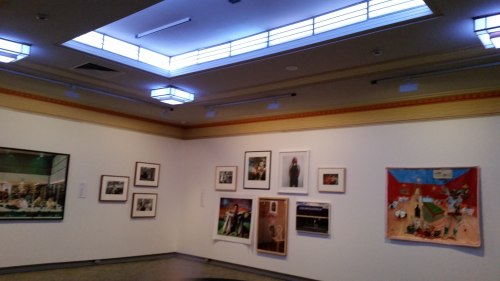
20180417_161756_small20180417_161725_small20180417_161322_small20180417_160602_small

It has a terrific collection, largely based on the gift of its major benefactor, Mack Jost. There’s most of the Australian artists you know represented there, with a strong emphasis on modernist work,  but I hadn’t seen any of them before. Well worth a look.

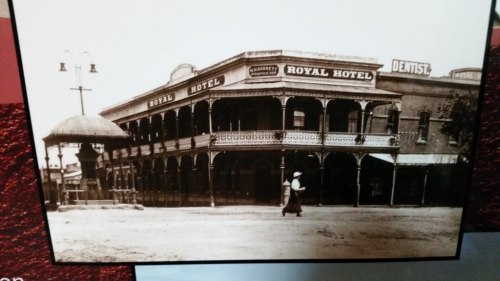
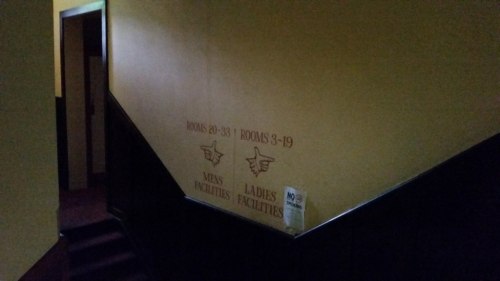
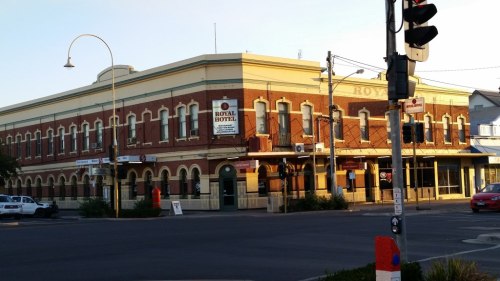
I really don’t like motel rooms much, so when we saw that the Royal Hotel had accommodation, we thought that might be fun.  Once the cast iron balcony came down in the 1960s, it lost a lot of its charm.
20180417_173911small20180417_200257small

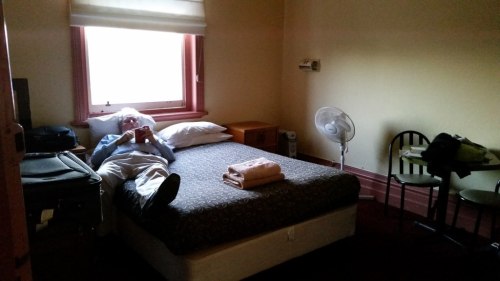
Hey- at only $60.00 a night, you can’t expect the Hilton.  The bed was comfortable, the hot water was hot and the Parma Night excellent. And it has a certain rustic charm.

20180417_175650

Shared bathroom

20180417_175728_small

20180417_175745_small

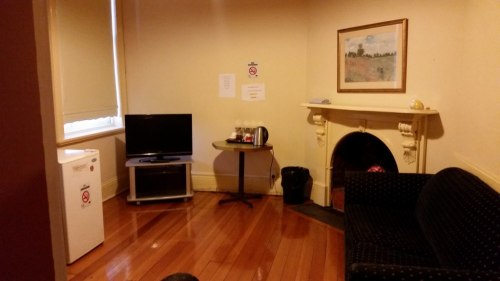
The small but functional lounge

20180417_175826_small

On Wednesday we backtracked a bit to the Grampians – or rather, Gariwerd- to see the aboriginal rockart in the National Park.  The area was hit by bushfires in 2014. It has grown back well, especially in comparison with Marysville which seems to have taken longer to revegetate, but I don’t know….I feel as if  Gariwerd /the Grampians have dropped the tourist ball a bit.  Their signage at the rock art sites was poor, with signs defaced or faded to the point of illegibility.   It’s an important part of Gariwerd – dammit, I’m going to use the indigenous name, even if they won’t – with its approximately 200 rock art sites comprising 80% of the Southern Victorian rock art. Five of them are open to the public, and we saw three of them.

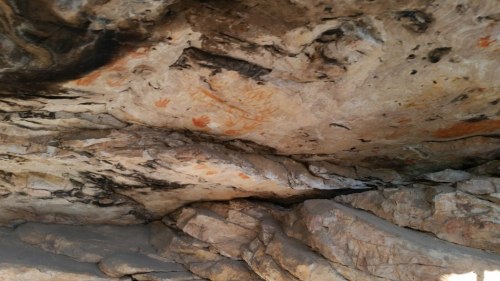
First, Gulgurn Manja. It’s in a cave in a rocky outcrop, overlooking the valley. The handprints were made by children.
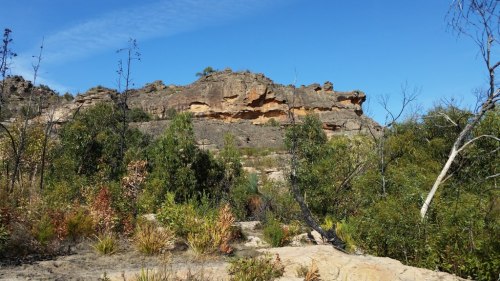
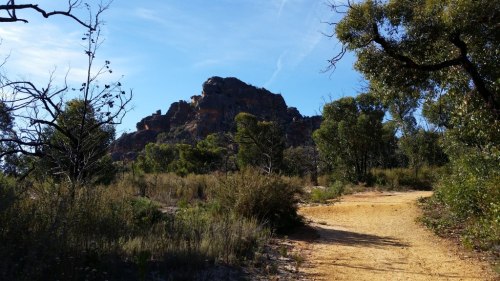
20180418_094613small20180418_094716_small20180418_095212_small20180418_095455_small

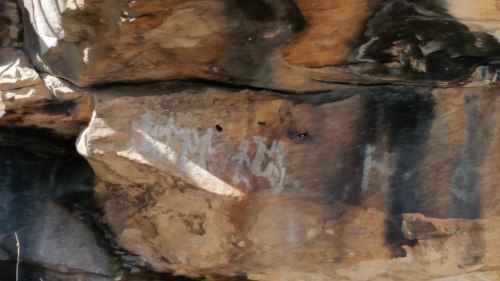
Then a bit further on to Ngamadjidj Shelter. Actually, a lot further because we got lost. Again, a bit of decent signage wouldn’t have gone astray.  This art has sixteen white figures, which is unusual because figures were usually painted in ochre. No one knows exactly what it means, because the traditional lifestyle of the  Jarwadjali people had been destroyed before it would be documented.
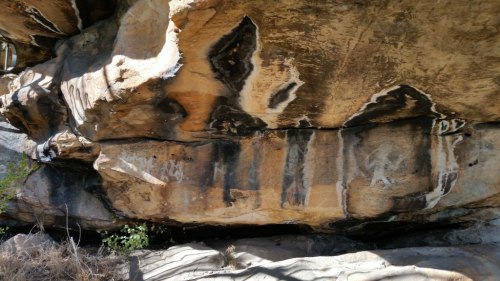
20180418_111354_small20180418_111404_small

Finally, Bunjil’s Shelter, near Stawell. This site is very significant because it’s the only depiction of Bunjil, the creator of the land, the people, the plants, the animals and the law.   You can see the presence of burnt trees around the site. Shame about the cage protecting it, but it’s necessary unfortunately.
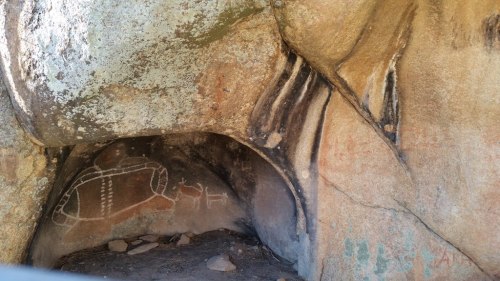
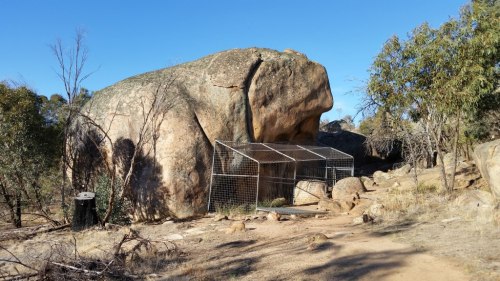
20180418_160803_small20180418_161018_small

Actually, I hadn’t realized how well the sculptor Bruce Armstrong had referenced the stone above the Bunjil drawing when he created the Bunjil statue in central Melbourne that is rapidly disappearing amidst all the high-rises near Southern Cross (always Spencer Street) station.
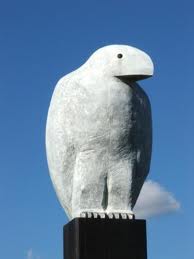
bunjilstatue

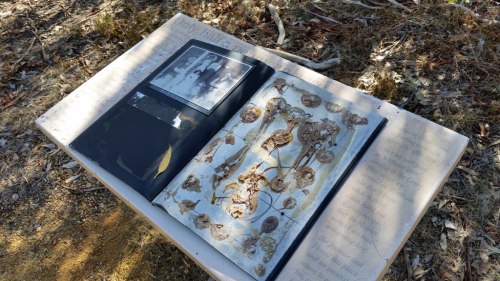
We called at Zumsteins Picnic Area.  It, too, was burnt out in 2014.  It was quite disorienting because it looked nothing like the way I remember it, with deciduous trees and kangaroos everywhere.  This article from 2013 shows how it was prior to the fire.  The signage was damaged here too,  with images torn from the information boards, exemplifying what I mean by ‘dropping the tourist ball’.  I wouldn’t have thought that it would take four years to replace.
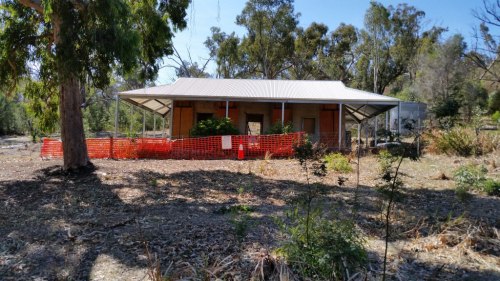
20180418_120314_small20180418_120442_small

There was a similar sense of dislocation when we visited Brambuk Cultural Centre. When I was there years ago, the distinctive curved roofline of the Brambuk Centre stood out, but it is now surrounded by trees, and obscured completely by a rather ordinary National Park centre.  Unless you knew otherwise, you wouldn’t even be aware that Brambuk was behind the National Parks building. It seems that plenty of money has been lavished on the National Park building, but the displays at Brambuk itself could do with some care.  On the top level the information boards from the excellent Koorie display are arranged in a haphazard way, and they are looking rather tired and worn. Are local politics at play here? Methinks they are.
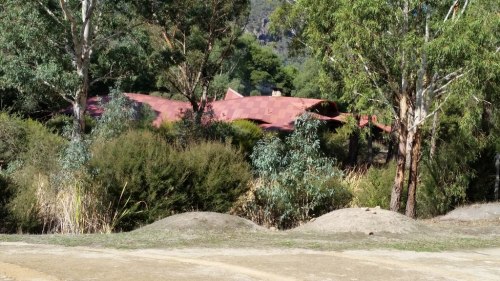
20180418_142140_small

The distinctive roof of Brambuk Cultural Centre
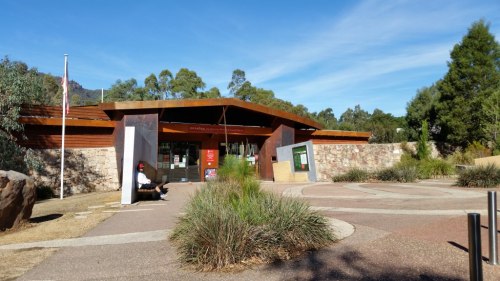
20180418_142454_small

The National Park Centre

The afternoon drawing to a close, we just managed to catch the Stawell Historical Society while it was still open. It is located in the old Pleasant Creek courthouse, as is my own Heidelberg Historical Society, but through a combination of a generous bequest and council and government funding, the administrative offices and records of the Society are in a brilliant new office building adjoining the court house. They have extensive records of families and newspapers, and very impressive temperature controlled store rooms.  The courthouse holds various honour boards from local organizations, a good photograph display from the 1860s -so early!- and a modelled streetscape.

20180420_102359_small

It was past the closing time for the Historical Society, and so we headed for our accommodation for the night. $60.00 a night at the pub in Horsham last night…what will tonight bring?
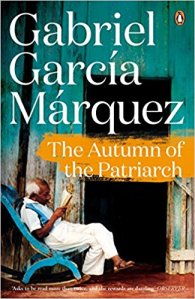


‘The Autumn of the Patriarch’ by Gabriel Garcia Marquez

AutumnofthePatriarch

1975, 240p.

I cannot tell a lie: I don’t think that I’ve ever been as glad to finish a book as this one.  It was a difficult book anyway, and my choice of reading platform was disastrous.  I was reading it on an e-reader and then had to swap to a tablet when the e-reader kept crashing (I suspect that the size of the file is too big for it).

Why so difficult- apart from the technology? Because it is the same story told six times, with variations between each telling, and because there are very, very few full stops.  You could go pages and pages without a pause.  In this regard, it is similar to the short story ‘The Last Voyage of the Ghost Ship’ that I read earlier this year. But a technique that was quirky and interesting in a short story became suffocating in a full-length novel.  I found myself thrashing through the text, as if I were drowning, waiting for somewhere to take another gasp of air. Because I was reading it electronically and the table of contents in such a large omnibus edition did not go down to chapter level, it was not easy to flip through to find where the chapter ended, for fear of losing my place – I’d never find it again.  In fact, I didn’t know where the book itself ended, and as the next chapter started up with the same story again, I began to despair lest I never reach the end of this book.

But I think that that’s how Garcia Marquez wanted you to feel. The story is about an unnamed dictator in an unnamed Caribbean island, who just does not die. Well – he does, ostensibly, in the first chapter where he engages a double to deflect any assassination attempts, and the double dies as a result. But in the succeeding chapters, his death is foreshadowed, but he just doesn’t die.  In a decrepit palace that is invaded with creepy-crawlies during the night, the Patriarch wanders from room to room, locking up the house, playing dominoes with other old dictators that he has imprisoned, raping the young women in the women’s quarters until he finally falls asleep on the floor, his arms cradling his head, only to wake up again the next morning and do it all again.

His country is submerging into debt and decay, and he is kept in power by his debtors, after they have pillaged the nation, causing him to even sell them the sea. He is uneducated and he forces the church and the people to deify his mother after she dies. Although impotent against his international debtors, he has absolute power within his own country, ordering mass deaths at will.  But he is fearful of losing his power, which is why this lonely figure wanders the house at night.

I read this story as part of a course that I am doing through Coursera called Gabriel Garcia Marquez: Between Power, History and Love, delivered in Spanish. Of course, I read the book in English: my mind just boggles at the thought of translating such complex sentences! After hours of translating, I worked out what the lecturers were saying, and their comments certainly added to my enjoyment of the story, but also highlighted to me how much is lost when reading an author who makes so many references to other (Spanish) texts.  I would never have picked it up, but the book pays homage to and subverts at least two other texts: Christopher Columbus’ account of the discovery of the Americas, and a poem ‘The Triumphal March’ by twentieth-century Nicaraguan poet Rubio Dario.  Well- both of those would have just slipped right past me!

The other point made by the lecturers was that this book, one of three ‘historical’ novels by Garcia Marquez, was published during the 1970s. The Patriarch is not named, but he could be any one of the dictators who have emerged from Latin America, and continued to do so when the book was published ( Pinochet in Chile, the Dirty War in Argentina etc).  It is part of a genre of Latin American ‘dictator novels’, but Garcia Marquez’s Patriarch is none of them and all of them.

Worth reading?  Yes – but be prepared for a really difficult read. And buy or borrow it as a real book. It’s just too hard to read electronically.

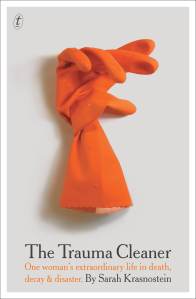
‘The Trauma Cleaner’ by Sarah Krasnostein

krasnostein

2017, 257 p

After I finished reading this remarkable book, I tried to think of other biographies (as distinct from memoirs) I had read of living people. I found myself rather stumped.  There’s Bernadette Brennan’s recent literary biography of Helen Garner Helen Garner and her Work but at that point, I came to a dead end. I don’t read celebrity biographies. I suppose that the political biographies issued under the Quarterly Essay imprint (e.g. on Turnbull, Abbott, Gillard) might qualify, although I tend to think of them more as commentary than biography.

But The Trauma Cleaner is a biography of a living, breathing woman, of whom you would have known nothing had not Sarah Krasnostein written this book.  Sandra Pankhurst is a cleaner, based in Melbourne, engaged in cleaning the places you would not want to be.  The rooms in which people have died unnoticed for months; the apartments where young people have died abruptly of a drug overdose; the homes where filth exudes out from under the doors into the unkempt front yards; the homes with a veneer of order on the outside that harbour an interior palimpsest of hoarded squalor that the owner cannot control.

Sandra , who owns and manages Specialized Trauma Cleaning (STC) Services, is a hands-on worker. Not only does she know all the tricks in the trade of stain removal, but she knows the limits that timber, carpet and plaster can bear: that sometimes a built structure just cannot be salvaged from the human misery it has contained. She handles people with professional skill, particularly hoarders who have either self-referred or been referred by agencies, but she gets her own hands dirty too.  She disguises her judgment of people’s weaknesses and trauma well; or perhaps she genuinely doesn’t judge.  Because she has had her own trauma too.

Told in alternating chapters, we learn that Sandra was born Peter. She had a terrible childhood in Footscray – and just as the houses that STC deals with are surrounded by normality, so too a childhood of abuse and emotional deprivation was surrounded by neighbours, other kids, street kerbs and suburban disinterestedness.  She had been a husband and father before her sex reassignment surgery; she had also been a drag queen, sex-worker, hardware store owner and wife.

Krasnostein accompanies Sandra as she is at work, flinching at the stench and drawn by the same fascinated horror that I felt as I read about the different jobs.  That same fascinated horror pulls the reader through Sandra’s story too.  Krasnostein talks with Sandra, who admits that there are whole chunks of her story and chronology that are missing through drug use or psychological blockage. She also talks with Sandra’s associates, tracks down people who have known Sandra over her life, trawls through documentary evidence. She clearly likes Sandra, and admires her, but at one point in particular, she is very angry with her. She knows that her relationship with Sandra is as brittle and contingent on acceptance as every other relationship that Sandra has had.

This is a beautifully written book. As it goes on, Krasnostein reveals herself as well, although I found this less satisfying, almost as if as author she was bumping her subject out of the spotlight, with a ‘look at me too- I’ve suffered’. Perhaps that’s unfair.

I commend Text Publishing for the photographs.  They’re colour photographs and well placed in the text, tethered in the chronology of the surrounding pages instead of pre-empting the story. They come in three groups, oddly spaced throughout the narrative. You see Peter and Sandra right at the point you’re reading about.  I found myself turning back to these photographs often.

I have been asking everyone I know ‘Have you read The Trauma Cleaner??’ and urging them to do so. I found it absolutely compelling and disturbing, and literally stayed up all night to finish it.  It won the Victorian Prize for Literature and the Victorian Premier’s Prize for Non-Fiction in 2018, and it fully deserves its success.

AWW-2018-badge-rose-199x300

I’ve read this as part of the Australian Women Writer’s Challenge.

Strange things from the box of photos No 4

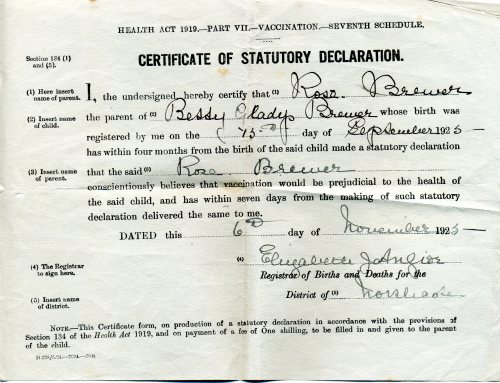
You might remember that we were going through a box of photos, looking for images that could be used in Dad’s memorial service. Ever the historian, I was attracted to things that my brother wasn’t.

Oh dear. My maternal grandmother was an anti-vaxxer.

img566


‘Frank Hardy: Politics Literature Life’ by Jenny Hocking

Hocking_FrankHardy

2005,  258 P & notes

I don’t particularly remember Frank Hardy.  If asked off the top of my head, I would have said that he died in the 1970s. I’m like the former premier of New South Wales Barry Unsworth who said in 1986, “I thought Frank Hardy was dead. I really did.” In fact, Frank Hardy didn’t die until 1994, but for me he somehow seems always to be of the  black-and-white TV decades, always associated with the races and cigarette smoke. I don’t remember the television program “Would You Believe?” (1970 -1974) which seems to have been a forerunner to “Would I Lie To You?”, on which he appeared as a regular panelist. But I do remember the Channel 2 miniseries ‘Power Without Glory’, for which Frank Hardy was notorious when it was published in 1950 and feted when it was televised in 1976.  It tells the story of John Wren of Collingwood, fictionalized as John West of Carringbush, and the corruption of the local ALP.

Melburnites of a certain age (and older) will be familiar with the underworld figure John Wren and it seems that many Melbourne families have their own John Wren stories.  For myself, my first husband’s family’s foundry was in Johnston St Collingwood, just up the road from John Wren’s tote.  On my side of the family, my own great-grandfather joined in the Sunday morning horse races along Sydney Rd to the Sarah Sands Hotel  ( a turn of the century version of drag racing maybe?) where he ended up beating a horse owned by John Wren, who was keen to purchase the victorious horse. My great-grandfather was not keen to sell. Wren came up to my great-grandfather, assured him that every man had his price, and left his card with him.  I don’t know how the story ended.

The first word in the subtitle of Hocking’s book is ‘politics’, and it was politics that drove Frank Hardy’s life. Hardy, as a member of the Communist Party, was financially supported by the Party for four years to write Power Without Glory. I had naively forgotten that the Communist Party hated the Labor Party as much – if not more- than the Nationalists/Liberals. The book was a way of smearing the Labor party by publicizing links between Labor politicians and the underworld ‘entrepreneur’ John Wren.

In her biography of Frank Hardy Frank Hardy: Politics Literature Life, Jenny Hocking describes the writing of Power Without Glory and its effect on the rest of Frank Hardy’s literary work.  It was a big book that Hardy mapped out carefully, researching real-life figures and very  loosely fictionalizing them by giving them pseudonyms with the same initials.  The book’s Wikipedia entry has a long list of the real-life and fictional characters, and the renaming is all rather obvious.  It was an unwieldy book, and it was to solve a narrative problem that Hardy took up a rumour that he’d heard about an extramarital affair and a resulting illegitimate daughter.  As Hocking tells it, Hardy agonized over the inclusion of this illegitimate daughter and so he changed her identity into a son. He was to continue to agonize over this decision in his own reflections on the writing process for the rest of his career.

Power Without Glory was published in 1950 within the context of the Menzies government’s Communist Party Dissolution Act.  It was printed surreptitiously, as seen in a  fascinating article by Des Crowley about the State Library of Victoria’s four-volume copy of the book ‘Proof Copy or Clandestine Version‘.  Almost immediately Hardy was brought before the court by the Wren children for criminal libel of their mother Ellen Wren (Nellie West). Hardy was found not guilty, on the basis that John West was a synthesized fictional character, not a real person.  He had escaped the clutches of the law through the decision that Power Without Glory was fiction but he and his readers knew that, at its core, it was not. The questions of fact, fiction, truth, reality and memory lay at the heart of many of his later works, most particularly The Hard Way and Who Killed George Kirkland?  It was like a weeping sore.

But as Hocking shows, there was more to Hardy’s career than Power Without Glory. Hardy was a member of the Communist Party from youth. Hocking describes the Australian literary scene at the time, when ASIO agents eyed literary figures and organizations with suspicion, and when the Party itself fractured after Kruschev’s revelations about Stalin, and the rise of Communist China.  Hardy was an outsider to academia, he was very much a contemporary of the other realist writers at the time: Jean Devanny,  Dorothy Hewett, Katherine Susannah Pritchard.  Hocking captures well the jealousies and enmities within the various branches of the Society of Realist Writers, and the politics behind the editorship of the Melbourne Realist Writers’ Group’s publication Realist Writer as it metamorphized into Overland.  Hardy railed against the “Patrick White Australia Policy” which lionized White but starved Hardy of Commonwealth grants because of his politics. In many ways, he received more recognition overseas that he did in Australia, even though he affected a quintessentially ‘Australian’ identity and stage presence.

Hardy was often impecunious, often because of his gambling, in which he followed his father. He was a difficult husband, conducting multiple affairs, leaving his wife Ross [sic] to cover the family expenses, and in effect doing exactly what he wanted to with little thought of his obligations or responsibilities. He was a loving brother to his sister Mary, who compered that weird Channel 7 trotting show Penthouse Club, which I loathed.

[As an aside, Marieke Hardy who appeared on the late, lamented First Tuesday Book Club, followed her grand-father and great-aunt into screen-writing and television]

He was also heavily involved with the Wave Hill Walk Off, acting as scribe and reporter for Vincent Lingiari and the Gurindji land rights struggle.  It was an involvement that drew the enmity of business, the Liberal government and the Communist Party, which dominated the indifferent North Australian Workers’ Union.  It was through this involvement that he became a close friend of Fred Hollows.

I really enjoyed this book, which took me to many events and places that I didn’t anticipate.  Hocking draws heavily on Frank Hardy’s own papers, but also Hardy’s autobiographical writing, newspapers spanning some 40 years, correspondence and papers of a slew of contacts and interviews.  You don’t need to have read Hardy’s works (I’ve only read Power without Glory) because Hocking gives a good taste of their flavour, and her list of Hardy’s works at the end of the book highlights how prolific he was as a playwright, journalist and writer of both short stories and full length novels.  The book is painstakingly researched but easy to read.

But -oh- he was a slippery character.  He was a great ‘yarner’ and gave the appearance of being open, while boiling inside with secrets. His carefreeness barely cloaked carelessness and irresponsibility.

Near the end of the book, Hocking sums up his life:

In Hardy’s fragmented character, the committed political activist, tireless Party worker and determined writer coalesced with the man who shamelessly abandoned himself to the lure of racing, gambling and debt.  It was this divided character, with its alternating obsessions that had enabled Hardy to withstand decades of official disinterest, denial and derision, sustained by a political cultural milieu that he had himself helped create. But the uneasy juxtaposition of literary revelation, political action and personal secrecy within him always threatened to fracture, held together through continuing self-examination and by the unmet promise of eventual disclosure. Although he wrote extensively about himself, presenting each new work as the opportunity for self-reflection and revelation previously denied him, in each retelling Hardy revealed little that was new. (p 256)

Source: La Trobe University Library

Read because: My interest was piqued after reading Paul Strangio’s book about the Victorian Labor Party Neither Power nor Glory

My rating:  9/10

AWW-2018-badge-rose-199x300

I’ve read this as part of the Australian Women Writers Challenge for 2018.

A couple of days in Marysville

It’s been a rough month or so, and we decided to head away for a couple of days. I’m keen to head back to Tasmania this year but Steve’s U3A commitments preclude going away for more than a week. So instead we decided to head up to one of my favourite places, Marysville.  When I was a child, we used to stay there for a week each September at Marylands Guest House.  We went up there again in about 2005, by which time Marylands was somewhat out of our price league, having been rebadged as Marylands Country House.

Marysville was almost obliterated during the Black Saturday bushfires of 2009, along with all its guesthouses.  Although there has been a lot of rebuilding, there is now only one Guest House as such, complete with tennis court, billiard table, table tennis table, lounge, library etc.  That’s what I wanted: not a B&B, not a motel room, but a proper guest house.

El Kanah was originally one of the ‘Mary’ chain of fake-Tudor guesthouses, called Mary Meadows. There’s a picture of it in its Mary Meadows form here.  During the 1970s it was taken over as a Christian enterprise and renamed El Kanah. In fact, my best friend Micheline and I stayed there after end-of-year exams one year.  You can see the pre-fire El Kanah here and some interior shots of the guesthouse here.  You can see photos of El Kanah in the aftermath of the fires here.

The present-day El Kanah is still a Christian undertaking, but no questions are asked about your religious affiliations when you book in.  I don’t know how they would have reacted if we declared our  Unitarian and an agnostic leanings, but they were very pleasant and friendly people. The Billy Graham video, the wafting sound of hymns and ‘blessings’ didn’t bother us. It’s certainly a large undertaking, and I wonder quite frankly how they can afford to run the place.  It’s not cutting-edge in its architecture, but it’s very comfortable, and I’m glad they kept the curved windows at the front to reference the old El Kanah (Mary Mount). It’s a patchwork bed cover sort of place and it only has instant coffee.  If it’s real coffee and modern decor you want, go down to the Vibe instead.

20180301_100335

From the front

20180227_144151_small

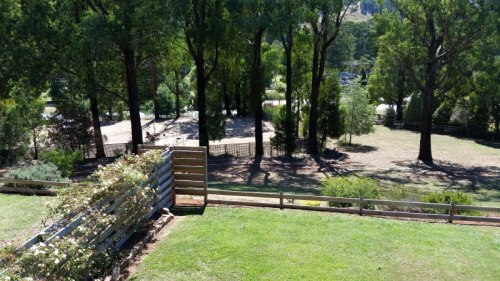
View from our balcony

20180227_144124_small

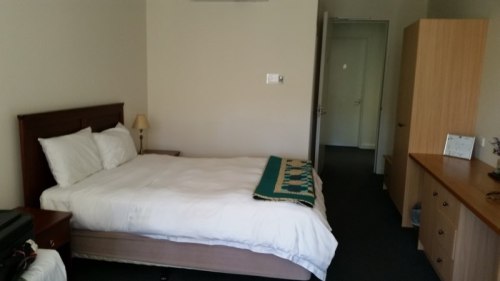
Our room

Anyway we had a lovely few days, ambling down to the town for our real coffee and a read of the newspapers, kicking back and reading a whole book in one day in either their very comfortable library or out in the garden, and driving around to the various forest walks.

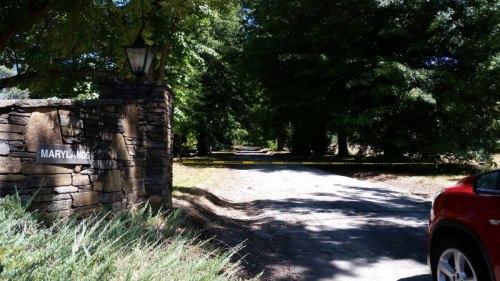
We drove past where Marylands used to be. When we visited on Cup Day a few years back, there were plans to subdivide the site.  I’m rather pleased that the driveway  lined with oak trees is still the same as it used to be, with no sign of building yet.

20180227_141244small

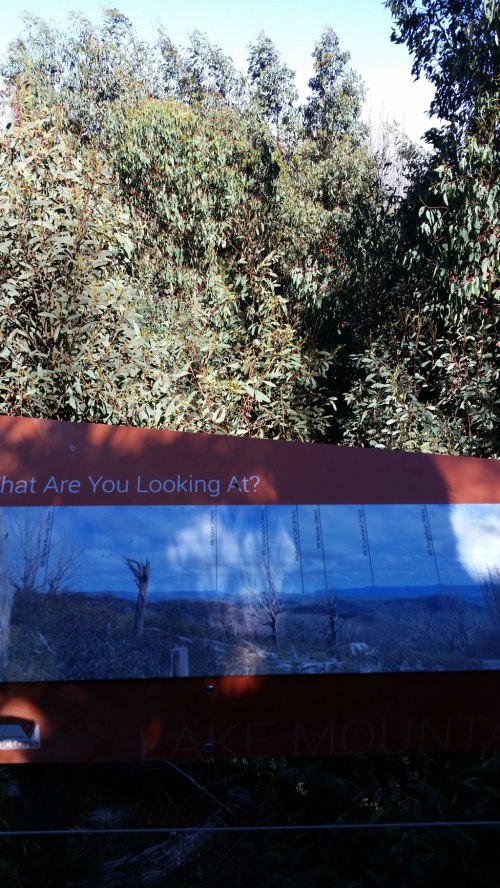
We drove up to Lake Mountain, a popular cross-country ski-ing location. Of course, there was no sign of snow at all on a 25 degree day. We were interested by the Bjarne K Dahl memorial boardwalk which was constructed before the trees all began growing back.  This image on the information board from October 2013 shows the outlook at that time, with the surrounding mountains clearly visible.  There’s been so much growth in the intervening five years that it is unrecognizable.

20180228_100058_small

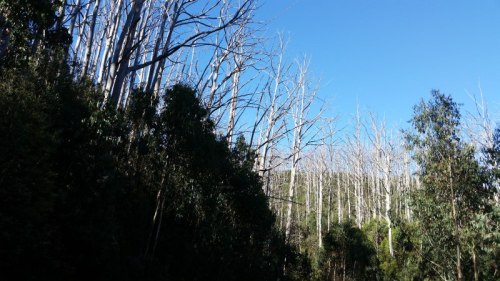
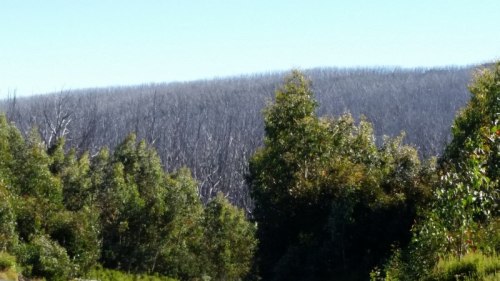
That’s not to say that there’s no evidence of the bushfire.  Particularly on the tops of the mountains, there is little regrowth yet.

20180228_093347_small20180228_101008_small

I was interested to learn that the reason that Lake Mountain has large grassed expanses is because the mountain ash trees did not have a chance to regenerate after the 1926 fires before they were burned again in 1939. The rapid succession of bushfires disrupted the usual seed-dropping cycle that allows mountain ash forests to recover from fire.

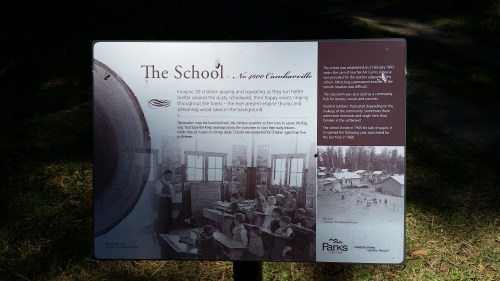
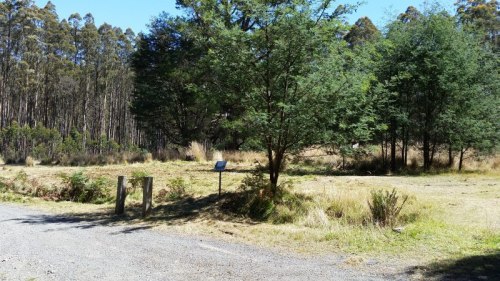
We visited Cambarville, which had been a timber town during the 1940s, following the 1939 bushfires.  It is now an empty site, with a few interpretative signs laying out the school, mill and ‘main’ street.

20180228_12154320180228_121551_small

It, too, was burnt out during the Black Saturday fires, although it was long gone by then.  It must have been a pretty bleak place to live, with no electricity, mud and inhospitable terrain.

The waterfall walks were beautiful.

20180228_125701_small

Even though there has been lots of money poured into Marysville to ‘save’ it, there’s still something ghostly about it. I know that we went up mid-week during summer, but it feels as if the rebuilt town is too big for itself.  The Vibe hotel and convention centre dominates the main street, and the rebuilt bowling greens do not have a bowling club to use them. There are very few ruins any more, but many footpath crossings lead only to empty blocks.

The autumn leaves will turn soon.  All of the oak trees in Murchison Street are flourishing, and Marysville will be just as beautiful in autumn as it was before the fires. And it does have a real guest house.

Hardcore History podcast: Blueprint for Armageddon

I’ve taken to trying to walk a bit more for fitness, and so I kit myself up with my smartphone and wireless headphones, turn on a podcast and off I go.  For the past 23 hours I’ve been listening to Dan Carlin’s Hardcore History opus, ‘Blueprint for Armageddon’, which runs for six episodes ranging in length from 3 hours and 7 minutes to a massive 4 hours and 29 minutes.  It’s about World War I, told chronologically and based largely on primary sources and a survey of secondary sources.

Dan Carlin is not a historian, but a broadcaster who loves history. He spends too much comparing people and events for my liking, and at times I felt as if the series was descending into trench-porn as he tried to capture the experience of fighting on the western front.  He cited frequently from primary sources from soldiers fighting on different sides, read in a harsh tone to distinguish it from his commentary.

So why did I persist for 23 hours? Well, he did a really good job particularly in the first episode on laying out the groundwork for the war that was to follow, drawing heavily on Barbara Tuchman’s The Guns of August. Even though he confessed his frustration at what he left out (even at 23 hours!), I thought that he did a good job of ranging across the different theatres of war, even picking up on the Australians and New Zealanders although his main focus is the western front. He does go on and on about things, but I didn’t mind that as my mind could go off on a little wander of its own, then I could refocus and catch up with what he was saying (indeed, by the time I tuned in again, he was often still making the same point!)  And although he does labour some ideas, at heart they’re often insightful, original and interesting points that he’s making.

Still, that’s enough military history for me for now.

Movie: Wonder

Dad thought I’d probably enjoy this. Then he thought again.  As someone with a cleft lip and palate, I’ve had my own share of stares and cruelties as a child.  I’ve also felt the pain of being the parent of an affected child.  Perhaps it might be too close to the bone? he wondered.

He need not have feared.  I was not uplifted.  I was not cast down. My main response to this movie was nausea at its unrelenting saccharine-ness.

The little boy who starred in the movie does not have Treacher-Collins syndrome. His appearance was created through prosthetics and makeup. I’m not sure how I feel about this. I acknowledge that it would be an exceptional child who could both act and live a life of being stared at and shunned.  I don’t know if anyone would want to play in a kid’s head that way.

On the other hand, there’s something inauthentic about a movie with the message of “you are beautiful no matter what” and “be kind” choosing a non-affected child to pretend to have Treacher-Collins.  Something a little too easy about being able to wipe off the prosthetic and then go on to the next movie.  I’m uneasy about it.

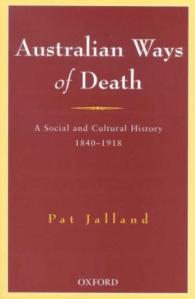
‘Australian Ways of Death’ by Pat Jalland

jalland

2002,  328 p & notes

This might seem a really perverse book for me to have read recently. My father died a fortnight ago, and I began reading it while he was gravely ill.

You’ll note from the title of this book Australian Ways of Death: A Social and Cultural History 1840-1918 that Jalland finishes her book at the end of WWI. In the epilogue she explains why she made 1918 the cut-off point. Most obviously, the death and disappearances of so many soldiers overseas in WWI, with their bodies  buried on the other side of the world (if found at all), forced a change in the way people mourned. Information was incomplete and delayed, and there was no physical grave nearby to be visited.  But she also points to the present-day medicalisation and denial of death that has emerged since 1918.  The influence of Christian churches declined; there was a change in the meaning of death as life expectancy rose with a shift from infancy to old age as the most probable time of death; the medicalization of death meant that the death of a patient represented ‘failure’, and the physical act of caring was relocated from women relatives to hospitals and nursing homes. (p.327)

So why read this book now? I felt with Dad’s death that we were reverting to an older, more traditional way of facing death. First, after several bouts of bypass surgery and an inoperative stent over a period of thirty-five years, Dad was dying with heart and renal failure – a slow, inexorable death for which there was no magical surgical or medical cure, just as was the case during the 19th century.  Second, we chose to help Dad die at home, not in hospital. Even though we had a hospital bed, carers and nurses attending him and twice-weekly visits from a wonderful GP, they were walk-on, walk-off players. The more common scene was just us, day and night, in the lounge room where Dad decided he’d prefer to be, with a bag of prescription drugs to be sure, but more importantly face-washers, ice chips and glasses of water. And so, I sought out this book, out of curiosity and fellow-feeling, and probably as an attempt to intellectualize what we were experiencing these last few weeks.

Prior to the publication of this book, Pat Jalland had written about death and the Victorian family, most particularly in Britain. In this book, she looks for continuities but also differences between the Australian and British experience.

Part I examines immigrant deaths at sea, both of children and of adults. Her time frame extends beyond the mass immigration of the 1840s and the gold rush, into journeys made later in the century. Chapter 1 ‘The Terror of a Watery Grave’ explores the experience of losing a child while on-board ship, which was all too common, and which was often dealt with expeditiously and without formal ceremony. That did not mean, however, that the parents did not grieve: they did, from the ‘poshest’ cabins through to the meanest steerage berth. Chapter 2 ‘Faith, Fever and Consumption’ took up the experience of on-board death amongst adult passengers, who rarely had the opportunity to have the ‘good death’ that nineteenth-century people sought, even though the ‘sea air’ and Australian climate was thought to be restorative.  Because the journey was such a huge life-event, taking people far from their families, there is a cache of correspondence that Jalland can draw on that represents a range of families of differing economic status.

In Part II, ‘The Good Christian Death’, she explores the transmission of ideals of ‘the good death’ from Europe to Australia. She notes that it survived strongly over two generations from the 1830s through to the 1880s.  She follows  Hilary Carey’s suggestion that during the last decades of the 19th century and early decades of the 20th, religious indifference increased among the working classes and intellectuals began to question their faith. She argues that the ‘good Christian death’ was experienced differently by Roman Catholics and Protestants. Protestants emphasized a more individualistic death, dependent on family support, where Catholics relied more on rituals dispensed through the priesthood, and thus somewhat removed from family responsibility.  She notes that deathbed scenes from the 1870s onwards, as described in condolence letters and correspondence to those at ‘home’, moved away from a pious concern with the spiritual state of the sufferer, to a desire that the patient die without pain. A ‘good’ death early in the century was a spiritual one; by the end of the century it was a painless one.  She notes that although funerals like Burke and Wills’ extravaganza consciously set out to emulate a British funeral like that of Wellington’s, there was discomfort both with the expense and extravagance on the one hand, and embarrassment at shoddiness of the colonial attempt on the other.   Strangely, amongst the clergy, there was more emphasis on hell in Australian theology than British theology, despite attempts by Unitarians and liberal Anglicans to abolish or at least moderate the terrors of the doctrine. Tombstones were derivative of the graveyards of Great Britain and Europe, but there was greater emphasis on ‘In Memorium’ advertisements in the newspapers.  Keepsakes, hair remembrances and photographs were popular, especially as they could be conveyed physically across the ocean.

Most of this section draws on the writings of middle-class, educated correspondents, and Jallard pauses to examine two particular examples of masculine middle-class memorialization: that of Herbert Brookes for his first wife Jennie.  Even though he later went on to re-marry Ivy Deakin, the daughter of Alfred Deakin, throughout his life he visited Jennie’s grave twice a year.  The other case study was Dr John Springthorpe, whose memorial tomb I wrote about here.  I found it interesting that both these intellectual men, who mourned so deeply and openly, were associated with (although not adherents to) Rev Charles Strong’s Australian Church – in fact, Jennie was Strong’s daughter.

Part III shifts gear, and looks at ‘Death and Destitution’.  Part II had been drawn from the correspondence and writings of middle-class families, but here Jalland turns to the statistical reports and records of ‘benevolent’ asylums, where the individual voice is rarely heard. Although by the 1870s reforms in Britain were gradually changing the nature of the workhouse from a punitive institution to a form of general hospital . This did not occur until decades later in Australia.  Jalland compares the major institutions in different states, noting that conditions were better in Adelaide and Melbourne Asylums. In Tasmania, there was a particular stigma attached to the convict stain, and many sick and dying paupers were ex-convicts. She devotes a whole chapter to benevolent asylums in New South Wales, where a number of government inquiries called on inmates as witnesses, eliciting changes to key institutions in the early 20th century.

In Part IV, Jalland examines death in the bush and in the Great War. Although the literature and artwork of the 1890s sentimentalized the bush burial, or emphasized the heroic deaths of explorers and bushrangers, it was more common for men to die of accidents, illness and – quite frankly- stupidity.  The harsh environment made elaborate rituals impossible and inappropriate. There was respect for the dead, and a stoic acceptance of its inevitability. There were wakes- often “noisy and exuberant masculine affairs” (p. 259). Aboriginal deaths at the hands of settlers were silenced, and many old bushmen, often ex-convicts, died lonely and destitute deaths.  Lost children captured the public imagination, but more commonly women died in childbirth, and children often died after birth or through illness.

In the epilogue, Jalland links the stoic, pragmatic attitude towards bush funerals with the death of mates in the trenches during WWI.  For those at home, there were no graves to visit, and death permeated the community. Churches became more feminized, especially in Protestant churches, and some turned to spiritualism.  As in Part II, Jalland turns again to the example of middle-class, intellectualized masculine grief at WWI loss through the example of John Roberts, who kept detailed scrapbooks about his son and Justice Henry Bourne Higgins who suffered silently.  These men were not religious, and their response marked the increased secularization of death in the twentieth century.  Jalland explored this further in her later book Changing Ways of Death in twentieth-century Australia: war, medicine and the funeral business.

This was a strange book to read at a strange time.  I much preferred the chapters where she cited letters and case studies, rather than the demographic and statistical chapters.  I really liked the way that she approached the question of 19th century death from so many aspects: middle class/ working class; male/female; Catholic/Protestant; Urban/Rural; English/Australian. Other writers have since picked up where she left off (for example, Tanya Evans on benevolent asylums, or Bart Ziino on war graves).  But there is real human interest here,  with a common humanity, even though practices may have been different.  At a difficult time I found it interesting and oddly comforting.

AWW-2018-badge-rose-199x300

I’ve read this book as part of the Australian Women’s Writers Challenge.

Strange things from the box of photos No. 3

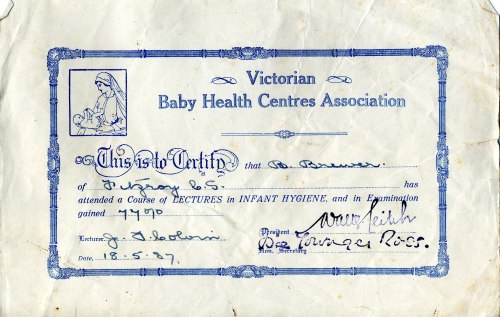
This certificate was awarded to my mother when she was in Grade Six.  It’s hard to imagine Grade Six girls (because I’m sure that it was only girls) being taught baby-wrangling at school today.  No doubt these 1930s girls would have been expected to help their mothers.

And her 77% result? Well, I guess that’s 3/4 of a baby.  It was obviously enough.

img565