Category Archives: Uncategorized

Movie: Colette


(From a few weeks back)

It’s a pity that Keira Knightly was case as Colette in this movie. She’s too well-known and I was consciously aware of that throughout most of this movie, except for one striking scene where she becomes very angry. Dominic West was very good, and disappeared better into the character. I must confess to never having read any of her work, and really knew little about her. Still, an interesting take on celebrity and marketing in the literary world of a century ago.

My rating: 3.5 stars

I’m off……again

IMG_3243

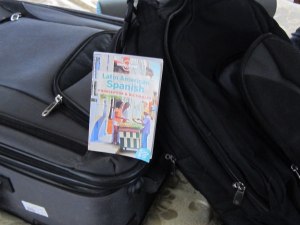
Did I mention to you that I’m off again? This time to Buenos Aires, Colombia and the Atacama Desert in Chile.

You can follow my adventures – and this time I hope that this rather edgy trip doesn’t have any adventures to speak of – at my other travel blog

https://landofincreasingsunshine.wordpress.com

I rather foolishly promised that I would write the first sentence of each entry in Spanish, so apologies to those who don’t read Spanish, and even deeper apologies to those who do!

‘The Presbyterian Church of Victoria: Growth in Fifty Years 1859-1909’ by D. Macrae Stewart

PresJubilee

1909, 129 p.

This book was written to celebrate the golden anniversary of the creation of the Presbyterian Church of Victoria in 1859, combining the Synod of Victoria, the Synod of the Free Presbyterian Church of Victoria and the Synod of the United Presbyterian Church of Victoria. There was one section of the United Presbyterians who didn’t join until after 1870, but in terms of golden jubilees, 1859 was the date. (Mind you, the earlier book I read about Presbyterianism in Victoria dated the coming together of different strands of Presbyterianism to 1867 instead.)

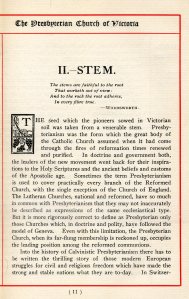
Written as a celebration publication, the text is laid out quite beautifully, with red margins and decorated inhabited initials to mark the start of each chapter. Stewart has used a planting metaphor to organize his chapters, which are titled ‘Seed’ ‘Stem’ ‘Branching’ ‘Pruning and Grafting’ etc.

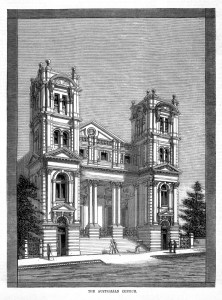
As this book goes up to 1909, it covers the Charles Strong controversy of the 1880s, which of course had not occurred when Sutherland published his earlier history of the Presbyterian Church in 1877. Charles Strong, who had been the pastor of Scot’s Church in Melbourne (probably the premier Presbyterian church in Melbourne)became the first minister of  the Australian Church in 1885 after being charged with  promulgating unsound and heretical doctrine and resigning his position from Scots Church.  I think that if I’d been alive at the time, I would have been attracted to the Australian Church.

the australian church.

The Australian Church at the eastern end of Flinders Street (near Spring Street). It seated 1200 and opened in 1887 but the Church shifted to more economical premises in 1922. The Australian Church was finally dissolved in 1957. From the Australasian Sketcher. SLV http://handle.slv.vic.gov.au/10381/258170

The book has several plates showing prominent churchmen, mainly of the past but with some contemporary men (in 1909) as well. So many beards!  There are few mentions of women, but there is a section on the Presbyterian Mission Womens Union, famous for its cookbook. I only now realize that I always called it the PWMU rather than PMWU.

The book is curiously silent about the 1890s depression. Perhaps in 1909 it was too soon to discuss such things.

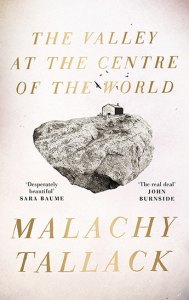
‘The Valley at the Centre of the World’ by Malachy Tallack

tallach

2018, 352p.

I can’t remember quite why I borrowed this book when I saw it on the ‘New Books’ shelf at the library. Perhaps I’d heard good reviews of it or maybe it was its setting in Shetland that attracted me. I enjoy Shetlands on the ABC and I heard a cracking interview with the author of Vera and Shetlands, Anne Cleeves. What ever drew me to it, it’s a beautiful book that I almost didn’t want to end. It surprises me that the author is a young man. The book felt as if it were written by an older person (think, perhaps Marilyn Robinson’s Gilead or perhaps Elizabeth Strout’s work) in terms of its treatment of the relationships between people, infused with a sensitivity to place and space.

The Valley at the centre of the world is exactly that – a single valley with just five houses clinging to The Road that runs above and parallel to ‘The Burn’, the waterway that runs to the sea. The use of ‘The’ is intentional: there is only one. In its harsh but beautiful isolation, there is a timelessness about The Valley, although people are coming and going. Older man David has lived there all his life, as did his father and grandfather before him. Although he does not consciously think of it this way, he owns the valley.  His wife Mary, came there thirty years ago and their daughters Kate and Emma have both shifted away.  Sandy, a newcomer, was their daughter Emma’s partner and came back with her to the Valley but the relationship has broken up. He stayed on when Emma left, and with a respectful relationship to his inlaws (do you have inlaws if you’re not married?) and now landlords, he takes over the cottage and croft left vacant when Maggie, a very old inhabitant dies. There is Terry, a morose alcoholic single father, and Jo and Ryan, who have shifted into the Red House from the city, with Ryan a go-getter spiv taking advantage of the cheap rent. Finally, there is Alice, a crime writer (who reminded me not a little of Anne Cleeves herself) who has moved to the valley after the death of her husband. She has decided, somewhat presumptuously I think, to write about the Valley and is particularly drawn to Maggie as a character, hoping to find some secret or depth about this woman who had spent her whole life in the Valley.

The book revolves around the lives of this small group of people, who each have their griefs and flaws. It is a slow book, just as life itself in The Valley is slow. Soap opera? Perhaps, but it’s soap opera written with insight and generosity.

What is striking is the use of dialect in the conversation. There’s a glossary at the front, but it’s more the sentence construction and small words that slows you down as a reader. I don’t subvocalise or even mentally vocalise when I read, so this was a strangely auditory reading experience for me.

I really loved this book, and didn’t want it to finish.

My rating: 9/10

Sourced from: Yarra Plenty Regional Library


Looking forward: 2019

These are not resolutions- they’re challenges!

  1. To read twenty books in the Australian Women Writers Challenge 2019
  2. To read sixty books overall in my Goodreads challenge.
  3. To finally finish reading Harry Potter y la piedra filosofal in Spanish (it’s taken about six months so far)

Looking back: 2018 in review

This seems to be the time of year when people review their reading and viewing progress over the last year, so I’ll add my two-bits.

During 2018 I read 57 books that I reviewed on this blog (I actually read more but I’m ‘saving’ them for when I have no posts). Of these 36/57 were by women, which doesn’t surprise me. I’m involved in the Australian Women Writers Challenge, and that tends to steer me towards women writers.

I mainly read Australian works, with 35/57 being written by Australians, although not necessarily set in Australia. Of these 35, 24 were written by Australian Women, again probably reflecting the AWW challenge.

I lean towards non-fiction, with 37/57 falling into the non-fiction category. Of these 37, twenty were ‘academic’ non-fiction, both history and biography, which I distinguish from other non-fiction by the presence of footnotes and/or a bibliography.

As far as most memorable reads go, I started the year well with Phillipe Sands’ East-West Street and finished it with David Sornig’s Blue Lake.  Along the way and with hindsight, I really enjoyed Janet McCalman’s Journeyings, Sarah Krasnostein’s The Trauma Cleaner, and Judith Brett’s The Enigmatic Mr Deakin.

I saw 27 movies over the year, eight of which were subtitled. If I were to nominate a New Year’s resolution (which I won’t) then it would be to see more international films.

And that was the year that was.

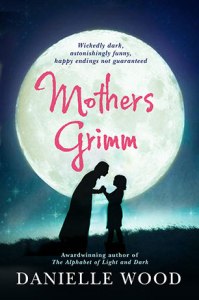
‘Mothers Grimm’ by Danielle Wood


wood_mothersgrimm

2014, 212 p.

When I was little, my mother gave me her copy of  ‘Children’s Treasure House”, printed in 1935. It was a huge book- some 700 odd pages, with stories from a range of mainly British authors, and a sprinkling of Hans Christian Anderson and the Brothers Grimm. It had beautiful art deco illustrations, including colour plates. Few of the stories were rewritten for younger readers, and the fairy stories were left with their darkness and thinly veiled menace. There were plenty of  absent mothers, bad mothers and step mothers, but the good mother was always absent. It seems that the story can only begin once the Good Mother gets out of the way.

In her prologue to her collection of long short stories Mothers Grimm, Danielle Wood reminds us that the archetype of the Good Mother still surrounds us, in advertising, in magazines and in impossibly well-groomed women in your playgroup. Written in the second person, she invites the reader into an identification with a less glowing model, the not-very-good, ambivalent, rather resentful mother instead. She does this through four lengthy short stories, each titled with a single word, that have at their base the sort of archetypes that emerge in the tales of the Brothers Grimm. I can sense the presence of those archetypes (e.g. Hansel and Gretel in ‘Cottage’), but I must confess that I’m struggling to put my finger on the exact story or character for some of the others.

The four stories are all set in the present day, with women as the main characters and men playing only bit parts. The women here are sisters and mothers, and they are flawed. Some are exhausted, others guilt-riven, some manipulative, others cruel. The stories are long enough to really develop the characters and draw you into identification – not necessarily sympathy- with them. At about 40-50 pages in length, they are just the right length for me as a reader: able to be read in one sitting, and meaty enough that you don’t’ want to turn to the next one, but just let it sit instead.  They are Australian stories without going all ‘Henry Lawson’ on the reader; they are urban and current and thoroughly relatable.

But looking at the publisher’s blurb on the front cover (which to be fair, the author has limited control over), I found myself wondering if I had read the same stories. “Wickedly dark, astonishingly funny, happy endings not guaranteed” it reads.  Dark, certainly but I found too much truth in them to be funny, and there are certainly no happy endings here, just realistic, stuck-with-it ones. As life is.

My rating: 9/10

Sourced from: Yarra Plenty Regional Library.

Other reviews:

Sue at Whispering Gums enjoyed it, and did a much better job than I in identifying the source stories!

AWW-2018-badge-rose-199x300

I have included this on the Australian Women Writers Challenge 2018 database.

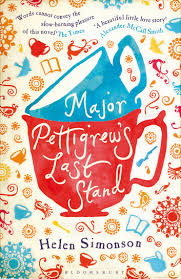
‘Major Pettigrew’s Last Stand’ by Helen Simonson

simonson

2010, 359 p.

This was a bookgroup selection and I’d left it late to start reading it. So, in the one night I was catapulted from Vichy France and Nazi interrogators in Lovers at the Chameleon Club  into  English village life, retired Army Majors and golf-club gossip in Helen Simonson’s Major Pettigrew’s Last Stand. A very abrupt change of pace!

I was surprised to learn that Helen Simonson is an American writer, albeit British-born, who has lived in America for the past twenty years. She captures village life remarkably well. Midsomer Murders is a cliché, but when I visited my brother who lives near a village outside Maidenhead, I was stunned to find myself in a village that looked very much like that murderous locale, right down to the village green with the white posts and looped chain fence. This is the sort of place in which  68 year old Major Pettigrew (retired) makes his last stand.

Not that you’d know it from the opening pages of the book where, numb after the death of his brother, he has put on his deceased-wife’s floral housecoat. The doorbell rings, and he answer it to find Mrs Ali, the widow of the local general-store owner. With self-assured pomposity and casual racism, he had barely been aware of her except to buy his blended tea from her, but they strike up a friendship.  They are drawn into the disastrous plans by the local golf club to have as their party theme ‘The Last Days of the Maharajah’, an ignorant and insensitive event which conflates India and Pakistan, the Mughals and the Empire. Both the Major and Mrs Ali are quietly resisting the suffocating oversight of their son/nephew, both of whom are insufferable in different ways. The book does become rather hyperactive at the end.

Is it the persistence of Baby Boomers as a reliable reading market that has led to a rash of older-person ‘twilight’ relationships? I’m thinking of Our Souls at Night, Elizabeth Strout’s Olive Kitteridge, or Australian author Josephine Wilson’s Extinctions, all of which have older protagonists who are being pressured by their offspring.

This book is a comfortable read that reveals a wry sense of humour. I was reminded of Barbara Pym, and perhaps even shades of Jane Austen. I hadn’t ever heard of it, but it was a very enjoyable escape that made you squirm at time with embarrassment, roll your eyes at pretension and prejudice, and rejoice in a happy ending that didn’t necessarily tie up all the ends too neatly.

Sourced from: CAE bookgroups (a reading selection for my bookgroup)

Rating: 7.5/10

I hear with my little ear: podcasts 7 – 14 December 2018

Background Briefing. The Bird and the Businessman. I am angry!! This is appalling. I have written to the Minister and Shadow Minister. And while I’m thinking about it, I’m angry about the proposed freeway in the Edithvale wetlands too.

Revolutionspodcast Episode 9.14 The Ten Tragic Days. OK, so President Madero was democratically elected, finally breaking the hold of Porfirio Diaz over Mexico. He only ruled for 15 months before he was deposed by counter-revolutionary forces emboldened by US Ambassador Henry Lane Wilson. A pretty depressing episode really, especially the care with which it was made to look ‘constitutional’.  I need to find a podcast that makes me laugh, I think

Rough Translation  Intruders. Argentian daytime television program ‘Intruders’ was tacky, daytime television (that everyone watched but no-one would admit watching) with a long-standing, smirking, somewhat sleazy male host and a procession of women in high heels. Then, things changed, as the show began voicing feminist ideas. A fascinating podcast.

I hear with my little ear: Podcasts 30 Nov- 6 December 2018

Rear Vision It’s the 20th anniversary of the Good Friday agreement in North Ireland, but I was more attracted to these podcasts, broadcast earlier this year, in relation to Brexit and the fears of a ‘hard border’ in Ireland again. It’s a two-part series, with Part I looking at The Troubles and Part II looking at the agreement. It’s really good to revisit the history of the Troubles brought right up to date. I didn’t realize how fragile the ‘peace’ is.

Another Rear Vision episode that I’ve had saved for a while is Red Marauder: A History of Drought in Australia. An interesting idea: that drought only really entered settler consciousness after the Selection Acts of the 1860s and 1870s that made it possible for small-scale farming, rather than earlier when squatters could just move their flocks and herds if one area became dry. An interesting review of drought policy over the last 30 years, too, and the way that really good policy was unstitched to return us to ad-hoc drought relief again.

Russia, if you’re listening. This episode is called “Why are news networks calling Paul Manafort an idiot?” but it also goes on to talk about Russia and the naval standoff with Ukraine. And interesting to go back to the Felix Sater episode, now that he’s popping up in the news again.

Revolutionspodcast. Episode 9.13 The Plan of Ayala. Francisco Madero decides to rile up his old friends, including Emiliano Zapata who issues the Plan of Ayala, a blue-print for third-world agrarian revolutions everywhere.

Duolingo Podcasts. These really are good. La voz de la calle is about a man in Buenos Aries who had fallen from a job, his own home and family into homelessness in the Argentinian economic crisis of 1999. My Spanish teachers had mentioned the Argentinian pronunciation of words with double-L, and it’s certainly apparent here.