Category Archives: Uncategorized

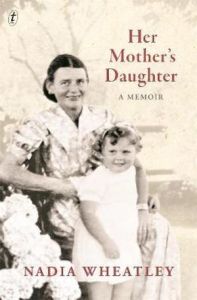
‘Her Mother’s Daughter’ by Nadia Wheatley

Wheatley_Mothers_Daughter

2018, 352 p.

I’ll be honest: I don’t really like the ‘parental memoir’ books, even though I seem to keep reading them.  You know the ones I mean, where a child (often already an established writer) writes the biography of one of their parents, interweaving it with their own memoir and ‘journey’ in trying to understand their parent/s. I’ve read my share of them, historian Jim Davidson writing about his father; Biff Ward writing about her historian father and his wife; Catherine de Saint Phalle writing about her Parisian parents Poum and Alexandre; Marie Munkara writing from the point of view of a member of the Stolen Generations re-discovering her family; Anne Summers writing about her mother and a painting, and Magda Szubanski writing about her family and coming out.

That’s a lot of books for a genre that I’ve said I don’t like. I am uncomfortable with the stripping-bare of a parent who cannot defend their actions, and I dislike the sense of long-held grievance that often permeates a child’s judgement of their parent, no mater how long ago these childhood events occurred.

So why, then, did I read this ‘parental memoir’? I think it’s probably because I admire Nadia Wheatley as a biographer through her excellent biography of Charmian Clift The Life and Myth of Charmian Clift and I was interested to see how a professional biographer/historian deals with the problem of writing a hybrid biography/memoir. [It was this methodological curiosity that led me to read Davidson and Summers, and will probably lead me to Jill Roe and Brenda Niall one day.] More immediately, it was as a response to reading excellent reviews by Jonathan Shaw and Sue at Whispering Gums.

The title of Wheatley’s book Her Mother’s Daughter is an act of claiming back her relationship with her mother. She was told by family that because she was only nine when her mother died, she couldn’t possibly remember her. Besides, she was told, her mother would have hated her Leftist policies. It was in reconstructing her mother’s life as an adult, from what people told her about her mother, and drawing on her own memories written at the time of her mother’s death in a valiant attempt to stop them dissipating (surely the act of a future writer and biographer!) that she realized that her mother would not have rejected her because of her politics and that she was, indeed, more of her mother’s daughter than her wider family recognized.  The choice of title is also an act of distancing herself from her father, to whom she was often likened, and with whom she had a fearful, strained relationship. His behaviour, as her research proved, was even darker than she realized as a child.

The book is written in four parts. The first section ‘Neen’ tells of the early life of Wheatley’s mother Nina Whatley, born in 1906 in northern NSW, whose own mother died while Nina was young. Her life seemed destined to end in nursing her much-loved elderly father and her less-loved stepmother, but World War II was her escape, when she enrolled as a nurse and worked with the 6th A.G.H. in Greece and Palestine. After the war she worked in refugee camps with Displaced Persons with the United Nations Relief and Rehabilitation Administration, taking up a position of responsibility that saw her nicknamed “Miss UNRRA”.

It was in these camps that she met the English doctor, Dr (John) Norman Wheatley, as described in Part II ‘Nina and John’. Dr Wheatley was married (although separated) at the time, and unknown to Nina he had a darker side that manifested itself through his alter ego ‘Mr Black’, a legal identity that he used for gambling, dodgy enterprises, affairs.  Already here as a reader you sense the perils for Nina in finally marrying Dr Wheatley. Their affair, while it was clandestine and without responsibilities, filled their weekends with liaisons, parties and travel. When Neen unexpectedly fell pregnant, he did not welcome the child, and Neen returned home to Australia to have her child.

Part III ‘Nina, John and Nadia’ is the longest section of the book, and it conveys well the anxiety evoked in this little girl by her father’s capricious, heedless and manipulative behaviour. They shift from one house to another as her father’s enterprises turn sour. Her sardonic father plays mind-games with both mother and daughter, with his menacing repetitions “do you understand?” when telling or showing Nadia aberrant  anecdotes and images. When Neen complains of chest pain, he ignores her, dismissing the pain as psychosomatic, a diagnosis too easily conveyed and shared amongst the male-dominated psychiatric fraternity. It was a dismissal that probably robbed Neen of years of health.

In the final Part IV, after Neen’s death, Nadia goes into the care of a school friend’s family; a paid arrangement she later learns, and one where she is vulnerable. The relationship with her father, already brittle, petered out.

Looking over this summary, there’s not a lot of joy here. Disappointments and betrayals, when they occur, seem inevitable. Yet, the book does not have the howl of grievance that too many parental memoirs have, perhaps because Wheatley’s intent is to recover her mother in order to identify with her, instead of to judge. The judgement is directed towards her father instead.

There is a narrative distance between Wheatley the author and Wheatley the character, and I think it is this detachment and – is ‘professionalism’ the word?- that makes this book a work of biographical reconstruction as much as memoir.  Most of it is written in the third person, but occasionally Nadia Wheatley the adult biographer breaks into the narrative, commenting on information that she has uncovered, responding with scepticism, regret or shame (as when she realizes that Neen’s inheritance of the family home had caused such resentment in the family). Wheatley has brought her biographer’s eye to her own family, contextualizing it within the mores and expectations of the time, filling in background information about the refugee schemes after WWII and psychiatric medicine during the 1950s, particularly in relation to women. She is explicit about her sources – her mother’s letters (often quoted verbatim), interviews and conversations with family members,  discussions with people who knew Neen – as a way of testing her own reality and memory against those of other people. Although the structure of the book is mainly chronological, it skips back and forth, shifting between third and first person. It is a deft book, written with confidence. Its emotional tone is dispassionate, and you, as a reader, do the emotional work of being enraged at people’s self-centredness, fearful of what seems inevitable, and hollowed by grief and unfairness. That Wheatley has brought you to this place is a testament to her skill as a writer.

Sourced from: Yarra Plenty Regional Library as an e-book

My rating: 9/10
AWW2019I have included this on the 2019 Australian Women Writers Challenge database
 

I hear with my little ear: Podcasts 16-23 September 2019

Letters of Love in World War 2. Have I mentioned that I’m really enjoying this series? In Episode 2 North Africa: Lost Messages, Cyril is sailing off to Egypt, but Olga doesn’t really know quite where he is. The mails are interrupted, and there are whole weeks of silences.  In Episode 3 Siege of Tobruk: Battlefields and Reality,  Cyril writes Olga a long,18 page letter after the battle of Tobruk. It’s surprising that it got through the censors, but I guess the battle was over by then and it didn’t matter what information he gave. His long letter, full of battle, is interwoven with her gentle letters about life back home, shifting house, just getting on with things. I’m not surprised  by their anti-facism, but they are both rather radical and even pro-communist.

RevolutionspodcastEpisode 10.12 The Decembrists led an uprising against the Tsar as part of the revolutionary ferment during the 1820s. But it didn’t go well. Mike Duncan has been doing these Revolutions podcasts for years and years (literally) and now it’s all paying off as the connections between the different revolutions become clear.

Outlook (BBC) A year ago Brazil’s National Museum burnt down.  In Keeping my country’s burned past alive, one of the anthropologists talks about the loss of artefacts relating to the indigenous Wari’ people, although fortunately she had digitized many of the voice recordings that were destroyed. She, and her fellow museum workers, decided to get tattoos to mark their grief at the loss of the museum.


Movie: The Australian Dream

I felt ashamed as I watch this. I had forgotten just how decorated Adam Goodes is (was), and I hadn’t realized that he knew so little about his family’s story. His stance against racism was treated with contempt and I just wanted to shrivel up watching Sam Newman, Andrew Bolt and Eddie Maguire. The film operates largely at the emotional level, and I think that Stan Grant lets Australia and the footballing fraternity off too lightly.  And as if that isn’t bad enough, the comments under the YouTube video are horrible reading. Nothing has been learned.

My rating: 4/5

I hear with my little ear: Podcasts 8-15 September 2019

Letters of Love in WW2  I’ve only just started listening to this, but it’s very touching. After their parents have died, adult children and grandchildren find a cache of letters in the attic. They are the letters that Cyril and Olga sent to each other after Cyril went off to fight WW2, having only been married three months. They are beautifully read, and there’s a short commentary from the family at the end of episode 1. Episode 1 is around July 1941 when Cyril sails towards Egypt. [I didn’t know that women were offered 50% off the cost of joining their husbands at war]. Cyril, in particular, writes beautifully.

Lectures in History. You know- I somehow avoided doing American History the whole way through high school, and I know more about Canadian colonial history than I do about American colonial history. Colonial America before the Revolution seems to me to be a fairly evenhanded explanation.

Money Box (BBC). I’m listening to a money program?? (I’m doing a talk about Work at my UU fellowship- that’s the only reason why.) Universal Basic Income – Can It Work? is a panel discussion about Universal Basic Income- how does it differ from current and historical provision? What have the trials found? Can it work?

Revolutionspodcast  Episode 10.11 War and Peace picks up at the death of Catherine the Great, just before Napoleon came on the scene.  Her son Czar Paul came to a bad end and Czar Alexander enters the picture. The podcast gives a fascinating account of the Napoleonic Wars from Russia’s point of view- did you know that Czar Alexander captured Paris? (I didn’t)

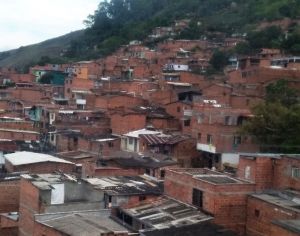
IMG_20190220_094158_smallBBC Assignment. . Colombia’s Kamikaze Cyclists is about young teenagers who career down the steep hills surrounding Medellin in Colombia on specially modified bikes without any safety gear. These kids live in the slums that cling to the sides of the mountains surrounding Medellin.


Start the Week (BBC) Jared Diamond has a new book out – Upheavals: How Nations Cope with Crisis and Change. In it, he argues that there are parallels between an individual facing a crisis, and a nation facing a crisis. As he did in ‘Collapse’, he uses different societies to illustrate his thesis. In this panel discussion of his book, Jared Diamond and national crisis,  there’s quite a bit of talk about Brexit and Trump, but he also talks about Finland and Meiji Japan. And little old Australia gets a look-in too.

I hear with my little ear: Podcasts 1-7 September 2019

Podcasts about Snyder’s Road to Unfreedom. Having finished reading Timothy Snyder’s book The Road to Unfreedom, I listened to three podcasts where Snyder is talking about his book. Boy- the guy can talk! Certainly he’s going over the ideas that he has already written in his book, but he can talk articulately about tangential issues as well. He comes over as more optimistic in person than I felt he was on the page. On April 9 2018 he spoke at the Free Library of Philadelphia  and answered, not always successfully,  some interesting questions. He made a particular effort to speak about Russia, Ukraine, Europe and America all within the same frame.  It’s notable that he emphasized that the Mueller investigation, which had not reported at that time, would be about the rule of law and not other issues.  In Dan Snow’s History Hit, he speaks more as a historian, about the role of history in reclaiming the importance of time. Finally, Snyder is interviewed in a program titled “Liberal Democracy’s Misplaced Faith in the Future” on Trumpcast, which is a more blatantly politically partisan (i.e. anti-Trump) than the other programs, and this interview is far more U.S. oriented

Rear Vision (ABC) I listened to two podscasts that really tie in with current events. Trump, Greenland and the longer tale of American real estate talks about previous times when America has purchased land – from the French with the Louisiana Purchase, from the Russians when they bought Alaska, from Spain when they bought Florida, and Arizona and New Mexico from the Mexican as part of the Gadsden Purchase. However, in recent years America has been able to exert hegemony through the construction of bases without having to buy the whole country – some 500 of themacross the world. It is suggested that Trump’s plan for purchasing Greenland betrays his real estate developer tendencies, rather than a strategic plan.

The second podcast  Kashmir in lockdown was about Kashmir and India’s revocation of Article 370. The two academics here tell of their perspective of this action from the point of view of their own country (Pakistan or India) although they do have quite a few commonalities.  I’m uneasy about Indian assertiveness here, especially with two nuclear-armed countries.

Rough Translation Two good ones here. DIY Mosul is about the phenomenon in post-war Mosul (in Iraq) where people started volunteering to clean up the city- something almost unheard of after so many years of war. Yet an act that seems so benign wasn’t necessarily perceived that way by the post-war Iraqi government.

We Don’t Say That is about language in France -in particular, language for talking about blackness. There are two related stories here: one about a woman of French/American/Congolese origin who is trying to get a particularly offensive French term changed, and running up against the strict official controls on the French language. The second story is about claiming the word “black” in French, in a culture where race is not spoken about (even though it might operate powerfully). Really interesting.

Saturday Extra. Continuing with her series on Latin America, Geraldine Doogue talks with Gustavo Flores-Macias from Cornell University about the militarization of the Southern Border of Mexico/Guatemala, at the behest of the United States in Mexico Under Pressure. Mexico is beefing up its National Guard, an organization introduced in 2006 to deal with gangs, but which coincided with a higher murder rate in Mexico. Now the National Guard is controlling the Southern Border in a political ‘deal’ where U.S. chooses not to impose tariffs yet, as long as Mexico stops migrants coming through.

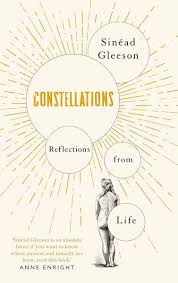
‘Constellations: Reflections from Life’ by Sinéad Gleeson

Gleeson_constellations

2019, 242 p.

It’s strange that the book that annoyed me most this year, Lee Kofman’s Imperfect, and one of the best books I’ve read this year, Constellations deal with very similar subject matter. Like Lee Kofman, Sinéad Gleeson had a childhood marked by illness, and then six months to the day after her wedding, she was diagnosed with leukemia. With a major operation to fuse her severely arthritic hipjoints, she (like Kofman) would have her share of scars, and she, too, has considered other women whose bodies have betrayed them. But where I felt that Kofman’s book was self-indulgent, bitter and almost voyeruistic  in its observations on her own and other peoples’ flaws, Gleeson’s book is deeply human and ultimately optimistic. Reflecting on the metal implants, stitches and  surgical interventions on her own body, she writes

I have come to think of all the metal in my body as artificial stars, glistening beneath the skill, a constellation of old and new metal. A map, of tracing connections and a guide to looking at things from different angles. (p. 17)

And so, with this title, each self-contained chapter is marked out by a star map of the constellations that reference, often obliquely, the content. While certainly some of the chapters deal with her illnesses, she ranges further into a consideration of motherhood, friendship and Alzheimers. This collection of stories looks forward as well as back, with a concern not about the ‘body surface’ as Kofman would call it, but an honest and deeply compassionate appreciation of – and she does appreciate, value, honour – the person inside.

She uses interesting constructs to structure her narratives. In ‘60,000 Miles of Blood’ – the length of all the blood vessels in the human body- different sections of her writing are titled by blood group:  A+, A-, B+, O etc.  In this story she reflects on her own diagnosis of leukemia, blood donation, periods, Blood of Christ, DNA. In ‘Where Does It Hurt?’ she uses the adjectives in the McGill pain index to verbalise pain (Hot/Burning/Scalding vs. Wretched/Blinding) as the headings for small reflections on pain, some in verse, some in prose. ‘Panopticon: Hospital Visions’ is actually written in hospital, a series of very short paragraphs, observing the ward around her.

It’s not all illness. In ‘On the Atomic Nature of Trimesters’ and ‘The Moons of Motherhood’, she writes about pregnancy, birth and early motherhood. She observes other people and their relationships to their bodies- Frida Khalo, Lucy Grearly and Jo Spence in a chapter similar and yet so different to Kofman’s work. There’s a chapter about the Irish referendum campaign to amend the constitutional ban on abortion (which I heard about in a podcast) and she gives us one of the most insightful and respectful stories about Alzheimers that I have ever read in ‘Second Mother’.

These are beautiful stories, detached and yet deeply human, written in crystalline prose. With Kofman’s Imperfect, I could feel myself taking a step back from the author, not wanting to associate with her. My response could not have been more different with this book. Here is a  breathing, loving, compassionate human – ‘body surface’ and deeper – and one that I wanted to stand closer beside, to hear more.

My rating: 9.5 /10

Sourced from: Yarra Plenty Regional Library

Up in the Land of Increasing Sunshine again

Melbourne has had a dearth of sunshine lately, but there’s plenty in Queensland, so I have popped up there for a few days.  You can read about my brief, and much more local, adventures at my travel blog Land of Increasing Sunshine (https://landofincreasingsunshine.wordpress.com/)

Movie: Litigante

Well that’s weird- a Spanish trailer with French subtitles that tells you absolutely nothing about the film. Despite the title – in English, the Litigant- this is not a courtroom drama. The main character, Silvia, is a lawyer, but that’s only one part of her life as a single (by choice) mother. Her own mother, Leticia, used to be a lawyer too and even though she is dying – too slowly- of lung cancer, the two women argue incessantly.  Silvia is compromised by the shady dealings of the government bureaucracy for whom she works as a lawyer, and she is embarking on an unexpected love affair.  She is stressed, stretched and so tired. It’s a real slice of life, and thoroughly convincing.  I saw it as part of the Melbourne International Film Festival in Spanish, with English subtitles.

My rating: 4 stars


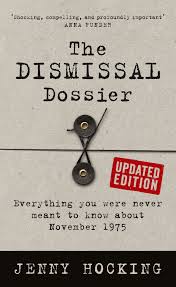
‘The Dismissal Dossier’ by Jenny Hocking

Hocking_Dismissal

Updated edition 2016, 75 pages & notes

Is it only Labor supporters ‘of a certain age’ who remember where they were in 1975 when they heard that the Whitlam government had been dismissed? I was in my second year at La Trobe University, and being November 11, it was in the midst of exams. I remember sitting on the brick steps at the Agora, wondering if the student troops would rally and whether there would be a march on Parliament House. But there was nothing- at least not immediately. I think that people were just stunned.

And, after reading Jenny Hocking’s small book The Dismissal Dossier: Everything You Were Never Meant to Know About November 1975, I’d have to add that not only were people just stunned, they were lied to as well. It has taken over forty years for the truth to trickle out, through vendettas, scribbled notes in archives, interviews, and  re-evaluations. The story isn’t over yet: Jenny Hocking, who wrote the celebrated two-part biography of Gough Whitlam, is still pursuing ‘The Palace Letters’ between the Queen and her secretaries and Australia’s then-Governor General Sir John Kerr, which have been designated ‘personal and private’ by Buckingham Palace, and thus out of the reach of Australians.

So- what weren’t we meant to know and now we do, largely through Hocking’s persistence?  We now know that the Palace did know ahead of time that Kerr was planning to sack Whitlam. Through Reg ‘Toe-Cutter’ Withers’ spilling of the beans after himself being dismissed, we know that Fraser was aware of it too.  We now know that  Sir  Anthony Mason  had been involved even before Sir Garfield Barwick (the Chief Justice) was, and that Barwick and Kerr agreed to obscure his involvement at the time and afterwards.  We also know that Kerr, fearful that Whitlam would sack him first, had shored up his position with the Queen’s secretary and Prince Charles in advance.  We now know that Kerr was anxious that a Royal Commission not be held into the Loans Affair because it would have come out that he had signed off on the minutes of the Executive Council meeting that approved the plan.

There’s a lot, too, that we have either forgotten or not realized the significance of.  The Senate had not refused Supply, but the Liberal/Country party refused to vote on it. Whitlam’s poll numbers were improving, while Fraser’s were plummeting over the stalemate in the Senate. Whitlam had already spoken with Kerr about holding the half-Senate election days earlier and had the agreed papers in his pocket, which would have brought the stalemate to a head. The House of Representatives still sat on the afternoon after the Dismissal, and passed a motion of no-confidence in Fraser as Prime Minister by a margin on 10 votes – the ultimate breakpoint in our parliamentary democracy, which should have seen Fraser stepping down immediately.  There were in effect two dismissals on 11 November: first the dismissal of Prime Minister Gough Whitlam, then later that afternoon, the dismissal of the House of Representatives, which Kerr prorogued to avoid having to do anything with that embarrassing vote of no confidence.

These things have been revealed over the last forty years, but because they have been drip-fed, you tend not to see the whole picture. After Reg Withers revealed that Fraser had been in on it before the Dismissal, Fraser admitted that he had lied. How did I not know that? I remember Sir Anthony Mason’s dismissive “I owe history nothing” but I’d forgotten his role. I remember news of a dinner with Prince Charles, but didn’t make the connection. That’s why this book is so important. It’s only short, but it draws the threads together. It re-kindles the rage.

I was fortunate to hear Jenny Hocking speak last week (and a recording of her presentation can be found here). She reminded us that Gough’s exhortation was to “Maintain your rage and your enthusiasm“. Reading this book reminds me why we should maintain the pressure for a republic, and why Hocking’s own persistence and assiduity has been so important.  After the Federal Court dismissed her attempt to have the Palace Letters revealed, just this afternoon she was granted Leave to Appeal to the High Court of Australia. Those letters will and must be revealed one day: I just hope that she and  I live long enough to see them.

My rating: 5/5 because it’s it’s such an important book. Read it.

Sourced from: SLV e-book. (Did you know that you can download e-books from the State Library if you have a card?)


AWW2019I have included this on the 2019 Australian Women Writers Challenge.


I hear with my little ear: Podcasts 24 – 31 July 2019

13 Minutes to the Moon continues. In Episode 6 Saving 1968 they look at Apollo 8, which was the break-through journey leaving Earth’s orbit and entering that of the moon, and travelling to the ‘other side’. Shame about the Bible reading on Christmas Eve though. In Episode 7 Michael Collins: Third Man they examine the career of Michael Collins, who stayed behind when the lunar landing craft sailed off into the darkness. Much of it is read from Collins’ autobiography

Today in Focus (Guardian UK) The Story of Grenfell United takes up the story of the survivors of the Grenfell Towers fire, two years on, who still feel that they have not been heard and that there will be other Grenfells.  It finishes with a ‘roll call’ of those who died, at a memorial ceremony. It’s chilling to hear how many of them have the same surname.

Revolutions Podcast Episode 10.5 looks at the life of Mikhael Bakunin, the ‘father’ of collective anarchism. He met Karl Marx before the 1848 Revolution, and hung around in similar circles. He was imprisoned for many years, then escaped to Japan and ended up travelling the globe before finally joining the International Working Mens Association. Episode 10.6 is very good, explaining collective anarchism. After abolishing the state, heredity wealth, the army, the police etc. a collective society would share the wealth amongst those who share the labour (i.e. no free ride here)

The Documentary (BBC) The Documentary has a series on language learning. As you know, I bumble along learning Spanish, and it was rather daunting to hear about  The Superlinguists: The Polyglots  who speak multiple languages – 15, 20 of them.  In The Superlinguists: Multilingual Societies they travel to India, which has a huge diversity of languages with people able to speak several, depending on purpose and audience, and Luxembourg where there are three different languages that children are educated in simultaneously and were people seem to be able to swap effortlessly between. How depressing.

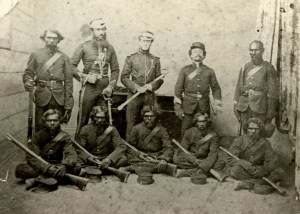
Queensland_Native_Police_1864

Queensland Native Police 1864 Source: Wikimedia

The History Listen (ABC) The Native Police was a police contingent composed of indigenous men who were used by settlers and the colonial government to ‘disperse’ (i.e. round up, murder) other indigenous people in lands coveted by the settlers. It makes for an unsettling family history among indigenous people today – to have forefathers who massacred other indigenous people- sometimes among other branches of their own family. This series of two programs Queensland’s Native Police: the Frontier in my Family and Queensland’s Native Police: Grappling with the Gaps explores how present-day indigenous families deal with this uncomfortable knowledge