Category Archives: Ivanhoe Reading Circle

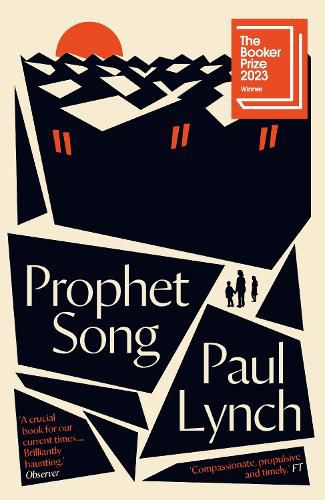
‘Prophet Song’ by Paul Lynch

2024, 320 p.

SPOILER ALERT

I am writing some weeks after I finished reading this book, and I really regret that I didn’t sit down and write it immediately afterwards. My response to it has dulled with time, but I do remember slamming it shut and announcing “Fantastic!!” I read it for the Ivanhoe Reading Circle immediately after finishing Sally Carson’s Crooked Cross (review here) and the two books complement each other beautifully. In fact, I think I will always link them mentally because they seemed to be a similar response to an uneasy, suffocating situation, separated by nearly ninety years.

The book is set in Dublin, at some unspecified time, two years after the National Alliance Party has passed the Emergency Powers Act, which gives expanded powers to the Garda National Services Bureau, (GNSB) a new secret police force. Eilish, the mother of four teenaged children, the last only a baby, answers the door to two policemen seeking her husband Larry, a teacher and trade union organizer. Within the first chapter, her husband disappears after a peaceful union march, and her attempts to find where he has been taken fail. Eilish is a mother, daughter, wife, scientist and a long-time resident of Dublin. For much of the book, and as the world becomes a sharper place, she concentrates on the mundane, the quotidian, trying to keep routines together. She holds on to the life that she had before, that she thought was immutable, too afraid to look beyond her house, her community, her family. Catching sight of herself in the mirror in the hallway

[f]or an instant she sees the past held in the open gaze of the mirror as though
the mirror contains all it has seen seeing herself sleepwalking before the glass the
mindless comings and goings throughout the years watching herself usher the
children out of the car and they’re all ages before her and Mark has lost another
shoe and Molly is refusing to wear a coat and Larry is asking if they’ve had their
schoolbags and she sees how happiness hides in the humdrum how it abides in
the everyday toing and froing as though happiness were a thing that should
not be seen as though it were a note that cannot be heard until it sounds from
the past seeing her own countless reflections vain and satisfied before the glass (p.43)

Her friend Carole, whose husband has also disappeared, urges her to resist and to look at what is going on around her as people in her street beginning hanging National Alliance Party flags from their windows, and as her house and car is vandalized. People stop talking:

…the brilliance of the act they take something from you and replace it
with silence and you’re confronted by that silence every waking moment and cannot
live you cease to be yourself and become a thing before this silence a thing waiting
for the silence to end a thing on your knees begging and whispering to it all night and
day a thing waiting for what was taken to be returned and only then can you resume
your life but silence doesn’t end you see they leave open the possibility that what you
want will be returned someday and so you remain reduced paralysed dollars an old
knife and the silence doesn’t end because the silence is the source of their power that
is its secret meaning silence is permanent. (p.165)

Eilish’s father Simon is living alone and subsiding into dementia, but he still has flashes of clarity which pierce through the domestic cotton-wool that Eilish is trying to cocoon herself within.

…if you change ownership of the institutions then you can
change ownership of the facts you can alter the structure of belief what is agreed
upon that is what they’re doing Eilish it’s really quite simple the NAP is trying to
change what you and I call reality. If you say one thing is another thing and you say it
enough times, then it must be so and if you keep saying it over and over people
accept it as true this is an old idea of course it’s really nothing you but you’re
watching it happen in your own time not in a book. (p 20)

Her sister Aine in Canada is urging her to leave while she can, but Eilish feels rooted to Dublin, still hoping that her husband Larry will return. She tries to protect her eldest son Mark by sending him away; and it is only when her thirteen year old son Bailey is killed -and she finds his body in the morgue, tortured- that she finds the strength to act. And here we come to Lynch’s purpose in writing the book. As the world hardened against refugees, he asks us to engage in ‘radical empathy’ by seeing the leaving and flight from a repressive regime from the perspective that it could happen to us, just as it has with Eilish, just as it has again and again throughout history:

…it is vanity to think that the world will end during your lifetime in some sudden event, that what ends is your life and only your life, that what is sung by the prophets is but the same song sung across time, the coming of the sword, the world devoured by fire, the sun gone down into the earth at noon and the world cast in darkness, the fury of some god incarnate in the mouth of the prophet ranging at the wickedness that will be cast out of sight and the prophet sings not of the end of the world but of what has been done and what will be done and what is being done to some but not others, that the world is always ending over and over again in one place but not another and that the end of the world is always a local event, it comes to your country and visits your town and knocks on the door of your house, and becomes to other but some distant warning, a brief report on the news, an echo of events that has passed into folklore… p. 304

There is only one perspective in this book- that of Eilish- and as you can tell from the quotes, it is told in a breathless, relentless suffocating urgency with no punctuation and few paragraphs. Yet, it was not hard to read once you relaxed into it- just as the people of Dublin relaxed into autocracy and violence, I guess. I can think of few books that frightened me as much as this one did. Absolutely fantastic.

My rating: 10/10

Read because: Ivanhoe Reading Circle selection

Sourced from: own copy

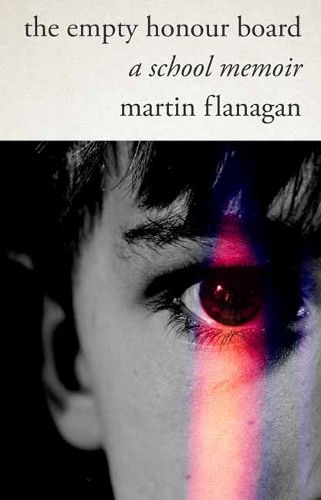
‘The empty honour board: a school memoir’ by Martin Flanagan

2023, 208 p.

When it comes to the Catholic Church and sexual abuse of children, there is little space for nuance without it being mischaracterized. However, nuance is what we find in Martin Flanagan’s memoir of his school days at an un-named Tasmanian Catholic boarding school between 1966-1971. As he says in his opening line “I was warned against writing this”. Not only was there the danger of stirring up pain and controversy, but there was the danger of being forced to rethink one’s own story that had seemed certain.

By the time you get to my age-67 at the time of writing- people’s sense of their personal history has taken a mythological turn. Most of us cling to the notion that there is meaning in our lives and, whether we know it or not, arrange the furniture in our minds- our memories- accordingly. We acquire a personal mythology, and personal mythologies, when they clash can do so violently. This is a region where demons lurk. (p. 2)

But as a stream of claims from former student from his school surfaced, the demons found him:

Each disclosure took me back to a time in my life when I thought I inhabited a concrete reality. Now that concrete reality was bending and breaking like buildings in an earthquake. (p.3)… Behind the issue of what actually went on at my school on an island off the southern coast of the world’s most southern continent, global forces were at play- ancient controversies to do with the Catholic church, the Pope, the authority of priests, celibacy, the Vatican’s exclusive maleness and the epidemic of sexual abuse that has followed it around the world. Somewhere inside all that of that, being thrown about like a leaf in a storm, was me, my story. (p.8)

Flanagan was not sexually abused himself – or at least, he did not perceive that he had been sexually abused. But at the age of sixteen he was invited into the room of one of the priests where the priest, Eric, gave him a massage with his pyjama bottoms removed, face down on the priest’s single bed, nude from the waist down. After a vigorous massage of his legs with oil, he rolled over and the priest glanced at his limp and uninterested cock. “End of story” (p. 86)

Completely inappropriate though this clearly is, Flanagan did not consider himself to have been sexually abused, even though other people thought that he had been. As far as he is concerned, “to be abused you must surely feel as if you’ve been abused”. He feels that he was inoculated from a strong response because he never did believe in the Catholic church, and because by then he was already quite certain in his own sexuality.

However, he knew other boys who were sexually abused by the priests. At much the same time as this happened to him, he was the school captain, and he was led by another boy to where he found a 12 year old shaking and shuddering in his pyjamas, with a spray of semen up his back. He and other boys reported the priest to the school rector. Some thirty years later, he gave evidence against one of the three priests from the school who were charged with sex crimes.

Flanagan may not have been sexually abused but he was abused by the ingrained cruelty of the school that filtered down through the priests and bubbled up among the boys themselves. He felt ashamed of many things: his abject begging not to get the cuts for some minor misdemeanour, his failure to intervene when he saw other boys being bullied, his desperation to appease the bullies who had decided that he was a ‘teller of stories’ as a ‘fear like a sort of radiation illness infiltrated my being’. (p.74). Years later, he began having panic attacks at night. For about six months he was in mental tumult until

In the end, one hot day I was standing beside a blackwood tree in the paddock beside our little home, when a shadow hurried across the grass towards me. With it came a great fear that I was about to be extinguished or swallowed up, and I cried out ‘I have a right to be!’. Pure madness, I know, but I’m glad I did it. Glad I shouted at my shadow. At the negative imprint of those early years. I have a right to be, everybody has a right to be. What do I believe in? Human dignity. (p.102)

What saved him was sport, especially football, and writing about sport. It was through sport and writing that the boys he had gone to school with, now men, circulated back into his adult life. These men came with their own stories, their own pain and the author’s response and reconciliation with this shared, and yet so private, experience takes up the last third of the book. The report that he had made as school captain on discovering the shivering boy in his pyjamas all those years ago resurfaced as part of the controversy over the school 43 years later. He reads the letter from the rector to the head of the order detailing the report that Flanagan himself had made, which the rector described as ‘fooling around’. Here he learns about the evasions and plans to withdraw the priest from classes, to move him around the state, or divert him into working on the school magazine. As a result of the Royal Commission into Institutional Sexual Abuse that he learns about ‘Father GMG’, sent to his school to avoid the repercussions of another interaction of a sexual nature, who is moved from one school to another. There is a pattern here.

Over the years, the author attends three Catholic ceremonies. The first was a vigil at St Ignatius, Richmond as 25 year old Van Tuong Nguyen was hanged in a Singapore jail for drug running. The second was Ned Kelly’s funeral in a Catholic Church in Wangaratta in January 2013. The third was a Ritual of Lament in 2021 run by his old school. He struggled over whether to go: he didn’t like ceremonies; he feared inauthentic emotion; he feared doing it the ‘wrong way’. He went.

What is striking about this book is the way that Flanagan holds many things in tension: acknowledgement that the same men who whipped him also imbued in him a love of literature and writing; disgust at the sexual abuse and yet compassion for the situation that, at least for the priest that he gave evidence against, he

could be well described as a maladjusted, sexually immature, lonely individual… [who] had virtually no possibility of a sexual relationship with a woman given his living circumstances. (p. 7)

He accepted the word that two of the priests at the school were unaware of what was going on amongst their brother priests. He did not characterize what he observed at his school as a long display of cynical behaviour. Instead,

[W]what I see at the core of this whole business is abject human isolation surrounded by a floundering belief system. (p. 142)

The book is not divided into chapters, and although it moves forward chronologically, it is divided into dozens of small shards, separated by asterisks. It’s almost as if the truth he is grappling to explain is also fragmentary, without an overarching structure that can be imposed onto it. There is some sort of resolution – not ‘closure’- with the Ritual of Lament performed by the now-coeducational school, no longer an all-boys boarding school. He sees this book, which was almost finished at the time of the Ritual of Lament, as his way of honoring the experience from 40 years ago as he sees it now. He speaks only for himself.

The old school’s honour board doesn’t have an entry for my last year. Perhaps it’s because the following year the school started a new era by going co-ed, perhaps it’s because my last year ended in a scandal. The tide of golden print records the year – 1971- but after that are empty spaces of varnished wood. The real names in this book are my honour board, although the list, I must add, is far from complete. (p.11)

My rating: 8/10

Read because: Ivanhoe Reading Circle August selection

Sourced from: own copy

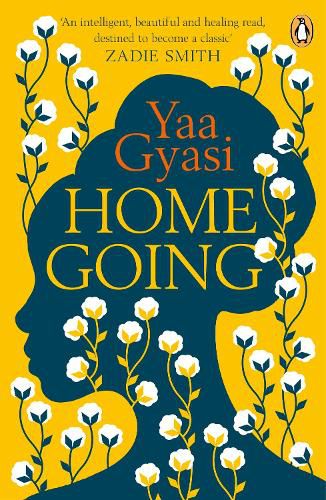
‘Homegoing’ by Yaa Gyashi

2016, 300 p.

Despite its modest 300 pages, this book covers a huge scope, covering three hundred years over two continents: Africa and America. It opens in Ghana in the mid 18th century, with two half-sisters who are unknown to each other. One sister Effia, of Fante tribal heritage, is coerced into marrying a white British officer sent to oversee Cape Coast Castle, a staging post for enslaved Africans prior to being shipped across the Middle Passage. Living in luxury at the Castle, she is oblivious to her half-sister Esi, of Asante tribal heritage, imprisoned as “cargo” in the basement holding pens, before being shipped to America. The two family trees bifurcate at this point as Effia’s line stays mainly based in Ghana, with the ongoing effects of colonization affecting the life events of generation after generation. Esi’s line is based in America, spanning slavery, Jim Crow legislation, the Harlem Renaissance and drug-fuelled urban life.

The opening pages of the book have a time line, tracing the generations in two distinct branches. The narrative alternates between the two branches, in a series of fourteen separate but linked short stories. They could be read separately because each one in effect starts again in its opening paragraphs, although there are small familial references that allow the reader to place the character within their familial context. In many ways this disjointed narrative reflects the dislocation of slavery and the rootlessness of not knowing where you come from. It was a rather jarring reading experience: you would come to be invested in a character, only to have the narrative whisk you across the ocean and time into a new story.

Running through the book is the theme of betrayal and complicity. The coastal Fante tribe capture and sell the Asante people to white slavers. In Harlem Renaissance New York, a black man who ‘passes’ as white leaves his wife to marry a white woman. Step-mothers are cruel to their step-children; families shun their gay children. There is also the theme of severance: two half-sisters growing up on different sides of the globe; and particularly in the American part of the narrative, severance between parents and children, one of the tools of enslavement, but which recurs from generation to generation. This severance lies at the heart of identity and reflects the title of the book: one of the characters, speaking of the Back to Africa movement says “We can’t go back to something we ain’t never been to in the first place. It ain’t ours anymore.”

A rather heavy-handed motif of the book was a pair of gold-flecked stones, one each given to the two half-sisters by their mother Maame. Esi’s stone was soon lost, buried in the mud of the holding cell at Cape Coast Castle, while the other stone was handed from generation to generation. I was dreading a rather mawkish resolution of the two stones at the end of the book but fortunately Gyasi was an astute enough writer not to fall to such an easy trope.

I enjoyed the book, with the equal weight given to the Ghanan and American experience, a weight judiciously and scrupulously meted out. I did find myself thinking of Alex Haley’s Roots which took a similar generational approach but from memory, there was not the bifocal approach of both African and American stories in that book.

It is particularly impressive that this is a debut novel, as the author has such control of a tightly structured dual narrative. The structure did feel a bit like a straitjacket at times, and not all characters were as fully developed as others. But it is a good exploration of slavery, colonialism, inter-generational trauma and the intersection of colour, class and gender- in many ways a book of its time, despite its historical focus.

My rating: 8/10

Read because: Ivanhoe Reading Circle selection. I wish that I had written this review soon after reading the book, instead of waiting weeks. You’d think that I’d know by now.

Sourced from: Readings paperback.

‘The Lover’ by Marguerite Duras

1984, 128 p.

One of the very best things about belonging to a book group is when you go along, thinking that a book is a bit mediocre, and you leave having been introduced to a swathe of subtleties and themes that you just hadn’t thought of before. This is what happened with me at the Ivanhoe Reading Circles’ discussion of Marguerite Duras’ The Lover.

The Lover starts and ends with the reflections of a 70 year old woman, which was the age that Marguerite Duras was when she wrote the book. Although she later distanced herself from the book, claiming that it was a “pile of shit” that she wrote while she was drunk, it closely follows the contours of her own life and could probably best be classed as fictionalized memoir. It is set in Indo-China, then under French rule, in the late 1920s. Both the title and much of the narrative revolve around an affair she conducted with a man twelve years older than her, when she was aged only fifteen. It is a consensual relationship, although she treats her lover with a rather patronizing pity, knowing that as a Chinese man he cannot hope to marry her as a white woman. The 70 year old narrator claims that the girl (who alternates between ‘she’ and ‘I’) is no victim here; that she is hungry for the physical act and that she gains confidence and status through the affair. She does not love him, or at least she claims this, but he is humiliated by the relationship, and later confesses that he has always loved her. I found myself thinking of Nabakov’s Lolita written from Dolores’ point of view, (acknowledging that Dolores was younger, and Humbert was older), in this case without the lens of paedophilia and in this case further complicated by issues of class and colour.

The title and the reputation of the book rest on the affair, but that is only part of the story and on the second reading I found myself even more aware of the other aspects of the novel. The girl is white, her family being French in a French colony. Her mother is a widowed schoolteacher and the family is poor after her father’s death and following the disastrous financial purchase of a ‘concession’ in the rural countryside. The girl’s mother, who suffers from bouts of mental illness, is nonchalant and even complicit in her daughter’s affair with this rich Chinese older man (although twelve years is not an excessive age difference, and in France then and now the age of consent is 15). He gives her money, and the family needs it, especially as her older brother is siphoning money from his own family to feed his opium addiction. Her hatred of her older brother is sustained throughout her life, especially when her younger (but still 2 years older) brother dies.

The book is not easy to read. Many times she returns to the image of the girl on a ferry crossing the Mekong River, dressed in a faded silk dress with a belt belonging to her brother, gold lame shoes and a pink-brown fedora. This is how her lover first saw her, and this is how the 70 year old her sees herself looking back. The narrative is shattered, switching repeatedly between first and third person, interspersed with flashbacks and flashforwards. There is a flatness of tone throughout, as if the book were being narrated at a distance in a monotone.

I’m pleased that I read it a second time. I realized on second reading that the repetition and fragmentary nature of the narrative was not going to resolve itself miraculously at the end, and I slowed down to savour it more. Her affair – or whatever you would call it- as a 15 year old, her childhood in French Indo-China, her yearning to write, the paradox of ‘pleasure unto death’, memory and madness are themes that she returned to again and again in her writing. She might have decried it as a pile of shit, but it’s not.

My rating: on second reading 9/10

Read because: Ivanhoe Reading Circle selection

Sourced from: purchased e-book.

Other reviews: Anthony Macris in The Conversation

‘Sneaky Little Revolutions’ by Charmian Clift

2022, 448p.

[Warning: discussion of suicide]

This book, edited by Clift’s biographer and former daughter-in-law Nadia Wheatley, is marketed as ‘selected essays’. More properly, they are a selection of 80 of her 225 newspaper columns published mainly in the Sydney Morning Herald and Melbourne’s Herald between 1964 and 1969, when they came to an abrupt halt with her suicide.

The newspaper columnist was (is?) a curious beast. Although there are innumerable bloggers and sub-stack writers, there seemed to be something rather special about turning over the page of a print newspaper, and seeing an article by a regular columnist, in its accustomed place on the page. I used to enjoy the columns of Sharon Gray (who I see is actually Adele Hulse), Pamela Bone and Gillian Bouras who ended up living in Greece – all women- and Martin Flanagan in the Age. I know that Anne Deveson wrote a regular column, but I only know of her through her daughter Georgia Blain. The only physical newspapers that I still receive are the Saturday Paper and The Age on Saturdays and although they have a stable of staff writers and comment columns, the only one who comes close to my perception of the ‘newspaper columnist’ in the Charmian Clift mould is Margaret Simons with her gardening columns in the Saturday Paper, and perhaps Kate Halfpenny and Tony Wright in The Age. Somehow you feel as if you know them, and that you could plonk down beside them in a coffee shop and just take up talking with them.

Of course, it’s all artifice because despite the appearance of confidentiality and intimacy, columnists project a particular view of themselves, and one that is often quite removed from reality. This is the case with Charmian Clift whose columns brim with confidence and warmth, when instead she had lived, and was still living, a life that was far removed from the suburban Australian life of many of her readers. She and her husband, writer George Johnson, circulated in an artistic and intellectual milieu on the Greek island of Hydra that could simply not be found in Australia (barring, perhaps, the communal living at places like Heide in Bulleen). There’s little sign in her columns of the infidelities and arguments that wracked her marriage. She never mentioned her family members by name, and referred only obliquely to her husband’s long hospitalization with TB. The birth of an illegitimate, and relinquished, daughter when she was 18 years old was coded as “a wrong road…that led me to disaster”.

I could find only one mention of her alcoholism:

A whole human life of struggle, bravery, defeat, triumph, hope, and despair, might be remembered, finally, for one drunken escapade.

One can only read with hindsight her essay about her husband’s forthcoming semi-autobiographical second book Clean Straw for Nothing, which she had not dared read, for fear of what he might reveal about her through the character Cressida Morley

I do believe that novelists must be free to write what they like, in any way they liked to write it (and after all who but myself had urged and nagged him into it?), but the stuff of which Clean Straw for Nothing is made, is largely experience in which I, too, have shared and … have felt differently because I am a different person …

Indeed, several commentators have linked her apprehension about the publication of this book with her suicide in July 1969 at the age of 45- a suicide that seems so paradoxical with the fiesty, intelligent personae that she had curated through her columns.

Wheatley has titled this book ‘Sneaky Little Revolutions’, echoing a rather condescending but also self-effacing comment that Clift made about her own columns to her publisher in London:

I have been making my own sneaky little revolutions …writing essays for the weekly presses to be read by people who don’t know an essay from a form guide but absolutely love it….

Some of her essays are disarmingly suburban, but there are many others that are subversive and indeed, “little revolutions” for the mid-1960s, deep in the midst of the Menzies-era. She resisted the smugness of white-Australia that expected her gratitude for returning to comfortable Australia from a ‘foreign’ country; she supported the rights of women and decried their ‘second-class’ status; she said “sorry” some forty years before the Australian government did; and she revelled in young ‘protestants’ (i.e. protesters) who challenged the complacency of the 60s. In an essay that was not published at the time, she criticized the contingency and unfairness of the National Service draft, which left some men untouched and diverted the life course of others.

As a middle-aged (who am I kidding?) woman myself, I loved her essay ‘On Being Middle Aged’.

…the middle-aged drag time around with them like a long line of fetters, all the years that they cannot escape, the mistakes that can never be undone, the stupidities that can never be uncommitted now, the sames and humiliations and treacheries and betrayals as well as the prides and accomplishments and happinesses and brief moments of wonder…. I often think that middle-aged people have two lives, the one they’ve lived, and a parallel life, as it were, that walks around with them like a cast shadow and lies down with them when they go to sleep, and this is the life they might have lived if they had made different choices in that time when time was so abundant and the choices were so many.

There is a run of essays in the volume about her trip to central and northern Australia. At a time before cheap airfares and mass international travel, her beautiful writing brought to life a view of Australia from above- something that not all Australians had seen. In ‘The Centre’:

Pitted pores. Dried out capillaries of watercourses. Culture slides of viridian clotting thick creamy yellow. Wind ridges raised like old scars, and beyond them the even, arid serrations of the Simpson Desert, dead tissue, beyond regeneration. And yet, the tenderness of the pinks, the soft glow of the reds, the dulcet beige and violet seeping in.

She has a distinctive voice, although one that is not completely unlike my own with her colons and lists and parentheses and made-up words. The genre of the newspaper column does impose a straitjacket of must-haves: an engaging introduction, a set word length, and a rounding-off last paragraph. I found myself longing for a longer essay than the requisite six pages in my e-book and something more thorny and less self-contained.

Is there any point to re-publishing seventy year old newspaper columns? Yes, I think there is in exceptional cases, and few newspaper columnists have that honour bestowed upon them. I think that it rescues some good thought, good thinking and prescience from the flow of ephemera and evokes a humility in us to remember that many others have held certain political positions and made similar observations in the past.

My rating: 8/10

Read because: Ivanhoe Reading Circle selection

Sourced from: purchased e-book

‘Murder in Punch Lane’ by Jane Sullivan

2024, 368 p.

There’s a particular frisson of delight when you’re reading a novel set in your own town. You recognize the streets and you have a mental landscape painting of the setting, even if it is set 160 years earlier. Jane Sullivan, herself now a Melbourne resident after emigrating from England decades ago, takes us to post-Gold Rush Melbourne, and in a way not unlike Kerry Greenwood with her Phrynne Fisher novels, introduces us to a feisty, intelligent amateur detective who is less sidekick and more spur to her co-investigator Magnus Scott, a journalist who styles himself as ‘The Walking Gentleman’.

The novel starts in a bedroom, as a doctor tries to revive a beautiful young actress Marie St Denis from what appears to be, and is later characterized as, an accidental laudanum overdose. Her closest friend, aspiring actress Lola Sanchez, is not satisfied by such a neat explanation, and she enlists the help of journalist Magnus Scott, one of the few people who wrote a sympathetic obituary for Miss Dennis, to investigate. Fired up by the techniques and success of the detectives in the penny-dreadful crime literature she enjoys, Lola undertakes some amateur sleuthing to uncover multiple footprints in Miss Dennis’ room- but to whom do they belong? Lola devises a list of possible suspects, many of whom belong to the highest echelons of Melbourne society, and disguising herself as a young boy, breaks into houses and sneaks around bedrooms looking for clues. In the meantime, Magnus himself is on a rollercoaster of financial events, and it seems that indeed, there are shadowy forces at work, who may or may not be the same men that Lola is suspecting.

I was thinking about 19th and early 20th century crime fiction, and its reliance on plot, coincidence and red herrings, especially compared with the detective stories of the 21st century and their emphasis on the character and motivations of the detective, just as much as of the perpetrator. This book is truly in the former category, complete with cliff-hangers and diversions that at times strain credulity.

For the historian of Melbourne, it is gratifying to see that Sullivan has done her research, and acknowledges the assistance and friendship of writers like Lucy Sussex, whose recent Outrageous Fortunes: The Adventures of Mary Fortune, Crime-writer, and Her Criminal Son George is dealing with a similar time-span and genre. I found myself thinking of Barbara Minchinton’s work on Madame Brussells and The Women of Little Lon, although these both look at a later date. A couple of times I found myself raising a sceptical eyebrow, only to find that Sullivan was right: cold cream in 1868? ( Yes, and before then too), the Menzies Hotel? (Yes, opened in 1867) and so, yes, Sullivan has done her work.

I enjoyed Sullivan’s playful tweaking of real-life characters in creating her own Lola Sanchez and Magnus Scott. The name Lola Sanchez of course evokes the Gold-Rush performer Lola Montez, and Magnus Scott as ‘The Wandering Gentleman’ and editor of the New Bohemian bears more than a passing resemblance to Marcus Clarke. She integrates historical figures as well, most notably the enigmatic Redmond Barry, patriarch of Melbourne’s cultural scene but with his own domestic ambiguities, and Dr Nield, the coroner. She takes us to Redmond Barry’s house in Rathdowne St Carlton that later became integrated into the Royal Childrens Hospital, the Theatre Royal, Chinatown and the eponymous Punch Lane, running between the current-day Exhibition and Spring Streets. And as Sullivan explained in a talk that she gave to the Ivanhoe Reading Circle in April, there was indeed an actress Marie St Denis who died of laudanum poisoning, and the story sprang from historical events, with equally heavy doses of research and imagination.

I wonder if this is the first in a series? There’s scope, and plenty of other Melbourne murders to explore…

My rating: 8/10

Sourced from: Purchased e-book

Read because: Ivanhoe Reading Circle Open Meeting

‘The Bee Sting’ by Paul Murray

2023 (2024), 656 p.

Spoiler-ish

Had I been watching this on television, I would have thrown the remote at the television when the closing credits scrolled down the screen. As I read it in its a lengthy book form, I found myself beseeching Charles Dickens to come back and show how to tie up a complex story with a definite ending (send the main characters to Australia, drown them, send the car over the cliff- anything that finishes the story off!)

I had heard that this book was about a car-yard closing down, which did not seem a particularly promising premise for a book. Indeed, it is about a family-owned car-yard closing down, but it’s also about the implications on the family – Dickie, Imelda, Cass and PJ- as their financial situation tightens.

It’s set in Ireland, but it took me quite a while to shake off the sense that it was an American story instead. Certainly, there are mentions of the Magdalen convent in the middle of the town that nobody talks about, and the weather is often wet, but I still didn’t have a strong sense of its Irishness. Perhaps the car-yard, which seems a particularly American phenomenon, led me astray.

Dickie and Imelda married about 20 years ago, largely on the rebound from the death of Dickie’s brother, the local football hero Frank. Frank and Imelda had been engaged to be married, and after his death, Dickie and Imelda both sought solace from grief in each other’s arms. Dickie had long been slated to take over the family car-sales yard from his father Maurice, after completing a degree at Trinity College in Dublin. But other events had intervened, and so we find Dickie and Imelda, living in what had been the large family home on a large tract of land, deeply indebted and with the car yard in trouble. Their daughter, Cass, is in her final year of school, trying to work out her place with her friend Eileen and her own sexuality as she, too, goes to Trinity College. Their son PJ spends much of his time online, where he is being taken beyond his depth.

The story moves around, concentrating on different characters in turn, some written by a detached narrator, others told as a stream-of-consciousness where thoughts and verbal utterances are intertwined. As with all families, there are the family stories but here they are unpacked and challenged as the spotlight shifts from person to person, and through flashbacks and back-story. Each of the characters is being lured by a different way of being, and there is an underlying pessimism about the outside world with its physical and emotional violence. Sex in the book is largely sordid, either physically or emotionally, and there are many near misses as events could have taken an even more calamitous turn.

The book is fairly heavy-handed in its preaching on climate change and societal collapse, although it does play a part in the plot. It does add to the ‘going to hell in a handbasket’ vibe of the whole book.

The action speeds up at the end of the book, with increasingly short chapters told from different characters’ perspectives until the narrative is a series of short paragraphs, as all the characters converge on one spot. But what happened? I think that perhaps, there was no near-miss here.

I enjoyed the book, although particularly in the first third I felt an oppressive sense of dread and doom every time I picked it up again. Despite the underlying pessimism of the book, and the unrelieved bleakness, Murray had filled out his characters enough for you to care about them as fellow humans, with whom we share vulnerabilities and thwarted dreams. My son said that it was the best book he read last year: I wouldn’t go that far, but I could barely put it down the further into it I went. So for me, not the best, but pretty damned good.

My rating: 8.5/10

Read because: Ivanhoe Reading Circle selection- and then I couldn’t attend the meeting because of COVID!!

Sourced from: Ladyhawke Books, Ivanhoe.

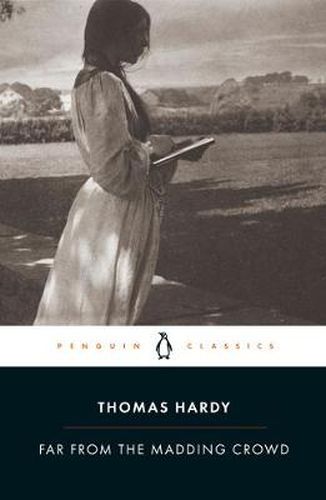
‘Far From the Madding Crowd’ by Thomas Hardy

480 p. 1874

I didn’t read Far From the Madding Crowd at school, even though many people of my age did. It seemed to be a perennial of the Year 12 (HSC) English reading list. I hadn’t read any Hardy at all until I read Tess of the D’Urbervilles at university, which I remember enjoying although now, having read Far From the Madding Crowd, I wonder whether I would still do so.

Like Hardy’s other Wessex novels, Far From the Madding Crowd is set in rural England, harking back to an agricultural past and village life that had been largely eclipsed by the time the book was written in 1874. Although the novel is peopled with stock characters from tales of rural life- the chortling peasants in the local pub, the perfidious army officer, the worthy but stodgy landowner next door- the two main characters, Bathsheba Everdene and Gabriel Oak are of a more complicated economic and social milieu. When we first meet Bathsheba, she is a young, well-educated, independent but young woman without her own financial resources, confident enough in her own opinions to reject the marriage proposal of the hard-working and earnest Gabriel Oak. By the next time we meet her, she has inherited property from her aunt and is determined to manage the farm by herself, without the assistance of a bailiff. Gabriel Oak suffers a reversal in fortune and is now forced to work on Bathsheba’s farm, undertaking the tasks of a bailiff without the title.

Clever but impetuous Bathsheba sends a Valentine to her older, rather stodgy neighbour Mr Boldwood, daring him to ‘Marry Me’. He takes Bathsheba at her word, and tries to woo her but Bathsheba, who wants more passion in a relationship than she could ever feel with Mr Boldwood, rebuffs him. Gabriel, aware of the hopelessness of his love, continues to care for Bathsheba. He tries to warn Bathsheba against the perfidious Sgt. Troy, but she plunges into a hasty marriage with him anyway, only to find that he is gambling away all her inheritance. When Troy disappears after his illicit relationship with servant-girl Fanny becomes public, Bathsheba is in a holding pattern, still legally married to Troy and having to bat away Mr Boldwood’s renewed wooing. It is only after Troy is finally killed, and Mr Boldwood taken away as his murderer, that Bathsheba and Gabriel are free to marry. Unusually for Hardy, there is a happily-ever-after-ending.

I grant that Hardy’s depiction of Bathsheba is nuanced and complex. In some ways she is an air-head, toying with men and their emotions, self-centred and wilful. However, she is also independent and principled, although she is exposed to almost intolerable emotional coercion by both Troy and Boldwood. The timeless theme of a woman surrounded by eager suitors, of differing degrees of integrity and suitability, reappears in different guises throughout film and literature.

But each time the book got bogged down in yet another pub-scene or drowned the reader in its lush descriptions of sunrises and fields, I found myself thinking “How on earth would you interest a Year 12 boy in THIS?” I was relieved to hear in the discussion at the Ivanhoe Reading Circle that this book is no longer on reading lists for secondary students, and thank God for that. I may roll my eyes at yet the recently-published but ultimately forgettable fiction books drenched in current politics and sensibilities that are assigned to students today, but some “classics” are too heavily freighted with the politics, sensibilities and stylistics of their own earlier time to become virtually unreadable without a strong reason for doing so.

My rating: 6/10

Read because: Ivanhoe Reading Circle July selection.

‘Birnam Wood’ by Eleanor Catton

2023, 423 p.

Silly me. Here I was assuming that this book, with a title referencing Macbeth, would be an updated telling of the Macbeth story – but any connections with Macbeth are rather tangential. You may remember that in Shakespeare’s Macbeth, he took comfort in his security as King from the prediction that “Macbeth shall never vanquished be until / Great Birnam Wood to high Dunsinane Hill / Shall come against him”. Assuring himself that trees could not move, he later realized the true meaning of the prediction when his enemy and his army advanced on Macbeth’s castle under the protection of the tree branches they carried, thus appearing to be a forest moving up the hill.

‘Birnham Wood’ was the name that a gardening co-operative adopted for themselves as they engaged in organic ‘guerilla gardening’ on unattended plots and spaces, living on the food grown as they squatted on disused sites, using water if it was available, carting their own if it was not. There’s elements of humour in Catton’s book, and this is one of them: in a world of terrorists and rogue militias, guerrilla gardening seems rather incongruous. [Having said that, the son of one of my distant relatives is a hard-core forager and dumpster-diver, and his parents have found it very difficult to cope with his subversion of all of their expectations for his career and future in his outright rejection of the capitalist economy.]

Acting as a collective, there are nonetheless power differentials between the members of Birnam Wood. The group was founded by 29 year old Mira Bunting who is approached by Robert Lemoine, a shadowy multi-millionaire attracted to New Zealand as part of the wave of ultra-rich Westerners looking for a bolt-hole in the event of nuclear war. His true intent is the surreptitious mining of rare-earth minerals in a remote national park, carried out under the cover of his pest-eradication drone company. He offers the Birnam Wood collective the opportunity to farm on his property and funding, and takes on the ‘conquest’ of Mira as a personal challenge. At the meeting of the collective to decide whether to accept Lemoine’s offer, Mira is confronted by Tony, with whom she had had a drunken sexual encounter before Tony left for overseas, four years earlier. He has now returned to the collective and rejects Lemoine’s offer as blood money. When his objection is voted down, he leaves, suspicious – correctly as it turns out- that there is more to Lemoine’s proposal to the group. The group meeting to decide the matter evoked brilliantly the interminable earnest university meetings I remember, overlaid with a 21st century patina of political correctness. In the meeting, Mira was backed up by her best friend Shelley, who was actually thinking of leaving the collective.

The book is quintessentially New Zealand, with its ‘pure’ image, green and fertile national parks, and propensity for earthquakes and landslips that has rendered the wider Christchurch area largely inaccessible after the main highway is cut. There is something slightly ‘woolly jumper’ about the collective which includes sincere and rather unworldly workers, inspired by ideas of conservation, ecology and rejection of capitalism.

Against this bucolic background, Robert Lemoine stands out as a 21st century James Bond villian/ Egon Musk type caricature. His sheer evilness is made more believable by his control over the electronic communications channels of mobile phone and internet and his surveillance of the members of the collective, which keeps him one step ahead of Mira, Shelley and Tony as they each think that they are acting autonomously, competing to come out on top in dealing with Lemoine.

The satire drops away and the book ramps up in the second half to become a page-turning, cat-and-mouse thriller, something I would have thought impossible in a story about an idealistic group of guerilla gardeners (of all things!). It’s to Catton’s credit that she’s able to carry this off at all. I won’t give away the ending, except to say that the ending probably had more to do with Macbeth than anything else in the book.

I read this book with the Ivanhoe Reading Circle as their June selection. Many of the members were disappointed with the ending: I was perhaps less critical, seeing any other possible ending as a cop-out, and spying a few loose ends that Catton may left dangling that could presage a different outcome.

Most of all with this book, I was so impressed with Catton’s ability to switch so skillfully into a completely different genre to that of the historical fiction The Luminaries, the only other Catton book that I have read. So many writers ‘stick to their lane’ after having a book as successful as The Luminaries was, but Catton has upended these expectations completely. It is a book that surprised with its completely modern setting and its morphing from a somewhat prickly social satire into a page-turning thriller. Eleanor Catton is completely in charge of her narrative, and has the flexibility of a very skilled writer with decades of writing ahead of her!

My rating: 8.5/10

Read because: Ivanhoe Reading Circle selection.

‘Demon Copperhead’ by Barbara Kingsolver

2022, 546 p.

Before I read this book I already knew that Barbara Kingsolver wrote it as a homage and 21st century take on Charles Dickens’ David Copperfield. Kingsolver’s book at 548 pages is certainly seen as a ‘big baggy monster’ by today’s standards, but because I am a complete glutton for punishment I read the original David Copperfield as well, and you can see my review here.

I’m so pleased that I read the original before I read Demon Copperfield because, even though Kingsolver’s book stands on its own two feet perfectly well, I enjoyed seeing parallels between the two books, and how she gave the events of the original book a 21st century twist. Quite amazingly, I think, these allusions to the original (which would only be obviously to readers who had read it) did not propel the modern book into farce or melodrama, which a homage to a 19th century, somewhat dated, book could easily do. Instead, they made perfect sense within a modern context.

In Dickens’ time, child labour blighted the childhoods of children. In the 21st century, drug addiction blights the children of users, who often end up using themselves. Vicious and avaricious stepfathers and childbirth deaths could orphan a child in the past: now it is overdoses, particularly of prescription drugs like Oxycontin which spring from, and in turn, corrupt the medical/pharmaceutical/crime network that have made them the scourge they are in America. (Thank God and successive Australian Governments for the Pharmaceutical Benefits Scheme and drug detection schemes that have prevented the same thing happening in Australia). The original David Copperfield was left to the mercy of unscrupulous employers: Demon Copperhead was the plaything of a welfare bureaucracy that worked more to the interests of unscrupulous ‘care’-givers playing the system for profit. Sport and his ability to draw became Demon’s means of escape.

The Wikipedia page for Demon Copperhead shows the pairing of original characters with Kingsolver’s characters. The names have resonances, but the judgements you make of them as a reader do differ. Dori (Dickens’ Dora) is addicted to Oxycontin, and although she is passive and in thrall to her addiction, she is not the airhead that Dora was. Mr Micawber in Dickens’ book was a larger-than-life, loveable perennial optimist: Mr and Mrs McCobb are grifters and schemers, just as reprehensible as Mr Creakle who fosters boys as a cheap labour source and in order to get their welfare payments. U-Haul does not have the same sinuous oiliness of Dickens’ original Uriah Heep, who made so much of his purported ‘umbleness – there is no 21st century equivalent of ‘humility’ as a virtue- and he seems to play a less important role in Kingsolver’s plot. Dickens is coy about Steerforth’s corruption of Emily: Kingsolver is upfront about the prostitution and sex trafficking into which Sterling Ford drags Emmy, Demon’s childhood friend.

In Dickens’ books, London and the large Victorian cities provide a backdrop to the plot. Kingsolver, who is from Appalachia herself, sets her book in the southern Appalachian mountains of Virginia. She knows these places (as did indeed Dickens know London and England), and both writers use their books as a critique of their own society. I did find myself thinking of Shuggie Bain or J.D. Vance’s Hillbilly Elegy, and there has been some critique of Demon Copperhead as being ‘poverty porn’. I didn’t see it that way. I was driven to finish the book, fearful that Kingsolver would do something very smart-alecky and postmodern to the ending. Did she? You’ll have to read it to find out.

This book garnered many prizes including the Pulitzer and the Women’s Prize for fiction. It well deserved them. It was a brilliant re-telling of David Copperfield, with many winks and nudges for those familiar with the original, and a perfectly independent story on its own terms.

My rating: 10/10

Read because: Ivanhoe Reading Circle March selection.