just how Alexander Downer thought that his comments on Fran Kelly’s breakfast program last week were going to improve the asylum seeker problem. The previous government had a solution- undertaken “sotto vocce” and it “hasn’t generated much publicity lately in Australia”:
We used to get the navy not to guide the boats into the Australian shoreline, what we did (laugh) was we got the navy to tow the boats back to the Indonesian Territorial Waters, left the boats with enough fuel, food and so on to get to a port in Indonesia, guided them to where to go and then left them- obviously monitored to make sure that the boat was safe, but disappeared over the horizon…. We didn’t run around boasting that we were doing this because we knew the Indonesians accepted these people back through gritted teeth.
My wordy, that’s a refugee policy to be proud of, and one we’d endorse heartily if the boats were sailing in the other direction, wouldn’t we. Ah yes, we can hold our heads high.
…whether we really need ARMED security guards at railway stations? Bailleiu seems to have picked a winner as an election policy. But two ARMED security guards down at the little station in Macleod? Every night? I don’t think so.
that newspapers are increasingly being used as an outlet for the activities of lobbying firms. It’s just “he said/she said” being mouthed by ventriloquist politicians, ‘spokesmen’ and ‘independent’ commentators.
The Age yesterday had a register of the climate-change lobbying companies- easily found yesterday; I couldn’t find it on the site today- I had to find it through the Centre for Public Integrity which then had a link to it through the Sydney Morning Herald. The PDF file showing the large companies, the lobbying companies who contract to them, and the lobbyists and their policitical connections can be found at
Trawling through the death notices today, as is my wont, I noticed that Constance E. Little (formerly of Swan Reach and Eagle Point) died yesterday. For regular Age readers, Constance E. Little has been a mainstay of the Letters column where she aired her opinions on everything from John Elliot to global warming. In December 2008 she announced that she would be capping her pen because of ill-health after a stroke.
Most of her letters were sent from her sheep and beef farm on the Tambo River at Swan Reach in south-east Victoria, but her interests and observations ranged far beyond that. She was born on 30.11.1919 in Benalla, and apparently began writing letters for her school paper at the age of 14, later contributing to local, country and metropolitan newspapers over many years. She sounds some lady: her funeral notice asks those planning to attend the Bairnsdale service to “please wear a dash of pink in Connie’s honour”.
Her death notice says “Constance loved all her readers and thanks them and her editors over her lifetime.” I think it is equally true that her readers loved Connie and thank her over a lifetime. If she’s a believer, and if she’ s right, then no doubt she’s giving those beyond the pearly gates a piece of her mind as well. If not, we’re all the better for her writing and her engagement with more earthly things. Vale Constance.
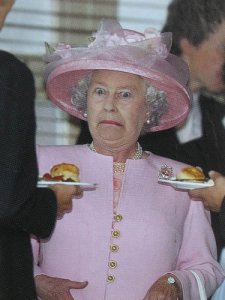
Yes, Ma’am, another un-birthday- although given that your birthday is celebrated on multiple days in multiple countries, and you have your ‘real’ birthday and your ‘official’ birthday, you must be about 428 years old by now. We’re celebrating it today in Australia- although not all of Australia mind you- Western Australia celebrates it on the last Monday of September or the first Monday of October. This is because Western Australia celebrates its Foundation Day on the first Monday in June, and we can’t use up all our Public Holidays at once, can we ma’am?
Her Maj’s birthday is actually on 21 April, but after George V died they decided to keep the ‘official’ birthday on or around 3rd June, which was his birthday. England celebrates the Trooping of the Colours on the 1st, 2nd or 3rd Saturday in June, but this actually commemorates the anniversary of Elizabeth’s coronation on 2 June 1952. And it doesn’t really count because it’s a Saturday. Anything worth celebrating is worth a day off, I reckon.
Up until 1936 the Monarch’s birthday was celebrated on the actual day. So up until 1820 that would have been 4 June for George III; between 1820-1830 it was 12 August for George IV; between 1830-1837 King William IV’s birthday was celebrated on 21 August, then 24th May for Victoria’s birthday between 1837-1901. You’ll note that these are all in summerish months in England. Edward VII’s birthday on 9 November was celebrated between 1901-10 and both he and his people came to appreciate the idea of birthday celebrations in summer rather than winter. George V’s birthday was honoured on 3 June between 1910-1936- a more favourable date for Northern Hemisphere climes than November. It’s been 3rd of June or thereabouts ever since.
New South Wales celebrated King’s Birthday right from the start. David Collins described the first celebration of King’s Birthday in 1788
His Majesty’s birthday was kept with every attention that it was possible to distinguish it by in this country; the morning was ushered in by the discharge of twenty-one guns from the Sirius and Supply; on shore the colours were hoisted at the flag-staff, and at noon the detachment of marines fired three volleys; after which the officers of the civil and military establishment waited upon the governor, and paid their respects to his excellency in honor of the day. At one o’clock the ships of war again fired twenty-one guns each; and the transports in the cove made up the same number between them, according to their irregular method on those occasions. The officers of the navy and settlement were entertained by the governor at dinner, and, among other toasts, named and fixed the boundaries of the first county in his Majesty’s territory of New South Wales. This was called Cumberland County, in honor of his Majesty’s second brother; and the limits of it to the northward were fixed by the northernmost point of Broken Bay, to the southward by the southernmost point of Broken [sic] Bay, and to the westward by Lansdown and Carmarthen Hills (the name given to the range of mountains seen by the governor in an excursion to the northward). At sunset the ships of war paid their last compliment to his Majesty by a third time firing twenty-one guns each. At night several bonfires were lighted; and, by an allowance of spirits given on this particular occasion, every person in the colony was enabled to drink his Majesty’s health.
Some of the worst among the convicts availed themselves of the opportunity that was given them in the evening, by the absence of several of the officers and people from their tents and huts, to commit depredations. One officer on going to his tent found a man in it, whom with some difficulty he secured, after wounding him with his sword. The tent of another was broken into, and several articles of wearing apparel stolen out of it; and many smaller thefts of provisions and clothing were committed among the convicts. Several people were taken into custody, and two were afterwards tried and executed.
The anniversary of his Majesty’s birthday, the second time of commemorating it in this country, was observed with every distinction in our power; for the first time, the ordnance belonging to the colony were discharged; the detachment of marines fired three volleys, which were followed by twenty-one guns from each of the ships of war in the cove; the governor received the compliments due to the day in his new house, of which he had lately taken possession as the government-house of the colony, where his excellency afterwards entertained the officers at dinner, and in the evening some of the convicts were permitted to perform Farquhar’s comedy of the Recruiting Officer, in a hut fitted up for the occasion. They professed no higher aim than ‘humbly to excite a smile,’ and their efforts to please were not unattended with applause.
The anniversary of his majesty’s birth-day was celebrated, as heretofore, at the government-house, with loyal festivity. In the evening, the play of ‘The Recruiting Officer’ was performed by a party of convicts, and honoured by the presence of his excellency, and the officers of the garrison. That every opportunity of escape from the dreariness and dejection of our situation should be eagerly embraced, will not be wondered at. The exhilarating effect of a splendid theatre is well known: and I am not ashamed to confess, that the proper distribution of three or four yards of stained paper, and a dozen farthing candles stuck around the mud walls of a convict-hut, failed not to diffuse general complacency on the countenances of sixty persons, of various descriptions, who were assembled to applaud the representation. Some of the actors acquitted themselves with great spirit, and received the praises of the audience: a prologue and an epilogue, written by one of the performers, were also spoken on the occasion; which, although not worth inserting here, contained some tolerable allusions to the situation of the parties, and the novelty of a stage-representation in New South Wales.
By the time our Judge Willis arrived in Port Phillip, it was Queen Victoria’s birthday that was being celebrated on 24th May, as it was to be for sixty-five years. From the 1820s onwards, Sydney society had celebrated the Birth Day of the monarch with a levee and ball at Government House, and by 1841 a similar practice was proposed for Melbourne. However arrangements broke down in acrimony in 1841 over whether the ball should be a public or a private event.
The private ball (sneering described as the ‘Dignity Ball’ by its critics) was defended by the Port Phillip Herald as a private occasion that had been postponed from the race-week earlier in the year, and that it just happened to occur on the Birth Day. The Herald argued
When the Government give a ball, which is generally on the birth day of the sovereign, cards of invitation are issued to the public and to different classes of society and this is as it should be for a simple and substantial reason- the expenses are defrayed out of the public purse. (PPH 7 May 1841)
However, this was a private occasion, overseen by stewards prominent in Port Phillip Society at the time: Simpson, Powlett, Meek, James McArthur, J. Lyon Campbell, Verner and Major St John.
The Port Phillip Gazette and Port Phillip Patriot, affronted at these “upstart exclusives” and “ill-bred puppies” proposed a truly public ball to be held at Yarra Yarra House in Flinders Street on 24th May, with admission tickets for a gentleman and a lady priced at 2 guineas. Messrs Abrahams, Langhorne, Kerr and Sullivan were stewards, with Connolly and Urquhart’s disputed involvement.
So who won the Battle of the Balls? The private ball was postponed until 4 June, then later until 8th June to accommodate Presbyterian families who would not have been able to attend on the 4th because that week had been set aside for religious observances. The Public Ball went ahead on 24th as planned, but it rained. The Private Ball took place on 8th June, attended by 44 ladies and 67 gentlemen; the stewards provided a most magnificent supper, which was done ample justice, and festivities continued until 5.00 a.m. In a coup for the more exclusive Private Ball, Superintendent La Trobe and his wife attended: they had not attended the Public Ball.
The next year only one private ball was held. I find myself wondering why the fuss of the preceding year was not repeated: perhaps it had been just newspaper hot-air. The Port Phillip Herald of 27th May devotes half a column to it:
THE BALL. The most splendid entertainment that has ever yet taken place in the province was held in the long room of the Royal Exchange on Wednesday evening, in honor of the Queen’s birth-day. The ball, although got up by private subscription, and as one of the regular “private assemblies”, was attended by nearly all the rank and fashion of our rising town. Notwithstanding the very unfavourable state of the weather, and the almost impassable state of the roads, the ball room was crowded at an early hour. Several of the gentlemen appeared in rich fancy disguise, and some of the dresses were very much and deservedly admired. The gentleman who appeared as an Italian Brigand was perhaps the most successful in attracting the fair notice of the visitors, although there were other parties very elegantly attired. The enlivening colour of the different fancy dresses added much to the brilliancy of the entertainment, which was considerably increased by the fascinating beauty of several of the ladies, who, believing that “beauty unadorned is adorned the most,” trusted to their usual tastes in not appearing in fancy costume. His Honor Mr La Trobe and Lady honoured the Ball with their presence, and dancing was kept up with the greatest spirit throughout the whole evening; the arrangements altogether were excellent. The music gave evident satisfaction, and was only eclipsed by the management of the supper, which met with deserved encouragement, and reflected great credit upon the caterers of this very necessary appendage to a dance. Nearly three hundred persons, it is calculated, graced the scene, and all departed to their homes highly delignted with the evening’s amusement.
Georgiana McCrae attended the 1843 Queens Birthday Ball and describes it as follows:
Dr Thomas drove out in his gig and took me to town. At 10 p.m. we went en masse to the Mechanic’s Institute. All the elite of the colony assembled, and in full swing, including Mr and Mrs La Trobe; the Mayor, Mr Condell and his niece, dressed in Mantis green, not unlike the insect itself in the waltz attitude. Mr C. H. Ebden’s movements somewhat eccentric, now and then cannoning among his neighbours…Dancing was kept up briskly till after 1.a.m.
Well, ma’am no dancing any more. In fact, it’s a dead loss as a celebration of anything except perhaps the opening of the ski season and a few football matches. And a very merry un-birthday to you ma’am.
Should Melbourne University should be known as “The White Knight for Struggling Arts/Music Institutions” or as “The Institution That Ate Its Competitors”? The Victorian College of the Arts amalgamated with Melbourne University as the “Faculty of VCA and music”, and last year the Australian National Academy of Music, based at the South Melbourne Town Hall, also fell under the auspices of the University of Melbourne when the Federal Government withdrew its funding. So much for choice.
Enter the new Dean, Professor Sharman Pretty. Employed as a “change agent”, she is charged with restructuring the VCA’s six schools into three, shaving $11 million dollars from the budget and fitting the schools’ offerings into the Melbourne Model. And so we see the music theatre course, which started this year with 32 students accepted from 370 applicants, suspended from 2010- but “Professor Pretty says it will return if it can be made to fit the model“. Yes, that’s the way- fit the course to the curriculum model- not to the students, not to the work environment, not to the demands of the genre itself.
I’ve done my time observing the nursery of music theatre from the outside: the tap-dance lessons, the end of year dancing school concerts, the examinations, the auditions, the hair rollers, the tap-shoes, the false eyelashes. Consider the mainstay of musical theatre today, the franchised musical, shipped into a capital city for a financially-lucrative, solidly-marketed period with its authorized sets and carefully mandated cookie-cutter characters. Is this really post-graduate study???
But Professor Pretty knows how to play the market game.
Benchmarks?? Internationally competitive?? Sheesh. I don’t really understand what drives the artistic character, but I strongly suspect that it has nothing to do with academic excellence, grade point averages and assessment tasks, and an awful lot to do with dreams, drive and ambition. I wonder if we can “benchmark” them?
We can all relax. There was a parliamentary delegation in Mexico City this week. Here’s a picture of them.
But, as Pixie-Anne Wheatley might say, the real question on our tips and lips is
“ARE THEY SMILING FOR THE CAMERA BEHIND THE MASKS???”
And our government, I hear, has stock piled two face-masks for every man, woman and child in Australia. I wonder if that means we can wash one, and wear one? Or do we keep one for good, and wear the other one while we’re just dagging around the house?
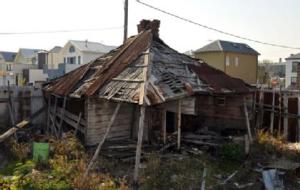
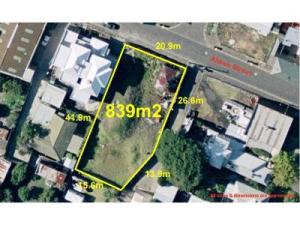
I see that the good people of Williamstown are concerned about the possible demolition of what they suspect might be Melbourne’s oldest house. Judging by the McMansions in the background, it no doubt occupies valuable space. The evidence for the 1842 date seems to be rather sketchy though- land could change hands several times in the efferversence of the early 1840s without an actual dwelling being built. A search on the Heritage Victoria database records that Pope, who purchased it from James Cain in 1842, was a property-owner and eligible to vote in 1843. However, many men had several parcels of property, and he could have qualified otherwise through other holdings. The database gives an approximate date of 1855, presumably because the type of construction was common around 1850. The 1856 rate book records it as a four room timber building.
Attached though I am to old things, I don’t know if I’d die in the ditch for it. It needs so much work as to constitute an absolute re-build. Its value as a curiosity, or as a reminder of times past could just as easily be achieved by shifting it to a park somewhere.
One building that I would have stormed the barricades for, though, was Redmond Barry’s house at 494 Bourke Street that was demolished in 1924. (It must be a sign of age that I think of it as “only in 1924″ when it’s actually ninety years ago). It was situated between Queen and Elizabeth Streets, on the north side of Bourke Street- then numbered as 97 Bourke Street West. The five roomed, low-slung brick cottage with an old mulberry tree in the remnant of a garden would have stood as a reminder that there were people living in that section of Bourke Street, at that time close to the hub of town, as distinct from shopping or working in it. There’s so much else in Melbourne that commemorates him as literally larger-than-life, and this brings the man back to a human scale.
But this building is long gone of course, so perhaps I should gird my loins to defend the Northcote Bowl. Ugly, yes. At one time ubiquitous, yes. And, while not the first or only, it’s one of the last left standing in suburban Melbourne, yes. There’s a sentimental glow about something from a hundred years ago, but it’s just as important- and more difficult- to fight for something forty years old that now violates every concept of good taste without yet attaining the gravitas of being ‘historical’.
References:
Robyn Annear A City Lost & Found: Whelan the Wrecker’s Melbourne
“The dismantling will be recorded and it will form part of an archival record which will be lodged with the State Library, the National Trust and the Williamstown Historical Society” Heritage Victoria acting executive director Jim Gard’ner said.
The permit be directed that the parts of the house be “stored” at the owner’s discretion. Apparently all fabric and any significant archaelogical items are to be removed and catalogued.
I think they could do better than this. Somehow the documentation of the dismantling seems a rather inadequate response, and “at the owner’s discretion” is so wide that you could drive a truck through it.
On last night’s ABC news, I noticed a rather chilling form of accounting going on. Recent weeks have seen an increase in the number of “unauthorized arrivals”/”asylum seekers”/”boat people” coming into Australian territorial waters. The terminology varies, and I sense but am not attuned to the nuances in the different phrases. It is part of a world-wide phenomenon, and one that comparatively, Australia is largely insulated from. But we have a particular sensitivity to the image of hordes sweeping down and ravaging our solitary continent, sharpened perhaps by the inflexibility and cockiness borne of being an island nation, freed from the messy necessity of sharing borders with any one else.
And so to the news this week of the fire aboard one of the boats. The West Australian Premier’s rapid assertion that the boat was deliberately doused with petrol evoked a sinking feeling of deja vu, to the subminal soundtrack of “We will decide….”. I feel a hot prickle of embarrassment when I think of Australia’s refugee policy over recent years, a shame-faced acknowledgement that we have not acted with the fairness or generosity that we would like to claim for ourselves, but also feel wooden-tongued and at a loss to find the words or the prescription for a more principled stance.
However, as a result of the fire on board, the ABC news told me – let’s call it all ‘x’ as good mathematicians seem to do- X men were airlifted to Broome hospital, X to Darwin and X to Brisbane. X number of doctors had been called in for duty; X ambulance crews scrambled, X nursing teams assembled to provide intensive care.
In a society with finite goods and resources in the health sector, there is of course a form of rationing going on all the time. The whole Pharmaceutical Benefits Scheme is based on it; it underpins the question of funding for IVF treatment. It is reflected the bemoaning in today’s Sunday Age of the arrival of ravers who had overdosed on GHB while hospitals were on high-alert for the arrival of more innocent burns victims from Black Saturday.
But, rightly, all this accounting goes out the window in an emergency, when our shared humanity is at stake. As London bombing survivor Gillian Hicks reminded us just this week, kindness was extended to her , irrespective of colour, nationality, religion because she was a person who needed help. No-one was standing at the door, counting the doctors and nurses and totting up the figures when burns victims were being airlifted from Bali. “What ever it takes!!” the politicians vowed after the Victorian bushfires.



 The Resident Judge of Port Phillip