Category Archives: Book reviews

‘I Succeeded Once: The Aboriginal Protectorate on the Mornington Peninsula 1839-40’ by Marie Hansen Fels

There is a somewhat elegaic, wistful tone to this book, hinted at by its title. It is a quote from the journal of Assistant Protector William Thomas as he was about to re-locate his Protectorate for the second time in three years under official instructions.  He had been forced to shift from the Mornington Peninsula in 1840 to Nerre Nerre Warren, then forced again to shift to Merri Creek in 1843.  There were many reasons that he had failed, he said, but there was one time when he could have been said to have succeeded- and that was at Arthurs Seat between 1839 and 1840.

In the Afterword to the book, the author admits that there is “no conclusion, no grand summing-up” in her work.  She evokes the late Greg Dening, who taught that “the historical effort was to understand and to explain: not to judge, not to label, not to take sides.” (p. 397).  In many ways, it would have been helpful to have her afterword as a preface, because I found myself somewhat puzzled about what this book actually is. It is part of ANU’s Aboriginal History Monograph series, which presents “studies on particular themes or regions, or a series of articles on single subjects of contemporary interest.”  In this case, it focuses minutely on a relatively small area of land, over mainly a one-year period, although it does spill out of this chronological limit at times.

The book won the ‘Best Community Research, Register, Records’ category of the Victorian Community History Awards in 2011. The typographic layout of the book is more suited to a records-based document than a narrative history: it has the appearance of a work-book or training manual, and the headings and boxed biographies of individual aboriginal people feel as if they are the product of a word-processor rather than a commercial print layout.   It is thoroughly commendable that the book is available free as a download through ANU e-press here.  I suspect that I might have felt short-changed had I paid $29.95 for a print-on-demand copy (although, admittedly that is not a high price).   The rather thin covers of my book are already curling.

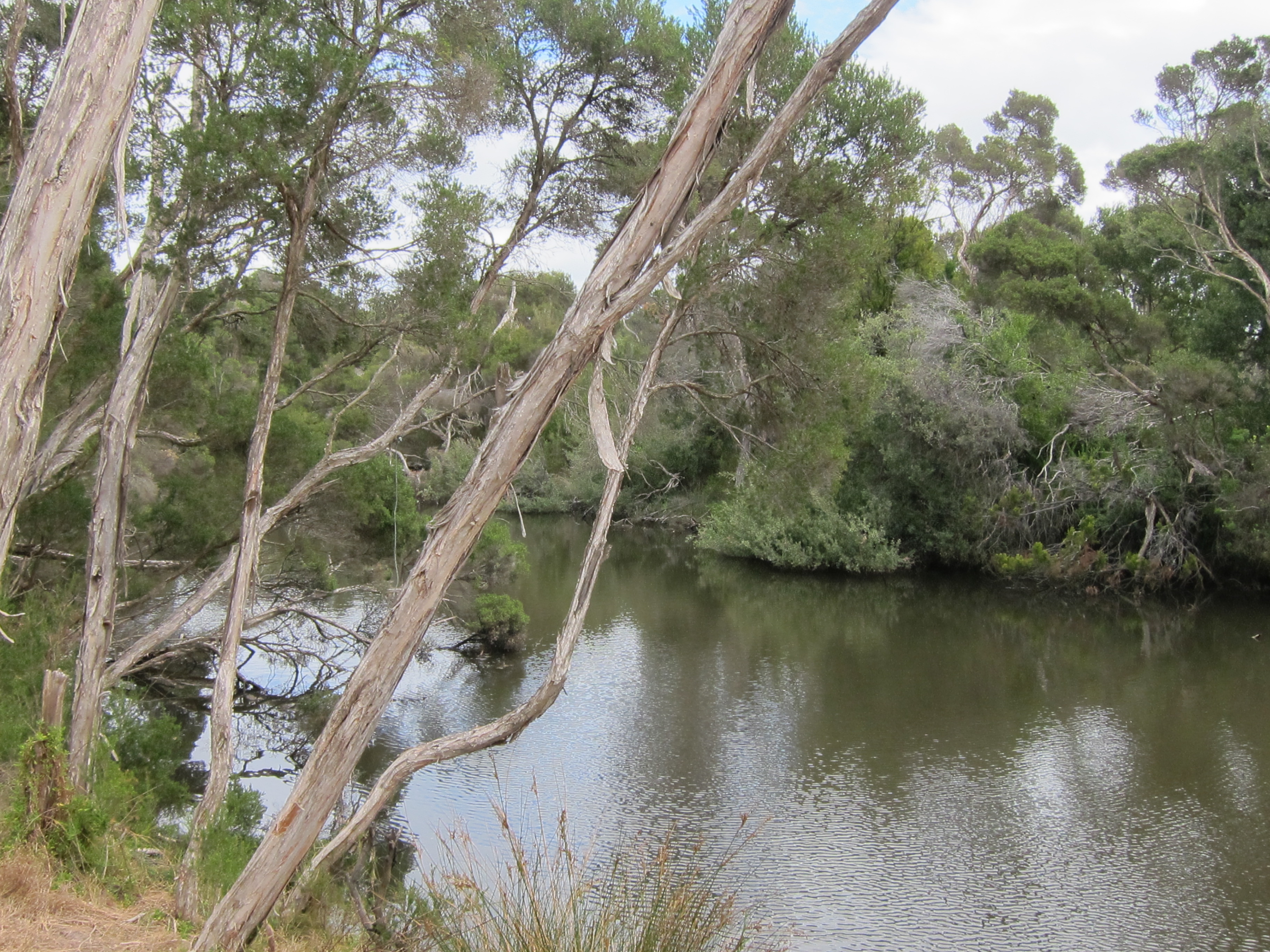
But the value of this book lies in its contents, not the layout.   As a Melburnian, and one who holidays on the Mornington peninsula side of the bay (rather than the “other”, western side), it was as if my January canvas of caravans and holiday houses had been stripped back to another, earlier frontier time.  Names were familiar, but distorted (like Moody Yallock for what I assume is now Mordialloc, and Kullurk for Coolart).  Although I was of course aware of McCrae Homestead, it had never occurred to me that there were other pastoralists down on the peninsula as well. I hadn’t thought of my caravan site down at Capel Sound as part of a squatter’s run, but I think that I sensed, just a little, an older history of the peninsula when I was down at Balcombe Creek a month or two back.
Her book is, as she admits, a contrarian view to the prevailing orthodoxies of confrontation, massacres and victimhood.  Instead, hers is a story of an “amiable, intimate, non-violent coexistence”, but this is not explained by the facile “our lot were a peaceful lot” with “mild and inoffensive” men. Instead, she argues:

That there was no conflict at all on the Mornington Peninsula is to be explained in the same terms as conflict is explained in other regions of Victoria, that is, in terms of individual leaders, of social and political agendas of groups, of the tone of relationships between both Indigenous and European. (p.177)

And this is what her book is- an exploration of the tone of relationships between Assistant Protector William Thomas and the squatter farmers of the Mornington Peninsula, and the men and women of the Bunurong people who ranged over it as their traditional lands.  Just as she did in her earlier book Good Men and True: The Aboriginal Police of the Port Phillip District, Fels delineates, names and gives a life trajectory and agency to aboriginal people who otherwise remain as the shadowy ‘other’. In text boxes headed with the variations of their names- both aboriginal and conferred-  (e.g. Nunupton/Nunuptune/Nalnuptune/Naluptune/Nunnapaton/Nunupthen/Namapton/Billy Langhorne/Mr Langhorne p. 266), you sense the white informants grappling with unfamiliar sounds, trying to render them into writing and to somehow capture individuals within a bureaucratic report and a census system.  She traces the appearance of individuals at different locations throughout the district as recorded in musters, reports and official letters, their family connections, and their all-too-often premature deaths.

She brings Assistant Protector William Thomas to life for us as well.  The Protectorate scheme was devised in Britain in response to humanitarian concern over the decimation (a term that under-estimates) of indigenous people across the empire.  The Protectors were greeted by many settlers with disdain and derision, and by humanitarians with frustration and annoyance at their various shortcomings.  Rather than being mobile, single men able to follow tribes ranging across country, they were family men operating on a model of establishing a mission in a central location.  I’ve mentioned Robinson before here and here, and Sievewright here.   Assistant Protect William Thomas was a family man as well, and shared with his fellow protectors the curse of execrable handwriting, although the depth and range of his private and public writings has been invaluable for historians (especially now that someone else has grappled with the handwriting!)

And so we see Thomas trying (not always successfully) to enforce Sunday observance; we see his powerlessness to stop a raiding party; the pettiness of Protector Robinson and the futility of railing against bureaucracy, and his sense of bewilderment and sinking disappointment as he returns to the Peninsula after the enforced and much-resented shift to Narre Narre Warren, only to find the peninsula deserted.

Although the focus of the book is on 1839-40, this one year did not happen in isolation.  Actions which took place in this focal year had antecedents, and when the Bunurong men took off on a raiding party towards Gippsland, it was yet another episode in a long-running distrust between the two nations that long predated white settlement.  She works hard to uncover the context and rationale for this feud, exploring a number of hypotheses that take her beyond tribal and cultural factors into a consideration of geological and archaeological evidence of sedimentation, inundation and earthquakes in millenia past.

Moreover, there had been contact between the Bunurong people and white sealers and timber gatherers along the coast and the Bass Strait islands in the decades before Fawkner/Batman claimed possession of the district.  Fels devotes a considerable amount of time tracing the kidnapping of particular individuals, both men and women, who ended up in the Bass Strait Islands, South Australia and even Western Australia,  far from Bunurong country.  This is important: as we speak, there are competing custodial claims from the Boonwurrung Foundation and the Bunurong Land Council based on the status and identity of Louisa Briggs, one of several women abducted.  The contentiousness of such issues is highlighted by the heavily censored and blacked-out reports generated by archaeologists and ethnographers as part of this twenty-first century dispute.

There is a sense, too, of the clock ticking over several of the sites that she describes here.   A footnote questions the expertise of the author of the archaeological report for the Martha Cove development, and a planning permit has been granted on a mission site, extended to 2013, for a Holiday Resort incorporating a winery, function centre, restaurant, hotel, camping park and golf driving range. Another mission site has been identified on private property, but she does not disclose the location.

This is not a ‘straight’ narrative history.  She rebuts a number of local history myths, and she challenges other written histories, for example Bruce Pascoe’s The Convincing Ground.   There is not a smooth narrative flow and it is certainly no coffee table book (and I’m sure was never intended to be).  It is history with its sleeves rolled up.
‘Imperial Communication: Australia, Britain and the British Empire c1839-1850’

Simon J. Potter (ed) Imperial Communication: Australian, Britain and the British Empire c1830-1850 ,London, Menzies Centre for Australian Studies, 2005

Growing up in the early 1960s, I am old enough to remember thinking of myself living in an empire, even if by then the proper terminology was ‘commonwealth’.  Although I am a fourth (?) generation Australian, there was still a sense that if you were going to travel anywhere overseas (by ship, naturally), then you’d go to England and ‘the continent’. Cars were made in England; your crockery was made in England; Enid Blyton WAS England; coats came from England; the Beatles and Carnaby Street came from England, and I was inordinately proud of my Mark Shaw three-piece pillar-box red pants suit made in England.  I didn’t realize it at the time, but I very much thought of England as ‘the centre’ and Australia, New Zealand and Canada as ‘the periphery’.  I don’t know that I really thought about the other red bits on the map at all, except to acknowledge them perhaps as a family of cultural political step-siblings who also received visits from our hatted and gloved Queen.

Academically, this centre/periphery model of the British Empire has been challenged by a number of views.  One of these is that, instead of  being pre-eminent at the centre of the empire, Britain was itself changed by the two way flow of wealth, information and political innovation from the colonies.  The second is that the British Empire is best seen as an intersecting, overlapping network or web, of personnel and information that flowed in circuits between and across the metropole and peripheries.  People are an important component of this- the waves of emigrants who circulated between locations, and the corps of officials and bureaucrats whose career took them from one placement to another.  My own work fits very much into this view of empire, and so, too, do the papers in this book.  It’s an approach that appeals to me because it combines the personal and fine-grained element of biography within a broader overarching structural model.

The first paper by Damen Ward from New Zealand is entitled ‘Colonial communication: forums for creating public opinion in Crown Colony South Australia and New Zealand’.  He has chosen these two colonies because they were both associated with Wakefieldianism and prided themselves that they were ‘free’ colonies rather than penal, and that their colonists were fully entitled to their legal and constitutional rights as free-born, active, independent British subjects.  He examines  this language of constitutionalism as it played out through settler-initiated public discourse, most particularly in public meetings, petitions and memorials, the press, and Grand Jury presentments where jurors themselves raised issues of concern to the population at large.

Zoe Laidlaw, in ‘Closing the Gap: colonial governors and unofficial communications in the 1830s’ examines the more personalized communication channels that governors and lobby groups carved out for themselves to ensure that their viewpoints were heard back ‘home’.  Although governors seemed to be in a privileged position in terms of official communication and access to the movers and shakers, they were much more vulnerable than they appeared.  Political parties moved in and out of office, particularly during the 1830s and 1840s, and the career-enhancing coup of naming a city or a river after a particular politician didn’t look quite so wise when that politician was bundled into the opposition.  Governors were under financial pressure and they were reliant on gossip or slow and often outdated information, and so they were reliant on ‘friends’ of like political persuasion who could represent their interests in person to the Colonial Office.  Unfortunately for them, though, their opponents and lobby groups could play this game too, and sometimes, as in the case of Sir John Franklin, the ‘friend’ turned out to be anything but.  Laidlaw illustrates this scenario through the example of Governor Bourke, who enlisted his son Dick as his envoy.

Finally, Alan Lester’s paper furthers the concept of the British Empire as a network by examining the rival humanitarian and settler circuits of communication that operated between and within sites in the Empire. The humanitarian networks reached a peak of influence with the anti-slavery and then aboriginal lobby-groups that held sway over the Colonial Office.  They, and their local branches, were challenged by settler groups, in differing degrees of formal organization, which strongly resented the imposition of a morality from afar.  This transcended national borders. Governors like Bourke were execrated as “liberals” by settler groups in South Africa,who later greeted news of his downfall in NSW  with glee.

These essays work well as a collection.  They spring from a similar historical approach, and their length is sufficient for their authors to develop and support an argument in some detail.  The layout of the pages is generous, leading to an easily-read and rewarding exploration of people operating as best they can and with differing degrees of awareness within the larger structure of empire within a tightly-focussed timeframe..

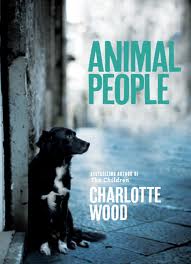
‘Animal People’ by Charlotte Wood

2011,  262 p.

There must be something about the challenge of writing a book set completely within one day, because many writers seem to have done it: James Joyce, Virginia Woolf (and in homage, Michael Cunningham), Gail Bell and, although I haven’t read it yet, my latest craze, Mollie Panter-Downes.  Limiting one’s focus onto a single day gives scope for close scrutiny of the quotidian and the elapse of hour after hour runs underneath the narrative like a bass-line.  But there’s a risk too – we all have our own mundane lives that are ticking over hour by hour too, and somehow or other the author needs to make you care enough about an ‘ordinary’ person to devote some hours of your life to watch someone else’s day unfolding as well as your own.

Characterization is fundamental to this contract between writer and reader.  You don’t need to like the character as such, but you have to at least care.  In this case, Stephen is a bit of a drifter, with a dead-end job as a kitchen-hand at the zoo, living a rather spare and bitten-down existence, aware of his family’s disappointment in him, likeable enough but wary of being tied down by commitment.  As he wakes on this hot Sydney morning, he knows that he is going to break off his relationship with Fiona, a good, passionate, separated woman, that day.  In this, he is quite steely, even though he knows that she is beautiful, that she loves him and her young daughters tolerate him, and that his mother has already absorbed them as ‘family’.  He combines inflexibility with irresoluteness; he is hard as steel and yet soft, he is selfish without asking for anything.  We probably all know someone like him.

Charlotte Wood is a good observer and it’s as if she has inserted herself behind our own eyes.  Her descriptions of the various people who orbit around Stephen have a verisimilitude similar to those in Tsiolkas’ The Slap– in fact, in many ways this book reminded me of The Slap in reverse.  The mounting heat of the day, and the brittle mania of a child’s birthday party add to the sense of unreality and the rising shriek of the day, as Stephen drifts closer and closer to making his break with Fiona.

There’s a second theme in the book- that of animals and the human relationship with them- that I felt was rather heavy-handed.  The parallels were rather too obvious, and it just seemed rather laboured.

I have read several very positive reviews of the book- in fact, people seem to be struck emotionally speechless by the book (for example, John Purcell on Booktopia and Michelle on Book To the Future).  I wouldn’t go that far.  Certainly, it was very easy to read, and I was quickly drawn in enough to want to keep reading, and it captured urban, middle class Sydney very well.  It had just a touch of the ‘book club’ about it, something that Lisa at ANZ LitLovers noted as well.  I don’t think that I mean this as a put-down (after all, I belong to online and face-to-face bookgroups myself) but there’s something about the straining for theme and topicality that made me wonder if it was written with this demographic in mind.

My rating: 8/10

Sourced from: Yarra Plenty Regional Library

Read because: I enjoyed The Submerged Cathedral and because I wanted to review it as part of the 2012 Australian Women Writers Challenge.

‘Cold Comfort Farm’ by Stella Gibbons

1932, 307 p.

This was the April selection for my face-to-face bookgroup, and for me it was a re-read, but ah! who can begrudge reading such a little gem of a book?!!  It’s laugh-out-loud funny (or at least, I found it so) and if you haven’t read it- DO!

The book is set, as the small note on an opening page says, in the ‘near future’.  As twenty-first century readers, this is immediately unsettling because a book written in 1932, as this one was, is very much set in the past for us.  Some of her predictions, like air-taxis for short-distance travel, the Anglo-Nicaraguan War of ’46  or video-phones jar you into thinking “hold on, when was this set?”  In many ways it feels like a novel set in the 19th century both in its setting and characterization with the ramshackle manor house and loping rural farmworkers, but it was set in the future at the time it was written.

It was intended, apparently, to be a satire on the rural-gothic novels of the Mary Webb and Thomas Hardy ilk, which are hardly bestseller material these days. Satire, unfortunately, generally requires at least a nodding acquaintance with the subject or genre being satirized.  So here we have the odd situation where we are reading a satire that feels oddly familiar, as if we have met all these characters before-   the mad great-aunt in the attic, the simple farmhands, the young girl unaware of her beauty- and yet it seems that they have seeped into our consciousness without  being able to identify where they have come from.

The orphaned young Flora Poste decides that instead of getting a job, she will sponge on her relatives for her upkeep.  When an answer to her request for board comes back on a grimy piece of paper, followed by a warning to stay away, she decides that of the lukewarm responses she has received from her surviving relatives, it is this one from Cold Comfort Farm that attracts her the most. So off she bustles to Cold Comfort, bringing her modern girl sensibilities and common sense to an aging, rambling manor house where all the closely-intertwined Starkadder family are in thrall to the matriarch of the family, Great-Aunt Ada Doom.  Great Aunt Ada, who has sequestered herself in the attic after seeing “something nasty in the woodshed”, has ensnared the extended family around her, afraid to leave the farm to pursue their own destinies, declaring that “there’s always been Starkadders at Cold Comfort”.  Into this comes young Flora who, with her aid of her trusty handbook “The Higher Common Sense,” schemes and plans to set up some with marriages and to nudge others into following their vocations.  It’s all thoroughly good fun.

As I reached the end of the book, I was struck by how completely and deftly within just over 300 pages the author has sketched out such memorable minor characters.  In a closing scene, she lists the guests at a Starkadder wedding, and as she numbered them off, one by one, I felt a little jolt of recognition and affection, as if I was attending a family wedding myself, where the guests were all known to me.  And as for “something nasty in the woodshed”…..well, you’ll have to read it for yourself.

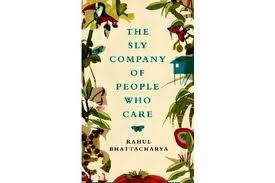
‘The Sly Company of People Who Care’ by Rahul Bhattacharya

2011, 281 p

Two things attracted me to this book.  First, the title.  Second, the fact that it is set in Guyana, the country formerly known as British Guiana.  And my interest in British Guiana?  Well, Judge Willis spent several years there as a judge, and I’ll be dealing with this period of his life in my thesis.  I approach the British Guianan section of my thesis with excitement mixed with a degree of trepidation.  Judge Willis was there at a fascinating time, just as the abolition of slavery was actually implemented, albeit fudged somewhat by the imposition of a long ‘apprenticeship’ on erstwhile slaves to protect the plantation-owners’ interests.  But then I think – I know Port Phillip intimately- its layout, its weather, its smells, its air, and I have at least been to York (Toronto) for a month and can start to imagine in my mind’s eye what it might have looked like- helped no end by a small scale model of 1825 York that I saw at William Campbell House in Toronto.  Does it matter that I’ve never been to the Caribbean?

Fortunately, it’s as if this book has been written just for me.  The narrator is a 26 year old Indian journalist who had briefly visited Guyana to cover a cricket tour, and he decides to return to be a “slow ramblin’ stranger”.  It took me a little while to realize that this book is, in effect, a travel book in three almost self-contained parts and that the plot, such as it is, meanders slowly.   The first section was rather disorienting: the narrator’s sharp ear catches the patois, and like him, you need to guess your way through. I was beginning to wonder whether the book was going anywhere and whether I was unable to detect, let alone remember, the plot until I realized that I was approaching it the wrong way. Like the narrator, I just had to watch and listen, and go where-ever it took me.

There is a lot of travel in this book- boats into the jungle, buses, taxis and small planes.  He accompanies some ‘porknockers’ into the rainforest jungle where they sluice illegally for diamonds on the edge of the dank watercourses; he travels to Brazil and Venezuela; he moves from place to place. He is the quintessential observer, he watches carefully and captures images and voices deftly, and he travels light both physically and emotionally.  It is only in the last section that he fleshes out into a character in his own right as he travels to Venezuela with the sensual and demanding Jan, and as their brittle relationship fractures in the traveller’s bad dream of cheap accommodation, poor planning, inadequate language and little money.

There’s a lot of history and politics in this book.  A note on the very first page explains that the term ‘Indian’ in Guyana refers to the descendents of the indentured labourers from India who were brought across to work on the sugar plantations after the abolition of slavery, and who now comprise 43.5% of the population.  The Africans comprise 30.2%, Mixed Race 16.7%, Portuguese 0.20, Chinese 0.19 and Whites 0.06.  The indigenous people at 9.2% are called Amerindians.  Indians from India are referred to as Indian nationals- and this is what our narrator is.  He is well-placed to see and feel the mutual incomprehension that the East Indian and Indian National have of each other, despite the vaguely recognizable physical appearance and the smell of Indian food that they hold in common.  He thinks about the wound that is left behind when someone leaves a village, their family, their country, and yet the inconsequentiality of that leaving for India as a whole.

The mind goes back to the wound.  To the East Indian the wound has been profound, in ways he knows and does not.  But in the geographical India, that pitiless, unceasing land which bothers not for whom it crushes or expels, there has not been the slightest cut.  The numbers have been undramatic, the impact negligible.  The people have been of the unimportant kind: nobodies whom nobody remembers, nobody knows of and nobody can be asked to care. (p. 99)

He observes, too, the racism of these groups, forced to co-exist with each other. Racism is everywhere; race is everything.

His descriptions are drenched with colour, and given that I’m not ever going to set foot in Guyana, they have sated my yearning to experience the weather, the sky, the smells, the air, for myself.

We put on shoes and gathered our things and began walking.  The trail was fresh squelch and the trees were still swaying apocalyptically though the rain was now beating slower.  The immense wetness of the rainforest made one feel submerged, but for the smells.  The smells were many, mud and leaves, heart of trunk and rotten fruit; the rustle of small animals, the slither of lizards, they all came scented.  It was soggy underfoot, thick squelch or big drenched leaves, brown, red and green, twenty or thirty deep.  It was walking on marshmallow. (p. 62)

Or the sight of the city awakening:

The bliss of the city is when it awakens- not the dawn hours haunted by the middle-aged shedding fat or burnt out adolescents returning home, but a little after, when the cleaning machines have brushed away yesterday’s evidence and the fresh day is falling crisp as golden wafers, when reasonable people with reasonable habits are coming out of their holes to dot the world with their strange faces, their gestures, costumes, voices, until bit by bit, by living magic, the grand tapestry is made. (p. 221)

And the title?  Well I’m not sure if I know what it means.  The India that expelled its people didn’t care, but I’m not sure that the Guyana that he describes here cares much either- for all the good will, there is also brutality, venality and suspicion. There is this cryptic aside:

Once I found a curious paean to the Dutch civilizing mission.  It was a four-page fine-print pamphlet, organized in sections, composed by an apparent descendant.  It extolled the courage of the pioneers- ‘who risked life and limb for the sake of the generations to come’. It lamented the passing of the Dutch Reformed Church- ‘which had given the people moral organisation for prosperity’. … The enterprise of the Dutch West India Company itself was honoured with its own subsection.  Here the first three words had been struck out by a blotted, once garish, purple nib.  They had been replaced by a single word. SLY.  In the margin a sentence had been started,  they think like they care- and abandoned there due to excessive blotting.  (p. 90)

Inscrutable.  Like many fragments, it hints at meaning but it’s hard to capture it. The whole book felt hard to capture, and yet by the end of it you realized that it had somehow captured you.

‘Religion for Atheists’ by Alain de Botton

312 p. 2012

I very much identify with de Botton’s motivation in writing this book about reclaiming the rituals and cultural practices of religion, without actually subscribing to its doctrines.  I have had a rather varied religious history.  After a childhood of Sunday School and youth group at my local Church of England, I still describe myself as culturally Anglican, with a deep love of the language of the old Book of Common Prayer, stained glass and hymns.  A dalliance over several years with born-again Christianity in my adolescence petered out into indifference in my mid-twenties.  My interest in Unitarianism was kindled in my fifties with none other than Alexander Downer (of all people) simpering that our treatment of East Timor over oil revenues could be balanced out by foreign aid “because that’s what aid is for”.  I heard a radio program about Unitarianism and its long history of trying to balance social justice with reason and commitment, and somehow or other that led to the Unitarian Church in East Melbourne, where I have attended somewhat sporadically ever since.  I very much enjoyed the more spiritually-attuned Unitarian services that I attended last year in Canada. They seemed  to capture my longing for community, time and space to think, social justice, music and reflection in a  ritualized setting.  So what do I believe in?  I believe in being human, in fallability, in good will, in humility at life’s trajectory, in community, in goodness, in beauty. God doesn’t really come into it.

Alain de Botton starts his book with the declaration that

To save time, and at the risk of losing readers painfully early on in this project, let us bluntly state that of course no religions are true in any God-given sense.  …the real issue is not whether God exists or not, but where to take the argument once one decides that he evidently doesn’t.  The premise of this book is that it must be possible to remain a committed atheist and nevertheless find religions sporadically useful, interesting and consoling- and be curious as to the possibilities of importing certain of their ideas and practices into the secular realm (p. 12)

And so, he identifies nine contributions that religion – any organized religion- can make to being human and considers them in their own right as human activities, rather than as expressions of spiritual belief. Community, kindness, education, tenderness, pessimism, perspective, art, architecture and institutions are each considered in turn, although there are overlaps between them – especially kindness and tenderness.  In particular he looks at the rituals and settings of religious activity, and suggests secular appropriations of them: museums organized around human traits, ritual sharing of food as a form of community, architecture designed to elicit awe, and art that evokes a sense of awareness of our own fleeting, fragile but precious lives.

His book is not an attack on Christianity, Judaism or Islam, and while it puts some suggestions on the table, it doesn’t really give any guidance on how they are to be achieved.  When he was going through his 9 contributions of religion, he could easily have included “ritually mark life’s transitions”.  It’s interesting that already people have developed their own secular ceremonies for namings, marriages and memorial services, without any need for a god to be involved in them, and without de Botton’s exhortations.

I know that critics have been derisive of his suggestions, but they very much appeal to me, and I think that already in my own way I’m seeking to find them already in my own life.  It’s paradoxical that he ends his discussion with the “visionary, eccentric and only intermittently sane sociologist” Auguste de Comte, who developed his own Religion of Humanity during the nineteenth century, because I feel that de Botton himself has made similar errors:

Comte’s greatest conceptual error was to label his scheme a religion.  Those who have given up on faith rarely feel indulgent towards this emotive word, nor are most adult, independent-minded atheists much attracted to the idea of joining a cult…Comte’s legacy, nevertheless, was his recognition that secular society requires its own institutions, ones that could take the place of religions by addressing human needs which fall outside the existing remits of politics, the family, culture and the workplace. p. 307

Sometimes I wonder if there’s not an element of self-indulgence and preciousness in a search for a non-religious religion.  I hope not.  I’m looking for something bigger than I am, but I want it grounded in being human, with all that entails, and embracing that humanity as something to be celebrated and cherished.

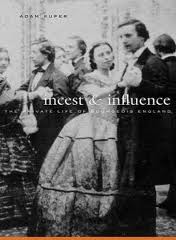
‘Incest and influence: the private life of bourgeois England’ by Adam Kuper

2009,  256 p. & notes

This book is nowhere near as kinky or Marxist as the title suggests.  Neither of the two forms of ‘incest’ described (cousin marriage and in-law marriage) are viewed that way today, and the ‘bourgeoisie’ is defined not so much in economic terms but as a network  of influence.  So if you’re going by the title, you may be led astray.

Cousin marriage, according to the Attorney-General’s web is not illegal in Australia (although it is in some states in the US), and there is no prohibition on in-law marriage with a dead partner’s sibling.  Yet both these relationships have been controversial in the past, with a mismatch between legal regulation, practice and literary depiction.   Cousin marriage, for example, occurs repeatedly in Victorian novels but its legal status was uncertain for many years, and the first chapter of the book explores the literary depiction of cousin marriage in some detail.   In-law marriage was even more legally contested, with even the Bible providing contradictory examples.  There were many examples of in-law marriage in the Old Testament, and Deuteronomy 25:5-6 made it the duty of a younger brother to “raise up seed” with the widow of an older brother, at least in certain circumstances.  An alternative theological stance, however, was that in the act of a man and wife becoming ‘one flesh’, one’s in-laws therefore became blood relatives.  This was the argument that Henry VIII used in seeking to annul his marriage to Katherine of Aragon, but then several marriages later had to wriggle in the opposite direction in order to marry Katherine Howard who was Anne Boleyn’s cousin (and hence under the ‘one flesh’ scenario, also his cousin).  While the technicalities were of crucial importance to the king and hence the succession, it was of less importance to the population at large.  In fact, it suited everybody’s purposes to have the law about in-law marriage  left rather ambiguous until Lord Lyndhurst ushered through an act of Parliament that made in-law marriages  illegal after August 31, 1835.  The deadline was crucial.  Lord Lyndhurst was acting to assist the seventh Duke of Bedford who had married his dead wife’s half-sister.  The inheritance of the son born from this second marriage could be challenged, and hence the cut-off date to ensure that it did not apply to him.  The law lasted for 60 years until it was repealed, largely because the colonies allowed this form of marriage.  Many people were caught up in the legislation, and it made illegal a form of marriage that had arisen quite naturally in many situations.  It was common for a sister to take over the care of her motherless nieces and nephews after a death in childbirth, and such a marriage could be seen as an act of fidelity on the part of both the husband and the sister.

Kuper then goes on to examine three different constellations of  marriage among three prominent circles of influence:  the Wedgewood/Darwin Lunar Men group, the Clapham Sect of Wilberforces, Thorntons, Stephens etc who were influential in the abolition of slavery, and finally the Bloomsbury circle.  This last group jarred a little because, not only was it set chronologically and hence historically in a different era, but also because bonking each other did not carry these same weight of marrying each other in order to cement family interests.  The book here relied on a fair bit of prior knowledge, and the genealogical details became rather tedious- almost as eye-glazing as the ‘begats’ in the first books of the Bible.

Darwin is a crucial figure in this study because, not only was his family thoroughly enmeshed in the tangled web of cousin and in-law marriage, but his own theory of sexual selection and inherited characteristics led to a re-evaluation of the dangers of cousin marriage, although members of the wider Darwin family took opposing views on the dangers of first-cousin marriages. The book closes with a fast-forward description of legislative and demographic changes over the course of the nineteenth and early twentieth centuries.  It points out during the 1920s the eugenics movement condemned cousin marriage and these scientific concerns passed into the general culture, leading to a decline in cousin-marriage numbers in both middle and upper class families.  However, even more influential may have been changes in business legislation which made limited liability a useful option for medium-sized firms who no longer had to keep marriage (and hence the money) ‘in the family’ in order to protect their assets. The imbalance of the sexes after WWI also affected cousin marriage, and the reduced size of families meant that there were fewer marriagable cousins to choose from anyway.

It does come as a bit of a jolt in the final demographic chapter, then,  to realize that the proportion of cousin marriages that he has been describing was always very small to begin with.  The figure of around 8-12% for bourgeois families is used early in the book, but then modified downwards to between 3-5 and 4.5 among the aristocracy and upper middle class half-way through.  It seems to have remained steady at between 4-5% throughout the nineteenth century and no percentage figures are given for the 20th century so it is hard to compare.  It would seem, then, that the convoluted marriage patterns that he describes in the three family constellations were rather more exceptional than he suggests, and that a more important question might be why nineteenth-century novels emphasized cousin and in-law marriage so much as a plot device when the statistical reality was so different.

Sourced from: Queensland University of Technology

Read because: I saw it at the new Readers Feast bookshop in the city, and thought it looked interesting.

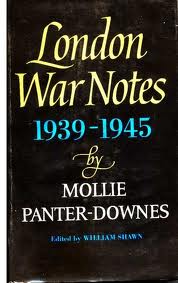
‘London War Notes 1939-1945’ by Mollie Panter-Downes

1971, 378 p.

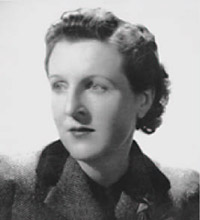
Recently I read a collection of short stories by Mollie Panter-Downes (my word, that is an unfortunate name!) and I was so impressed by her writing that I tracked down this collection of her “Letter from London” columns that were published in the New Yorker between 1939-1945.  The book is divided into seven sections, for each year of the war, each commencing with a brief one-page time line of major events during that year.

Having now read her fictional and non-fictional writing, I can see the connections between them.  Many of her short stories were set in the Midsomer-ish surrounds of village life, and certainly she writes quite  a bit about evacuation and billetting, and the dissonance between viewpoints of rural dwellers as distinct from those of Londoners.

These letters were written in real-time, and thus reflect the fluctuations in perceptions of the war: the initial excitement that it was actually starting, the sudden awareness of the stretch of empire once Singapore fell,  the mental readjustment that people had to make once they realized that the dreaded-Communist Russians were fighting a common enemy and thereby fellow-sufferers, the longing for the second front to open up, and the dread when it did.

There’s a certain chutzpah in presuming to speak for ‘a people’ , although the late Alistair Cook in his ‘Letters from America’ and Hugh Mackay with his quarterly ‘Mackay Reports’ do not seem to have found it problematic.  I certainly don’t think that I would be brave enough to claim to do so. When you are surrounded by like-minded people, it comes as a bit of a shock to realize that you might actually be in a minority! I often find myself  having to remember that the views of a left-leaning, somewhat academic, northern suburbs fifty-year old white woman from Melbourne are not necessarily those held in western-suburbs Sydney, or the resource-rich states of Queensland and Western Australia, let alone anyone of a different age cohort or nationality.  Likewise, when Panter-Downes speaks of an impatience with the paltriness of the sacrifices that people were being asked to make by the Government in 1941, or when she chides the London working-class for taking children from their safe country billets prematurely and returning them to the danger of the city, I do wonder how representative her views are.

But, irrespective of this, her notes do provide a wonderfully intimate and domestic view of life where somehow or other a sense of normality is carved out of such very extraordinary circumstances.  She writes of the theatres and cinemas starting their shows early at 5.30 so that people can get home before the bombing starts,  the issuing of the first directory of emergency addresses for large business firms “if London is rendered uninhabitable”, the marvellous tulip display in the parks in 1940,  people lining up to stay in the Tube stations overnight while the evening-rush commuters are streaming out.  She speaks of the weariness of people in the closing year of the war, falling asleep almost instantly sitting in a bus or train, having been awake night after night with bombing raids. She describes the dissonance of being able to stand on tiptoe to peep at the old gentlemen in the St James Street clubs where the large windows were left uncurtained as soon as the black-out restrictions were lifted, even though after five and a half years many people still drew their own curtains as a matter of habit.

I hadn’t realized that the planning for post-war reconstruction had been announced by the coalition government while the war was still underway. Knowing what we do of the long, skimpy years of post-war shortages, the optimism about the future seems at once both brave and rather pathetic, given that so many of those gleaming high-rise housing estates turned out to be so bleak and blighted.

She is an absolutely beautiful writer: crisp, pithy, observant. Here’s just a sample, picked at random:

What had been an ill wind for many people had blown good to the glaziers, from whose vans, backed against the pavement, hundreds of square feet of glass were being lifted out of straw packing.  The danger from falling glass and odd bits of masonry was still considerable, and police barricaded the surrounding streets to anyone who couldn’t show a pass or prove legitimate business there.  Opposite St Giles, the church where Milton is buried, the front had been blown out of a dark and Dickensian little eating house, and two men in bartenders’ aprons sat together discussing events among the broken mahogany hattracks and scattered spittoons.  A notice tacked up outside announced business as usual.  Around the corner, in Aldersgate, a sign in front of a delicatessen shop which had suffered the same fate proclaimed cheerfully, “We are wide open”.  It was doing a good trade among customers who did not seem to be moved by the facts that they could leave by the conventional door or through the space where the window had been.”  August 30, 1940.


My rating:  Yet another 9/10

Sourced from: The CARM centre ( i.e. the Victorian universities’ repository for old academic books), placed by Deakin University who in turn received it from Gordon Institute of Technology. What a well-travelled book!

Read because: I think that Mollie Panter-Downes is pretty damned good.

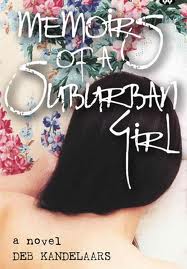
‘Memoirs of a Suburban Girl’ by Deb Kandelaars

158 p. 2011

I’m glad that this book only had 158 pages.  I really don’t think that I could have read any more.  As it was, I started reading it and turned off the light about 50 pages in.  I found that I was too anxious and troubled by it to sleep, so I turned the light back on and kept on reading until about 1.00 a.m. in the morning.

The book is set in 1979, and a teenage girl moves in with a violent older man, whom she calls S. B. (short for Spunky Boy) throughout, even though he turns out to be anything but.  She is only seventeen when she meets him, and she seems to encased in a nightmare world with this abusive, manipulative man, frightened and unwilling to take the first steps towards leaving him.

The book is written in the second person present tense, which I always find a rather claustrophobic, controlling narrative voice.  In this case, it is a risk.  There was a decision point at the very first episode of abuse at which many readers may have acted differently, and to continue to be addressed as “you” makes you feel somehow complicit and responsible for a decision that you might not have made.   I understand that she is making the point that it could be you, but maybe not.  There are choices here, even in the inability to make a choice.  The narrative is highpitched and breathless, and somehow garbled- as if it is falling out of her.

One of the most unsettling aspects of the book is its low-key suburban setting. There are neighbours, workmates, onlookers surely, who witness the violence in the car, in carparks, and who see the bruises and hear the excuses.  Yet somehow she seems to be isolated in her own parallel existence, with assistance from the few friends she manages to have, or her own parents,  visible, but just out of her reach.  She captures the late 70s and early 80s well in all their garishness.

It is a work of fiction, based on the author’s own experience.  It is presented as a memoir, and there are other memories coiled up in the telling.  In the middle of a beating, almost as a form of dissociation, her older and happier memories unspool, until she and you are jerked back into the grubby reality of her situation.

Should you read it? Yes, you should.  Will you like it? I don’t know. Did I like it? I don’t know. I couldn’t put it down- does that make it a good book?

Sourced from:Yarra Plenty Regional Library (who kindly bought it on on my suggestion!)

Read because:  It was highly recommended by Lisa at ANZLitLovers LitBlog

I’m reviewing this for the Australian Womens Writing Challenge 2012. It’s not too late to join, you know.

‘Bright and Distant Shores’ by Dominic Smith

502 P. 2011

The Voyage and the Return is, as Christopher Booker tells us in his book of the same name, one of The Seven Basic Plots.  On one level you could summarize the plot of this story quite simply- a young man travels to the South Pacific to collect artefacts and exhibits for an industrialist’s exhibition, then he returns.  But this summary would sorely undersell the complexity, exuberance and intelligence of this book.

I’ve been dabbling around with the 1840s colonial travellers and gentleman naturalists for too long, because the setting of this book jolted me into a different timeframe and mindset.  By the 1890s, wealthy, and especially American, magnates had moved into the field, buoyed by the increasingly large commercial success of the World Fair  phenomenon, and keen to pour their wealth into their private collections which could be levered for commercial and philanthropic gain.  They were anxious that the best artefacts had already been picked over, and were competing against each other  as well as private and public museums to scoop up what was left.  But a century of missionary endeavour and ethnographic plunder had changed the indigenous tribes as well, who were no longer content with mirrors and beads, and demanded guns as the price of exchange now.

Into this scenario steps Owen Graves, the poor but ambitious son of a demolitions expert, who is contracted by the wealthy owner of the Chicago First Equitable Insurance company to travel to the Pacific to collect artefacts, and especially human exhibits, for a display in his new building- the world’s largest. The company president, Hale Grey, insists that his dilettante son Jethro accompany the voyage where he could indulge his passion for collecting and taxidermy.

It was the “human exhibits” that were the sticking point.  Owen’s fiance, Adelaide, was a strong-willed and forthright humanitarian who would have been appalled by this trafficking, and so he did not tell her this part of  contract.  It transpired that he collected only two Melanesian islanders – a brother Argus Nui and his sister Malini- to take back to Chicago.  Argus had been thoroughly enculturated into British life by a missionary with whom he lived as house-boy, and both he and Malini were forced to enact a parody of primitive village life on the rooftop of the increasingly dangerous First Equitable Insurance building as it subsided into the lakeside shore.

It is ambiguous which setting is, in fact, the ‘bright and distant shore’. The Pacific Islands shimmer in the crystal waters, disguising the trade in people and artefacts not only on the part of American collectors and industrialist-philanthropists, but also the more sinister blackbirding system that supplied the Queensland canefields with labour. Or is the ‘bright and distant shore’ the tawdry  lure of America, that promises wealth and, for Argus, an opportunity to become a missionary perhaps in his own right?

This book is large and almost nineteenth-century in its scope and language.  It tackles big questions of exploitation, class, culture, avarice and tradition, and its characters- all of them- are complex and nuanced.  The writing is beautiful in many places with words that are unconventionally but deftly used and the narrative swoops across oceans and wreathes around one character after another.   It’s a very confident, assured book.

The author is Australian-born, resident in America since 1989, but that doesn’t stop us claiming our literary expatriates like Peter Carey and Geraldine Brooks. He’s right up there with them, but I hadn’t heard of him until this book.  It was shortlisted for both the Age Book of the Year and the Vance Palmer Prize Fiction Prize.

A thoughtful review by James Bradley is here.

My rating: 9/10 (again).

Read because: it was the February reading for the Yahoo  Australian Literature online reading group.

Sourced from: Yarra Plenty Regional Library