Category Archives: Book reviews

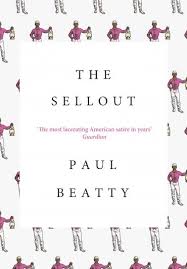
‘The Sellout’ by Paul Beatty

sellout

2015, 289 P

I still haven’t really come to terms with the fact that the Booker Prize now includes American works. Yes, I know that we’re all globalized and agile these days, but I think that the Booker has lost its distinctiveness since it was opened up beyond Commonwealth countries. While I’m ambivalent about the Commonwealth as a political entity, I do think that there is some underpinning cultural thread that links countries – especially the ‘white’ part of their population-  where, in living memory,  large numbers have grown up with a portrait of the Queen on the wall. The Booker Prize, I feel, is still the Commonwealth’s prize.

So I spent the first half of this Booker-Prize winning  book being angry at its American swagger, showoffiness and shoutiness. It was almost exactly half-way through that I started laughing, and then found myself chuckling away at various points to the end. I don’t read a lot of satire, and it’s a rather wicked pleasure when I do.

The un-named narrator, living in a post-Obama time, is African American and lives in Dickens, a lower-middle-class suburb on the outskirts of Los Angeles. His home-schooled upbringing had been unconventional and overseen by his sociologist father who seemed determined to visit on his son all the most ethically-controversial psycho-social laboratory experiments of the twentieth century. After his father’s death, the narrator drifts into his father’s circle of old, idle chatterboxes who he dubs “The Dum Dum Donut Intellectuals” and tries to hook up with an old flame. It is while he is wooing his bus-driving love-interest Marpessa that he jokingly starts off re-segregation on her bus (yes, re-segregation, not de-segregation) and, discouraged by the neglect of Dickens as a suburb, initiates a broader grass-roots program of resegregation throughout the suburb that actually works. School results improve, crime declines, civic pride burgeons – all because of a self-imposed segregation.

It’s all very slick and clever and  the book would probably easily reward a second reading. The blurb on the back describes it as “a powerful novel of vital import and an outrageous and outrageously entertaining indictment of our time”. Which is probably true. But I still think that it’s better recognized under the New York Times Book Review (as it was) than as winner of the Booker Prize.

My rating: 8/10

Sourced from: Yarra Plenty Regional Library

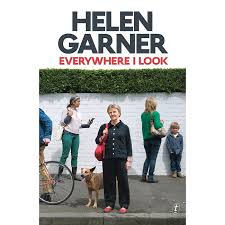
‘Everywhere I Look’ by Helen Garner

garner_everywhere

2016, 240 p.

When I checked out how many Helen Garner books I’d reviewed on this blog there are five, which makes her (along with Kate Atkinson) the author I’ve read most often in the last eight years. I read others of hers, too, read before I started blogging. It’s no secret that I very much enjoy her writing and feel a sense of wary affinity with her, bolstered by being much the same age and a fellow-Melburnian.

This book differs from the others I’ve reviewed in that it is a collection of her essays, several of which I have read before in the Monthly. None of them are particularly long and they offer a slice of perspective and a way of looking, as the title suggests. She has a penetrating intensity that disguises itself as a general-looking-around. I find myself wishing that I could discipline myself to look more carefully and thoughtfully, instead of just letting things wash over me.

As with short stories, it’s hard to talk about essays, because each one stands on its own two feet and it feels almost unfair to single one out above the others. A collection of essays, just as with short stories, does not just fall together but is instead a curated arrangement and selection.  This is particularly apparent in this book, which is divided into six parts. Continue reading

‘White Dog’ by Peter Temple

whitedog

2003, 337 p.

I think I’m just going to have to admit that I don’t really like Peter Temple’s books very much.  I’m already ambivalent about the fictional crime genre and Temple’s books, with their abbreviated dialogue and huge range of incidental characters, just confuse me.  I looked back at my review of Truth, another of his novels, and I could just as easily cut-and-paste the comments that I made about that book into this review too.

Just to add to the confusion, the ABC has recently screened another Jack Irish series that uses some parts of White Dog, but not the whole book. So not only did I have Guy Pearce firmly embedded in my head (no hardship, I must say) but I found myself half remembering some aspects of the plot and misremembering others that appeared in the television show only.

Like the other Jack Irish novels, White Dog is steeped in local Melbourne colour, very familiar to north-of-the-Yarra inner suburban Melburnians (as I am). However, it’s a rather curmudgeonly approach, dismissive of hipsters and all-day breakfasts and harking back to a 1980-1990s cool, and even further back to the glory days of Fitzroy Football Club.  It’s all thoroughly recognizable to a Melburnian but I don’t know that it would add much for readers elsewhere.

So all in all, not a particularly successful read.

Sourced from: CAE bookgroups

My rating: 6.5

‘The Bush’ by Don Watson

watson_bush

2014, 378 p & notes

I’m almost embarrassed to think how many times I have borrowed this book from the library and had to return it still unread once my renewal limit was reached. I first borrowed it after it received Premiers’ Awards in both NSW and Queensland and it was announced as the Indie Book of the Year in 2015.  I borrowed it again months later, but then decided to read Don Watson’s earlier book Caledonia Australis instead (see my review here). And now, after multiple renewals and many months, I have finally finished it.

I was wrong to see Caledonia Australis and this most recent book, The Bush as companion pieces.  The earlier book (originally written in 1984) is a product of Don Watson the historian, but The Bush, with its subtitle ‘Travels in the heart of Australia’ is more similar to Watson’s American Journeys or his more recent Quarterly Essay The Enemy WithinIn both these books Watson travels to different locations and milieus, talking with people, looking out the window, sniffing the air.  This is very much the way that you need to read The Bush. It was only when I realized that, and stopped looking for a clearly defined argument, that I began to enjoy it.

I only found the map, too, once I sat down to write this review, and I feel rather annoyed at myself for overlooking it earlier.  The map shows the breadth of his travels, extending almost 3/4 around the circumference of Australia and leaching inland.

He calls his book The Bush but as he points out, that short word is too small to contain all that ‘the bush’ evokes:

the bush is any one of many different kinds of forest, scrub, woodland, savannah, rangeland, grassland and desert, made up of countless species in countless combinations of shape, colour, light and atmosphere so ephemeral and various that, unable to cope with them, our collective imagination has rendered all as bush, and often reduced it to a river red gum combined with a flock of sheep.

Collapsing into a single word or image tropic rainforest and mulga, and all the ecosystems in between, is a natural enough convenience, but the bush describes much more than vegetation and its native creatures… It has equal measures of what was there before Europeans came and what is there now.  It is what we have done to the natural environment and what it has done to us.  The world outside us and the world within.  Wilderness, home and garden.  Temple, nursery and slaughterhouse. (p.69- 70)

The book starts with the personal: his grandfather striding across the paddock to his cowshed, and his grandmother sweeping the back veranda. Watson is a country boy (and already there’s the slippage in terminology between country/bush) from Gippsland, and in the final chapter he tells us that some forty-odd years later he has returned to the bush, albeit the very different bush of the Macedon Ranges. In between the chapters range across the Mallee and Wimmera, the Murray-Darling Basin, the Mitchell Grass Down and the West Australian wheatbelt.  The chapters are arranged, however, at a human emotional level as well as a geographical one: “The Bush Means Work” or “Striving to Stay in Existence” “Farming the Flood Plain” or “The Bush Will Not Lie Down”.

Each chapter starts with an italicized paragraph of subheadings to signpost the content to come, similar to those found in an old-fashioned novel (I’m sure that there’s a word for this, but I don’t know what it is).  These prefacing epigraphs (is that the word I’m looking for?) reflect the meandering, ruminative nature of the chapters, which branch off and diverge into unexpected places.  There are many lists, particularly of trees, grasses, birds and fish. There are also many commentators along the way: the present-day people he has met on his journey, explorers and visitors to Australia who diarized their impressions, settlers who documented their memoirs, historians who have responded to these primary sources, and fictional characters crafted by mainly Australian writers drawing from and replenishing the well of the Australian imagination about the bush.

For, as he says:

The Australian bush is both real and imaginary. Real, in that it grows in various unmistakable bush-like ways, and dies, rots, burns and grows into the bush again; real, in harbouring life.  Imaginary, in that among the life it harbours is the life of the Australian mind. It is, by many accounts, the source of the nation’s idea of itself…. The bush is a social construct as well as an ecological one: as much as the things that grow and live there, we define it by the people who inhabit it. (p66)

Embedded within the landscape are people, both Indigenous and European. There is no one ‘Indigenous’ chapter here, tacked onto the front or the back of the body of the book.  Instead, the Indigenous and European presences are interwoven throughout the chapters, sometimes existing side-by-side, at time working at cross-purposes, sometimes in a state of active hostility.

Much of the book reflects struggle with physical elements like soil, water, fire but its final words (before an oddly placed appendix) are those of in the realm of the emotions:

It can do no harm to settle on the public mind a deeper and more honest knowledge of the land than anything that myth and platitude allow, or to encourage love to overrun indifference… We need a relationship with the land that does not demand submission from either party, that is built more on knowledge than the hunger to possess, and finds the effort to understand and preserve as gratifying as the effort to exploit and command.  In the end it is possible to love and admire the bush… Except we need to love it as it is and can be, not the way it was and never will be again.  (p.373)

I enjoyed this book so much more once I started to look at it as a series of essays, rather than an argument in itself. They are beautifully written, and would lend themselves well to being read aloud, and being read over and over. You don’t need to read it in one go, and you don’t need to read it only once.  It’s the sort of book that belongs on your own bookshelf  and it will, on mine- especially now that it has been released in paperback.

Sourced from: Yarra Plenty Regional Library  (again and again)

My rating: 8.5



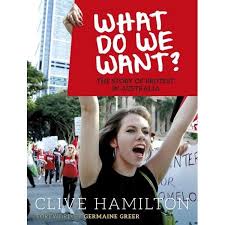
‘What Do We Want?’ by Clive Hamilton

hamilton

2016,  190 p & notes.

I quite often attend demonstrations. Climate change, the war in Iraq, anti-Kennett, Hiroshima commemoration, refugees – I’m there.

It’s often struck me as I gaze around at the people, many of whom are my baby-boomer age and at the police who generally just look bored, that demonstrating in Melbourne CBD in the 2000s is a fairly cost-free enterprise for me. I’m reassured that I won’t be arrested (a middle-aged woman isn’t much of a threat) and I’m certain that I won’t be killed. I am very much aware that there are other places in the world where this isn’t the case, and I suspect that although I’m happy to let the whole world see my principles and causes here in safe Melbourne, I’d suppress or maybe even jettison them in a more dangerous environment.  But as Clive Hamilton shows us in this book, protest in Australia has not always been as cost-free as it is now. Continue reading

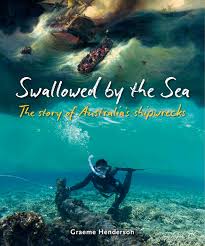
‘Swallowed by the Sea: The story of Australia’s shipwrecks’ by Graeme Henderson

henderson

2016, 203 plus notes

Every edition of each of the three newspapers published in Port Phillip during the early years of the 1840s had a prominently displayed ‘Shipping’ feature. It would list the ships that had arrived  and departed from UK and Australian ports  and their important passengers, then there would be a long list of the progress of various ships along the main shipping routes heading to or from Australia.  I’ve only been on a ship on the open seas once, but I can remember thinking as I looked at the empty waves around us, that it was as if we were the only ship on the ocean. Of course we weren’t: there were ships criss-crossing out of our sight and  modern communications ensured that we were easily trackable and findable.  Ship journeys in earlier times were nowhere near as trackable or findable, as Graeme Henderson’s book shows,  with several of the wrecks he describes still undiscovered.  But, as some of his chapters suggest, even in what seemed to be an ’empty’ sea, mariners’ knowledge of the sea lanes and ports meant that they knew where to go for help, even though it may be thousands of kilometres away.

Graeme Henderson is a maritime archaeologist and was director of the West Australian Maritime Museum for 13 years. He discovered his first shipwreck at the age of sixteen, sparking a life-long passion.  In this book he examines shipwrecks spanning 1622 right through to 2010 on both the west and east coasts of the Australian mainland.  Chapters 1-11 deal with shipwrecks during the mid 19th century when, of course, Australia was completely dependent on shipping for communication and travel.  Two of the  final three chapters deal with shipping losses in World War II (loss of the Sydney and the bombing of Darwin in 1942) and the final chapter brings us right up to the loss of the asylum boat, SIEV 221 which brought visible footage of a modern, but yet somehow timeless, shipwreck right  into our lounge rooms. Continue reading

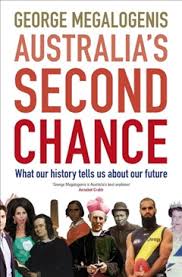
‘Australia’s Second Chance’ by George Megalogenis

megalogenis

‘Australia’s Second Chance: What our history tells us about our future’

2016, 292

When I did HSC Australian History back in 1973, one of the books we had to purchase was A.G.L. Shaw’s The Economic Development of Australia. With its mud-coloured front cover, it was not an enticing book and it remained resolutely unopened the whole year.  Despite my admiration for A.G.L. Shaw’s work on Port Phillip, I’ve never been tempted to dig it out again.

Generally, economic history does not have a lot of prominence within Australian historiography, especially in recent years.  This struck me particularly when I was looking at Upper Canadian history, where economic explanations of development seem to abound. I wondered if, perhaps the difference lay in the fact that Upper Canada was settled overtly as a capitalist, entrepreneurial venture, compared with Australia’s more ambivalent beginnings as a penal colony in NSW, Tasmania and Moreton Bay, or as a Wakefieldian experiment in South Australia combining economic and social/moral aims.

However, in Australia’s Second Chance George Megalogenis has written a history of Australia  from an economic perspective that starts with the First Fleet and goes right through to 2015. Megalogenis writes more as a journalist more than historian and political commentator and in this survey-history he relies mainly on secondary sources.

The thesis of the book is that with the Gold Rush, Australia had a windfall that opened us up to the  rest of the world and made us, during the 1870s, the most prosperous country in the world. However, by the end of the 1880s we were too rich for our own good, and insecure that we could lose it all and thus grasped at the White Australia policy as a way of keeping people and goods out in order to preserve our standard of living.  This insular, frightened stance locked Australia into low growth and a sluggish economy until post-war migration, in its various guises, reinjected diversity back into Australian society and again stoked the furnaces of economic growth. In the closing chapters of the book, written while Abbott was Prime Minister, he warns that income inequality and fear of competition could lead us to squander our ‘second chance’- the minerals boom and Hawke/Keating open economy- and condemn us again to mediocrity. Continue reading

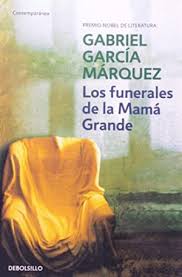
‘Big Mama’s Funeral’ Collected Stories by Gabriel Garcia Marquez

Still I paddle along as quickly as I can in my Coursera course on Gabriel Garcia Marquez‘s work, reading the literature in English with relish and the transcripts of the videos and linked articles in Spanish very slowly!

mamagrande

1962

This week I read a collection of short stories called ‘Big Mama’s Funeral’, so named for the final story in the collection. As the course explains, some of these short stories are in effect practice-runs for material that would appear in A Hundred Years of Solitude, while others ‘speak to’ other literature that would be familiar to Spanish-language readers (but not necessarily English-language ones). One of Garcia Marquez’ stories, ‘One of These Days’ involves a dentist whose patient, the Mayor, comes in with an abscessed tooth which the dentist- maliciously- tells him can only be extracted without anaesthetic. This story ‘speaks’ to a story by Hernando Telles called ‘Lather and Nothing Else’, a fantastic story available here that has a barber called upon to shave the military officer responsible for mass killings and atrocities. (To be honest, I preferred the Telles story.)

The two most memorable stories for me were ‘Tuesday Siesta’ and ‘There Are No Thieves in this Town’. ‘Tuesday Siesta’ is about a woman and her daughter who travel by train to visit a priest in order recover the body of her son, shot in an Oscar Pistorius-like encounter. Garcia Marquez captures well the hot somnolence of the Tuesday siesta  and the mounting hostility of the villagers who surround the priest’s house. The second story ‘There Are No Thieves in this Town’ involved the theft of billiard balls.

There is another short story I’ve been reading, which was published in ‘Eyes of a Blue Dog’, another collection of Garcia Marquez’s short stories.  It’s called ‘Monologue of Isabel Watching it Rain in Maconda’ and it’s the longest short story I’ve ever read because this time, I am reading it in Spanish!  By the time I’ve read half a page, I’m sweating with exertion (to say nothing of the humid, rainy weather I’m reading about) and no doubt I’ll still be reading it in three weeks when the course is over!

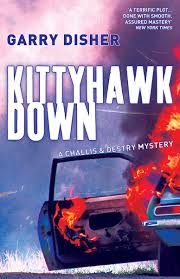
‘Kittyhawk Down’ by Garry Disher

disher

2003, 288 P.

Is a steady diet of Wallander, Scott and Bailey, The Bridge and -sheesh- even Midsomer Murders softening me up for detective murder mysteries?  Stranger things may have happened.  Whatever: I found myself quite engrossed in this  Australian crime story chosen by someone in my face-to-face book group.

As with the above-mentioned television crime series, this book is just as much about the interactions and messy personal lives of the police investigators as it is about the crime. Although the book is subtitled ” A Detective Inspector Challis murder mystery”, Detective Inspector Hal Challis is only one of an ensemble of police characters.  There’s Detective Sergeant Ellen Destry, whose 17 year old daughter  is recovering after almost falling victim to a rapist and serial killer in an earlier book. There’s the sleazy Constable John Tankard who hits on his female colleagues and who doesn’t seem far removed from the criminals he is chasing. Detective Constable Scobie Sutton bores everyone rigid yabbering on about his daughter, while Constable Pam Murphy has waded in over her head financially.

In many ways this book is a snapshot of the paradoxes of the Mornington Peninsula in Victoria.  There’s the affluent and often absent population up in the forested mountainside (think Red Hill) and the financially straitened underclass in ‘Waterloo’ (Hastings, perhaps? It overlooks Phillip Island, but it felt more like Rosebud to me). An immigration detention centre has opened up nearby, and the reactions of inhabitants remind me that we haven’t moved far in the 13 years since this book was published.  There’s drugs, crime and unsavoury connections among the underclass where boyfriends and broken families criss-cross each other. As the police note in one of their briefings, criminals often announce themselves through their defiance of small things like parking in the disabled bay. Rings true to me.

Disher’s chapters are only short and they rotate in their attention from one police officer to another.  Too much, perhaps, and there does not seem to be one main character in the book which feels as if it’s leaving itself open as the springboard for another book in the series.

But- and this is important- I actually knew who’d done it in the end, even though not all the ends were tied up.  And, as someone who’s not normally a fan of crime fiction, that’s a good thing!

Sourced from CAE bookgroups

My rating: 8/10


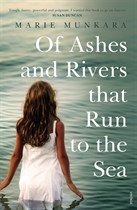
‘Of Ashes and Rivers that Run to the Sea’ by Marie Munkara

munkara2

2016, 274 p.

For me, the day that then-Prime Minister Kevin Rudd apologized to the Stolen Generations is a day lodged in my memory, along with moon walks, assassinations, bushfires and planes crashing into buildings. I was on a train to Bendigo for a history conference, and it seemed rather appropriate to sit with other historians, heads bent over a small transistor radio, listening to Rudd give a historic speech that was much better than I expected it to be.  But although as white Australians the speech may have made us feel a bit better about ourselves, it was always an apology to indigenous Australians.  They sat in the parliament and on the lawns outside, many in tears.  This was their apology. As a white Australian, I know the policies and justifications that led to the removal of indigenous children from their parents, but I can only imagine, incompletely, the emotional toll of this government-encouraged policy.

Marie Munkara’s book takes us into the heart of it because the author is one of those stolen children.  Born on the banks of the Mainoru River in Arnhem Land in  the Northern Territory, she was taken from her mother at three years of age. Her white foster father sexually abused her for years, and her white foster mother was bitter and harsh. Nothing was said about her birth family, although her religious family did meet with other families who had likewise adopted Aboriginal children under the aegis of the Catholic Church. Twenty-eight years later she found a baptismal certificate, and after some enquiries, she found out that her mother was still alive and that she had siblings at Nguiu on Bathurst Island.  Within weeks, she was aboard a plane to meet her family.  It is a troubled, awkward reunion.  Months after returning for a second stay, she confronts her birth mother:

‘Did you want me to come and stay here with you?’ I say petulantly. ‘You’re always so grumpy.’

‘You nebber ask me,’ she says tetchily like I’ve struck a raw nerve.

And mummy is right, I didn’t ask her. And I have never asked her about how she felt about her three-year-old child being taken from her life and a twenty-eight-year-old stranger waltzing back into it again.  I assumed that we would take up where we left off but I realise now that the years have been too long and the differences between us too many for that to occur. (p 232)

Certainly Munkara crashes back into her family’s life full of justifiable anger at her foster-parents.  But her perspective on her new family is steeped in urban, white values. She is appalled by the squalor, poverty and community violence and frightened by the snakes, rogue cattle, crocodiles and lice.  Repulsed by the barely-cooked meat served up to her, she decides to become a vegetarian: an urban affectation not easily catered for in a remote area. She is torn between judgment and an aching need to be accepted and folded back into her family.

If you’ve read Munkara’s Every Secret Thing (my review here) you’ll recognize the humour in this book with it’s ‘up-yours’ insouciance.  Many of the book’s small chapters are short vignettes where Munkara tells of meeting family members, nights at the alcohol-sodden club house, hunting trips and bush-bashing in completely unroadworthy cars.  Much of the time the humour is at her own expense.

The narrative voice is simple and feels to me as if it belongs to a younger writer. Munkara is fifty-six, but sounds almost adolescent.  This is not high literature by any means.

The crispy sauvignon blanc that I had bought to help pass the time left a subtle lingering citrus taste on my palate… (p. 4)

Nonetheless, particularly in the last forty pages of the book, there is an honesty and poignancy that transcends the rather pedestrian prose.

…there’s a little piece of something in my heart that no one can reach because it lives deep down inside me. I think this family wants to take the something out of my heart and make me black, just like the other family wanted to tame me and make me white.  I know that nobody is interested in the parts of me that don’t concern them.  The white parents aren’t interested in the pre-assimilation black bits because they wanted a white girl with black skin. And my real family don’t want to know about the post-assimilation white bits because they think I’m a black girl with a white heart. I know that I’ve disappointed them all. The anger from the white parents.  The pitiful looks from the black. The fretful and all-consuming silences from them both.  I wish I could open the doors to my mind and let them in, so they could see the world from my eyes and forgive me for not being able to fit their expectations. (p. 234)

Despite the raucous auntys and cousins surrounding her in her black family and the sterile figures in her white family, this is a lonely journey with higher emotional stakes than, say, Sally Morgan in My Place.  Its authenticity transcends its unsophisticated prose and structure. I haven’t read a book quite like it.

Sourced from: Yarra Plenty Regional Library

My rating: 7/10

I have posted this review to the Australian Women Writers Challenge website. aww2016