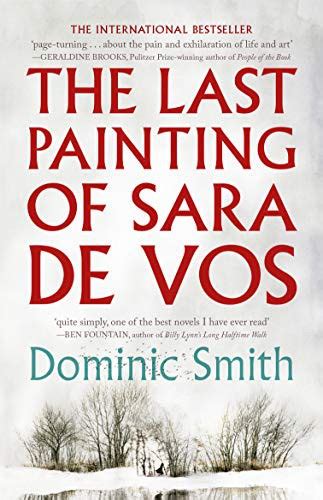
I guess that you could say that if a historical fiction book sends you off to internet-land to find out which bits are true, then it has worked. I should have taken more notice of the author’s note which explains that Sara de Vos is a fictional, composite character. But I didn’t and so, yes, there I was half-way through the book, searching high and low for the paintings that are described in the text, trying to find out more about Sara de Vos, only to find myself directed back to publicity for Dominic Smith’s book. So, to save you the search, Sara de Vos is a 17th century fictional character and the paintings described don’t exist, although there are similarities with the few details known about Sara van Baalbergen. Like the Sara de Vos of this book, she was admitted to the the Haarlem Guild of St. Luke and married a fellow painter. None of her works have survived.
SPOILER ALERT
But in Dominic Smith’s book, three of Sara de Vos’ paintings still exist- but which ones? The book opens in New York in November 1957, as a painting by Sara de Vos is stolen from the luxurious apartment of wealthy Marty de Groot, plucked from the wall above the marital bed. It ends up in the lands of Australian art historian, Ellie who is studying de Vos, freelancing in art restoration as a sideline activity. Her rather dodgy associate, Gabriel, asks her to make a copy of it. She asks no questions about where it comes from or to whom it belongs: she doesn’t want to know. It’s an opportunity to really study a de Vos painting close-up but it’s a decision that she regrets for the rest of her life, especially as her career blossoms and she becomes a noted academic and curator of Dutch Golden Age paintings. After assuming that the copy (i.e. forgery) has been resolved through her own contact- and more- with de Groot, it seems that her indiscretion of some forty years earlier is about to bring her undone as what she fears is two copies of the same painting are heading towards Australia, for an exhibition that she is curating at the Art Gallery of New South Wales.
So what was this painting, source of both desire, possession and trepidation? It was At the Edge of the Wood, thought to be painted by Sara de Vos in 1636, depicting a young girl standing against a silver birch, watching skaters on a frozen river as the sun sets. Through the flashbacks to the 1630s that are interwoven through the book, we learn that it was painted surreptitiously by Sara de Vos, who although admitted to the Guild of St Luke- something almost unheard of for a woman- was expected to paint still life pictures within a domestic setting. She and her husband Barent had been expelled from the Guild for painting unsigned landscapes outside of the Guild strictures and her life is falling apart. She is still grieving the loss of her seven year old daughter, and deeply in debt, Barent has deserted her, leaving her to make her own way.
The book, then, has three intersecting strands: Sara’s story in 17th century Netherlands; Ellie’s life in 1950s Europe and ill-advised venture into forgery and later interaction with the rightful owner Marty de Groot, and 2000 in Sydney when three de Vos paintings are heading to upend Ellie’s career. In places it reads like a mystery, and historical fiction, in other places a critique of the art scene and collecting practices, and an exploration of grief and regret. He writes exceptionally well of Ellie as an awkward, young and inexperienced girl far from home, embarrassed by her virginity and alternately attracted to and repelled by an older man who is interested in her for his own purposes. He does conversation well, and his descriptions of paintings are so crisp that you think that you might have seen them once- even though, of course, you couldn’t have. At times his description of painting and forgery techniques drag a little, but they do pay testament to the research that he has undertaken as part of writing this book.
And what was Sara de Vos’ last painting? Ah well, you’ll have to read the book…
My rating:8/10
Read because: Book Group selection, sourced from Yarra Plenty Library Book Groups collection.
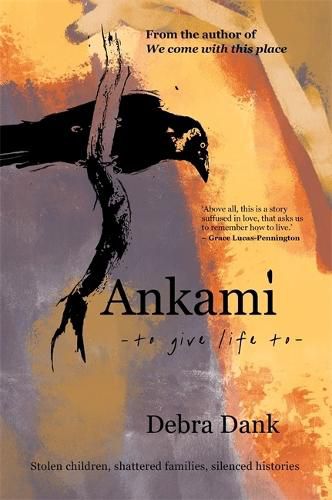
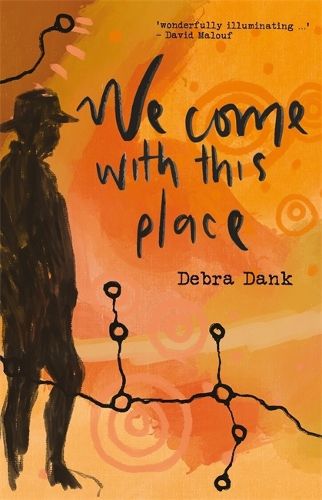
Both visually and in its subject matter, this third book by Debra Dank and her first We Come With This Place (see my review here) are linked. However, the tone of this book is different: instead of being a celebration of family, country and continuity as her first book was, this book is infused with an anger which is moulded into regret. The beautiful writing is still there, but there’s an injury here as well. I wonder if the timing of this book has something to do with this? It was published in 2025, post-Voice Referendum. I see the defeat of the Referendum as a mean-spirited rejection on the part of white Australia of the responsibility to listen – something that Governments seem happy to do with lobby groups, particular religious groupings and big business, but not our First Peoples whose ‘brand’ we blithely adopt at international events like Olympic Games and tourism advertisements.
She herself acknowledges her anger, which she capitalizes with an Upper Case A. As soon as she awakes, her uninvited bedfellow Anger whispers to her and causes her body to tighten. As she tries to locate where Anger comes from, she moves to “the outskirts of my reminiscence”, where she finds
sombre sub-memories that suggest the what might have beens, the sentient breathing of those who did not have the opportunity to make themselves more substantial by their living, but I find them there all the same, prowling like misshapen birds waiting to tell a calamitous story. I know too much about those birds, their earthly form an unsettling combination of shiny black feathers and yellowish beaks, staring eyes… and about their stories. They are often around, the flapping of their wings and their cawing voices adding to the daily rhythms of my living steps, but inside, with my unseen companion, Anger, they seem to offer obscure warnings of imminent and dire happenings. (p. 34)
So what has happened between her first and second books? Certainly in We Come With This Place there is violence and injustice but her Anger/Regret in this book starts as whispers from aunties who tell her of voices “all them kids” that cried at night, and older women in the community who urge her to go up to the islands in the north because her father had family there. When she asked her father, he denied that he had any other unacknowledged siblings. There was an appointment with an Aboriginal agency trying to link up families again that seemed to be fruitless. Then there was the unsolicited and unexpected phone call from a woman who was putting together and thought that they might be related on account of their shared name. There was silence when Debra told her that she and her father were Aboriginal. There was a silence. “Oh well, um, that’s nice. Er, you have a nice day”. (p. 81)
Then there is finally, definitely, the documents that she located in the National Archives.
Time collapsed in those moments of opening the attachments and doing the cursory read that I thought would be adequate to find what I had assumed was waiting to be found. I was looking for an easy telling of names and places and times that I already knew, not this thing that greeted me with a wicked and vengeful eye. In that moment I was so very grateful for those documents but there was an awful, almost hateful, separation too. I discovered that my father had not one sibling but four, who were taken, that my paternal grandmother had given birth to ten children, not the six that I had known about. Those four others seemed to be part of the Stolen Generations, and later, as I sat in silence to process that, I remembered that there had been whispers. (p. 62)
What seems to be particularly galling is that these four children are an absolute void. They are not named, or numbered. The document from the National Archive was a letter advising of the death of her maternal grandmother, the mother of 10 children. Her youngest child had died, and the other living five children were on the Alexandria station. The author of the letter didn’t know where the other children were.(p. 94) When the protector arrived up at Alexandria station, he expected to find the children there, but “I understand it is the practice to trade workers between this one and that”. (p. 87)
In the Redfern speech in 1992, Paul Keating (or Don Watson his speechwriter) spoke of the failure of imagination on the part of White Australia. Despite the bland language of the time, it doesn’t require a great deal of imagination to recognize child removal or slavery.
Here is the ‘Ankami’ of the title: “to give life to”. Her book gives life to these children of the absence. She recognizes that it is not anger, but sorrow at the ‘should have beens’ of these four missing siblings, aunts and uncles, and the web of cousins that might have been wrapped up into the family, as she had been.
I realize that I’m not angry at all, that what I’m feeling is loss, loss that is pervasive and soul deep and profound. I see now that wandering through my body to eventually arrive at what may be close to my soul, that careful travelling gaze found the site that hosts my sorrow. I live with long term loss that is impossible to grieve for because I don’t know who I should miss. I didn’t learn their faces. I didn’t feel their joy or wrath; they never taught me the things they needed to teach me as much as I needed to learn them. Mostly I don’t know how to miss them because they were never there, merely half-imaginings on that opaque edge of my knowing of what should have been, but they’re there in ways that I can never escape because they’re in my blood. And somehow I’m grateful for that because they deserve so much more than to only exist in that horrible arrangement of ink. (p. 177)
Danks spends quite a bit of time in this book talking about fruit cake, which seems a paradox. It is a fruitcake from a recipe brought from Scotland with the ‘settlers’ of her family, that has been handed on from daughter to daughter. She talks about her non-indigenous father-in-law’s stories of his childhood and the perils of surfing and the sea, stories that he had told many, many times before. We all have history, but only one history is told; only one history is recognized.
I think there is a particular kind of superficial living gripped by folk who hear only one history, only one way of thinking…let’s all be truly courageous about owning our entire history and acknowledging all of it, and then be proud- an informed pride, rather than one that is steeped in wilful ignorance. (p. 111-2) …. The central truth in this story is that all Australians now benefit from what was done to my family and to almost all other Aboriginal families in Australia and it can only heal us all to admit that much at least. But I don’t know that such a young country has the maturity to accept that. (p. 179)
It doesn’t. This is what Australia said ‘no’ to.
This book is confronting and asks difficult questions that we don’t want to answer, but it is not bashing you over the head with guilt. As Antonia Pont, who wrote the Foreword notes, the book “circles, spirals, sidles close to, and also confronts legal, political, communal and personal facts and happenings, with a rigorous yet not overplayed scholarly knowledge of the detail” (p.xii) It is a bit like probing the skin around a wound: touch, flinch, but touch again more gently. Such grace in allowing us the space to be so tentative, but still quietly insistent that there is much work yet to be done. ‘Ankami’ has been shortlisted for the 2026 Victorian Premier’s Award. It didn’t win, but it would be a worthy winner.
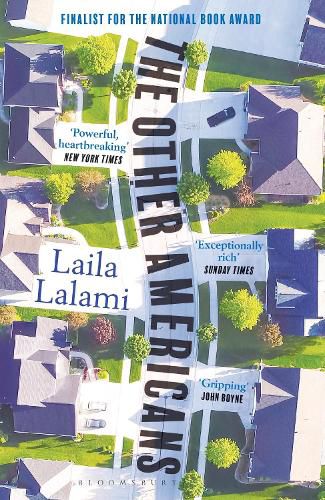
The front cover of this book shows a stylized drone-view type drawing of a suburb in America, with gabled houses surrounded by lush green lawn and trees. It looks just the way I imagine American suburbia to look, full of Leave-it-to-Beaver and Brady Bunch types. The ‘Other America’ in this book live in a rural town on the edge of the desert and the “other Americans” who live there are very different to this white, sanitized image.
Late at night in a small town in the Mojave Desert, California, middle-aged Driss Guerraoui, a cafe owner who originally emigrated from Morocco, is killed in a hit-and-run accident. It is assumed that it is accidental, but his daughter, Nora, believes that it was a deliberate ‘accident’ even though her grieving mother Maryam and sister Salma do not follow her in her obsession with finding the perpetrator. The local police are brought in, including Coleman, a female officer that we later learn is of African-American descent, and deputy sheriff Jeremy Gorecki, an ex-Iraq veteran who had grown up in the town and had long had a school-boy crush on Nora. Before the accident Nora had been living in Chicago, trying to carve out a career as a musician, and involved with a married man who had not followed through on his pledges to leave his wife. But when her father is killed, she returns to her home town and again becomes involved with the boys she went to school with, including Jeremy and A. J. and his father Anderson, who owned the bowling alley beside her father’s cafe. However, the accident did not go completely unseen. Efrain, an undocumented immigrant, saw the collision but fear of the authorities stopped him going to the police. He only came forward when Nora offered a generous reward, possible because of a bequest left to her by her father (a bequest resented deeply by her sister).
The story is told in a chorus of nine voices, including that of the dead man Driss. Because they are all telling the story from their own perspective, we learn much more than about just the accident and the investigation, which is rather an anti-climax as far as a police procedural goes. We see parallels between Driss and Efrain, both making a life in a new country; we learn of infidelities in Nora’s own family; we see racism and resentment being played out at multiple levels. Because they are told from each character’s point of view, we gain multiple perspectives on the same event but I feel that, as a writing technique, it’s a bit of a cop-out. The voices were not sufficiently different from each other and the author is relieved of the responsibility of tying them together. It has been done before, and it just felt a bit tired as a style.
My rating: 7/10
Sourced from: Yarra Plenty Regional Library
Read because: I have Leila Lelani’s new book reserved, and I thought I’d read one of her earlier works first.
As a local historian and having lived all my life within a 10 km radius, I have a strong sense of place, but I acknowledge that it is not the same as the First People’s sense of Country. That’s Country with a capital C, and there’s no ‘the’. It’s just Country, and I respect First People’s embeddedness in it, but deep down I know that don’t really understand it in the same way. Debra Dank’s We Come With This Place is probably the best explanation and expression of it that I have read.
Dank is a Gudanji/Wakaja woman: teacher, wife, mother and grandmother. She grew up in Camooweal in Queensland but her family, are from the south-western Gulf of Carpentaria and their dreaming is the three travelling Water-women, birthed from the salt water, who became the first tellers of stories and grew the country as they moved through it. The Water-women, and the knowledge of water runs through this book, opening and closing the narrative. This is probably the only conventional part of the telling, as different generations’ stories are interwoven without clear signposting, and as pain and abuse occur over and over again.
The introduction to the Yoorook ‘Truth be Told’ report spoke of putting First Peoples’ Stories against the written, European histories. A number of years ago, historian Ann McGrath wrote a history Born in the Cattle (1989), which used oral histories to tell the stories of Indigenous people living on pastoral stations in the Northern Territory, a ‘no-shame’ job which enabled the cattle workers and their families to live on Country, maintain traditional obligations, and earn a living. It seemed a rather rose-tinted analysis even at the time, and seems even more so thirty years later with our later knowledge of the Stolen Wages, and the Massacre Map. Dank herself gives a different view of the pastoral workers’ life through her father’s story, and through her own as well, as she spent several living on stations with her family, where they were treated with varying degrees of acceptance.
Her father, Soda, was born on the banks of the birthing creek on Wakaja Country, on what became known as Alexandria Station. After witnessing his mother being raped, and accused of poddy (calf) stealing and pursued by white co-workers on the path of vengeance, he escaped the Station and crossed the Queensland border into Camooweal, where he met Dank’s mother and married her and established a family. The indigenous community is not necessarily supportive of marriage between indigenous partners: Soda’s mother-in-law, an Indigenous woman who was protective of her status in a small, tightly-knit Methodist community, reported Debra’s birth to the Aboriginal Protector, who at that time had the power to take lighter-skinned children from their families. It didn’t happen in this case. Debra’s mother, who had benefited from Westernized schooling, put a heavy emphasis on education, and indeed she oversaw not only her children’s education when the family was living on a pastoral station, but that of the station-master’s children as well. Her father could neither read nor write. Her love for both parents is unmistakable, but she is clear-eyed about domestic violence within her family, and the recurrent injustice, racism and pain that recurs across the generations.
Despite her maternal grandmother’s hostility, Dank had a close relationship with her grandparents and from them she learned about Country. Her descriptions of camping, of tramping through desert scrub looking for water, and the vast landscape are beautiful. Through a series of short chapters, she tells of the lives of her grandparents (and further back) and parents but she does not necessarily help the reader by giving a straight-forward chronological account. At times, I found myself flipping back to see whose story it was – her father’s? Her grandfather’s?- but I’m sure that this is intentional. Violence and dispossession seeped through the generations, as did the love and knowledge of Country. It’s a love and knowledge that she is giving to her children, and to us too as readers. The cyclical story pattern reflects First People’s story-telling and its sense of time and patterns. She uses language as well, without the support of a glossary at the back, and so you need to deduce the meanings of words which, ever the teacher herself, she uses several times within a few paragraphs so that you can work out the context.
I was particular struck by one passage where she describes looking for food in desert country with her father, on land that was not their country. I realized that our Acknowledgements of Country embody similar sentiments, but without the promises of benign intention.
We had been cautious when we approached. Dad had been extra careful to talk to that place and to assure the old people there that we were coming to gather some food, and to let them known who we were and where we had come from. He went on to tell them we meant no harm and we would take only enough to feed us on that day, that our country and our people, like us, were grateful to be given food there. We would leave enough to share with the turkeys that would arrive soon, he assured those that dwelt there. And they were kind to us. We had enough to satisfy our needs, but it was always like that. Talk to the country, talk to old people, talk, talk, talk. Talk your story into this place to sit there with the ancestors. (p. 104)
If only we were able to acknowledge country so honestly.
This book was shortlisted for several awards in 2023, and it won four categories in the NSW Literary awards, the Australian Literary Society Gold Medal and the University of Queensland Non-Fiction award that year. It deserved such recognition. It is very, very good.
My rating: 9/10
Sourced from: Yarra Plenty Regional Library
Read because: I borrowed her most recent book about her family story, and I realized that I should read the original book first.
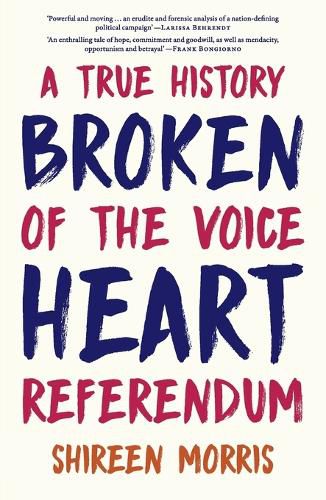
I was crushed by the defeat of the Voice referendum, appalled that such a simple request would be rebuffed by so many people through fear and -although no one wanted to own it – racism. No wonder First Peoples kept silent immediately afterwards, because the implications were just too awful. I can’t imagine how the people who had been the ‘face’ of the Yes case felt. Broken Heart by Shireen Morris tells us.
Shireen Morris starts off by explaining her own position: neither Indigenous nor white. She is of Indian Fijian ancestry, the daughter of parents who migrated to Australia in the 1970s. This placed her in an ambiguous position. It was a political reality that the Indigenous 3% minority would need supporters and the advocates from the 97% for the referendum to pass, and somehow the white constitutional lawyers and advisers, seemed revered and respected. But as a non-white ally, she was often accused of being ‘not blak’.
She is a constitutional lawyer, whose primary focus under the mentorship of Noel Pearson and the Cape York Institute over the previous 12 years had been Indigenous constitutional recognition. Now, I’m no great fan of Noel Pearson, I must admit. I find his Old Testament Prophet, hectoring tone abrasive, and his alignment with right wing politicians off-putting. However, in relation to referenda (referendums?) they will only pass with bipartisanship, and the referendum often has to be introduced by the party less ideologically likely to do so. For example, the much-vaunted 1967 referendum was introduced and carried by the Liberal Party, and the neo-liberal economic reforms of the 1980s could only have been introduced by a Labor party. It would have been far better (albeit rather galling as far as Labor voters are concerned) if constitutional recognition had been introduced by the Liberal Party. But as Morris showed in her previous book Radical Heart, once the then-prime minister Malcolm Turnbull rejected the Voice proposal in October 2017, there was little hope of bipartisanship. There was only ever bipartisanship for an amorphous and wholly symbolic form of recognition, and that proposal was explicitly and firmly rejected by Indigenous people. There were four choices: 1. accept a symbolic statement which would be rejected by Aboriginal people 2. wait for bipartisanship- but when, if ever, would that happen? 3. Abandon all hope 4. Try to win it without Bipartisanship. They went for the fourth option.
Noel Pearson and the Cape York Institute promote the idea of the Radical Centre:
Finding the radical centre requires engagement across divides, in contrast to the entrenched ideological positions and point-scoring of ordinary partisan politics. It is not simply about splitting the difference between two opposing principles to reach a lowest-common denominator. Rather, it is about harnessing the ‘dialectical tension’ in enduring disagreements to uncover a creative and ambitious reform solution… A thesis is proposed, which attracts a counterargument, the antithesis. The radical centre endeavours to synthesise these contradictory insights into a richer truth or a more correct and consensus-building position….The radical centre thus eschews simplistic categories like left and right. Finding it is an empathetic endeavour, requiring us to see the humanity and intelligence in our opponents and the kernels of truth in their opinions. (p. 26)
This is where Pearson and Morris aimed their activities, but there’s not much evidence of it here. People changed sides, allies became opponents, people lied. I wonder if they still have faith in the Radical Centre.
The book starts with a timeline, starting in 2012 through to the referendum on 14 October, when 40% voted ‘yes’ and approximately 60% voted ‘no’. It wasn’t always that way: there was around 60% support at first until mid-2023. There were many meetings and several drafts, and the accusation by the Coalition that Albanese presented it as ‘my way or the highway’ was just not true. There were many, many compromises but never from the Coalition. In retrospect, Morris thinks that they gave ground too early, which left them no where to go.
In 2014 Peter Craven, Julian Leeser, Damian Freeman and constitutional lawyer Ann Twomey proposed a constitutionally guaranteed Indigenous body to provide ‘advice to the Parliament and the Executive Government on matters relating to’ Indigenous people. Yet, at various times, all except Twomey distanced themselves from this initial suggestion. Frank Brennan opposed it from the start- he only wanted symbolic constitutional recognition. Others flip-flopped: Turnbull said yes, but with equivocation and probably did more damage by giving people reasons to vote no when he voiced his misgivings. Peter Craven seemed to live up to his name. Julian Leeser was a co-creator and longtime supporter of the Voice but then he recommended gutting the advice-giving aspect of it. But at least he had the courage of his convictions to resign his position. Morris dubs him ‘a noble politician’ for standing up for what he believed in, notwithstanding negative career ramifications. Given Leeser’s equivocation, I think she’s giving him a free pass. Ex-ministers Cheney, Peter Baume and Ken Wyatt declared that they would vote ‘yes’, and finally Leeser switched to genuine advocacy, along with Andrew Gee and Brigid Archer.
As far as Albanese is concerned, Morris claims that he committed the first error when announcing the referendum at the Garma festival without include the title of the law that was being proposed (I reckon – gees, it was a music festival, not a court of law or parliament). The announcement was a surprise, and it came over as a Labor policy. Albanese did offer to negotiate with Peter Dutton, but Dutton didn’t take up the offer. Why didn’t Albanese let that be known? And should Albanese have cancelled when the support collapsed? She suggests that perhaps Albanese thought that it better that the country reject it, rather than that he break a promise. Should he have delayed? Well, it probably wouldn’t make any difference: it was too late, not too early.
I think that she gives Jacinta Nampijinpa Price and Lydia Thorpe a free pass. I know for myself, my support wavered at the thought that Indigenous people themselves might not want it. As it turns out, there was overwhelming Indigenous support.
The Yes side made mistakes too. They were advised that most people only engage with a referendum question 4-6 weeks before hand, and that powder should be kept dry. But it was a mistake: the NO campaign got a head start, especially over Christmas when the YES campaign just went to ground. They had no answer to the NO’s objection that everyone was equal and that the Voice would divide the country by race.
There’s a lot of if-onlys here: if only the Coalition had championed a Voice during their time in government; if only Turnbull had not rejected it in 2017;if only people like Tony Abbott, Christian Porter, Jeff Kennett, Alan Jones and many others had not switched from Yes to No; if only the constitutional drafters Greg Craven and Frank Brennan had not attacked the constitutional drafting; if only the compromises Indigenous people made had been saved for when people were paying more attention. If only the Labor government had explained the constitutional change better, and been able to encourage Coalition co-ownership. If only the YES campaign had started campaigning in earnest much earlier; and if only it had better strategies for countering disinformation. If only the media had not prosecuted false balance, and had critiqued mistruths. If only we had better politicians: a bit smarter on the left and much kinder on the right.
And most importantly:
If only we were better Australians, more generous with our love and less susceptible to fear. p. 219
I don’t know where to go with this, and I don’t think that Shireen Morris does either. Her mentor, Noel Pearson, said that he would step back from politics if the Referendum failed and he has kept to his word. What a depressing book.
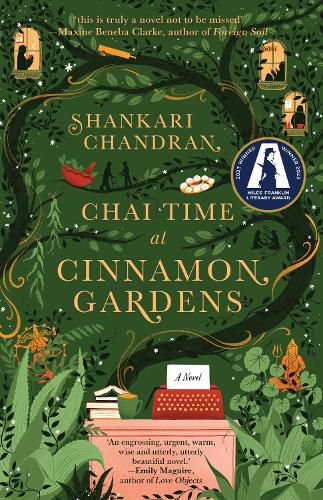
Chai Time at Cinnamon Gardens by Shankari Chandran
The Lovers by Tumna Kassab
Iris by Fiona Kelly McGregor
I’ve only read the first two of these, and it seems that I wasn’t particularly impressed with them either. Five of the authors were first-time nominees, and one was a debut author. It’s commendable to open it up to new talent, perhaps, but given that the Miles Franklin is still Australia’s premier literary prize, I don’t know that we were given six books that are going to last.
There’s nothing wrong with this book. It makes a perfectly good bookgroup book. It is packed full with issues: racism, domestic violence, PTSD, loyalty, colonialism, Tamil and Sri Lankan history. In fact, it’s probably too packed with issues. For an Australian readership, it introduces Tamil history and the violence in Sri Lanka that most of us have forgotten about (if we were ever very aware of it). It is even more relevant today than it was in 2023, with the rise of One Nation and March for Australia.
It is set in a nursing home, run by Anjali (Anji) who took it over from her mother Maya who relinquished it after her husband Zakhir left unexpectedly never to return. The narrative runs on two timelines: the present day and flashback.
The present day involves the marital strains between the home’s geriatrician Nikki,and her husband Gareth, a local councillor and hopeful political candidate, whose marriage is tense after the death of their toddler daughter Florence. Although Gareth doesn’t know it, his wife is having an affair with Ruben, a Sri Lankan worker at the home, who is clearly overqualified for the job but happy to take it. Thrashing about in his unhappiness, Gareth becomes caught up in a racist maelstrom, prompted by finding a statue of Captain Cook abandoned under the nursing home.
The flashbacks take us back to Sri Lanka (Ceylon) and the civil war between the Tamils through the terrorist group, the Tamil Tigers, and the Sinhalese army. But the flashbacks are handled awkwardly, and inserted clunkily into the text.
There’s just too much going on here. No doubt it will spark a good discussion at bookgroup next week, but I don’t think that it’s Miles Franklin material.
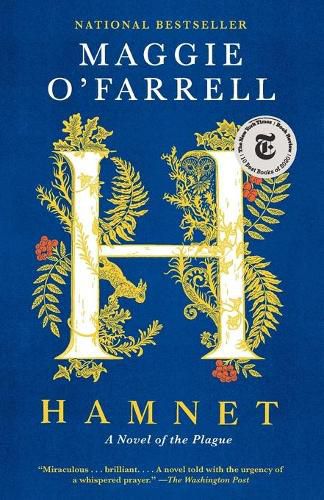
This book has been around for a while, but the recent release of the film starring Jessica Buckley and Paul Mescal has brought it to attention again. There was some surprise that O’Farrell’s book was not longlisted for the Booker Prize in 2020, but it did win The Women’s Prize for Literature, as well as other awards in 2020 and 2021. I’ve read several books by Maggie O’Farrell e.g. This Must Be the Place (my review here), Instructions for a Heatwave (review here) and The Marriage Portrait (review here). On looking back at my own reviews, I seem to have a rather ambivalent response to her writing.
One of the epigraphs to the book quotes Shakespeare scholar Steven Greenblatt’s assertion that in the late 16th/early 17th centuries the names ‘Hamnet’ and ‘Hamlet’ were interchangeable. Just as the book title ‘Hamnet’ is a manipulation of the ‘Hamlet’ we know as Shakespeare’s play, so too this book is a manipulation of a detail from Shakespeare’s life. Not once is Shakespeare named in the book, and although we know that the play referenced at the end of the book is ‘Hamlet’, it is not definitively stated anywhere. But right from the start of the book, where 11 year old Hamnet is roaming his house seeking a family member to help his sick twin sister Judith, echoing the opening graveyard scenes of ‘Hamlet’, we as readers know what O’Farrell is doing.
Ann Hathaway is not Ann who ended up with the second-best bed, but Agnes, a skilled healer and herbalist (in fact, the bed is mentioned). There is little known about her, but O’Farrell is not the first writer to try to flesh her out in more details – Germaine Greer has done so, too- but owing to the dearth of information, this needs to be a work of conjecture and assumption. O’Farrell’s Agnes comes from a wealthier family than her husband does, and they meet when her future husband takes up a Latin tutoring job in order to pay a debt sustained by his violent and feckless father. They intentionally fall pregnant, to force a marriage opposed by both families (although I seem to remember research from my undergraduate days that suggested that pre-marital pregnancy was not unusual, or a source of great shame). Her father-in-law continues to exert his power over his son, who lives in a smaller building adjoining the family home, and it is only when Agnes and her husband contrive to sell the family business’ gloves in London that her husband can embark on his career of writing, producing and acting in the plays that will make him famous.
But this book is not really about Shakespeare, who is absent for most of it, but about grief for a lost child. Both parents keen the death of 11 year old Hamnet, and Agnes is completely undone by her sorrow and her impotence to stop this plague-borne death. Hamnet’s twin, Judith, who looks so similar to him (plausible?) wants to know whether there’s a word for a child who has lost their sibling, as she walks the streets at night, hoping to glimpse him or sense his presence. O’Farrell writes this grief so well, with truth and experience at its core.
The book starts with two interwoven narratives, both voiced in the present tense: the first narrative introducing us to the members of the family, focussing on Hamnet as he searches for someone to help his sister Judith as she collapses with plague, and the second narrative a flashback to the meeting of Hamnet’s parents and their marriage.
The second part of the book is one long chapter following Hamnet’s death. It gradually moves towards the father’s career as playwright and suggests that the writing of ‘Hamlet’ is his way of working through his grief. Although the first 2/3 of this chapter was excellent, I wasn’t particular convinced by this end section, mainly because the play Hamlet has such a tenuous link with the death of a child. I found the argument put forward in the recent BBC three-part series Shakespeare:Rise of a Genius on ABC i-view more convincing where they suggest that it was the death of his father, and his questioning of his own responsibility as an adult son, compounded by the loss of his own son in Hamnet, that prompted his writing of ‘Hamlet’.
However, for me this didn’t particularly matter. There are 21st century infelicities right throughout this book, and although O’Farrell has clearly done her homework about Elizabethan family life, it’s not in the league of a Hilary Mantel. I didn’t read it to learn about William Shakespeare, or his wife Anne for that matter; but as an exploration of grief, it’s excellent.
My rating: 7.5/10
Sourced from: purchased e-book
Read because: I can’t decide whether to see the movie, and I wanted to read the book first if I do.
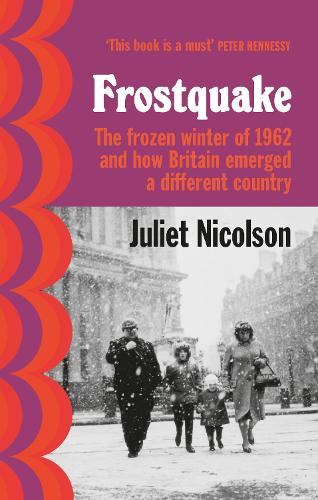
Well, it only took five years between hearing a podcast about this book and being inspired to purchase it, and actually reading it. And even then, I was spurred to read it because I’d like to read Andrew Miller’s The Land in Winter, set in the winter of 1962-3, which was short-listed for last year’s Booker Prize. Interestingly, Miller’s book also won the Walter Scott Prize for Historical Fiction, with the events of sixty years ago now considered history.
Frostquake, on the other hand, positions itself very clearly as ‘history’, telegraphed with the subtitle ‘The frozen winter of 1962 and how Britain emerged a different country’. In it, Nicolson argues that the winter of 62-63, the coldest since 1814, crystallised a tension between the old and the new. The old: Winston Churchill, Harold Macmillan, the continuations of the poverty of the Industrial Revolution, with 15 million people still lacking a plumbed-in bathroom. The new: JFK, Harold Wilson, the Beatles, consumer goods like televisions and refrigerators, glass office-blocks.
There are moments when society, however embedded, shifts on its axis. The long and lingering hardships of the paralysing winter of 1962-3 encouraged, even enabled, change: the very effect of shutting down empowered a thawing. Forces of social change that had been building over many years now found their moment of release as they broke through the icy surface. As the country froze it melted. (not sure about the page number because I read this as an e-book)
So what is a frostquake? One of the epigraphs to her book is a definition from an unnamed source:
Frostquake (n) A seismic event caused by a sudden cracking action in frozen soil. As water drains into the ground, it may freeze and expand, putting stress on its surroundings. This stress builds up until relieved explosively in the form of a frostquake (p. vii)
However, this book is not about weather or geology, although the snow and ice that started falling and forming for 10 weeks from Boxing Day 1962 through until to spring give the book its narrative parameters. Instead, this book is far more about people and their overlap with events on a national and world stage, drawn from conversations, memoirs and interviews. Some of these people are unknown: 19 year old Pauline Stone, driving through the mustard-like fog in her Mini Minor; Terri Quaye a 22-year old black jazz singer, Corporal Dennis Osbourne, travelling with his family on the Liverpool-to-Birmingham Express, which collided with the Glasgow-London express because of poor visibility. They each have a small story, of which the weather is just background.
But many of the people that Nicolson writes about are well known: Joanna Lumley talks about the cold at her boarding school; the Beatles are being transformed from scruffy, rather smelly hack musicians playing the clubs and careering from gig to gig into suited songsters who appear on the television; Mick Jagger and the Rolling Stones are London fixtures- Mick and Brian Jones sharing an Edith Grove flat, and with Mick taking on board the advice of Andrew Oldham, 19 year old window dresser at Mary Quant’s shop and music promoter “If you pretend to be wicked, you’ll get rich”. There’s the eruption of satire on the television, with comedians Peter Cook, Dudley Moore, Barry Humphries and Alan Bennett thriving into the 1970s and later. Author Antonia Fraser floats in and out, as does fellow author Penelope Fitzgerald. There’s a lengthy section on Sylvia Plath, who committed suicide in February 1963, in the depth of this cold winter.
Not only do other people, both famous and unknown, appear, so too does Nicolson’s own family. When she talks about spending Christmas of 1962 at her grandfather’s house at Sissinghurst, the penny dropped- Ah! She’s the daughter of Nigel Nicolson, who wrote Portrait of a Marriage, and the ‘Nicolson’ in the publishing company Weidenfeld & Nicolson. And so, she’s the granddaughter of Harold Nicolson, many-partied politician, who supported the decriminalization of homosexuality and the abolition of hanging, opposed the Munich Agreement with Hitler, published Lolita and disagreed with Anthony Eden’s Suez policy. And the granddaughter of Vita Sackville-West, who had died the previous summer.
Her upbringing in a political milieu is reflected in her attention to the Profumo Affair in particular, and the entanglement of the various characters who appear throughout the book. Nicolson herself received a pinch on the bottom from John Profumo, a one-time parliamentary colleague of her father, when he came to see the garden at Sissinghurst some thirty-years later. The glamour of JFK is here too, a contrast to the dowdiness of the Edwardian-figure of conservative Prime Minister Harold Macmillan whose career was derailed by the Profumo Affair. The anxiety of the Cuban Missile Crisis pervades the book, and Britain is being rebuffed from the European Economic Community by Charles de Gaulle.
The writing is quite beautiful. Here she is waking up on the day after Boxing Day 1962 as the snow begins to fall, the most snow they had ever seen in their lives:
The following morning we woke to the peculiar blue-bright light of reflected now filtering through the closed curtains. Instead of disappearing during the night as we had feared it would, the snow was still there, turning the landmarks of the garden- the walls, lawns, statues, urns- into something unrecognizable but unified. The sight was beautiful, its very transience on this familiar landscape making it even more precious. Snow muffled all sound and the silence felt dream-deep. Outside freezing snowballs melted the second they hit the napes of our necks and we tipped backwards on to the lawn, arms outstretched like acrobats, trusting that the mattress of snow would break our fall. Unlike a sandcastle on a beach, absorbed so soon by the waves, our imprints remained, hollows into which we could flop again and again. (Ch 7)
She returns to the silence of the snow-bound world at the end of the book, writing in the midst of COVID which brought its own silence to us. Writing in the winter of 2019-20, the daffodils and forsythia had just begun to blossom, and suddenly the earth felt lit up by yellow flowers.
Sixty years before the winter of 1962-3 the century had just turned and with it the old Victorian regime was dying. Sixty years after the winter of 1962-3 the world turned again, a little more sharply than it should have, unbalancing the stability we take for granted and throwing everyone into a state of profound shock….In December 2019, on a world map shown on every single news channel, a tiny red dot indicated a town in the heart of China, a million, million miles away from England, as the place where a brand new strain of a deadly virus had emerged, one that targeted the lungs, the enabler of breath, of oxygen and of life itself. Eight weeks later the dots had spread, and much of the world map was coloured red. In the autumn of 1962 many felt we were teetering of the edge of absolute destruction with nuclear weapons capable of wiping out mankind. And now, in the spring of 2020, the coronavirus, constantly visualized on screens as a spiky globe, an exotic species of underwater coral, a logo of frightening change, made us feel we were once again staring into the abyss, looking over the rim…. The country lanes were silent not this time because of the muffling of snow but by the absence of traffic. The world was in lockdown. The skies were blue, blue, blue, devoid of aeroplanes, not through mankind’s choice but for its survival. And the birds were going crazy in the sunshine. Nature seemed to have forgiven us not for doubting but for threatening its resilience and had returned once again with an astonishing beauty….Perhaps every half-century or so we need an intervention that is outside our control, an uninvited pause in order for resurrection to take place.
I enjoyed this book. I’m old enough to recognize the things she is writing about- indeed, the author and I are nearly contemporaries, and I do wonder if someone younger would enjoy it as much. It was not at all what I expected, which was a far more journalistic, meteorologically based account, but enjoyed the political and personal approach much more.
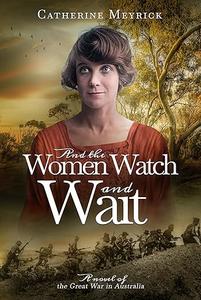
Especially in the wake of the centenary of WWI, there has been no shortage of books about men’s experience in war. They’re usually big fat books, often named for a battleground in large letters, with the (male) author’s name is letters much the same size. Women’s experience- especially the experience of women who didn’t go to war but instead stayed home waiting- is less often documented. And the Women Watch and Wait is based in suburban Coburg in Melbourne, and it captures well the dissonance between suburban life and battlefields far away, the agony of curtailed and delayed communication, and the emotional peril of allowing yourself to fall in love.
Kate is a young country girl who has been sent down to Coburg as company for her Aunt Mary, whose two sons have volunteered and been sent overseas as part of the first contingent of soldiers to be deployed. As well as the excitement of staying in Melbourne, Kate is excited that her boyfriend from Gippsland, Jack, has been sent to the nearby Broadmeadows Training Camp, and there are more opportunities for them to meet up before he leaves than there would have been had she still been in Gippsland. Time is rushing on, as the rumours of the trainees’ departure mount, and she is excited when Jack proposes to her. At this stage, there is still hope that ‘the boys’ will be back by Christmas, and there seems such pressure of time to commit, to get married and start up a married life. Jack leaves with his detachment, and Kate is left with her aunt, working in her aunt’s grocer shop, teetering between excitement to receive mail, and yet fearing what news the mail might bring. News does arrive, and she, along with the women among whom she is living, has to readjust her hopes for the future.
I’m probably a particularly critical audience for this book, because as it happens I’ve been writing a column for the newsletter of my local historical society for the past ten years or so that looks at events at the local Heidelberg level one hundred years previously. Just as Catherine Meyrick would have done in researching this book, I’ve followed the local newspapers closely, consciously looking for women’s experiences, reading every page and even the advertisements and classifieds. This has given me a close-up knowledge of one suburb, (albeit a few suburbs away from Coburg) and how the world-wide events of WWI impacted the social and political life of a community. I must say that she has nailed the local aspects, and I found myself nodding away to parallels that arose in her book which also occurred in Heidelberg.
The book is arranged chronologically by year, starting in 1914 and going through to 1919 with an epilogue. It has over sixty short chapters- too many, I feel- and the frequent changes of location made it feel a little like a screenplay. She integrates political events of the day, like the conscription debates, into her narrative and, again, she captures this big event playing out in small halls and conversations so well. I particularly liked that she explored the WWI experience from the Catholic viewpoint, something that is not represented well in the local newspapers that I have read.
It’s a difficult thing to undertake huge amounts of research, then to let it go in case it smothers the narrative (an advantage that historians have over novelists). At times I felt that small local details were made too explicit, but I’m also conscious that I may have read this book differently to the way that other people might read it. At an emotional level, the book rang true with love, fear, vulnerability and strength being lived out not in trenches but in suburban houses and streetscapes.
It’s appropriate that I should be writing this review on January 26, Australia Day. Here’s a recommendation: if you’re going to read a survey history of Australia, then read this one.
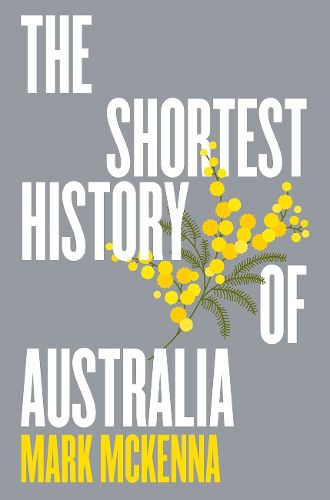
There’s lots of survey or short histories written by eminent historians to choose from, many of which appear in several editions as they were updated to encompass later events: Keith Hancock’s Australia first written in 1930; Gordon Greenwood’sAustralia A Social and Political History (1955) Manning Clark’s A Short History of Australia (1963) ; John Rickard’s Australia: A Cultural History (1988); Creating a Nation (1994) by Pat Grimshaw, Marilyn Lake, Ann McGrath and Marian Quartly; David Day’s Claiming a Continent (1997) and Stuart Macintyre’s A Concise History of Australia (2000). There’s even Alex McDermott’s Australian History for Dummies (2011). One could quite justifiably ask “Does the world need another short history of Australia?” And I would answer: yes, and it should be this one.
In 1968 New Zealand historian Keith Sinclair wrote an article for Historical Studies called ‘On Writing Shist’ (that second ‘s’ is very important!) He pointed out that shist (i.e. short history) is not a summary of what is known in order to be memorized, but a summary interpretation of a topic, intended to make it understandable. It should be aimed at the educated non-specialist, and the author cannot assume more than the most vague background knowledge. Facts are illustrative and form a “very thin, hard skeleton”, and the overwhelming problem is what to leave out, rather than put in. The heart of the task is to shape the overall pattern of ideas, facts and prose, interwoven into a pattern of thought and story. It is meant to be read, rather than consulted, utilizing the novelists’ tools of suspense and pace, driven by the author’s sense of commitment to his subject.
McKenna addresses the issue of the need for “new ways of thinking about the nation’s history” right in his first chapter. He writes:
Most national histories are ‘rise and rise’ narratives. They narrate the nation’s formation and walk chronologically through familiar milestones. In Australia’s case, there’s a chapter on Indigenous Australia before 1788, before moving onto the main story: penal colony to gold rushes and responsible government, then to Federation, the First World War and the Anzac legend, the Depression, the Second World War, postwar reconstruction and the Cold War; before waves of non-British migration, the new social movements of the 1960s and 1970s and the end of White Australia usher in the emergence of a more open, global economy and culturally diverse society. Or words to that effect. The history of the nation-state- from one formative event to the next. (p. 7)
So how is he proposing to avoid this straightjacket? His fundamental strategy is to see Australia as a continent rather than a nation, to turn both Edward Barton’s declaration “a nation for a continent and a continent for a nation” on its head. He foregrounds place, both the climate, ecologies and histories of different regions of Australia, and the Indigenous understanding of history which can never be divorced from place. And rather than that awkward, dangling introductory chapter of “The Aborigines”, he integrates Indigenous perspectives and actions throughout the whole book, from start to finish. Nor does he follow a well-ploughed chronological trench: indeed, Captain Cook and Botany Bay don’t appear in detail until Chapter 9, more than half-way through the book, in a chapter titled ‘Facing North’.
He starts right up front in Chapter 1 ‘The Founding Lie’, with a reflection on the Sydney Opera House, its design and construction, then considers its site – Bennelong Point. In Chapter 2 ‘From Ubirr’ he joins hundreds of visitors at Ubirr, in the Kakadu National Park looking north to the Arafura Sea at dawn- again, starting at a place- to emphasize the great migration from Asia into northern Australia, and the influence of trade with the north. Chapter 3 ‘The Island Dilemma’ looks at the sense of geography and the ‘island’ perspective that encouraged isolation as both a negative and positive force. He takes us to Christmas Island, both its now-deserted CI Club for administrators and Europeans, then its use as a detention centre for asylum seekers. Ch.4 ‘Taking the Land’ (and there, again is that ‘place’ emphasis) starts with John Howard at the Longreach Stockman’s Hall of Fame in 1997, promising that government legislation would ensure pastoralists’ rights after the Wik decision. He traverses land policy from Cook’s act of possession to the spread of ‘settlement’ and Aboriginal resistance, especially in Queensland. He notes that Australia has silenced not only the evidence of frontier warfare, but also the many efforts at reconciliation that were made between British settlers and First Nations Australians (p. 75).
Chapter 5 ‘War and Memory’ takes us to Australia’s “most storied beach”, 15,000 kms away. In a desperate craving to be connected to European history through blood sacrifice:
Over time, the birthplace of their nation was conveniently displaced 15,000 kilometres offshore to Anzac Cove. Australia thus became the only modern nation-state to create an origin myth not located on its own soil p.90
He points out that, two decades before the outbreak of the Great War, and for at least a decade after the war ended, in areas like Wave Hill and Victoria River of the Northern Territory and the Pilbara and Kimblerley regions of Western Australia, frontier violence was still occurring. War memorials to the First World War stand in villages, towns and cities throughout Australia, but the Australian War Memorial resists calls to recognize the loss of life in frontier wars.
Chapter 6 ‘Fire and Water’ takes us to Red Bluff, Kalbarri in Western Australia way back on 25 January 1697, and the desperate search for water by the men and officers from the Dutch East India Company who anchored three ships in Gantheaume Bay and rowed towards the coast. Drought, fire and flood are “a cycle as ancient as the country itself”, and while non-Indigenous Australians have long been familiar with bushfires and floods, the memory of one is swiftly erased by the arrival of the other, as if we’re fighting the same battles with the country (p. 111). Here are the plans for irrigation using the Murray-Darling, the Snowy River scheme and the fires at Mallacoota in December 2019. In Chapter 7 ‘Fault Lines’ we go to Waverley cemetery in Sydney, and the grave of Louisa and Henry Lawson, before embarking on a really good analysis of Catholic/Protestant sectarianism, touching on Ned Kelly, Billy Hughes and conscription. Chapter 8 ‘Fault Lines’ starts with Dorothy Napangardi, one of Australia’s most acclaimed artists, and the gradual recognition and appreciation of Indigenous ways of belonging to Country in the late twentieth century. For many non-Indigenous Australians, works of First Nation artists are a reminder that, as recently arrived migrants in a country, we do not have the same keys to Country. Modern Australia has always been a migrant society, and McKenna returns 19th century migration, especially from Ireland, and the Chinese migrants lured by the prospect of wealth on the goldfields. He goes through the conversion from a white, British enclave to a diverse multicultural nation, while noting that it was driven by self-interest and economic necessity. He reminds us of the memories of discrimination and prejudice through the story of William Yang, born in 1943 on a tobacco farm on the Atherton Tablelands. In Chapter 9 ‘Facing North’ (there’s that sense of place and geography again) we finally meet Captain Cook face to face. To illustrate the short-term economic mentality of resource extraction he turns not to gold, but to pearls, and the pearling industry not just for its importation of divers from Asia, but its mix of voluntary and forced Aboriginal labour (I didn’t know about this). He then moves on to New Guinea, and Australia’s WW2 in the Pacific.
I’d like to look at Chapter 10 ‘The Big Picture’ in more detail as an example of the diffuse way in which McKenna writes, his integration of stories of individual people into broader historical events, and the sweep of a theme across time. He starts with Charles Doudiet’s sketches of Eureka, which were only discovered in 1996 through a Canadian family which found them in their attic. These sketches verified for the first time the location of the Eureka Rebellion and the use of the Eureka flag, and they are the springboard for McKenna to discuss Australian democracy and its evolution from Eureka and the anti-transportation movement, through to self-government of the colonies in the mid 19th century. Then he moves to a second picture, Tom Roberts’ ‘Opening of the First Parliament of the Australian Commonwealth 9 May 1901′ and federation as a political compromise that combined elements of the US federal constitution and the Westminster system. The opening of Parliament House in Canberra in 1927 had many guests, but two uninvited guests were Jimmy Clements and John Noble, two Wiradjuri elders who walked 150 kilometres from Brungle Aboriginal station near Tumut in NSW to attend the opening. Here McKenna turns to Indigenous agitation for their rights in the 1920s and 1930s, set against Queen Elizabeth’s tour of 1954, the first reigning British monarch to set foot on Australian soil. He returns to Indigenous activism and the 1967 referendum, and the myths that surround it, before moving on to Whitlam and his deliberate cultivation of what Whitlam called “a vigorous national spirit” and ending the era of assimilation in favour of land rights and self-determination. This was encapsulated by the photograph of Whitlam pouring a handful of red earth into the hands of land rights leader Vincent Lingiari in 1975. However, the most seismic shift was the High Court Decision in the Mabo case, and he returns to Eddie Mabo’s sketch of his ancestral land on Mer which hangs not far from Tom Roberts’ ‘Big Picture’ in Parliament House. McKenna finishes the chapter with another painting of the people on Mer executed by Tom Roberts on his way to London in 1903. Twenty years after his arrival in London, Roberts presented the painting to the British Museum, and there it stayed undiscovered until found in 2009 by a curator from the National Museum of Australia.
He closes his book with an Epilogue titled ‘Modernity and Antiquity’ which starts with suburbia and the humble Sydney houses of both John Howard and Paul Keating. He notes that in the half-century since the dismissal of the Keating government, the old verities have vanished: Australia is now one of the world’s most diverse, multicultural and liberal democracies. The Indigenous cultures that White Australia tried to eradicate are now fundamental to the nation’s identity. From a protectionist economic policy, we are now an open, free-trade economy; the alliance with the US remains the linch-pin of its defence; the population has doubled since the mid 1970s and there is a distinctive rise of environmental consciousness, with the Tasmanian Greens the first Green party in the world. He notes that the closer we come to the present, the harder it is to discern which reforms will be of lasting significance. He returns to the “Big Lie” with which he started his book, and the question that continues to gnaw at Australia’s soul is how to tell the truth about the nation’s history and what Noel Pearson called “a rightful place” for First Nations Australians. Here are the apologies, the Uluru statement and the referendum campaign. He closes as he started with a place: this time Lake Mungo National Park (the most spiritual, life-changing place that I have visited in Australia) and the potential for Mungo to be “for all Australians, black and white. It can embrace us all in its spirituality, and draw us closer to the land.” (p. 266)
This is a beautifully written, really carefully crafted and highly original book. Although part of the ‘Shortest History’ series that ranges across the whole world, I feel that it is far more directed at an Australian audience than an international one, but both readers could take much from the book. Indeed, the word ‘shortest’ obscures the deep-time and Indigenous emphasis of the book. By eschewing completely the chronological approach, he prioritizes understanding of a theme illustrated through many kaleidoscopic prisms. In the author’s note at the end of the book, he says that he decided to “say more about some things rather than a little about many things”. He has certainly succeeded in this. His prose is beautiful, drawing your interest from vignettes based on people, with a pace that doesn’t get bogged down in details. It’s excellent. Read it.
My rating: 10/10
Sourced from: Review copy from Black Inc. but that hasn’t influenced my rating!

 The Resident Judge of Port Phillip