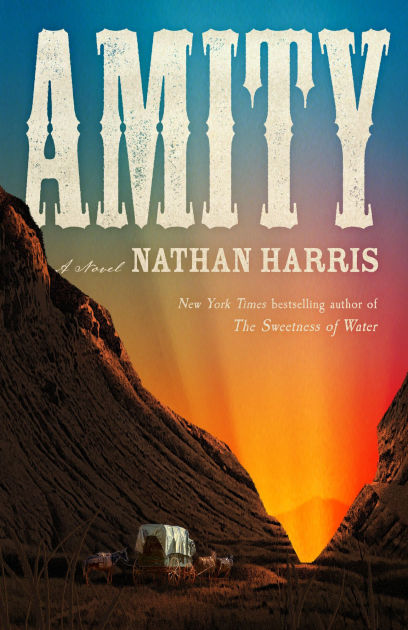
I loved Nathan Harris’ debut novel The Sweetness of Water, which I read soon after it was published in 2021. This second book, Amity bears several similarities to his first book, both set in Reconstruction era America, and both telling the story of a journey. Given that these were the qualities that attracted me to The Sweetness of Water, encountering them again was a pleasure rather than a drawback.
Set in Louisiana in 1866, it is a journey saga, told in two alternating parts. It is not immediately clear who is the author of the first-person frame story, focussing on Coleman, or what is the status of the interspersed ‘June’ stories, that focus on Coleman’s older sister June. Both June and Coleman had been ‘owned’ by the Harper family, and although ostensibly liberated after the Civil War, both were still bound to the family, if not legally, then through coercion and emotional manipulation. Two years earlier the siblings had been separated when Mr Harper took June, whom he had pressured into a sexual relationship, on a wild-goose-chase into Mexico in search of silver. Coleman, a sensitive and rather stilted house servant had been left with Mrs Harper and her adult daughter Florence in Mr Harper’s absence. When they received a letter from Mr Harper summoning them to Mexico, they followed: Mrs Harper and daughter expecting to reap the benefits of the get-rich-quick scheme, and Coleman hoping to find his sister June. Unknown to Mrs and Miss Harper and Coleman, June, revolted by Mr Harper had escaped and finds sanctuary in Amity, a town of emancipated African-Americans surrounded by displaced Native American tribes. As she is heading north, in search of safety and the dream of reuniting with her brother, he is heading south with Florence in response to Harpers’ summons, which Mr Harper wrote more as a lure to bring June back, rather than any intention to share his never-found wealth with his wife and daughter. In the harsh frontier territory the two separate journeys confront bands of Indian and Mexican army renegades, hustlers and refugees as any sense of safety is shattered by multiple betrayals and power switches.
Coleman is an odd character. Self-educated, he speaks in a formal, stilted tone and his loyalty to Florence breaks down in the face of so many threats that he feels unable to overcome. His formality makes it hard to warm to him, but by the end of the book you know why Harris has written him this way.
Harris writes landscape beautifully, and he captures well the ingrained cruelty of enslavement revealed not only through actions and betrayals, but also through the brusque and frankly shocking way that the Harpers spoke to their ‘servants’, despite the legal change in their circumstances.
I really enjoyed this book. Perhaps Harris could be criticized for re-writing his first book again and not moving beyond the Reconstruction Era of the immediate post-Civil War, but given that this era has been so shoehorned into a pro-South Gone With the Wind narrative, we need to hear more about the Black and Native American experience instead.
In his book, Killing for Country David Marr relates his frustration when trying to find indigenous voices while researching the history of the frontier wars. An Indigenous colleague told him: “You mob wrote down the colonial records, the diaries and newspapers. You do the work. You tell that story. It’s your story.” (p. 409)
In the raw wake of the Referendum result, I felt as if I just wanted to curl up and have it all go away, and I can’t begin to imagine how First Peoples felt. Surely if people knew, there would have been a different result, wouldn’t there? (Would there?) I thought back to the sessions I attended in the local Aboriginal meeting place where we set out timelines and participated in activities- but how every single person there was already committed to ‘yes’. But this is our work: making the dispossession, massacres and injustice part of our (i.e. non-Indigenous) history. Our history generally- not just for the already committed but the sceptical and cynical and antagonistic as well. I don’t know how you do that- a public information campaign perhaps? The first step is right here with this official publication, in writing, with the authority of First Peoples themselves, to be put alongside with the Convicts-Squatters-Gold-Anzac trope of the textbooks and curriculums we grew up with.
In our post-truth zeitgeist, where we all have our own ‘truths’, it seems incongruous that when it comes to ourselves personally, as individuals, we want ‘the’ truth. It seems to draw on a long-buried childhood urgency to assert that you are right, and the other person is wrong. In insurance claims, in relationship breakdowns, in autopsies, we want someone to take our side, we want to know what really happened, and we want ‘them’ (a parent, a counsellor, the media, a court) to take our side. While I was reading this report, I listened to an interview with William Dalrymple on Global Roaming. He pointed out that two opposing facts can both be true: for example, Israel was formed in 1948 and was a haven for post-Holocaust Jews AND hundreds of thousands Palestinians were rendered stateless in the Nakba that followed the establishment of Israel. The Yoorrook Report is the definitive attempt to put the Aboriginal truth on the record so that it stands alongside and is interwoven with the convicts-squatters-gold-ANZAC arc. As the First Peoples’ Assembly stated in establishing Yoorrook:
The Yoorrook Justice Commission was not established to find the truth: the truth was never lost. It was established so the state might finally learn to hear what had long been spoken among First Peoples. It was established to gather the stories that had been scattered by centuries of violence and denial and to give them shape, force, direction—and, crucially, an equal place in the historical record (p.140)…Our peoples will no longer have to carry the pain of these stories alone—this history and these truths become everyone’s history and truths. (p144)
The report is long: far longer than I expected because I didn’t realize that each PDF page actually contained two pages. It starts with a preamble and introduction by both former premier Steve Bracks, and chairperson of the Yoorrook commission, Professor Eleanor Bourke, and then has a lengthy timeline of colonization in Victoria.
Part I ‘The Jagged Line’ is about 100 pages in length, and is divided into chronological chapters:
Sovereigns, squatters and settlers
Massacres and the dawn of injustice
Gold Diggers and the ‘Aboriginal Problem’
Letters, petitions and deputations
Protection, assimilation and the Stolen Generations
Thinking Black, fighting back
The Edge of Something New and Ancient.
There was little here that was new to me, although I hadn’t seen the Gold Rush and the establishment of missions linked like this. It was the Gold Rush that brought in the money that financed the creation of the State Library and Museum and the University of Melbourne, which in turn played their part in scientific racism and the ‘collection’ of artefacts. The missions, which were established in the 1860s, were deliberately placed far from the main gold field sites. The text is supplemented by a map which shows the rapid alienation of traditional lands through surveying and appropriation as Crown land for sale or lease. The section on letters and deputations highlighted the importance of Victoria in particular as the site for protest and organization, and I did raise an eyebrow at the explicit acknowledgement of the Communist Party as allies in this fight.
Part II The Silence and the Telling is a 40 page explanation of the establishment of the Commission in the context of previous commissions, and the explicit actions undertaken to ensure the embedding of Indigenous Data Sovereignty into the testimony. Some of these stories had been told previously, but others not. Truth Receivers were appointed to make contact with 9000 First Peoples, and evidence was received from 1500 people. More than 200 witnesses appeared as part of the four year enquiry. The Enquiry itself faced its own problems: firstly finding somewhere appropriate to hold it (they settled on Charcoal Lane in Collingwood- a site that has resonance amongst Koories in Melbourne), and then gaining the cooperation of government agencies in getting information to the commission in a timely manner. It is striking how much care was taken in ensuring that it was not another white-fella commission of enquiry. There is a series of photographs showing various encounters and bestowal of gifts on various dignitaries, reflecting both the generosity of the First Peoples and also the need to have relationships enshrined in ceremony and ritual.
Section III is the longest part, where selected witnesses tell their stories. Some of the names are familiar: actor Jack Charles, or Paul Briggs, but others will only be familiar to people in contact with the Koorie community in Victoria and who will recognize the leadership role that many of these witnesses play in different organizations, denoted by the title ‘Uncle’ and ‘Aunty’. There are non-Indigenous witnesses too, including the Premier, the Minister for Education, The Chief Commissioner of Police, the Anglican bishop of Gippsland. Suzannah Henty, descendant of the Henty family who appropriated lands at Portland also appeared. Again and again the same themes arise: the heartlessness and pettiness of bureaucracy, the pain of the Stolen Generation and a sense of betrayal.
The report closes with the key findings and a long list of recommendations compiled from the different reports issued throughout the life of the commission. Will they just gather dust, as was feared? Well, the recommendation of Treaty was taken up with alacrity (reflective perhaps of the fear of electoral defeat of the Labor Party next year?) but already is mired in party politics with the Victorian Liberals vowing to scrap it should it win power.
I’m really pleased that I read this report, and I hope that more Victorians do so as well. In places it is beautifully, lyrically written and underpinning it is a quiet, determined insistence and persistence.
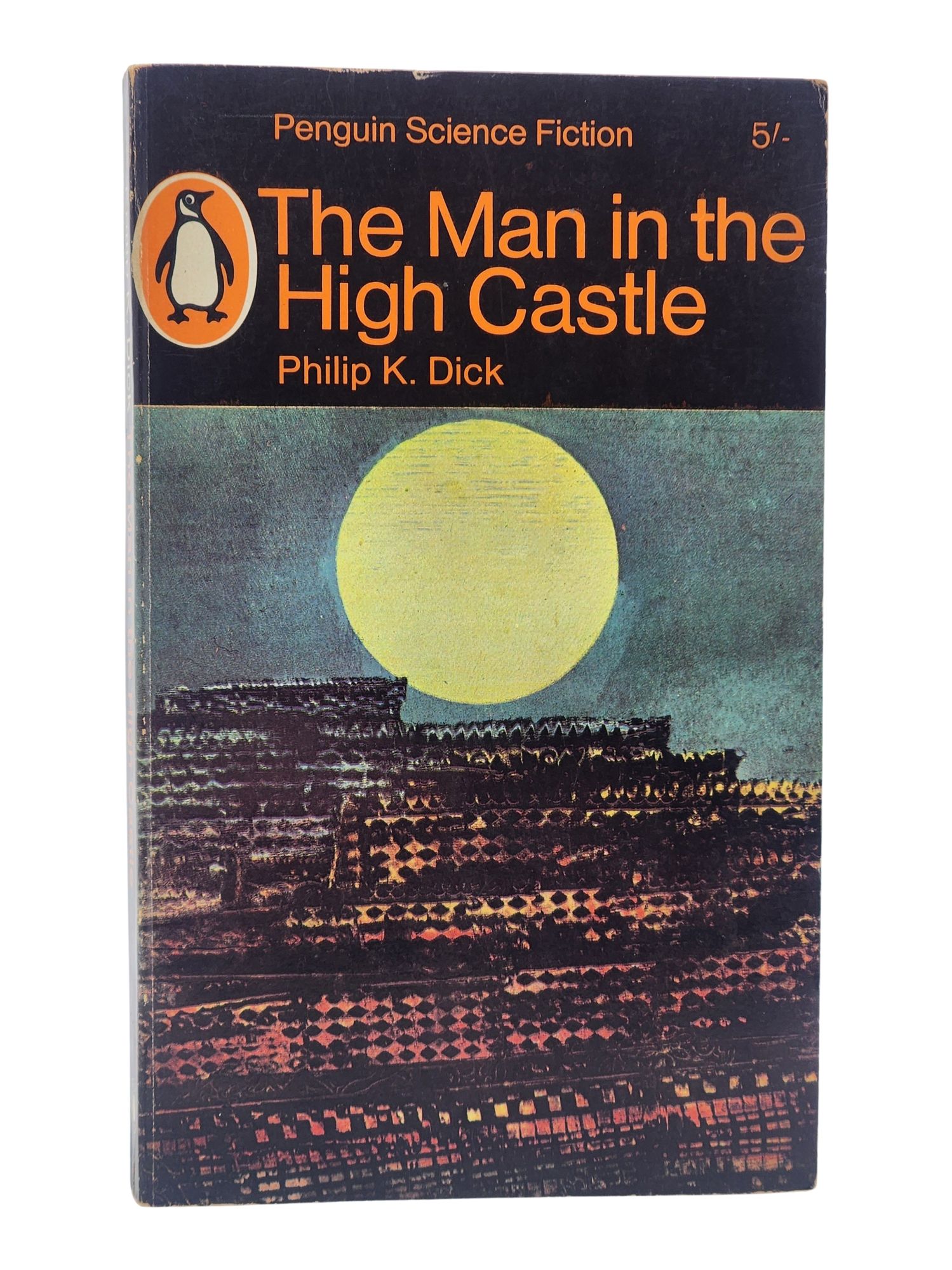
It’s interesting that my copy of The Man in the High Castle should be issued under the Penguin Science Fiction impress, because it doesn’t seem particularly science-fiction-y to me. It was first published in 1962 and envisaged a world in which Germany and Japan had triumphed during WW2, with the action occurring taking place in 1962- i.e. contemporaneously. To my mind it was more an alternative history or counterfactual than science fiction.
The narrative traces through several characters who live in an America partitioned into three. Nazi Germany controls the East Coast, as well as Russia and Western Europe. The east coast itself is divided in two: the remnant United States of America up to the Canadian border, and ‘The South’, both ruled by puppet regimes under Nazi control. The West Coast had been annexed by the Japanese as the Pacific States of America. Between the two regimes is the buffer Rocky Mountain states, where American citizens continue a depressed, oppressed existence.
The novel starts in the Pacific States of America, where businessmen Robert Childan runs a business selling pre-invasion Americana, most of which is counterfeit and manufactured by the Wyndam-Matson Corporation. Childan is contacted by Japanese trade official Nobusuke Tagomi, who seeks a gift to impress a Swedish industrialist named Baynes, who is coming to visit. Baynes, however, is really a Nazi defector who is coming to warn of the incipient activation of Operation Dandelion, a plan for Germany to attack Japan and attain world domination. Meanwhile, there is a banned publication, The Grasshopper Lies Heavy which is circulating surreptitiously, which posits that in fact, the Allies did win. Ostensibly the book is written by Hawthorne Abendsen, the eponymous ‘Man in the High Castle’. Juliana, the ex-wife of secret Jew Frank Frinke, is fascinated by the book, and travels unwittingly with an under-cover Nazi to meet the author, unaware that her companion Joe Cinnadella, has been sent by the Germans to execute Abendsen. It is a repressive and violent society, which has reverted to almost-magical times, with the I-Ching, a book of Chinese divination, guiding the actions of many of the characters, both Japanese and American.
The scenario is fascinating, but unfortunately the characters are not. I confess to losing track of who was who, and I am still bemused by the authorship of The Grasshopper Lies Heavy, although I think that the author intended this ambiguity. The characters are rather mechanical, and it is difficult to feel any connection with any of them. The end of the book becomes bogged down with a fairly metaphysical exploration of the I-Ching.
However, the book does form the political and ‘historical’ background to the excellent Prime four-season series, which managed in its first episode to evoke more sympathy and coherence to the characters than the whole book did. Interestingly, they turned The Grasshopper Lies Heavy into a film, instead of a book, which in a way made the whole scenario more implausible- who has a film projector hanging around in their apartment? Surely a book would be more portable and thus more dangerous. To eke four seasons of the TV series out of a fairly slim volume, obviously it was taken far beyond the original book, but to my mind so far, with far more success in character development than the book. So, for me, The Man in the High Castle is a book with a really fascinating premise which didn’t quite manage to develop its characters, or integrate its metaphysical aspects.
My rating: 6/10
Sourced from: My husband’s bookshelves. I had heard about the book, but never read it or seen a copy.
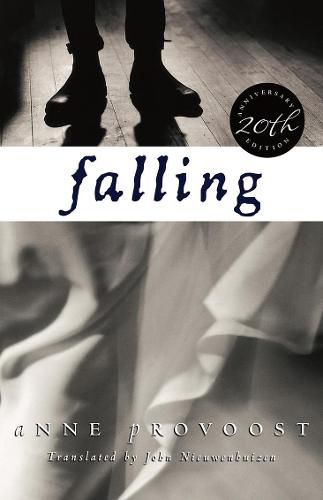
The twentieth anniversary republishing of this book has come and gone, it having first appeared in Dutch in 1995. I had heard of it, and knew that it dealt with Nazism, and assumed at first that it would be set during World War II. It came as a surprise, then, that it was set in the present day (in 1995) with themes that are probably even more resonant and urgent today than they were in 1995. My copy, collected no doubt from my local little library, had obviously been a school set-text, and the book won many Young Adult awards on its publication.
Lucas has accompanied his mother to Montourin, a small Belgian provincial town, to clean out his late grandfather’s house. The book opens with Lucas standing by the side of the road as his friend Caitlin is brought back from hospital after an accident that occurred three weeks earlier. The narrative then spirals back to explain who Lucas and Caitlin are, how she was injured, and Lucas’ part in that injury. It is written in first person, from Lucas’ viewpoint, thus aligning us as readers with his perspective of events in the weeks leading up to Caitlin’s injury.
On arriving at Montourin, he finds that there is an unspoken edge of hostility towards him and his family, exemplified by Soeur, an old nun in the nearby convent in which American-born Caitlin is staying. He does not understand why, and as he sees his mother sorting through and destroying his grandfather’s documents and belongings, he knows that something is being kept from him. He gradually learns that, after the death of one of his children during the hungry days of WW2 occupation, his grandfather denounced fifteen Jewish children and the nuns who were hiding him in the neighbouring convent, out of grief and resentment that these Jewish children were taking food rations that could have saved his daughter. Some in present-day Montourin shunned his grandfather for this action; others supported it.
Their support was generally unspoken, but outright admiration was voiced by Benoit, a young man older than Lucas, who combines menace, charisma and manipulation in his neo-Nazi outlook. Lucas is drawn into Benoit’s sphere and becomes involved, with varying degrees of culpability, in Benoit’s terrorist plans against the Moroccan refugees who have moved into the town. At the same time, he is attracted to the inscrutable Caitlin who fluctuates between flirt, friend and heartbreaker as she, too, seems to be becoming friendly with Benoit. But when Caitlin is involved in a single-car accident- the reasons for which are unclear- Lucas acts decisively, if precipitously, in a way that will change the rest of Caitlin’s life. I’m not really quite sure about the ending of the book, which is deliberately left obscure, but which struck me as a little melodramatic.
Since 1995 the presence of African refugees in Europe has only increased, as has the prominence and apparent electoral acceptability of neo-Nazi parties. This book is a warning against the slow slide towards fascism, especially for young men with no responsibilities who yearn acceptance from other young men. I can see why it would be chosen as an upper-school text, especially given its urgent relevance today. I’m not sure how it would be received by high school students though- it moves fairly slowly, and I wasn’t particularly satisfied by the ending.
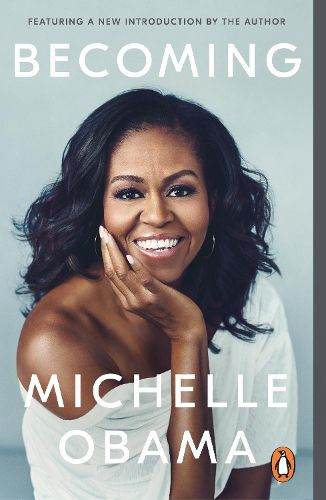
I had not had much interest in reading this book, deterred perhaps by the glamour shot on the front cover. Even though I very much enjoyed Barak Obama’s Dreams From My Father, I wasn’t particularly drawn to reading a First Lady’s life story, thank you very much. But it was a Book Group selection, and conscientious Book Grouper as I am, I resolved to read the book and I am so glad that I did. There was much more in this book that I might ever have anticipated.
The preface started with really good writing. It’s post-Presidency, and Michelle is alone in the house for almost the first time (excepting the security guards down in the garage). Her daughters are out, Barak is not at home, and she decides to make a grilled cheese sandwich. There’s no one to make it for her, no-one to say “Mrs Obama, let me get that”, no one to look askance at her desire for such homely comfort food. She sits on the back doorstep, and eats the sandwich.
The book proper is divided into three parts: Becoming Me, Becoming Us, and Becoming More. Becoming Me traces her early upbringing on the South Side of Chicago, where her remarkably hands-off parents bring her up to be an intelligent, independent young woman, super-organized and conscientious, ambitious and methodical. Becoming Us chronicles her relationship with Barak Obama, and her switch from corporate law to the non-profit sector. The ‘us’ expands to include her two daughters, born through IVF, and the tension she feels between being a professional woman, and a mother. Barak is becoming increasingly involved in politics, first as a state congressman, and then as presidential candidate, although she is often angry and resentful of the demands that politics make on their relationship. Becoming More takes us into the Obama presidency, and the weird home-life this imposes on their family. She needs to carve out her own identity as First Lady, even though this is a role that is not of her choosing, and she struggles to keep some sense of normality for her daughters.
The book is very honest. Barak comes over as a highly intelligent if selfish man, infuriating in his messiness, chronic lateness and lack of attention to detail. She for her part comes over as rather controlling and chronically insecure about whether she is good enough. The awareness of being a black woman in a predominantly white political milieu accompanies her always. She talks about the strains in their marriage as her life is subsumed into his ambitions, and her eventual decision to keep some sort of family routine of dinner and bedtime which Barak has to accommodate to, instead of the other way around. Her mother is a saint: I don’t know that I would get up at 5.00 a.m. to mind my grandchildren while my daughter went to the gym- if fact, I know that I wouldn’t (just in case any of my children get ideas).
She does not even try to hide her contempt for Donald Trump, which hardened even more when he won the Presidency. Trump’s actions in demolishing the East Wing seem even more egregious now, after reading about an engaged First Lady who opened the White House up to many people, through that very East Wing that no longer exists.
At first, I was so impressed with the writing in this book that I was rather disappointed when I learned that it had been ghost-written, or at least written with other people. Does that matter, I wonder? For me, probably yes, because I feel that her writing has been mediated through the other author, and I feel disappointed that the words are not hers. But this doesn’t detract from the honesty that pervades this book. She doesn’t once mention the word ‘feminist’ but the tensions between motherhood, professionalism and politics reflect the viewpoints of a modern, engaged intelligent woman that the world was lucky enough to have as First Lady for eight years.
My rating: A rather surprising 8.5
Read because: Reading Group Book
Sourced from: Darebin Library as part of their reading groups program.
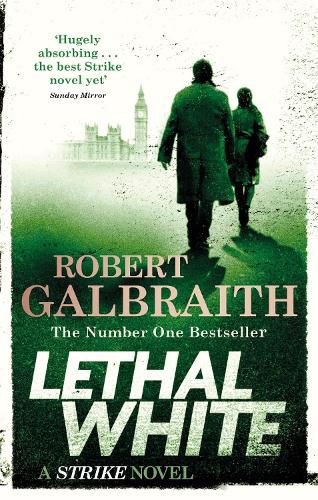
Cormoran Strike books, written by J. K. Rowling under the nom-de-plume Robert Galbraith, are for me a long-form type of comfort food. Very long-form, because like the Harry Potter books, these seem to be getting longer. Lethal White is the fourth in the series, and it comes in at a hefty 784 pages.
Detective stories are a genre, with recurring themes which are both part of their appeal and part of their frustration. In the case of the Cormoran Strike books, how long can Galbraith keep the unresolved sexual tension (UST) between Strike and Robin going? This book starts off with Robin’s wedding to the insipid Matthew. Surely a marriage should dampen any progress in the UST realm, but this is not to be. But how many more volumes can Galbraith keep this going? And surely if the UST becomes resolved, that will be the end of their relationship because who wants a married-couple detective agency? And on an unrelated theme, why doesn’t Comoran do something about his throbbing stump where his leg was amputated? Surely additional surgery is in order, or a new prosthesis or something! Moreover, how many more times is Robin going to end up in peril as the case draws to its close? Although, having said that, poor Nikki in ‘Silent Witness’ spends much of her time kidnapped and threatened- it seems to go with the territory that the female investigator- while her male counterparts need to work out how to ‘rescue’ her. But I guess that all these formulaic aspects are part of the genre.
Set during the London Olympic Games, Strike is approached by mentally ill man, Billy, who says that he saw a child being buried years ago. Is it true? At the same time, Strike contracted by politician Jasper Chiswell (Chizzle) to investigate blackmail for something that was not illegal years ago, but now is. As it turns out, the two cases are connected.
Meanwhile, Robin has married Matthew-and she is unhappy from the start. Strike encounters his past lover, Charlotte, who is now pregnant with twins and unhappily married too. Strike is in an uncommitted relationship with Lorelei, who wants more from the relationship than he can give.
Galbraith introduces a huge range of characters into the book, but somehow manages to keep control of them all. I like the way that the author has Comoran or Robin sit down and mentally draw the whole case together, neatly encapsulating it for this reader who can find herself completely confused. It’s like drawing a deep breath, before plunging underwater again. Within this complex ensemble, Galbraith has a number of pairs (fitting, really, for a parliamentary detective story where ‘pairing’ is part of the political scene)
Each chapter is headed by an epigraph from Henrik Ibsen’s play Rosmersholm (1886). I must admit that I don’t know the play, and Dr Beatrice Groves has done the work of drawing the links between Lethal White and Ibsen’s play. As with many of Galbraith’s books, the reason for the title is with-held until well into the book. In this case, we need to wait until Chapter 42 to learn that Lethal White is not a form of cocaine, or the nick-name of a thug, but instead is a horse disease.
I’m not normally a detective-fiction fan, but Galbraiths are different. I will keep turning to the Cormoran Strike series when I have tired of other genres or want to escape from non-fiction into a well-plotted if formulaic series that keeps me reading until far too late at night.
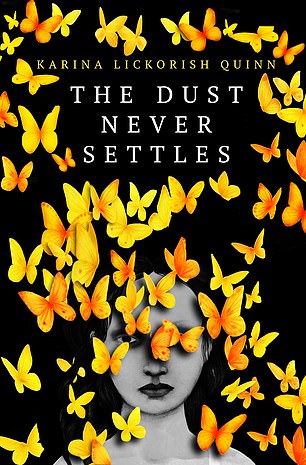
I don’t very often read a book just on the basis of a blurb alone, but in this case I did. Paul Lynch, the author ofProphet Song spoke highly of Quinn’s book in author interviews and his blurb describing it as ‘a mesmerising feat of imagination and a masterful debut’ graces the back cover. It’s a beautiful front cover, and the yellow butterflies evoke Gabriel Garcia Marquez, to whom this book owes quite a debt.
Anaïs Echeverría Gest has returned to her childhood home in Peru after an absence of several years in England. The family is expecting her to sign the papers authorizing the sale and inevitable demolition of her grandmother’s house, la Casa Echeverría in order to free up the inheritance. The house, which is a character in its own right, is a large yellow colonial mansion and garden overlooking the shacks and slums built by squatters on the dry plain behind the house called Los Polvos de Nadie y Nunca (the dusts of no-one and nothing) during the Agrarian Reforms of the 1960s. As soon as she steps over the threshold, she is assailed by the memories of the house- not just her life in that house, but the memories of the house itself- and the ghosts of family members and employees who had lived and worked there. Time seems to stretch and contract in the house; one minute the rooms are intact and the furniture dusted and lights illuminated, and the next minute the house is derelict and dark.
Anaïs has left her fiance Rupert Napier, a thoroughly English gentleman, in order to come home to Peru. She is curiously detached from Rupert, telling herself that she loves him but never really feeling it, and she is likewise ambivalent about her pregnancy. The future baby exists as a little pink fish in the corner of her vision, and as her pregnancy progresses the little fish changes shape until it is a huge, snapping lobster. When Rupert comes over to Peru, probably at the request of the extended family who are frustrated by Anaïs’ refusal to sign the papers, he brings with him all the Englishness of his family, an Englishness that Anaïs resented in her own English father’s refusal to acknowledge his second family in Peru, choosing instead to stay with his wife in England.
The house, built at the turn of the century, has seen multiple deaths, that are only just hinted at: a baby whose cries still echo through the house, the suicide of her Aunt Paloma and most importantly, the death of a 17 year old maid, Julia Álvarez Yupanqui who died when she fell (jumped?) from a window. As Julia falls from the window, the Earth falls away from her and is like a sheet of cloth; she sees Time “spread like an ocean, flowing this way and that, tossing up moments, driving them forwards on the crest of a wave then swallowing them again, pulling them back into the deep“. (p. 96) A disembodied presence, Julia wanders unseen through generations of the Echeverría family, right back to the Conquistadors and through centuries of dispossession, enslavement, poverty and violence. The people of Los Polvos, who saw her fall, believe that she has become a saint- and indeed, it seems that she has, as she walks unseen through history dispensing kindnesses as she passes.
It was not only the Polvorinos who saw her fall: Anaïs did too, crouched under a geranium bush. She becomes electively mute, and is seen by a succession of psychiatrists and doctors who try to make her talk. Anaïs could see the ghosts in the house and the adult Anaïs has a tenuous grasp on reality, and you are never really sure whether she is going mad.
So the story shifts back and forth between two realities: that English reality (denoted by chapters with English numerals) and the Peruvian reality in chapters with Spanish numbers. The Spanish chapters follow the disembodied Julia Álvarez Yupanqui and take us on a meandering journey through Peruvian history. There is an exhaustive list of characters in the appendix of the book, divided into the Echeverría family and a longer list of historical and imagined characters who feature in small, passing vignettes as Julia crosses the earth. These vignettes are beautifully written and draw you in just enough to feel disappointed as Julia passes by, leaving that narrative thread hanging loose. Reflecting the tragedy and complexity (and complicity) of various generations of the Echeverría family, there is a convoluted family tree that challenges the one found in One Hundred Years of Solitude with its seventeen Aureliano Buendías.
The complexity of this book is both its great strength, and its greatest weakness, particularly as the book goes on. The last quarter of the book is Julia’s journey through history, and Anaïs’ story drops away. I found myself having to consult the list of characters at the back of the book, having ‘met’ these characters earlier in the book but having forgotten them in the cavalcade of ghosts passing by. I enjoyed the frequent use of Spanish, which she paraphrases in the following sentences, but I don’t know if I would have felt that way had I not been able to read Spanish.
Because this book is just as much about time, land and colonialism as it is about individual people, it reminded me of Alexis Wright’s Carpentaria, which was similarly shape-shifting and which caused you to think “am I even understanding this?” In fact, I often said that out loud while I picked it up each night, enjoying the experience of reading it, but unable to hold it all in my head.
I like magical realism, but many people do not. This is a really ambitious, fearless book, and I suspect it is more memorable for its overall shape than for its details. It is flawed, but it’s very good.
My rating: 9/10
Read because: I loved Paul Lynch’s Prophet Song and I thought- if he loves this book, perhaps I will too. I did.
This book should have ticked all my boxes: set in Melbourne, written by a much-loved Australian author, written with a nanna’s-eye (and I do embrace my nanna-dom). But it sounded as if it would be a bit slight, and I probably wouldn’t have read it had it not been an Ivanhoe Reading Circle selection, read and discussed amongst all the other nannas.
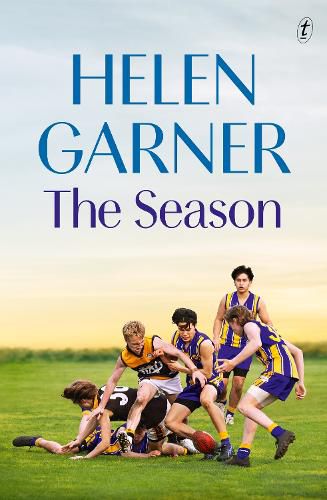
Even Garner herself sounded a bit ambivalent about the whole project, admitting that she wrote the book because she needed something to do, but didn’t have the energy to embark on one of her investigative non-fiction books. It traces the footy season of her grandson Amby’s under-16s footy team, at the J. J. Holland reserve in Kensington. As she always does, Garner conveys a strong sense of suburban place, and in this case, the football ground she describes so closely fitted with the oval that I walk through to my volunteer job in Kensington that I actually researched the club and found that, indeed, it is the J. J. Holland reserve. She’s there for the team’s matches; she’s there for their training sessions on cold weekday nights, and she’s there for the conversations in the car driving there and back.
Although ostensibly about football, it’s even more about young men growing into masculinity, and at under-16 Amby is at that liminal stage, with signs of the little boy still visible under the swagger of adolescence. Garner’s daughter lives next door, and she has a strong and enviable relationship with her grandchildren, especially Amby. At the same time, she is aging and feeling irrelevant and frustrated by her increasing deafness. In places she veers into idealization of these young men, seeing them as warriors, and even admitting to a slightly ‘off’ recognition of their adolescent sexuality (Garner has always been, and remains, perhaps more honest than she should be).
It is the football season that gives this book its beginning and ending, and the book was more a reflection than a plot-driven story. I had feared that it would be slight, and unfortunately it was.
My rating: 6.5/10
Sourced from: purchased e-book
Read because: October 2025 selection for the Ivanhoe Reading Circle.
I’ve always been a bit puzzled by the ‘Shortest History’ part of the title of this series of books published by Black Inc dealing with world history, many written by Australian authors. Declaring to be the shortest history seems rather definitive and pugnacious, and almost a challenge to later authors to become even shorter. The blurb for the series claims that the books can be read in an afternoon -something that I doubt, in this case – but certainly they are a work of concision and discipline on the part of the author, in being able to confidently assert a fact or event in a single paragraph instead of hedging with qualifications, nuances and debates. Of course, much is elided in such an approach, but there is also a bracing forthrightness about a sweeping history that needs to tie together so many small details into an overarching narrative.
Don Watson comes to the task as a historian in his own right, political speechwriter, and a commentator on current-day American society and political culture. As well as his American Journeys published in 2008 (my review here), he has been a regular contributor to the Black Inc./Schwartz stable on American politics with three Quarterly Essays: No.4 Rabbit Syndrome: Australia and America (2001), No 63 Enemy Within: American Politics in the time of Trump (2016) (my review here) and most recently in 2024 with No. 95High Noon: Trump, Harris and America on the Brink, which I reviewed here. With The Shortest History…. he is writing as an outsider, and a long-term, well-informed watcher as well.
His outsider status is most apparent in the opening chapters of the book, where he makes clear that there were competing European powers – England, France, Spain, Netherlands, Sweden- that put ‘boots on the ground’ on what was to become American territory. Drawing the distinction between the 1776 establishment of the United States, and the history of ‘America’ starting in 1492, he goes even further back 20,000 years to the first peoples, and the early introduction of enslavement that followed early European ‘discovery’. In what, perhaps, might be characterized as ‘black armband history’, he continues to turn the spotlight around onto First Nations and Black experience as the narrative of United States history marches forward…always forward.
The book progresses chronologically, but the chapters are thematic. In his introduction Watson notes that:
While the history of the United States is to an uncommon degree a history of ideas, it is equally the story of men and women testing the truth of those ideas against experience: in politics, in churches, on frontiers, in cities, in industries, in battle, in homes, in schools, in Hollywood, in literature and in music. (p. xiv)
Watson places strong emphasis on ideas: on the intertwined Puritan ideas of harsh punishment and discipline set against competing ideals of individualistic self-reliance, which in turn existed alongside traditions of social justice, education, communitarianism and democracy. He notes the influence of Enlightenment philosophers and the scientific revolution in providing an intellectual framework for their grievances and the language to express it through the Declaration of Independence, Constitution and the Federalists papers. He puts his historian hat on to discuss Turner’s Frontier thesis on the ‘freedom’ of the frontier in the popular imagination and he notes the recurrent waves of religious ‘awakenings’ and the struggle between order and chaos-‘ the American id and the American superego’ (p 58). Challenging these were the ‘maniacal appetite for wealth’ whetted by the financial opportunities following the Civil War, and especially during the ‘Gilded Age’ of the 1890s which pushed aside “the restraining influences of conscience and religion, or the egalitarian principles implied in the country’s democratic creed” (p.94) The Civil War, in his telling, had a long advent of compromises on the part of the North, which was well aware of the incompatibility of slavery with the ideals espoused in the republic’s founding documents.
Although we know the political landscape in the United (huh!) States today as being Republican and Democrat, the meaning of both words has changed over time. To be ‘republican’ was to champion the idea of the American republic, and it was not necessarily democratic. The nature of the parties changed over time, with the immigrant influx between 1890 and 1920 shaping the cultural and political evolution of urban America:
The Democratic Party evolved into the party of both the burgeoning multiethnic cities and the reactionary South, while the Republicans remained the voice of white Protestant provincial America. (p. 112)
Looking at the policies of Presidents over time, particularly in the Progressive era, it is not easy to distinguish to which party the president belonged. For example Woodrow Wilson was a southerner from the Democratic Party, and a progressive as well as a segregationalist. Kennedy did not like Martin Luther King, and he had little interest in domestic politics. Nixon was mad, but he was the most liberal republican of the century excluding Teddy Roosevelt (p. 187). Some Presidents receive more attention than others. Probably because of current-day parallels, President Andrew Jackson receives more attention than he might have in a book written 30 years ago. For a former speechwriter for Labor Prime Minister Paul Keating, I was surprised that he was so critical of FDR. It seemed to me that the emphasis on presidential personality and actions received more emphasis in the latter part of the book, within the time of Watson’s own memory, I would guess. Interestingly for a historian, he ascribes ‘luck’ as an important factor that determined a President’s actions and reputation.
This is not just a political history because Watson interweaves popular culture, including music, Hollywood and literature, as well as broader social movements including Communism and anti-Communism, evangelical religion and protest movements. However, the political emphasis does mean that it is a predominantly male history, with political actors Eleanor Roosevelt and Hillary Clinton receiving more attention than other women in his narrative. As the book moves on, the early emphasis on indigenous and Black history is muted and where it is mentioned it is mainly in political terms. Particularly in the post-WW2 years, he integrates conformity, consumerism and commercialization into the “American Dream”, which was very much restricted to white America:
Nothing spoke more eloquently of the American dream than the bustling heartland towns, their Main Streets lined with mom-and-pop stores, barber shops, diners, ice cream parlours, theatres and movie houses, with Fords and Chryslers and De Soto Coronados parked in rows; and, just beyond them, unlikely numbers of regularly attended churches, schools, sports stadiums and public swimming pools (p. 154)
Watson started his book in the introduction, with the attack on the Capitol building on 6 January 2021. At first, I thought that this reflected Watson’s own expertise and reputation as a commentator on American affairs, but when he returns to 6 January at the end of the book as part of his argument, it is as a historian.
The United States was born with one foot in the Christian church and the other in commerce. It might equally be said that it had a foot in the high ideals of religion and the Enlightenment and a foot in the frontier philosophy of whatever it takes. The loathing felt for the liberal elites, and for intellectuals in general, was an old one, and the failure of liberals and intellectuals to understand either the people who loathed them or the degree of their loathing was just as old. The ‘Washington swamp’ was not new [and] …the coonskin hats and the shaman’s horns in the Capitol building were as if lifted from a picture in my childhood Davy Crockett book…All these gestures to contemporary grievance connected to threads of belief and myth, and patterns of ideological dispute, that are as old as the country itself. Extraordinary, even ‘unprecedented’ as the insurrection of 6 January 2021 seemed, it occurred in the same grindhouse of uncrossable divides and undying fixations.” p. 261
I guess that only time will tell if Watson’s decision to start and finish the book with Trump was a narrative framing, or whether it is a historical analysis in its own right. Only in coming years will we know whether Trump II marks a whole new phase, or whether as Watson suggests in 2025, the Trump presidency reflects a continuity that flows across the United States’ history. By its very nature, a ‘short history’ with its abridgments and encapsulation, is probably best placed to provide an answer.
Whenever I drive past the flashing lights of ambulances and police at a road accident, I think of the couple of minutes before that collision: the conversation that would have been abruptly cut short, the reason the occupants were in the car, how they would have got up that morning oblivious to how their lives were going to change in the next 12 hours.
This is pretty much the same impulse that led Leigh Sales to write this book. As a journalist, she had been on the media side of many interviews and stories about people whose lives changed dramatically. She had also had her own brush with death when a placental abruption in what had been a normal pregnancy led suddenly to a life-threatening situation, and fears for both her baby’s life and her own. Shaken by the experience, she came to believe that we are all vulnerable to sudden, unexpected change and yet we do not live that way. Why?
Her book revolves around the case studies of various people, some of who became caught up in ‘newsworthy’ events, others who experienced the death of a loved one (something that we all face) or had suffered a catastrophic injury or illness. The chapters are re-tellings of her interviews, interwoven with some ‘easy to digest’ research which veers at times into pop-psychology, and her own reflections of how she would have responded in similar circumstances.
Some of the people and the events described are well-known: Louise Hope, who as well as suffering from MS, was also one of the hostages in the Lindt Cafe siege in Sydney in September 2002; Walter Mikac who lost his wife and two daughters in the Port Arthur killings; James Scott, the ‘Mars Bar’ man who disappeared in Nepal and Stuart Diver, who survived the Thredbo landslide but his wife did not. Others are less well-known, Matt Richell, who died in a surfing accident, Juliet Darling whose husband was killed by her psychotic step-son and Michael Spence, the vice chancellor of the University of Sydney, whose wife died within 3 weeks of her cancer diagnosis, leaving him with five children.
As it happens, the first two case studies are both of people with deep Christian faith. In the case of Michael Spence, it was precisely because of his religious faith that she interviewed him, even though Sales herself is not a believer. As a former-believer myself, I found myself dreading that the book was going to become religious tract. It didn’t, but I still found it strange that she was to organize her case studies in this way, giving such prominence to faith and a belief in a higher purpose for suffering.
She locates herself as a journalist in these retellings, having presented many of the news stories herself. She tells us that she often becomes tearful during her interviews, perhaps as a counter to the perception of the sang-froid of the television presenter. The intensity of media scrutiny led several of her interviewees to engage a publicity agent to manage media appearances. This did not always work out well: you glimpse the newshound in her when she talks about James Scott, dubbed ‘Mars Bar Man’. He was advised by his agent not to name the chocolate that was his only food, in the hope that he could secure a sponsorship deal later. It wasn’t actually a Mars Bar, but instead a Cadbury’s chocolate, but when he fudged (terrible pun) the brand of the chocolate in an interview, the interviewee (Richard Carleton) sensed obfuscation and toughened his questions. Although Carleton came in for criticism for the ferocity of his questioning, Sales admitted that she would have done the same thing once she sensed evasiveness.
She returns several times to the idea that, having had one dreadful thing happen to you, you were inoculated against further trauma. Statistically, this is not logical even though emotionally, it is. She seems to feel that Louise Hope’s MS should have been enough, without the Lindt siege, and she spends some time on the idea of the ‘jinx’ on the women that Stuart Diver (Thredbo) has married, his second wife having died with breast cancer. Diver speaks of being a ‘memory locker’- capturing and keeping happy times for when the bad times come – but Sales seems somewhat resistant to such a stoic and clinical response to pain.
She devotes several chapters to people who helped: Detective Norris who accompanies a grieving wife to the morgue; counsellors Jane Howell and Wendy Liu at the morgue; Mary Jerram at the coroner’s office; pastor Father Steve who has a strong belief that families should see the body.
All of this is told in an intimate, rather confidential tone of voice. I used to listen to Chat 10 Looks 3, the podcast she made with political commentator Annabelle Crabb (still going, I see) and this book had much the same sort of feel to it. Interesting, personal but something that you could listen to (read) without much effort or challenge.
My rating: 7/10
Read because: Bookgroup Ladies selection. Now that the CAE has wound up, we have no identity!
Sourced from: Darebin Libraries Book Group collection.




 The Resident Judge of Port Phillip