Author Archives: residentjudge

‘Breath’ by Tim Winton

2008

Had this been the only Tim Winton book that I had ever read, I too would be throwing every award that I could at it: last night it was announced that it had won the Age Book of the Year.

Like the swell of ocean waves, you think that it’s building into a surf-story, then all of a sudden you realise that you’re into the full-blown coming-of-age story complete with betrayal, sexual experimentation, parental estrangement, empty dreams and disillusionment. It has it all: beautiful writing that just takes you along with it, a wry narrator whom you almost instantly like, a love for the ocean, and an ease of telling that is sure without being pretentious.  Much like the public persona of Tim Winton himself, it seems.

And I guess that here lies my problem with it.  I’ve read several Tim Winton books, and I feel as if I’m reading the same story again and again.  His evocation of his Western Australian roots, his Christian background, his middle aged male protagonists, his collection of broken, betrayed and disillusioned people…they’re all there in The Riders, Dirt Music, The Turning and now again in Breath.  The sheer exuberance of Cloudstreet- probably my favourite Australian novel- seems a long time ago, and it was. He does Angelus, and his nostalgic male protagonists very, very well.  But I think of other authors- Peter Carey, Margaret Attwood, Joyce Carol Oates- who really stretch themselves and their writing into new shapes and places and I wish that, perhaps, he was a bit braver.

Retiring judges

One of my middle-of-the-night anxieties involves the degree of presumption I’m revealing in even attempting to comment on a judge’s career. After all, what would I know? Hell, I’ve only ever sat in the public gallery of a court!

So I was pleased to hear an appraisal of the retiring Chief Justice Murray Gleeson on Radio National’s Law Report the other morning by George Williams, from the Law School of UNSW. This is how Williams summed up the Chief Justice’s career

George Williams: I think you need to look at his role on the court in two different ways: one is as a judge, one amongst seven, and as a judge he’s well-known for writing judgments that are concise, that are direct, that really do get to the nub of the question of law, and he has a very strong reputation as being one of the leaders of the court over the last decade. As a Chief Justice, you can look at his public role, he’s someone who’s spoken strongly on behalf of important legal principles, he’s defended the court, and he’s been prepared to get involved in the media in discussing some of those issues.

Where he perhaps hasn’t had the same impact is perhaps changing the way the court operates internally. He’s been a good administrator, but we don’t have a court that’s perhaps made leaps and bounds in terms of moving towards more of a joint judgment system like the United States. It’s a court very similar to the court he inherited, and he hasn’t been a reformer in terms of changing those basic practices.

How do these criteria stack up with Judge Willis?

1. The quality of his judgments. Well, I’m not a lawyer, but it seems that his judgments were well thought through. Certainly he showed independence of thought- he was quite happy to go out on a limb and take a different stance from his brother judges- in fact, I suspect that he revelled in so doing.

2. Public role- speaking out on behalf of important legal principles. Certainly he was outspoken, but were they important legal principles or just a form of point-scoring? The scrutiny of the actions of public officers was important- but was it HIS role to do this? His stance on Aborigines- at a surface level contradictory, but on deeper reflection was based on important legal principles. But there’s always a “but” with Judge Willis. There’s a certain amount of ‘playing to the gallery’ in relation to settler rights in relation to Aborigines, the independence of Port Phillip from Sydney oversight, and the superior quality of Port Phillip without a ‘convict taint’. And his public role was certainly ambiguous- he absents himself from many of the public roles within Port Phillip Society e.g. patron, benefactor etc, and prides himself on holding himself separate. Yet the same man is heard gossiping loudly on street corners, and giving vent to political opinions in the shops.

3. Preparedness to get involved in the media. Probably too much. A bit of distance here would have been ‘judicious’ (groan)

4. Good administrator. He certainly was a good manager- ferocious in championing his own sphere of influence (BUT was that just a way of big-noting himself?) He resisted funding cuts strenuously (BUT ditto?); he was loyal to employees who were loyal to him (BUT did he need to shore up his position?). I’m sure that he volunteered to come to Port Phillip precisely because it gave him the opportunity to establish a court from scratch, based on his own principles and predilections. No doubt he had sniffed the political wind, too, and hoped that when Port Phillip became a separate colony, he would naturally become Chief Justice.

I don’t know if any of this has taken me any further, but it’s interesting to see what the criteria for judging judicial ‘success’ might be.

Things to celebrate

1.  That I live in UNESCO’s second City of Literature. I KNEW that there was a reason that I live here!

2.  That the Abortion Law Reform Bill might actually pass.

3. That St Kilda’s  stupendous Robert Harvey will have a send-off at Telstra Dome this Sunday- and I may just go!

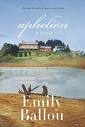
‘Aphelion’ by Emily Ballou

2007, 493 p

There is such a thing as too much.  Chocolate, for example. Or wine. Or, as in the case of ‘Aphelion’ by Emily Ballou, too much scenery, too many storylines, too much thinking, too much talk, too many themes, too much imagery, too many pages, too much ‘luminous’ prose.

The book is set in the Snowy Mountains, in a small town that has been relocated as part of the hydro-electric scheme.  Four generations of women live in the family home- the 101 year old Hortense, her 80 year old daughter Esme, Esme’s niece Byrne (about 50) and her own daughter Lucetta (20 plus).  Into this seething mass of mother/daughter/aunt entanglement comes young Rhett from next door, returning to the family home after the death of his mother, bringing with him Hazel the American museum curator who barely speaks to her mother.   You can probably imagine the multiple themes here: motherhood, regret, what-ifs, relocation, dislocation, nostalgia etc. etc. etc.

This book felt like a Sunday evening serial on the ABC with lots of Australian scenery (just in case it can be flogged off to British television), iss-ews that we can all identify with, and multiple storylines.

But it wasn’t all bad.  In fact, even though the book was overdue and I was accruing a daily penalty, I wanted to keep it until I had finished it.  Perhaps, in spite of all these qualifications and criticisms, the fact that I wanted to reach the end is the most important response of all.

On Rhodomontade

It would seem that there is no longer a Melbourne Debating Society. I’ve found the Debaters Association of Victoria Inc. but no sign of a Melbourne Debating Society. Which is rather a shame, as it was one of the earliest civic and ‘intellectual’ societies of Melbourne.

Edmund Finn writing as ‘Garryowen’ tells us that the debating society commenced in 1841 with a Managerial Board consisting of President: Hon. James Erskine Murray; Vice-Presidents: Rev. James Forbes and Surgeon A. F. Greeves; Chairman: Mr J.G. Foxton; Committee: Messrs James Boyle, G.A. Gilbert, R. V. Innes, D.W. O’Nial and J. J. Peers; and Treasurers Messrs. Thomas B. Darling and E. C. Dunn. The Herald of 12 October 1841 reports its first meeting. It appears to have met weekly, on a Wednesday evening, although sometimes on a Friday.

In his book The Capacity to Judge: Public Opinion and Deliberative Democracy in Upper Canada 1791-1854, Jeffrey McNairn highlights the importance of voluntary organizations in the development of “democratic sociability” i.e. that it was possible for men to deliberate in public, using argument. In particular he highlights literary and debating societies as a site for this development. So perhaps it just wasn’t that there wasn’t anything on in Port Phillip on a Wednesday night….

Garryowen continues:

This Society attracted to its ranks most of the talent of the town. Weekly meetings were held at the Scots’ Schoolroom on the Eastern hill of Collins Street, and considerable debating power was rapidly developed. It was not a mere ordinary school-boy exhibition of vapid declamation and puerile rhodomontade, but an intellectual gathering, where questions of interest to the community were good-humouredly, intelligently, and patiently discussed.

Rhodomontade??!! Now there’s a word to conjure with!!! Merriam-Webster tells me that it means “bragging speech, vain boasting or bluster”. Well, there was certainly scope for some rhodomontade at the Melbourne Debating Society because here are the topics that I’ve found in the Port Phillip Herald so far

  • Topic in October: “The motives which actuated Brutus and other conspirators in the assassination of Caesar”. The meeting came to the conclusion that “the death of Caesar resulted from patriotic motives”
  • Next topic “Whether America or any other nation will ultimately supplant Great Britain in the scale of nations”. Conclusion- no, Britain reigns supreme
  • November topic “Whether India has been befitted by British Connexion?” No clear cut result here – the meeting adjourned after a long discussion.
  • The November topic“Was the conduct of Elizabeth towards Mary, Queen of Scots, justifiable?” provoked a “long an animated discussion” but the meeting was all but unanimous for the negative. I suspect that the strong presence of Scots emigrants held sway here- there’s a heavy preponderance of Scots on the committee (President, and both Vice-Presidents at least), and the meeting is being held in the Scots school room
  • December: “Whether the character of King Charles the First is entitled to respect? The question was decided in the affirmative.
  • January “Is the practice of dueling justifiable?” also decided in the affirmative
  • February “Are literary and scientific pursuits suited to the female character?”, again decided in the affirmative
  • “Is Phenology founded on reason and the evidence of acknowledged facts?”.

At the stage I’m up to in my reading, the Phrenology debate in late February was postponed because of the imprisonment for contempt of court of one of the members of the society, the young Port Phillip Gazette editor George Arden, on the orders of Judge Willis, the ‘real’ Resident Judge of Port Phillip. The night was spent discussing the imprisonment, and a petition and address signed to George Arden (although from what I can find at the moment, not actually made public)

Here the Melbourne Debating Society spilled over into Politics with a capital ‘p’. As McNairn pointed out in relation to the Canadian debating societies:

P. 90 “The political significance of debating societies thus lay more in their guiding principles and in the skills and sociability they fostered than in the content of their meetings. Since most brought together men from various religious and partisan affiliations, denominational and political controversy was shunned and, in most cases, prohibited. Societies provided a haven from the less-controlled debate of public politics, but as training grounds their political role was undiminished.”

The Melbourne Debating Society had been grappling with the issue of religious and partisan affiliation from its commencement.Within the first months, there was discussion over whether rules should be promulgated for the quoting of scripture, and one of the December meetings was turned over to a discussion of ‘the expediency of countenancing the discussion of polemical and political subjects by the society’. At its 31 December meeting (no New Years Eve frolics here!) it was decided to prohibit  religious and political discussions.

Am I surprised by the topics chosen? It seems that they draw on a shared knowledge of British and classical history (a knowledge that could by no means be assumed today) and an awareness of Britain’s wider empire- at least in the United States and India. It’s important to remember that these debates are conducted within the politics of their time: the 1857 Sepoy rebellion in India had not occurred; the United States at that time included the original 13 states and the states ceded through the Louisiana Purchase, but the western 1/3 of what we now know as the United States had not been annexed at this stage. Australia hadn’t seen the last of dueling: Sir Thomas Mitchell and the politician Stuart Donaldson fought a fuel over allegations of extravagance in the Surveyor-General’s department in September 1851!! (and I thought politics today was all theatre!)

I was fascinated by the “female question” debate, which was reported in some detail on 8th February 1842. It’s very hard to find reports of public activities of women in Port Phillip in the 1840s, but on 30th November, the Debating Society decided that in future ladies will be admitted, “their fair presence and patronage being secured, victory is certain.” They were certainly present for the Charles the First debate, which was “graced by the presence of ladies”. However, there is no further mention of a female audience in later reports, which seems odd given that the February debate centred on “Whether literary and scientific pursuits are suited to the female character?”. Certainly, if they were there, they didn’t contribute to the debate- only men ever spoke.
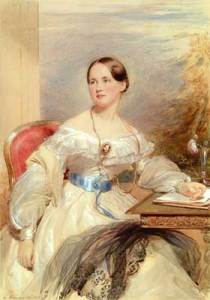
The Hon. President James Erskine Murray opened the debate in the affirmative by enumerating various females of literary distinction, and asserting that they were rendered “more sensible and conscientious in the discharge of their domestic duties” than women of limited capacity and neglected education- “in short, that it was easier to direct the intelligent than the ignorant”. The respondent, Mr Osbourne, contended that woman was not by nature intended mentally or physically to sustain the labour of acquiring that superior extent of knowledge, and that it would interfere with her devotion to domestic affairs. Women would no longer be fascinated by respected individuals of the other sex “upon whose opinions she rests with confidence as the safest code of general direction”- instead of being fascinated, they would actually take a part in literary and scientific discussion! Thoroughly modern SNAG as he was, however, Mr Osbourne commended the more beneficial system of education that has become prevalent in Britain, America and Europe where “all the pretty nothings which at one time formed the almost entire course of female education” had been replaced with general principles of science and useful literary studies. The Hon James Erskine Murray, in reply, decried this education that made women “in many instances as only fit to hearken to the insipid babblings of young men in preference to intelligence and rational conversation” He instanced Mrs Somerville, Lady Jane Grey, Mrs Clarke, Johanna Billie, Edgworth and others. Mr Smith, speaking for the negative, accounted for the difference in ability between men and women by a description of the respective skulls of the two sexes. Mr Stafford, for the affirmative, brandished Mary Stewart, Elizabeth, Catherine II and the Countess of Pembroke to shew that the sex gave evidence of genius , which no system of exclusion could obscure.

The warmest applause of the evening went to Mr Smith who “alluded to the domestic happiness to be experience by a Benedict, who, returning to dinner after the duties of the day, instead of finding the rump steak and oyster sauce &c. smoking a welcome to his appetite, finds his lady so deeply immersed in Euclid, or buried in the mysteries of Algebra, as to let him cater for himself.”

And so the evening ended. As the Herald concluded:

The subject of debate, as far as opinion went, had, we imagine, been decided in the breast of every one ere the discussion commenced. The question was too loosely and generally given for an advantageous discussion, and was decided in the affirmative.

So there you have it.

References:

 Finn, Edmund The chronicles of early Melbourne, 1835 to 1852 : historical, anecdotal and personal / by “Garryowen”, Melbourne, Fergusson and Mitchell, 1888

McNairn, Jeffrey, The Capacity to Judge: Public Opinion and Deliberative Democracy in Upper Canada 1791-1854, Toronto, University of Toronto Press, 2000.

Dancing diplomacy with Kevin

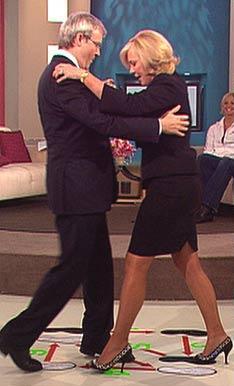
According to Kevin PM,  when we’re dealing with China, it’s two steps forward, one step back.  And when we’re dealing with Pyongyang

…it’s two steps forward, one-and-a-half steps backwards, if not two steps backwards or two-and-a-half steps backwards…

(Age, Aug 12 p6 “Rudd pins deadlock on North Korea”)

And he thinks HE can dance????  Come on, Kev…we’re just GOING FORWARD.

How do you like your history? Sliced or threaded?

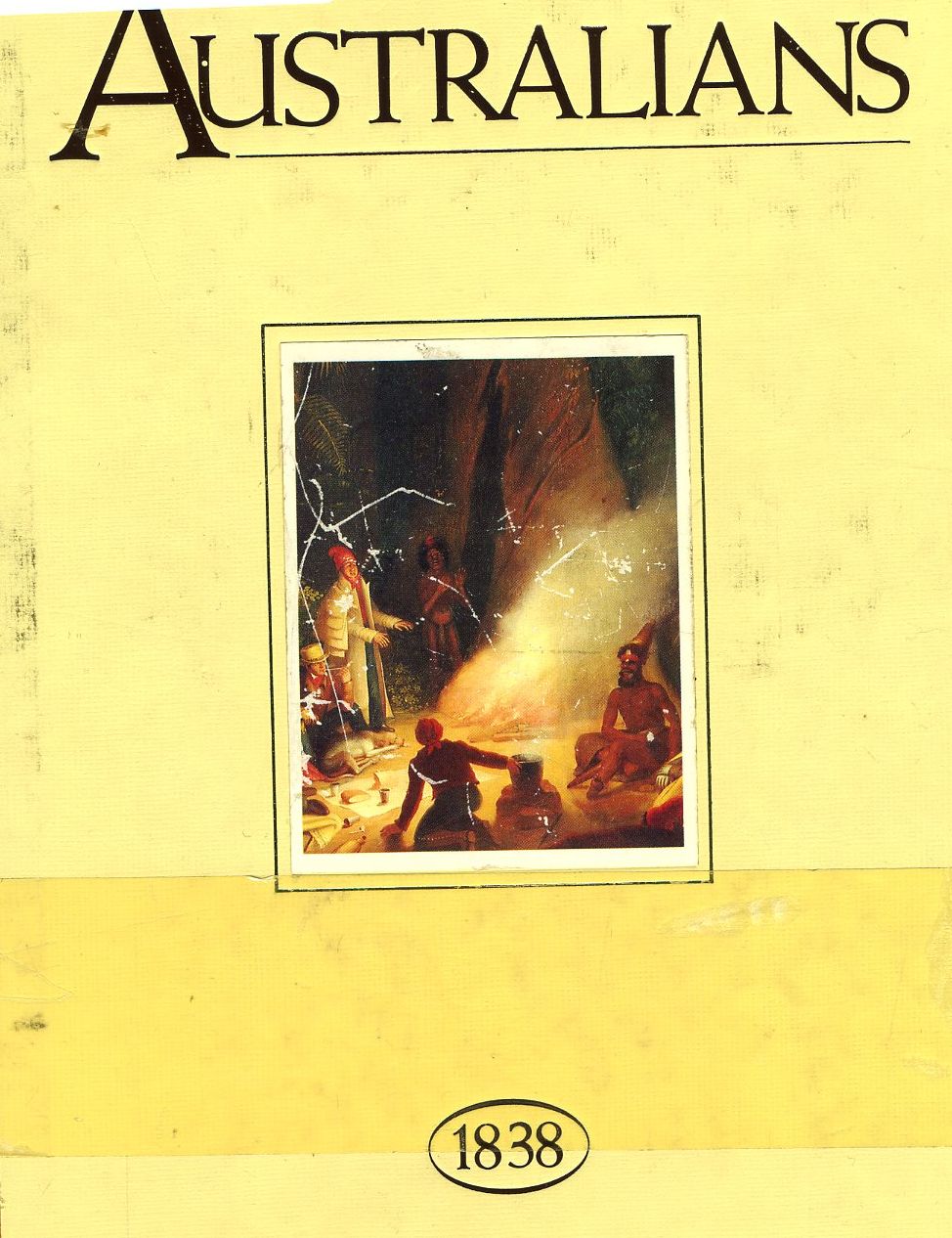
A couple of days ago I finished reading Australians 1838.  This book is part of a series of reference books published for Australia’s Bicentennial in 1988. As well as a dictionary, atlas, book of statistics and separate bibliography, each volume is devoted to a ‘slice’ of Australia’s history at 50 year intervals- 1788, 1838, 1888, 1938 etc.

1987, 474p.

The process of developing these books is almost as (if not more!) interesting than the final product.  The project did not receive money from the Australian Bicentennial Authority, relying instead on funding from research grants and university support.  The project involved literally hundreds of scholars, and in the case of the 1838 volume, spawned its own accompanying journal ‘The Push from the Bush’ which took on a life of its own.  Although described as a ‘collaborative history’, closer examination of the contributors to specific chapters shows that the main authors were Alan Atkinson, Marian Aveling, and  S. G. Foster, along with sections by Lyndall Ryan, Joan Kerr, Richard Neville, Beverley Earnshaw, Margaret Anderson, Barrie Dyster, Jillian Oppenheimer, Frank Broeze, Sandra Blair, Rob Linn, Frances O’Donoghue, Mimi Colligan, Elizabeth Windschuttle, Elizabeth Webby, A. J. Rayer, Laurel Heath, Tony Rayner and Martin Sullivan.  And who said you can’t write history by committee?

By deliberately adopting a ‘slice’ approach, the series steps out of the mould of the “traditional Australian catechism” of Convicts, Squatters, Gold, Land Acts, The Kelly Gang, The Anzacs, The Depression and World War II.  As Alan Gilbert and Ken Inglis wrote in the Preface:

By writing about one year in people’s lives…historians could avoid creating the most common illusion conveyed by narrative approaches: that history is a stream, carrying people towards a predetermined destination clearly visible to us, if not to them.  Slicing through a year, we might hope to see and hear people living as we do, taking some things for granted- the sun rises and sets, the seasons pass, people grow older- but at the same time surrounded by choices and uncertainties.  We might recognize people more easily as our own kind if we met them living out the daily, weekly, seasonal, annual and biological rhythms of their lives; and we would certainly understand them more fully by grasping the truth that the future that beckoned or alarmed them was not necessarily our past- what actually happened- but rather a hidden destiny, a precarious vision of probabilities, possibilities and uncertainties. p.xiii

I’m not sure that this rather subversive view of history is actually realized by the book. It certainly achieved a panoramic view of what it was to live in 1838, but the sense of contingency, false starts and misconceptions doesn’t come through particularly strongly.  As a reader, it felt rather blinkered by focussing just on the one year with no  antecedents and consequences- there was no scope for that very human act of  wondering what happened next.  It was if the book was shut with a resounding clap and a “no more now, time for bed!”

I do, too, find myself wondering about the intended market.  In Macintyre and Clark’s 2006 (2nd edition) book The History Wars, the series is noted as being marketed as a heritage item, in terms of its design, production values and cost.  The reason that I read it was to find an insight into what it was to think like an 1838 Australian ( a rather anachronistic concept- more correctly, NSWman, Van Diemen’s Lander, South Australian and West Australian).  Why would anyone else read it?  It doesn’t have a strong narrative thread: nor is it a reference book per se.  It is beautifully produced with copious and lavish pictures.  Perhaps it’s intended to just sit on the shelf??

Which brings me to a different way of taking one’s history- threaded.  I see in Saturday’s Age that the National Museum is again in the news- this time, with the second iteration of the multimedia display ‘Circa’, a revolving theatre that leads from the entry foyer to the museum’s interior.

A controversial review of the museum by sociologist John Carroll , also described in The History Wars and Graeme Davison’s chapter in Macintyre’s The Historian’s Conscience (2004), criticized this particular display as a “paradigm for what is weak in the parts of the museum that are weak, in that it leaves confusion rather than clear, engaging narratives…. It’s far too much a jumble of snatches of opinion, one after another, which have no coherence together…”.  As Katharine Murphy notes in the Age article:

The new version can’t be accused of failing the chronology test.  It ties up 40,000 years of Australian history in a neat narrative bow, highlighting key elements of the museum collection- Phar Lap’s heart, the Banks Medallion featuring botanist Joseph Banks, and the prototype handmade Holden from which all modern Holden cars descent- in an effort to connect the visitor more directly to the place, rather than engaging them with a more abstract, and at times political, discussion about the experience of being an Australian. The contrast between the old and the new, on any analysis of tone and substance, is stark.  There is now a clear beginning, middle and end, and a location of history in time and place.

I would feel a little more comfortable about this if Howard’s cultural warriors on the National Museum Council (headed by Liberal Party president Tony Staley,  John Hirst, Howard biographer David Barnett and right-wing columnist Christopher Pearson) felt a little less comfortable.  I’m not opposed, however, to the importance of chronology and narrative- it’s something that I’m grappling with in my own telling of Port Phillip.  I’m very much aware of the need to have ‘befores’ and ‘afters’ in the way that we, as humans, impose a narrative structure on events.  I’m fascinated, in Judge Willis’ case, by the distortion of time and distance in the Colonial Office’s attempts to manage what was, after all, a personnel crisis in one of their overseas branches.

But the ‘neat narrative bow’ of this display disturbs me.  It sounds rather like an advertisement for the ‘must-sees’ of the museum- perhaps it’s not necessary to go any further but just sit on the floor and watch what you could see without all the walking? Perhaps I shall just have to bestir myself and hie myself hither to Canberra to see it for myself.

David Roberts PATERNALISM IN EARLY VICTORIAN ENGLAND

1979, 278 p

One of the frustrations that I’ve faced in trying to understand Judge Willis has been to try to understand his mindset. Why did Port Phillip society of the time find him so unacceptable and demand his dismissal? Was he too radical? Was he too conservative? Was he neither of these things? This book focusses on early Victorian England which, although a hemisphere away from Port Phillip, was the milieu that informed the thinking of colonial judges and civil servants and was the lens through which their patrons and superiors back in the metropole viewed their actions.

In this book, Roberts attempts the heroic in trying to define and illustrate the workings of an unnamed-at-the-time set of varying beliefs and attitudes which he, along with other 20th historians, identifies as ‘paternalism’. He argues that, bolstered by Romanticism and literature, paternalism reached its apogee in 1844. It’s a slippery concept, though, despite his attempts to pin it down through analysis, for example, of the backgrounds of the contributors to the major ‘paternal’ journals and quarterlies of the day, or by the speeches and voting patterns of ‘paternalist’ MPs in the 1840s. He divided these parliamentarians into 6 categories: the Romantics, The Peelites, The Churchmen; the Country Squires; The Whigs and the Anglo-Irish, but even he admits that there is no consistency between their espoused position in speeches, and their actions. Paternalism, it seems, is only one of several influences. In fact, his concept is so hemmed in by qualifications and disclaimers that you start to wonder if what he is describing exists at all.

But, despite his difficulties in defining it, he posits that after 1848 ‘it’ was no longer functional: rendered less relevant by the rise of urbanisation, a self-conscious middle and working class and the mid-century intellectual developments of science, rationalism, empiricism and belief in progress.

I’m not sure that this book has taken me much further in understanding Judge Willis. It’s interesting that his major patrons are categorized as either Peelites or Whig paternalists- but I’m not really sure yet what, if anything, that means.

Possum Magic

The residence of the Resident Judge has, for some months, been under a vermin attack. Last year it was the mice, then -worse still- the rats in the ceiling.  A couple of weeks ago possums took up residence in the roof. Exterminators and removers have been called, and the place SHOULD be vermin free.

But it’s not.

A couple of weeks ago, I noticed a chewed banana on the kitchen floor.  I thought that one of our four FOX TERRIERS (supposedly renowned for their vermin-chasing propensities!) had brought it in.  A little later, I noticed that after I had used half a banana on my cereal in the morning, the other half had been eaten while still in the fruit bowl.  Alert now, AND alarmed, I started to scrutinize the fruit bowl more carefully. Yes- the tops of pears had been nibbled; whole bananas would be eaten leaving the empty skin still attached to the others in the hand; bananas would be taken out of the bowl and left on the bench.

We thought they might be getting in through the dog door (specially cleaned of doggie snot for this photo lest you think me slovenly)

Could they be getting in through the doggie door? Well, maybe…. so I’ve taken to locking it. The first night I locked it so that they could get out but not come in (lest they already be here in the house).  At 1.30 a.m. I could hear them bashing at the door.  After a brazen banana heist that night, I took to locking it completely- no ingress or egress! I’ve tested it- they can’t be getting in through here. But at 5.00 a.m. this morning they were back…

How are they doing it? The dog door is locked.  All the cupboards are shut- and I can’t believe that they’d shut the cupboard doors after them (after all, no-one else in the house does).  The airconditioning and central heating vents have not been disturbed.  The dogs are not sniffing anywhere.

My daughter’s room has a sliding door, is locked and has no visible space under it.  The bathroom and toilet don’t seem to have any visible sign of entry. There’s just one room…at the end of the passage.  My only subscriber knows what’s behind the door. COULD they be squeezing under the door and getting in from there???

So here we are: flummoxed by a possum.  I have taken to leaving some banana outside on the porch, but last night it REJECTED it!! Self-serve, it seems is the way to go.

Kevin Rabalais THE LANDSCAPE OF DESIRE

2008, 280 p.

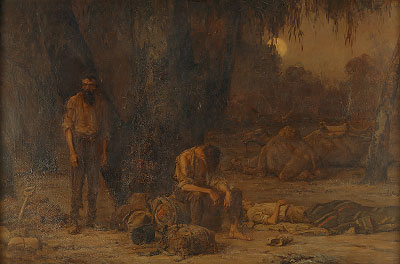
As a newcomer, you’d have to be pretty brave to write a fiction book about one of another country’s iconic stories. The author of this book is American-born and now living in Australia. Quite apart from the narrative draw of the Burke and Wills expedition in its own right, it’s obviously the sort of story that attracts writers from other countries. The English writer Sarah Murgatroyd with The Dig Tree also mined the Burke and Wills story with, I think, more success than Rabalais has had. And of course, Alan Attwood with Burke’s Soldiers and Alan Moorehead ‘s Cooper’s Creek also tell the Burke and Wills story- and they’re just the ones that I’ve read! Generations of Australian school children have heard the story; the highly glorified Burke and Wills statue has been shuffled to and fro around Melbourne streets and now overlooks the corner of Swanston and Collins Street, and the imagery is strongly reinforced by the Longstaff painting in the National Gallery of Victoria.

So how then, does a writer who has not grown up immersed and inured to all this mythologizing deal with the story? This is a fictional account, and focusses on the love interest between Robert O’Hara Burke and the actress Julia Matthews which he expands by having William Wills fall in love with her as well. I’m not aware of this twist- but hey, it’s fiction. The story is told in small snippets, disconnected in time and location and has the feeling of being at times over-written. As an Australian reader, it is familiar to me: I can’t imagine how a reader new to the story could possibly follow it.

If he is writing for an Australian audience whose knowledge of the expedition can cope with these narrative discontinuities, then he has even more responsibility to get things right. I always understood that they reached the mangroves of the Gulf of Carpentaria, observed the tidal flow, then turned back. I have never heard, as Rabalais asserts, that they stood in the foamy sea. This gives the expedition a triumph that it was denied, and there’s something very Australian in that. We are comfortable with our heroic failures- we like them that way.

There’s a sniff of the writing exercise about this book. Many sections are only 3 or 4 pages long (a good length for ‘workshopping’), and there is an appalling, anachronistic interjection of an authorial reflection about photographs which, thankfully, starts and ends abruptly never to be seen again.

The Moorehead book is the ur-text of Burke and Wills stories. Sara Murgatroyd, who died of cancer at the age of 34 just after her book’s publication, gets a good look in and has left a strong legacy. Other than that, I don’t really think the world NEEDS another Burke and Wills story.