Terrific film. Set in the western suburbs of Melbourne, it’s a slice of suburban life that is Melbourne through and through, but also broadly human. It’s the experience of a young mother who suffers an aneurism and is warned that lifting, constipation, stifling sneezing and orgasms could trigger another bleed : as her doctor said, there’s one of those you can avoid. And so, she and her husband do, over a one year period punctuated with tooth fairies, nits, football finals and Christmas raffles. All this domestic clutter continues as Natalie returns to her role as mother, fragile and teary, reprieved and troubled by her own mortality; her husband Ross is rocked by her near-death, anxious about the constant restructuring in his own workplace, quailing in the face of financial troubles and resentful of his wife’s tentative explorations of spirituality.
The acting was wonderful: Sasha Horler (Natalie) would look at her children and crumple into tears- and so did I. I held my breath as she lay in her hospital bed, so still and so very, very ill. When Bubblehead the fox terrier was attacked by a larger dog, I found myself shaking like a leaf, just as I did when my own little Ellie was monstered by the dog down the street. A look; a comment tossed over the shoulder- it was like watching someone else’s life unfold before you.
This is Sarah Watt’s second film after Look Both Ways. There are similarities between the two: both are set in Melbourne; both are intimate slices of a set period of time (a weekend; a year); both use animation as structural devices although there was less of this in ‘My Year Without Sex’. I do find myself wondering whether she will move beyond such up-close explorations of illness and mortality: it’s obviously a theme that is important to her.
This film is not unlike ‘The Castle’ in that, as a Melburnian, you can identify instantly with so many aspects of their daily life- even if MY house is much neater, my children are older, we’re on the other side of the Westgate etc. It’s such an affectionate film. I’m delighted that it’s doing so well.
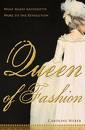
If I’d written this book, I couldn’t have resisted her subtitle: ‘What Marie Antoinette Wore to the Revolution’. Although to be fair to any humourless editor who may have insisted on the more staid title, the first half of this book does deal with Marie Antoinette as Queen, and only the second half is devoted to the Revolution.
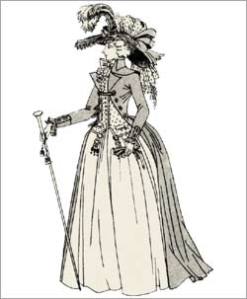
A French Queen’s clothes were never neutral: the young bride-to-be Marie Antoinette was stripped of her Austrian clothes on the border, despite her mother’s care in making sure that they were of the latest French design, and clothed in authentically French court fashion, including a wicked boned corset and the ceremonial grand habit de cour – the court dress of Versailles with a tight-fitting bodice, voluminous hoopskirts and long train. The clothes were not enough, though, to encourage her diffident husband, the future Louis XVI and it was in the in-between phase, before he bolstered her position at court by bedding and impregnating her, that she began experimenting with court fashion. She scandalized the court by refusing to wear the corset; she introduced the English-style redingote (riding coat) and wore trousers while riding.
Redingote
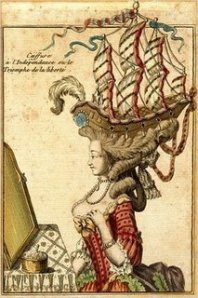
Once Queen, her own style set the standard for fashion at court. She introduced the pouf– huge, towering hairstyles built on scaffolding made from wire, cloth, gauze, horsehair, fake hair and the wearer’s own hair, teased off the forehead. In amongst this would nestle an elaborate miniature still-life- for example ‘ a three-foot high pouf that replicated a verdant garden, replete with flowers, grass, a bubbling stream, and a tiny windmill edge with jewels and powered by a clockwork mechanism’ (p. 104.); or more political poufs, like one that depicted the French frigate that won a key victory against the British in June 1778.
pouf a la Belle Poule
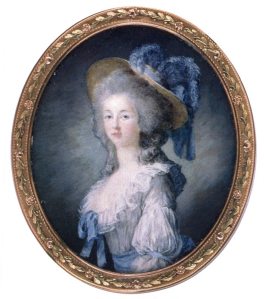
Away from the court, at her Petit Trianon garden shed, she broke away from the formality of the court by wearing a lightweight chemise dress known as the gaulle, made of airy, ruffled muslin with a wide sash at the wait and ribbon bracelets at the elbows. The gaulle was popular not just in France, but across the Channel in England as well.
The Princess de Lamballe, Marie Antoinette's BFF, wearing a gaulle
This earlier section of the book was interesting, but rather laboured. Perhaps this reflects the long waiting-around time that Marie Antoinette had to endure before her husband managed to ‘do the deed’. Weber draws heavily on Antonia Fraser’s biography of Marie Antoinette throughout her book- I don’t know why, but I’d mentally placed Fraser’s meticulous work into a different category from a scholarly (but popular) book like Weber’s. At times I felt like saying “Okay- I get it! Clothes matter!” during the early chapters.
For me, the book really took off with the Revolution. Weber spends little time discussing the Revolution per se, but instead looks at it through the lens of Marie Antoinette’s clothing, and just like the Revolution itself, there is a dizzying array of statements being made in the clothes she wears. During the early days of the Revolution she adopted the cockade in blue, white and pink (not red) worn by the people in the streets, to express her sympathy in the movement. In trying to escape to Varennes, she adopts an unassuming dark brown dress with a black shawl and hat, but in the pictures portraying their escape, she is depicted wearing the gaulle she made famous. Once arrested, she adopted again the colours of royalty- purple and green, and sometimes the Austrian colours of yellow and black: at the risk of a bad and anachronistic pun, surely a ‘red rag’ to the Revolutionaries. She insisted, over her jailers, on wearing black once her husband had been executed, a dress that became progressively more tatty and threadbare as her imprisonment stretched on. Finally, taken to the guillotine, she pulled out a white dress that she had kept carefully hidden throughout her imprisonment, and died in that. Even the fact that she had saved this white dress highlights her awareness of appearance: she had been suffering very heavily from uterine bleeding for months, was desperate for rags to staunch the flow, and to have kept this dress intact speaks volumes.
Weber draws on other biographies, the memoirs of royalists written at the time and small ephemeral documents like receipts and accounts with her dressmakers and milliners. It is a beautifully written book that she has obviously enjoyed writing- so much so that there is a personalized narrator-centred introduction and afterword- as if she can’t bear to let the topic go. And yet I wish she had integrated her afterword into her introduction, because it detracted from the masterful closing paragraph of the book that encapsulated everything that had come before:
Even before she had reached the guillotine, this aspect of her history, her body, her being, had been erased- leaving only white. But the erasure reveal even more than it concealed, condensing as it did the whole of her perilously fashionable past. White the colour of the fleur-de-lys and of a young bride’s complexion. White the colour of costume parties and sleigh rides in the snow. White the color of a powdered head, coiffed by Bertin and Leonard- or by the mob. White the colour of a muslin gaulle, imported or otherwise: pretty at Trianon, perverse in Paris. … White the simultaneous coexistence of all colours: revolutionary blue and red, royalist violet and green. White the color of the locks that she saw the executioner slip into her pocket as he sheared her head to prepare her for her fate. White the color of martyr-dom, of holy heaven, of eternal life. White the color of a ghost too beautiful, or at least too willful, to die. White the color of the pages on which her story has been- and will be- written. Again and again and again.
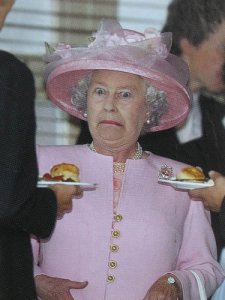
Yes, Ma’am, another un-birthday- although given that your birthday is celebrated on multiple days in multiple countries, and you have your ‘real’ birthday and your ‘official’ birthday, you must be about 428 years old by now. We’re celebrating it today in Australia- although not all of Australia mind you- Western Australia celebrates it on the last Monday of September or the first Monday of October. This is because Western Australia celebrates its Foundation Day on the first Monday in June, and we can’t use up all our Public Holidays at once, can we ma’am?
Her Maj’s birthday is actually on 21 April, but after George V died they decided to keep the ‘official’ birthday on or around 3rd June, which was his birthday. England celebrates the Trooping of the Colours on the 1st, 2nd or 3rd Saturday in June, but this actually commemorates the anniversary of Elizabeth’s coronation on 2 June 1952. And it doesn’t really count because it’s a Saturday. Anything worth celebrating is worth a day off, I reckon.
Up until 1936 the Monarch’s birthday was celebrated on the actual day. So up until 1820 that would have been 4 June for George III; between 1820-1830 it was 12 August for George IV; between 1830-1837 King William IV’s birthday was celebrated on 21 August, then 24th May for Victoria’s birthday between 1837-1901. You’ll note that these are all in summerish months in England. Edward VII’s birthday on 9 November was celebrated between 1901-10 and both he and his people came to appreciate the idea of birthday celebrations in summer rather than winter. George V’s birthday was honoured on 3 June between 1910-1936- a more favourable date for Northern Hemisphere climes than November. It’s been 3rd of June or thereabouts ever since.
New South Wales celebrated King’s Birthday right from the start. David Collins described the first celebration of King’s Birthday in 1788
His Majesty’s birthday was kept with every attention that it was possible to distinguish it by in this country; the morning was ushered in by the discharge of twenty-one guns from the Sirius and Supply; on shore the colours were hoisted at the flag-staff, and at noon the detachment of marines fired three volleys; after which the officers of the civil and military establishment waited upon the governor, and paid their respects to his excellency in honor of the day. At one o’clock the ships of war again fired twenty-one guns each; and the transports in the cove made up the same number between them, according to their irregular method on those occasions. The officers of the navy and settlement were entertained by the governor at dinner, and, among other toasts, named and fixed the boundaries of the first county in his Majesty’s territory of New South Wales. This was called Cumberland County, in honor of his Majesty’s second brother; and the limits of it to the northward were fixed by the northernmost point of Broken Bay, to the southward by the southernmost point of Broken [sic] Bay, and to the westward by Lansdown and Carmarthen Hills (the name given to the range of mountains seen by the governor in an excursion to the northward). At sunset the ships of war paid their last compliment to his Majesty by a third time firing twenty-one guns each. At night several bonfires were lighted; and, by an allowance of spirits given on this particular occasion, every person in the colony was enabled to drink his Majesty’s health.
Some of the worst among the convicts availed themselves of the opportunity that was given them in the evening, by the absence of several of the officers and people from their tents and huts, to commit depredations. One officer on going to his tent found a man in it, whom with some difficulty he secured, after wounding him with his sword. The tent of another was broken into, and several articles of wearing apparel stolen out of it; and many smaller thefts of provisions and clothing were committed among the convicts. Several people were taken into custody, and two were afterwards tried and executed.
The anniversary of his Majesty’s birthday, the second time of commemorating it in this country, was observed with every distinction in our power; for the first time, the ordnance belonging to the colony were discharged; the detachment of marines fired three volleys, which were followed by twenty-one guns from each of the ships of war in the cove; the governor received the compliments due to the day in his new house, of which he had lately taken possession as the government-house of the colony, where his excellency afterwards entertained the officers at dinner, and in the evening some of the convicts were permitted to perform Farquhar’s comedy of the Recruiting Officer, in a hut fitted up for the occasion. They professed no higher aim than ‘humbly to excite a smile,’ and their efforts to please were not unattended with applause.
The anniversary of his majesty’s birth-day was celebrated, as heretofore, at the government-house, with loyal festivity. In the evening, the play of ‘The Recruiting Officer’ was performed by a party of convicts, and honoured by the presence of his excellency, and the officers of the garrison. That every opportunity of escape from the dreariness and dejection of our situation should be eagerly embraced, will not be wondered at. The exhilarating effect of a splendid theatre is well known: and I am not ashamed to confess, that the proper distribution of three or four yards of stained paper, and a dozen farthing candles stuck around the mud walls of a convict-hut, failed not to diffuse general complacency on the countenances of sixty persons, of various descriptions, who were assembled to applaud the representation. Some of the actors acquitted themselves with great spirit, and received the praises of the audience: a prologue and an epilogue, written by one of the performers, were also spoken on the occasion; which, although not worth inserting here, contained some tolerable allusions to the situation of the parties, and the novelty of a stage-representation in New South Wales.
By the time our Judge Willis arrived in Port Phillip, it was Queen Victoria’s birthday that was being celebrated on 24th May, as it was to be for sixty-five years. From the 1820s onwards, Sydney society had celebrated the Birth Day of the monarch with a levee and ball at Government House, and by 1841 a similar practice was proposed for Melbourne. However arrangements broke down in acrimony in 1841 over whether the ball should be a public or a private event.
The private ball (sneering described as the ‘Dignity Ball’ by its critics) was defended by the Port Phillip Herald as a private occasion that had been postponed from the race-week earlier in the year, and that it just happened to occur on the Birth Day. The Herald argued
When the Government give a ball, which is generally on the birth day of the sovereign, cards of invitation are issued to the public and to different classes of society and this is as it should be for a simple and substantial reason- the expenses are defrayed out of the public purse. (PPH 7 May 1841)
However, this was a private occasion, overseen by stewards prominent in Port Phillip Society at the time: Simpson, Powlett, Meek, James McArthur, J. Lyon Campbell, Verner and Major St John.
The Port Phillip Gazette and Port Phillip Patriot, affronted at these “upstart exclusives” and “ill-bred puppies” proposed a truly public ball to be held at Yarra Yarra House in Flinders Street on 24th May, with admission tickets for a gentleman and a lady priced at 2 guineas. Messrs Abrahams, Langhorne, Kerr and Sullivan were stewards, with Connolly and Urquhart’s disputed involvement.
So who won the Battle of the Balls? The private ball was postponed until 4 June, then later until 8th June to accommodate Presbyterian families who would not have been able to attend on the 4th because that week had been set aside for religious observances. The Public Ball went ahead on 24th as planned, but it rained. The Private Ball took place on 8th June, attended by 44 ladies and 67 gentlemen; the stewards provided a most magnificent supper, which was done ample justice, and festivities continued until 5.00 a.m. In a coup for the more exclusive Private Ball, Superintendent La Trobe and his wife attended: they had not attended the Public Ball.
The next year only one private ball was held. I find myself wondering why the fuss of the preceding year was not repeated: perhaps it had been just newspaper hot-air. The Port Phillip Herald of 27th May devotes half a column to it:
THE BALL. The most splendid entertainment that has ever yet taken place in the province was held in the long room of the Royal Exchange on Wednesday evening, in honor of the Queen’s birth-day. The ball, although got up by private subscription, and as one of the regular “private assemblies”, was attended by nearly all the rank and fashion of our rising town. Notwithstanding the very unfavourable state of the weather, and the almost impassable state of the roads, the ball room was crowded at an early hour. Several of the gentlemen appeared in rich fancy disguise, and some of the dresses were very much and deservedly admired. The gentleman who appeared as an Italian Brigand was perhaps the most successful in attracting the fair notice of the visitors, although there were other parties very elegantly attired. The enlivening colour of the different fancy dresses added much to the brilliancy of the entertainment, which was considerably increased by the fascinating beauty of several of the ladies, who, believing that “beauty unadorned is adorned the most,” trusted to their usual tastes in not appearing in fancy costume. His Honor Mr La Trobe and Lady honoured the Ball with their presence, and dancing was kept up with the greatest spirit throughout the whole evening; the arrangements altogether were excellent. The music gave evident satisfaction, and was only eclipsed by the management of the supper, which met with deserved encouragement, and reflected great credit upon the caterers of this very necessary appendage to a dance. Nearly three hundred persons, it is calculated, graced the scene, and all departed to their homes highly delignted with the evening’s amusement.
Georgiana McCrae attended the 1843 Queens Birthday Ball and describes it as follows:
Dr Thomas drove out in his gig and took me to town. At 10 p.m. we went en masse to the Mechanic’s Institute. All the elite of the colony assembled, and in full swing, including Mr and Mrs La Trobe; the Mayor, Mr Condell and his niece, dressed in Mantis green, not unlike the insect itself in the waltz attitude. Mr C. H. Ebden’s movements somewhat eccentric, now and then cannoning among his neighbours…Dancing was kept up briskly till after 1.a.m.
Well, ma’am no dancing any more. In fact, it’s a dead loss as a celebration of anything except perhaps the opening of the ski season and a few football matches. And a very merry un-birthday to you ma’am.
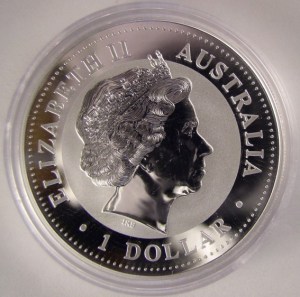
I see that the Royal Australian Mint is considering a general overhaul of Australia’s coinage. Now, I reckon that the most dangerous job in the world must be The Depictor of the Queen’s Jowls. We started off with a yoof-ful Queen in 1953, then every 10 or 20 years there’s an update. Just how would you present the Queen with these depictions of increasing decrepitude? Present them early in the morning before she’d worked up her grumpiness for the day? Perhaps slip them to her late at night after a G&T or two? Would you make a selection of jowls and ask her to select one?
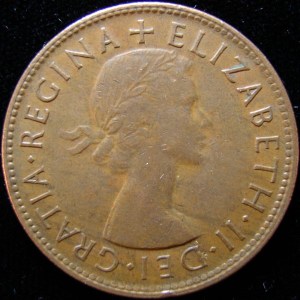
Apparently there have been five depictions of the Queen on the obverse of Australian coins. In 1953, the year of the Queen’s coronation, the effigywas designed by Mary Gillick. ‘Effigy’ is the Royal Mint’s term, not mine. I thought that an effigy was something you burnt.
Gillick design 1953
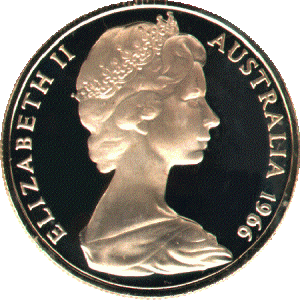
My! She’s looking very French Revolutionary there. Or perhaps Greek Goddess. Then, with the introduction of decimal currency in 1966 a new effigy designed by Arnold Machin was used. Apparently her portrait always faces to the right to conform with a convention, started with Charles II that the new monarch’s portrait would face in the opposite to their predecessors. As well it might in his case.
Machin design 1966
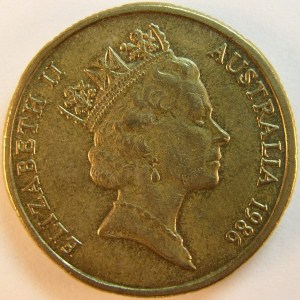
The Machin image was designed for the British Royal Mint, and approved in 1964. It did nearly 20 years service until the new Raphael Maklouf design was used in 1985. Apparently 17 artists were invited to submit designs, and a set by Maklouf was selected. (Wonder what happened to the other 16 designers?) A ‘revised’ model was accepted by the Queen for circulation.
Raphael Maklouf design 1985
The Ian Rank-Broadley design of 1988 is a brave one. Is that a hint of jowl we detect? She only had a choice of three designers this time!
Ian Rank-Broadley 1988
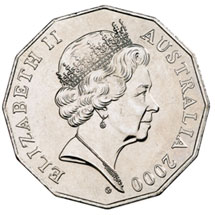
And then, finally, an even braver man- Vladimir Gottwald. This design is only seen on the Royal Visit 50 cent coin. He’s our very own man this time- the first Australian designer since Sir Edgar Bertram Mackennal to have his design on the observe of an Australian coin. Do you like her crown? It’s called “Girls of Great Britain and Ireland” , a wedding gift from Queen Mary in 1947. Good to see that the old “girl” is bringing out the old stuff.
Vladimir Gottwald 2000
And so, a new Queen effigy perhaps? A poisoned chalice if ever there was one, I reckon….
I’ve now finished the final of the Miles Franklin shortlist for 2009- a shortlist this year dominated by the literary bulls of Australian literature (Winton, Flanagan, Nowra, Bail and Tsiolkas). I don’t know whether to be assured that the shortlist is truly gender-blind by not including a token female writer, or whether to snort that SURELY one of the many books published by female writers must have qualified.
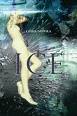
I think this is the one amongst the shortlist that I enjoyed reading the most. At first it seems to be a straight fictionalized biography of Malcolm McEacharn, a colonial entrepreneur responsible for the refrigerated meat export trade among other things. Nowra has used some fictional licence here, but sticks fairly closely to McEacharn’s biography. A shy, diffident man, McEacharn’s mother remarried and shifted to India, leaving him as a young worker to find his own way in the world. He falls in love with Ann, a bewitching beautiful girl. When she dies, he is maddened by grief, and the rest of his life- apparently successful with money, clothes, mansions, political influence- is just a series of layers with his love for Ann at its core.
Running parallel to this is the present-day voice of Rowan Doyle, likewise maddened sitting beside his comatose wife, who had been writing a biography of McEacharn when she sustained catastrophic injuries when attacked by a crazed ice addict. Doyle picks up the story, based on her research, but embues it with his own feelings of grief and loss, and finds himself unable to stop writing because it is his last contact with his wife.
This juxtaposition of death/coma and ‘ice’ in its many manifestations is deliberate, self-conscious and a little laboured at times, but I found myself drawn into the sorrow and obsessive love in the book and was in tears by the end of it. The modern narrative breaks in at unexpected places, and because the biography itself is a product- their joint product, already researched with its ending known- there is quite a bit of foreshadowing.
Louis Nowra: The interesting thing about all this is that I don’t believe you can know anybody after two generations. What I’m saying is if I write about an historical character…I really don’t know Malcolm. All I know is these papers that I’ve read and a couple of interviews that he did. I have a kind of a vague idea about him. So really the novel is not an historical fiction. What I’m attempting to do is almost parody historical fiction. I’m not saying this is the real Malcolm, I’m saying this is Rowan’s version. No one can possibly know about people more then 50 years into the past, I think…
Ramona Koval: So you’re talking about straight history as well?
Louis Nowra: I think straight history is fine, but once you start to second-guess characters, once historians start to identify with a character, I think you become very much on slippery ground. Like my grandparents, for example, I have learned a lot about their lives when I wrote my first memoir. At the same time, they are tremendously vague for me because I don’t have their values, I don’t have their sense of morality and I don’t have their sense of how they fought so hard for money. So I cannot judge them. And the same is with historians. I actually think that sometimes there’s a bit of flimflam that goes on.
Through his character Rowan, Nowra (hah! an anagram!!) backs away from claiming ‘truth’ from his writing. He tells his comatose wife that he’s found extra information to add to her already-completed research; he reads her research notes and moulds them into an explanation that is more consonant with his own emotional response to grief, rather than a straight biographical account.
And as Nowra says in this interview, ‘Ice’ is very much a love story and a meditation on the narrow line that divides love from obsession. It’s not unlike ‘Wanting’, one of the other Miles Franklin shortlist for 2009, but it’s more tender in its approach. I hope it wins, although I suspect that ‘The Slap’ will win, and that ‘Wanting’ should win. But I can always hope, can’t I?
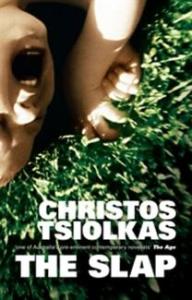
It’s doing well, this one. Plans for a television series; won the Commonwealth Writers Prize, and shortlisted for the Miles Franklin. The Miles Franklin is awarded for any ‘published novel or play portraying Australian life in any of its phases’ . [An aside: I hadn’t realized that a play could win it.] Certainly, The Slap portrays Australian life of the backyard barbeque of inner-ish suburb of Northcote, Melbourne in the 2000s in all its domestic, self-absorbed, middle class glory. When one of the fathers slaps an obnoxious four-year old he triggers off much tut-tutting amongst the witnesses that ripples out into broader questions of discipline, family loyalty, abuse, friendship, class, religion, ethnicity, suburbs- the lot. Everyone’s here- the yuppie bayside suburb Greek boy made good; his cousin married to the Indian vet; the Sex-and-the-City writer who wants to do more than write soap opera scripts; the earth mother and her drop kick partner; the young gay adolescent boy struggling with his sexuality; the Greek grandfather; the Aboriginal muslim and his Aussie wife. Yep- I think that covers every inner-city suburban stereotype we need.
The book is told in long chapters written from the perspective, but not in the voice of, people who were at the barbeque and witnessed the slap. For some, it was just that- a spur of the moment slap to a child behaving badly; for others it was a violation of the rights of the child and his parents; others saw it as a criminal act; yet others as an unspoken manifestation of other domestic violence. These chapters work well: they are long enough for a reader to shift into the character’s mindset, and because they move forward chronologically, they keep the plot unspooling.
There are actually two slaps- or at least physical encounters with this same little brat- in this story, each bookending the first and last chapters of the book, and yet we don’t see them in the same way- largely because of the other knowledge we have gleaned about the characters along the way. Much of this other knowledge is fairly unattractive. It uncovers infidelity, jealousy, class envy, prejudice, vindictiveness, self-centredness and dishonesty. To be fair, it also uncovers loyalty to family and loyalty to friends, but even these things look rather shabby and unhealthy too.
Gerard Windsor reviewed this book in the Sydney Morning Herald where he described this book as “a strikingly tender book”. I didn’t see it this way. I think it’s a jaundiced book, populated with human, recognizable but ultimately unlovely people. I’m not convinced that it’s high literature: it smacks of the four-part miniseries- almost like Big Brother in the Backyard. Perhaps the same sense of voyeurism is what keeps you reading, to find out what people just like you are going to do in this situation.
As a Port Phillip District resident, I enjoyed reading about my Melbourne home town. The Heidelberg Court House is just down the road, I know the streets that he’s talking about. I know these people too. As inner suburban, middle class, university-educated, chardonnay-sipping Melburnites older than 25, we’ve met them all one way or another. It truly is “Australian life in its 2008 phase”, but somehow I think I’ll feel a bit short-changed if it wins the Miles Franklin. Is “reality reading” (like reality television), authentic and identifiable as it is, the same as “literature”? I’m not sure.
Should Melbourne University should be known as “The White Knight for Struggling Arts/Music Institutions” or as “The Institution That Ate Its Competitors”? The Victorian College of the Arts amalgamated with Melbourne University as the “Faculty of VCA and music”, and last year the Australian National Academy of Music, based at the South Melbourne Town Hall, also fell under the auspices of the University of Melbourne when the Federal Government withdrew its funding. So much for choice.
Enter the new Dean, Professor Sharman Pretty. Employed as a “change agent”, she is charged with restructuring the VCA’s six schools into three, shaving $11 million dollars from the budget and fitting the schools’ offerings into the Melbourne Model. And so we see the music theatre course, which started this year with 32 students accepted from 370 applicants, suspended from 2010- but “Professor Pretty says it will return if it can be made to fit the model“. Yes, that’s the way- fit the course to the curriculum model- not to the students, not to the work environment, not to the demands of the genre itself.
I’ve done my time observing the nursery of music theatre from the outside: the tap-dance lessons, the end of year dancing school concerts, the examinations, the auditions, the hair rollers, the tap-shoes, the false eyelashes. Consider the mainstay of musical theatre today, the franchised musical, shipped into a capital city for a financially-lucrative, solidly-marketed period with its authorized sets and carefully mandated cookie-cutter characters. Is this really post-graduate study???
But Professor Pretty knows how to play the market game.
Benchmarks?? Internationally competitive?? Sheesh. I don’t really understand what drives the artistic character, but I strongly suspect that it has nothing to do with academic excellence, grade point averages and assessment tasks, and an awful lot to do with dreams, drive and ambition. I wonder if we can “benchmark” them?
I will mandate that car horns be modified to the highest standards of emotional intelligence. There will be a friendly little toot for “Hey, the red light’s changed!” or “I’m here- don’t back your car into me!”.
There’ll be a happy little wave for “Hello! Haven’t seen you for ages!” and a cheery call of “Hey, I’m here in the driveway waiting for you!” when you pick someone up from their house.
There’ll be a slightly more impatient “Come ON, I can’t wait all day!” and a derisive “Get off your mobile phone, you wanker!”.
And of course, there’ll still be the loud, strident “IDIOT!!!!!!”
To be honest, I’m not absolutely sure that I ‘got’ this book. I am wary with Murray Bail- the first time I read ‘Eucalyptus’ I found it pleasant enough though underwhelming, but on a second reading wondered why I hadn’t picked up on the brilliance of its structure the first time. Does ‘The Pages’ have another level as well? But should you have to read a book twice in order to understand it?
In many ways ‘The Pages’ reads as if it is a complement to ‘Eucalyptus’. Where in ‘Eucalyptus’ we had an antipodean Scheherazade weaving stories from the landscape, in ‘The Pages’ we have an antipodean Wittgenstein who travels the world and returns to immure himself in the solitude of his shearing shed to write his philosophy of the emotions. In ‘Eucalyptus’ we have stories hanging like leaves, evoked by the names and appearances of eucalyptus trees ; in ‘The Pages’ we are left with sheets of paper, largely empty except for single, aphoristic thoughts.
The plot, such that it is, operates at two levels. Erica, a competent, articulate academic philosopher, has been engaged to assess and edit for publication an archive of papers left by Wesley Anthill, a peripatetic and largely self-taught philosopher who returned from travelling Europe to his family pastoral property, where he locked himself away to write a philosophy of the emotions. Erica travels out to the outback homestead to examine the materials, accompanied by her psychoanalyst friend Sophie who is recovering from yet another failed relationship, this time with a married man. While there, Erica sinks into the quiet rhythms of the pastoral lifestyle shared by Wesley’s brother Roger and sister Lindsay, who indulged and supported their eccentric brother’s writing. Erica comes to appreciate and love Roger’s earthy, grounded ‘philosophy of the hand’ which is such a contrast to the laboured and hard-wrung philosophy that Wesley had grappled with, alone in his woolshed and now nothing more than sheaves of paper, expungable with the simple act of spilling a cup of coffee.
The second plot involves Wesley’s own gradual quest for knowledge, stepping tentatively from autodidactism into formal academia, then moving around Europe in the footsteps of other philosophers. Although he fled Australia because he felt it unreceptive to philosophy, he returned there, after tragedy, to find and write his own, original philosophy. An essentially solitary man, he seems ill-fitted to write a philsophy of the emotions.
The pacing of this book is unusual. It unspools slowly, like a laconic country story, and when I was approaching the end of the book, I wondered how Bail was going to finish it in so few pages. It ends with a string of disconnected thoughts that just hang there. It’s a big book: themes of philosophy, psychoanalysis, words, Europeanness, Australianness ; and yet not much happens in the book. It’s complex but simple.
If this sounds ambivalent and contradictory, it’s probably because that’s how I found the book. I’m not sure if it’s brilliant or banal- which is very much the way I felt about ‘Eucalyptus’. Miles Franklin winner? Well, ‘Eucalyptus’ won the Miles Franklin a few years back- so obviously many people detected at first what I took two readings to find. Perhaps ‘The Pages’ is like that also, but I tend to think that put up against novels with a stronger story, ‘The Pages’ will be seen as too elusive, too strange.
Am I getting old? I think I must be. The younger people in my life, whose reading tastes I trust, really enjoyed this book. So, obviously, did many other reviewers and long-listers for literary prizes. But I don’t know- I just found it rather wearing.
It’s a long book- over 700 pages, which is a hefty commitment in anyone’s language . The book has large, implausible plot swings, and stories nest within other stories, each as sprawling as the one that preceded it. It’s loud, it’s exuberant, it’s confident, it’s young. The voice is that of an educated, self-conscious, ironic young male, and while I found it mildly amusing, I couldn’t say that I laughed out loud.
I just felt as if it had been done before. It’s not the first book to have stories within stories, nor will it be the last. It didn’t have the sustained, carefully constructed tone of Barth’s The Sotweed Factor or the intricacy and humour of Sterne’s The Life of Tristam Shandy. I can see the similarities with both Dickens and John Irving mentioned in the blurbs on the back cover, in terms of larger-than-life characters and riotous plots. All of these books are long and convoluted- no doubt one of the pleasures and perils of the genre.
I’m glad that it was short-listed for the Booker and long-listed for the Miles Franklin, but I don’t think that it deserves to win either award. It’s a swaggering, raucous book, and I wonder how (if?) he’ll follow it with a second novel. Good on him. But I think I’ll turn the volume down, pull up my knee-rug and read something a little more polished and restrained.




 The Resident Judge of Port Phillip