Author Archives: residentjudge

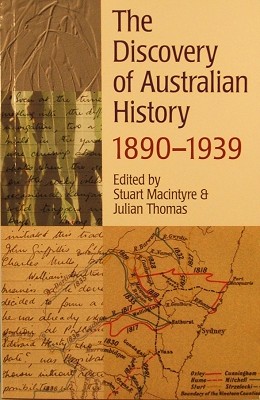
‘The Discovery of Australian History 1890-1939’ ed. Stuart Macintyre and Julian Thomas

1995, 191 p.

I borrowed this book from the library primarily for its chapter on S.H. Roberts,  the author of “The Squatting Age in Australia 1835-1847”.   Despite my intention to read only that chapter, comments on my post about that book and discussion here and here regarding what we would now call “political correctness” and historians led me to read the whole book.  I certainly do not profess any great knowledge here at all: I have read only this one book and a couple of other bits and pieces.

My gut-feeling was that the question of political correctness was anachronistic( i.e.  relating a phenomenon to the wrong time), and having read this book, I found nothing to disconfirm that view.  The book, edited by Stuart Macintyre and Julian Thomas (both of whom contributed a chapter) is a series of biographical sketches of key figures of the first and second generations of academic historians.  The focus is not so much on biography, but on the “profession and discipline” of history, both personally and as a field of intellectual endeavour.  Because of its time-span, the “sandstone” universities only are represented: George Arnold Wood and Stephen Roberts at Sydney; A.V.C. Melbourne at Queensland; G. C. Henderson and Keith Hancock at the University of Adelaide;  Edward Shann at the University of Western Australia;  Ernest Scott, Jessie Webb, Kathleen Fitzpatrick and Max Crawford at the University of Melbourne..

It is sobering to remember that until the 1890s, there were only three universities- Sydney, Melbourne and Adelaide.  At the University of Sydney prior to Wood’s appointment, history was included under the umbrella of natural history, or part of the classics. The University of Adelaide offered a chair of modern history and English language and literature. History had long been taught at the University of Melbourne, closely associated with political economy, law and the classics but the early holders of the chair were not recognizable as academic, research-based historians.  For many decades, there would only be the one professor at the single university in each state, with one or possibly two assistants and he – always ‘he’- would lecture across all history subjects presented. (A post on the women in this book will have to wait for another day).

The selection of any one professor was often not in the hands of the university at all- the University of Melbourne for example, delegated an English selection committee, based in England, to make the appointment.   Universities resisted what they perceived as government interference: at Melbourne, the chair had included history and political economy, but the second field was dropped in expectation of State government funding for a separate chair of economics or political science.  This funding did not eventuate because the university would not agree to the government’s stipulation that the new post be filled by one ‘whose views and training accord with Australian traditions and conceptions of economic matters’. (p. 72).  In their selection practices, and the talent pool to which they looked, Australian universities were integrated into an Imperial network.  Without exception, these academics gained their post-graduate qualifications  in England- predominantly at Oxford, with one or two in London.

And  to the extent that these Australian historians were involved in politics at all, it was generally at a British Commonwealth level through various Commonwealth bodies and sub-committees. They also contributed to ABC broadcasts as public intellectuals.  Two economic historians, however, played policy roles within government. Shann was very much involved in a sub-committee of the Australian Loan Council during the 1930s and later on a committee investigating unemployment under the Lyons Government- an involvement that he was later criticized for.  A.V.C. Melbourne was heavily involved in imperial trade policy.  As far as “political correctness” is concerned, George Arnold Wood seemed to have been affected most by it: after criticizing the British government for taking military action against the Boers, he was given only one lectureship up to 1916 and he felt that the university was unjust to him. Nonetheless, his appointment spanned 1891-1928.  The blurb on the back of the book writes that:

The path was not an easy one. The times and the institutions were conservative, resistant to change and new direction.

Institutional conservatism is clearly apparent but political conservatism less so. Certainly many of these historians had deep-seated political beliefs (Shann, for example was a Fabian; several of them embraced Liberalism) and publicly participated in the elite and  intellectual milieu of their societies. The chapters in this book do not pay much attention to the content of the histories produced by these historians, but there seems to be no suggestion that they tempered the narrative of the histories they wrote for the political government of the day.

The history discipline itself, across the world, underwent a huge change during these years as it shifted away from an antiquarian and chronicling emphasis to adopt von Ranke’s emphasis on primary sources.  Here there was fertile ground.  It was these historians who were involved, with others, in the compilation of the grunt-work of Australian historiography- the Australian Dictionary of Biography (Keith Hancock) and supporting,  the compilation of Historical Records of Australia (Wood and Henderson, among others; Scott was involved in writing a rather critical report on the project). It’s hard now to imagine that these sources were ever not available, but Henderson wrangled for five years with the Secretary of State for the Colonies, with the support of successive South Australian governors, over access to government dispatches, enclosures and reports relating to South Australia. The Secretary of State refused to give general access to records beyond 1837, although was willing to consider special cases for records up to 1860 and perhaps beyond (p. 39). When you look at the index, there is reference throughout the book to the  Australian and New Zealand Association for the Advancement of Science, the major professional body to which these academic historians belonged.

In the introduction Macintyre and Thomas note that the essays in their book

resist the temptation to chart a clear line of historiographical progress, whether in the form of an evolution from literature to science, or in the emergence of Australia as the subject of narrative or analysis, or the growing prestige and sophistication of the university. (p. 7)

I felt as if there was a qualitative difference between the chapter on Max Crawford, and the other chapters- as if there was a fundamental shift that occurred at the end of the timeline of this book.  The Cold War was no doubt largely responsible for this, as well as the ushering in of a more mass-oriented tertiary education system. I’ve just been looking, through Google Books, at the introduction and conclusion to Fay Anderson’s book  “An historian’s life: Max Crawford and the politics of academic freedom” . In her conclusion, she observes that selection committees considered the political affiliations of candidates for academic posts from the 1930s (p. 372) and suggests that the study of self-censorship among historians would be a fruitful area for research.

Certainly, I felt in reading these essays that they described a different world, a different intellectual milieu.  The huge expansion of university education in the post-war years brought a whole new environment with more students, a broader pool of historians vying for academic posts, a more defined set of local academic peers, and less integration with the imperial academic network.   All of this is much more familiar to us now, more conducive to intellectual jousts over the content of one’s history and I suspect, more responsive to party-political pressures than this earlier, elitist and empire-driven era.

Letters of a Nation Archive

Want to spend hours and hours and hours fiddling round on a website? [ahem, as if I don’t already]. Well, you might want to check out Australia Post’s “Letters of a Nation” website.  The project was part of Australia Post’s 200th anniversary.  They invited contributors to send in letters held in their personal collections which were scanned, indexed and transcribed and are all there on the website.

In fact I even had a little weep over the letters sent by the POW returning to Australia to his four year old son.

Fantastic!

https://200years.auspost.com.au/#/bicentenary/loan

‘The Squatting Age in Australia 1835-1847’

1935 first edition; 1964 second edition. 358 p.

…a book dealing with the thirties and far more important than its unpretentious exterior would indicate (p.273)

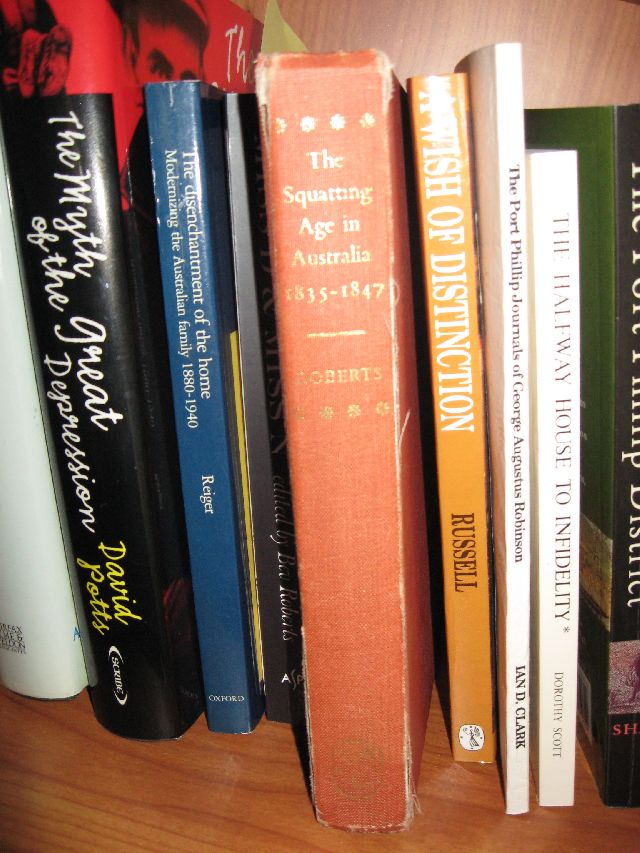
This is Stephen H. Roberts talking about another book entirely, but the same could be said of his own book “The Squatting Age in Australia 1835-1847”.  That’s it up above on the bookshelves- the rather drab burnt-sienna coloured one. It’s been around for decades and decades; it is cited in many other works, but oh- even the title induces in me a rather shrivelling distaste.  I was astounded to find a recent blogpost about the book written in November 2009 by another reader and smiled at the thought of possibly travelling on the same train and our eyes meeting (across the top of our bi-focals, I suspect) over our respective copies of ” The Squatting Age in Australia” (Nah, not likely, as he seems to be based in Armidale, NSW).  Still, a whimsical little thought.

I have to say that I was surprised by what I found inside.  Perhaps the most striking thing is the language: not at all the dry-as-stubble,  stiff and factual voice that I expected but instead a rather “purple” narrative voice written often tongue-in-cheek (or at least, I think it is) and more exclamation-marks than a Facebook page!!! Yes!!! Really!!!

Stephen Henry Roberts– that’s Sir Stephen was  Vice Chancellor of the University of Sydney and Challis Professor of History there.  His Australian Dictionary of Biography entry describes him as “empirical, research oriented, with a concern for international trends and an ability to place Australia in a wider colonial context“.   The empiricism in his work certainly comes through: there’s very detailed maps, budgets and statistics peppered throughout the book.  His first publication was  History of Australian Land Settlement 1788-1920, based on his masters thesis, and after moving to London, he moved to more international studies with publications on French colonial policy, modern British and European history and Far Eastern history before returning to Australian history with The Squatting Age written in 1935. In this book he brings his international approach to bear most powerfully in Chapter 2 ‘The Wool Trade’ which I found to be a fascinating account of how Australian wool production fed into the broader European wool industry that burgeoned and changed after the Napoleonic Wars. He also has a good analysis of the 1840s Depression in New South Wales and its context within the broader international economy.

Born of working-class origins, Roberts did not restrict his intellectual efforts to academe alone.  As a leading interational analyst, he gave public lectures, wrote for the Sydney Morning Herald and broadcast for the ABC.  In 1936 he travelled again to England on study leave, spending three months in Germany where he met with Nazi leaders and attended their rallies.  His next book The House that Hitler Built (1937) exposed the dangers of appeasement, warned of the war intentions of the Nazi regime and condemned the persecution of the Jews.  The book was translated into a dozen languages and reprinted many times.

According to the ADB, the “Sydney school” of historians that coalesced around Roberts was:

proudly a ‘hard school’, not merely because of its declared standards of data, but in its overt hostility to what it conceived as romantic or literary approaches to the past

This description surprised me.  In this book he presents a highly romantic and idealized view of the pastoral industry and the squatting project as a whole, albeit with a rather more grounded view of the boredom and dirt of the shepherd’s lot.  Like other books of its time it is interspersed with stanzas of poetry- a rather quaint stylistic touch to modern eyes.  He places strong emphasis on personality and it is here, in explaining motivations and character,  that perhaps his flights of fancy betray him.  I found the sweeping statements to support his grand rhetorical flourishes even more troubling. There appears to me to be a contradiction in his large claims: he makes much of the “quietude” in politics in the early 1840s and yet spends much time on the Great Crisis between 1841-44, and the “struggle” with Sir George Gipps.  Crisis and quietude seem to be mutually exclusive, to me.

His work has been criticized for textual errors and sloppy proof-reading and these were still evident, even in the second edition which, according to his preface had undertaken “obvious correction of misprints” and “elimination of errors”.   In a chapter in The Discovery of Australian History, edited by Stuart Macintyre and Julian Thomas, Deryck Schreuder (the author of the ADB entry) writes:

[Roberts] wrote voluminously, but also hastily.  At one stage he produced four studies (in five large volumes) in the six years between 1923 and 1928, all based in archival sources, and all covering areas where he had to pioneer a research path.  Not surprisingly, the works show signs of haste: some incorrect footnotes, faulty transcriptions, errors of fact, gaps in the documentary sources, assessments which have not always stood the test of time….Roberts never wilfully manipulated his sources to make an argument, and he did work extraordinarily hard to cover all the primary and secondary sources involved, often indeed finding the major archival source for the first time. …Whether his innovative studies, and the power of some of his studies, outweighs these defects is another matter for consideration: he is not always given the benefit of that balancing perspective. (p. 131)

The book is very much of its time, and it is too easy to deride it for its easy dismissal of aboriginal resistance and environmental heedlessness.  His use of the bland terms “dispersal” and “expansion” obscures a whole other history that took another fifty years to emerge.   That doesn’t make it any less confronting, as Geoff Page’s poem “A Classic Text”, published in Arena Magazine in April-May 1993,  remarks.  I can’t think of a way to quote the poem without producing it in its entirety- and that surely would be a breach of copyright-  so you can see it for yourself at The Great Forgetting: poems . (The link will take you to Google Books- the poem is on p.61-5.)

And yet there is a sense of humour that comes through the book- and that truly IS surprising given the worthy and rather stodgy subject manner.  I’ll leave you with a little observation he makes about the dominance of pastoral demands on Gipps’ administration-, complete with Roberts’ own exclamation mark,  and remember HE said it, not I!!

It was all the song of the sheep- money for the sheep, land for the sheep, labour for the sheep, roads for the sheep, merchants for the sheep, ships for the sheep one long ruminant refrain! (p.96)

References:

S. H. Roberts The Squatting Age in Australia 1835-1847

Deryck Schreuder ‘An Unconventional Founder: Stephen Roberts and the Professionalisation of the Historical Discipline’ in Stuart Macintyre & Julian Thomas (eds.) The Discovery of Australian History (1995)

Deryck Schreuder ‘Roberts, Sir Stephen Henry’ http://adbonline.anu.edu.au/biogs/A160125b.htm

Geoff Page and Pooaraar ‘A Classic Text’  in The Great Forgetting (1995) p. 61


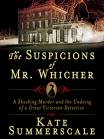
‘The Suspicions of Mr Whicher’ by Kate Summerscale

304 p. 2008

It seems that after reading Curthoy and McGrath’s How to Write Histories that People Want to Read, I have picked up, one after the other, two books that would qualify-  Nicholas Shakespeare’s In Tasmania and now this one,  The Suspicions of Mr Whicher by Kate Summerscale.   This book won the Samuel Johnson Prize for Non-Fiction in 2008, and also bears the designation “New York Times Bestseller” on the front cover.

The book describes the true-life murder of a three year child in 1860, taken from his bed in the nursery outside the bedroom of his parents Samuel and Mary Kent, and found with his neck slashed and body wrapped in a blanket in the outside privy. The family that lived in this three-storey Georgian house was not a happy one.  It was a second marriage for Samuel Kent; the older children of the first marriage had been relegated for the second family; the new Mrs Kent was not all she seemed at first.  Suspicions mounted about the relationship between Mr Kent and the nursemaid who slept in the bed beside the murdered child, the sanity of the daughters of the house, the probity of the servants: the case opened the lid on the fug of family relationships amongst what otherwise appeared to be a respectable, prosperous middle class Victorian family.

The book takes a careful chronological approach with only what I marked as one example of foreshadowing that suggested that the outcome was known to the narrator.  Instead, events and evidence unfold bit by bit, complete with the false-starts and false-leads of any investigation,  and the narrative closely follows the newspaper articles and legal documentation generated by such a notorious case.  I hadn’t heard of the case at all but I assume, given that the murderer ended up depicted in Mdme Tussuad’s waxworks, that the case has more notoriety in England even today.  For someone completely unfamiliar with it, I wasn’t sure right to the end- and even then….?

But this is more than just a country-house murder story: instead it is a closely-grained and grounded study of domestic Victorian life and sexuality, the development of “the detective” as a profession and the relationship between the press and Victorian fiction.  The detective, Mr Whicher, is a lower-class employee in a newly-developing profession, and class sensitivities emerge over what is perceived as  his puerile probing of domestic relationships and middle-class respectability, and the derisive sneering of the popular periodical press.  Summerscale embeds this true-crime story within a broader study of the detective-novel as a literary phenomenon, both at the time in the work of Wilkie Collins and Dickens, and later as a literary genre much loved of BBC Friday night dramas.

The book is carefully footnoted and researched; there are maps and photographs, and an extensive bibliography.   Its chronological structure makes you feel as if it is unfolding before your eyes and it’s quite a page-turner.  And surely that qualifies it as “History That People Want to Read”.

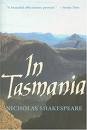
‘In Tasmania’ by Nicholas Shakespeare

2004, 396p.

It was fitting that I should read this book so soon after finishing Ann Curthoy and Ann McGrath’s book “How to Write History that People Want to Read“.  Nicholas Shakespeare certainly can write and his book did quite well as I recall. So, two out of the three.  But I ask myself- is it history?  I suspect not, despite the “History/Travel” designation on the back page- or at least, it’s history in the same way and to the same extent that the television program  “Who Do You Think You Are?” is.

In fact, the “Who Do You Think You Are” television series came to mind several times while reading this book: there’s the quest story for an ancestor; the findings; and some sort of meta-narrative that ties it together.  As with the television show, there’s an emotional and partisan sympathy for characters solely on the basis of their blood-relation to the narrator:  a large and all-encompassing historical tragedy only becomes real once it can be centred on an individual who happens to be related.  And as with the television show,  the voice and perspective of a professional historian who weighs in with an objective, distanced observation rescues you as reader/viewer from the fug and too-close identification with an ancestor.

Shakespeare himself is a recent immigrant to Tasmania, and part of his own sense of belonging in Tasmania is tied up in the identities of two ancestors, from different branches of his family tree, whose destinies- as one might expect in a small island community- run parallel with occasional points of connection.  Anthony Fenn Kemp, the army officer and merchant is a linch-pin figure whose ubiquity enables Shakespeare to bring in Alexander Pearce the cannibal, Tasmanian Tigers and other riffs on Tasmanian history.  The other ancestor, Petre Hordern was a failed alcoholic from a wealthy family, who submerged himself in the bush and dragged his family into poverty.  These two characters form the book-ends of his narrative, and Shakespeare meanders throughout history and his current-day genealogical quest.

Shakespeare speaks to historians, and reads the histories they have written, but he cites only conversations.  His intent springs from the personal, and he excavates the primary material he has unearthed,  literature and other writers, and family lore as his richest lode. His eye is always on the story as story.  Nonetheless, it is beautifully written, human and textured- but it’s not necessarily history.

Richard Holmes, Nerval, madness and a book not written

Have I mentioned to you that I really very much enjoy Richard Holmes’ work? I think I may have, once or twice.

You might be wondering why I am so enamoured of Richard Holmes at the moment.  I have not particularly characterized my own work as biography- in fact I think that I have consciously resisted the idea of writing biography.  Yes, I am looking at my judge, but I’m even more interested in the reaction to him in the societies in which he operated, the hot-buttons he pushed, and what that suggests about that colony.

And yet I find myself identifying with much of what Holmes says about the biographer’s relationship with the subject.  My family rolls its collective eye and  I often laugh at my ability to play Six Degrees of Separation between any possible event or person and Judge Willis.  I read court reports in the newspaper and wonder “What Would Judge Willis Do?”.  I seem to be able to find some connection, however tenuous, between Willis and practically anyone in Port Phillip in the 1840s.  I walk around Melbourne and I try to “see” it with 1840s eyes.

It was rather reassuring to find that Richard Holmes does this too. In talking about his four-year passion in writing about Shelley, he writes:

The pursuit became so intense, so demanding of my own emotions that it continuously threatened to get out of hand.  When I traveled alone I craved after intimacy with my subject, knowing all the time that I must maintain an objective and judicial stance.  I came often to feel excluded, left behind, shut out from the magic circle of his family… I was often in a peculiar state, like a displaced person, which was obviously touched off by some imbalance, or lack of hardened identity, in my own character… Indeed I came to suspect that there is something frequently comic about the trailing figure of the biographer: a sort of tramp permanently knocking at the kitchen window and secretly hoping he might be invited in for supper.  (Footsteps p. 143-4)

He talks about the biographer becoming gradually more confident about his/her subject’s character.  This is something that I’ve only recently been able to say about myself.  Just recently, I mentioned to a fellow-student something that I felt about my judge, just on the gut-feeling that, knowing what I do about him, I think he would act this way.  I was right, and even though I often bemoan that “I just do not get this man”, I think perhaps I do more than I admit.  Holmes writes:

Yet a biographer does become slowly convinced about his subjects’ characters.  After studying them and living with them for several years he finds that they become one of the most important of all human truths; and I think perhaps the most reliable….   [The subject might act ‘out of character’] Yet the biographer views and witnesses these daily human affairs in a special and privileged perspective.  He gains a special kind of intimacy, but quite different from the subjective intimacy that I had first so passionately sought.  He sees no act in isolation; nor does he see it from a single viewpoint.  Even the familiarity of a close friend or spouse of many years suffers from this limitation.  The biographer sees every act as part of a constantly unfolding pattern: he sees the before and the afterwards, both cause and consequence.  Above all he sees repetition and the emergence of significant behaviour over an entire lifetime.  As a result I have convinced of the integrity of  human character. Even a man’s failings, sudden lapses, contradictory reactions, sudden caprices, seem in the long run to fall within a pattern of character.  One could say, paradoxically, that people even act out of character in a certain way: there is always, so to speak, meaning in their madness, provided one has full knowledge of the circumstances.  (Footsteps p. 173,4)

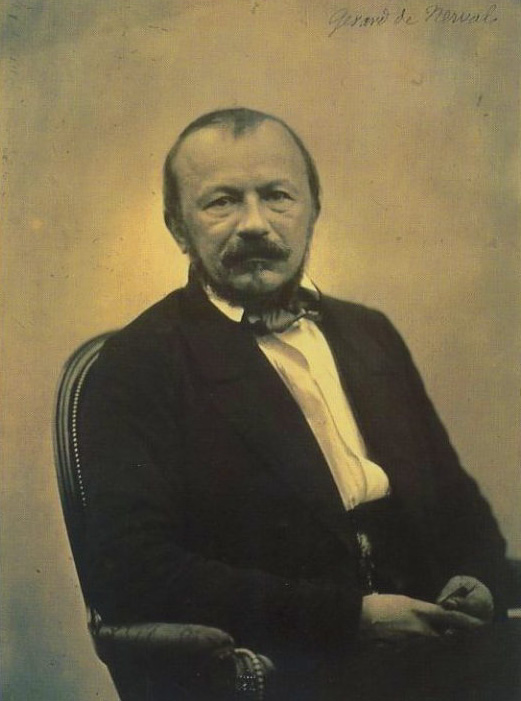
But Gerard de Nerval nearly brought him undone.  In his book Footsteps: Adventures of a Romantic Biographer, he writes of his obsession- and it truly became that- with the writer Gerard de Nerval, a French journalist and writer who was himself floridly insane and ended up committing suicide.

Gerard de Nerval

The biographical problems in writing about Nerval were daunting.  What to even call the man? (given that this was an assumed name).  How much to trust Nerval’s unverifiable telling of own childhood, given that it was written in the grip of madness?  How to write about the madness when it was at the centre of his self?  How to write about a person when Nerval himself often saw himself as two people?

All the logical and traditional structures that I had learned so painstakingly- the chronology, the development of character, the structure of friendships, the sense of trust and the subject’s inner identity- began to twist and dissolve.  It was becoming more and more difficult to tell, or to account for, Nerval’s life in the ordinary narrative, linear way. (p. 249)… As my months went by in Paris, I became more and more convinced that was exactly what could not be done, and that I had reached the limits of the biographical form, as a method of investigation.  Instead, I found myself slipping further and further into a peculiar and perilous identification with my lunatic subject, as if somehow I could diagnose Nerval by becoming him.  As if self-identification- the first crime in biography- had become my last and only resort. (Footsteps p. 264)

Holmes experimented with different techniques.  Could he write a biographical group portrait of the people who surrounded Nerval, using “a central but relatively neutral or unfamiliar figure to tell the story of a famous group of circle”? (p. 208) But the danger is that the “neutral” figure becomes the focus.  Should he abandon any pretence of objective documentation, evidence or chronology and write it as a novel instead? (p.265).  Could he use the Tarot cards that Nerval placed such credence upon as an organizing device for a life that defied chronological and developmental unity? [Personally, I think that this could have worked really well.]

In the end, his major work on Nerval remained unpublished- a book not written, so to say, – or at least, a book not read, although he did contribute an essay to a translation of Nerval’s work in 1985.   Until- voila!- Nerval reappears in  Holmes’ 2000 book Sidetracks: Explorations of a Romantic Biographer,  in the form of a radio documentary called “Inside the Tower” – or as he describes it “a radio drama based on the life of the poet Gerard de Nerval.  All Nerval’s speeches are drawn from his own essays, letters and journals.”  It was broadcast in 1977 by Radio Three, with Timothy West as the voice of Gautier.

Holmes noted:

The discovery of radio, as a vehicle for biographical story-telling, moving effortlessly inside and outside its characters’ minds, shifting with magical ease between different times and locations, was a revelation and an inspiration to me. (Sidetracks, p. 55)

And even moreso now, I would say, with podcasts that can give a program a life beyond its initial airing.  This genre solved so many problems:  he could capture the multiple perspectives of Nerval’s friends by writing commentaries for them as bit-players, so that they contribute to our understanding of Nerval without having to take centre stage themselves.  He could use Nerval’s own words- great screeds of them- to capture Nerval’s own voice, and what an acute and lyrical one it is too!  He starts with the suicide,  in the form of a police report, with eyewitnesses, mortuary assistant, police commissioner; then broadens out to include his friends, his doctors- then finally Nerval himself.  Holmes himself speaks as biographer, but he doesn’t dominate the stage.  Instead, it is Nerval’s voice, unadulterated, honoured.  Brilliant, brilliant stuff.

References:

Richard Holmes Footsteps: Adventures of a Romantic Biographer (1985)

Richard Holmes Sidetracks: Explorations of a Romantic Biographer (2000)

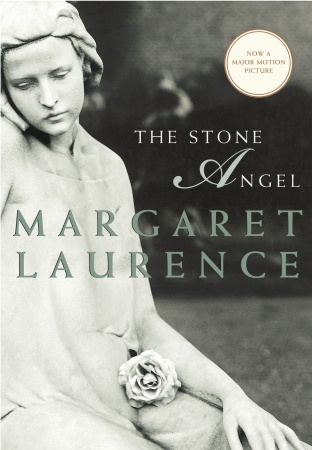
‘The Stone Angel’ by Margaret Laurence

1964, 308p.

[There are plot spoilers here]

I’m not a great epigraph reader, but the epigraph of this book seemed particularly apposite- Do not go gentle into that good night/ Rage, rage against the dying of the light (Dylan Thomas). Hagar, the focal character of this book is raging all the way, just as she has throughout her long life.  The only daughter of a rich merhant, she despised her widowed father’s pride in her achievements and emotional dependence on her, and deliberately  married the sort of man she knew he disapproved of.  The marriage foundered: she was ashamed of her husband’s uncouthness and refused to ever reveal the pleasure that sex with him brought her.   Her eldest son Marvin was invisible to her throughout his life; her favourite son John died in a stupid driving prank.  And yet it is the long-ignored Marvin that she shares her home with, along with his dowdy wife Doris, on whom the care burden falls as Hagar becomes more frail, dependent and confused.   Doris herself is nearly seventy, and Marvin and Doris plan to place her in a nursing home.  Enraged and frightened, Hagar runs away to an old family property in the country where she spends a few cold, thirsty dank nights until found and hospitalized with a diagnosis of cancer and a short time to live.

Laurence has wonderful control of this story.  She handles the time shifts deftly as Hagar slips between reminiscence and present awareness- sometimes even within the same paragraph.  Although Hagar is the point of consciousness in the book, your sympathies for Marvin and Doris are aroused because Hagar surely is a vicious, acidic, scheming, vindictive, selfish and unfair old woman.

There are biblical allusions throughout the text that I chose not to explore, enjoying it sufficiently without feeling the need to contort it into a Christian frame.  In a nice little postmodern touch, as I neared the end of the book I realized that the text turned upside down.  “How prescient! How modern for a book written in the 1960s!” I thought, assuming that it was a commentary on Hagar’s own mental confusion.  But no- the book was just misbound.  Sometimes a cigar is just a cigar…

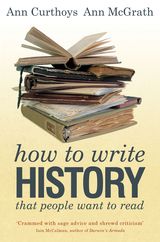
‘How to Write History that People Want to Read’ by Ann Curthoys and Ann McGrath

2009, 238 p.

This book is exactly what the title says it is: a how to book on writing history.  This no-nonsense approach pervades the book- it’s a real [clap] “Come on! Get stuck into it!” sort of book.  It could have, but wisely has not, been called “History Writing for Dummies” because it shares features of those little yellow books- the cheery, confident tone, the jokes that make you groan, the dot points,  the anecdotes and the bubbling optimism that of COURSE you can write history that people want to read!  I must admit that there’s something about all this bustling, practical advice that brings out the long-lost teenager in me.  I want to roll my eyes, toss my head, and mutter “der–” (the ultimate expression of nonchalance and superciliousness in my adolescence- I warned you that it was some time ago).

Except that it is so damned practical and, yes, good advice.  The book is aimed at a wider readership than just  PhD student- it also has family historians and local historians in its sights.  It is very simply written, with short sentences which at times seemed  just a little patronizing.  But of course, this is a book of advice and it does not pretend to be other than this. Clarity and  a certain amount of  firm direction is fundamental to the act of giving advice: I must remember that a bit of humility and preparedness to listen is fundamental to gaining from it.

This book starts from the beginning, right from conceptualizing your history project and your projected audience.  It has good, practical advice about archives  and the how-to of working with sources , then moves on to the writing.  It was at this point that I stopped my eye-rolling and read more carefully because writing, and thinking about narrative and action, character and the emotions  is right where I am at the moment.  And this is probably the real strength of this book; at some stage it is going to connect with you as history-writer at some point in the cycle.  In this regard, you could buy it at the start of your thesis or project, and dip into it usefully for a bit of a kick up the backside or a dust-off after a setback when you need it. The examples they used from a range of histories were well-chosen; you didn’t need to know anything about the content, and the text guided you to look through the content to the technique.  The discussion of footnotes, grammar and punctuation again had me tossing my head with impatience -until I’d come across something that I thought “oh really? Is THAT the difference between a colon and semicolon?” and “You mean that my examiners won’t even READ my quotations?”.  At times I bridled at the decisiveness of their approach but when I came to areas that for me are foggy and ill-defined, the clarity was reassuring.  I suspect that  I am very bad at taking advice.

The trouble with aiming at a broad audience is that sometimes, in order to avoid alienating one audience, the needs of another audience are put onto the backburner.  As a postgraduate student, I yearned for a chapter about analysis.  They do mention analysis, but its difficulty is downplayed by giving it equal billing with themes and chronology as a narrative problem.  I think that analysis is more than this: it goes to the heart of the endeavour; it is what makes history more than just a good story.  It might be stripped out of histories for publication so as to attract a wider audience; it might be over-kill for a local or family history, but for an academic thesis there  is a fundamental assumption that your thesis says something, means something beyond just the narrative at hand.  This is the real work of history,- it’s the part that makes your head hurt- and it’s hard.

I almost didn’t read this book when I first heard about it because I thought that I had read it before. But no- that was an earlier book (2000)  by the same authors that has been recently re-released: Writing Histories: Imagination and Narration.  It  is an edited collection of papers by contributors to a Visiting Scholars Program workshop for fifteen very lucky post-graduates, and is a who’s who of Australian historians who I admire deeply:  Tom Griffiths, Bill Gammage, Donna Merwick, Greg Dening, John Docker, Deborah Bird Rose, Peter Read and of course Ann Curthoys and Ann McGrath themselves.  This book, in many ways, supplied my “missing” chapter, even though I found it rather daunting.  In my reading journal after reading this book I wrote:

I can’t say that I feel empowered- intimidated more like it; overwhelmed by other people’s erudition and breadth, and feeling stodgy and constipated!

It’s a pity that the two books aren’t released by the same publisher, because they would be a wonderful combination within the same volume.  The prose and vision doesn’t exactly soar in “How to Write History” but it is warm, encouraging and empowering.  The virtuosity and incisiveness of the historians talking about their craft in “Writing Histories”  while inspirational, can be almost paralysing.  As an aspiring history writer, I need both.  I need to be beckoned onwards by those up ahead of me;  I need the grip of a confident, more experienced friend at my arm, and  a damned good shove from behind as well!

The morning after the night before: Anniversary Day 1841

So how was your Australia Day?  From the coverage of Melbourne (Port Phillip)’s Australia Day celebrations, it seems to have been a street parade with different multicultural groups represented, citizenship ceremonies, flags at the Australian Open tennis tournament and Lily Allen in a flag dress at the Big Day Out.

From The Australian, 28TH JANUARY 1841

And as for Sydney in 1841?  There was a long report about the yacht regattas on the Harbour, mention of a cricket match and the dinner that followed it where

Turtle, venison and the other good things of this life were in abundance, conjointly with sparkling champagne &c.; and a more loyal set never yet met at the festive board.  The Queen’s health was drunk with enthusiasm, and Australia, the land of their adoption, was honored with reiterated cheers.  These jovial souls kept up the joyous scene to a late hour, and returned to their homes delighted with their evening’s meeting.  May they meet on many such occasions, is our hearty wish.

then the Harmonic Club who presented a prize to the winner of the sixth race.

There’s then a report about the town itself:

…It was expected that the festivities in celebration of the natal day of the colony would have been concluded with a general illumination throughout the town; but, the the great disappointment of the good folk of Sydney, the streets were all in darkness with the exception of the houses of Mr Diod [?] of Pitt Street who displayed in beautifully variegated lamps, a star, with the age of the colony (53) underneath, supported by the letters A. A. on either side; and of Mr Ward of Bridge-street, who exhibited the Scottish Thistle and the letters V. R. which had a beautiful and dazzling effect, and drew a large concourse of admiring spectators.  Both these decorations were executed by Messrs Wood, of King-street, who have long been known to the Australian public as the most celebrated “illuminati” of the age.  Mr Aldis, the tobacconist had a few lamps in his window; and Mr Carrick, the publican of Bridge-street sported a few tallow candles in the same manner, both of these, however, only sufficed to make the “darkness visible”.

I must confess myself mystified by these “illuminations”- perhaps one of my readers might illuminate me!  From the Sydney Gazette of May 27 1841 it seems that gas was not supplied to Sydney until 1841, although as editorials at the time pointed out, this was a mere 25 years after gas lights were introduced for general use in London.

Many reports of celebrations mention “illuminations” but I’m not sure how they worked.  I see advertisements for “illumination lamps” and “transparencies” and on 21 April 1829 T. Wood the Lamp Contractor advertised that “Persons desirous of illuminating on His Majesty’s Birth Night are requested to make an early application to T. Wood, Lamp Contractor, George-Street who will provide Lamps and Devices at moderate charge” .  Inclement weather tended to extinguish the illuminations. The Colonial Times (Hobart)  of 26 Aug 1834 reports on an illumination at Government House that cost three hundred pounds but could not go ahead for two nights because the wind was too strong, and when the lamps were finally lit, the view was obscured by large ugly pine trees.   There is a long description of the Queens Birthday illuminations on 25 May 1839 (i.e. two years before the Anniversary Day illuminations mentioned above and two years before the introduction of gas):

In the evening the customary birth night ball was given at Government House, and, notwithstanding the unpromising state of the atmosphere, it was very numerously attended. The entrance to Government House was brilliantly illuminated, the gate being surmounted with the word ” Victoria,” in very large letters, and the verandah with a large crown and wreath. In various parts of the town the inhabitants displayed their loyalty in the shape of illumination. The following principally attracted our reporter’s attention : -Australian Club House. – The words ” Vivat Regina.” in large letters, surmounted by a large crown, and star with festoons &c. Mr. James Wood, opposite the cattle market, wine merchant, Crown and V. ; Anchor and Hope (Doran) public house, corner of King and Pitt streets, neat variegated star ; Shakespeare Tavern (Rogers) Pitt-street, letters Q. V. with Shakspeare’s head illuminated. Cornwallis Frigate, (Meredith) Pitt street, the letters V. R. surmounted with large crown and star, a truelover’s knot &c. King’s Arms (Stone) Pitt-street,.Star and Garter with letters V.R.,rows of variegated lamps &c. Garriek’s Head (Murray) Pitt-street, letters V. R. surmounted by Crown. Australian Chop House Pitt street, letters V.R.  and Crown, festoons &c &c ; Mr. Dole, Tobacconist, George-street, opposite Police Office, letters V.R.; Mr. Martin, Castlereagh-street, (publican) near Cattle Market, star; Forbes Hotel (Mrs Barnes) King and York-stree, letters V. R. with handsome crown, festoons of variegated lamps, suspended round the windows. William the Fourth (Morris) Pitt street-, illuminated transparency of Queen Victoria. Mr. Denne, Pitt-street, Brunswick Star. M. Gill confectioner V.R.. and Crown Pitt-street. Crooked Billet (Puzey) George and Hunter-streets, V. R. and Crown. Mr. Samuels V. R. and Crown, George-street.

The devices most attractive to the spectators were a very neatly executed transparency of the noted “Jim Crow” exhibited above the door of the Flower Pot, public house, York-street, and a handsome transparency in Pitt-street, in front of the residence of Mr. Gould, painter and glazier, representing Queen Victoria, with a rampant lion, having  the motto Invicta on the one hand, and  the Royal Arms on the other, each occupying a window.-Two fire balloons were sent up in the course of the evening.

Here we see expressions of loyalty amongst the working people of Sydney, in their pubs and businesses- and quite a collection it is- with many V.R.s and crowns, Shakespeare’s head, lovers knots and a “Jim Crow”.

Anyway, enough of the mysterious illuminations- back to Anniversary Day in 1841 from The Australian.

A number of Australians dined together on Tuesday at the St. John’s Tavern, to celebrate the Anniversary of their Native Land.  There were about fifty present; the dinner was sumptuous in the extreme, and after the cloth was removed, several loyal and patriotic toasts were proposed, which were responded to by the warmest enthusiasm.  During the evening some very eloquent speeches were made, which reflected much to the credit upon the heard and head of the speakers, breathing as they did, a true loyal feeling for their Sovereign, and a love for their Father Land.  The harmony of the evening was enlivened by some very pleasing music.  They kept up the festivities of the day until a late hour, and departed with a feeling of mutual reverence to the Parent Country, and love for Australia and her institutions.

I find it interesting that there is a distinction drawn between the “good folk” of Sydney and the “Australians” who no doubt are the native-born.   Australia is their “Father Land”, but Britain is the “Parent Country”.   The term “the anniversary of their Native Land” (meaning of course only fifty-three years!)  grates harshly on our 21st century ears.

References:

The wonderful National Library of Australia Newspapers page of course!

Australia Day editorials

One of the set pieces in the editor’s armoury must be the Australia Day editorial which needs to be dusted off each January and polished around the edges a bit to distinguish it from the editorial the year before, and the year before that.

I was interested to compare the editorials of The Australian newspaper in 1841 and today.  The Australian as we know it today was founded in 1964 and is part of the Murdoch empire.  It’s not a paper that I read regularly, except for the Australian Literary Review which is issued on the first Wednesday of every month, and even there the paper’s centre-right stance seeps through. It shares the name but not the lineage of the Australian newspaper founded by William Charles Wentworth as New South Wales’ first privately-owned newspaper in 1824.  Wentworth’s Australian newspaper in 1841 acted as a mouth-piece for Wentworth’s own politics at the time where he was agitating for representative government and independence from the twin and paradoxical evils of Colonial Office oversight and neglect.  It published its last edition in 1848.

The Australian 2010

So, The Australian’s editorial of 25th January 2010 on the eve of Australia Day-  what did it have to say? Well, there’s plenty to celebrate apparently:

Australia Day marks the real start of the year in this country: once tomorrow’s holiday is out of the way, the nation gets down to the serious business of work and school after the summer break. This year, the celebratory mood is likely to linger longer thanks to the upswing in the economy and a growing confidence in the future after a year of living anxiously in the shadow of a global downturn.  The year begins with real hope that economic stability and strength will nurture the social coherence and health that must be the core goal of any modern society.

The paper notes the financial emphasis of Rudd’s speeches over the last week leading up to Australia Day (productivity, deficits, infrastructure blah, blah, blah) but then warns us:

There’s more to life of course, and the Australia Day celebrations draw attention to the less tangible questions of community, social tolerance, and national identity…But our national holiday becomes an empty affair if we ignore the real challenges facing many of us.

The editorial then goes on to speak about “Twenty-two years ago, at the Bicentennial celebrations on Australia Day” when “the nation was trapped in a painful historical debate that denied the real issues facing indigenous people, particularly those in remote areas.  The often fruitless arguments over whether the country had been invaded or settled 200 years earlier served to polarise rather than educate white and black Australians over their shared history.”

I find it interesting that the touchstone date in this editorial (and in commentary generally)  is now 1988 rather than 1788.  In the last twenty-two years, the editorial says, we have ” come a long way in recognising the rights of indigenous Australians to decent housing, education and jobs” and “there is room for optimism…”.  Twenty-two years ago the population was 16.6 million; now it is 22 million and projected to be 35 million mid-century and The Australian is “excited by the potential for vibrant social and economic growth” although cautioning of the need for clear plans.  “The integration of more ethically diverse Australians must be carefully guarded” and “racism has no role in Australia which, since the abolition of the White Australia Policy in the mid-1970s, has built an enviable reputation as a tolerant and welcoming nation”.

Australia Day- marked by citizenship ceremonies around the nation- is a perfect time to affirm belief in a mature and single society that also accomodates difference.

The paper notes the affection for Prince William at his recent (fleeting) visit and the respect for his grandmother, but asserts that “those feelings would seem to have little or nothing to do with Australians’ support for a republic”.

The Australian 1841

Why 1841? Because Judge Willis was still in Sydney in January 1841, although it was well-known that he had been appointed to Melbourne and his house, horses and phaeton were being advertised in the newspaper.  In a few days, he would make his farewell speech from the bench- in itself a matter for controversy as might be expected.  But given that Anniversary Day celebrations were most conspicuously celebrated in Sydney compared to the other colonies, it seems fitting to look at Judge Willis’ last Anniversary Day in Sydney.

The editorial of 26th January 1841 (published on the actual day) starts off with a blaze of optimism:

On this 26th of January 1841, the Colony of New South Wales commences the fifty-third year of its existence.  What striking and gratifying recollections does the reoccurrence of this, our natal day, recall to our mind? Where, in the whole range of ancient and modern history, can an instance be found of a similarly rapid advance towards wealth, importance, and respectability, under circumstances so singularly discouraging, under the pressure of obstacles of such peculiar magnitude?

The Australian was very much Wentworth’s creation, and the next very lengthy sentence goes on to criticize the Colonial Office, and the influence of the South Australian lobbyists, with their Wakefieldian agricultural-based ideas, who were pushing an alternative to the squatter-based, pastoral future that Wentworth was agitating for:

Labouring under all the odium which has naturally attached itself to a penal colony, systematically disdained and neglected by the Colonial Office, the only quarter to which we have been enabled, and indeed are still able to look for assistance and sympathy, with out financial resources misapplied, our most earnest prayers for free institutions disregarded, autocratically governed at the caprice now of this, now of that minister, with enemies avowed, and enemies concealed, handed over with indifference within the last twelve months to the tender mercies of Colonel Torrens and the Land Board…

This gargantuan sentence continues with a look to the past, going back fifty, even twenty years to the penal origins of New South Wales.  As with the editorial of 2010, there’s an element of bringing observations within the scope of living memory.  The bleak environmental picture painted here sits at odds with the more benign environment portrayed in Grace Karsken’s recent book The Colony, and the reference to Aborigines is very much of its time:

we yet can exhibit, where half a century, nay twenty years since, gangs of lawless convicts laboured upon a limited and uncleared desert, where the hallowed names of religion and justice were unknown, where the wandering savage, lowest in the scale of humanity, and the wretched English criminal, scarce gained a scanty subsistence from an ungrateful soil, where unblest sons poured their angry luster upon the thirsty sand

Now the observant eye of Englishmen beholds:

far-stretching districts, hundreds of miles in extent, covered with flocks and herds, teeming with convertible wealth, the fertile banks of numerous rivers producing abundant supplies of agricultural produce…

and a maritime industry that is “sending home annually in the place of hundreds, no less than eight millions of pounds of wool…verging upon the annual value of a million of money…” and “importing British manufactured produce to the amount of twice this sum.”  It seems a little incongruous to us now to think with pride on the amount we import (as distinct from export), but in 1841 it was a matter of pride that New South Wales was now a sophisticated and modern consumer society, proud of its place within the broader imperial marketplace.

But the life of an upstanding member of society has its responsibilities as well and so,

We trust that our readers will permit us to remind them without offence that the joy and the festivity with which they so pleasingly celebrate this birthday of their country, should be tempered with reflections of a higher and a somewhat more thoughtful nature.  These they are bound to entertain for their own sake, for the sake of those who come after them, for the sake of vindicating for themselves that high and leading position in this hemisphere, which it is in the order of things that they must, and that at no distant day attain. We would urge upon all, whatever may be their condition in life, to give their individual efforts for upholding and still further exalting the standard of integrity and of morals in our social community.

In particular, the Australian deplored “with reluctance and with grief” that “an avowed selfishness, the bane of all young communities, is to a very large and engrossing extent, prevalent throughout this country”. The editorial called upon

everyone who occupies a position which gives him influence over his fellow-colonists, to promote these views fearlessly and cordially, if he has any true or forward-looking desire for the welfare of his native or adopted country.

Note that this was leading by example, and a call to the leaders of society rather than to “the people” as a whole.  The political winds were stirring, but nobody was agitating for democracy as we know it today- and would even less so in coming years with the rise of Chartism and the 1848 revolutions to follow.

…if you do your duty at this now early hour of the political day, when the seed can be sown and the tree of virtue planted, you will indeed be “remembered for good”, for upon a nation such as by your wise efforts may be constituted, one in honour, one in high and unswerving principle, one in their passionate love of liberty, one in their disdain of everything that is mean, and sordid, and cowardly, it is not too much to say, that the feet of tyranny, foreign or domestic, shall NEVER trample.

The Australian was confident that representative democracy- limited though it was- would be just around the corner but we know that the drip-feed of a form of self-government would take over a decade.

The eyes of Britain are more and more intently fixed upon you.  The importance of this Colony is being rapidly appreciated at home.  Representative institutions of on the eve of concession to us.  May we so wisely and temperately use them, as to convince our worst enemies that we are worthy of the boon granted.

And now for the important thing- what’s on? Sydney always put on a bigger bash for Anniversary Day than the other colonies did, so here’s what’s happening:

And now, with reference to the sports of this day- His Excellency will be present at Macquarie Point with a numerous party.  We perceive that many excellent boats, several of them newly built for the occasion, will contend for the prizes.  All the available steamers will ply about the harbour during the day with bands of music, to enliven the scene.  The shipping will hoist their colours and be decorated with all their flags.  In the evening Mr Wyatt will present, at the Theatre, the owner of the successful vessel with a silver cup of the value of thirty pounds; and a numerous party of Australians will dine together at the St John’s Tavern, to celebrate the auspicious occasion.  In fact, nothing will be wanting but the sun to shine brightly to complete the happiness of our towns men.  We hope that no accidents may occur to damp the festivities of the day.

I’ll let you know how the day went off, tomorrow.