Author Archives: residentjudge

‘Wolf Hall’ by Hilary Mantel

2009, 650 p

I have been missing in action from blogging recently.  One reason is that I am actually writing real stuff complete with footnotes and headings as I should, and the other reason is that I’ve been back in King Henry’s London, thoroughly engrossed in Hilary Mantel’s Wolf Hall.  It’s been quite a while since I’ve read a book as insistent and attention-grabbing as this: I genuinely didn’t want to be anywhere else in my head other than Henry’s court.

The book, as probably everyone in the world knows, is about Thomas Cromwell, Henry’s adviser and fixer.  But I must admit, that’s as far as my knowledge went.  I’ve seen the BBC series, I’ve read my Phillipa Gregories (The Other Boleyn Girl), Margaret Georges (The Autobiography of Henry VIII)  Antonia Frasers (The Wives of Henry VIII) and my Alison Weirs (The Six Wives of Henry VIII)- I know all about Henry and Ann- how hard could this be?! I thought.  But as I ventured further in, I started to lose confidence in myself.  After all, I’ve never seen A Man for All Seasons, and I couldn’t really remember Thomas Cromwell in all those biographies and historical fictions I’d read.  And so about 100 pages in, after an abrupt event in Thomas’ life, I decided that perhaps I needed to do a bit of Wikipeding and just get my head around the bare bones of his life.  I had only read a few lines before I realized that I didn’t want to do it this way- I wanted Thomas’ life to unfurl with its uncertainties, ambiguities, shocks and plans, just as it did for him, and just as Hilary Mantel wanted it to for her readers.

The Thomas Cromwell that Hilary Mantel gives us is on one level very recognizable- we grieve with him as he both draws comfort from his memories of loved ones he has lost; we relax with him in the comfort of his home- he is a flesh-out, human being.  But there are  facets of him that we cannot know though- the nonchalance about torture, the cold pragmatism by which people are dispatched; the unquestioned acceptance of Henry’s embodied sovereignty.

Thomas Cromwell was of lowly birth and yet he became the most powerful man in Henry’s court. Mantel gives only hints of how he achieved this, not in the form of a linear narrative, but in the flashbacks and learned knowledge that all of us weave together as experience  as we move through our own life trajectory.  We learn, then, of a violent childhood, an escape to Europe,  working as a mercenary and in the mercantile sphere as well,  violence committed- sprinkled through the novel, hinted here and there.

Mantel herself has described her technique as putting the camera on the shoulder of her main character.  The whole narrative is told from Thomas’ perspective, and she refers to him as “he” throughout.  This was disconcerting at times when there were other “he”s as well, but if you had to re-read once or twice, it was a way of reminding us as readers where we have been placed- behind Cromwell’s eyes, seeing what he sees, processing information through Thomas’ memories and experience.  It is also written entirely in the present tense, which I always find rather uncomfortable and suffocating, but it gives an immediacy to the writing.

This is part of a two-book endeavour, and I’m really looking forward to the second book.  There’s a terrific podcast of a presentation given by Hilary Mantel and Sarah Dunant at Birkbeck institute about history, fiction and historical fiction.  You can listen to or download it here

http://backdoorbroadcasting.net/2009/06/talking-books-novel-history/

It’s obviously a very carefully researched book, and if you listen to the podcast you’ll hear about how she delineates the factual from the fictional.  But as well, she’s working through her own theories about events, agency, personality and historical forces, contingency and deliberation:

The fate of peoples is made like this, two men in small rooms.  Forget the coronations, the conclaves of cardinals, the pomp and processions.  This is how the world changes: a counter pushed across a table, a pen stroke that alters the force of a phrase, a woman’s sigh as she passes and leaves on the air a trail of orange flower or rosewater…

Uplifting Quotes for the Uninspired Historian #1

From J. G. A. Pocock ‘Tangata Whenua and Enlightenment Anthropology’ in The Discovery of Islands: Essays in British History p. 201

…the historian is not concerned to show that belief systems are ridiculous, but to discover why they were not ridiculous once.

Latin

Readers of this blog will know that I am an assiduous reader of death notices.  I must be getting older because I used to read the birth notices too but I rarely do now.  I guess that I’m looking for people that I know (knew).  However, it’s not necessary that I’ve ever met them: I’ve often found myself in tears reading tributes to people who are complete strangers to me.  I used to reassure myself that only old people die because the majority of death notices in The Age (my paper of choice) are for  elderly people, although I must admit that I am disconcerted by the number of deaths occurring among people born around 1945- that’s getting a little too close for comfort. My gut-feeling is that there is a spike around sixty-five year olds then another one around eighty year olds, but I have no evidence for this and can’t be bothered monitoring it enough to prove it.

Anyhoo, there was a death notice in today’s Age (21 April) written entirely in Latin.  I  sat looking at it for some time.  I don’t read Latin but I suppose that a certain generation (probably those born around 1945 or earlier), a certain educational class (i.e. privately-school educated) and certain professions (especially the law) still do.  Generation after generation of Catholic congregations heard, and continue to hear, the Mass in Latin.  Nonetheless,  it still seems an  odd thing to do: to pay to place a public notice that only selected people could read.  Perhaps the quotation had a particular resonance in their relationship? Perhaps it was a form of  in-knowledge amongst a group of peers who share a cultural, religious or professional heritage that includes Latin?

I can only wonder how the poor call-centre operator on the end of the phone coped with it.  I’ve been exposed to more Latin than I’d like over the last few years  because Judge Willis was particularly fond of breaking into Latin in his court-room, and so I have had to resort to good old Google to work out what he was quoting. Don’t you wonder now how we ever got on without the internet?  Sometimes as I’m typing something into Google I wonder where I would have tried to find this information in a pre-Google world.  But I must say that even Google fails me in translating this death notice.  Perhaps it’s not a quote: it might be original.

As I say, Judge Willis was fond of Latin.  His  flights of Latin fancy occurred usually in an address to the jury, or in a speech that he knew would be reported in the newspapers- in fact, he used to pass on his addresses to the newspapers directly so that they would be quoted correctly, including, I assume the Latin.  His lengthy letters to politicians often included a hefty dose as well. As Garryowen (Edmund Finn) tells us in his Chronicles of Early Melbourne:

It was Willis’s custom to open each monthly Criminal Session of the Supreme Court with an address or charge to the jury panel; but, in reality, more of an ultra-official oration to the general public.  These fulminations had, however, the merit of careful preparation, and though more abusive than pungent, were on the whole clever specimens of tolerably readable, though overdone phraseology, highly spiced with well-fitting pedantry.  They were crammed with quotations, ancient and modern, from languages living and dead.  Never did one of them appear without Latin excerpta.  (p. 943)

An article by David Lemmings called ‘Blackstone and Law Reform by Education: Preparation for the Bar and Lawyerly Culture in Eighteenth-Century England’ discusses the use of Latin in the courts.   During the English Civil War the use of Latin was proscribed, but it was reinstated in the Restoration.   Public resentment at the mystification of the law through use of Latin re-emerged, and in 1731 an Act was passed that, from 25 March 1733, all proceedings in English law courts (excluding the Admiralty Court) and in Scottish Exchequer courts would be in English.  A number of clarifying acts permitted the continuation of  Latin in the Exchequer and the retention of technical terms in Latin.  As Lemmings writes:

Although the language of law had been ‘Englished’, it retained its own esoteric style and often archaic vocabulary that continued to bond lawyers together, while bemusing the public. (p. 74)

Nonetheless, Judge Willis was certainly fond of quoting lengthy slabs,  generally for rhetorical effect.  He seems to have done so far more than his brother judges in Sydney did.  Latin was an essential part of a boy’s education, and even in Port Phillip he could be assured that fellow gentlemen, or even aspiring gentlemen, who had been exposed to formal schooling would understand him.  As a shared marker of education and formality, Latin would have been much more common than it is today.  Michael Cannon, for example, notes that after the Separation of what was to become Victoria from New South Wales was announced, an Elizabeth Street wheelwright constructed several “variegated inflatable balloons”, 10 ft in diameter, decorated with the word “Separation” carrying circulars printed in English and Latin to carry the news into the bush (Cannon p. 461.)

But perhaps Willis’ Latin was not all that I suppose it to be.  Garryowen goes on to tell  of Daniel O’Donovan, a young Irishman employed by Judge Willis as a horse-groom who was, perhaps, the best Latin and Greek scholar in the province. In the absence of Willis’ Tipstaff in court on one occasion, O’Donovan was engaged in a casual capacity and rigged up in a “cast-off white choker and swallow-tail” to act as Crier.

…after the disposal of one or two formalities, the Judge began his address.  A quotation cropped up, but of this the Judge did not care, for, as hitherto, he would take it as a hunter does an ordinary jump, in tip-top style.  It was a hackneyed passage from one of the Satires of Horace, and the orator stepped in amongst the hexameters with a graceful lisp, as if assured that what he was saying would be duly appreciated.  In this manner he travelled safely over the fourth line, but in the fifth uttered a slight misquotation, when the new Crier was down upon his great superior, and figuratively shook him as a terrier would a rat.  “I beg your Honor’s pardon” said the irate O’Donovan, “you are murdering my most favourite author, and this I cannot permit to be done by either Judge or Jury.  If your Honor will kindly allow me I shall set you right; if fact, permit it or not I’ll do it.  So now your Honor and gentleman of the Jury, listen to the only true and correct version”. Here followed some dozen lines of Horace, including the corrected reading of where the Judge had floundered.  It is no exaggeration to say that all in Court except the Judge and his “Tip” were convulsed with laughter.  As for Willis, he was flabbergasted at O’Donovan’s gross but unconscious contempt of Court, and at length screamed to the Sheriff to place the transgressing scoundrel under lock and key until he could command time and patience to consider how to best summarily deal with him…Mr Raymond, the Deputy-Sheriff, kept him under durance until the time for adjournment.  He was then told to call next day for the wages due to him…” (p. 944).

I suppose that, as long as you can pronounce it correctly, a sprinkling of Latin confers a solemnity and authority onto one’s pronouncements.  I’d do it myself, if I could.  But I’m afraid that, with my 1960-70s Australian state-school education, all this Latin is Greek to me.

References:

Michael Cannon Old Melbourne Town: Before the Gold Rush, Loch Haven, Main Ridge, 1991.

David Lemmings ‘Blackstone and Law Reform by Education: Preparation for the Bar and Lawyerly Culture in Eighteenth-Century England. Law and History Review, Vol 16, No 2 (Summer 1998) pp. 211-255

Garryowen (Edmund Finn) The Chronicles of Early Melbourne 1835-1851 Melbourne, Fergusson and Mitchell, 1888.

‘Convicts of the Port Phillip District’ by Keith M Clarke

One of Port Phillip’s claims was that, unlike Van Diemen’s Land and New South Wales,  it was not a penal colony.  It was opened up during the 1830s when emigration schemes were hitting their strides and there was much to be gained by distancing Port Phillip  from the degradation and corruption that was perceived to flow from contact with convicts.

But it was not as clear cut as this.  Right from the start, there were convicts in Port Phillip.  The earlier abandoned attempts at settlement at Sorrento and Western Port involved convicts, and had they been more successful, there would have been a permanent convict presence in the area.  As it turned out, Melbourne was established by, or at the behest of,  private pastoral and agricultural interests.  When these pastoralists, their sons and their agents moved in, especially from the Middle District around Sydney, they were able to bring their assigned servants with them.  John Hirst, in his book Convict Society and its Enemies notes the slippage in terminology that avoided the use of the term “convict” and instead used “assigned servant”.  He suggests that all sides were comfortable with this linguistic subterfuge:  emancipists and expirees were keen to expunge the moral connotations of ‘convict’, and for those who availed themselves of labour from the assignment system, the use of the term “servant” framed the contract as the more acceptable master-and-servant relationship that underpinned all labour exchange at the time.

Once they were here as assigned servants, there was no formal supervision at the local level.  In theory, assigned servants could only be transferred between owners with the permission of Governor Gipps, but this does not seem to have been strictly enforced. An advertisement for land of the Plenty River in May 1841 included “five government men” in the purchase, and according to Judge Willis,  at the height of the economic depression in 1842 there were two hundred assigned servants wandering at large because their masters could no longer afford to keep them.

Then there were convicts sent down from Sydney.  Some of these were highly qualified “specials”, who were sent to fulfill particular roles.  For example Phillip Harvey, who had been transported after pleading guilty to a charge of forging and altering two Bills of Exchange, was sent down from Sydney after being instructed by Mr Dunlop the Astronomer on the keeping of meteorological journals.  Another convict worked as a writing clerk at the Police Office and Judge Willis strenuously protested him being left in charge of prisoners on remand because he was  “not fit to have charge of free persons, who coming out to this colony were entitled to all the privileges of British subjects.”   The distinction between government and domestic employment was not clearcut: a letter to the Port Phillip Herald complained that Dr Shaw of Geelong had been using men assigned to the customs service to fetch wood and move furniture.

Then there were the public works gangs sent down to work on roads and other constructions.  They were a highly visible presence, although they do not seem to have worked in irons.  Just as one could imagine today, the “shockjocks” of the press at the time became highly exercised at the sight of convict gangs fiddling around on their spades in fine weather, and when unemployment rose in 1842, it was felt that government work should be provided to emigrants rather than convict work-gangs.

Added to this were convicts who had gained tickets-of-leave (for example, the Port Phillip Herald of 12 April 1842 has an advertisement of a ticket-of-leave belonging to Martin Brennan that had been found), and those whose sentences had expired.  A large number of people coming across from Van Diemens Land fell into this category.

So, we should perhaps raise a sceptical eyebrow at all the “free” rhetoric coming from the Port Phillip boosters.

A book that deals with the convict presence in Port Phillip in more detail is Keith M Clarke’s Convicts of the Port Phillip District.  Self-published in 1999, it is a large, illustrated paperback book of 370 pages, much of which is made up of appendices giving names, shipping details, and sentencing data and comments for the different waves of convict settlement (Sorrento, Western Port, Port Phillip and later the exiles sent between 1844-1849).

It is from this book (p.100)  that we learn that, of the population of 12, 994 in Port Phillip during the 1841 Census, there were 2,762 who had been transported to the colonies- i.e. 21% of the Port Phillip population at the time.   Although the numbers are rubbery, there were 338 holding tickets-of-leave, 185 on Government Service, 637 on private assignment and 1455 “other free” men and 147 “other free” women.  “Other free” was a catch-all category that included emancipists, those free by servitude, and those holding conditional pardons.

We can also see from his compilation of Supreme Court data that many of these assigned servants were under the control of prominent Port Phillip personalities that we have met before: William Verner (Judge Willis’ good friend), Porter, Carrington, Thomas Wills, Dr Thomson, Ebden, Lonsdale,  Peter Snodgrass.  It is significant that Judge Willis himself did not have assigned servants, and in this he was true to his word in 1839:

For my own part, I have ever  considered the provisions of His Majesty’s order in Council, in 1831, for reconstructing the Supreme Courts of Judicature in certain crown colonies, when negro slavery unhappily existed, to be most wise in prohibiting the Judges from being owners of, or in any wise interested in slaves, or their labour. Believing the same principle to be as applicable to the bondsmen of Australia, as to the negroes of Guiana, Trinidad, and St Lucia, I have abstained, and ever will abstain, so long as I remain on this bench, from being the assignee of convict service. I will never permit the possibility of insinuation that my private interest can in anywise interfere with the honest discharge of my judicial duties.  I will always endeavour to keep myself beyond all reach of vulgar suspicion.

A large part of this book involves a retelling of the different settlements in Port Phillip, albeit with particular attention to convicts.  It is a largely narrative approach, and while the bibliography cites the body of academic work on this era, it does not engage with the literature in an academic sense.   It starts with a description of the parish system in England and the changes to Poor Law legislation during the Industrial Revolution.  The second chapter describes changes to the penal code in England during these years and the global nature of transportation to penal settlements worldwide.  The third chapter involves the establishment of the Botany Bay scheme and explorations of the Port Phillip Area.  Chapter 4 involves Sorrento (Sullivans Bay); Chapter 5 Westernport, and in Chapter 6 the coming of sealers, the Hentys, Batman and Fawkner.  Chapter 7 describes the appointment of William Lonsdale and the convict workforce under his supervision.  Chapter 8 covers the La Trobe years, including the pressure to accept exiles under the revamped transportation-that-dare-not-speak-its-name system.

The heart of the book is the 200 pages of appendices with names and details.  These are set out in spreadsheet format and give you the little jolt of recognition that these are real individuals, who each have their own life story.  In this regard, the book would be a useful addition to a family history resource centre, where family historians would no doubt fill in the gaps between the statistics.

References

Keith M Clarke Convicts of the Port Phillip District, Waramanga, KM & G Clarke, 1999.

J. B. Hirst Convict Society and its enemies


‘Revolutionary Road’ by Richard Yates

1961, 337 p

I haven’t seen the film of Revolutionary Road, and indeed had not even heard of the book or the writer until I heard a Radio National Book show program before its release.  But when I saw it in the catalogue for my face-to-face bookgroup (as distinct from my online bookgroup/s) I chose it as my selection for the year.  Ah- the responsibility!  Our discussions generally start “Who chose THIS book?” which is rather intimidating,  before one of us  sheepishly admits  “Umm…I did”.

Well, I did choose this book, and I’d glad I did.  It’s written with that bragging American smart-aleccy tone that unsuccessfully disguises a deep insecurity.  It reminded me of Carson McCullers’ Member of the Wedding, F. Scott Fitzgerald’s Great Gatsby and Salinger’s The Catcher in the Rye– all American books, all quite short, all edgy and anxious books.   Common to these books is the disjunction between dream and reality; a dissonance that is tossed off with a insouciance that is pathetic and heartbreaking.

The book is set in 1950’s suburban Connecticut and it is shot through with anxiety about exposure and failure.  Frank and April Wheeler are a young couple, with two young children, who pride themselves on being superior to the suburban lifestyle that they find themselves in. Their neighbours may be petty, suburban and blinkered, but Frank and April see themselves as quite unlike them.  In their own minds, they are just passing through and going through the motions before breaking out into the lives that they really want to live.  There’s lots of alcohol and drunken conversations, railing against modern life and conformity, but there is a basic, underlying dishonesty about their mundane backgrounds and the banality of their day to day life.  The book is unflinching in its gaze: you feel discomfited for them; you experience that hot prickle of embarrassment that you feel when you can see when someone you love is trying desperately, and failing, to maintain their dignity.

It’s a beautifully written book.  Yates writes in long sentences but never loses control of them. They flow, almost conversationally, and he interweaves effortlessly what is said with what is thought, but not said.   There is much of this double-vision throughout the book-  people plan conversations  but do not voice them;  Frank and April are self-consciously aware of the image that they are projecting, and  every one of the characters has ulterior motives that are poorly disguised.

The 1950s are far away enough now to feel as if, indeed, it is  a foreign country where things are done differently.  The book feels like a retro time-piece, with martinis before dinner and patios, green lawns and Home Beautiful houses.  But it was written in the early 60s, almost about events and people who were contemporary at the time,  and you can sense the waters shifting; you can feel Bob Dylan and Betty Friedan and 1968 forming under the surface.  It’s edgy and painful and well worth reading.

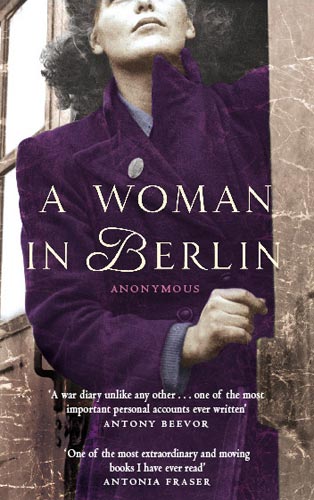
‘A Woman in Berlin’ by Anonymous

2002 (originally 1954), 311 p

What is it they say about scams- that’s if it’s too good to be true, then it probably is?  That’s the way that I felt when I first starting reading this diary that starts on 20 April 1945 as Berlin falls. The diary ends, rather inconclusively some eight weeks later in 22 June 1945.  Obviously I wasn’t alone in my scepticism, borne just as much of admiration for the anonymous author and her writing, as the feeling that it was almost too good, too observational, too aware as a historical source.  The historian Antony Beevor, felt the same way too:

It was perhaps inevitable that doubts would be raised about this book, especially after the scandal over the fake Hitler Diaries.  And the great bestseller of the 1950s, ‘Last Letters from Stalingrad’ was found to be fictitious over forty years after its first appearance.  On reading  the earlier edition of this diary for the first time in 1999, I instinctively compared my reactions to the Stalingrad letters, which I had read five years before.  I had become uneasy about the supposed Stalingrad letters quite quickly.  They were too good to be true…As soon as I was able to compare the published collection with genuine last letters from Stalingrad in the German and Russian archives, I was certain they were false.  Yet any suspicions I felt obliged to raise about ‘A Woman in Berlin’ were soon discarded.  The truth lay in the mass of closely observed detail.  The then anonymous diarist possessed an eye which was so consistent and original that even the most imaginative novelist would never have been able to reproduce her vision of events.  Just as importantly, other accounts, both written and oral, which I accumulated during my own research into the events in Berlin, certainly seemed to indicate that there were no false notes.  Of course, it is possible that some rewriting took place after the event, but that is true of almost every published diary.  (p. 5)

And this is what I needed to hear: a reputable, informed historian making the call about the authenticity of what I was reading.  The diary certainly is well written.   Some of the entries are unrolled out over the length of a day, written a couple of hours apart; others are written a day or two later.  The diary opens as Berlin experiences the first bombings, like the roll of distant thunder that draws closer.  Women and children mainly cower in basements, hearing the explosions coming closer and aware of the rumours of the mass rapes that would sweep along with defeat.   The tension is like the rumble of bombs: insistent, breath-holding fear.

When it comes, as you know it must, she says little. For me, this was one of the hallmarks of authenticity- that she distanced herself from the physicality of it, except for one (of several) Russian soldier who slowly, deliberately, opened her mouth and spat into it.  The universality of the raping is horrific: “how many times?” is a commonplace, matter-of-fact question as friends and acquaintances meet again on the other side of the nightmare.

The author is an educated woman, a journalist who has travelled widely, and she speaks Russian.  She consciously decides that she will use her Russian to gain the protection of an educated, high-ranking officer and what follows is a strained, strange, conflicted relationship, compromised to its core by issues of power and consent (or the lack thereof).

As the Russians sweep through and life starts to take on a different normality, German men start reappearing from their hiding places  and their own relationships with their women are distorted through shame, impotence and disgust.  The women themselves speak about the rapes, even indulge in a form of gallows humour about it, as a way of mental survival.  The men are appalled by this response.  Along with the re-establishment of the water supply, the intermittent running of public transport, the issuing of inadequate food rations and the first shoots of entrepreneurism, much of the camaraderie and communalism of the women starts to break down.

We do not know what happens next- the anonymous author is obviously about to move onto a new phase because old relationships have been severed in this strange new world, and choices need to be made.  And that, for me, pointed to its authenticity as well:  a grinding, hard reality and ‘normalcy’ creeps over the last part of the book; there is no great climax and no resolution either.

I see that they have made a film of this book but I hadn’t heard of it. In fact, I hadn’t heard of the book at all until I read Kimbofo’s review of it.   Part of me wanted to look away out of discomfort and shame; the other part of me wanted to keep reading out of curiosity and admiration.  It’s very good.

Banyule Festival- wait there’s more!

After a Saturday night awash with nostalgia at Twilight Sounds at Sills Bend, I frocked up on Sunday for the annual Heidelberg Historical Society bus tour.  You’re likely to find me down at our museum one Sunday a month with my secretary’s hat on.

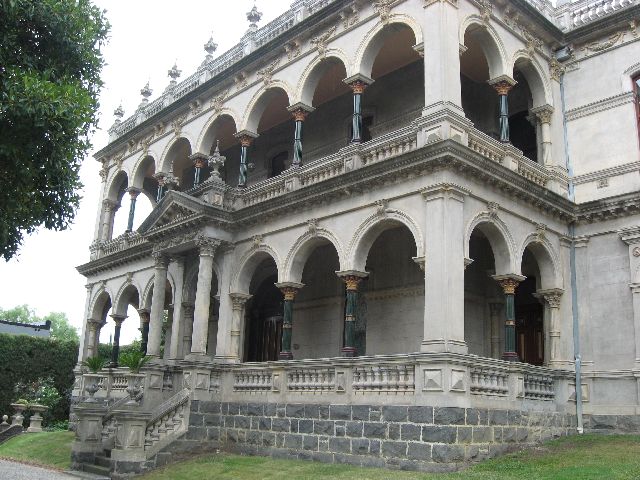
So onto the bus we hopped and off we headed to Ravenswood in East Ivanhoe.  The house was commenced in 1891,  at the commencement of the depression and was one of the last boom-style mansions built before everything went pear-shaped.

It is a house built for display.  It would have been prominent as  visitors headed towards Ivanhoe from the city and can still be seen easily from the railway line should you happen to look to the east and up the hill as you’re rattling along.  The exterior of the house was built with this prospect in mind, as it is at its most ornate on the south-west side, but rather plain on the other sides (perhaps hoping for future extensions?).  The house itself,  is not extensive- it has four main rooms and a hallway on the ground floor, with bedrooms upstairs, and utility rooms at the back.  A very large ballroom was added in 1895, so obviously the depression did not affect the owner, the financier Robert Kennedy, too much.

We weren’t able to take photographs inside the house, but the emphasis on display carried through internally as well.  Because the house had been used as a number of years as a nursing home, most of the original features were lost, but they were able to establish that paintwork was used ‘creatively’ throughout- lots of marbled paint, fake timberwood and trompe-l’oeil. It had been beautifully renovated- the paintwork was truly beautiful, the carpets thick- and the gardens carefully tended.

Then onto the bus again and up to the Ivanhoe RSL which is located in a home originally known as Clarivue (sometimes spelled Clairvue).

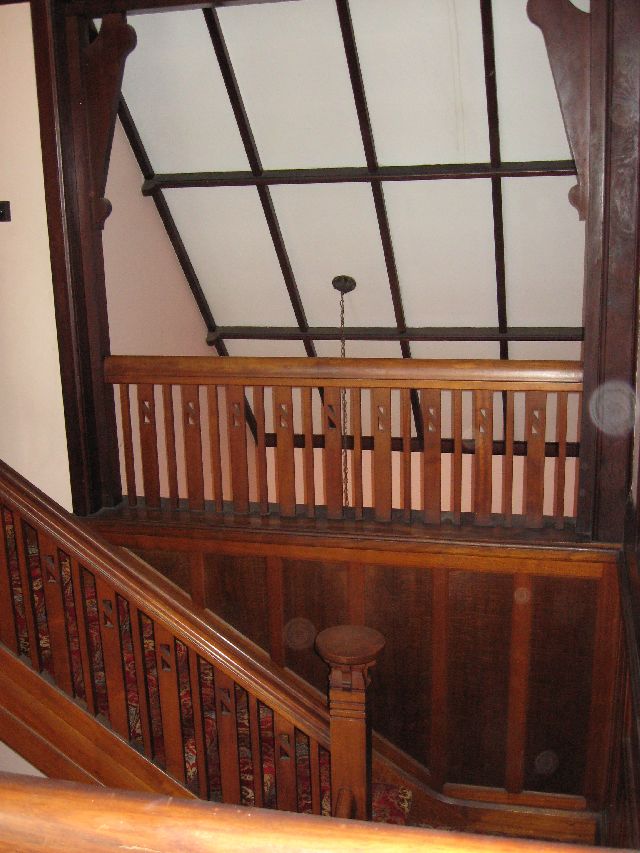
The house was commenced in 1913 and was designed for a timber merchant.  As you might expect, this one has real timber throughout, compared with the timber in Ravenswood.

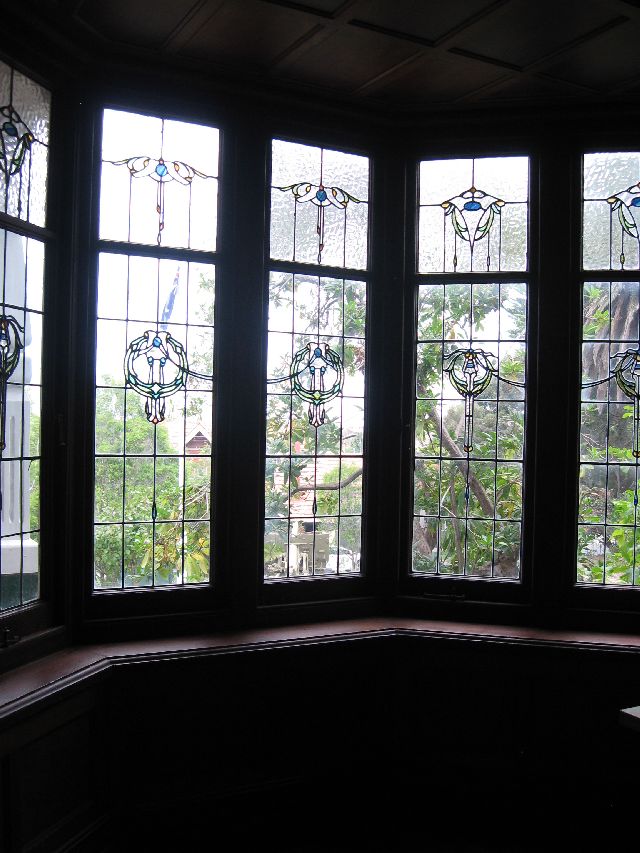
It’s being used as the RSL, so it lacks the loving attention that Ravenswood has been lavished with in recent years.  Nonetheless, the windows and woodwork are largely intact.

Ah…. but money, money, money.  The Ivanhoe RSL does not have pokie machines- what a Faustian pact that is.  You can see other RSLs gleaming away with their rendered paintwork, downlights and chrome fittings, purchased with tears and recriminations.  Ironically, this house is probably better preserved because it lacks the money to tart it up for short-term gain.

And so onto the bus, back to the Old England Hotel (fondly known as the OE) for afternoon tea and our bus tour was over for another year.  And with my Secretary’s hat on, thanks to Miles Real Estate and the Old England Hotel, the Ivanhoe RSL and the owners of Ravenswood as well!

And forty years later…

Last night was Twilight Sounds at Sills Bends.  This is an annual event, held at my favourite place in the world- well, Melbourne anyway- Sills Bend by the Yarra in Heidelberg.  I’ve written about Sills Bend before. The Yarra Flats were my childhood playground; now as an adult I just love the deep shade of the oak trees, the old fruit trees and the sense of connection with an older Heidelberg.

Last night felt particularly nostalgic as Cotton, Keays and Morris were performing.  I spent probably two years of my life between 14 and 16 desperately in love with Jim Keays and the Masters Apprentices.

Their album was the first full-priced album I’d bought- my pocket money only stretched to K-Tel albums with lurid limegreen and orange psychedelic covers- and every afternoon on the way home from school I wondered if there would be a newsletter from ‘Denise and Di and Mrs G” from the Masters Apprentices Fan Club (it was, let us say, a sporadic publication).  They had played at the Scots Church Hall in Burgundy Street for my high school social when I was Form 2 at Banyule High School.

I know that ‘real’ historians are not supposed to admit to such sop, but I’ve always been attracted to time-travel stories.  I wish that I could come up behind that fourteen year old girl, screaming and sobbing at Jim Keays’ feet as, wreathed in streamers and poured into black leather pants, he endured  what was probably another dreary school gig. They sang their new song, 5.10 man and I bought the single the next week.

I wish that I could tell that 14 year old girl that forty years later, she’d be watching this same man.  She would still be the same person deep down, but she’d end up doing many of the things she wanted to do. She’d live a suburb or two away; she’d have a career; she’d have children (who would not deign to accompany her to Sills Bend to indulge such nostalgia).  She mightn’t know it at the time, but she’d find other people who liked the things she did. She’d do well at school and go to university- yep, she’d STILL be at university forty years later!! She’d fall in love properly and people would fall in love with her.  Forty years on, she’d say that she has a very good life.

And he, too, would live a life that he probably couldn’t have foreseen on that stage in 1969 and I wonder if he’d say that he has a very good life too. I hope that he would.

Anyway a good night, a good gig.  And the excitement goes on today too…..

‘The Bee Hut’ by Dorothy Porter

2009, 139 p.

I wasn’t going to write this post. I was going to write about my own experience of poetry as a reader, the frustrations of reading a collection of poetry in an online environment etc. etc. But I’ve just been crying as I turn the page on the last poem in The Bee Hut, the collection of Dorothy Porter’s poetry that was completed just before she died in December 2008.  I feel so very sad at the thought that this is, literally, the last poem. I’ve been thinking, too, of my friend Dot Mac (everyone knew her that way)- another Dot, my Dot-  who also died of breast cancer a few years ago, at much the same age.  I still can’t quite believe that my life goes on, day after day, and yet she is not here.

While I was reading this book, I found myself wondering about the interweaving of the poet’s life and her poetry. It seemed to me that the whole book was pervaded by a clearness of vision- a close, intense, way of looking- that had been sharpened by her cancer and confrontation with death. In the final poems there is a closing around and a drawing inwards that I think even someone unaware of Dorothy Porter’s own biography would detect.

The book itself is divided into sections, almost like the acts of a play. In this way, it has its own narrative thread, as a collection.  There are travel poems- dust-laden poems about Egypt, cold green poems about London; there are theatrical poems written as lyrics for stage performance.  There’s a section of poems about illness, reflecting the first bout of cancer years earlier, then there are the final, quiet poems at the end. There’s a sense of movement through the poems as a whole, rather than just one self-contained poem after another.

I read this book as part of an online book group that I’m in that focuses on Australian literature-http://groups.yahoo.com/group/AustralianLiterature if you’re interested in joining us. We read and discuss (rather desultorily I must admit) one book a month. This was the first poetry book we have read, and I found it hard to actually comment on it during the process of reading, beyond saying “I liked this bit….” and quoting particular phrases and stanzas.  But there’s an artificiality about reading a book over a month like this, and I don’t think it serves poetry well.   I think that poetry has to be purchased, rather than borrowed; I think that you need to have it at hand for dipping into, rather than reading straight from cover to cover.  I think it needs to be read out loud, rather than read through. It stands on its own two feet: anything that I could add is superfluous.

I really didn’t think that I’d be in tears at the end of it.  The opening poem has been well chosen: the first words you encounter are:

The most powerful presence/is absence.

And what a powerful presence this is.

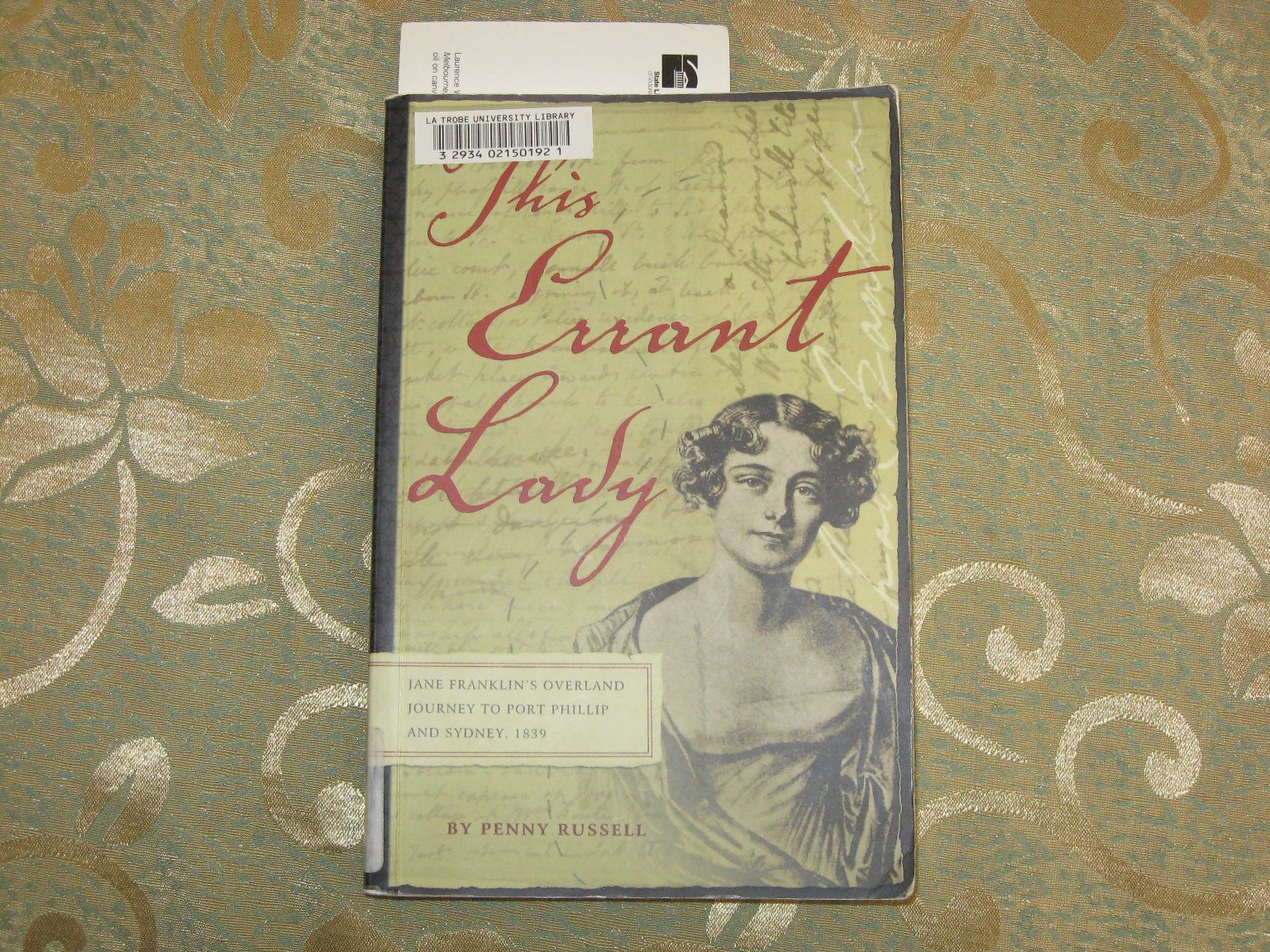
‘This Errant Lady’ by Penny Russell

2002, 207p.& notes

Now here’s a way to decide which book to read next-  what goes well with your decor?  It gave me great pleasure to see Penny Russell’s This Errant Lady lying on my bed, matching so well with my doona cover!  Martha Stewart, eat your heart out!

I was drawn to read this after finishing Ken McGoogan’s Lady Franklin’s Revenge recently.  I’d forgotten that Jane Franklin visited Port Phillip and Sydney in 1839 and I was interested to see what she said about Port Phillip in particular, even though Judge Willis, the Resident Judge of Port Phillip had not arrived at this stage.  I’ve been writing a chapter the last few weeks on Judge Willis’ involvement in colonial politics, which has taken me back to his relationships with Sydney colonists, and as a member of the government elite (albeit of a neighbouring colony), Jane Franklin was well-placed to comment on political events and personalities in Sydney.

Having now read her journal of her overland trip to Port Phillip and Sydney in 1839, I can now see why Ken McGoogan wrote the biography he did, quite apart from any other propensities that a writer on arctic exploration might have.  Jane Franklin’s journals are travel diaries in the true sense of the word- lots of information about routes taken, facts gleaned, people met etc. but not much about her own inner world.  I share the frustration of Penny Russell the editor in her preface:

In recording this epic adventure, Jane Franklin treated her diary essentially as a notebook, producing a compendium of often unrelated scraps of information.  This was in keeping with her general habit in travel writing.  Despite her enthusiasm for knowledge, Jane Franklin rarely ventured to express her opinions, speculations, or interpretations in writing.  The judgments offered in this, as in all her diaries, are generally borrowed from guidebooks, histories or local inhabitants.  Whether she agreed with them or not, she did not see her diary as a space for formulating her own opinions.  She confined her attention to the external, the observable- to what could be ‘fixed’ on the page (p. 16). … Her opinions, her thoughts, her own personality must be deduced as much from what is unwritten as from what is written- her character sketched in the space left vacant in her accounts. (p. 17)

This utilitarian approach can be partly explained by the fiction by which her trip was justified, both to her husband and to Tasmanians generally- that it was a research trip into a sister-colony that would be of use to her husband Sir John Franklin, Governor of Van Diemen’s Land, and would be a form of diplomatic representation of VDL at a governor-to-governor level.  The reality was that she was restless and curious and liked nothing better than getting away from her husband and the scrutiny of a small colonial society.  Mind you, she liked her comforts too- the iron bedstead came on this trip, just as it did on all her journeys.  But she revels in ‘roughing it’ and escaping amongst people who were only vaguely aware of who she was, and you sense the increasing tightening of protocol and deference as she moves from the outlying areas into the more settled districts surrounding Sydney.

The editor, Penny Russell, has excluded much of  the weight of detail that shackled Ken McGoogan’s biography, but she has tried to keep enough in

to preserve the rich texture of Jane Franklin’s portrayal of a colony arrested at a particular moment of development: a moment of optimism for the future, in a society still built on convict labour and pastoral expansion, in which progress rested upon the sufferings of the chain gangs and the brutually dispossessed Aborigines…But the catastrophic pastoral depression that would destroy the hopes of so many in the early 1840s had not yet made its mark, and the grandeur of half built churches and suburban villas, the growing concern over education, and the diversity of experiments in agriculture and industry all suggest an overall confidence. (p. 16-7)

Russell  has also worked hard, though, to preserve the human aspects of Jane Franklin’s interactions with the people she met.  Her trip was a long one- from April to July 1839- and she was quite devious in her excuses to cut it short as Sir John wished her to do.  But she probably should have come home earlier: it was quite clear by July that she had outstayed her welcome with the Gipps’, and it is her discomfort at this knowledge that makes her more likeable.  We have the intimacy of her coming into Mrs Gipps’ bedroom for a chat, thinking that she was alone, and finding Governor Gipps stretched out on the bed; we have the cringing, walking-on-eggshells  embarrassment when Gipps was furious that she had allowed his carriage to become soaked while she was using it.

For me- and I admit that this is probably an acquired taste- I enjoyed finding characters from “my” Port Phillip and Sydney strolling onto the stage.  So we meet Mr Verner (who was to become Judge Willis’ good friend and neighbour) bowling along in his carriage with two friends;  there’s a ship with Protector Robinson’s Van Diemen’s Land aborigines on board (some of whom were to be sentenced to death by Judge Willis two years later);  Captain Lonsdale (who was to become one of Judge Willis’ targets) taking them to a corroboree but arriving late so that it was all over by the time they arrived; there’s Chief Justice Dowling and his wife, and Justice Alfred Stephen (Judge Willis’ brother judges with whom he was anything but ‘brotherly’).  In fact- and this is important for my purposes- conspicuously absent is Judge Willis and his good lady from the balls and levees and receptions that were laid out for Lady Jane Franklin.

And so, eventually Jane headed for home. What a trip that was!  As with all journeys, once you’ve decided that yes, you’re ready to go home, it seemed to take an age.  But in this case it did-  five weeks from leaving the heads to their arrival back in Hobart (a trip that can take about 3-4 days for the Sydney to Hobart yacht race today).  Buffeted by storms, and with food and water supplies running low, their ship bobbed around; once almost glimpsing the coast of Tasmania before being swept out into the seas again over towards New Zealand.   Relieved, no doubt to be back, you still sense Hobart society swallowing her up again, with criticisms of her recklessness in even embarking on the trip and sniffy comments about petticoat government.

Penny Russell has intervened quite a bit in this book.  She has, by her own admission

emphasised particular stories, bringing into bolder relief images that are blurred, tangled or broken in Jane Franklin’s original. (p.17)

From the original transcript, retrieved and recorded by Roger Millis (who wrote the huge tome on Waterloo Creek), she has favoured people over trees or buildings, but not reproduced “the exhaustive and inexhaustible coverage of the original”, she has omitted hearsay information, and trimmed wordiness and detail “to give them greater narrative cohesion and more dramatic immediacy.”  She has supplemented the text with lengthy footnotes, giving a biographical sketch of the people Franklin mentions in passing, and interspersed Jane Franklin’s own text with clearly marked corroborating information from letters and other people’s diaries.  The book is given a clearer structure by its division into chronological chapters, many of which are prefaced by an italicized introduction.  You are aware, and Russell makes no secret of the fact, that you are reading a mediated text.   Which is probably a good thing: as the back cover blurb notes:

An intrepid traveller, Jane Franklin was consumed by an unquenchable curiosity. She looked, questioned, listened and wrote- pages and pages of minuscule notes on every topic that came to hand.  This edition, carefully abridged and introduced by Penny Russell, makes the diary available for the first time to general readers.

And while it’s probably not exactly a ripping yarn,  we general readers (and more specialized ones too)  should be glad that she has.