Author Archives: residentjudge

‘New Voices’ at Eltham

On Saturday I went up to the “New Voices” Writers’ Festival up at St Margaret’s Church in Eltham.  Apparently it’s been running for a number of years but to be honest, I hadn’t heard of it before- or perhaps I just didn’t notice.

I was attracted by the first two sessions in particular that focused on the memoir as a genre: Rodney Hall- twice Miles Franklin winner- speaking about his memoir Popeye never told you, followed by cultural historian David Walker conversing with the biographer and historian Jim Davidson about Walker’s own memoir/reflection Not Dark Yet: A Personal History.

Although distrustful of autobiography as a genre, Hall was spurred to write Popeye never told you mainly for his siblings.  The book covers his childhood in wartime Britain from the ages of 5 to 9, and he intentionally adopted the voice of a child with short sentences, and a child’s eye perspective of size, relationships and causality.  Hence, he chose episodes  for their impact on him rather than their historic or narrative significance, and drawing on the rather linear and black-and white reasoning of a child, he limited his conjunctions to words like “and” “but” “so” etc. It’s a brave, and perhaps rather contrived narrative stroke, and one that could fail disastrously.  However, this review suggests that Hall succeeded well.

The second speaker of the day, David Walker, also moved out of his accustomed genre in writing Not Dark Yet: a Personal History.

After a long career in academe, Walker’s eyesight deteriorated suddenly in 2004 as a result of macular degeneration.  With the term “A personal history” as the rider to his title, this book is not just a memoir (or perhaps an ‘auto-ethnography’ as Walker himself has described it) but also a reflection on family history, history more generally,  memory and storytelling.    When he was  (rather chummily) discussing the book with fellow-historian Jim Davidson, it brought to my mind Inga Clendinnen’s Tiger’s Eye, one of the most personally influential books I have ever read.  In fact, it’s not going too far to say that you would not be reading this blog, at least in the guise it is,  had I not read Tiger’s Eye. Historians, I think, approach memoir and autobiography with a particular wariness and cannot completely divorce their professional academic skills from the shaping of their own life-story, so I’m interested to read this book. Certainly Tom Griffiths’ review (another historian I deeply admire) suggests that it will be well worthwhile.

I’m not really a writers’ festival sort of person, which may surprise you, given that I love reading so much.  I do, however, enjoy hearing non-fiction writers talking about grappling with a body of evidence in some form (lived experience, research, primary sources) and shaping it into an argument and narrative.  There’s an independence of the material beyond the author, and a  responsibility on the author’s part for some degree of fidelity.

However,   I’m less drawn to hearing fiction writers speak about their craft.   For me, it’s a bit like reading an artist’s or art critic’s statements about a work in a gallery: a self-consciousness and layering of meaning that seems sometimes contrived and retrospective.  Listening to fiction authors talking about their work- a creation of their own making-  is a discussion that really requires you to have read the book in question, in a way that is not necessarily true for a non-fiction book, and so after a rather good lunch, I left early in the afternoon.

As well as drawing on sponsorship from publishers  and the local council, the day was conducted under the auspices of the Eltham Bookshop. I was saddened to read in the local paper that after 14 years this bookshop, like so many others, is really struggling.  Its proprietor, Meera Govil, is a generous contributor to the cultural and literary life of Eltham and surrounding districts, and the leafy north would be the poorer for her shop’s demise.  I shift a little uncomfortably in my chair as I write this: I rarely purchase books but instead borrow them from libraries or buy them second hand.  I’ve bought from Amazon and Book Depository, and I am drawn by 10% loyalty schemes for the few books that I do buy.  Although I’m still chafing at the e-reader experience, I know that I’ll succumb increasingly if the digital versions are priced attractively enough.  At one stage I promised myself that I would buy one book a month, but that resolution has gone out the window.  I look in despair at the deluge of new books that keep on tumbling into the market, and I am saddened to hear of such small print runs and the out-of-print status of so many precious works. Perhaps print-on-demand might be one form of salvation, but it’s  such a bland and stripped down product in its present form.  It’s all beyond me.
How many historians does it take to write a history book?

I see here that fifty historians  assembled at the recent AHA conference in Launceston to commence work on the new Cambridge History of Australia, scheduled for publication in 2013.  Fifty historians??!!!  Ye Gods!

Who are they, I wonder?  Will they divide into teams for specific chapters or sections? Are there lead writers with the rest as advisors?  Will they write collaboratively? Fifty!

Seeing my city with new eyes

One of the things about being away for any considerable length of time is the way that you view your own home once you return.  I came home to a house that was cleaner than I left it (ah, the joy of adult children!) and a recently-planted garden that is not only still alive but growing like topsy! But today was the first time that I’ve been into Melbourne itself, and I felt as if I were seeing it after a long absence.

It’s a beautiful clear, sunny but cold winter day today, and the city absolutely sparkled.  I don’t know if I just fluked it, but the trains both to and from the city were clean, warm and with little graffiti.  I had been opposed to the proposal to remove seats from the trains to provide more standing room, but having now used public transport in Toronto, Boston, New York and London, the carriages did seem particularly cluttered with seats.  There was little rubbish on the stations- in fact, our streets generally seem clean in comparison with streets in the cities above.   The underground stations in particular seemed light and modern. The trains were on time, the trams were predictable only in their unpredictability.

It’s the infrequency of our public transport that’s the sticking point.  Other cities do not have the same emphasis on time- in fact, you were often hardpressed to find a clock- because trains arrived so often that it didn’t really matter if you missed this one, because the next would soon arrive.  Not so for us here in Melbourne- 20 minutes is too long between day time services.  It seems that every tram and bus stop has a disconsolate little clutch of would-be passengers, stepping out onto the street, craning to see if something -anything- is coming.

And Melbourne itself: look- the Darebin and Merri creeks are running high! That sparse and artificial planting on the banks of the Merri, beside the over-engineered bike path, is looking a little better.  People have moved into the high-rise opposite Heidelberg station (although I’m still cross that it dominates the hill as much as it does).

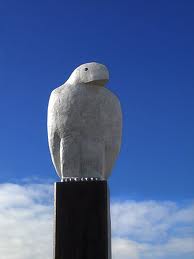
I read in this morning’s paper that they’re thinking of moving the statue of  Bunjil the eagle in order to, no doubt, build yet another high-rise in Docklands. Other than Colonial/Telstra/Etihad stadium (which I always make a point of calling ‘Docklands Stadium’ on principle) I’ve only been down to Docklands once, and it seemed a particularly godforsaken place.

I noticed, too, that the building on the old CUB site is finally going up as well. This is the one that is planned to have an image of William Barak on it.

Artists impression of the finished building

I really don’t know quite what to think of these modern representations of aboriginal presence.  Appropriation? Acknowledgment? Tacky? Reverential? Is the CUB building a fitting juxtaposition to the Shrine of Remembrance at the other end of Swanston St/St. Kilda Rd?  Or an ironic one?

Most of all today, I noticed our beautiful, big bowl of sky.  Yes, I know that it’s the same sky,but somehow it seems bigger here. I think that I must be glad to be home.

‘Teaching Scholarship’ by Caroline Walker Bynum

The Facebook page of the Australian Historical Association had a link recently to ‘Art of History’, a column in the American Historical Association’s Perspectives on History publication.  The column contains essays by established American historians writing on the art and craft of historical writing.  Such copious advice is probably best taken in small doses, so I’ve been enjoying reading slowly, one article at a time.  The first link is to an article from 2009 called ‘Teaching Scholarship’, and a thought-provoking little article it is, not just for a clapped-out and inactive educational designer (as I am) but for historians more generally.

Caroline Walker Bynum, a professor of European medieval history,  starts by pondering what ‘scholarship’ is and comes up with a checklist for what it means for a historian in particular,:

Hard work in archives and libraries without taking shortcuts through the research of others; integrity of citation from primary sources and secondary authorities; thorough grounding in earlier work (and not just that of the 1990s or later); situating of specific conclusions in complex historical contexts; genuine discoveries and original questions, not just a rehash of current theories; and always, always the struggle to ensure that the issues raised are appropriate to the material at hand, that it is not pulled out of shape by contemporary concerns or anxieties…

These values, she suggests, are not part of the baggage that the young undergraduate, or even graduate, brings to history.  The American education system (and I suspect that much of this is true of the Australian system as well) encourages students to “do research” by cutting and pasting primary sources, predominantly from the internet.  By pushing students to move beyond this approach, she claims that college instructors have (albeit unintentionally) encouraged what she calls

a sort of hypercriticality that may undercut—even while it in some ways enhances—what they need in order to be scholars. We have taught them to be critical of where they find material; we have taught them to expect bias and to study authors for it; we have taught them to ask questions of their material, not just “accumulate facts.” All to the good. But in the process we have perhaps led them to think that when they have “critiqued” someone else’s position, they have found one of their own; that the work of the historian is to find the flaws in how others put things; that the task is finished when they have contextualized—as part of a “school” or a “trend,” a political commitment or an “identity position”—someone else’s conclusions. And such contextualizing or “critiquing” often means demolishing. We reward the cheekily worded rejoinder, the clever diagnosis of bias in their supposed elders and betters. It is hard to teach any other way when one needs to engender skepticism about the vast wash of material available out there in cyberspace.

But, she argues, beyond these so-called “critical skills”, there are those values of scholarship that she started her article with, and they often run counter to the quick demolition-job of hypercriticality

We value patience and the ability to postpone gratification until we get something right. We value the silences in our sources more than the speed with which we obtain results; and we are willing to slow down, to read again, to listen to what is not being said, in order that we may spot unlikely possibilities. We assume we are in continuity with the work of other scholars and that the best work is not necessarily the most recent. An archivist in France in 1900, for example, or an archaeologist in Mongolia in the 1950s may have gone further than a recent theorist who knows the basic material less well. We understand that the purpose of a footnote is not so much to disagree with someone else’s argument or call attention to our own interdisciplinary reading as to express gratitude to those earlier scholars without whose work we could not make progress ourselves.

She talks about techniques she uses to encourage this mind-set in her students. One involves getting students to review a review as a genre, to appreciate its demands and to break the reliance on oneupmanship and paraphrase.  A second activity involves getting students to critique a lengthy footnote by following up every source that it references, and to assess- positively or negatively- the relevance and strength that such sources bestow on the argument.   It is only at this point, after students have been alerted to the demands of reviewing and imbued (hopefully) with some sense of  humility, that she asks them to write a book review.

All of this touches on some of the insecurities I feel myself in writing reviews on this blog.  I sometimes come into contact with the authors of books that I’ve reviewed, and while I expect that they’re largely oblivious to the fact that I’ve written about them, I wonder if I’d be quite as confident making my comments to their face.  Sometimes I wonder at my own presumption in commenting on someone else’s achievement in something that I could only dream of: at other times, I wonder at my own presumption in even thinking that what I’m doing even matters at all!

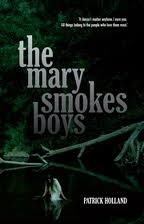
‘The Mary Smokes Boys’ by Patrick Holland

2010, 239 p.

Rather odd name- The Mary Smokes Boys– until I realized that ‘Mary Smokes’ is the name of a country town in Queensland in which the book is set.  The author of this book, Patrick Holland, hails from Roma, inland of Brisbane in Queensland, and in writing this book, he combines his childhood hometown with that of Esk,  the fictional home of the comediennes The Kransky Sisters. In my head when reading this book, I thought of the cold nights of  Toowoomba and those small country towns with their single main street, dogleg railway line and strung-out fibro cottages that you pass on the Melbourne-Queensland run, where you think “But what on earth do people DO here?”

This book falls well within the Australian rural gothic genre- think Chris Womersley’s Bereft, Sonya Hartnett’s Surrender, Gregory Day’s The Patron Saint of Eels, Elizabeth Jolley’s The Well, Craig Silvey’s Jasper Jones  and Rosalie Ham’s The Dressmaker.  It has often been pointed out that the late 19th century literature that so much fed into our image of ourselves as Australians – the Henry Lawsons and Banjo Patersons- was often grounded in a rural setting, despite the fact that Australians then were heavily urbanized.  It’s still true- overwhelmingly Australians live in urban areas, and yet much of our literature is based on small-town life that somehow we feel as if we know, even if it’s just from the window of a car, driving through.

The sense of place and the slow, almost aimless pace of life in a small country town are captured well in this book.  It is in three parts, and it tells the story of Grey and his sister Irene who grow up in Mary Smokes with a shiftless and pathetic father after their mother dies in childbirth.  They are poor, limited, and largely defeated right from the start.  Their mother is a gaping absence in all their lives, and Grey and Irene’s brother/sister relationship develops over time from resentment, solicitude, dependence to eventually something that verges on the edge of  an unhealthy physicality.  The Mary Smokes Boys are the group of marginal, bored, similarly unmotivated boys who grow up in Mary Smokes, who drink too much and dabble in dodgy petty crime and work in dead-end and casual agricultural labouring jobs.  As might be expected in a Queensland town, there’s an aboriginal presence  with wary and unarticulate relationships between white and ‘half-caste’ boys who are connected by the intimacy of time and shared childhood experience.

The tone of the book is laconic- so much so that when big plot shifts occur, they are told in that same, slow, understated narrative voice.  Although events were foreshadowed for some time, as a reader I found myself having to re-read to make sure that something so big had actually happened. It was a pity, too, that big events were often marred by rather clichéd writing, right at the climax, with tears ‘burst[ing] from his eyes’, knives being driven into hearts, and clunky dialogue.

The real strength of the writing comes in the descriptions of landscape, weather and the slow pace of country life. For instance, there’s a description of an all-night shift in a country petrol station that unspools slowly, dreamlike, as travelers emerge out of the darkness of the highway and are swallowed up by it again.  As you read it, you know that at times you’ve been one of the customers passing through the fibro petrol station with its dried-out food and dog-eared magazines that Holland has described so well.

I read this book on my e-reader. It was reasonably priced for an e-book ($9.95), which is about the price that I think an ebook should be, instead of $20.00 which is the price they are asking for some other e-books.  However, I’m still not sure that I don’t read differently, and with less satisfaction, on the e-reader.  I wonder if somehow my sense of the pacing of a book is influenced by one page looking very much like the one that preceded it. I sense a lack of progress through the book, and I think that it’s because you can’t see the pages that you’ve read becoming thicker on the left hand side as you progress through the book.  It’s possible that my judgments about books read in this mode are negatively skewed as a result.

My rating: 7.5/10

Reason read: Australian Literature online bookgroup (even though I finished it long after everyone else)

‘The Bostonians’ by Henry James

504 p.  1886

When in Boston, read The Bostonians, I thought- especially as I already had it on my e-reader and didn’t want to buy paper-based books while I was away. As it happened, it was much longer than I anticipated, and I was still going on it in New York (and even London!) but that suited me fine as it had quite a long section on New York as well.  His descriptions of Boston, Harvard University and New York were evocative, and enhanced my enjoyment of my sightseeing.

So as location-literature, it worked quite well but I’m not so sure that it worked so well as a novel for me.  The plotline revolves around Basil Ransom, a young Southern gentleman, who falls in love with a young feminist orator Verena Tarrant who becomes increasingly under the influence of his cousin, an older, more ardent feminist, Olive Chancellor.  Who and what is the beautiful Verena going to choose: the high moral fervour of the feminist cause, or the romance of the attractive, masculine Basil?  The final third or so of the book teeters on this decision, and a long drawn-out decision it is too.

There is a snideness to James’ approach to Olive Chancellor, who is, it must be admitted a rather unattractive character, and to feminism in general.  I didn’t ever get a particularly good grasp on the politics that Verena espoused, or Verena herself for that matter, beyond an image of her as a golden creature who somehow mesmerized audiences with her oratory.  The relationship between Verena and the older Olive hints at lesbianism, although this probably could not have been explicated further at the time.  The shadowy feminism that bound the women together is presented as little better than charlatanism or some kind of semi-religious mass delusion.

It is a long book, and it felt even longer when I was reading it on in snatches, and on an e-reader with only a vague sense of how much further there was to go: an aspect of e-reading that I don’t particularly enjoy.  I found myself just wishing she’d make up her mind already, and then felt rather annoyed with her final decision anyway.

My rating: 7/10

Reason read: Because I was there!

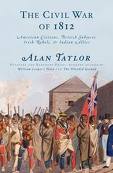
‘The Civil War of 1812’ by Alan Taylor

640 p. 2010

It’s taken me a while to post this review.  I’d borrowed the book while in Melbourne, hoping to finish it before heading over to Canada, where I would hear the author speaking at the Canadian Historical Association conference.  I wasn’t able to finish it in time and, lured by the cheapness of books overseas,   ended up buying my own copy.  It was too heavy to cart around, so after completing it, I sent it home surface mail.  It hasn’t ‘surfaced’ so far, though.

Living on the other side of the globe, I hadn’t realized the challenge to both Canadian and American histories in the title.  But I had taken this book with me into our communal kitchen, where two American fellow-travellers were making breakfast.  “The Civil War of 1812?” he read from the spine of the book, “But the Civil War was in the 1860s”.  Americans tend to ignore the War of 1812 completely (even though they commemorate it every time they sing the Star Spangled Banner), while Canadians tend to see it in terms of a British/American conflict rather than a civil war amongst erstwhile compatriots.

But I think that Alan Taylor , an American historian, has chosen the title of this book very deliberately.  The full title  is “The Civil War of 1812: American Citizens, British Subjects, Irish Rebels and Indian Allies” , a title so long that it almost obviates the necessity of reading the book.  It is a title that sums up his argument very neatly: that the War of 1812 arose from fundamental disagreements about the world view of kindred people- beween Federalists and Republicans in America; between different definitions of “loyalty” in the states that were to become Canada; amongst Irish immigrants, and between the Aboriginal tribes who aligned themselves on either the Republican or British sides.  It was just as much a civil war as the conflagration some 50 years later.

In many ways, this book is a sequel to his earlier book The Divided Ground, and it shares many of the features of that book.  Chapters are headed with single words e.g. ‘Blood’, ‘Crossings’, ‘Scalps’.  As with his earlier book, his focus is on people, flawed as we all are by incomplete and uncertain views of the future, and acting for the best as they saw it, on the  knowledge they had at the time.  There are more players in this drama than in his earlier book, however, and when I heard him speak at the conference, he mentioned his fear that there were perhaps rather too many.  He was right to be concerned: he skates that thin line  but manages not to cross it.  He is helped in this, as he was in his earlier book, by a well-constructed index.

The book is constructed chronologically, but it is not at all a string of battles, written in that laudatory and sychophantic style that many military histories adopt.  Like John Keegan before him, he focusses on the felt physical experience of battle, embodied in pain, blood, smells and fear.  He also highlights the contingency and uncertainty of a civil war, in particular, where ‘loyalty’ can be so easily framed as ‘partisan’ activity with such brutal vindictiveness afterwards.

His focus in almost entirely on the war on the northern border, with only fleeting attention given to the battle of New Orleans and the burning of the White House- the aspects of the 1812 war that, to the extent that Americans remember it at all, are central to the American narrative.  He points out that the American victory at New Orleans was not a turning point at all, but that the the negotiations for ending the war had been set in train prior to this.

Next year will be the bicentenary of the war, and I’m sure that this book has been published with an eye to this market.  It should do well, especially with the paperback version due out later in the year.  It is immensely readable, even for a southern-hemisphere reader with limited knowledge. It mounts a challenge to the American hubris that discounts the war of 1812 as just a skirmish and the accompanying narrative that presents the Revolution as an all-powerful and irresistible phenomenon from the start.  In Taylor’s hands, the contingency and unpredictability is returned to the past- something that we do well to recognize.

You can hear a podcast interview between the author and Lewis Lapham here.

Rating: 9/10

Reason read: Because there was a roundtable with the author at the Canadian Historical Association conference, and because it predates my work on Upper Canada in the 1820s.

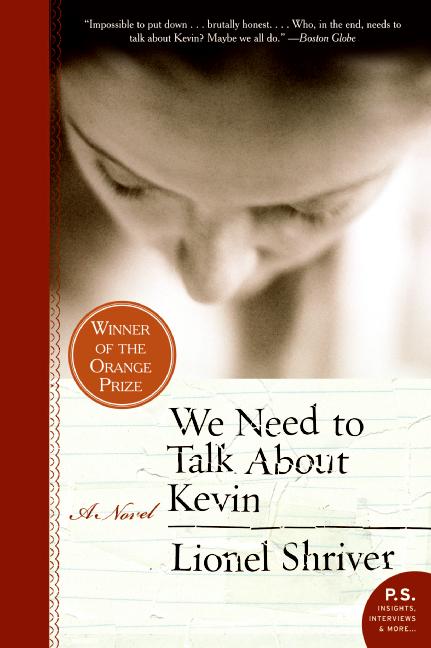
‘We Need to Talk about Kevin’ by Lionel Shriver

2003, 400 p.

I was surprised to note that this book was written in 2003. I felt that it was much more recent than that, and I see that it is about to be released as a movie later this year.  It was my selection for my face-to-face bookgroup, and I was rather dismayed that we did it while I was overseas, thus missing our meeting.  It was the first book that I have purchased for my e-reader, as distinct from the freebies that either came with the reader or that I have downloaded from Internet Archive.  It was rather distressing then, to find that it disappeared from my reader when I had to recharge its batteries through the computer.  I’m not really sure how to get it back: I had downloaded the original on my computer at home, and there was a message about not being able to download it in Canada- obviously ‘they’ had detected that I was in Canada now.  Most curious.  I was about 300 pages, and really wanted to finish it, so I ended up buying a hard copy as well.  So I guess that you could say that this first foray into purchasing an e-book was not an unqualified success.

The fact that I wanted so much to finish it says much about the book.  For about the first 100 pages I was really annoyed by the volubility of this narrator- did she have to go on and on about everything?  Surely Franklin, her estranged husband, would never read these lengthy, detailed letters!

The letters are arranged chronologically, and speak to Franklin as “you”.  They are a form of confession and catharsis as she re-lives her relationship with her son Kevin.  From the outset, she was ambivalent about Kevin: she was undecided about a pregnancy because of her success with her travel-guide company ‘On a Wing and a Prayer’, and she resented her husband Franklin’s overwheleming solicitude for the baby.  Both these tendencies intensified as Kevin grew from baby, to boy, to adolescent: Franklin could see only good in his son, Eva could see only manipulation and malevolence.

I’m not sure at what point my frustration at Eva the narrator dissipated.  It was probably as Kevin became more and more chillingly evil. The small details of his malevolence  were, in many ways, the most disturbing.  We are told in the first pages that Kevin will end up perpetrating an atrocity at his school, and the book slowly, but inexorably, moves towards that point.

I’m sure that the ladies-who-say-ooh in my bookgroup would have discussed motherhood and our ambivalences about our children, and the contribution (if any) of the family’s dynamics to Kevin’s personality.  I’m sure they would have discussed the nature of evil, and whether it is ever inherent, and how the trajectory of Kevin’s crime unfolded.  I wish I’d been there for the discussion.

My rating: 9/10

Reason read: My face to face bookgroup.

Judge-chasing

Entries might be a little light-on here for a while.  We’re over in Canada for the next month, then the UK after that.  If you’d like to follow my travel blog for a while, you’ll find it at

http://janineandsteve.wordpress.com

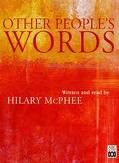
‘Other people’s words’ by Hilary McPhee

2001, 312 p.

Most people writing an autobiography (or even more risibly, having it ghost-written) announce that it is ‘in their own words’.  The title of this book is a little disingenuous.  The book certainly is in the words of the author, Hilary McPhee, but it is the story of her time dealing with other people’s writing as editor and proprietor of McPhee/Gribble books- a small, relatively short-lived, but influential publishing house in Australia.

As you might expect from someone immersed in other people’s words, the book is very well written.  It is divided into two parts.  Part I is largely biographical, pulling on a few family history strings, and contextualizing McPhee’s life as an Australian, swept up in the political and social changes of the Whitlam era and afterwards.  It establishes her as an intelligent, middle-class, educated young woman who seemed to fall into the publishing industry almost inadvertently, although her love for reading was a constant throughout her life.

Part II commences many years later as she settles down in the Melbourne University archives, reopening the files of the defunct McPhee/Gribble company which had been donated to the university.  As she does so, the emotions evoked by memories sweep over her- elation, bitterness, cold disappointment.  The company was started by two Australian women, in a male-dominated industry still hidebound by the copyright and marketing constraints of the colonial publishing market.  And for a golden moment, it worked. They were young, they had children, it was exciting and new and different.  Somehow, in a less performance-driven time, they managed to combine what sounds like a creche with the sensitivities of working with authorly egos and wading into an international industry where Australia was only a minor player.  It ended in tears, of course and quite literally, as most people reading this book would probably know.

In this regard, I find myself wondering whether the first part of the book was even necessary.  Apparently McPhee herself found the arc and voice for Part I only after writing Part II, and while it helped to contextualize the story of the company and its main actors, I would have been quite happy just to have had Part II.

This is a real reader’s book.  McPhee/Gribble developed an enviable list of writers- Helen Garner, Tim Winton, Murray Bail spring immediately to mind- but there are other writers here too that, after reading this book several years ago, I rushed out to read (e.g. Glen Tomasetti’s Thoroughly Decent People). Or at least, I bought their books to add to the to-be-read pile (e.g. Rod Jones’ Julia Paradise, and Gerald Murnane).  She occasionally gives the opening paragraphs of the most famous of the books they published and the words hit you with a rush of familiarity and affection, as if they are old friends from way back that you  weren’t expecting to see.  I haven’t read all the books she mentioned by a long shot, but I’d heard of most of them, and while the book could descend into name-dropping in less skilled hands, I certainly didn’t feel that way.  I found myself scouring my bookshelf, and pouncing on the McPhee/Gribbles I found there – “aha! there’s one”- and perusing the little logos on the spine in a way that I hadn’t before.

The book ends wistfully and rather pessimistically as the book industry becomes more depersonalized and more market-driven. I hadn’t realized the consequences of industry policies before globalisation- I was aware of the difficulties of Australian authors getting published, but less aware that the British dominance of our industry meant that American titles were rarely released here.  And since globalisation, she describes a scenario (that one suspects in drawn from real life, unfortunately) of a young writer’s first book being rushed through into a marketing schedule before it was ready and sinking silently as the next product was pushed through.  I suspect that things have not improved, ten years later.

Look- she has a blog where you can read a chapter of the book, a transcript of a 2006 interview and there’s a 2010 interview on Radio National’s bookshow.

My rating: 8.5/10

Reason read: Face-to-face bookgroup (the ladies who say oooh, except that they don’t anymore.)