Author Archives: residentjudge

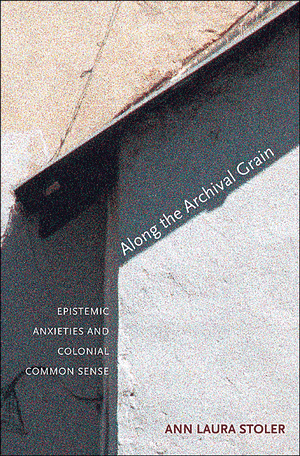
‘Along the Archival Grain’ by Ann Laura Stoler

Ann Laura Stoler Along the Archival Grain: Epistemic Anxieties and Colonial Common Sense, Princeton & Oxford, Princeton University Press, 2009, 278 p & notes.

It was only when I googled the title of this book that I realized that I’d been thinking of it under the wrong name: it was not, as I thought “against” the archival grain, but “along” the archival grain.  It’s an important difference, as the author points out.  While previous historians concentrated on compiling records from the archives in an accessible form- and this is particularly true of 19th century Australian historians like Frederick Watson and the Historical Records of Australia- now we are exhorted to read against the archive and to resist its hard-won accessibility.  But Stoler writes:

Some would argue that the grand narratives of colonialism have been amply and excessively told.  On this argument, students of colonialism often turn quickly and confidently to read “against the grain” of colonial conventions.  One fundamental premise of this book is a commitment to a less assured and perhaps more humble stance- to explore the grain with care and read along it first. (p. 50) …Reading along the archival grain draws our sensibilities to the archive’s granular rather than seamless texture, to the rough surface that mottles its hue and shapes its form.  Working along the grain is not to follow  a frictionless course but to enter a field of force and will to power, to attend to both the sound and sense therein and their rival and reciprocal energies.  It calls on us to understand how unintelligibilities are sustained and why empires remain so uneasily invested in them. (p. 53)

When I first returned to postgrad study in history after an absence of some thirty years, I was perplexed by other students’ references to “the archive”.  Where was “THE archive”, I wondered?  Was it some huge Borgesian labyrinth that had somehow escaped my notice, like Platform 9 3/4 in Harry Potter?  I’ve since realized that “the archive” is not so much a place, as a mental construct of the primary material that we draw on as historians.  Approaching “the archive-as-subject” worthy of scrutiny in its own right, rather than “the archive-as-source” that needs to be mined and extracted, reflects the “archival turn” captured  by Derrida’s book Archive Fever.  The link with Derrida and cultural theory might suggest to you that, in many ways, the writing in this book is rather dense and self-conscious, and it certainly is.  But it is also very careful, poetic writing.  The author weighs her words carefully, reveling in alliteration and paradox, and I found that I had to slow down and subvocalize while I was reading  to let the pleasure of the language wash over me.

The title hints at the theoretical emphasis of the book, but it makes no mention at all of the Dutch East Indies context in which it is applied.  I think that’s probably intentional.  Stoler has been writing about the Dutch Indies for decades- the earliest of her works that she cites was written in 1985- but this is a book borne of long years of immersion in a historical context and it moves far beyond that region.  It is a tribute to the accessibility of the book that I could read and enjoy it with minimal knowledge of the Dutch Indies, and come away feeling that I had learned a great deal (although I really would have appreciated a good map!)

The book itself is divided into three parts.  She starts with a two-chapter reflection on the archive itself and methodological and epistemological responses to it.  Part I which follows is headed “Colonial Archives and Their Affective States” where she examines three small, or even non-existent events in Dutch colonial historiography.  The first was a protest meeting held in 1848 against an edict that the upper echelons of the civil service would be restricted to young men who had been educated in the Netherlands; the second was a series of blueprints of state fantasies for solving the ‘problem’ of the Inlandesche Kindern, a shifting category that included Indies-born Europeans, and mixed bloods; and the third examined two commissions that were held into poverty amongst poor Europeans in the Dutch Indies.  Part II entitled “Watermarks in Colonial History” focusses on Frans Carl Valck, a lowly ranked assistent-resident whose unwelcome report on the murder of a plantation-owner’s family led to his hasty removal to another colony and eventual dismissal and subsequent complete disappearance from the official record. In this section she juxtaposes and interrogates two different archives- the official and the family- against each other.

Interestingly, she suggests in the prologue that

some readers may want to turn directly to these last two chapters that trace the biographies of empire, and may find it more compelling to read them first. (p. 51)

Ah- there’s a problem: when the author herself is not secure in the structure that she has,like all authors, eventually have to settle for.  Which to go for? Compelling reading or the structure that won out? I stayed with the chapters as laid down, but I wonder if it would have been a different book if I had read the last chapters first.  As it was, each chapter was quite self-contained, but it’s an interesting question.

I very much enjoyed this book.  It is a dense read, and at times I found the references to Derrida, Foucault, Rorty etc. rather overwhelming.  Check out the Amazon look-inside feature first, and you’ll quickly sense whether it’s a book that will appeal to you or appall you.  But it came at the right time for me, and it has stretched my thinking about my own work and even spurred me to WRITE a paragraph or two!
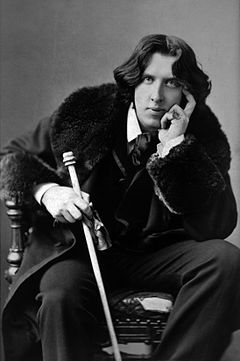

Six degrees of separation between Judge Willis and….Oscar Wilde

Can I link Judge Willis and Oscar Wilde in fewer than six steps?  Easy.

1. Oscar Wilde’s very good lifelong friend was Robbie Ross.

2. Robbie Ross’ full name was Robert Baldwin Ross. He was named for his maternal grandfather, Robert Baldwin.

3. Robert Baldwin was a lawyer and parliamentarian in Upper Canada and aan ally and friend of….

4.  Judge Willis, Puisne Judge of the King’s Bench, Upper Canada!

Frocking up for the theatre

For a little treat the other night (well…a rather expensive treat actually) it was off to see the MTC production of The Importance of Being Earnest.  To get ourselves in the mood we watched Wilde starring Stephen Fry the night before, and sitting in the Sumner Theatre on Tuesday night, I was very much aware that we were laughing away at the same lines, probably delivered in much the same way to the audience at its opening night on St Valentine’s Day 1895.  It was a very traditional performance- no postmodern trickery or contemporary insertions here- and I felt rather overawed to be three rows away from one of the world’s greatest actors, Geoffrey Rush, right here in our shared home town.

What a striking, imperious and handsome Lady Bracknell he makes! (even though I don’t particularly think of Geoffrey Rush as handsome.)  He clearly relished rolling around in  the language, and being so close, we could see every raised eyebrow and every moue.  The rest of the cast was very good too, although if I had to name any criticism it would be at the slightly over-rehearsed delivery of Algernon’s lines. I recall Fry’s character in Wilde issuing the injunction that the lines should be delivered as sparkling, off-the-cuff repartee, rather than something that had been memorized and enunciated, and I think that the same observation could be made here too.

Two odd things about our night at the theatre though.  One was the sight of a very pushy woman, approaching everybody in the front row, asking them if instead of enduring their front row seat, they would be willing to swap with her seat at the back (“See, where the man is waving?”). When someone asked her if there was a particular reason, she said that she liked to be able to see their faces close up- well, don’t we all?  What amazed me was that someone actually did swap with her.

The second odd thing was an email we received a couple of days prior to the performance.  We have just endured a couple of hot days, and the email cautioned that the stage was heavily airconditioned for the comfort of the actors on stage in heavy costumes, and that as we were sitting in the front rows, we might want to bring a jacket or shawl.  It was good advice- it did get chilly after a while.

Patrons might have appreciated advice about their big night out at at Melbourne’s first theatre during the 1840s too.  The Pavilion, later renamed the Theatre Royal, was located on the east side of Bourke Street, between Elizabeth and Collins Street.  Garryowen describes it as:

one of the queerest fabrics imaginable.  Whenever the wind was high it would rock like an old collier at sea, and it was difficult  to account for it not heeling over in a gale.  The public entrance from Bourke Street was up half-a-dozen creaking steps; and the further ascent to the “dress circle” and a circular row of small pens known as upper boxes or gallery, was by a ladder-like staircase of a very unstable description. Internally it was lighted by tin sconces, nailed at intervals to the boarding filled with guttering candles, flickering with a dim and sickly glare. A swing lamp and wax tapers were afterwards substituted, and the immunity of the place from fire is a marvel.  It was never thoroughly water-proof, and, after it was opened for public purposes, in wet weather the audience would be treated to a shower bath. Umbrellas were not then the common personal accompaniment they are now in Melbourne, but such playgoers as could sport a convenience of the kind took it to the theatre, where it was often found to be as necessary within as without. The expanded gingham would of course, very seriously incommode the comfort and view of the adjacent sittings, but that was a consideration so trifling as to be scarcely thought about.  (Garryowen ‘Chronicles of Early Melbourne’ p. 452)

I know that we often complain about people with their mobile phones in the theatre, but there are worse things:

… the Pavilion would at times be turned into a smoking saloon, and even when some of the more mannerly persons in the pit would take off their hats and place them on the floor, the bell-topper, cabbage-tree, or pull-over, whichever it was, would be utilized as a spittoon for shots expectorated with sure aim from the dress circle.  If any of the unhatted individuals happened to present a bald pate, the spot was regarded as a justifiable target for hitting at short range, and terrible would be the indignation with which an unoffending spectator, somewhat sparse in hair, would find himself patted on the bald crown-piece with something analogous to a molluscous substance “shelled” at him from one of the side boxes.  In hot weather or cold the moist application was an unpleasant sensation, and naturally resented. The person so “potted” would pull out his handkerchief, wipe his head, jump up, and “rush the batter” whence he would be probably repelled with a black eye or enlarged nose. (Garryowen, p. 456)

So, are we ready and all frocked up for our night at the theatre? Let’s see …  umbrella, hat, handkerchief….I’ll settle for the shawl or jacket thank you.

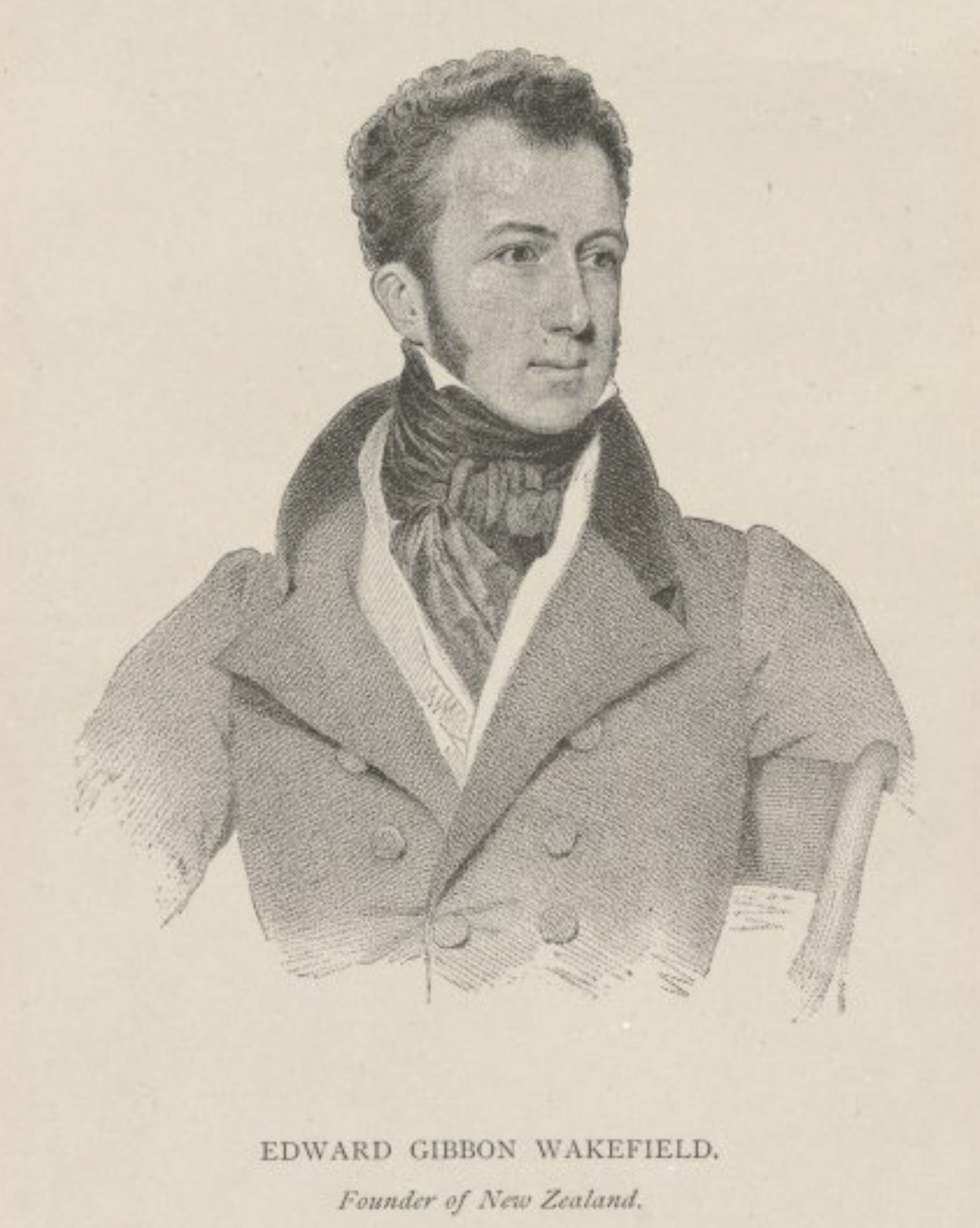
Edward Gibbon Wakefield and all the other Wakefields.

One of the joys of research- and yes, it IS still a joy- is that sometimes you are led into a direction that you didn’t anticipate.  I’m not talking about the siren-songs of distraction that keep your head turning from side to side, but a genuine surprise that makes you stop to re-evaluate what you’ve already found from a different perspective. The other day  I was speaking with a friend who is a librarian, who enjoys the act of finding and building order into material, and he said that he could not tolerate the anxiety that the next resource he turned over might upend the whole thing. I don’t see it that way (yet?): I am still open to surprise and fluidity.

As a result, regular readers might have detected that I am wandering recently into the swamps of colonial constitutional history- not a destination I would have expected or relished-  and it is here that I have stopped for a little while with Edward Gibbon Wakefield (EGW from hereon) with two books that I’ve just read.

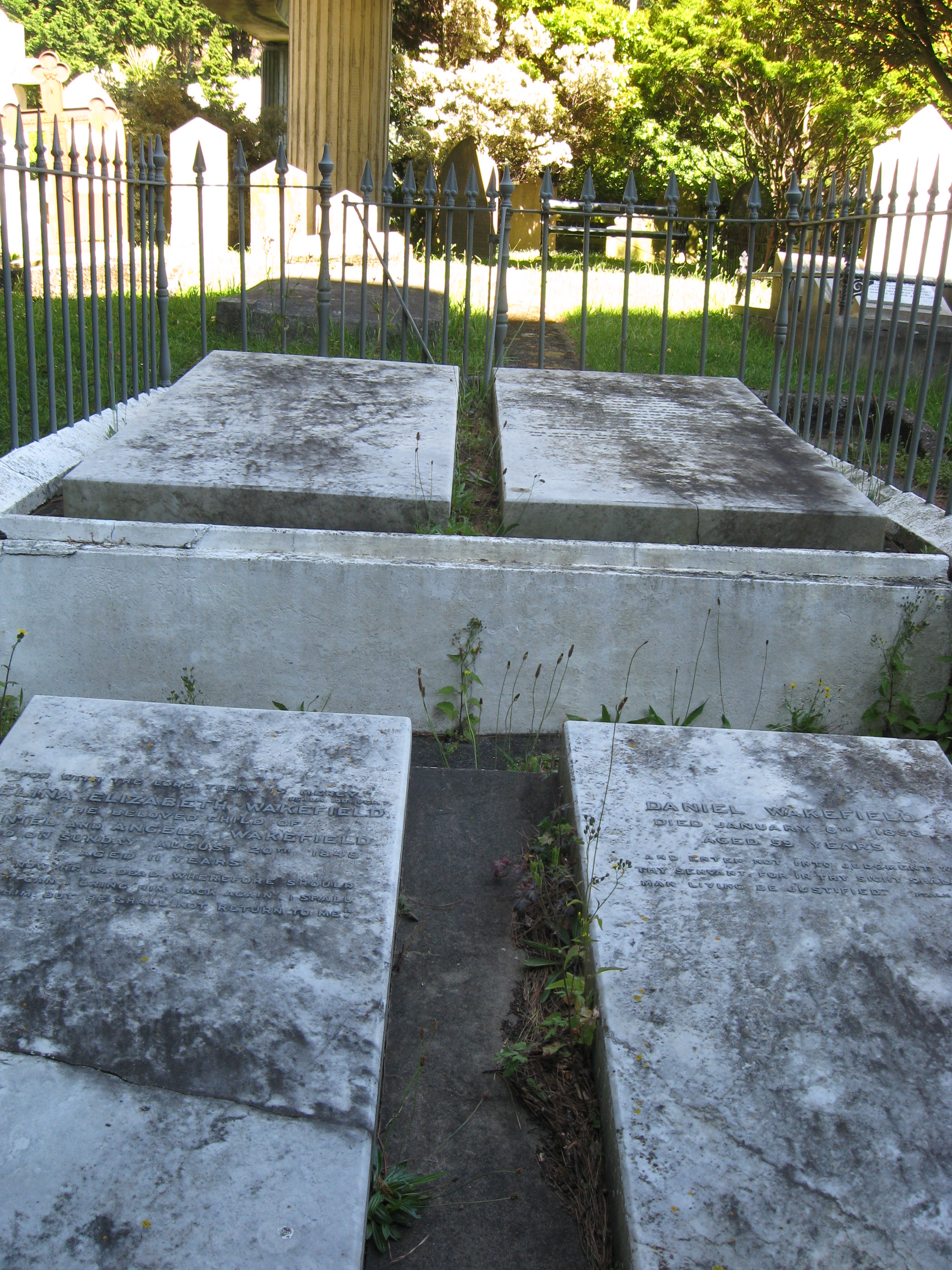
Edward Gibbon Wakefield (to the extent that he is known at all)  is most often associated in Australia for his connection with the settlement of  South Australia in 1836 under his theory of ‘systematic colonization’.  Put very briefly, this involved encouraging immigration to the colonies across all strata of British society, but ensuring that labourers remain available as a mobile labour force by selling land at a “sufficient price” that too high for them to purchase until they had been in the colony for a number of years. I was aware that there were Wakefieldian settlements in New Zealand, in Christchurch in particular, and so I was rather bemused by all the Wakefieldian graves in Wellington.

Wakefield family graves, Bolton St cemetery Wellington

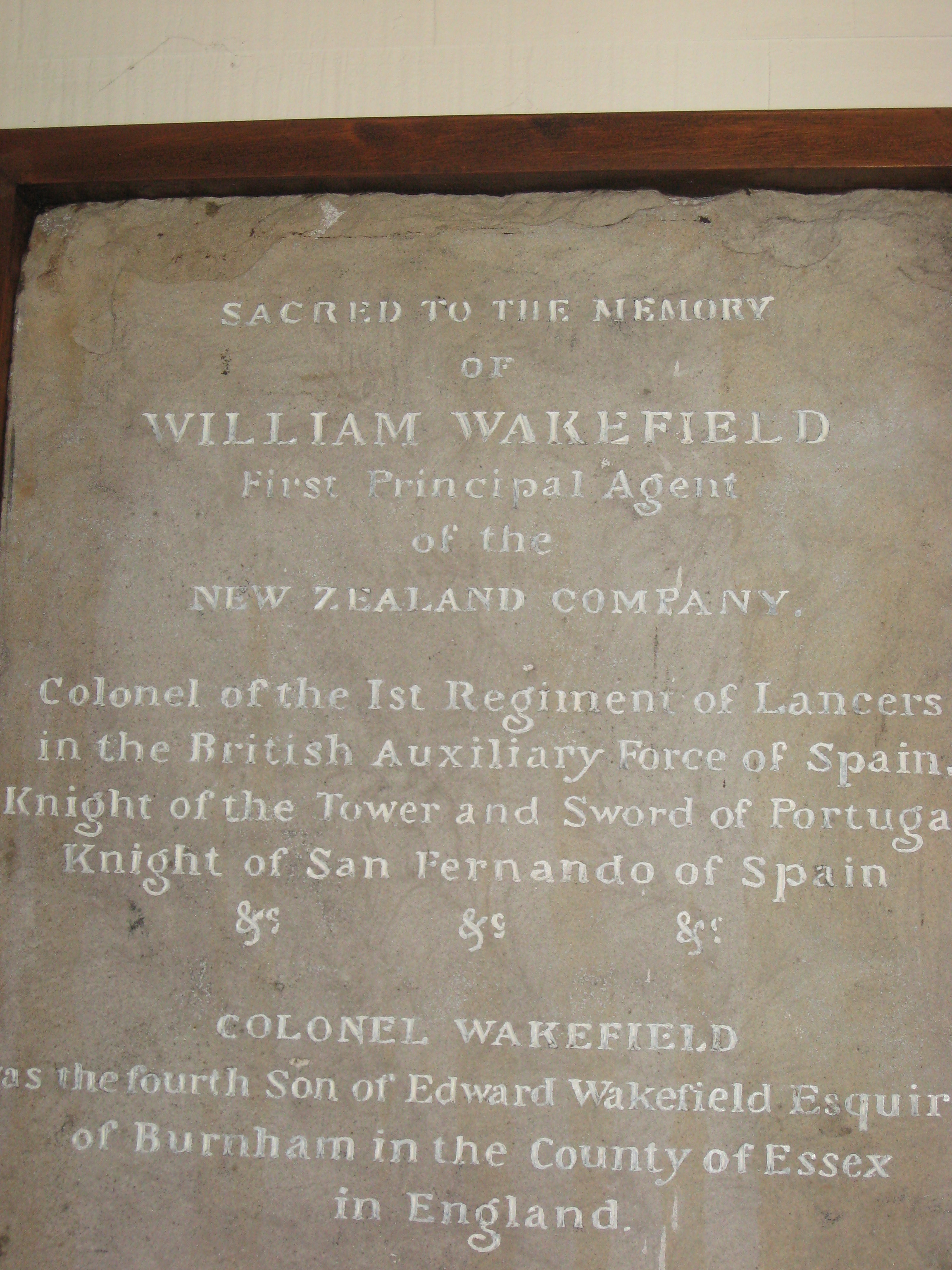
Memorial plaque to Col. William Wakefield, Bolton St cemetery.

The works that I have read on New Zealand, namely Paul Moon’s Hobson  and Peter Adams’ Fatal Necessity portray the Wakefieldians as insistent self-interested lobbyists, who needed to be watched carefully. I was also aware that Wakefield had been imprisoned for kidnapping an heiress- indeed, it was during this period of incarceration that he wrote his Letter from Sydney (penned from his cell in Newgate!) which spelled out his systematic colonization theories.

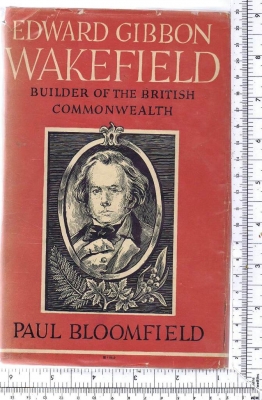
Paul Bloomfield: Edward Gibbon Wakefield: Builder of the British Commonwealth, London, Longmans, 1961, 378 p.

The first of the two books I have read recently is Paul Bloomfield’s Edward Gibbon Wakefield: Builder of the British Commonwealth. This book, written in 1961, has been described in a paper by Ged Martin as “the high-water mark of uncritical admiration of Wakefield and his work ” as the title might suggest. He starts his book with the abduction, told in racy and engaging prose- and why not, because it’s a good story.  It was, however, an episode that cruelled Wakefield’s career from that point on, as the scandal attached to it ensured that he could never put his name to any official policy that drew on his principles, and  he had to content himself with background lobbying and influence instead.  There are relatively few footnotes, although there is a bibliography and useful index, and there are frequent references to novels and literary characters, as if Wakefield himself sprang from fictional origins.  This is something that I find myself having to resist in my own work.  The 19th century novel is so pervasive and its representation in film and television provides such a ready visual backdrop that it’s easy to switch to a fictional shorthand.  As such, Bloomfield depicts the abduction as a youthful aberration that denied Wakefield the acclaim he deserved.  The emphasis is mainly on Wakefield’s lobbying in England amongst Parliamentarians, although it does follow him to Canada and New Zealand as well.

He made an interesting observation (especially in light of my recent posting and resultant comments about Christmas with the cousins)

One day someone will publish a study of the difference made in English sentiment by the change from a fifteen million population composed of large families to a fifty million population in which most parents have no more than two children.  We have only to look into the lives of the prolific Quaker cousinhoods, including the Wakefields, to see what an advantage their special community-sense was to them, what a source of strength it was to them to live in a clime of mutual aid. (p. 205)

The second book that I’ve read recently on Wakefield does just this.

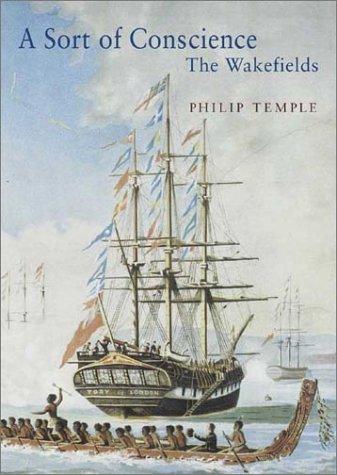
Philip Temple, A Sort of Conscience: The Wakefields, Auckland, Auckland University Press, 2002 (paperback edition 2003), 541 p.

A Sort of Conscience is more nuanced than the Bloomfield account, and it spreads its analysis further into the Wakefield family as a whole- the brothers and sisters, nieces and nephews, many (but not all) of whom ended up embroiled in one way or another with Wakefieldian enterprises.  Although fundamentally positive towards Wakefield, Temple acknowledges the flaws of personality amongst many of the Wakefield siblings and while not dismissing the abduction completely, argues that even more disquiet amongst influential people was prompted by  Wakefield’s involvement in a dubious legal case about his first wife’s lucrative will, some ten years prior to the abduction escapade.  Like Bloomfield, Temple shows that Wakefield was forced to operate in the background when his policies were implemented, but this seems fortuitous as he was overbearing, interfering and careless of details.

Temple draws heavily on family correspondence, which seems to be voluminous, especially once the family spread across the globe.  Many of the letters were addressed to Edward Gibbon Wakefield’s sister, Catherine, who married a minister and stayed behind in England- in fact, Temple quips at one stage that his book could easily have been called “Dear Catherine”.   You can detect in the family a bifurcation between the family members who moved from the Quaker to Evangelical affiliations, and those who became caught up in the entrepreneurialism and politicking of EGW as he sought to have his theory of systematic colonization embedded into colonial policy.  However, you’d have to say that the politicking won out, as more and more siblings and nephews travelled overseas to New Zealand in particular, where Wakefieldianism was implemented in its purest form.  EGW himself ended his days there, although in Wellington rather than Christchurch (the settlement which most closely approximated his theory. )

Wakefieldianism is often presented as a monolithic and inflexible policy, although frustratingly vague in important details like the price that should be charged for land to make sure that settlers remained labourers for a few years instead of moving straight on to being self-employed farmers.  I was interested, then, to see that Wakefield himself was more pragmatic and open to change than I expected once he actually moved to the colonies settled under variations of his theories.

This book is, like Bloomfield’s, ultimately sympathetic to Wakefield, although with more serious qualifications, as the ambivalence of the title suggests.  By following him more closely to the colonies, and by broadening the scope to the Wakefield family as a whole,  Temple captures well its mobility and the emotional tenor of lobbying and patronage in early 19th Britain and its colonies.  The book has been very well received, winning the Ernest Scott Prize in 2003, the Ian Wards prize for historical writing, and the Biography category of the 2003 Montana New Zealand Book Awards.

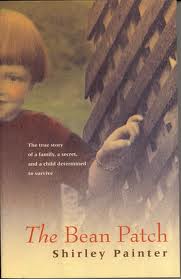
‘The Bean Patch’ by Shirley Painter

2002, 310 p

Spoiler alert. 

The author of this book was 83 years old when this book was published.  It was the product of a writing course undertaken at Holmesglen TAFE in her later years, and its narrative voice is just a little stilted.  But she is conscious that she is crafting a narrative, as well as relating it and so she makes the decision to withhold and complicate information so that the reader experiences the same partial and confused state that she did for so many years:

Because memories are often disjointed, I had two choices in dealing with them.

The first was to tidy them all up into a neat chronological order, with a beginning, a middle and an end.  But a lifetime of reading wonderful books has made me a highly critical reader, and I feared that choice might make for a very flat narrative.

The other choice was to present the reader with the same gaps, the same clues, and the same dilemmas as I had, so that the effect would be the same: What’s going on? Who in this dangerous and contradictory world can be trusted? Who are the goodies in white hats and who are the baddies in black hats?

Tough, reader! I have chosen for you the hard option   (p. vii)

This stylistic choice works well, and it is the promise that it will all come clear that draws the reader through the narrative.  There seems to be such a disconnect between what seems like an ordinary-enough life with husband, children, career, house, brothers and sisters, juxtaposed with a nightmare existence of extreme brutality.  This disconnect becomes even stronger in part 2 where, tangled in amongst the narrator’s story of breakdowns and therapy, details of the abuse are released in jerks and flashes- as indeed, such searing and painful memories must be.

But the reader is left with the final question of credibility, and here I find myself in uncomfortable territory.  I had let suggestions of the paranormal go through in Part I, but with the litany of abuse and crime in Parts II and the Epilogue  of the book, drawn out through extensive therapy, and encompassing recovered memories at and before birth, I found myself stepping back and asking “Do I really believe all this?” Although I feel almost disloyal to the narrator in distancing myself from these recovered memories,  I just cannot credit the bloodshed and crime without external corroboration.

I’m obviously not alone in my hesitation as this Sydney Morning Herald review shows.  The Bean Patch was awarded the Dobbie award in 2003 for a first book by an Australian woman writer.  The book is marketed and publicized as ‘memoir’.  Deborah Adelaide, one of the judges for the award is quoted in the review as saying that the truth or otherwise of parts of the memoir is immaterial:

Because we know it is based on her life, and the thrust of the story is true, to me the details don’t really matter

Ah, but it’s more than just details- it’s the whole premise of the book.  All memoirs are constructed narratives, and the reader takes on the author’s part in this construction as part of the memoir genre, aware that these choices are an inherent part of what is being offered.  There is always the question of fidelity and soundness of the architecture by which the author has chosen to structure the narrative, but if the whole intent of the endeavour is suspect???  I’m not sure.

Update 27 August 2014

The Age this morning published a beautifully crafted obituary for Shirley Painter (3-11-1918 – 29-07-2104) written with the assistance of family members.  It notes that:

Shirley was dux of both her primary school and MacRobertson Girls’ High School and earned an honours arts degree from Melbourne University.  She married and raised three children.

She taught Latin and English with diligence and care at St Catherine’s Secondary School for Many years. .. She was supported financially to go on to university by a bursary created by her teachers who recognized her extraordinary ability.  As a teacher she gave her tireless support and encouragement to young women seeking to find that spark in knowledge and thought that might enliven them.  She felt angry, in recent years, that free education had become a thing of the past….

Shirley was a lover of art, film and literature and a member of book clubs, film groups, bridge clubs, ACSA (Adult Survivors of Childhood Sexual Abuse) and Probus…

Shirley is survived by her three daughter, four grandchildren and the legacy of hope and love she embodied.


At the NGV: ‘The Mad Square: Modernity in German Art 1910-1937’

Some months ago we went to the NGV to see the Vienna Art and Design exhibition.  As you walked around that exhibition, which took a largely chronological approach, the 20th century works in the final rooms became increasingly fractured, subversive and unsettling, and the political chill of the approaching Nazism was almost palpable.

However, entering this current exhibition, part of the Art Gallery of NSW’s travelling exhibition program,  what had seemed to be subversive in the Vienna exhibition now appeared defiant and brave.  As a child, one of my favourite stories was The Snow Queen by Hans Christian Anderson, where a shard from an evil, broken mirror enters the eye and makes everything appear ugly.  Shards have warped the vision of the world here- a perverted, edgy, dissonant world- but it’s also a world clearly responding to the ugliness outside of  war, defeat, inflation, radicalism and increasing totalitarianism.

The shadows of World War I are long, and they manifest themselves through confronting depictions of maimed soldiers, pushed to the margins of society.  Were disfigured soldiers found in English art of the same period?- I’m not aware that they were.  I’m sure that the wounded were just as present but their meaning was different for the side that ‘won’ the war.

There is also the underlying menace of sexual violence, exemplified by Davringhausen’s painting of Der Lustmorder (The Sex Murderer) where a sickly, boyish prostitute lies on a bed oblivious to the murderer lying underneath (see here)  and there are film clips of abducted women in The Cabinet of Dr Caligari, and debased women in Metropolis.  This is an ugly world.

The last room of the exhibition has archival footage showing Hitler’s Degenerate Art exhibition, where works such as these were collected and shown, captioned with ridicule, before being destroyed or sold off onto the international market.  One of the final paintings in the exhibition is The Mad Square, from which the exhibition takes its name, by Felix Nussbaum, depicting artists protesting against their exclusion from the Prussian Academy of Arts, their artworks tucked under their arms.  It is sobering to remember that Nussbaum and his entire family perished in the concentration camps.

This is an unsettling exhibition.  After a while, the blockbuster exhibitions tend to merge into a bit of an blur  (did we see that at The Impressionists? or Vienna? or Dutch Masters?) but I think that this exhibition stands alone. Well worth seeing.

There’s an excellent companion website here at the Art Gallery of NSW.

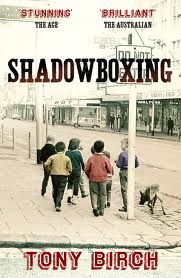
‘Shadowboxing’ by Tony Birch

2006, 178 p.

Shadowboxing is a collection of ten linked, largely autobiographical short stories set in Fitzroy during the 1960s.  As such, it ticks all my boxes: Melbourne-based, baby-boomer, cumulative stories.  They stand alone quite well, while building up into a longer-term, more nuanced work, and indeed apparently several had been published previously and were reworked for this collection.

The stories are written in the first person by the fictional Michael Byrne, looking back as a young father on his own childhood.  He was brought up in one of the sidestreets in Fitzroy where the houses were demolished as part of a slum-clearance program in the 1960s.  As such, it is a vanished landscape, and many of the attitudes of the people living there have vanished too.  Children had their own world, largely divorced from that of adults; people looked the other way from domestic violence in their own families and the families of their neighbours; there was an expectation that boys needed a good slap around the ears from their peers and older men to be a ‘real man’; mothers were alternately put onto a pedestal and abused.

The relationship that lies at the heart of these stories is that of Michael and his abusive, wounded, father.  Indeed, many of these stories are observations on masculinity and fatherhood and Birch resists the temptation to give easy, feel-good answers.  Redemption and forgiveness are here, but they are both fragile and deeply ambivalent.

The Melbourne depicted here, while in many ways more closely aligned with working-class slum suburbs across the world, is clearly recognizable to Melburnians.  I’m surprised that ‘The Return’ hasn’t been picked up in an anthology of  Australian Christmas stories because, while it describes a December Melbourne well known to Melbourne baby-boomers, it also captures the tenderness that can exist between an older brother and his little sister.

These are terrific stories, honing in on small details and events and yet able to take big strides across a family’s history-  indeed, across the history of a suburb and a generation- as well.

Update: You might be interested in the Radio National Hindsight program about the slum clearances in Fitzroy that Andrew mentions in his comment below.

My rating: 8.5/10

Read because: it was the December read for the Yahoo Groups Australian Literature group

Sourced from: La Trobe University Library

The dilemmas of reading a sequel

At the moment I’m reading River of Smoke by Amitav Ghosh, the second in what will be the Ibis trilogy.  I very much enjoyed the first book Sea of Poppies, written in 2008 which was shortlisted for the Booker Prize.

So, some eighteen months later, here I am with the second installment. The sad reality is that I really can’t remember all that much about the first, except that I enjoyed it.  Even my own blog post doesn’t enlighten me particularly.  I’m aware that he’s providing small snippets of back story for those who have not read the first book, but they’re not evocative enough to trigger a rush of memories.  At the moment, all they’re doing is frustrating me- should I remember more about this character???

Reading a trilogy as it is being produced, rather than coming to it later as a finished product, means that there is often a long waiting time between volumes- three years in this case.  Authors generally do back track a bit, but there’s a limit to how much they’re able to do this without retelling the first story over again.  I assume that they write so that a new reader could read it without having read the first book.  However, while the author has probably been living with his characters – and maybe even his/her vision for the work as a whole , for years- readers (or at least, I)  don’t have this same level of intimacy and have moved on to other books and other stories.

So what to do? Thanks to the wonders of the Internet, I can easily find a plot summary of the earlier book but somehow that feels like cheating.  I feel as if the book should be able to stand on its own two feet, but I’m willing to admit that perhaps the problem in this case lies more with the reader than the author.

Dammit- I’m going to do it.  Lord Wiki, here I come.


An Australian Christmas c.1963

Christmas seemed so much more fun when you were a kid.  Will our children and grandchildren look back at their Christmases with such fondness? I hope so.

My Mum was the youngest of seven and no doubt as the spoilt youngest child, managed to avoid doing Christmas dinner until I was about thirteen years old. Until then, every Christmas was the same with lunch and dinner over at Auntie Flo’s and it is these Christmases that I think back on.

Father Christmas would come as he could always be relied to do, leaving presents in a pillow case at the end of the bed. He was an orderly Santa- along with larger presents there would always be a rectangular box of assorted lollies that included Fruit Pastilles (both multicoloured and blackberry), a Choo-Choo bar and a Kit Kat.  There would be a glass jar jar of puce-coloured candied peanuts: the jar itself bore a very strong resemblance to a  jar that might once have held Vegemite or Kraft Creamed Cheese spread, and I’m almost sure that it did.  Among other presents, there was always a book for me, sourced from a large box of remaindered children’s books that my parents bought at auction somewhere.  As a result, the book itself was pretty hit-or-miss, although one year it was Charles Lambs’ Tales from Shakespeare , another year a collection of Greek myths.   One particularly memorable year there was a wooden paddle-board that obviously didn’t fit in the pillow case which was maneuvered into my room by Santa with much un-Santa-like giggling and muffled laughter.  On another earlier Christmas, Santa brought my doll Debbie in a pink dress in a proper doll box.  There was always, always an orange at the bottom of the pillow case.

Then over to my Auntie Flo and Uncle Ted’s for Christmas lunch. They lived in Waiora Rd Heidelberg Heights in a house with huge gardens, overlooking the Yarra Valley right across to the Dandenongs.  I always loved going there. Although I was a little scared of my uncle’s very dry sense of humour and bristling moustache, I loved my Auntie Flo, my favourite aunt and my godmother.   Girl cousins were fairly rare in my family- four girls to eleven boys.  Auntie Flo didn’t have a daughter, and I always felt very special with her. My cousins Wayne and Paul held all of the attraction of older male cousins: they were handsome, funny and big and very affectionate to their little girl cousin.   The Christmas I can remember most clearly was a very hot day, so the canvas awnings were all pulled down, bathing the inside of the house in a green, almost underwater light.  The house  smelt of Christmas pudding that would have been bubbling away for hours: I now make the pudding for my own family to the same recipe, amused every year at how much alcohol is in this pudding that was eagerly eaten by a family of teetotallers (3 tablespoons of spirits; 200 ml beer).  After lunch, more presents- always something special from Auntie Flo, and once even a doll’s house WITH STEPS made by my cousin Wayne in woodwork, all decked out in curtain and carpet scraps from their own decorating and my initials JL in gold paint over the front door.

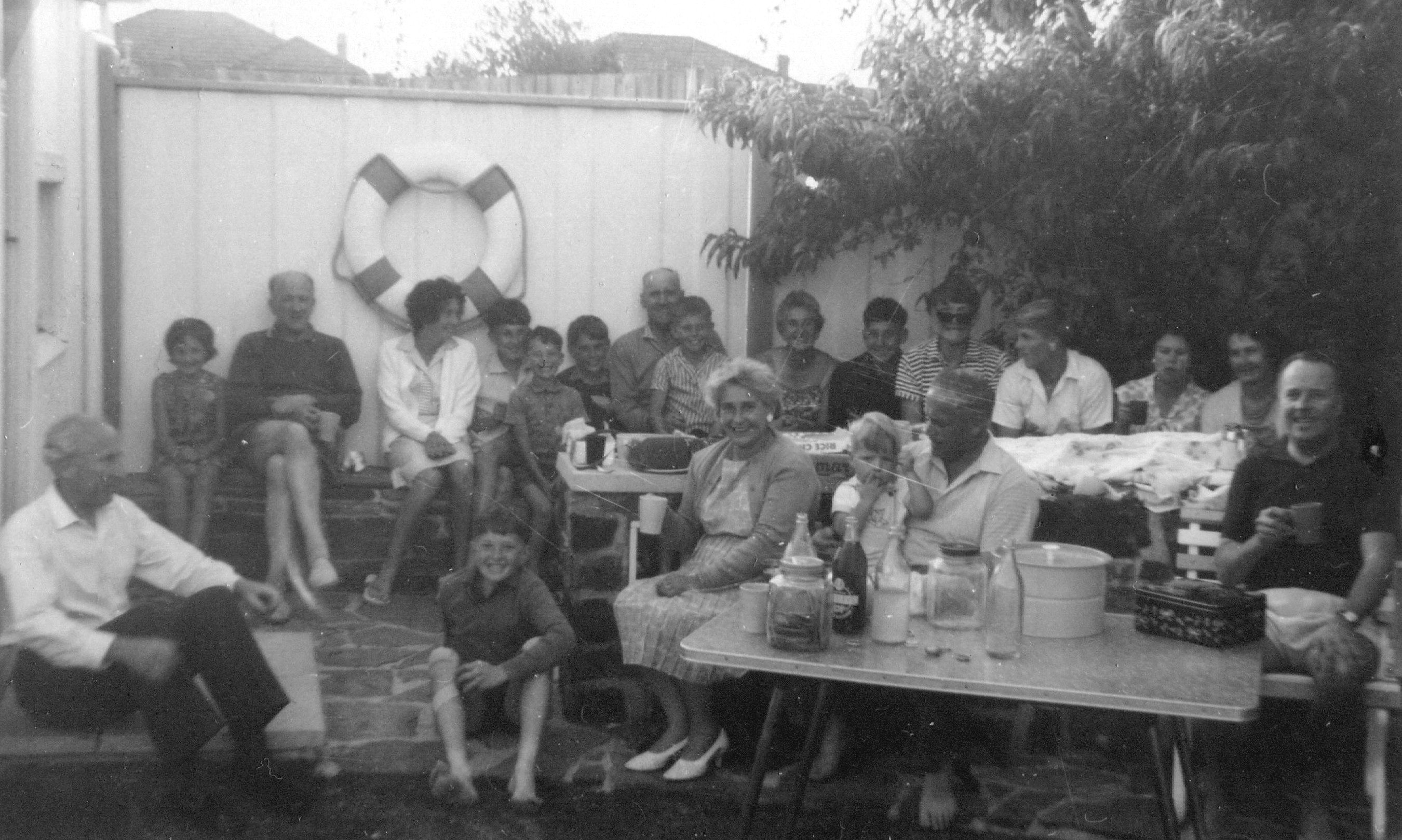
I'm sitting on the extreme left hand side at the back. My brother Colin is sitting 5 from the left with Auntie Flo in the middle, 9 from the left. I THINK that Cousin Paul is wearing sunglasses 11 along, with his brother Cousin Wayne turning towards him. Mum is seond from the right hand side. Uncle Ted is sitting on the ground at front left, and my brother Rohan is sitting on Dad's lap front centre.

After lunch, the other cousins would come over- all older than us- and loud and funny and boisterous.  Auntie Flo and Uncle Ted had a fully tiled inground pool, which was rare in those days, complete with a changing room up the back, and footbaths set into the concrete to wash the grass from your feet before going in.  Once the obligatory and scrupulously kept hour for our “dinner to go down” elapsed (does anyone do that these days?), it was into the pool. They had inner tube tyre rings in the pool, and there would be a rough game of pool basketball, races up and down the pool and  pool-wrestling perched on top of my cousins’ shoulders.  Once our fingers were corrugated and our lips blue with the cold from being in for so long, we’d play shuttlecock on another terrace of the lawn, with the shadows from the trees lengthening around us.

Yet more food- cold meat brought by my butcher Uncle from Geelong (and maybe the butcher uncle from Reservoir?), salads, my mum’s famous pavlova and my Auntie Flo’s shortbread.  I once announced that I prefered Auntie Flo’s shortbread to my mother’s: I was not popular.  Another family of cousins had joined us by this stage, and then there would be the third round of presents, although often smaller ones by this stage.

By now, there would be much rubbing of little eyes and we’d head off home. We travelled out of our way to see the Boulevard lights in East Ivanhoe- strings of multicoloured globe lights and decorated gardens.  There would be one or two illuminated houses, then a few more, then the main display, concentrated in the middle of this long, curving street.  Crowds would cluster around these main houses, and the traffic would slow to a crawl.  Little did I realize that some 15  years later I would marry the little boy who then lived in the house on the bend with the most spectacular lights, and that 20 years later the week-long display of “the lights” would be an integral part of my own children’s Christmas.

But gradually the gaps between the displays would get wider and wider, until there would be just one or two outlying houses and the car would finally reach Burke Rd.  It was then- and only then- that I would know that Christmas was over for that year.

Happy Christmas.

Count me in too!

The Australian Women Writers 2012 National Year of Reading Challenge sets out to actively promote the reading and reviewing of Australian women’s writing.  It shouldn’t be necessary, but this year’s Miles Franklin shortlist without a single female author and the imbalance of women writers (18/48) in the National Year of Reading’s Our Story  suggests that it is.

The idea is that you  sign up for reading and reviewing books by Australian women writers during 2012.  You can read in one or multiple genres, and you select the number of reviews you’d like to commit to.   There’s genres listed there that I’m not particularly enamoured of (romance, crime, SF) so I’ll limit myself to fiction and nonfiction and aspire to be a Franklin-fantastic Dabbler (i.e. read 10 books and review four).

Gender bias in reading is so insidious.  I would have thought that I already leaned towards female writers in my fiction reading, but when I count through my Australian literature reviews for 2011, I’ve reviewed nine male writers against eight female.  I didn’t include Australian non-fiction largely because I knew that it would make the statistic look even worse!  Given that I try to read the Miles Franklin shortlist each year, the male authors ticked up during the middle of the year and it was only a bout of female writing at the beginning of the year that brought some semblance of balance to my figures.

So here goes in 2012