Author Archives: residentjudge

Pressing matters

So, what do we think of today’s new sized Age?  Personally, I like it.  The Australian Financial Review has been tabloid- oops- COMPACT- for years and both the Guardian (whose advent in Australia I’m looking forward to) and the Independent in the UK are small newspapers.

Mr Judge and I divide up the paper each morning over breakfast, and I’ve got to say that sometimes, particularly early in the week, we were ending up with virtually one sheet of paper each.  Not a lot of paper for $2.00.  Thursday and Friday’s papers looked meatier, but much of the bulk comprised full-page alcohol and vitamin supplement advertisements.  Saturday’s Age has always been good value with longer articles and a more international approach . I often whinged that some of the Saturday content that took almost all day to read could surely have been distributed across the other days of the week instead. The Sunday Age is rubbish.  Today’s new edition, at least, had longer and better quality articles and more pages – but let’s see how long that lasts.  I must admit that for the first time in nearly 40 years, I hesitated before renewing my subscription this time  (I am philosophically opposed to direct debit so I had to decide whether I wanted to have a full year subscription again).   I splashed out and bought a tablet on the weekend, so I may well be tempted by the Guardian when it arrives.

I was rather amused by the holier-than-thou, lofty statements of the editorial:

The Age’s unparallelled coverage of the social, political, intellectual and cultural life of this city, this state, this nation and beyond will continue in abundance.  So will our commitment to independent journalist, free of corporate, commercial and political influences, robust in argument and fair in  analysis.  The Age’s much-envied reputation for reporting and scrutinising without fear or favour has been hard won, but deservedly so.  It is what generations of readers have come to expect, and it will continue to underscore what we do best.

I was amused because, thinking about the three newspapers in Judge Willis’ Melbourne, all three of them  (The Port Phillip Gazette, the Port Phillip Herald and the Port Phillip Patriot) each made similar claims.   Each paper published twice a week in turn, so it meant that there was daily newspaper available for each of the six days of the week.  Visually, they were very similar, even though they preened themselves on the superiority of their type and typesetting.  Each was four pages in length; each had the first page entirely devoted to advertisements;  each had an editorial blatantly  reflecting the politics of its editor; and each had a letters column stuffed with letters often written by that self-same editor under pseudonym.

I was even more interested this morning to see the response of the Herald Sun, skanky little tabloid that it is.   They led with an exclusive on tape recordings made of conversations between staffers in Baillieu’s government and eyebrows are raised about Simon Overland, the OPI, Peter Ryan etc. etc. etc.   Despite an overall leaning towards the Liberal party, I suspect that the Herald Sun had been sitting on these tapes for some time, and brought them out this morning quite intentionally.

So, fun times at the breakfast table.

‘Thinking for yourself’ Robert Manne

Oh wow. Oh wow. Oh wow.

manne

I learned yesterday that these were Steve Jobs’ last words but I want to use them for something closer to home:  a conference entitled ‘Thinking for Yourself’ held at La Trobe Uni on Thursday and Friday to honour Robert Manne, who has resigned from La Trobe University where he has been since 1975.  Strictly speaking, I guess that it was a Festschrift but I don’t know that we’re particularly good at this sort of lionization in Australia.  It paid tribute to a man who has made a broad contribution to public discourse in Australia. As the publicity blurb for the conference notes, he has been at the heart of many of the large debates in Australian public discourse:

During his almost four decades as a university researcher and teacher and public intellectual he has been involved in a series of bitterly contested controversies concerning the interpretation of the Holocaust, the nature of Communism, the Cold War, social democracy and its neo-liberal critics, the dispossession of the indigenous population of Australia, multiculturalism, the state’s responsibility for asylum seekers and, most recently, the politics of climate change.

He’s a man who has moved from the left to the right, and to the left again.  I don’t see this as indecision or wishy-washiness: instead I see it as the use of intellect and information in action.

Robert Manne has been closely associated with Morry Schwartz, who publishes The Monthly and the Quarterly Essay. The lineup of people who paid tribute to and reflected on Robert’s interests was almost like a roll-call of regular contributors to these publications.  Hugh White, Mark McKenna, David Corlett, Clive Hamilton, Anne Manne.  But wait- there’s more: John Hirst, Dennis Altman, Tim Soutphommossane, David Ritter, Patrick McGorry, Raimond Gaita, Pat Dodson, Mick Dodson, Ramona Koval, Ghassan Hage …. it just went on- top-flight commentators and academics (albeit of a largely but not exclusively) left-ish persuasion.  Each of the speakers was introduced by a short paragraph that Robert Manne himself had written about them, and they of course reciprocated with comments about him.  There were participants from all over the globe, on a wide range of topics.

The presentations were grouped around a number of themes that reflect Manne’s work: The Cold War and Intellectuals; Australian Political History and Culture; The Public Sphere; Universities; Multiculturalism and the Republic; European History and Politics; Asylum Seekers and the Rule of Law:  Contemporary Social Democracy/Left and Right, and Culture and Politics.   Several references were made in passing to George Orwell, Hannah Arendt and Tony Judt- writers and thinkers who have had a deep influence on Robert Manne and  in whose tradition he himself fits.

There was just so much to think about that I really can’t do it justice.  Have you ever been in the audience of something and thought “How lucky am I to be hearing this?!” It was like watching a particularly good edition of The Monthly played out live in front of you, and I could have listened to nearly all of them for hours.  Oh wow.

‘Gone Girl’ by Gillian Flynn

gonegirl

2012, 395 p.

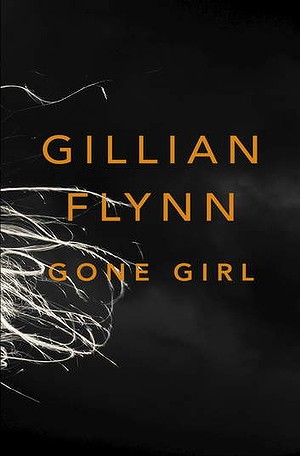
I always keep a bit of an eye on the Book Scan results of bookshop sales that appears in the Saturday paper.  I’ve noticed Gone Girl bobbing around on the Independent list and –lo and behold!- last week it made it to No.1   However, I haven’t seen anyone reading it, or heard of anyone else who’s read it.  But obviously lots of people have read it, because after reading a glowing review of it in August last year, I put a hold on it at my local library.  Number 63 I was, on ten copies.  Finally, it was my turn.

And I can tell you nothing about it.  Except, perhaps, that it involves a disappearance, and that it is written in alternating chapters, all tethered chronologically back to the day of the disappearance.  Beyond that, I’ll give too much away and I don’t want to do that.  The book just teetered on the edge of implausibility, but didn’t fall over, and each time I started “Hey, but what about….” the author had anticipated my objections.  While not high literature, and probably 1/3 too long, I found it a real page-turner- and hey, we can all enjoy one of those every now and then.

If you can’t stand waiting as No 63 in line, don’t worry- apparently it’s already been optioned as a movie with Reese Witherspoon as one of the lead actors, and it’s absolutely tailor-made for Hollywood.  I’m not quite sure how they’re going to do it- lots of voiceovers, perhaps and  done well, it should be a winner.

My rating: a rather guilty 9/10. Dammit, I could barely put the thing down.

Sourced from: The long waiting list at Yarra Plenty Regional Library

Read because: It has been on the best seller list for ages.

‘Babes in the Bush: The Making of an Australian Image’ by Kim Torney

torney

2005,  241p.

I feel as if the McCubbin image that graces the front cover of this book has been hanging in the corridor of every school I have ever attended.  Just looking at it evokes for me the smell of squashed sandwiches and pencil cases.  Likewise, the mere mention of the “Lost in the Bush” story in the primary school reader brings back memories of brave little Jane Duff, struggling with her brother to carry their baby brother through the ravines of the endless bush, tenderly covering him with her cotton dress at night.  Of course, that’s the whole power of an image:  just a glimpse or uttered word evokes a cascade of remembrances and associations. And as the title of this book suggests, the lost child in the bush is a particularly durable and potent Australian image. Continue reading

‘ A Stranger Here’ by Gillian Bouras

a_stranger_here

1996, 247 p.

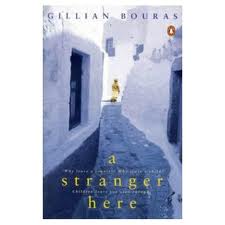
The Age, my daily newspaper (which is, unfortunately, becoming less and less pleasurable- did you hear that the Guardian is coming to town?) no longer has its regular columnists who let you into their lives over an extended period of time.  I suppose that Martin Flanagan writes within that tradition, and the much-missed Kate Holden did too on the back page of Saturday’s Age.  The late Pamela Bone was good; so was Sharon Gray; and I remember Gillian Bouras as well. As I recall, she was a Melbourne teacher who went to live in a Greek village, and she continued to write her column from Greece.  She  has mined her life for novels, too, and this book  continues this tradition.  Is it fiction or non-fiction? I have no idea.  I think that I’d classify it as memoir and biography dressed up as fiction.

It is written in three alternating voices of three women, overlaid by an invisible third-person omniscient narrator :  first, the Greek peasant mother-in-law Artemis;  second, the friend Juliet; and finally the writer Irene (who may, perhaps be the omniscient narrator writing in first person).   Australian-born Irene now lives in England, self-exiled from Greece where her youngest child still lives after the breakdown of his parents’ marriage.  She doesn’t want to return to Australia and she cannot bear to be too far from her youngest son whom she loves perhaps too unhealthily.  Her mother-in-law Artemis, addled by dementia, has always resented Irene, and the friend Julie, herself British-born, has stayed in Greece, turning a blind eye to her husband’s infidelities and she is rather impatient of Irene’s indecisiveness and passivity.

I received this book as part of my book-group’s Kris Kringle: we each anonymously wrap up a book of our own that we have enjoyed and put it wrapped into a basket and choose another.  Over the Christmas break we read the book, then at our first meeting we return it, speak about our response to it, and try to guess who ‘gave’ it.   It doesn’t at all surprise me that this was a book given by one middle-aged woman to another middle-aged woman, and it has been interesting reading this and My Hundred Lovers in such close succession, because there is a similarity between them.   They are both very female books, written by older women, who have been scarred, chastened and emboldened by experience.  Both books do not have a clear-cut beginning and end point, and while driven by the elapse of time and the waxing and waning of relationships, do not have a plot as such.

While identifying with it, I did become a bit impatient at the ‘stuckness’ of the narrator in this book and was relieved that it didn’t go on for much longer, even though I was enjoying reading it.  I do wonder if  the author takes the  adage “Write what you know” a little too seriously: can any one person’s ordinary life carry the burden of so many novels???

My rating: 7.5/10

Sourced from:  well- who knows???  I think Sue, but I’m not sure.

Read because: it was the 2012 book group Kris Kringle.  And she identifies herself on her website as “An Australian Writer Living in Greece” so I’ll include her on the Australian Women Writer’s Challenge.

awwbadge_2013

Australian Women Writers Challenge 2013

awwbadge_2013

Well, I did it in 2012 and I’ll do it again in 2013. I’ll probably read quite a bit of fiction because I tend to anyway, but this year for the Australian Women Writers Challenge 2013,  I want to concentrate on Australian Women Historians writing Australian History.

Last year Yvonne Perkins in her blog Stumbling Through the Past analysed the gender balance of book reviews in three major Australian history journals.  She found that by and large, History Australia and Australian Historical Studies have a fairly even gender balance the books that are reviewed (with even a slight leaning towards female writers), while The Australian Journal of Politics and History had more reviews of male authors.  It’s an interesting post- read it here– and it spurred her to develop a list of books written by women historians.

To be honest, I was surprised that there was such strong gender balance in two of the journals she analysed, because my perception is that more books are written by male historians.  I did a little detective work myself, counting the books in the ‘Australian Studies/Australian History’ section of Readings bookstore in Carlton.  Whatever the breakdown in the book review section of the major Australian historical journals, on the shelves male historians romped it in – only 28 of the 95 books I counted were written by women.

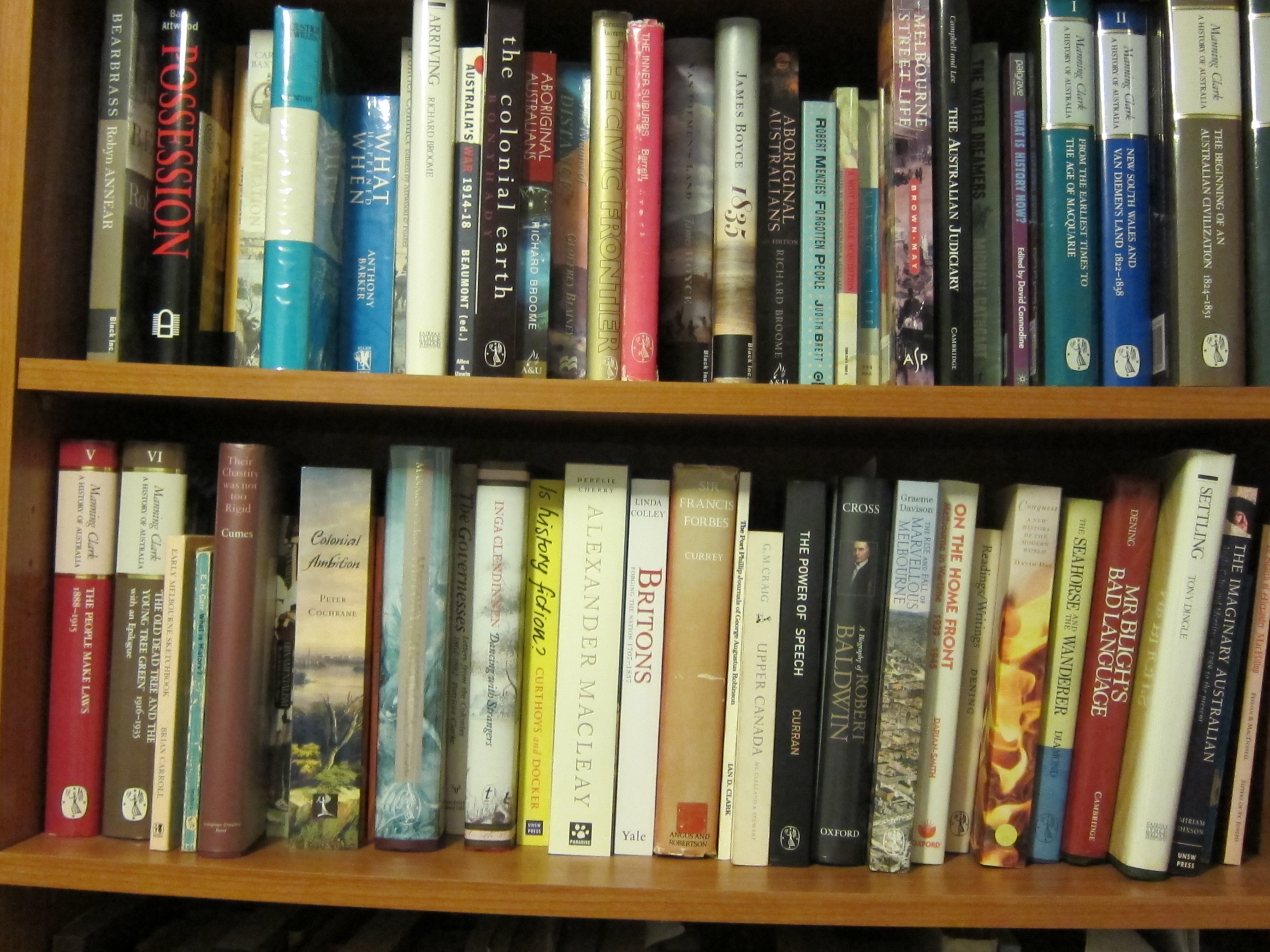
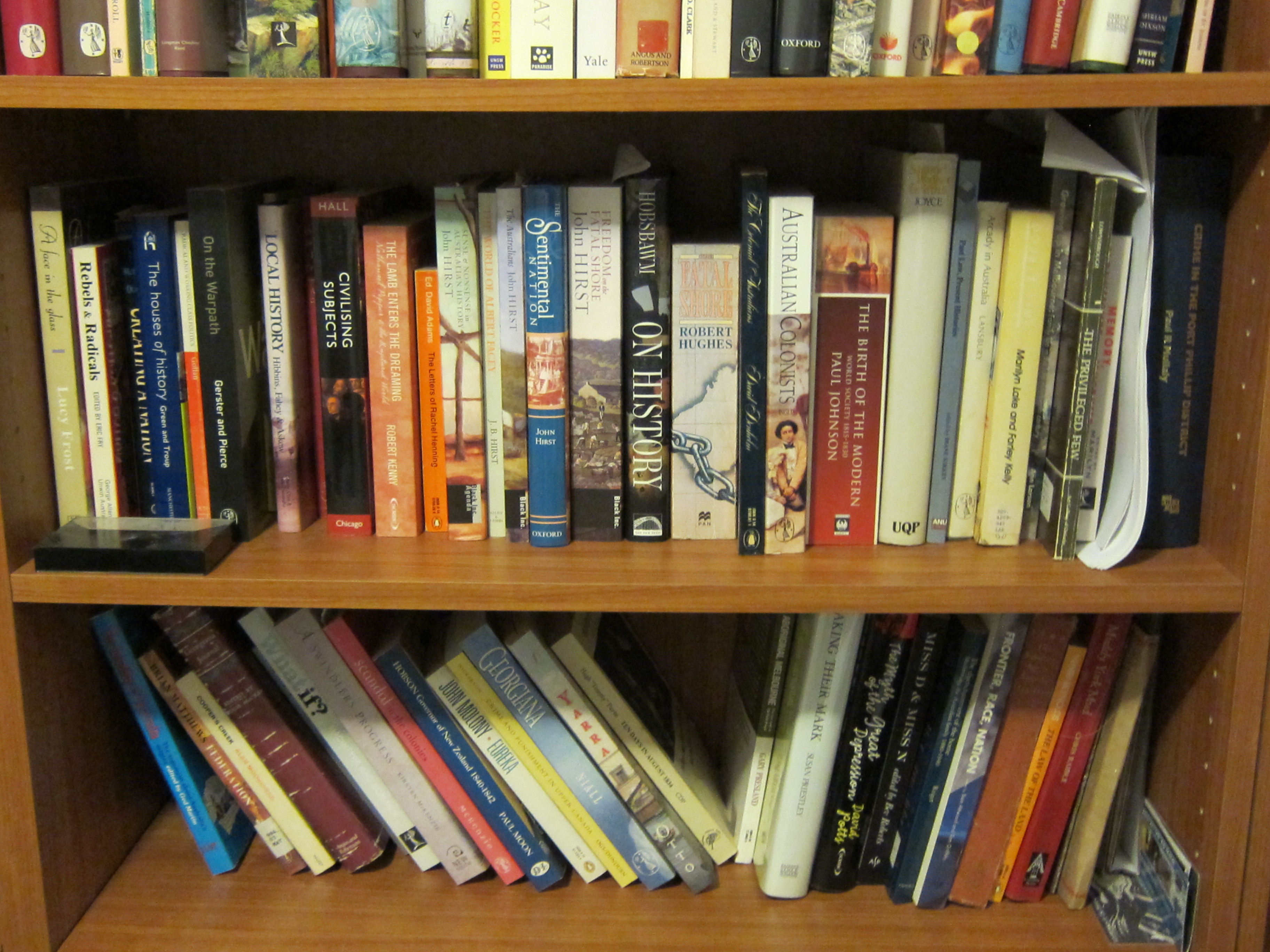
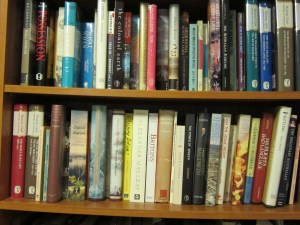
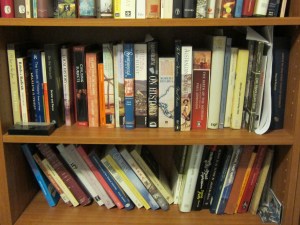
And certainly, if I turn my head to the left and look at my own bookshelves, there are many more books written by male historians.  I can think of a number of reasons for that.  First, I don’t very often buy history books new (whereas I do buy second-hand) and so any bias in the past will be reflected in the books I buy. I really am trying to have less clutter around, and so I borrow from the library, and try not to buy. But I’m often attracted to the remainder bin, the ‘Specials’ table and the second hand bookshop, and the piles of books that academics put outside their door when they’re cleaning up their offices…..and my bookshelves show the result.
IMG_0194

IMG_0195

Second, my area of interest is nineteenth century colonial societies in white settler nations- especially Australia and Upper Canada.  It’s a fairly old-fashioned sort of interest now, and was mined fairly heavily in the 1960s and 1970s.  I’m coming to it imbued with all the ‘isms’ and ‘turns’ of the past fifty years, but I must admit that many of the books on my shelf are terribly dated- and the bias towards male authorship in the 60s and 70s shows.

Finally, and related to this, early women Australian historians writing Australian history had a hard time even being recognized as academics, let alone published academics.  Some time ago, I wrote a post about Kathleen Fitzpatrick , a historian at Melbourne University who wrote, but abandoned, a book on Charles La Trobe that she had been working on for some time.  There is a suggestion that she withdrew from the field because another (male) historian was writing on him as well, and she didn’t want to compete with him.

Just recently, I read an article called ‘ The Writing of Australian Biography’ by M. H. Ellis who is depicted in his Australian Dictionary of Biography entry as just the sort of male historian that one might want to step back from.  It was published in Historical Studies (Vol 6, No. 24, May 1955) after being read before Section E of the Conference of the Australian and New Zealand Association for the Advancement of Science held at Canberra in January 1954.  I disagree with much of what he says in his paper, but what really struck me was the language. I’m sure that any female biographer with the audacity to even sit in the room slunk away quietly, well aware that she had no right to be there:

 No very young writer, hastily scrambling over a rich reef of documentary material, is likely to have the natural insight to enable him to distill from it a living image that will appeal as being the stuff of life to readers of diverse ages and mental outlooks in different periods, and inspire confidence in any picture he may draw of the mind and motives of a man of mature years… Nothing but slow filtering of essentials through the sieve of parallel experience can teach one man what makes another man function and behave as he does and enable him to put his findings down on paper in a manner to convince those who have endured or are enduring life that he is setting down truth.”(p 434)

Or how about this one?

There must be in all true biographers a natural and honest bias toward good principles, which are the yardstick by which men are measured.  Biographers should be the most human of men and subject to the decent prejudices and preferences which guide the ordinary citizen.  It would be right against human nature if such men did not involuntarily exhibit their likes and dislikes, their amusement or lack of amusement, their approval or disapproval, if they write from the heart.  But if he tries to suppress or falsify his natural emotions, then the biographer’s work becomes sodden dough or dead meat or false in note.  But in any case the chances are that when his subject takes control of his imagination he will be at his mercy if the man is worth writing about.  (p. 437)

Just imagine if a female biographer wrote about a female subject!!…ah, but would she be worth writing about??  It is sobering to think that this is the intellectual climate that our early women academic historians operated in.  It makes their few publications even more significant.

And so, for my Australian Women Writer’s Challenge this year, I’d like to consciously read and review some histories written by women.  Where possible, I’ll look for histories related to my thesis to review, but I’ll try to review them as a reader, rather than for the contribution they make to my own work. I did review a couple of histories for the Australian Women Writers Challenge last year, and I found myself consciously trying to make my review more general than I might have otherwise, and I’ll take the same approach this year.  Other histories I find, that are unrelated to my own work, I’ll be reading just as anyone else would, as I won’t have much pre-existing knowledge to bring to the book.

I often feel a bit diffident about reviewing books when I know that I’m going to run into the author- which is quite likely when reviewing Australian History books by Australian historians.   I get an attack of the M. H. Ellis-es, and I feel that I really have no right to review and that I should just slink out of the room.  But I shall stand tall (take that M. H. Ellis!!), knowing that on the few occasions when the connection has been made “Oh, so YOU’RE the Resident Judge!” (and I cringe at the presumption of my blog-name), there has never been any unpleasantness- to the contrary, in fact.

 

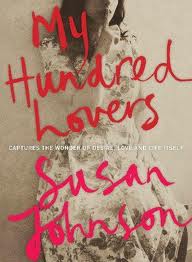
‘My Hundred Lovers’ by Susan Johnson

myhundredlovers

2012, 262 p.

I must admit that the whole Fifty Shades  phenomenon and its innumerable offshoots leaves me cold.   So it was with some trepidation that I borrowed My Hundred Lovers, hoping that a writer that I’ve enjoyed in the past would not betray me with a fleeting and warped assertion of empowerment through a string of  hot-breathed, moist, look-away sex scenes. I need not have feared. This is a beautifully written book, expanding love and sexuality to encompass the whole of life and being human.

It is written as one hundred chapters, each very short consisting rarely of more than four pages, and sometimes as little as a paragraph.  The hundred lovers here (such a daunting number!) are the spark between sensuousness and embodiment (in the sense of being in the body) and the whole range of a woman’s experiences.  There is  much for the fifty-year old reader to reflect and identify with here: the ambiguity of father/daughter physicality; the childhood sex play that I find myself looking back on and wondering about;  explorations of changing adolescent bodies; self-exploration;  sex for all the wrong reasons; sheer experimentation.  But sensuousness and being in the body is more than genitals and crevices: it’s also luxuriating in water, sand, heat; buttery croissants; it’s buildings and houses and landscapes; it’s friendship and companionship.

Unlike the sweaty, fervent erotic fiction that its title evokes, this book champions an older, wiser, more lived-in view of love.  It’s a view of love that  a fifty-year old reader does not feel disqualified from- if anything, it affirms and confirms what it sometimes takes fifty years to learn:

Love arrived smaller and more humble than advertised.  Love turned out to be plain, quotidian… She preferred herself now, less succulent and more loving, humbled, loved. (p.261)

This book is more than a list, it’s a life-story with relationships, losses, pain and confession, all measured out against the beat of passing time.  In fact, counting and taking measure is prominent here.  As she tells us in the opening sentence, romance between the average couple dies two years, six months and twenty-five days into marriage.   Most of us will live for a thousand months.  There are one hundred experiences in this book, numbered off in a countdown, and given that the book could have finished anywhere really, I found myself counting too…98, 99, 100.  Biography (including fictional biography as in this case) relies on the countdown of years and the elapse of time for its shape; unlike memoir which is an intellectual construction where time can be squeezed, stretched and compressed like clay.  This book combines the two- it is basically chronological in its structure, but events and reflection are intertwined and the whole  “100” framework is a literary and arbitrary construction.

The writing is crystal-sharp: quite an achievement in a genre that even has its own award for failure and mis-steps in the Bad Sex Awards– a dubious ‘honour’ that must surely shrivel up the juices of any writer.  Although it is completely self-contained in its own right, the author’s highly-acclaimed earlier work The Broken Book, a fictionalized biography of Charmian Clift, sits alongside it as a close companion.   They are both beautifully written, intelligent books.

My rating: 10/10

Sourced from: Yarra Plenty Regional Library

Read because:  I’d heard of it and very much enjoyed the author’s earlier works.  And I’ll backtrack a little and  count it for the Australian Women’s Writing Challenge 2013

awwbadge_2013

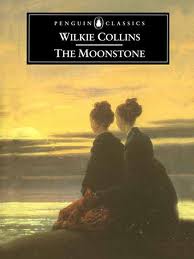
‘The Moonstone’ by Wilkie Collins


moonstone

1868 (reprinted 1998), 473 p in very small font!

Oooof! That took some reading!  Nothing like a big, flapping Victorian novel to gobble up reading time.

The Moonstone by Wilkie Collins has been hailed by some as the first detective story, and it certainly has many of the features of every BBC production you’ve ever seen: the amateur detective, the country house, the incompetent and bumbling police officer, the canny ex-policeman, sleep-walking, creeping round corridors in the night.

The Moonstone is a huge diamond, pillaged on a colonial adventure in India, and brought back ‘home’ to England where it is bequeathed by her uncle to Rachel Verinder on her 18th birthday.  That night, after her party, the diamond disappears.  Suspicions fall on three mysterious Indian gentlemen who have been seen around the country estate, and when an unnamed object is committed to the care of a banker for one year, it is assumed that it is the Moonstone.  Meanwhile there are distraught servant girls, opium addiction, quicksand…it’s got it all, really.

I’m not particularly enamoured of detective stories, but what really impressed me was how modern (or post-modern, really)  this book is in its construction.  After a brief prologue, detailing events of 1799, it is told in two parts or ‘periods’.  The first, set in 1848 is titled ‘The Loss of the Diamond” and consists of one long narrative,  ‘The Events, related by Gabriel Betteredge, House Steward in the service of Julia, Lady Verinder”.  The section period, “The Discovery of the Truth” is set a year later, and consists of eight separate narratives, contributed as statements, or drawn from letters and journals.  There is an epilogue, itself in the form of three statements.  It reminded me a little of Tristram Shandy in that Collins deliberately sets the narratives up against each other, parodying the author in some segments, and unsettling your confidence in others.  It could have quite easily come from the pen of John Barth (e.g. The Sotweed Factor) a hundred years later.

But, indeed, it was published in 1868 in serial form in Dickens’ magazine All the Year Round, which no doubt contributed to its rather daunting length.  We modern readers more accustomed to our books in 300 page bites, and I must admit that I did pick it up each night marveling at the fact that I seemed to have been reading for so long with still so far to go.  Still, at least when I got to the end of it, it was perfectly clear just what happened, instead of the rather vague endings in more recent books that leave you wondering whether you really do know who committed the crime after all.

It’s the first book for 2013 with my face-to-face bookgroup, and I’m wondering if others made it to the end.  I’m glad that I did, but I think what I took away from it was more a sense of admiration for Wilkie Collins’ writing than a driving need to know who-done-it.


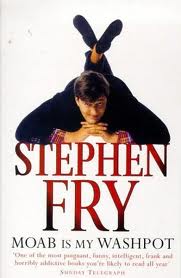
‘Moab is my Washpot’ by Stephen Fry

moabismywashpot

2011 (originally 1997),  434 p.

When, for what seems like years, the best-seller lists were dominated by Fifty Shades of Twilight (or whatever it was), one little spark of light was Stephen Fry’s ‘Moab is my Washpot’ which seemed to just hover there for month after month.  I had no idea what the title meant, and now, with this reissue, I find that obviously no one else did either because he has had to append an explanatory preface.  The title is a quote from Psalm 60 (‘Moab is my washpot, and over Edom I throw my sandal’). For the young Stephen Fry, it captured the idea that the world was a battleground between beauty and the barbarians, between sensitive souls like himself and the Phillistines who were everyone else.  For the adult, successful Stephen Fry, it now captures the “rebarbative, supersensitive and insanely solipsistic soul that I was”. He has a measure of affection for that earlier Stephen Fry though, and by the end of the book, so I do.

Despite his claims to be “middle class at a middle-class school in middle England” (p. 201), it’s certainly not a middle-class that many Australians would recognize.  Boarding school seems such a terribly British phenomenon,  the tattered photograph of his childhood mansion that he carried with him throughout his life is certainly no middle-class Australian home, and the language in which he revels is certainly English, but not Australian.

It is a very self-aware autobiography.  As he himself says:

…I was and am both transparent and opaque, illegible and an open book. (p. 319)

At times he addresses his putative reader: “Bloody hell, I do rattle on, don’t I?” (p. 256) and “Yeah, yeah, yeah- you were a thieving little tosser, we get the picture, we will draw the conclusions thank you.” (p 303).  You are constantly aware of his awareness that this is all construction.  He is, indeed, both transparent and opaque.  He seems to write with disarming honesty about his inability to sing and play sport, his late maturation into adolescence, the almost-expected school-boy sex play with his peers, and his long awareness of his own queerness in both senses of the word, his stealing, his arrogance.  In his writing about his infatuation with Matthew Osborne  all the Bridesheadness of his story drops away: a crush is a crush, and an exhilarating, searing, heightened, poignant, unrealizable and utterly human thing it is too.

But being a book written Stephen Fry, you are well aware through his use of  rolling, fruity, razor-sharp language that you are in the presence of a huge intellect and a huge ego very much in control of what he is divulging or choosing not to divulge. He’s aware of the power of his language too:

I have always wanted to be able to express music and love and the things that I have felt in their own proper language- not like this, not like this with the procession of particular English verbs, adjectives, adverts, nouns and prepositions that rolls before you now towards this full-stop and the coming paragraph of yet more words.

You see, when it comes down to it, I sometimes believe that words are all I have…Language was all that I could do, but it never, I felt, came close to a dance or a song or a gliding through water.  Language could serve as a weapon, a shield and a disguise, it had many strengths.  It could bully, cajole, deceive, wheedle and intimidate.  Sometimes it could even delight, amuse, charm, seduce and endear, but always as a solo turn, never a dance. (p. 101)

It comes as a surprise, then, to learn that he had to have speech therapy to slow down his speech enough to make it intelligible.  But even that’s part of the man too: the stream of synonyms and witticisms comes tumbling out so quickly that you can barely keep up and you feel that you’re drowning in his language. You sense that he’s toying with you as a reader too, and yet you don’t really want it to stop.  I think that I would be struck dumb with fear, completely intimidated,  if I were ever to sit next to him at the  hypothetical celebrity dinner party that people keep summoning up.   I very much enjoyed his book, but I think I prefer him safely in print.

My rating: 9/10

Read because: it’s a good before-bed read and I quite like Stephen Fry.

Sourced from: Yarra Plenty Regional Library.

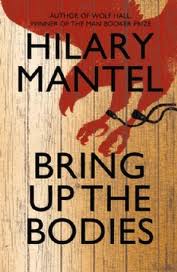
‘Bring up the Bodies’ by Hilary Mantel

mantel_bringupbodies

2012, 407 p.

I had promised myself two book treats over Christmas.  One was Rhys Isaac’s The Transformation of Virginia and the second is this one- Hilary Mantel’s Bring up the Bodies.  I had purchased it the very week that it became available…and of course it has sat on my bookshelf unread ever since.

I loved Wolf Hall, the first book in the series. It was one of those engulfing reading experiences, where you don’t want to pick up another book for days afterward because everything else will look sallow and weedy in comparison. I must admit that I haven’t been quite as blasted-away over this second book, but it is still a damned fine read and it had me sneaking away to grab 15-minute reads whenever I could.

It is written in the same second-person present tense voice as Mantel used in Wolf Hall– naturally enough, because it is a sequel.  It is at times a little ungainly: in a conversation between several men, she had to qualify “he-Cromwell….” when there were a few too many he’s around.  I found it distracting in the first book, but I fell more easily into it this time, and found that it served to evoke memories of the earlier volume.  That’s the problem with the second book in a trilogy that is published several years after the first: how can you remind the reader of what occurred earlier without burdening the book with flashbacks, and yet bringing new readers, unfamiliar with the earlier volume, along with you?  I found this with Amitav Ghosh’s  River of Smoke, and vowed then never again to read a series until it was completed.  Ah, but this is Hilary Mantel, and she struck just the right balance- and I think that her continued use of this unconventional narrative voice assisted her.

Thomas Cromwell is the main protagonist of this book as well, and while he continues to be a complex, conflicted man, you see the cold steel in him as well.  In the earlier book, Cromwell had negotiated Henry’s divorce from Katherine of Aragon in order to marry Anne Boleyn.  In this book, Henry has turned against the Boleyn marriage, and Cromwell again needs to shift and manipulate the pieces into place to meet the king’s desires.  The Henry/Anne story has been told many times, but not as quietly and with such menace.  Small events and conversations flit in and out, and it is only later in the book that you see them woven into the sticky web of coercion, blackmail and power that Cromwell so quietly and ruthlessly uses to immobilize his enemies.

Mantel helpfully provides a very good ‘who’s who’ at the start, arranged by place and allegiance.  I found myself referring to it often- maybe a little too often- but perhaps that reflects the nibbly way in which I read it, even though I would have loved to have read it in one big gulp.

Was it better than Wolf Hall?  I don’t think so- Wolf Hall was so big and so different that I don’t think any sequel could continue at the same intensity without becoming a parody of itself.   This book is tighter, more claustrophobic and more chilling.  Can’t wait for the third.

My rating: 9.5/10

Read because:  I knew that I would enjoy it and wanted to relish it.

Sourced from: my very own bookshelf.