Author Archives: residentjudge

‘So You’ve Been Publicly Shamed’ by Jon Ronson

ronson

2015,  269 P.

One of the problems with a media-savvy author who travels the world promoting his book is that by the time you get round to reading it, you feel as if you’ve already done so.

This was the case for me with this book, which I had heard about through multiple interviews on different Radio National programs. The author, who had his own taste of being the victim of cyber-stalking, becomes fascinated by the phenomenon of shaming over the Internet as a modern manifestation of an older form of punishment and social control.  In particular, he tells the stories of Jonah Lehrer who fabricated quotes in an article on Bob Dylan, and Justine Sacco whose flippant sarcasm in a tweet about being white and the likelihood of catching AIDS went viral. Both were deluged with internet outrage and it’s no exaggeration to say that their lives were destroyed.

Ronson examines the use of shaming in formal legal settings. He discusses Judge Ted Poe who orders deliberately shaming punishments for the offenders who appeared in his court, and he fact-checks the Stanford Prison Experiment which has been offered up  as ‘evidence’ that we are all capable  of evil actions once a social-media crowd phenomenon gets started. He meets people who have started internet fire-storms, and attends a shame eradication workshop established by an enterprising psychotherapist. Finally, in a hopeful sign that there can be redemption, he meets representatives of a company which specializes in white-washing Google search results for people who have been subjected to public shaming.

Of course, through his book Ronson shames these people again by publicizing their plights anew and I found his smug voyeurism rather off-putting. Nonetheless, many of his points resonated.  I found myself thinking of Monica Lewinsky’s powerful TED talk The Price of Shame and Waleed Aly’s recent Andrew Olle lecture where he noted the rush to emote rather than to think.

The book was an easy enough read. I just felt that I’d already heard it all before.

Source: Yarra Plenty Regional Library

My rating: 7/10

This Week in Port Phillip 1842: January 1-7

In 1842, there wasn’t the extended January break that we now enjoy. Instead, things returned pretty much to normal after New Year.  But let’s just laze around a bit longer for this first week of the year 1842.  I did write about New Years Eve/New Years Day 1841 in an earlier posting, so you might want to flip back to have a look there. My posting for this week is an elaboration on that description of the New Year holiday 1842.

What was on New Years Day 1842?

1. The William’s Town Festivities

newyearsday

The day dawned fine:

The dawning day exhibited a most favourable promise of congeniality; the blueh eavens were unspooted with a cloud, and as the sun arose gloriously refulgent, casting his invigorating beams on the glad earth, a light breeze sprung up, gently rippling the face of the still waters… in fact every prospect was afforded of what is, in Australia Felix, emphatically termed “a beautiful day”, when the purity of the air is such, and the alternations of heat and coolness so nicely poised, that it is impossible for the imagination to conceive, or the desire to yearn for an atmosphere more grateful to the sense.[PPP 3/1/42]

Williams Town was a-bustle getting ready:

On Saturday, the first day of the present year, the good folks at WilliamsTown were on the qui vive at an early hour in the morning, to do justice to the bill of fare which had been drawn up for the occasion, and have everything in readiness by the time the shoals of Melbournites had arrived, who came dropping in after nine o’clock by all modes of conveyance,

” Some pushed along with four-in-hand, while others drove at random

In britsky, buggy, or go cart, curricle, or tandem.”

others sought, the more gliding motion of the London wherry, the gig, or the whale-boat, exhibiting their separate insignia, and stoutly struggling as to whom should first arrive at the goal of contention; lively strains of music came wafting over the water, and added much to the hilarity and excitement of, the scene. The Aphrasia steam boat was also laid on for Williams Town for that day, and was filled with a most respectable assemblage. The Town band engaged for the occasion took up its position in front of Dawson’s, Albion Hotel. The committee of management, consisting of Captain Lawrence, Messrs, Hutchinson and Latham, and Mr. John Davies having been appointed Judge of the sports, finding every thing in readiness, orders were given that the amusements should commence, which was attended to by the

GIG RACE,For gigs pulling four oars, coming off. The prizes were for the first boat £6, and for the second £3. The boats entered, consisted of Captain Sullivan’s, Caroline,(white),Mr. Austin’s Fairy Jane, (green,)and Mr. Levien’s Mary Ann, (black.) Distance: from a boat moored off the wharf, round the shipping and back again. At starting, the gigs kept together in excellent style, but after some short distance, it was clear the Caroline was drawing a-head; the scene now. became particularly animated and interesting, the Fair Jane, with the Mary Ann close on board, struggling hard for the superiority ; the Caroline, however, kept the lead, and came in upwards of one hundred yards before her adversaries. The following was the result.

Caroline 1

Fair Jane 2

Mary Ann 3

The Caroline performed the distance, about four miles, in twenty minutes. The

JUMPING IN SACKS,

which had been added to the amusements of the day by way of novelty, was next exhibited, and probably produced more fun than anything going during the day. Four men named Brown, Freeman,Moffit, and Hussey, were the competitors for the £2 prize, and appeared to think the affair quite a matter of course. The candidates having been introduced into the canvass were duly arranged in a line, and “start,” was the word; Brown shot ahead like a planet in its sphere ;Hussey found himself prostrate with his nose exhibiting the process of drill husbandry upon an improved system; Freeman bit the dust, and was released from his confinement, after going through as many contortions as an eel in a sandbasket ; Brown and Moffit had it all to themselves, and the first heat terminated by Brown coming in winner. The second heat had a similar termination, causing immense sport.

The next article on the bill of fare was

A FOOT RACE

For £3 Between three competitors, C.M’Intosh, C. Buckley, and M. Mooney.The contest was spirited, and the spectators appeared well satisfied with the exertions of the runners. After one false start, the race was decided in favor of C.M’Intosh, who clearly evinced his ability to trip it on the light fantastic toe.

The hour of two having arrived, it was thought judicious that the Lion should feed, Mr.Dawson having gratuitously provided a glorious spread for that purpose. About three hundred availed themselves of the opportunity, and ample justice was done to a sheep which had been roasted whole, and an enormous round of beef with the usual concomitants. The scene was rich and entertaining, and varied with all the tints of the rainbow- Here might be seen in one corner a bush man tendering to his lady love a cube of beef, delicately tinged with mustard, and inviting her to soothe her irrited[sic] feelings by its demolition ; in another portion of the apartment, a miniature Hercules was slaughtering the sheep, and accommodating the various claimants with portions, not exactly dismembered according to the strict rules of anatomy, ” Cabbage, oh” was vociferously shouted by an active youth, who distributed the foliage in such portions as he thought correct. The popping of corks, the gurgling of the liquor, with a thousand other et ceteras, contribute: to make up a scene worthy the easel of Wilkie. [PPG 5/1/42]

The Port Phillip Patriot was likewise amused by the scenes at the free lunch:

THE FEED. Father Time, combining business with pleasure had, but the completion of the occurrences we have narrated, caused the hour hand of the dial to closely approximate to the hour of two, and half past one being fixed upon as the period of commencing the grand feed liberally provided by Mr Dawson for the occasion, the assembled multitude were invited to partake thereof, “without money and without cost”. Accordingly a rush was made towards the feeding room, where was to be seen at one end of the table a sheep roasted whole, and at the other an immense round of corned beef; the interval being garnished with concomitants…. The scenes that followed were worthy the pencil of a Cruikshank. At one side of the table might be seen a man busily dividing a junk of beef and a loaf of bread, between himself and three females, while in another place a curious wight was examining the contents of the cruet of cayenne, as suspiciously as if it contained poison.  One individual, who evidently possessed  great talents as an explorer, after probing the carcass of the unfortunate sheep, discovered an enormous lump of fat, with which he danced round the room in ecstasies, calling the attention of his acquaintances to the circumstance of it being “a nice bit for making candles”. Another audibly expressed his opinion that their entertainer was a “jolly good fellow” and that he would always take care to patronize him when he gave a dinner on the same terms.  Between 200 and 300 persons availed themselves of this pro bono publico dinner, and, as may be supposed, by the time the room was finally deserted, the beef, mutton and “wegibles” were but as “things that were” [PPG 3/1/42]

Lunch disposed of, let’s go back to the games and frivolity:

THE SAILING MATCH,

Between Mr. Thompson’s Ariel and Mr. Dawson’s Lively, next came off . The odds at starting were considerably in of the smallness and peculiar build of the Ariel but all is not gold that glitters ; the Ariel proved her superiority at starting, and maintained it throughout the race. Running too near in shore, the Lively grounded, leaving the Ariel to take it easy-for the rest of the run, and to her judge and committee awarded the prize. The owner of the Lively wished to make it a drawn match, but the former decision was confirmed. It is expected that these boats will again try their respective merits for £40 a side. The above match being brought to a close, the

WHALE BOAT RACE

Was called on. Three boats were entered, the Cornstalk, William, and Paddy from Cork, and the prizes, for the first boat £10, and second ditto £5,with entrance money added. At starting, the contest was very spirited, the boats keeping abreast for a considerable distance; shortly after the Cornstalk took the lead, which she kept in admirable style throughout. The result was,

Cornstalk 1

William 2

Paddy from Cork 3

The winning boat, as well as the second in, are of colonial manufacture, having been built by Mr. Charles M’Intosh of Williams Town. The Paddy from Cork is what her name denotes.

THE GREASY POLE.

Next excited the interest of the company being surmounted with a very tolerable tile, to obtain which it was necessary to travel through various states of Greece. Several attempts were made to reach the beaver without effect, and some of the aspirants even went so far as to touch the under portion of the brim, and then found themselves again on terra firma —a most annoying circumstance. At last, as the competitors stood gasping for breath, one of the sons of Mr. Liardet,of the Pier Hotel, essayed the attempt. As Beau Brummell left on his writing-table that invaluable secret which has caused so much discussion in the beau monde, as to the stiffening of cravats, that starch was the man, so did young Liardet exclaim on seizing hold on the pole, ” Sand is the man!” and after making a liberal use of this article, with which he had loaded himself like a Blackheath donkey, he quickly attained the dizzy height, mounted the castor, and was quickly upon his legs.

A WHEELBARROW RACE

Concluded the sports of the day. Four men started blindfolded for a prize of a£1 : the sport was capital, the contending parties making off  in all directions except towards the winning post. In consequence of a quibble, the race was run over a second time.

THE DINNER

Followed at six o’clock, got up in Mr Dawson’s best style — that is saying every-thing. About fifteen guests sat down to the repast, and did ample justice to the entertainment. During the dinner, the band played several enlivening airs, and the guests perpetrated the usual loyal and other toasts, and broke up about twelve o’clock. In the evening a concert was held at the Victoria, when a Miss Sinclair made her debut with considerable eclat. Thus ended the amusements of New Year’s day in Australia Felix. [PPG 5/1/42]

2. A concert at the Pavilion

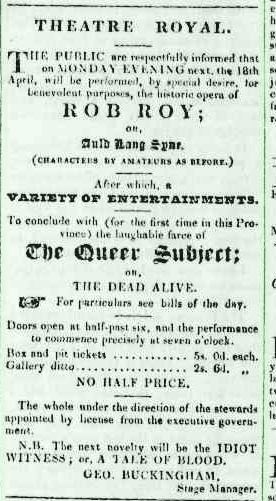
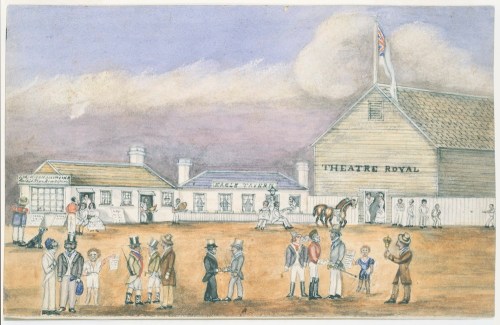
Perhaps a concert at the Pavilion theatre might be more to your taste?

The concert at the Pavilion on Saturday evening to see in the new year was numerously attended. Although there were a number of rather suspicious characters loitering about the Pavilion who had been properly excluded, and those granted entrance were “not all of the upper ranks of society” but they conducted themselves with propriety.  The Pavilion will soon be a most fashionable place of resort.  The star “Miss Sinclair” has excellent command of a good voice, and with a little more practice her success as a vocalist is certain.  Miss Lucas labored under the effects of a heavy cold. When Miss Lucas had to withdraw, an amateur entertained the audience with a variety of dances, expert gesticulations &c and deservedly stands a favourite. [PPH 4/1/42]

3. A bank opening

What a strange time to open a bank for the first time! I assume that the Saturday opening hours were for the benefit of tradesmen and shopkeepers who might want to bank their week’s takings.  Obviously the bank preferred people to put money in, rather than take it out!

Port Phillip Savings Bank open for business on Saturday night 1 January.  Opening hours for receiving deposits Saturday 7-8 p.m. and Wednesday 1-2.  Repayments to depositors on Wednesday only 1-2. [PPG 1/1/42]

4. A Ticket-of-Leave Muster

Even though Port Phillip wasn’t strictly speaking a convict colony, there were convicts, assigned servants and ticket-of-leave prisoners there.  On 1 January each year, there was a Ticket-of-Leave Muster, just to make sure that everyone was where they should be.

5. A cricket match

There was a cricket match between the government officers and the civilians.  The government officers won.

6. A game of shinty

SHINTY. On New Year’s day a splendid game at the good old Scotch game of shinty came off on Mr Donald McLean’s farm on the Merri Creek. About twenty stalwart Highlanders ranged on either side, and the game  was so keenly contested that after a four hours’ struggle under the broiling heat of the mid-day sun the parties were fain to withdraw the game, neither party able to gain the victory. [PPP 6/1/42]

7. A hot roast dinner at the jail

NEW YEARS DAY. On Saturday last, the first day of the new year, the whole of the prisoners at present confined in Her Majesty’s jail, at Melbourne, were regaled with roast beef and plum pudding, at the expense  of His Honor Mr Justice Willis, who had kindly directed that no cost should be spared to make the prisoners as comfortable as their unhappy circumstances would admit. The arrangements for the feast were made under the superintendence of Mr Wintle, the jailer. [PPP 6/1/41]

So how’s the weather?

For the week 1-7 January, the highest temperature was 96F (35C) and lowest 60F (15.5C). “Light airs early in the morning, followed by strong winds A. M.  Fine weather 1st,2nd,6th and 7th, oppressively hot 3rd, followed by squalls and rain”

‘H is for Hawk’ by Helen Macdonald

hisforhawk

283 p & notes, 2014

I’m not quite sure how Helen Macdonald managed to interweave a detailed and rather technical book about training a goshawk with a clear-eyed description of a profound grief that almost tipped into madness. But manage it she does, educating millions of readers about the minutiae of falconry along the way, and I found myself missing the narrator and her storytelling when I finally finished the book.

Helen Macdonald is a historian who was in the third year of a fellowship at Cambridge University and nudging 40 years of age when her father, a noted photojournalist, died. She was plunged into a deep, and (I think) unhealthy and somewhat warped grief, not unlike that of Caroline Jones whose book I reviewed rather harshly here.  She had a mother and brother of whose own grief she is completely oblivious, but through the death of her father she was brought completely undone by her own loss of a mentor and fellow-bird enthusiast.

One of her favourite books as a child was T. H. White’s The Goshawk, which tells of White’s unsuccessful attempts as an ‘austringer’ with his own goshawk, Gos.  Trying to reconnect with her father and the security of the father-young daughter relationship, Macdonald re-reads White’s book. However, by now she is conscious as she never was as a child, of White’s biography written by Sylvia Ashton Warner which reveals White (the author of The Once and Future King which was later adapted into the movie Camelot) to be a deeply unhappy homosexual teacher who struggled with his attraction to sadomasochism and flagellation.  White’s harsh and driven training of his goshawk, using medieval training methods, seems to be another manifestation of cruelty and fetishism.  For Macdonald, who has procured her own goshawk, re-reading White provides a salient less in how not to train.

It is these two narratives of bird-training, then, that run through the book: her own training of Mabel the goshawk, and White’s unsuccessful training of Gos in the 1930s.  There’s lots of arcane vocabulary that by the end of the book you identify immediately, like ‘yarak’ (being in heightened hunting mode), ‘bating’ (rising up with wings flapping) and ‘mute’ (a more genteel word for bird-shit).

Closed in on herself and her own grief, there are only fleeting mentions of the outside world: she likens the goshawk’s hood to those worn at Abu Ghraib, or listlessly notices the crowds outside the Northern Rock bank during the 2007 financial meltdown.

Her identification with Mabel runs at a deeply existential level

I’d flown scores of hawks, and every step of their training was familiar to me. But while the steps were familiar, the person taking them was not. I was in ruins. Some deep part of me was trying to rebuild itself, and its model was right there on my fist.  The hawk was everything I wanted to be: solitary, self-possessed, free from grief, and numb to the hurts of human life.  I was turning into a hawk. (p 84)

The narrative pull of this book is watching Macdonald gradually find her way out of grief.  It’s a beautifully written book, sharply descriptive of Mabel the goshawk, clinical in the author’s own observation of herself and her grief, and poetic in its descriptions of landscape.  No wonder it won the Samuel Johnson Prize for Non-Fiction in 2014.

My rating: 9/10

Sourced from: A friend who lent it to me months ago and probably thinks I’ve lost it.

This Week in Port Phillip 1841: 24 -31 December 1841

Of course, Port Phillip celebrated Christmas on 25 December, along with the rest of the British Empire.  In 1841, 25 December was a Saturday, thus providing a two-day holiday. It’s a sobering reminder of the rarity of holidays in the nineteenth century, with no paid leave available until 1935.

Christmas Day falling on a Saturday gave two consecutive holidays to the labouring classes, in whose pleasures, as well as that of the residents at large, the unusual coolness of the weather at this time has greatly contributed (PPG 29/12/41)

[Casualization and barely-restricted retail opening today means that a proportion of workers no longer get paid annual leave, or indeed two consecutive days holiday.  The traditional January-shutdown of industry is becoming a thing of the past, too.]

Christmas celebrations

I’ve written about Christmas in Port Phillip in 1841 here and about Christmas in Port Phillip during the early 1840s here.

However, on 5 January a letter was published in the Port Phillip Herald by a Mr. J.R.M. of Douttagalla, praising the simple joys of a Christmas ‘pic-nic’ on the Salt River. It all sounds rather too wholesome and improving:

 A PIC-NIC AT THE SALT WATER RIVER, CHRISTMAS 1841

“Here, for retreat in sultry hour

Some hand had formed a rustic bower;

It was a lodge of ample size

But strange of structure and device

Of such materials as around

The workman’s hand had readiest found”


I was repeating these lines as I entered “the sylvan shed” where our little party had laid out to pass the afternoon. But my attention was soon arrested by the exceeding beauty of the scenery around us.  There, in the foreground, and only a few yards from our feet, lay a noble sheet of water, calm as “a cradled infant”, and margined with various specimens of the monoperigynae and monopetalae. Up the slanting sides of the ravine grew the tall and stately tea tree and cleagni, interwined with the teazles and woodbines of the corisantherae, here and there pushing out a pretty pale corolla, as if beauty and innocence had been engaged in decorating grace.  Farther off in a deep recess, the gigantic gum-gree stretched forth its bare white branches, like a skeleton in a green house! Or like a dream of paradise after death had entered there! The field of view from the bower was such a picture of nature’s own beautiful embroidery as would have elicited and harmonized with the exquisite imagery of Claude Loraine.

The party consisted of no more than Mr and Mrs H____ with their six fine children and myself. The boys entertained us by reading and reciting in excellent style pieces selected for the occasion; and the little girls, playful and sportive as young fawns, went skipping about in all the happy enjoyment of domestic felicity…

The viands were in admirable keeping with this little family picture:- plain, substantial and elegantly laid on the greensward, canopied by wreaths of flowers and foliage, as if the Naiads and Limnades had consecrated this spot to retirement and primitive innocence…

On leaving this scene of rural and domestic happiness, I could not help reflecting on it with pleasure and admiration. There sat the fond father and mother in the bosom of their young amiable family, enjoying their pleasures, and participating their amusements. How truly rational these enjoyments! And how exalted they stand in contrast with other anniversaries I had previously witnessed of a Chrismas merry-making- where reeling riot and desecration had usurped the throne of intellect, and man- the lord of the creation- seemed to have forgotten dignity, abandoned reason, and trampled on gratitude to HIM whose name was announced at this happy season in “tidings of great joy to all the people,” and should fill the heart with love and joy, and ineffable glorification at a Christmas merry-making.  J.R.M. Douttagalla, 27 December 1841.

Getting rowdy

Perhaps it was too much Christmas cheer, or the warm weather, or the increase in numbers of immigrants, but it seemed that the newspapers- most particularly John Fawkner’s Port Phillip Patriot – were especially conscious of unruly behaviour among the labouring classes.

Rowdy groups appeared to congregate around Little Bourke Street, which by 1855 was a centre of Chinese activity.  Already in 1841 it was known as a slum area.

SABBATH BREAKING. A number of idle vagabonds are in the constant practice of openly profaning the Lord’s Day by congregating in Little Bourke-street and there amusing themselves by gambling with half-pence, playing at ball &c. On Sunday week we observed about thirty persons employed in these practices.  The non-apprehension of the ringleaders in these sports evinces a very unpardonable negligence on the part of the constabulary; we trust, however, that this public notification of the nuisance will have the effect of preventing  its recurrence. (PPP 27/12/41)

Nefarious activities took place off the street as well:

DISORDERLY HOUSE One of the greatest nuisances which has existed in Melbourne for some time past has been a house of ill-fame situated in a lane leading from Bourke-street. On Friday last, at the police office, two notorious characters named Peter and Elizabeth Toote, were fully committed to take their trials for keeping this nest of infamy. From the evidence for the prosecution, it appeared that scenes of the most revolting nature were there nightly carried on, and that it was also a receptacle for the most notorious thieves in Melbourne. (PPP 27/12/41)

On the 27th December there was a ‘riot’ in Brunswick Street Fitzroy (then known as New Town).

DISGRACEFUL RIOT – A most disgraceful scene took place on the night of Monday last, in the neighbourhood of Brunswick Street, New Town. Some vagabonds of both sexes, principally Irish, had congregated together and were engaged in fighting each other with sticks, tomahawks, stones or any other missile which they could conveniently obtain, accompanying their efforts with vollies [sic] of oaths and imprecations; nor was peace and good order restored the whole evening. As the constabulary force is to be increased by twelve men at the end of the present year, we trust that the authorities will see fit to station at least two of that number at New Town where they are much required. (PPP 30/12/41)

It was a shame really, as the Police Magistrate had just that day acquitted all but one of the revellers arrested over the Christmas/Boxing Day holiday:

VOTARIES OF BACCHUS. On Monday last, the Police Magistrate discharged all the parties, with one exception, who had been taken up during the Christmas holidays for drunkenness, the exception was that of an old offender, who has accommodated with a seat in the stocks for four hours. PPP 30/12/41)

Concert and Tradesmen’s Ball

There was more to do than brawl on Monday 28th, because it was the night of the Tradesmen’s Ball. It was held at the Pavilion Theatre, which I have described previously.

CONCERT AND BALL. By PHIL GARLIC

“.Past ten o’clock” sang out the watchman, as we were wending our way homewards through Great Bourke-street. “Past ten o’clock,” and the information came to us unexpectedly for we had been engaged in ” counting hours for minutes,” we had, in fact, been Romeo and Julietizing; the scene in Capulet’s garden was fresh in our remembrance, and as we soared along we repeated to ourselves

“The brightness of her cheek would shame those stars

As day light doth a lamp : her eye in heaven

Would through the airy region stream so bright .

That birds would sing, and think it were not night.”

How far we would have gone on in our rhapsody is uncertain, had not the Pavilion presenting the unusual aspect of an illuminated front burst upon our view, and we paused to inquire the meaning of such an appearance. Mr. Hodge informed us that the tradesmen of our infant city were celebrating Christmas by holding a concert and ball, and his kindness politely afforded us admission to the scene of festivity.

We will not say that our eyesight was dazzled by the beauty and splendour of the scene, but we must say that we were charmed by the neat dresses and happy faces every where visible. Many of the ladies were in “full dress” in honour of the occasion ; one in particular, who had arrayed ” the temple of her thoughts” (a very handsome little edifice it was) in artificial roses bound up with pearl white satin ribbon, we admired exceedingly. On the other hand, we will not deny that we experienced sincere emotions of pity for several of the dear creatures, who were compelled to hold their bonnets on their knees to avoid their being crushed, and were thus kept in a fidgety state, the whole evening; others very wisely tied theirs on the pillars, which had the double effect of putting them out of harm’s way and adding to the ornaments of the building.

We had scarcely taken a hurried glance at these arrangements when a gentleman in very ” dickey” apparel appeared and sang ” Sich a gettin’ up stairs,” which was received with great applause and encored. Then a little boy with a shrill voice sang “Isle of Beauty,” and after that a gentleman splendidly attired in a blouse, with a red button-up waistcoat, and light trousers announced that “as soon as the feenarly was over the ball would commence.” And accordingly we had the finale ” God’ save the Queen'”- but nobody seemed prepared for the ball.

On the contrary, the company, many of whom, to judge from the incessant popping of corks, were enjoying themselves exceedingly, were by no means satisfied with the banquet of sweet sounds dished up by the careful Hodge. Loud calls were heard for “Jack Rag,” and ” Jack Rag”, became with the rougher sex an almost universal cry, till at last we in our simplicity imagined that Jack Rag was a very boorish sort of person not to come forward and speak to his friends, seeing that they were so clamorous for his appearance.. ” Jack Rag” however, turned out to be an epithet conferred on the gentleman who sang ” Sich a gettin’ up stairs,” but he with a proper spirit disdained to appear when called upon so disrespectfully.

The singing, too, was properly speaking over, and Mr. William Cooper, a son of Vulcan, who officiated as master of the ceremonies, stept forward and with it a few stamps a la Richard the Third succeeded one by one in extinguishing the lamps in front of the proscenium, which, as they were severally operated on, sent upwards a I gracefully picturesque cloud of smoke. Loud cries were ‘ now heard for “Mr Cooper’s song,” but Mr. C. was “no wocalist,” and so he assured the ladies and gentlemen. “Cooper’s song,” reiterated a mischievous wag in one of the boxes to the right. ” Lay down,” responded that worthy gentleman looking daggers at the disturber, but the clamour was not so easily subdued, and the noise and calls for the song continued.

The master of the ceremonies looked excessively angry and excessively puzzled.- “Leave them to me, I’ll manage them,” at last imploringly whispered a hanger-on of the establishment  – ” Leave them to you!” indignantly replied the insulted gentleman; “No, I’m master here,” a demonstration which was received with loud applause. ” Ladies and gentlemen,'” continued Mr. Cooper, “but I won’t say the ladies, for they know how to behave  themselves, but I say, gentlemen, I’ve come here to enjoy myself, and I hope you’ve done the same, so don’t let us have no rows.’

Order was then restored, and Mr. C. intimated, that ” as Mrs. C. didn’t feel inclined, he would feel obliged if any lady would lead him off in a quad-drilll.” No answer was made to this appeal, but a respectable costermonger at length succeeded in giving  an impetus to the affair by promenading with a fair friend up and down the stage which would have been n delightful exhibition only that by keeping his hat on he somewhat, marred the effect. A country dance was soon arranged ; ” haste to the wedding,” was struck up, and “hands across” ” up and down the middle ” &c., &c., were gone through in beautiful style. One remark we feel bound to make— we hate egotism in every shape, and therefore we consider the conduct of the gentleman in top boots (” we mention no names,” but we believe him to be an ostler,) who danced in a corner by himself, highly reprehensible.

To conclude ; at eleven we were compelled reluctantly to leave the gay and be-witching scene of festivity, highly delighted at the exhibition of the happiness which prevailed throughout. We consider much praise is due to the getters-up of the affair, not only for the intention, but the successful mode in which they succeeded in carrying it out, and we therefore beg to wish them “many happy returns of the season.” (PPP 30/12/41)

A Christmas Box

I’m not sure about the receipt of Christmas boxes in general, but the apprentice working for the barrister Horatio Nelson Carrington certainly received a box around the ears two days before Christmas. It demonstrates how much physical punishment was condoned under the Master and Servant legislation then in force.

AN UNTOWARD APPRENTICE. — Mr.Carrington, the solicitor, had occasion on Thursday, to bring before the Police Bench an apprentice, for the most improper conduct. It appeared that the previous evening, upon Mr. C. going home and not finding preparations for dinner at five o’clock, as he had directed, he enquired of the boy the reason, when he coolly replied that he had better do it himself ;  naturally irritated, Mr, C. gave him, both correctly arid legally, a box on the ears, when the young urchin turned round and seized him by the lappelle of  the coat,  some knives were lying on the  table, and the boy made towards them, evidently with the view of stabbing Mr.C., who rushed him out of the room. Just as Mr. C. let go of his hold, the boy struck him a violent blow on the side of the head. A horse-whip being produced, Mr C. gave the boy a most judicious whipping, and then handed him to the care oft the police.

The Bench sentenced the boy to fourteen days in a cell, and Mr. Carrington said that he would give up the boy’s indentures and pay his expenses in the Seahorse to Sydney; he belonged to the Orphan School. Mr. C. said further, that the boy had the most vicious turn of mind when spoken to; he was constantly in the habit of replying,” My father was a lag, my mother was a lag, and I hope to be a lag myself.” No doubt the wish of this young gentleman will be carried out in due time. (PPG 25/12/41)

How’s the weather?

Southerly breezes ensured that the weather remained much cooler for this last week of the year. There was one day of 88 degrees (31 degrees) but the rest of the week was more temperate.

Fresh and strong winds or gales almost constant; weather cool for the season and much clouded but with little rain.

And with that- on to 1842!!!  (and 2017!)

‘La Mala Hora’ (In Evil Hour) by Gabriel Garcia Marquez

lamalahora

(1962, 183 P)

I read this as part of the Coursera course that I’ve been following on Gabriel Garcia Marquez. I read the book in English (of course!) but the online course that analyses the books is in Spanish. There’s nothing quite like trying to follow something fairly abstract in a language that you’ve only beginning to learn to slow your progress!

This short story was originally published in 1962 as ‘This Town of Shit’ but Garcia Marquez disavowed the original version and rewrote it.  I read it as part of a collection of short stories, but running at over 150 pages it is more strictly speaking a novella.  It foreshadows many of the themes of One Hundred Years of Solitude and he has used other sections in other stories as well.

It is set in an unnamed town, where someone is posting lampoons (ie.satirical posters) about local personalities and their hypocrisies and secrets.  It’s not made clear who the lampoon-poster is, but after a man is murdered on account of the rumours, eventually the Mayor cracks down. He declares martial law and uses the opportunity to rid the village of his political enemies.  The threat of violence hums throughout the story.   At the same time, the humidity congeals and the rain pours down without stopping. As a result, it’s a rather suffocating short story, where you almost will the violence to come down, to break the anticipation.

Australian Women Writers Challenge 2016 Completed

These are the books that I read for the 2016 Australian Women Writers Challenge.  I had great intentions of reading more history books written by female historians but I only read five.  I seem to have read more memoirs than I realized.

Oh well. Next year. Roll on 2017

January 4, 2106. You’ll Be Sorry When I’m Dead by Marieke Hardy

January 5, 2016 The Convent by Maureen McCarthy

January 7, 2016  In My Mother’s Hands by Biff Ward

January 23, 2016  Hello Beautiful! Scenes from a Life by Hannie Rayson

February 17, 2016  Leap by Myfanwy Jones

March 4, 2016  High Seas and High Teas by Roslyn Russell

April 20, 2016 The Natural Way of Things by Charlotte Wood

May 4, 2016  Blockbuster: Fergus Hume and The Mystery of a Hansom Cab by Lucy Sussex

June 20, 2016 From Rice to Riches by Jane Hutcheon

July 4, 2016 The High Places by Fiona McFarlane

July 13, 2016 Fractured Families by Tanya Evans

August 3 2016, Reckoning by Magda Subanzski

August 19, 2016  Skin Deep by Liz Conor

September 9, 2016  Tiger’s Eye by Inga Clendinnen

October 3, 2016 Of Ashes and Rivers That Run to the Sea by Marie Munkara

December 5, 2016 Everywhere I Look by Helen Garner

December 15, 2016 Living with the Locals by John Maynard and Victoria Haskins

December 19, 2016 Only Daughter by Anna Snoekstra

December 22, 2016  The Good People by Hannah Kent

December 26, 2016  Wicked But Virtuous: My Life by Mirka Mora

December 28, 2016  The Light Between Oceans by M.L.Stedman

‘The Noise of Time’ by Julian Barnes

barnes_noise

2016, 180p.

I must confess that it took me some time to work out that the subject of this small novella is Dimitri Shostavkovich. In the first part of the book, Shostakovich is an unnamed ‘he’, waiting by the lift outside his apartment, a small suitcase at his knee, expecting to be arrested. “All he knew was that this was the worst time.” (p. 7) His composition, Lady Macbth of Mtsensk had been denounced by Pravda, and critics who had previously praised it quickly distanced themselves from it.

They always came for you in the middle of the night. And so, rather than be dragged from the apartment in his pyjamas, or forced to dress in front of some contemptuously impassive NKVD man, he would go to bed fully clothed, lying on top of the blankets, a small case already packed on the floor beside him. He barely slept, and lay there imagining the worst things a man could imagine.  His restlessness in turn prevented Nita from sleeping.  Each would lie there, pretending; also, pretending not to hear and small the other’s terror. (p. 15)

We meet him again on a plane, returning home from a trip from America twelve years later. In front of the world’s media, he has been humiliated as a Soviet stooge. “All he knew was that this was the worst time.  One fear drives out another, as one nail drives out another.” (p. 61).

And then we meet him again, another twelve years on, in 1960, when he is being pressured to join the Communist party,  repeatedly, strongly and with the threat of violence. The violence is always suspended – for now.

All he knew was that this was the worst time of all.  The worst time was not the same as the most dangerous time.  Because the most dangerous time was not the time when you were in most danger.  This was something he hadn’t understood before. (p. 115)

We often read books of courage and resistance, but less often of extorted compliance. As the Shostakovich character reflects, anti-communist sympathizers wanted martyrs, thus themselves becoming like Power (always written with a capital letter and never specified) in that whatever he gave, more was always demanded.

Under the pressure of Power, the self cracks and splits.  The public coward lives with the private hero. Or vice versa. Or, more usually, the public coward lives with the private coward. But that was too simple: the idea of a man split into two by a dividing axe. Better: a man crushed into a hundred pieces of rubble, vainly trying to remember how they- he- had once fitted together. (p. 155)

I often tend to think that cowardice is an easier option than bravery: when I hear of acts of heroism, I often wonder if I would have it in myself to act in the same way. But if this is a book about ‘cowardice’, it’s a cowardice that has no upside. Instead it deadens and leaches the joy from life:

… But it was not easy being a coward.  Being a hero was much easier than being a coward.  To be a hero, you only had to be brave for a moment- when you took out the gun, threw the bomb, pressed the detonator, did away with the tyrant, and with yourself as well. But to be a coward was to embark on a career that lasted a lifetime.  You couldn’t ever relax. You had to anticipate the next occasion when you would have to make excuses for yourself, dither, cringe, reacquaint yourself with the taste of rubber boots and the state of your own fallen, abject character.  Being a coward required pertinacity, persistence, a refusal to change- which made it, in a way, a kind of courage. He smiled to himself and lit another cigarette. The pleasures of irony had not yet deserted him. (p 158)

This book is written in this quiet manner, in the third person, in a somewhat stilted language that only barely masks rage and frustration. The sentences are brief, as are the paragraphs, and the three sections of the book are broken up into asterisked sections.  For a book about a composer, there was little music: instead there were words, muttered and issued through clenched teeth.

After I belatedly realized that “he” was an actual figure, Shostakovich, I wondered if, in this information-rich world I should go off and google him before I proceeded. I didn’t, but I do wonder if I might have got more from the book if I had done so.  Sheila Fitzpatrick, the Australian historian of Russia, wrote an excellent and highly informed review of the book in the LRB where she demonstrates that she, at least, understood the allusions and references to other Russian composers and historical characters that flew right past me.

Instead, because of my ignorance of the real-life historical figure and his biography, I almost had to read the book as an allegory and the use of ‘he’ and capital-P ‘Power’ and the interiority of the narrative lent itself to such a reading.  Its three parts had a strong chronological structure within which flashbacks shuttled back and forth, and the recurrence of a new demand or challenge every twelve years racheted up the tension.  As such, then,  its brevity was a real strength. I don’t really now if I would have wanted it to go on for much longer.

Source: Yarra Plenty Regional Library

My rating: 8.5/10


‘The Light Between Oceans’ by M. L. Stedman

the-light-between-oceans-ml-stedman-small

2012, 345 p.

As it happened, I read this book with my bookgroup (AKA The Ladies Who Say Oooh) just as the movie was released.  No doubt I’ll see the movie about two minutes before it closes, when it’s down to one session a day at Cinema Nova in a cinema with six seats. I’ll be late to review the film, just as I am late to review the book. By reading it  in November 2016, everything that could be said about this book has already been said before.

And so you probably already know that it’s set in the 1920s on a lighthouse off the Western Australian coast.  The time and setting is important. The 1920s in Australia, so geographically distant from the European battlefields, were hollowed out demographically and emotionally by the loss of men who didn’t come back or returned as wraiths of the men they were.  Tom Sherbourne has returned apparently physically and emotionally intact, but when faced with questions of life, death, parenthood and morality, we realize that he has been moulded by his war experience. He craves the order and solitude of lighthouse life, and feels the moral burden of having survived when others didn’t.   His wife Isabel, like 1920s women throughout Australia, rejoiced in Tom’s physicality and masculinity at a time when men were scarce, but could not grasp the enormity of the war experience and its existential ravages on her husband.

The setting in a lighthouse on an island is important too.  Not only does the mechanics of the plot hang on the logistics of infrequent contact between the lighthouse and the mainland, but the emotional and ethical question at the heart of the book relies on isolation as well.

The isolation spins its mysterious cocoon, focusing the mind on one place, one time, one rhythm – the turning of the light. The island knows no other human voices, no other footprints. On the Offshore Lights you can live any story you want to tell yourself, and no one will say you’re wrong: not the seagulls, not the prisms, not the wind.  p. 120

The book is a Jodi-Picoultesque dilemma set in 1920s Australia, but it could in many ways be located in the country of any of the  Commonwealth Allies – Canada, Newfoundland, New Zealand. The dialogue, to me, had some infelicities (were the terms ‘kids’ and ‘cubbies’ in use in  1920s Australia?)  but she captured the historical theme of return from the war well  without labouring it, and the descriptions of landscape were carefully crafted.  In the face of such happiness, you know from the start that things are not going to end well. It is this feeling of impending doom that keeps you turning the pages. I felt a little cheated by the ending, not so much in terms of plot, but from a feeling that it was rushed and the nuances unexplored.

Sourced from: C.A.E. library

My rating: 8/10

aww2016

I’ve read this for the 2016 Australian Women Writers Challenge


‘Wicked but Virtuous: My Life’ by Mirka Mora

mora

302 pages & abundant illustrations and photographs, 2000.

The artist and matriarch of a clutch of artistic Mora sons, Mirka Mora is a Melbourne institution.  Earthy, twinkly and eccentric, she often pops up on documentaries to provide a bit of a shock when such naughtiness and carnality slips from the lips of a woman well into her eighties.  Her autobiography, narrated in the same tangled-syntax and lightly-accented giggle that bubbles out of her interviews, is roughly chronologically ordered under a number of themes: My Paris, My Melbourne, My Restaurants, My Work, My Men, My Children, My Workshops etc. As she tells us at various times in the book, she is not particularly comfortable with the idea of writing an autobiography. Much of it is drawn from the journals that she wrote at the time, most particularly in the catch-all chapters that intersperse the narrative ‘Pele-Mele: a Medley’ and ‘Inselbergs, Motets and Quodlibets’.

Mora’s childhood in Paris during WWII, as the Jewish daughter of a French resistance fighter, was marked by fear. Through her father’s contacts with the resistance, Mirka and her mother were released from a French concentration camp prior to their deportation to Auschwitz. Her parents separated and divorced shortly after the war.  But Mirka’s was already an unconventional upbringing when, even before the war,  she was in effect handed over to a young woman in the same apartment block who took a shine to her, and left her for extended periods of time with her own mother in the countryside. When the 17 year old Mirka  met Georges Mora, another resistance fighter, after the war she married him so that he would make love to her.  After emigrating to Australia, they owned a succession of restaurants and Georges became an art dealer.

While I knew that she was an artist, and an unconventional one at that, I hadn’t realized how deeply embedded she was in the contemporary art scene in Melbourne during the 1950s and 1960s- or at least she was, in her telling.  The book is a succession of ‘names’ and slyly-told anecdotes and I found the constant name-dropping rather tedious.  So too the exhaustive and rather obscure lists of books she had read and which, to be frank, I don’t really see reflected in her work.  There is an ambiguous whimsy/grotesque aspect to her paintings, and flipping through the pictures inserted into the middle of the book, there is a sameness about much of her work (or is it a working out of a strongly defined theme?)  I tend to think of her in the same category as, say, Michael Leunig.  I’m not sure whether I’ve just praised or damned her.

I’m bemused by the way that this book managed to be open – particularly about bodily functions of various kinds- and yet quite opaque as well.  And yes- I know that I’m being hypocritical here because I often bemoan the tell-all memoirs that drag a parent’s secrets into the harsh light of day (e.g. here and here). I don’t know whether it was from a sense of delicacy that she skated over any real discussion of her husband and sons, or whether it was because she wanted the spotlight for herself because, as she would admit herself, she does have a very healthy self-regard.

I think that the part of the book that affected me most was a hand-written letter from Mirka to her womb, which was removed by hysterectomy in 1993. A rather quirky, perhaps macabre undertaking, but one which captured for me a sense of comfort and wistfulness in her own femaleness. The letter just hangs there, in the closing pages of the book, unremarked.

The book is generously illustrated with photographs- ye gods, she was a beautiful young woman!- and reproductions of her paintings.  I was aware of a recent undiscovered mural in the former Cafe Balzac restaurant (owned by the Moras) that was under threat but I couldn’t really think of any others, especially after reading her chapter on public commissions.  She wrote that she had completed a mural at Flinders Street Station – and, after racking my brains over where it could possibly be- here it is!  I must say that it is more striking than I realized, and a real gift to the people of Melbourne.

On finishing the book, while rather fond of this small, puckish character, I felt  underwhelmed and almost cheated by her autobiography.

Other reviews: Lisa from ANZLitlovers reviewed this and seem to like it even less than I did.

My rating: 5/10

Sourced from: CAE bookgroup.

aww2016

I’ve posted this on the Australian Women Writers Challenge website.

The City That Knows How to Eat

Makes me proud to be a Melburnian.  Although strictly speaking it’s ‘smashed avo’, not avocado toast.

http://www.eater.com/2016/12/19/13986438/melbourne-restaurants-avocado-toast